Fall 2019 Parlando Top Ten, numbers 4-2

We’re now nearing the top of our look back at the most liked and listened to audio pieces this past fall. Yesterday we used words from a trio of women writers, and today starts off the same way. If you missed the original posts on my encounter with these texts and creating the music for them, I’m including a link to them in each of their notices in this Top Ten series, and those linked posts also will show or link to the full texts. The player gadget to hear the audio performances with original music is after each listing below.

4. Autumn by Emily Dickinson. We start off again with Emily Dickinson. I can’t help it, every time I go looking for some additional texts I run into a short Dickinson poem that fascinates, and that’s just the sort of thing I like to use here.

Oddly, this one isn’t the weird, sly, or mystical Dickinson. It’s just a light piece of occasional verse. In my original post I noted that Dickinson’s classmate and friend Helen Hunt Jackson could have written and published this sort of poem, and it’s the sort of verse that would have fit well in the newspapers and periodicals of the time.

Of course, her times weren’t placidly occasional as this poem seems to be—they were less so than even ours are. She grew up in a time that the U.S. political system was falling apart, unable to solve the social and economic addiction to chattel slavery based along racial lines. Her own father was a local principal in one political faction trying to grapple with this.*  The years of her greatest poetic output paralleled the bloody 4-year civil war that followed.

I can’t say for sure why Bob Dylan issued his Nashville Skyline  album in 1969—another war-torn time. In that LP Dylan dared to write the simplest, even corny, statements; and the singer who had snarled and howled his words at the height of his fame sung them in a tenor croon. Is there some truth—or at least momentary respite—in those sentiments? Opinions differ. Dickinson’s “happy autumn” poem reads like that to me. My suspicions are that it was a part of her capacious mind (no one can be fierce all the time), that she wanted to show (in this early poem) that she could do those expected kinds of verse, and that maybe it was a resting place for her (as it could be for us) from the changeable world that refuses to change.


Brancusi’s Golden Bird by Mina Loy. It was a blockbuster trade. The United States sent Ezra Pound and T. S. Eliot, both powerhouse Modernists with a reverence for old school classicism to the European side in return for a scrappy English up-and-comer Mina Loy and a future draft pick which turned into W. H. Auden.

Not quite as disastrously one-sided as the Babe Ruth for cash trade that happened 100 years ago a week from today, but then maybe the U. S. side thought that with William Carlos Williams, Robert Frost, and Wallace Stevens they were already primed to take on the post WWI poetic field.

And as I noted in my original post, this poem of Loy’s was published in the same issue of The Dial  that included a modest little contribution from Eliot: “The Waste Land.” You might have heard of that one.

It’s only lately that some have come to re-assess Loy. And talk about fierce, committed, and assertive writing by a woman—Loy could bring it. “Brancusi’s Golden Bird” is a high-energy hymn to Modernist art.

Mina Loy and Patti Smith

Separated at birth? Mina Loy and Patti Smith. Alas, Loy was more than a generation ahead of the electric guitar, a fault we’ve now remedied.


In the 21st century, Patti Smith, one of my heroes for demonstrating the uses of heroes, and a model for the value of guitars with poetry, has issued some below the radar explorations of various Modernist artists. Let her heart and mind go where it wants to go, but I do sometimes wonder if she’ll get around to Mina Loy, whose soul might resonate with hers.


Do Not Frighten the Garden by Frank Hudson. Yes, the Parlando Project continues to be about “Other People’s Stories.” That means it’s about how I react to others’ writing. There’s no lack of selfish pleasure in that. The thrill I get when I compose the right music for a text, or when I complete a translation of something from another language, or just perform a piece with some degree of satisfaction is more than enough.

And really, honoring other people’s work is important! If our poetry scene is only voices, however vivid and individual, speaking only their own words, then it risks being the silent forest for the trees.

In my defense, I offer that “Do Not Frighten the Garden,” is inspired by a phrase in one of poet Robert Okaji’s poems as I discussed in my original post on this. In all probability I wouldn’t have written my poem if I hadn’t read his poem. Writers in general are instructed to “Write what you know,” but like “Look before you leap” and “He who hesitates is lost,” opposites can be true. Particularly with the immediate lyric poem, there is another possible instruction: “Write what you didn’t even start to know until just now.”

And here’s my holiday wish to you, adventuresome reader and listener: that something we present here inspires you to see something differently or possible. Tomorrow we’ll be back with the reveal of the most popular piece this fall.


*I found out awhile back that Emily Dickinson’s father was a Whig and then Unionist Republican, which indicates that he was one of those that sought compromises that allowed slavery to continue while preserving the union. As far as I know, we have only small indications of Emily’s own views on these issues, but Amherst was not an all-white community, and while researching these things I found a link to a fascinating story of her father’s part in defending those who thwarted an attempted abduction into slavery of a local Afro-American woman.

Fall 2019 Parlando Top Ten, numbers 7-5

Continuing our review of the Top Ten most liked and listened to pieces this past season here at the Parlando Project, here are the next three.

My son likes to needle me by asking what old dead white men I’m presenting today on the blog. What could be my defense? I could respond that many of the poets whose texts I end up using were young when they wrote their poems—but he’s a teenager, and frankly the idea that Rilke wrote his poem “Autumn Day”  that seems to be about the restlessness at the onset of old age when Rilke was still in his 20s wouldn’t impress him. Someone in their 20s may not be ancient to him, but they aren’t exactly young in the way he is either.

And dead? That state is somewhat masked by literature. The writer, especially the poet, is always whispering in your ear. Perhaps we can tell by clues of language if they are ghosts or more present confidants, but they both whisper just the same. Will they lie pretty or tell the truth? Ghosts and the living do both. Are the living wiser, do they know all that the ghosts know and more besides? Only if they have listened to the ghosts.

Are they white today? Yes, plenty pale. I talked to my son this month about the arbitrariness of “Western Culture.” I asked him “Just how white was Socrates? Just how white was Homer?” This week the news announced some finds from a Mycenean grave dating from Homeric times, and the featured picture was a pendant engraved with an African goddess. Well, we don’t have Homer in the Top 10 today, though we do know—however misunderstood and thus transformed—that ancient Greek and Chinese poetry influenced our founding English language Modernists.

Hathor pendant from Pylos gravesite

An African goddess pendant found in an ancient grave in Greece.


And none of today’s trio are men today, which shouldn’t surprise long-time readers here.

7. Besides the autumn poets sing by Emily Dickinson. It’s remarkable how much Emily Dickinson, a woman born nearing 200 years ago can seem modern, maybe even more modern today than she seemed to her first readers at the turn of the 20th century. Back then she seemed the quaint and curious poetess, a little rough around the edges technique-wise, but bringing some charming homespun metaphors with just a bit of a gothic edge. Now we may read her as if she had time-traveled to read late 20th century European aestheticians and philosophers instead of Emerson.

I believe we’re more correct now. This old man has listened to the ghosts and they are often dunderheads regarding Dickinson. And besides, as I wrote in my original post about this piece, I think this poem is having some wicked fun with the old white male poets of her time.

As to the missing people of color, let me supply the answer to a clue in that original post. Though disguised by the acoustic music arrangement, I based the changes in my music for this around a cadence from Jimi Hendrix’s “Purple Haze.”


6. Song by Louise Bogan. Unlike Dickinson, I had nothing to reassess about Bogan when I first encountered her poetry while working on this project. Bogan’s song is as straightforward in its complexities and contradictions as Dickinson is sly. The stark emotional directness of Bogan’s poem challenged me as a singer. I decided to modify the text by using the classic Afro-American Blues line stanza form, repeating a line to add an opportunity for emphasis and shading.

I partially apologized for my voice needing to be the singer to get this song out as part of the Parlando Project in my original post. I try to not apologize for my musical limitations (doing so helps no one) but this is one of those pieces that I’ve composed for this project that I hope someone who is a better singer will take up.


5. November by Amy Lowell.  Speaking of the blues, this piece by the born rich and died much too young promoter of concise Imagist poetry Amy Lowell uses bottleneck* slide guitar, a playing method associated with blues musicians.

Which brings me to another side point: American music is American music substantially because it has had Afro-American music to anneal its soul. Strange that: the colonizers’ sin driven by not having enough healthy indigenous people to exploit brought forth upon this continent a new music which is its leading artistic glory. I can’t write a poem much less a sentence to properly express that.

As I wrote in my original post on this piece, I’m still coming to grips with Amy Lowell. I suspect those bohemians who disrespected her were right and wrong, but I have no idea of the proportions. This poem of hers is  quite good I think.


*I’d read about blues slide guitar, but I can still recall the first time I saw it played (in “The Sixties”) when a teenaged kid from the Twin Cities area named Don Williams removed from his authentic folk-scare Levi’s denim jacket pocket an actual severed bottle’s neck, tuned his guitar I think to open D, and played a John Fahey-ish rendition of Poor Boy (a long way from home).”  Reconstructing that moment, Don (like Amy Lowell) probably had access to material and cultural resources that I a poorer kid from a tiny town didn’t have—what a strange way for the blues to work!—but I remain grateful to this day for the introduction.

Fall 2019 Parlando Top Ten, numbers 10-8

It’s time to look back on the past season and to look once more at the most listened to and liked pieces over that time. We do this in the classic count-down method, moving from the 10th most popular to the most popular piece.

This time I’m going to link to the original post each time so that you can read the longer discussion of my encounter with the text, but if you’d just like to hear the recordings of the performance of the poems, the player gadget following each listing will do that.

10. October by Paul Laurence Dunbar.  When something makes these count-down lists it’s often hard to know if it’s the inherent interest in the author, the things I wrote in the post introducing the poem, or the qualities of the musical piece and its performance that account for that. In this case I think it could be a bit of all three. I wrote in my post about what I thought was an undertone in this seemingly happy autumn poem. Was that a misreading? I’m not sure, but it informed my solemn musical performance which may work even if you don’t share my sense of this supple poem.


9. Saint (Cecilia) by Stéphane Mallarmé.  I do generally get a good response to my translations from languages other than English, which encourages me to continue them here. This one was a real bear to wrestle with, and my post on it went into detail with the kind of problems I encountered in that process.

I highly recommend translation as an exercise for poets. Not only do you need to achieve a Vulcan “mind meld” with another artist when translating them, but the mental muscles activated to find the best English word in sense and sound are great ones to develop for one’s own writing.


Rilke Mallarme and Dunbar

Three poets awaiting the invention of the MacBook and the modern coffee shop with WiFi: Rilke, Mallarmé., and Dunbar.


8. Autumn Day by Rainer Maria Rilke.  Another translation that received good response this fall. Here I ascribe a substantial portion of that response to those looking for and appreciating Rilke poems, and finding some here. Of course, there may be many reasons for that desire to seek out Rilke, but I’m under the casual impression that he’s treasured for what seem to be life lessons to his readers. I noted in my post on this poem that it’s been a particularly popular target for translators, but you still may want to look at mine, or hear the way I performed it.

This poem of his is also an example of a theme: gardens and small agriculture, that I returned to again and again this fall. Perhaps it’s my own position in life’s passage that caused that, but there are a good number of autumn poems that are both about the experience of “cultivating one’s garden” and the valence of the ending of a growing season. Such is Rilke’s.


Do the Dead Know What Time It Is?

Here’s a poem by 20th Century American poet and artist Kenneth Patchen performed with music which manually realizes some ideas often produced by machinery.

Patchen is one of the original poetry accompanied by jazz guys, an idea that is one of the tributaries to the Parlando Project, but the poem of his I use today isn’t one that sings off the page when you first look at it. The speech in it seems casual, as if one is overhearing someone talking.

“Do the Dead Know What Time It Is?”  has a very unusual structure. It’s one part a Robert-Browning-like dramatic monolog and another part seeming snippets of a bar-room conversation. But Patchen doesn’t separate these out into differentiated sections of a multipart poem, rather the two modes seem to be occurring at once, the louder monolog spoken by “the old guy” to the younger man and then the often whispered and interrupted conversation between the younger man and a woman who is trying to pick him up.

Here’s Patchen reading this poem with a jazz combo. I also just discovered that The Blue Aeroplanes did a version of it with a rock band decades ago.


I first thought: oh, what a great thing for a recording! I’ll put one in one stereo channel and the other on the other side—but then I thought better. The claustrophobic nature of these two conversations is part of the effect Patchen has designed.

As barroom stories go, the old guy’s story is a good one, even if the younger man is only half-listening—but the second, whispered one, is all about what isn’t exactly said. I could go on at length about how the two stories connect, what they say to each other in the structure of the poem Patchen made, even though the two conversations in the bar never actually join each other. I found the poem quite moving, but I’ll leave it to you to connect them.

Instead, let me dance about the architecture of the music today. I’ve been on a loud electric guitar kick lately, which may frustrate those of you that prefer the acoustic music, which will return in good time. Music structured like this piece is often constructed by loops stored and manipulated by computer software or by small solid-state devices that can capture a phrase and repeat it. Similarly, the original rappers’ DJs used turntable manipulation to repeat a section of a grooved record, a task that can now also be emulated digitally at the press of a button. There’s nothing wrong with these methods or machines.

Still, I most often try to play the repetitive parts you hear here. It’s not something I’m naturally good at, and I allow some imperfections to occur. Perhaps I do this because I became enamored of the hand-played repetitions that made up the composed music emerging in New York near the time I left for the Midwest—but it’s not Steve Reich or Phillip Glass* that today’s piece sounds most like. The proximal influence is a record album that came out in the early 1970’s called No Pussyfooting  by Eno and Robert Fripp. That record’s guitar textures were produced by mechanical means too, two tape recorders set several feet apart from each other so that the “looping” was really a long loop of tape between them that allowed measures played by the guitar to repeat and get gradually added to in approximately real time. This seemed magical then, but a tidy little box that sits on the floor and costs about $100 can do all that these days.

No Pussyfooting

It was hard to find a barber shop with a fresh tarot deck in the ‘70s


There are two guitars in my music here, but the one that sounds throughout most of the piece I’m playing with loud sustaining notes that I (unconsciously) made sound as if they are a repeating loop with variations even though it’s real-time, straight through playing emulating Robert Fripp’s sound on that record which made such an impression on me at the time. One never knows what ghosts will visit when I plug in a guitar.

You can hear that music combined with Patchen’s words with the player below. The full text of “Do the Dead Know What Time It Is?”  is available here.


*Reich did use tape loops as well as live through-played instruments. Seeing the small ensemble Phillip Glass toured with in the ‘70s: electric combo organs that sounded like “96 Tears”  and “Light My Fire”  along with a handful of wind instruments was amazing in a small space.

Emily Dickinson’s Snow

I woke up this morning to learn that it’s Emily Dickinson’s birthday—and I didn’t get her anything.  Well, we do know how to do something here at the Parlando Project and that’s create musical presentations quickly, and it’s not like we’ve run out of Dickinson poems to use.

So today’s piece is a Dickinson poem about snowscapes. Having had the opportunity to visit the Dickinson family house in Amherst and hearing there that the area across the highway road was in Dickinson’s time a farm field helps me visualize Emily writing this. I can clearly sense her looking out the window from her bedroom writing table on that road and field that are this poem’s landscape.

This is Dickinson in her playful mode, but that doesn’t stop her mind from creating some exact and fanciful descriptions for the snowscape, starting right out with the snow fall being sifted like flour (do cooks still sift flour?) *

The least playful image in my mind is also the most striking in the poem, it’s a description of that farm field as “summer’s empty room”, not yet filled with snow (the furrows are still visible) and some now deserted plant stalks are jutting through picking up windy veils of snow. This is likely a poem written about an early winter, December, snow fall

In other work Dickinson can be harrowing or she might present us with some concise mysticism or philosophic equation, but that’s as close here to a darker note as we’ll get in this one. She seems content in her vision of a stilled winter and a smoothed and sparkling world—as I was today watching the white outdoors and below-zero temps just the other side of my glass as I wrangled a dense percussion track for this piece. It was afternoon before I moved on to a few keyboards. Then the final musical task was to add the 12-string electric guitar parts.

DeArmond S72-12

My electric 12-string, “recordless, but for them”


Long time readers here will know that the Twin Cities is something of a center for the 12-string guitar, an instrument I’ve used since shortly after I arrived here, but the electric 12-string remains a rare instrument here as it is elsewhere. Acoustic or electric, for each of the guitar’s conventional six strings the 12-string adds a paired string right next to it. Most of those additional paired-strings are conventionally tuned** an octave higher than the regular guitar strings, and the two strings when struck never quite vibrate in unison, adding a slight wobble that’s either charming or sea-sick depending on one’s taste and ear. I added to that with a whole load of echo, delay and reverb today, and all this called for the parts to be played sparsely and slowly. Even with an echo effect glitch*** that ruined the first couple of takes, I was able to lay down the parts quickly enough that you can hear it tonight with the player below. If you’d like to follow along with today’s poem (sometimes cataloged under its first line “It sifts from Leaden Sieves”)  the full text is here.


*Emily would have sifted as the household’s baker. The flour in her time was less refined—and sifting also removes things like bugs or foreign matter that might be mixed in with the flour. And sifted flour is more suited for blending with other ingredients. Sifting seems metaphorical matter for creating art, doesn’t it?

**Conventionally the high B and high E strings are tuned in unison and the bottom 4 in octaves, but some players tune additional strings in unison rather than octaves (Steve Tibbetts and Huddie Ledbetter/Leadbelly for two unlike examples).

***User error on the part of the producer, engineer and musician, which is easier when they are all me. I also make the tea, so there’s no one else to blame.

Night, and I Traveling

When I started this project a few years ago I didn’t realize that I’d have to largely work with poetry which is in the public domain. This can still disappoint me, but there’s been a welcome side-effect.

This limitation caused me to look deeply into the first couple decades of the 20th century for texts to use. I knew a little about the pioneers of Modernist poetry in English, or thought I did—but as things often go, the more you find out, the more you find out you don’t know.

I had carried the impression in my younger years that Modernist English poetry started out with “Prufrock”  and “Hugh Selwyn Mauberley” and that it soon moved on toThe Waste Land”  and Wallace Stevens with his multi-section poems set off by roman numerals. All stuff with moments of beauty and extravagant language, but also a bit heavy-lifting if one wanted to take it all in, much less wonder what the poet was on about.

But when you look for the actual beginnings, you find Imagism in the time before WWI—and the poems are much more modest: often short, sub-sonnet length, and they aren’t out to wow you with the elaborateness of their imagery, which is concrete and immediate.

Are these slight poems, ones lacking the impact that the weight of a few hundred lines and some quotes from Latin or Tudor poetry could bring? You can read them that way. Absorb them like a short paragraph in a novel that you are rushing through to get to a waypoint of a plot, and then they may seem so.

But the men and women that wrote these poems didn’t intend these poems to be slight. They intended revolution or rejuvenation of the poetry of their language. Compression. Concision. The leaving out all express sentiment to be replaced by a call for their readers to be involved, to see the certain things the poem described and to feel them as fresh experience, not as an allusion to ideas about the experience.

Well here’s a poet and poem I didn’t know about before this project, and one that isn’t classed as one of the pre-WWI Imagists as far as I know, even though this poem is—intentionally or not—exactly an Imagist poem. The poet’s got more names than Du Fu, for he didn’t always write or name himself in English: the Irish poet Joseph Campbell, AKA Seosamh Mac Cathmhaoil, and Joseph McCahill.

Joseph Campbell

No, not the “Power of Myth” guy, the other Joseph Campbell


Like many Irish poets of the turn of the 20th century he was involved in trying to end the colonial status of Ireland. He lived in Ireland the colony and the free state, England and the United States. He wrote lyrics to traditional Irish melodies, plays and other stuff (including a memoir of his imprisonment during the struggle for Irish Independence).

But here’s one of his poems, first published in 1909, and as Imagist as anything by Pound, H.D., Flint, T. E. Hulme, William Carlos Williams, or Sandburg were writing around then:

Night, and I travelling.

An open door by the wayside,

Throwing out a shaft of warm yellow light.

A whiff of peat-smoke;

A gleam of delf on the dresser within;

A woman’s voice crooning, as if to a child.

I pass on into the darkness.


Like Frost’sStopping by Woods on a Snowy Evening,”  Campbell’s “Night, and I Traveling”  takes place in the old, unlit, rural night. And instead of a dark copse of trees, it’s a country house, perhaps more a hut, that the traveler pauses beside. What does Campbell see?

Light from a hearth burning peat, that not-quite-coal that served the country people of his time. There’s a dresser and some small array of porcelain dishes displayed on it. There’s an ambiguous line: he hears inside the hut “A woman’s voice crooning, as if to a child.”

Why did Campbell choose “as if” for two of his 46 words? Well, practically he might not have seen the woman, much less the child. It may be meant to suggest that the child is being lullabied to sleep and this may be the reason the traveler doesn’t even consider helloing to the home’s inhabitants. Or it could mean that the child is no longer home, grown and left for elsewhere, or even dead.

I don’t think I’m imagining that later implication, though it’s not explicit.

The last line is rich in ambiguity too, though it seems to suggest it’s resolving that spare line that preceded it. Is our traveler passing on into the darkness like the child who has left home or has left life? Or is he a traveler who has “miles to go before he sleeps” who cannot stop and rest or talk to those who live in the hut? Or is the traveler perhaps a person who knows or suspects he’ll never even have such a meagre but real home like the one he’s passing? I know too little of Campbell’s life as of this point to weigh that last possibility against his own biographical facts.

You’re free to hear the poem as saying any one, or all, of these things. It’s still a charged moment even without it being defined exactly—perhaps even more so for that. I’m not Irish, but it seems to me to be a concise emblem of Ireland at his centuries’ turn.

Musically, I used a 12-string acoustic guitar with tambura and sitar drone accompaniment today. I can’t say it’s authentic Irish music, but then Celtic music in the 20th century picked up a lot of things like alternative guitar tunings brought by a Scottish-Guyanese man traveling from Morocco and bouzoukis from Greece. To hear my music and performance for this poem, use the player below.


The Night Is Freezing Fast

One peculiarity in the process of producing these pieces is that I plan sometimes based on odd intuitions. So, as I was looking forward to another session with LYL Band keyboard player Dave Moore late this fall I made a snap decision.

I had earlier noted this turn-of-December poem by A. E. Housman and made a note that it would be a good way to transition from the autumn to winter season here. That’s planning.

Then intuition stopped by.

Is intuition the Manic Pixie Dream Girl or Disreputable Boy Friend of an artist’s mind? I don’t know, but intuition was suggesting that for music I could combine Housman’s words with Motörhead. Somehow it’s hard for me to visualize the graceful classical muses dancing about me with their lyres and lutes suggesting this sort of thing.

Minerva and the Nine Muses by Hendrick van Balen

Yes Dave, I’ve been working with cellos, violins and acoustic guitars a lot this fall. But the muses are suggesting: Lemmy!


I had less than a day to add more “plan” to this intuition. I listened to some Motörhead to refresh myself on them, and quickly settled on their name-sake song “Motorhead”  as a rough template for what I’d try to do with Dave the next day. Taking the Housman poem text, I added some refrains* to bring out more song-like qualities, and to closer match the text of Lemmy’s “Motorhead”  song.

Motörhead performs “Motorhead” for a group of people who seem to be waiting for the 12-step group meeting to start


Dave arrived and we did a quick pass through with the original lyrics to get the sense of the musical donor for this dodgy operation. I dropped a chord or two of this already simple song form, and then we were on to attempting “The Night is Freezing Fast.”

This week I listened to what we put down that day.

Dave acquitted himself admirably, as he often does, with this spontaneity. And the take you’ll hear below also has my original guitar playing from the session. But there was one substantial fault to it: all the tempo I could push myself to that day was still too slow for Motorhead.

Honoring intuition with plan, I none-the-less pressed on completing “The Night is Freezing Fast.”  I added bass guitar to the track, guitar under the guitar solo (it wasn’t manic enough to stand without a second guitar) and recorded a final vocal.

What you can hear with the player below is an imperfect mixture of plan and intuition. Considering it now I think the intuition was even better than I hoped. The overall plot of Housman’s poem is a little gem: the onset of cold winter recalls to the poem’s speaker the otherwise un-explained Dick who hated the cold—and then a mere one additional verse comes which by sideways description tells us that Dick is dead and buried.

I’m not familiar with English idiom of Housman’s time and place, but one line in his text “prompt hand, and headpiece clever” is colorfully awkward to me, but in the context of the poem I read a stalwart and resourceful friend or workman being described.

Lemmy’s lyrics had a strong fatalistic tendency that meshes well here. The lines I added that were meant to echo “Motorhead’s”  structure added an extra element to Housman’s spare poem, bringing out an undercurrent that’s there but easily missed. Housman says the dead friend has become the “turning globe:” he’s now part of the eternal seasons. The sea change (or ice change) that’s occurred implies that he’s become December, the always returning season of fresh death. In the run out after the verses I started interjecting some cries in the manner of John Lee Hooker.**  Melding Lemmy and Housman was intuition’s idea, and a good one.

My planning and execution were, I think, less successful. On the other hand, it’s the best Housman/Lemmy mashup you’ll likely hear today (or most other days). Housman’s original text is here. Lemmy’s lyrics to “Motorhead”  are here, suitable for your next book club or 12-step meeting. The player to hear the LYL Band performance of “The Night Is Freezing Fast”  is below.


*Refrains, choruses, hooks—these sorts of things tend to make page-words more song-like. In this project I’m helped by having a liking for songs and other musical expressions with words that don’t use those structures, but in this case I thought they’d also help intensify some elements in Housman’s poem, and in this setting, intensity is a requirement.

**Specifically, I was recalling Hooker’s “I’m Goin’ Upstairs,”  which ends with a magnificent and mysterious verse and an upper register ululation that chills me every time I hear it. Here are Hooker’s lyrics and the most-well-known recording.

Doubt Brings Autumn

Today’s post includes the 400th audio piece since this blog officially launched in August of 2016. For such round numbers it seems appropriate to use a representative selection, but then the Parlando Project’s aesthetic is to avoid formula. So, the text for today “Doubt Brings Autumn”  is from my own poem. Long-time readers/listeners here know that’s not my usual practice.

When I started the Parlando Project I hoped to create 100 to 120 of these combinations of various music with various words. The music would test my limits as a musician and composer, and the words would be focused on “Other Peoples’ Stories,” an emphasis on other writers and artists rather than my own life.*

I had no idea how enriching it would be to encounter the work I would turn to, looking not just at “Poetry’s Greatest Hits” but also at the lesser-known poems and poets. That choice made around four years ago largely by intuition and confoundedness still seems to be the right one.

I started with some pieces already done, and some already expected. Not nearly 100, but once this project ignited it was hard to put the fire out. Now at 400, the natural urge is to press on to 500.**

One key to keeping this process going and to avoid the formulaic is to introduce random or coincidental elements into the making of these things. One favorite toy of mine to play with is to intentionally seek out and explore misinterpretations of sentences. Syntax and context is a slippery thing after all, why not have some fun with it? Until last month I didn’t know what to call this kind of language play, when it suddenly occurred to me where I must have picked this concept up.

There was once a great comic duo called Burns and Allen, whose career spanned the later vaudeville stages to radio to early television. The act’s trick was for George Burns, the straight man, to report some mundane event or judgement and for the comic, his wife Gracie Allen, to then find some confounding misinterpretation of that statement. Hilarity ensued, as any attempt to put the Dada spring-snakes back into the can was met by more sproinging twisting of the otherwise obvious meaning.

Poetic license: I couldn’t find any short clips of the classic double act, but the concept extends to this scene


That realization led me to name this kind of language play a “Gracie.”

“Doubt Brings Autumn”  began with a Gracie. A blog I read regularly written by an Iowan, Paul Deaton, had in series discussed the seasonal cycle of his food garden and an orchard he works at over the past year. His posts, as well as alternative voice and keyboardist here Dave Moore’s garden probably led me to use more stuff related to gardens this past year. In one post this fall Deaton remarked that frost and even some snow had come and that “If there is any doubt, autumn has definitely arrived.”

We all know what Paul meant, but if one takes this as a Gracie, it could just as clearly mean that doubt, even in small doses, causes, brings on, autumn. That became the germ, the seed, of this poem.

It’s been through a number of versions and revisions, and I revised it yet again slightly this morning after the performance you’ll hear was recorded, but the idea, inherent in both Paul’s life (he’s contemplating retirement) and mine (I’m “retired” but working near-constantly on this project, my “garden”) was a rich one. Our doubts, our questions about how to continue and react to our own seasons, are they cause or effect?

Doubt Brings Autumn

This is the current version with a small change in the next to last line


The last line works not just from its sound but gains also from another accident of English. The words unraveling and raveling are not opposites, each form of the word means the same—but raveling is the rarer word and subconsciously adds a paradoxical element that winter could  intensify instead of relaxing and untangling our unanswered questions, our doubts.

Another note on this poem in process: when I read an earlier version an accomplished poet whose work I respect reacted to the pun for frost and Frost***  with dismay. All poems and poets work from their own sensibilities, but mine steadfastly believes that humor, even the coincidental humor of Gracies and puns is unavoidable in the human condition. That other poet’s reaction was likely right, in that many (who knows, maybe most) will find the mood broken by that move in my poem. I do wish I didn’t confound them, but I somehow must.

Musically, I’ve finally been able to play fiddle rather than violin on a piece using the MIDI interface on my guitar. The sound of largo bow work is lovely, but so too are many folk traditions which saw away more insistently. The player to hear “Doubt Brings Autumn”  is below, and thanks to all that read and listen here!


*This insight came from a review of a book of Kevin FitzPatrick’s poems, where the reviewer seemed surprised and delighted to find many poems there “with other people in them.” “Why should this be rare?” I asked myself. In a musical metaphor I’d remark that I love solo acoustic guitar—just one set of hands and six strings—but what if all music or even all guitar music was only that or even mostly that? So much we would be missing!

**If I’m able to reach that number, I think that would be a good time to reassess the effort and focus it takes to do this project. If you’d like to help encourage this effort, the best thing you can do is spread the word. I have (too?) little inclination to promote this project on social media or even face-to-face. But even if I had that useful skill, I wouldn’t have time to do it.

***In my awkward defense, I pointed out that Robert Frost likely intended to pun on his own name in his magnificent “October”  where the endangered garden grapes have already suffered a leaf-wide incursion of burning frost.

Fire Dreams, or Carl Sandburg’s Come On, Pilgrim

Emily Dickinson isn’t the only one of this project’s favorite American poets to write a Thanksgiving poem. Carl Sandburg did so too.

Long time readers here will know how much I like Sandburg and how often I like to speak toward the canon-keepers to point out that early Sandburg was a devoted Modernist with a strong American democratic take on Imagism, one that kept to Imagism’s unfussy and concise mode of expression without dressing itself up with any unnecessary scholastic references. Of course, I’m no opinion-shaper, and even if William Carlos Williams has undergone a reassessment as a domestic Modernist of the same era, Sandburg doesn’t seem to have benefited from the same second look.

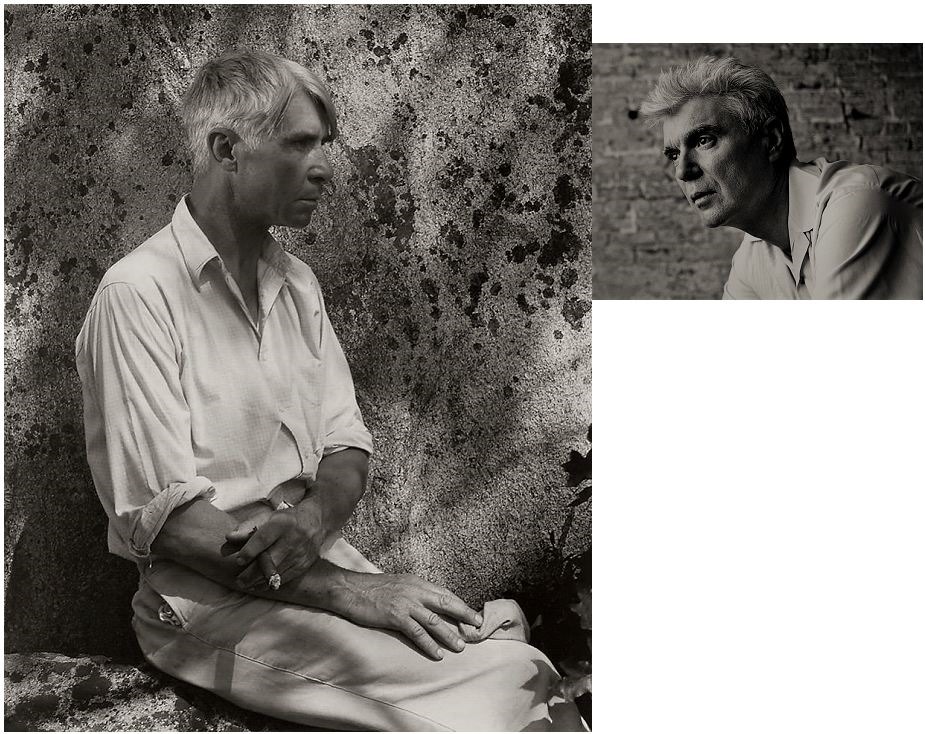
Sandburg and David Byrne seperated at birth

My title may reference the Pixies and Larry Norman, but I think this Edward Steichen image of Sandburg looks a little like David Byrne.


I think this is a great pity. A poem like Sandburg’s “Clark Street Bridge”  is as perfect an Imagist poem as any written in London or Paris, and Sandburg’s subject matter and life-experience is broader than most of his fellow Modernists, because he traveled across America with his Imagist eye and working-class soul.

That said, I have to say that today’s Sandburg text is a partial example of why this might be so. This is the kind of Sandburg poem that people think  he wrote. It’s somewhat sentimental, unquestioningly patriotic, and there are almost no strong, immediate Imagist images in it. Although it’s not that long-winded, it seems to me longer than it is—and if it had broken into a Whitmanesque catalog of a hundred things at least it would have the courage of its convictions.

So, it’s a Thanksgiving poem, but it’s not great Sandburg. Why bother?

Its central Pilgrim history myth may not be entirely accurate, but it is a good story—one that children were told in his time and mine, and perhaps even sometimes now: tempest-tossed dissenting religious immigrants undergoing tremendous trials. For good or bad, Sandburg leaves out the native Americans who helped them survive,* and who were rewarded with a few decades of peace before the wars of conquest ignited in the Pilgrims’ region.

Historians like to point out that the Pilgrim Thanksgiving didn’t include most of the foods that we’ve come to expect for the modern American holiday harvest meal. Sandburg reduces it to “soup and a little less than a hobo handout today,” which is also inaccurate but makes the connection he’s trying to make. America always has pilgrims like these somewhat mythologized Pilgrims. Sandburg, the child of working-class immigrants knew this completely, the ones who worship the God of broken hearts and empty hands.

And though he doesn’t show it here, Sandburg also fully knows the imperfection of America, and yet still wishes to say yes to gratitude, to thanks “if so be” for himself and his child.**  He wishes to say yes before perfection—and continue yes “Till the finish is come and gone.”

So, while this is not the poem to restore Sandburg’s rightful place in Modernism, I think it’s still worth hearing on this holiday. The full text of the poem is here, and the player to hear the LYL Band perform it live*** is below.


*In hearing the story of the Pilgrim Thanksgiving as a child I never absorbed the full story of Squanto (Tisquantum,) which deserves to be better explored. There is a long and detailed Wikipedia entry on the context of this American.

**And before we leave that, let me point out that Sandburg is the rare Modernist who deals with children wholeheartedly.

***LYL principals Dave Moore and myself are both dealing with the inability for our hands to follow what musical precepts we hold, and this has reduced the appearance here of the more spontaneous LYL Band recordings. I’ve been missing that element and we’re trying to do what we can.

One day there is of the series: Emily Dickinson’s Thanksgiving, sort of

Did you know that Emily Dickinson wrote a Thanksgiving poem? It’s not one of her “Greatest Hits” or anything, but it does represent a couple of Dickinsonian traits: skeptical humor and puzzling philosophical concision. You can read the text of it here as I discuss my encounter with it.

Dickinson didn’t use titles, and the first line, our entry into the poem, starts off with a strange tentativeness. What’s the series? All the days of our lives, of history? Or a series of holidays? I suspect the last, in that the next line throws up the American holiday inside quotes. It’s hard not to read “Thanksgiving Day” in Dickinson’s text without intonating the words with “air quotes,” that at least slightly dismissive way of saying “Well, you can call it that  if you want.”

I’m not a Dickinson scholar but I get the impression that Dickinson uses quotes literally—that is, when she’s quoting someone*—but there is a sense here of our modern manner in the poems first half. And as the poem continues, its opening comments could be written this week by someone musing on the holiday. Yup, Thanksgiving is a strange mix: part a big meal, a gluttonous celebration; and part memories of worshiping dissenter pilgrims and family. And Dickinson, in her thirties as she wrote her poem, notes she’s not sitting at the kids table nor is she some honored elder closer to the pilgrims than the present. So, outsider in a middle place, she says she’ll post a review, from her “Hooded thinking.”

Maybe you’re visualizing The Handmaids Tale  when you read “Hooded.” I think Dickinson is taking a bit of a religious acolyte’s stance in her review, even if playfully. Her two-word review: “Reflex Holiday.” You’re just going through the motions she seems to be saying.

Emily Dickinson family portrait

One won’t get a turkey drumstick: Emily Dickinson on the left with her siblings.


The poem could end there, but Dickinson takes off in the second half in gnomic concision. This is often beautiful as word music, but it’s hard to follow her mind.

What’s the sharp subtraction for the early sum? A falling away from religious immediacy? Mankind’s fall from grace? Forgetting the history or piety of the holiday? The next two lines are even more weird. What the heck does “Not an acre or a Caption/Where was once a Room” mean? This is Dickinson the hermetic riddler. I’ve rolled that couplet around in my head for a week and it always slips from my grasp.

The tossed pebble wrinkling the sea lines have a Blakean tone. Here the mystic Dickinson is plain as any mystic can be in words: our lives, our actions, are small against creation—just visible, just for so long. Her final couplet seems to say that our thanks, our Reflex Holiday, is insufficient to the gift. This realization combined with the reflex action is, in a way, a more sublime and awe-some thanks.

What an odd poem! It starts out witty and lightly skeptical and (as best as I can figure it) closes on a humble mysticism.

Musically, I tried to hew to the mystery, if a strange resonant piano and wavery synth can portray that. The player is below. Thanks for reading and listening!


*If she is quoting a person, it may well be Sarah Hale, a New England journalist who campaigned for the importance of a Thanksgiving holiday during Dickinson’s day.