I Have Loved Hours at Sea

I don’t plan ahead with this project much, which has it’s benefits and costs. Often one piece sort of kicks off the idea for the next one and so on. That was the case with doing my roll up of last year’s section of “The Waste Land”  for National Poetry Month, and then following it up with a very short poem by Sara Teasdale, T. S. Eliot’s contemporary in growing up in St. Louis Missouri.

But I had looked at doing another Sara Teasdale poem other than her “Morning.”   I even went so far as to write a sketch of the music I would use. I liked what I had there, but “Morning’s”  striking compression made it more of a contrast to Eliot.

This project has a lot of inefficiencies like that, poet’s collections I read or skim and then find nothing that inspires me to go further. Ideas for musical combinations that don’t quite bear fruit. Poems that jump out at me as compelling, only to find that they aren’t in the public domain and therefore free to use. Ideas that seem sound but get pushed aside by other ideas that step in front of them.

Given the extraordinary work that I put into this project: selecting my own texts, researching what to say about them, and then composing, playing and recording multiple musical parts, these inefficiencies could trouble me. I certainly don’t want to increase them, but I’m somewhat comfortable in them. Like a meditative walking maze, there’s something in the time and indirectness that lets other thoughts in.

Pink Moon

The Official Moon of Shelter in Place. None of you stand so tall. Pink Moon is going to get you all.


I’m continuing this project in a time of a global pandemic, which doesn’t aid efficiency either. Luckily so far, I haven’t had to deal with any family members or friends suffering from the Covid-19 virus. In their place, there’s the toll of artists who have succumbed to it. It’s been a tough week for that. Bill Withers, who in his too brief time singing through the music industry, produced songs and performances of them that could carry this troubled workman through his clocked-in days. Adam Schlesinger, a songwriter after my own heart who liked to jump and mix genres. Hal Willner, that most underappreciated functionary in the arts, the impresario, who melded other artists into projects many and wide, projects often aimed (as this one does) to celebrate other artists. And then John Prine, the singing mailman from the outskirts of Chicago, who came from nowhere quickly into the Seventies age of the singer-songwriter, and then stayed like a little public park that you knew was always there, visited by yourself, some others, some pigeons, but nothing elaborate and scenic enough to celebrate.

Prine had some interesting things to say about his job. He said that he considered his mail route as “a library with no books.” As it turns out, he didn’t fill it with books—though he returned more than he checked out—but with that portable, walking art: songs. Actor Viola Davis once said that graveyards contain the stuff of her art while urging you to make it part of yours too.

They are the only profession the celebrates what it is to live a life

“Become an artist. They are the only profession that celebrates what it is to live a life.” – Viola Davis


When something, someone, goes away it’s a good time to notice what a sum total of things are. Some people are heroes for one thing they once did. Some have career highlights, a dozen or half-dozen models of importance. Others do things for decades, just doing what they do. Prine’s like that. Here’s a guy that in the decade that got called “The Me Decade” wrote songs that had other people in them.  He kept writing, forging his trademark take on the human condition into song after song. No big thing. That’s what he does. Or did, because now he’s dead and you notice something: there aren’t a lot who did that, and we have songwriters and songwriters still who will do something other than that.

Anyway, these thoughts in a pandemic brought me back to this other Teasdale poem, the one I didn’t use, “I Have Loved Hours at Sea.”

It’s a premature, self-elegy. That’s a hard form to pull off, but I think Teasdale does. It’s bitter-sweet, but that’s what we should expect from Teasdale, poem after poem. It can be read as a poem with a moral, a lesson, that we should live our lives fully so that our container of time is fulfilled—but also as Teasdale often does, there’s a gothic undertone to it all: many the blessing she recounts is qualified or undercut and stated by this young poet in a past tense. Here’s the full text of her poem.

So, as you can see with the player gadget below, I decided to go through with performing this second Teasdale poem in a row. I even decided to write and perform a short piece for strings as an introductory lament. In the delay of inefficiencies and skimpy planning, “I Have Loved Hours at Sea”  now seems to have a reason to be performed, and perhaps for you to listen to.


Teasdale’s Morning

It’s easy to figure T. S. Eliot as an English poet—after all, while his “Waste Land”  spans history and cultures, its landscape is distinctly English and European—but he grew up in St. Louis Missouri, a middle-of-America river town.

I promised you a different poem by a St. Louis poet last time, and so now we return to the compressed lyricism of Sara Teasdale. Just four years older, and with a family that would have crossed paths with Eliot’s in similar social circles, there’s no indication that I’ve seen that these two ever met in childhood.

And oh how different in some ways this poem of Teasdale’s is. “The Waste Land”  is hundreds of lines long. Even it’s third section, which I presented in whole form a couple of days ago, takes over 20 minutes to do it justice. Teasdale concentrated on the concentrated, and her poem “Morning”  first published in 1915, is just 8 lines long, and I assay it in less than 2 minutes.

“The Waste Land”  is a cathedral of High Modernism, and a poem like “Morning”  is what? A little song? A diverting lyric? A small bit of uncomplicated thought or feeling? A mouse in the wainscoting of the sanctuary? A facet light dropped from a stained glass window? In the end we are left with the question of how big is big and how small is small.

One of these songwriter poets is not from St Louis

One of these cats is not from St. Louis.


But here’s one thing the two poets shared. Both of them suffered from some form of depression. Eliot’s poems are generally seen as a search for meaning. Teasdale’s poems are seen as about a search for love. The former seems grander, the later more feminine. But how different are the essences of these two consolations really?

I am an old man. I haven’t answered these questions. You, reader, may well be younger, perhaps you’ll get further in this?

Morning

I went out on an April morning
All alone, for my heart was high.
I was a child of the shining meadow,
I was a sister of the sky.

There in the windy flood of morning
Longing lifted its weight from me,
Lost as a sob in the midst of cheering,
Swept as a sea-bird out to sea.


Before I leave you with my performance of Teasdale’s “Morning,”  let me just talk a bit about how I experienced it. Like “The Waste Land”  it starts in the spring of April, our U. S. National Poetry Month. The second line may trip off the tongue in song, but it’s a strange one: “All alone, for my heart was high.” One could write an essay on that line I think. My first reading was that the poem’s singer is experiencing heightened feelings which bring forth her sense of aloneness. But it also seems to be an image of feeling a oneness with nature, as outlined in the following lines of the stanza, away from humanness. Uncannily, the conclusion of the stanza seems like the John Lennon anguished lines in his song “Yer Blues:”  “My mother was of the sky/My father was of the earth/But I am of the universe/And you know what it’s worth.”

The second stanza tells us in its second line that longing, this aloneness, has been lifted by the flooding experience of this natural morning. The resolution of the final two lines is deeply ambiguous as I read them. The line “Lost as a sob in the midst of cheering”—anyone who has suffered depression, or even a moment of intense sadness, recognizes this image, and I don’t think we can read this as a simple consolation of nature’s largeness. I feel the final line, lovely and sound-rich though it is, is also ambiguous. The sea may be home to a sea bird, but is it home for the poem’s singer?

So only 8 lines, laid sideways, infinity.

You can hear my performance of Teasdale’s “Morning”  with the player gadget that should be below. If you’re reading this post on an iPhone or iPad with the WordPress reader you’ll be wondering what I’m talking about, but if you use the box-with-arrow share/action gadget in the iOS WordPress Reader app you’ll see a choice to Open in Safari, and the player gadget and your ability to hear the audio performances will be visible in the full browser.


Thanks for reading and listening. This project doesn’t ask for funds, but if you’d like to help it consider helping spread the word about it, particularly on social media during this National Poetry Month.

President Declares Poetry an Essential Service

In a sharp turn-about that shocked many in our nation’s capitol, the President today declared that poetry is an essential service that must remain open during the current pandemic emergency.

“People tell me, that may surprise you, but they do, they say, you know Mr. President your speech is very poetic. I’m told I’ve been compared to the great French poet Ubu Roi, and you know that’ll surprise a lot of the so-called elites who look down on the way I talk straight in several directions. And I hear that Andre Breton had some very good things to say about my campaign. That Andre Breton is a smart guy, and I hear he’s a doctor too, so it’s especially good to hear that he supports me these days.

Ubu Roi Performance

The President also demonstrated there are plenty of ventilators, tests kits, and protective masks and gowns available.

Now this is odd, because I’ve been involved in other things, but I think I could have been a poet if I’d wanted to. A great one. Maybe I didn’t because I don’t have a big ego like a lot of those poets do. Someone showed me some poetry today, and it didn’t seem to get to the most important things. It seemed to be mostly about the poet themselves. I don’t know if I could do that. But poetry seems to be like that, so maybe I could. I dunno—poets look to what I do, and do the opposite maybe.

Oh, some folks are telling me that I need to get back to the declaration. All right. As you know, our country is going through some tough times. Sometimes they are in little rooms, not fine rooms like this one here, or the ones that you could write in at my hotels or resorts by the way. Great rooms. Big ones, you could put a lot of poetry in there. Stuck at home, and I hear that some of them write and read poetry in those rooms. So, it’s an essential service to social distancing. Even in the earliest days of social distancing I’m told poets across the country were happy to comply with the earlier, looser crowd size regulations of 50 people—some of them even asked if the authorities could go further and require 50 people to attend their readings.

The declaration. It says here that:

Read poetry out loud, at full voice, often, until this emergency is over. It’s good for your lung function. Sad poems will tell you your sorrow is not all the sorrow in the world. Love poems will tell you there is an invisible web of desire as important as gravity. Poems of joy will make you leap like Carl Sandburg’s goats in pastures of plenty. Poems will turn your eyes inside out so you can see with another heart, and hear its strange burbling music.’

That’s the stuff here they want me to say, but I suggest you wait until after I’m done talking to start with the poetry. Oh, and this guy tells me it’s National Poetry Month. Yes, I think so. I hereby declare poetry an essential service today, and every April 1st.”

Reached for comment, Andre Breton suggested that he could not comment at this time, being dead and all. But he referred us to this section of his Surrealist Manifesto  as performed in English by the Parlando Project. He further added “Vous pouvez cliquer sur le gadget du lecteur ci-dessous pour l’entendre.”

Ode on a Grecian Urn

This may have been one of the first poems I fell in love with: the richness of the language, some sense of strangeness, the exoticness of the depicted setting–all enough for a young teenager. I did not mind the often outdated language then—less then than I do now—as I expected poems then to be written in an old and alien adult literary language.

If you’d asked that teenager what it meant, I would have probably stumbled out something to defend my appreciation of it—but what I did know was that “Ode on a Grecian Urn”  is just flat-out lovely word music.

One could go on about that, but no technical analysis will increase or decrease a listener’s appreciation for that element. Music has a structure, theorems and practices, but it remains subjective and it is not engineering. My performance of it today may not do it justice either, let your own ear or voice be the judge.

Beyond that, what about my experience of the poem today? This week, the always Interesting Literature blog discussed the poem’s meaning, bringing it back to my mind, and causing me to read it anew. My immediate reaction, reading it in our current times, was that this is a poignant poem infused with an intense “almostness” and an express “never.”

You don’t need biography to feel this element in the poem, but Keats wrote this in the spring of a year in which he had cared for his brother Tom as he died of tuberculosis that previous winter. In around a year, the medically trained John Keats would notice symptoms that he well knew were from his own infection. Another year from there he would be dead from the feared infectious respiratory disease of his time. So I read it differently today in our time of the pandemic Covid-19.

But “Ode to a Grecian Urn”  isn’t poetry as memoir, a common genre in our time. Instead, despite its failure as an example of pared-back language avoiding words describing emotions, the concept of the poem is not unlike that of Imagists nearly a century later.*  Keats looks at a thing, a decorated classical Greek vase,** and records that moment.

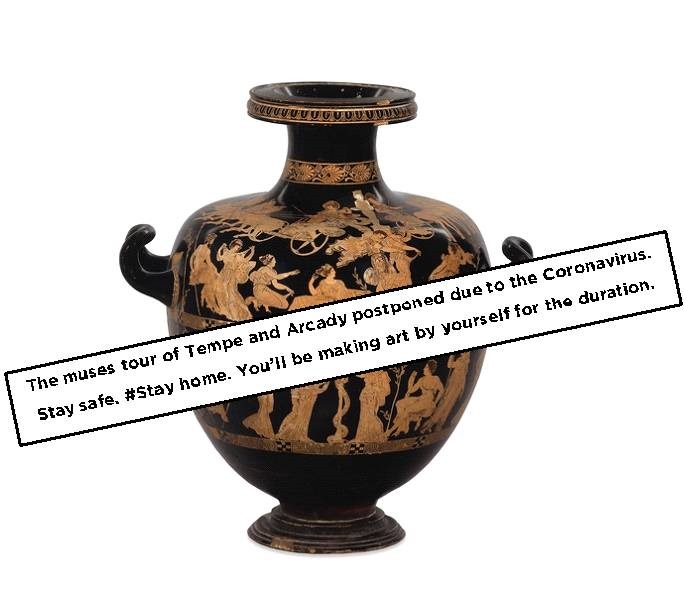
Muses posponed by CaronaVirus

I’ve figured out why it’s hard to create this week—the muses are sheltering in place. And it ain’t mine.


I’ll resist the urge to go through this poem line by line, but as the poem’s speaker approaches the titular urn he wants to interrogate it. One could draw a cartoon where the vase is in a police station room and the poet-detective is trying to tease out the details of the caper, while we the audience look on. The vase ain’t talking. The detective says that you were seen with that couple at that musical party, would you like to tell us why she was running? OK, so who were the musicians at the gig? You don’t know! Whatd’ya mean?

But let’s return to that almostness, that never. The lover and the beloved are palpably close, yet they cannot touch. The musicians are playing, but it’s somewhere out of ear-reach. Are they all six-feet, a social distance apart? What’s avoided by this freeze, this lock-down? The sorrow with a “burning forehead, and a parching tongue.” Keats seems to intend this as an illness metaphor.***

The poem tells us this vase includes another scene, a cow being led to a ritual slaughter. A vegan, Hindu, or animal-rights advocate may cringe, but the scene is one of an entire town wishing for this consummation, and we may conclude the scene is “You will die so that we may live or prosper”—which after all is the belief of all such rituals. I’m not supposing that Keats was Joaquin Phoenix, however we may view this sort of thing; and most readers have historically taken the poem’s characterization of this as pious at face value. But Keats could have imagined his urn with another religious scene, and chose this one.

If he doesn’t want an element of dread in the sacrifice scene, why does he choose to add the detail that the pious morn has left a town with eerie deserted streets?

At the poem’s end, Keats places the famous couplet “Beauty is truth, truth beauty,—that is all/Ye know on earth, and all ye need to know.” As well-known as these lines are, they’re the source of some controversy. Some think them profound, some glib. They are meaningless babble or a concise summary of Keats’ aesthetic.

The urn, this mesmerizing object, has artistic impact, and that means it’s beautiful in an aesthetic sense. It doesn’t mean it’s clear in its message. It doesn’t mean it’s a simple comfort. Yes, Keats says near the end, the urn is “A friend to man.” But friends are friends partly because they will tell us things that mere sycophants or acquaintances won’t, and friends will be there when things are not all wonderful and happy. It’s true too in this sense: that it is not telling itself with ulterior motives or self-interest.

The experience of the two scenes that precede this summing up are not happy ones. Even the consolations of artistic immortality are slight: we know nothing about the end of the lover’s pursuit, the musician’s tune, the name of the village or if it prospered, or if the sacrificial cow had a soul that was reborn.

As I performed it I decided to downplay what that past teenager would have read as a ringing conclusion. After all, whatever Keats’ sweet unheard intent might have been, his object that we can see and puzzle over tells us that the urn is saying this to him, not some “deity or mortal, or both.”  A piece of art says what it says in ways its creator cannot control, as the poem predicts it: “In midst of other woe than ours.”

So, I read it today as that weak voice that says, from when this poem was written, from this time when I performed it, in a time of contagious illness, in a time when caretakers were at risk, to a time when our streets are silent, at a time when some pious ready sacrifices instead of remedies, a time when music is silences and lovers parted—that there is somehow something beautiful to be discerned that is still as true as our living moments.

Speaking of musical engineering, I decided to keep the music silent or very minimal for the first part of this one, even though this project is all about combining music with words—the text’s “unheard music” was just to powerful to contradict. I also chose to keep everything in a major key/major chords, because that too is how I read the text: the urn’s subjects think they are in joy, though we see them, like re-viewing films and video of past happy social crowds today, in a different frame. To read the full text of Keats’ “Ode on a Grecian Urn”  go here. The player gadget to hear my performance of it awaits you clicking on the player gadget below. Stay well. Take care.


*The idea of poetry expressing the experience of another piece of art, particularly visual art, ekphrastic poetry, long predates Modernism and Imagism. By using this approach to the everyday encounter with the world, the Imagists extended this technique.

**There is wide agreement that there is no singular vase/subject to discover that Keats actually encountered in a moment. Britain had recently absconded with “The Elgin Marbles” from Athens, a series of marble sculptures that Keats viewed in London, and he had seen period vases, even making his own drawing of one.

***In Illness as Metaphor,  Susan Sontag spent a good deal of time on the historical ascribing of tuberculosis to a dissipated or too passionate life-style in pre-germ-theory times. Currently, lovers may be close but separated precisely by our knowledge of microbes.

A light exists in spring

Given the times we live in and the current virus-crisis, can I be excused for being a little bit late with an audio piece for World Poetry Day?

It occurs to me that if World Poetry Day was some kind of Olympian-Olympics or the World Cup in Verse, and the United States had to look over its relatively short history on the literary scene and pick it’s most powerful and representative champion, Dickinson could be our choice, even though she spent her writing career not really having one.

Indeed, when I was introduced to Emily Dickinson as a teenager back in the middle of the last century, that was the inevitable, subtitled fact about her: a recluse, a nun of poetry in effect—self-isolated in her room, scribbling odd little poems which are now seen to have at least some middling value because, well, they’re so unusual and such.*

For a century and a bit more, past-through that time when I first read her, and over our new century line by a couple of decades, readers, critics, and listeners still discover that there’s as much there in her little poems as we seek to look, and look again, for.

Take today’s spring poem of hers “A light exists in spring.”  It’s as simple and complicated as a William Blake song of experience. It’s as metaphysical as a poem by Donne. Yet it doesn’t push me, or (I think) many other readers away. It draws me in to this mystery of what it is describing. Dickinson confides in us: we are likely to feel/see this too.

I compared her to Blake with consideration, because poems like this strike me as describing some kind of mystical or limerent moment. Dickinson has a strange effect often, she can be a cold romantic, a skeptical seer, as I read her.

Something in spring almost  speaks to her, and that “almost” in her poem seems powerful—a present absence. I question my musical setting once again today. I’m not sure if I have mistaken a playfulness in this poem as a meditation upon a mystery.

Perhaps it’s my time, and much of the other world’s, this World Poetry Day that leads me there. Many of us are taking Emily’s vows this March, this spring: sheltering in place, practicing social distancing, pondering perhaps a mysterious illness’ distance short or near—and whatever our usual disposition, we may be now far from even lonely crowds in our homes and rooms. This spring is visible as a distance as far as we can see.

My Fathers House 1850  Emily Dickinson

Shelter in place: Emily’s room was on the 2nd floor behind the trees in the front-left of this picture.


The player to hear my performance of Emily Dickinson’s “A light exists in spring”  is below. Thanks for listening, reading, and sharing the existence of this project.


*Scholarship has shown this blurb-level summary of Dickinson’s life was misleading. For a woman of her time and location, she was above the average line in experience (Some college! Visited other cities. Privileged and connected family in a college town located in the region of America’s greatest intellectual ferment at the time). But by her middle age the burden of a woman’s domestic role and a much speculated-on illness tied her down to the homestead, and only then, in her later years, did she become the recluse of legend.

The Most Popular Parlando Project Piece for Winter 2020

December seems so long ago doesn’t it? More so this spring in our current crisis. Back on the 10th of December I awoke, took my bike ride to breakfast in a pleasantly crowded café, where I read that it was Emily Dickinson’s birthday. While eating breakfast I decided I should try to make a Dickinson piece before the day was done.

This morning in March, I rode to that same café. Normally there are 20 or 30 folks there drinking coffee, eating breakfast, talking, reading or fiddling with notebooks or notebook computers during the morning on a weekday—more on weekends. Today they are to close their dining area for the duration at noon, and the two couples eating breakfast several empty tables apart (along with some not-present more) will need to do what I did and pickup takeout fare to keep this place a going concern.

Last morning to dine in at Turtle Bread

Cold but sunny morning, and taking their last chance for awhile to have breakfast together.


When Emily Dickinson was a child, her family grew up not in the grander family house her grandfather had built and lost due to debts and business ineptitude, but in another house across the road from a cemetery. Some biographers think this molded the young mind of our great poet, but then the literature of that time had a decidedly gothic tinge to it anyway. And that’s not the place she lived as the poet we know.

Her father worked assiduously to repair the family wealth and regained the homestead. Emily’s room is in the front of the house. Out to her left would be the garden and orchard that she became the master of with the illness and eventual death of her mother. Below her, the kitchen where she and the family’s immigrant Irish servant fixed the family meals and baked. That garden and orchard is now gone as the world of her family and town moved on from its former rural self-sufficiency. Also gone is the 11-acre Dickinson meadow that would have been more or less straight-on in view for Emily at her writing table on one of her December birthdays.*

The famously sequestered Dickinson of her later adult years would have been living our current Covid-19 life of “social distancing” and stay-at-home self-isolation. You might think her poetry would be more solipsistic for that, but she really was a mind forever voyaging. The winterscape she portrays in this short poem is quite likely that Dickinson meadow or her bare garden.

Though the creation of the music and recorded performance of it was rapid even by this project’s quick pace, I don’t think it suffers from that at all as I listen to it again today. The post I wrote about it in December was not one of the most liked or read this winter, but the audio piece was listened to more than any other one during the past three months,** and by enough to score the top spot anyway.

As I consider my sequestered music making today—something I can create even in these times, by myself, playing each part in turn—I feel for those other musicians whose art and the revenue to support it requires a live venue, a paying crowd coming through the door. Of course, cooks, wait staff, musicians—small businesspeople for the most part and only a portion of our world—are not the only ones who will suffer through the duration of our current crisis, but they were in my thoughts as I write this.

Is Dickinson’s poem lighthearted and playful or more gothic in mood? My current reading of Dickinson is that it’s both. She is amazed at the shapes and filigrees of the barren landscape, yes—but it is a place of stilled and departed artisans as she portrays it. She sees an absence, that resonate line: “Summer’s empty room.”

My performance of Emily Dickinson’s “Snow” also known as  “It sifts from leaden sieves” is available with the player gadget below.


*Here’s a highly detailed blog post about the vantage point of Emily’s room in the Dickinson homestead. It even goes so far to suggest that the irregularities of mid-19th century glass may have been the genesis of some of the impressionistic or even visionary imagery in Dickinson’s poetry.

**The second most listened to piece was #6 on the list “Do the Dead Know What Time It Is.”

Winter 2020 Parlando Top Ten, numbers 4-2

As we continue our countdown toward the most popular piece of this ending winter, we come to a section coincidentally that’s all poets known by three names. You can’t plan something like that, but your listens and likes counted up that way.

4. “The Stare’s Nest at My Window”  by William Butler Yeats. This poem grew on me after I selected it from a short collection of poems Yeats wrote on the Irish Civil War that followed Irish independence. Just after I read the series for the first time this winter, I mentioned to my wife that Yeats seemed to be too far into his mystical side for me to find something I could attach to in them. “The Stare’s Nest”  seemed only the least bad for my use after that first reading, largely because I could grasp its word-music as promising.

I often work on the music and performance before I work on the research about the text and its background. I did so here, though one may think it perverse to do that—my setting and performance will then come from me working without a context, and without the best information about an author’s intent. Still, the setting I came up with accumulated considerable power for me, and even though it’s me playing all the parts I composed and reading Yeats’ words, my impression of “The Stare’s Nest”  was transformed as I experienced what came from that combination. Though I made these components, the whole presented something I was unaware of.

What did I become aware of in the process of creating the piece? This poem I feel is perched somewhere between a prayer and a magical spell for his country.


3. “The Times are Nightfall”  by Gerard Manley Hopkins. Speaking of word-music that pulls me into places I might not otherwise choose to go, Hopkins is an example. He seems to be a full-on Christian mystic with more than a touch of hair-shirt depressive in his soul that he doesn’t fight so much a seek to feel more fully.

But his metrical conception, his use of repeated sounds, I’ve liked from the first time I read him. He believed his ideas there (borrowed from the more Saxon ancestral branches of English poetry) worked better than the musical structures adopted from the Romance languages or from poetry in Latin.

One can test his theories by seeing how his hymn to dark winter works with music as I do here.

Yeat and Hopkins

Yeats the great Irish poet and nationalist spent a good deal of time in England. Hopkins, the English poet with a distinctly English prosody was a priest unhappily sent to a post in the still colonized Ireland. Despite our world-wide virus crisis, St. Patrick’s Day will be celebrated by an Irish diaspora here in the United States this week.


2. from “Dirge”  by Ralph Waldo Emerson. Emerson is better known as an inspirational force via his essays and influence on Transcendentalism than as a poet, but his influence was felt by poets and in poetry. The distinctly American poetry that emerged in the 19th century is almost completely made up of poets touched by him.

When I have dipped into Emerson’s own poetry it’s produced some of the most popular pieces during the run of this project, but I wasn’t looking to find another Emerson poem this winter. “Dirge”  came forward in a round-about way from watching the Apple TV+ Dickinson,  a streaming series presenting a youthful, passionate Emily Dickinson. That series fully intends to use our present culture as a lens and overlay to espie into Dickinson’s times, something that I think worked for its released first season, though it works most completely if one looks also with a more sober eye at this genius. The creators seem to have done their homework. Lot’s of little details and obscure Dickinson trivia are referred to. And speaking of Transcendentalists, they manage to have some wicked fun with those other three-names Henry David Thoreau and Louisa May Alcott—who are both skewered with lesser-known biographic facts that aren’t full pictures of those two by far, but make for some good scenes.

In one scene, Dickinson and a young man Dickinson is crushing on bond over their mutual love of Emerson’s “Dirge”  for its gothic lines about a field of ghosts. I had to check out the poem. I worried that is might be a too long and how well the 19th century sentimentalism in the text would work for modern audiences, but trimmed a bit for length, the listeners here sure liked it this winter.


So, what’ll be the most popular piece here from the past few months? Will the author go by three names? Obscure author or well-known? American? British Isles? Translation from another language? Stay tuned.

Winter 2020 Parlando Top Ten, numbers 7-5

Back now to our recounting of the pieces that you, our readers and listeners, most liked and listened to this past winter. Let’s jump back in as we count them down.

7. “We Wear the Mask”  by Paul Laurence Dunbar.  This one is remarkable in that it was released on February 24th, very late in the winter season, yet it still racked up a lot of listens to go with the number of likes here on the blog, outstripping the other well-known Dunbar poem I performed and released three days earlier: “Sympathy (I Know Why the Caged Bird Sings.)”

These two poems are the best known works of this early 20th century Afro-American poet directly addressing racial issues, and given the seriousness of racism and the quality of “We Wear the Mask”  as word-music, it’s well earned its current position as a much anthologized poem.

Why did it edge out “Sympathy?”  Who can really say? I liked both performances I did of the Dunbar poems myself. “Sympathy”  has the more complex arrangement, but simplicity that works has its appeal. Or was it something random—did Dunbar’s title put it in search queues connected to world-wide Covid-19 concerns?


6. “Do the Dead Know What Time It Is”  by Kenneth Patchen.  I was completely enraptured by this poem of Patchen’s because of its complicated paralleled half-conversations. In the previous Top Ten post this week I remarked about how Marianne Moore’s poetic expression seemed to echo the actual syntactic twists of transcribed common speech, even at the cost of being harder to follow on the silent page. In Patchen’s poem, we have the more common “naturalistic dialog” where syntax is complete, where sentence structure is plausible, not the fractured and disagreeing actuality of literal transcribed speech. But Patchen has two speakers totally focused on non-answering halves of a conversation: the old guy at the bar who wants to tell the poem’s persona of a second-hand encounter with the God-head, and the poem’s persona, a quasi-homeless swain in conversation with an unheard and somewhat mysterious woman* at the same bar.

The chemical reaction of these two side-by-side half-conversations builds until one phrase appears to link the two—two loves linked somewhere between desperation and desire.

Patchen All at Once is What Enternity Is

And all our count-downs are happening over and over. Patchen as painter.


5. “The Little Ghost”  by Edna St. Vincent Millay.  So, a comforting God-head appears off-stage in Patchen’s poem. Hugo Ball’s ghost in our last Top Ten post seemed of the malevolent poltergeist type. Now here Millay’s is a much more benign spirit who seems to signify being there after being there.

Regarding the music for this one: like a number of my generation, I encountered Ravi Shankar LP records and performances in the Sixties. For a moment some borrowed sense of South Asian music permeated the culture of popular music groups and their audience. Why did that happen? Has anyone asked, much less answered, that question? Yes, I assume the drug and social stress induced search for mysticism was a factor. Maybe George Harrison and his access to the culture through The Beatles alone was enough. But I can speak for myself: some musical qualities easily discerned in this music grabbed me then as they still do now. The musical structures related to steps in various orders away from and returning to a home drone pitch. The opulence of microtones beyond the conventional 12 notes. The singing rhythms.

In the Seventies, that decade that everyone forgets, I spent nights working in a busy Emergency Room, often with an Indian-born surgeon, who as the evening would wear us on, would suture while hum-singing tunes of his homeland. Every so often, even these decades later, I sometimes find myself singing unremembered vaguely South-Asian melodies when working late on some task.

Evidence of some ghost? I doubt it myself. Not reincarnation—resonance.


We’re more than halfway down the countdown. The next three coming up here soon.


*Is she a down-and-outer like the poem’s persona just looking for some kind of human connection? A prostitute seeking money? An analog to the God-head, or is the poem’s persona that? By not clearly defining this, the poem gains mysterious power I think.

Something I wondered about regarding poetry and pandemics

The next part of our regular countdown of the most popular Parlando Project pieces from last winter will continue soon, but as the world and U. S. consciousness turns increasingly to COVID-19 and pandemic protocols, a question occurred to me.

Many posts and pieces in the earlier years of this blog used for texts vivid pieces about WWI, often written by participants, soldiers in the “The Great War.” And stepping back just one level, there are also poems about the war from folks who didn’t fight in it, but who lost close friends who did. I made the observation then that WWI was the last war to be extensively covered by poets.

Now of course this doesn’t mean that there is no poetry associated with other, later wars. But the WWI connection with poetry was that significant. Most of the era’s great poets, the canon members and chief modernist pioneers wrote war poems. It was that extensive. The Modernist movement had started before the war, but the war made it seem necessary, the proper way to express what it was.*

But as the war was nearing its end, a great and deadly pandemic, the “Spanish” flu of 1918-1919 struck. Statistical estimates say that it killed more people than the World War did. And in America the deaths were next door, not across the ocean.

Yet I can’t think of one great poem about the 1918 flu pandemic,** and when I did a web search today I found very little in minor, overlooked verse too. Those poems may exist, but like the 1918 pandemic itself, they may have found less retrospective honors. Even other literary arts didn’t seem to have a lot of examples. Katherine Anne Porter’s Pale Horse, Pale Rider  short novel was often brought up, but that frequency of a single novella being mentioned seems to testify that wasn’t a common subject in serious fiction either.

Why could that be? My first working theory is that war has a long history as a poetic subject, going back to Homer or the classical Chinese poets. While illness, and it’s descendent death, is also present in the poetic canon, illness itself is not a long-standing primary subject, and it’s almost always portrayed there as a singular event, not a great widespread event like a war. My second thought is that war is also associated with maleness and the male role, and is therefore the more “serious” subject. And then I thought of a third factor: war, however arbitrary its casualties are in reality, something the Modernist war poets helped illuminate, retained yet in 1918 some sense of a battle of honor, a test of “serious/male” skills where the winner may have won because their righteous cause added to their valor.  Pandemics, not so much. As Sontag’s Illness as Metaphor  pointed out, there are tendencies to blame the sick person for their fate across history, but parts of us also know that’s not always so. Arbitrariness can be written about in poetry, but that has difficulties. The kind of caring and loss that is more associated with the female role could substitute, but that would mean that that role would need to be honored.

ChicagoInfluenza

This blog cares about your safety! We are sanitizing all our musical pieces daily and have asked the Internet to continue to prevent us from going viral.


*American’s native Modernist revolution was ahead of the British, with our modern American poetry lineage going back to Whitman and Dickinson, who like the WWI era modernists had likewise started their work before the trauma of the American Civil War; but at least in the case of Whitman, their trajectory was re-shaped by that war. Though it’s harder for me to find that war in the poetry of Dickinson, others think it’s there, and the events must  have had an impact on her.

**The 1918 flu that finished off wounded WWI vet and indispensable French language Modernist pioneer Apollinaire could be said to be present only by  implication in Tristan Tzara’s masterful elegy. And that’s presented as a singular death, not part of the great pandemic.

Winter 2020 Parlando Top Ten, numbers 10-8

For those that have been following our look at English poet Frances Cornford, we’ll have at least one more example coming of her stuff soon. But now is the time when we count-down the ten most liked and listened to pieces from this past winter.

It’s been a slightly difficult season for this project for me personally. It’s frankly been hard to keep up the level of posting, research, composition, recording, and playing that goes into it. What has been encouraging is the increase in listenership for the audio pieces and your continued readership here on the blog. December set a new record for monthly listens with increases coming significantly from those who hear only the audio pieces from the places where you might get podcasts (Apple Podcasts, Spotify, Stitcher, PlayerFM etc.)* During February the number of listens passed the milepost of 50,000 all-time downloads. This is small by the scale of Internet sensations (typically measured in millions) but to me that’s satisfying in the larger, but sparser crowd of those interested in poetic expression.

Readers here on the Parlando Project blog know that besides the same audio pieces the podcast listeners get, you get more information here about the writers and my reaction to what they’re doing. You might think of the blog as a kind of an “insiders ring” in that way. Blog traffic took off last fall, which made my heart leap up, and it’s continued at a similar level over the winter.

Given that I mostly keep with the older pre-1924 Public Domain stuff that is unrestricted in reuse, and because I wander about various musical genres in a way that’d tempt many old car radio listeners to “push the button” and current playlist streamers to tap play next, I especially appreciate those who stick with this project and it’s eclectic tastes!

Hugo Ball in metal 1080

“Metal man has won his wings!” I worked this winter to make Hugo Ball The King of the Dada Blues Singers


Let’s go to the countdown. Today we’ll cover numbers 10 through 8 as calculated from listens on all platforms and likes here on the blog. The title of each piece will be hyperlinked to the original post, so you can click and check on what I said about it then.

10. Rimbaud’s “Eternity.”  This winter I decided to make things more difficult for me by doing more translations of non-English poetry, adding translation to the whole compose/record the music, play most of the musical parts, research the context of the text, and then write about those tasks. And Rimbaud may have caused me more trouble in translation that anyone other than maybe Mallarmé. I labored to some kind of reasonable draft on two or three Rimbaud poems, but the results just didn’t grab me in English. Knowing that some other poets who I admire think highly of his work, I couldn’t figure out if I was picking the wrong poems, or what.

Arthur Rimbaud - the most famous photo

“Go Rimbaud, Go Rimbaud….” The most famous photo of the teenaged poet.


Then with his “Eternity”  I realized—this poem’s impact in French comes from its invocatory power.  This is why someone as unafraid of going over the top as the young Patti Smith could be drawn to his writing. Free verse can reach that level, but loosening my translation so that I could (uncharacteristically) render it as a rhyming verse made this one more compelling.


9. “The Labors of Hercules”  by Marianne Moore.  Marianne Moore writes in English, but her expression is so unusual that I feel like I need to translate her to get to the heart of her poems. Unlike Moore’s contemporary Gertrude Stein, whose verse is even harder to draw denotative meaning from, the task of performing Moore to music is challenged by her conversational rhythms which sound like someone talking.**  Not only does this make it harder to fit in regularized music (I didn’t) it tends to lure the listener into thinking that they should be able to comprehend what Moore is getting at. With Stein you’re quickly aware that words are being used in a musical way, so you can just enjoy them for sound value. With Moore you sometimes think that the speaker herself or you the listener are in early days as English as a second language.

Young Marianne Moore

A lesser-known photo of Marianne Moore. Like Frost and William Carlos Williams, I always visualize her as if she was born at that advanced age that she was at when I started to encounter poetry, not as this young woman


I’m doing the back-patting here, but I think I helped Moore’s gist come across a bit better by my performance than the poem left sitting mute on the page.


8. “Ghost Blues”  by Hugo Ball.  Another case where I decided to go with a looser translation in order to vivify the original work for the modern English language user. The original post shows some of the intermediate steps I went through in translating this Dadaist poem from German. One thing that I think I’ve figured out after the original post is that a word that I couldn’t find in any of my accessible German dictionaries, “Gängelschwemme,” is probably a place name. My performance uses “spillway” for it, and still I have no way to know for sure (if it is a place name) if it references something along those lines.

I decided to make this a Dada Blues as it might be loosely rendered by electric players in the blues revival of the Sixties. Unlike a lot of pieces here, this one isn’t really composed. I had setup a loop to see if my translated text might fit to a groove like that. As I sung, I felt moved to plug in an electric guitar as I tried the lyrics.

“Hey, this works pretty good” I thought. I hit record. And one take later this is what you get.


If you’re new here you may notice that all of these are electric guitar pieces in a rock’n’roll context (though “The Labors of Hercules”  is more irregular and somewhere in-between post-rock and free-jazz in my mind). Long time listeners here know that’s not what we consistently do. Stick around, the next three of the Winter 2020 Top Ten is coming up soon.


*Just to clarify expectations: the Parlando – Where Music and Words Meet podcast is only the audio pieces themselves, unadorned. While I suppose I could chat about the poems and my music in the discursive and wandering way most audio podcasts do, I don’t do that.

**Back in the 1960s when I first got a little plastic cassette recorder, I took to recording people having casual conversations and then transcribing the words literally. Here’s what shocked me in this practice: the words on the page made little grammatical or syntactical sense. The transcriptions didn’t even match “natural, realistic” dialog in fiction. Our daily conversation is often more avant-garde than we realize; and we are comprehensible to each other orally in ways that we would not be if our speech was turned into page text, through things like timbre, expression, non-regularized conjunctions and connections.

I suspect Stein and Moore were both more exacting mental transcribers of what we actually say aloud than conventional literature expected, and as two women aware of the modernist movement in general (not just literature, but music and visual art) they combined this objective phenomenon with their own aesthetic techniques.