Free to Fall

Allow me to be more internal than I usually am when presenting these pieces. Today’s piece uses my own words (we do that rarely here) and it’s here today for a peculiar reason — and peculiar is something I enjoy indulging in.

Early this autumn I was looking for a musical piece that represented the season, and I recalled this poem of mine that I had written music for. When? I probably wrote the poem early this century, and from a file I found, I was able to determine I wrote the music in 2007. Sometime after writing the music, I recorded what I recall was a pretty good version of it, likely with Dave Moore playing keys.

“Maybe I made this one of the early Parlando Project pieces” I thought. At the beginning of this Project as I was figuring out how to compose and record our combinations of original music with literary poetry, I had used several recordings of that vintage. Having some already completed pieces gave me time to get a handle on other tasks while getting this thing going.

But, what, I didn’t know? Well, I’ve put up over 700 publicly accessible pieces in this Project’s lifetime since 2016 — and that doesn’t count the ones that just didn’t work or didn’t fit the concept. One might like to think I keep my eye on every sparrow — but with that amount of catalog, it’s not fully accessible in my head. So, I looked. Here. For my own work.

Nope. I hadn’t presented it. It might not have made the cut because I wrote the words, and the Parlando Project is about other people’s words. Where else might it be? I looked in my somewhat disorganized collection of sessions and finished non-public pieces. Nope, not found there either.

My solution then was to re-record it. Recording time has been hard to come by lately, but I remembered this poem-which-became-song as being effective, so I tried to have it ready when I could open my microphone and record.

The piece is called “Free To Fall.”  As I wrote at the start of this inward story, I said I remembered it as being an interesting variation on the poetic perennial of autumn. In the first verse I already hit the falling leaves motif (can that one be escaped?) and I think the “every tree grows tall” was me referencing the British folk song “The Trees They Do Grow High.”   I continued to try to bring some longstanding tropes into this brief song: my own restatement of François Villon’s “Mais où sont les neiges d’antan*” starts off the second verse. I think the lines “Old men carry winters/in which the children play” are my own, but like my memory of where I put this song’s older recording, who knows if I just don’t recall some inspiration or reference.

The third verse’s reversion to summer memories and grief may be influenced by what I consider to be one of the great autumn songs, one found in every fakebook: Joseph Kosma/Jacques Prévert/Johnny Mercer’s “Autumn Leaves.**”  That song too begins with falling leaves, but references a summer lover now gone. Having lost my late wife in August might have made sure I made that step back in memory in the song.
Free to Fall Illustration 800

“Everything is free to fall”

.

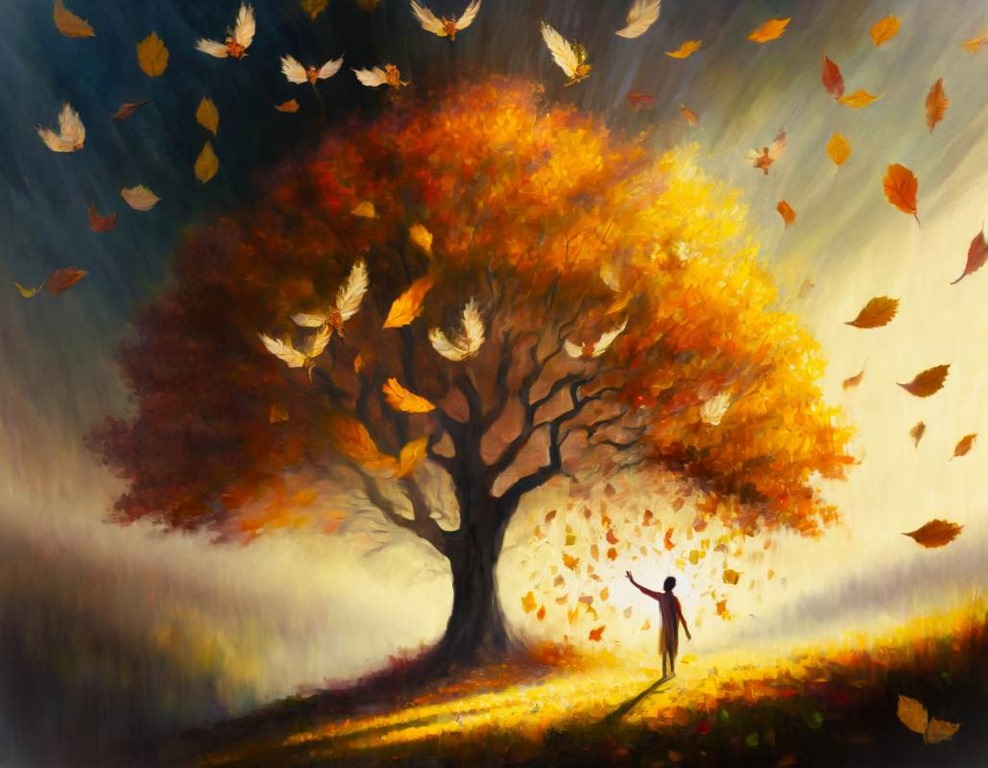
The originality of this compressed catalog of autumn thought comes in the refrained pair of lines “I grew up believing/everything was free to fall.” What was my intent there? I’m not sure if I’m articulate enough to do as brief a job as the poet me did in writing the poem. Yes, I knew many readers/listeners would think of things like free will and predestination, shibboleths of theology — but in the lines’ first statement I wanted the connotation that autumn’s falling leaves are freed from their work in photosynthesis and now can flutter and drift. The fourth verse refrain may (or may not) put this in a different context. Is this a compressed statement of “free will,” the doctrine that humankind has the choice of choosing good or evil, which also carries a connected thought that this is what makes good, good, not just an inherent trait? I was likely aware of that when I wrote it, but in performing it this fall I took another plausible memory: that there are those who believe in an afterlife, or a rising or rebirth of the souls of the dead, but that the song’s singer believes that however temporary or final autumn’s dying off is, that there’s a freeing element in it, like that leaf that has been loosed at the start. That’s a bittersweet freedom I wanted to convey.
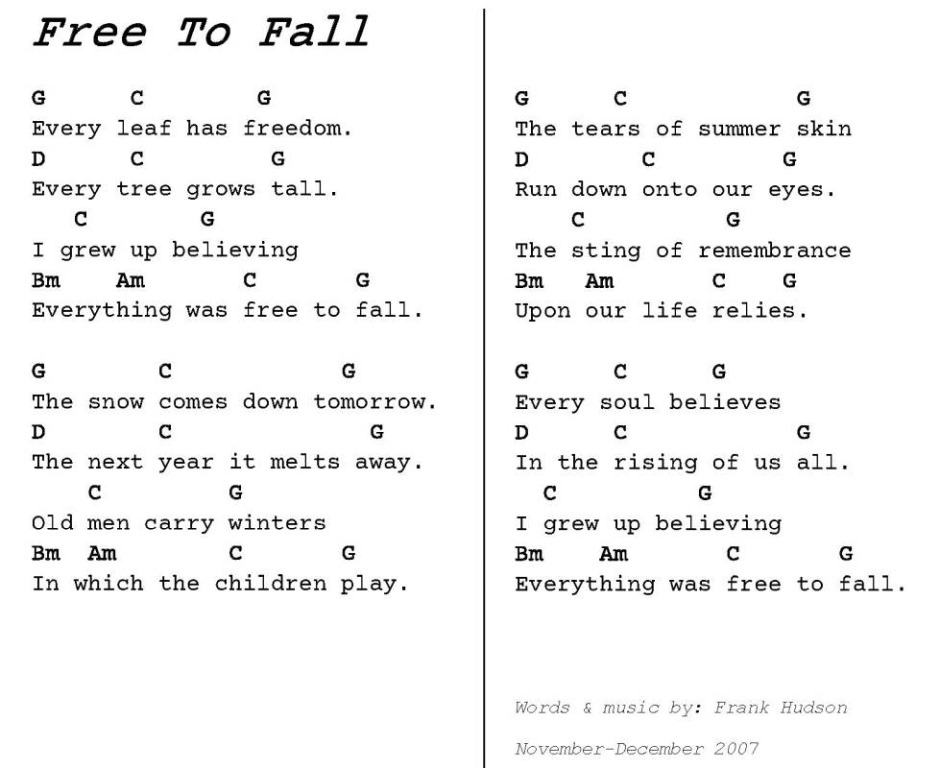
Free to Fall

Here’s a chord sheet so that other singers can extend or improve my performance

.

This poem/song works for me. Maybe it has some worth to you. In summary, the way I think it works is from the ability of compressed verse and song to collect things in a small memorable chunk of words, a portable experience. I’m glad I remembered this 16-year-old song and that I was able to record a new version to share with you. You can hear it with the audio player gadget below if you see that. No gadget? Some ways of viewing this blog won’t show them, but this highlighted link will open a new tab with its own audio player.

.

*“Where are the snows of yesteryear” is the concluding line of his “Ballade des dames du temps jadis”  published in 1533. Yup, those snows are definitely gone.

**One of the abandoned Parlando Project songs you won’t hear came from my idea to do a fresh translation of Surrealist-associated poet/lyricist Prévert’s French “Autumn Leaves” lyrics. I got a hold of those lyrics in French, and found that Johnny Mercer’s English lyrics are a freer, looser sort of translation. Prévert’s lyric is longer and more miserable, while Mercer’s cuts right to the nub of the situation without wasted elaboration. I found there was nothing I could do with Prévert’s French that would even approach the recasting that Mercer had already done.
Emily Bronte’s Cold Halloween Spell

Continuing our Halloween Series featuring some of our listener’s favorite fantasy and supernatural pieces from the seven years of the Parlando Project we get to today’s short Emily Brontë poem “Spellbound.”   Once more we have an eerie situation with withheld information that adds to the mystery while paradoxically compelling our attention.

Before beginning the Parlando Project I was only aware that Emily Brontë had written poetry, holding that fact as having no other consequence. I’m not even sure what drew me into her poetry — memory fades — but it may have been finding out that another Emily, Emily Dickinson, read it. Brontë’s poetry, which preceded her famous novel Wuthering Heights,  was at least partially extracted from a series of writings she and her young siblings created within a set of fantasy worlds — and though this short discussion of Emily and Anne Brontë’s imagined world of Gondal doesn’t list this poem as being part of that universe, “Spellbound’s”  setting doesn’t sound out of place from the northern, winter island in their Gondal.

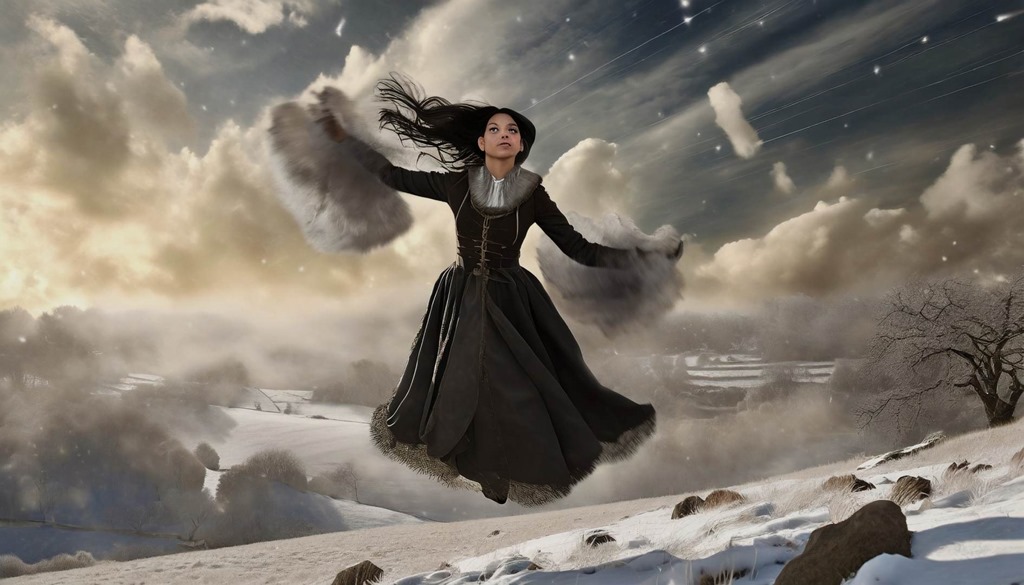
Nor out of place in the northern U.S. where I live, where the wind and weather is casting us to cold with predictions of snow and ice within the next 24 hours. When I first presented this poem three years ago,* I was intrigued by the prepositional position that the poem’s speaker seems to be in. In the poem they say that clouds are above them and the wintery wastes are below. It could be that Brontë was only envisioning a highlands or hillside perspective, but my mind’s eye had the spellbound speaker suspended, frozen in mid-air. Perhaps again, my imagination overtook me in that detail, but then I’m glad for Brontë’s imagination which created this chilling and enchanting poem that let me picture that.

Bronte's Spellbound 1080

Another illustration created by enchanting Adobe’s Firefly with an incantation. Firefly claims that it doesn’t use uncompensated artists work in its AI model.

.

I rather like the music I came up with for this one. Maybe you will too. An audio player is below for many of you so you can hear the performance of it, but some ways of reading this blog will suppress that page element, and so I also offer this alternative: a highlighted link that will open its own audio player gadget.

.

*If you follow this link to my original presentation of “Spellbound”  you can see the lyrics as part of a chord sheet in case you would like to perform this song yourself.

Thinning Shade

This month, as I wondered what poem to explore through setting it with music, a voice — my voice from a portion of myself — often spoke up. “You still have sheets of poems by Kevin FitzPatrick that you typed-up after he died, ones you thought you might perform.”

This week I finally listened to myself.

In my studio space I have a short stack of those sheets, printed out when I thought I might perform them around a year ago. I picked this one up. I had scribbled some chords on it, and I now tried to recall what melody I’d planned over those chords on a day last spring when Dave Moore and I performed things we recalled of Kevin and Kevin’s poetry. That spring day, I had reordered and reduced that stack as the two of us alternated suggesting musical pieces. This one was shuffled to the bottom then. Had I not felt I had finished the composition? Could be. More likely? From what I could see on the page, it had more chord changes than things which work best when I hand them to Dave and he has to try to follow my eccentric phrasing in real-time.

I picked up a guitar and started running through the chords, trying to discover, or rediscover, a likely tune. In doing so I made a few alterations and after an hour or so of that, I sat at my acoustic guitar recording location in my studio space and performed the guitar and voice tracks of the song you can hear below. As I played, I was thinking of Kevin and some full measure of retirement, that as it turned out, he didn’t get.

But then, none of us know what we’ll get. Part of the reason I have had a rapid release schedule over the years with the Parlando Project — its get-it-down-and-move-on-to-the-next pace — is that factor. Not only do I skip over additional steps toward perfection, the amount of things released probably wears some listeners out. Though somewhat more talented, my fellow studio-rat Prince used to get pushback from his record company that he should trim back his output, that it was too much, bad for his career and their business. Well, should he have waited? Did he get enough time?

Thinning Shade 2

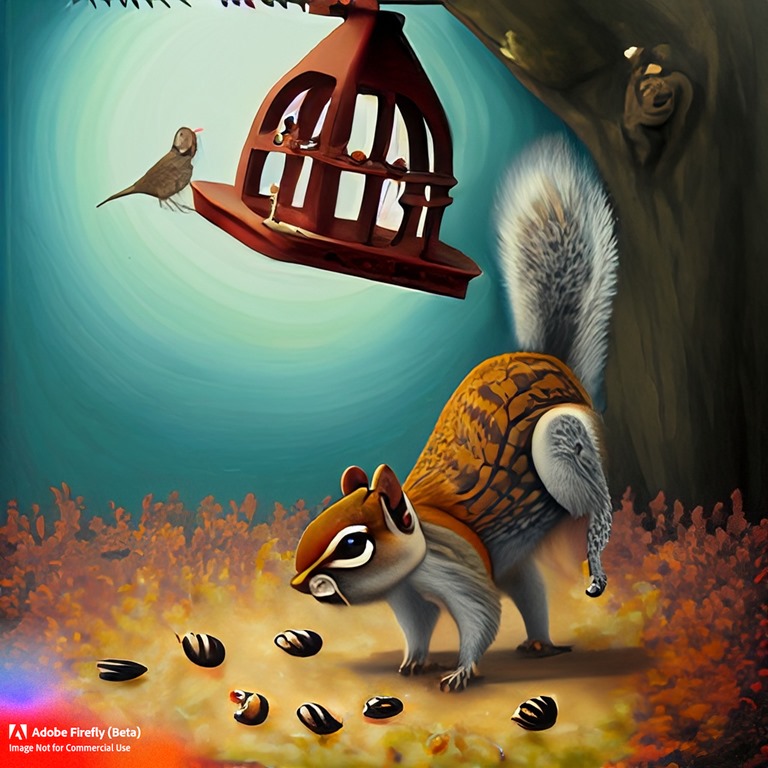
More playing with Adobe Firefly, the AI art generator that claims to not use uncompensated artists’ work.

.

Like most of Kevin’s poetry, his poem “Thinning Shade”  doesn’t call out for my extemporaneous insights to direct the attention of readers. But while going through the process of composing the music and going over the performance, the poem did get deeper for me as it repeated in my ear. I see myself as his sparrows and that “fattening squirrel,” “pouncing on seeds…in fussy haste.…”

Thinning Shade 1

Extending Robert Hunter: Talk about your plenty, talk about your ills/One squirrel gathers what the fussy bird spills. Great analysis of the song “St. Stephen” linked here.

.

You can hear my performance of Kevin FitzPatrick’s poem as a song with the link below. As the poem reaches it’s volta, I decided to slow down and add a string sextet to my guitar accompaniment. You can hear it with the player gadget below. No player you can see? You haven’t missed your chance at gathering the seeds, there’s this backup link that will open an alternative player in a new tab.

.

Interested in reading more of Kevin FitzPatrick’s poetry? His books are available at this site, KevinFitzPatrickPoetry.com that I’ll link here.

Beneath the Poplars, César Vallejo’s Easter Locus Solus

As National Poetry Month continues, let me take a brief break from the personal history of Parlando inspirations to again do in the present what this Project does: explore a poem as I combine it with new music. A few weeks ago I found an early poetry collection by the Peruvian poet César Vallejo. Before looking into this collection Vallejo was just a name to me, a poet who is best known as being a favorite of other poets whose work I had read.

If I had time to write more tonight I could go into his troubled life, but I do not. Suffice to say he grew up poor in rural Peru, and by paths he traveled to Lima and studied some in Peruvian universities, but poverty and trouble with the authorities seems to have always followed him. He fled to Europe and had down-and-out adventures there, but eventually died there 85 years ago this April. In a brief interchange with another poet on Twitter this spring we agreed that from what we know Vallejo seemed to always be an expatriate, an exile — and unhappy from that. If so, unhappiness for a man, but poetry deals with diaspora often and well — perhaps because even when we are dealing with our native language, the dialect we spoke from childhood, we are seeking in poetry to find its real home. So often poets stand in the midst of other native speakers of their language and find this so.

My adventure with a poem in a foreign language forces by nature a greater travel. Even if I have another English translation, I try to find it in the original and start again with the awkward literalness of a machine translation of that. Other translators likely have smoothed over the troubles of a literal with their chosen solutions, and out of some pride and a desire to not appropriate the work of other living writers, I then try to make a vivid poem in English out of it. Besides recreating the poem’s images and music of thought* in English, I often drill down into individual words by looking at foreign language dictionaries and examples of usage to see what plausible other English words might convey the author’s intentions. Though I feel conflicted about this, the process of collaborating with a dead author engages me as if I am writing my own poem, and from that arises a danger that I may be tempted to extend the poem or add variations on the original’s theme. In this Vallejo poem, my translation has a couple of gray areas, which I’ll note for accuracy’s sake.

Here’s my translation of “Bajo Los Alamos”  into “Beneath the Poplars:”

Beneath the Poplars

Jose Garrido was another young Peruvian writer that Vallejo knew before exile.

.

A few notes on my translation. In the first line “bardos” might well be translated into poets or bards. I made an eccentric choice, “scriptores,” trying to make the image more clear and mysterious at the same time. I thought of the poplars branches swayed over in the pasture wind would be like monks hunched and copying manuscripts, and that would be consistent with a poem that I feel is about labor and respite. I believe poets labor, but as a word poet doesn’t suggest it directly enough.

The 11th line was difficult for me, and I can’t right now recall all the struggles I went through to arrive at the line in my version. Given that the poem is about an old shepherd falling asleep in autumn, a clear image of the falling leaves being like sheared wool may have attracted me more strongly than a literal line translation.

I think the 12th line describes a sunset — and while Vallejo didn’t say sky, I decided to clarify the sense of “azul” here as the blue sky, as we mean it when we say “out of the blue.”

Lastly, did you notice that this poem mentions Easter, but is set in autumn? Peru is south of the equator and April is autumn there. All those easy connections we northerners feel about Easter and spring as a resurrection metaphor fall apart in the global south.

A gorgeous poem of work and rest, and I hope my rustic music helps set the mood for it. Given Vallejo’s life it seems he’s writing here of his locus solus, his essential place that he’s exiled from. Here’s how you can hear my performance of it: there’s an audio player displayed below for many of you. No player? This highlighted link will open a new tab with an alternate audio player.

.

*I give priority to transmitting what I think are the poet’s images to our eyes through our words. The word-music, such as rhymes and meter where present, I generally take as what is unfortunately lost in translation, though I like the resulting poem to have an attractive sound in English. The “music of thought” is my own term for the order and manner of repetitions in the presentation of the poem’s substance by its images and statements. This has its own musical structure and can more easily be transferred into a different language.

My November Guest

Back in 1916 American Poet Robert Frost published this short poem about what we’d today call Seasonal Affective Disorder (SAD). SAD is that syndrome where the increased darkness and other autumn changes set off depression in some individuals. Like many early Frost poems, it’s a beautiful, graceful poem with effective yet unaffected rhyme and meter — but when I saw it early today in a Twitter post by Cian McCarthy I was struck at the unusual way Frost treated this account of seasonal depression.

“My November Guest”  is set in the time of year we’re experiencing in my part of Minnesota this week. We’ve had two days of dark rain, even thunderstorms, the rain falling unbroken through the bald branches of the trees. It was around 60 degrees F. when I awoke this morning. I rode my bicycle to breakfast at a café wearing shorts as I might in spring, but when I rode past a small pond on my route I noted per the Keats of memory that “The sedge has withered from the lake/And no birds sing.” I returned home and spent an hour or so reading on our porch, but the forecast says it’ll be 26 F by midnight. Snow and ice will be falling north of us over the evening. “Robert Frost” is certainly the correct name for a poet to describe this.

Within the poem’s 20 lines Frost recounts a conversation between the poem’s narrator (we’ll say it’s Frost for simplicities sake as I paraphrase the poem) and his “Sorrow” (the poem’s name for depression.) Most of the conversation are points sorrow (simultaneously personified as external nature) is making to Frost. Sorrow/nature is stating that these dark days could be seen as beautiful. Frost says he is listening to this, feels what his sorrow is telling him has worth. The poem continues: the absent bird song, no colorful leaves on the trees, the cold mist — is it the dullness of grey or the burnish of silver? “You can’t see this as beautiful” nature concludes.

My November Guest

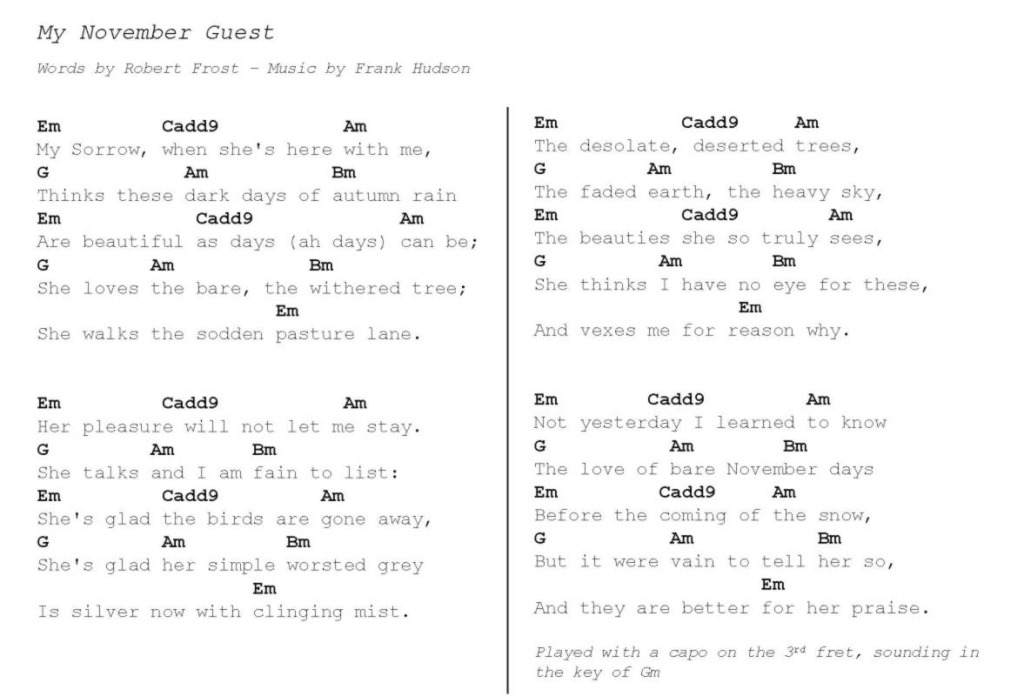
Here is the song I produced from Frost’s poem in songsheet format. I present these in hope that better singers than I might perform them.

.

Frost’s last stanza is his part of the conversation. “Yes, I know how to read the book of nature — or at least the calendar. I wasn’t born yesterday.” His day, the poem’s day, like my day today, may have been dark and damp, but it wasn’t yet the winter that is coming over the walls of the calendar’s date-boxes soon. I know I’ll miss sitting on the porch, biking without mitts, streets only wet not packed with snow or ice. The early and long November darkness may overwhelm us, set off mad clocks inside us, but that’s only dark, only hidden. Or so we tell ourselves and light our LUX lamps. Frost says it’d be vanity to tell his sorrow and this nature this, his mere knowledge, for nature knows the is  of this that surpasses knowledge.

Today’s music is a simple arrangement: me singing with acoustic guitar, as I quickly spent the middle of the day setting Frost’s poem to music and then recording it efficiently in my studio space before I need to hide my microphones from HVAC noises there. You can hear it with a player gadget where you can see that, or with this backup highlighted link for those who can’t.

.

A Murmur in the Trees

I said, when I was listening to the Tell It Slant Festival’s marathon reading of all of Emily Dickinson’s poems, that I was jotting down lesser-known Dickinson numbers which I might perform in the Parlando Project manner. Well, here’s one of them.

If you’ve followed my various Dickinson performances over the years you may have seen me emphasize Dickinson’s visionary aspects, her outlooks gothic and satiric (often combined), and sometimes her abstract poems of philosophic thought. One thing I noted again during the marathon was that she can be a very acute and intimate poet depicting pain. She’s all that. But sometimes she’s more at playful. Today’s piece, “A Murmur in the Trees,”  for example.

It’s glancingly a nature observation poem, but fancies have taken it over by half-way in, as a fairy tale seems to break out. The opening stanza sets things at night, and perhaps we are in the Dickinson garden (where Emily, predicting an REM song to come, sometimes did gardening tasks at night). There’s a noise, the title’s murmur, in the trees.

The second stanza breaks with a line of alluring consonance that remains a mystery to me, the “A long — long Yellow — on the lawn.” Sunset’s last light beams or dawn’s first ones? Filtered moonlight? And then we are told, something like little footsteps are heard.

The third stanza portrays little fairies or gnomes trooping home, the fourth, robins that could be strange birds who wear nightgowns and sleep in “Trundle beds” or Robin Goodfellow with wings. The poet’s speaker, presumably Emily herself, reminds us these are not metaphors in this moment for normal animals, since what she observes “would never be believed.” She finishes by saying that she won’t test the credibility of her observations anyway because she’s in league with those she’s observed, she’s promised “ne’er to tell” what her night garden contained. The final two lines return to mystery — if nightgown-wearing birds or gnomes, or the both of them hanging out together aren’t ambiguous enough — by saying “Go your way — and I’ll go Mine — No fear you’ll miss the road.” What’s the road? Are they birds seasonally approaching their autumn migration time where Dickinson is famously staying put? If we take that aspect, Dickinson appreciates they know a road away where she may not. Or is the road that other mystery, the “long Yellow on the lawn?” Fairies* are said to have paths (not to be obstructed) that are often difficult for regular humans to detect, but sometimes different colored grass or vegetation is said to be a sign of fairy roads. Is that the long yellow in the grass?

Fairy Birds or Tiny Gnomes

Actual photograph of enchanted birds attempting a marathon reading of all 1789 Dickinson poems. Meanwhile, tiny gnomes have paths and “houses unperceived” if you look hard enough in your night garden.

.

The little song I made from Dickinson’s “A Murmur in the Trees”  can be heard with the graphical player below. No sign of the player? No fear you’ll miss the road, there’s this backup highlighted link  that will open a player to play it.

.

*This second reading assumes some understanding of Celtic or British Isles folklore on Dickinson’s part. I’m not sure what is known of that possibility. There were Irish immigrants in Dickinson’s Amherst, eventually some as domestic workers at the Homestead.

From Us She Wandered now a Year

How much did Emily Dickinson want her poetry to be understood? I can’t be sure, but I suspect she wanted it to be both puzzling and  understood.*  While she didn’t publish to any extent in her lifetime, she did send by mail or otherwise share poems with friends. The conventions of Dickinson’s 19th century America may be different, but it’s possible that not everyone understood each poem, or even welcomed the arrival of those poems’ enclosure, but these acts indicate that she had elements in her poetry that asked for a public place for her work.

The posthumous publication of a large selection of her poems in a series of books at the end of the 1800’s did find ample volunteer readers though. Selected from her handwritten manuscripts by outside editors and somewhat regularized, they were also presented with tacked-on titles and within subject sections like“Time and Eternity,”  which however criticized by current scholars helped frame her work for her first posthumous readers.

There’s a certain kind of Dickinson poem, often with a touch of gothic whimsy, that most easily attracts a general readership. Others feature proto-Imagist observations that continue to delight readers. While there were other American poets of Dickinson’s time who had a substantial non-academic readership, now more than a century-and-a-half later, few read any other than Dickinson and Whitman.**

Having a general readership should discount no one’s literary merit, but snobbery may ask to have its say. If Dickinson is a poet admired and even read by those who are otherwise unattracted to poetry, this can be introduced as evidence against her worth as a true poet.

Given that, I have been noticing someone on behalf of the Emily Dickinson Museum has been regularly posting short Dickinson poems on Twitter asking for those who come upon them what their interpretation of these poems are. Few of the Dickinson poems this Twitter docent shares are the well-known “Greatest Hits” of Dickinson. Many are eight short lines, and those lines are often full of Dickinson’s oddest syntax and metaphysical musings. Being asked for an on-the-spot interpretation freezes many a reader as much as an armed robbery would — but at least in such a street encounter one likely knows where one’s wallet and valuables are. While I’m old enough to have grown accustomed to my own misreading of subtle poems that my fears of embarrassment are diminished, even I am hesitant to offer a Twitter reply. And this is true even though I’ve already performed some of Dickinson’s poems of that sort. What this series of Twitter posts demonstrates most vividly I think is that a great deal of Dickinson, though a time-tested popular poet, verges on incomprehensibility. So why did Dickinson write such poems?

My theory is that Dickinson was seeking to record in these cryptic short pieces certain moments of personal insight. Why take the time to versify them then? There’s evidence that Dickinson had a musical mind, and containing them such may have been a combination of the matrix of natural “music of thought” and the practical mnemonic virtues of verse. Dickinson was known to write short poems down on household scrap paper, indicating that thought was going on during domestic workdays. Perhaps I’ve come up with this mentally-drafted commonplace-book theory in that I spent some of my ordinary working life composing poetic stanzas in my head that were informed by things I was seeing and thinking while my hands were occupied. Such work is not necessarily “public poetry,” though in Dickinson’s case it now can be viewed by us strangers far removed by Dickinson’s time and place. Here’s her poem. You can be one of those strangers.

From Us She wandered

In memory of my feelings. Dickinson’s austere compression here.

.

So what was Dickinson on about with her poem known by its first line: “From Us She wandered now a Year?”   I’m not sure, and I’m sort of comfortable with that. What is clear? It doesn’t have the attraction of imagery. “Wilderness” is totally undescribed, not rising to the level of an image, and “feet’ and “eye” are the only other concrete nouns in the entire poem. There’s no clear sense of where or when this poem occurs. While there’s some sense of separation or change as of the first phrase, the poem evokes no clear-cut emotional tone. “She” and “Us/We” are vague characters, though I read the latter as a general evocation of humanity. Dickinson’s eccentric capitalization invites us to consider many words as philosophic entities, not a “wish you were here” note about a traveling friend.***  Thomas Wentworth Higginson and Mabel Loomis Todd, her posthumous editors, put this poem in that “Time and Eternity”  section, and invented a title “Invisible”  for it, which indicated they didn’t know what she was on about either.

Do I have an impression? I think the poem’s “She” is Transcendentalist Nature, which as I understand Transcendentalism is essentially the revered manifestation of the true universe and any Creator. “Wandered now a year” is the unstoppable progression of seasonal time which goes forward over any barren obstacle that might stop a corporal creature (Wilderness) or without any memorial break for death or state of nothingness (Ethereal Zone). The second stanza says we cannot not fully understand this, though we may have some autumnal intimation at some part of this cycle, where we “took” (in) this “Mystery.”****

I could be wrong, but a worthy enough meaning. Still, the overall effect remains its stark unsensual expression. Few of the normal pleasures of poetry are found in these eight lines. No imagery, no statement of the senses meant to invoke feelings in the reader (other than mystification perhaps). Word-music alone is there in Dickinson’s hardwood-seat pew hymn-meter, the thing she used to write her own hymn book. This is a highly intellectualized and discorporate poetry, but as I said at the beginning, I don’t know if Dickinson intended us to read it. If not, then Dickinson’s feelings and experiences being left-out are beside the author’s point. After all, she herself may have sufficiently felt them, and this artifact is meant only to evoke that memory for herself.  I, this other human today, have this overall emotion evoked: awe at the dexterity of her mind.

Today’s performance has music I composed and played in my “punk orchestral” style along with 12-string guitar. I’m using simple musical structures for the orchestral instruments, but I tell myself I can do so in the same way that guitar combo bands using a few root-V chords can none-the-less communicate something. It’s a brief poem that I represent in a short musical piece you can hear below with the graphical player, or in its absence this alternative highlighted link.

.

*This is a common, if not always acknowledged goal of poets: to be worthy not just of a reading, not just of some understanding, but to be worthy of a deeper and more careful and caring reading. That’s a lot to ask for words, even beautiful sounding words.

**I considered adding Poe to this exceptions list. Despite my own efforts, I doubt I could make a case for Longfellow retaining 21st century readership.

***Possible that there’s a specific lower-case “she” and this poem is more simply a “missing you” poem? I’ll offer this aside my theory, that if Dickinson felt that toward specific shes then it could occur to her to personify a manifestation of at least a conceptual Godhead as “She.” It’s possible to be thirsty and thoughtful.

****Sandy Denny’s song “Who Knows Where the Time Goes”  would be an example of a more elaborate and sensuous expression of the same sort of thought. It’s also a feeling I tend to get each fall, which may help spur my Septober Energy, where I set out to harvest what creative energy I have.

Fall 2021 Parlando Project Top Ten, numbers 10-8

It’s that time again when I present our quarterly countdown of the pieces most liked and listened to here at the Parlando Project during the past season. We’ll proceed from the 10th most popular and move up to number 1 in the next few posts. The bold-faced heading for each piece are links back to the original post that introduced the pieces here, in case you didn’t see them earlier this autumn.

10. Cobwebs, Steel, and Moonshine by Carl Sandburg.  Longtime readers here will know of my admiration for American poet Carl Sandburg, and so it may be no surprise that this is actually the second time I used parts of a single Carl Sandburg poem for a Parlando Project audio piece. The Sandburg poem is “Smoke and Steel,”  a poetic celebration of labor and laborers from a collection of the same name published in 1920. I used that whole poem’s title for the piece I created out of the beginning of it for May Day in 2019, but for this past American Labor Day I used the conclusion of “Smoke and Steel”  and gave the result this title. I dedicated it to another American poet, Kevin FitzPatrick, who was suffering from a serious and unexpected illness that killed him later this fall. This is the first of three poems in this fall’s Top Ten dedicated to poets Dave and I knew and exchanged work with who were suffering mortal illnesses.

I’m thankful that long-time reader of the blog rmichaelroman submitted a good guess as to what the steel might be in Sandburg’s short ode to workers and work: rebar.

Player gadget below for some of you, or this highlighted hyperlink will also play it.

.

9. Bond and Free by Robert Frost.  It’s been a while since I mentioned it, but Robert Frost bugged me when I was young. He was still alive, and omnipresent in anthologies one might find in school, which caused me to treat him like other 20th century poets and critics treated Longfellow: as a square preaching platitudes who stood in the way of younger and fresher voices who’d question all that with a more unruly poetry. I was misreading Frost of course, but through that error I did find others I thought in opposition to him that I found rewarding back then. Eventually I came around to love the word-music in his shorter lyric poems, and from that attraction found a starker and more divided meaning was there.

“Bond and Free”  is Frost in his more metaphysical and frankly philosophic mode, which isn’t my favorite Frost, setting out here a cosmic stage where Love and Free Thought conflict. He sounds more like Shelley or Keats in “Bond and Free”  than the more modern diction he was able to make sing in other poems, but sing the words do.

Player gadget below for some of you, or this highlighted hyperlink will also play it.

.

Frost-Moore-Sandburg

Three young poets at work. One played in the LYL Band.

.

8. They’re All Dead Now by Dave Moore. One of the most popular of my Halloween series this year, even though it’s a longer ballad form story that put my singing strength to the test. Longtime listeners here will know Dave as the most common alternate voice here at the Parlando Project as well as the keyboard player you’ve heard in the LYL Band.

He’s also a fine writer of poetry and songs. For reasons too complicated to deal with now, I fairly often sing Dave’s songs here rather than having him sing them himself. There’s a factor when someone sings another writers’ song. While they may bring a different kind of talent and musical craft, they may also somewhat misunderstand the song — or misunderstand (maybe more at “re-understand”) it in a valuable mutational way. Though I’m not a great singer, I do try to bring something to Dave’s songs when I present them here.

Every song stands to gain much more than one more life when sung by someone else. From time to time I’ve encouraged others to sing some of the Parlando Project songs. Anyone have their own cover of one of our Parlando Project pieces you’d like me to hear?

Yup, player gadget below for some of you, or this highlighted hyperlink will also play it.

.

Jazz Fantasia, a pioneering work of Jazz Poetry

This Friday is International Jazz Day, and for a project that subtitles itself “Where Music and Words Meet,” it’s a little odd that I talk less about the musical half of what we do. My project assumes that poetry, even on the page, can be defined as words that want to sing. What manner of tune fulfills that desire? It varies.

Early in this project it became apparent that I was going to feature a lot of early 20th century verse as it was the newest poetry that was clearly available for reuse. This was the time when literary Modernism came to English language poetry, greatly expanding the tactics that could be applied to poetry, and it came in too with an idea that much of what had become expected of poetry was tired and worn out, inauthentic and false.

Almost simultaneously, a very similar movement was happening in music. Though largely segregated from European Modernist composers in person, Afro-Americans were developing at the turn of the century a twisted helix of musics that came to be called Blues and Jazz. Differentiating between those two things is a complex matter. Blues is a nearly inescapable element of Jazz, and Blues is more substantially a vocal music, and so Blues needed a poetry from the start. That means that Blues song lyrics are the Modernist revolution as originally expressed by American Black people, though because of their context and place in American culture this was not understood as such. Like Modernist poetry, Jazz and Blues too demonstrated freedom to use new tactics, and they too wanted to replace tired and false musical tropes.

Poets, even those who intend for their work to be published and read on the page, can’t help but be informed by the music they know and admire. Earlier this month I’ve speculated on Emily Dickinson’s use of 19th century hymn-song meter and a possible connection for her deviation from strict poetic forms informed by her own improvisations on piano. By 1920 we had a Modernist Jazz music coming to America’s attention, and literary Modernist verse, though not without its naysayers, had reached an American audience too. It’s like flame and gasoline, isn’t it? When are they going to meet?

I can’t say what the first Jazz Poem was, or who wrote it. If it was composed by an Afro-American it may have been unnoticed, unpublished, and unrecorded (save by the oral tradition and the folk process which didn’t keep their names). Some of the traditional folk-blues lyrics seem to date from the turn of the century, but they were not printed as poetry then — and even as vocal recordings, the oft-cited first blues record, Mamie Smith’s “Crazy Blues,”  dates from 1920.*  The recording history of Jazz predates that a bit, with the all-white but still claiming “Original” Dixieland Jass Band’s broadly comic “Livery Stable Blues”  coming out in 1917, and that’s sometimes cited as the earliest Jazz record. Two poems already featured here: Ray Dandridge’s “Zalka Peetruza”  and Fenton Johnson’s “The Banjo Player”  were available in 1922 for James Weldon Johnson’s Book of American Negro Poetry.**   The former’s “tom tom” beat and the later’s Modernist free verse could make them Jazz Poetry. Some articles cite Langston Hughes’ “The Weary Blues”  of 1925 as the first Jazz Poem, and it is unquestionably a Jazz Poem, but even Langston Hughes had some issues to overcome with it. Back in our February focus on Locke’s The New Negro  anthology of 1925, recall that the elders mentoring and gatekeeping The Harlem Renaissance weren’t yet welcoming Jazz into high culture and were unsure of its effect on their project to elevate America’s appreciation of their race.


No, not that Prince’s band. A 1915 example of proto-Jazz and Blues being integrated into society dance music.

.

Which brings us to the underrated Modernist figure of Carl Sandburg,***  the white Midwesterner who had won the Pulitzer prize for his free-verse poetry in 1919 while being based in Chicago. In 1920 he publishes a follow-up collection, Smoke and Steel containing today’s poem called “Jazz Fantasia.”   This too is clearly Jazz Poetry. It appears to be portraying an instrumental performance, and while unlike Hughes’ poem it quotes no Blues lyrics, it’s clearly a Jazz performance with its imitation of horn sounds, the husha, husha, hush of brush work on the high hat, and their sandpaper swish on the snare, the tin can of cowbell, and the knocking pan-metal ring of stick hitting rim.

If not Blues form as such, two details from Sandburg’s 1920 words (here’s a link to the full text of the poem) stand out to me. Half-way in, there’s a car, a cop, and… “bang-bang!” Striking to hear a still modern pain in a 100-year-old poem isn’t it! And the poem’s conclusion makes a case for the breadth of Jazz expression infrequently made in the fad for Jazz during the Jazz Age: that it wasn’t only frantic music with comic musical effects suitable for careless youth further forgetting their cares, but that it could also portray some green night lanterns and the boats ceaselessly beating against the current.

It was imperative to me that today’s musical performance for International Jazz Day must use some approximation of Jazz. I play no brass instruments and I find them hard to approximate with virtual instruments articulated by keyboards, so you’ll hear an anachronistic, more modern, Jazz trio: drums as featured in Sandburg’s poem, guitar, and bass. The player gadget for this may appear below — and if it doesn’t, this highlighted hyperlink will also play my performance of Sandburg’s “Jazz Fantasia.”


.

*In 1903, Afro-American composer W. C. Handy encountered a Blues playing guitarist in Tutwiler Mississippi, noted he was singing a Blues song with recognizable Blues lyrics. He thought the music was “The weirdest thing he’d ever heard” but by smoothing it off and adopting it to the composed brass band and society dance music he was familiar with, he made use of those Blues elements.

**Other examples of Jazz Poetry influenced writers I’ve managed to sneak in here are Kenneth Patchen who read to Jazz music, Le Roi Jones/Amiri Baraka, a poet who also wrote widely about Jazz, and even words by Laurie Anderson who was influenced by fellow Chicagoan Ken Nordine who had released several LP records he called “Word Jazz.” The music on Laurie Anderson’s recordings doesn’t read as Jazz to most, but focus instead on her voice and you’ll hear that same ‘50s cool jazz phrasing.

***I often make the case here that Sandburg’s poetry contains some admirable examples of the compressed and spare Imagist aesthetic, but besides poetry he’s intimate with the rise of photography as an art via his wife’s brother Edward Steichen, he was reportedly the first daily newspaper cinema critic in Chicago, and he was an important popularizer of American folk music.

And speaking of Langston Hughes achievement, Hughes’ early poetry often sounds unmistakably to me like he had “heard” Sandburg and taken some of his riffs into his own heart to be further extended by Hughes’ personal familiarity with the Afro-American experience.

Fall 2020 Parlando Project Top Ten, numbers 4-2, and what is it that you’re trying to do anyway?

Before continuing with our count-down of the most liked and listened to pieces here this past autumn, let me remind newcomers what the Parlando Project does. We take words, mostly other people’s words, usually poetry, and combine them in different ways with original music.

“Oh, you mean you make them into songs?” Well, sometimes, yes. But not always. I don’t always sing the words, thus the project’s name.

“So, it’s spoken word with some music in the background.” You could say that about some pieces, but I want the words and the music to interact, comment on each other. The music isn’t just background.

“Music with chanted words. Are you a rapper?” I wish. Can you imagine the commercial potential of old guys chanting poetry, often to acoustic instruments? House-party! I’ll bring the Gerard Manley Hopkins, Emily Dickinson, and Fenton Johnson! No, I’m not a rapper, but you could say that I’m more a separate branch growing off the roots of things that rap also grew from.

“Are you some kind of beatnik?” Wait, where’s my black turtleneck, I’m going to reverently listen to some cool jazz records now while trying to remember what was so important about being intoxicated first. Oh, what was the question again?

“The last few numbers on the Top Ten had those orchestral instruments. Are you setting poetry texts to music in the tradition of art song?” One limitation of this project is that neither Dave, nor certainly I, possess bel canto voices that can realize what most art song composers do. I’m conceptually doing what art song composers do, but the empirical results reflect my outlook, performance resources, and limitations. Also, like Yeats, I fear that elaborately sung melodies obscure the impact of the words.

OK, back to the countdown. If you’d like to read what I wrote when I first presented these pieces, the bold-faced titles are hyperlinks to that.

4. O Let Me Be Alone Awhile  by Emily Bronte.  You could feel bad for Emily B. that my Halloween piece using her spellbound poem didn’t make the Top 10, but this one, an introvert’s shout-out that some readers and listeners might have felt was especially appropriate in this pandemic “everyone stay at home” time, did. The player to hear this should be below, but if you don’t see the gadget, you can use this highlighted hyperlink instead.

.

Autumn Indian Pipe and Dickinson Poems cover

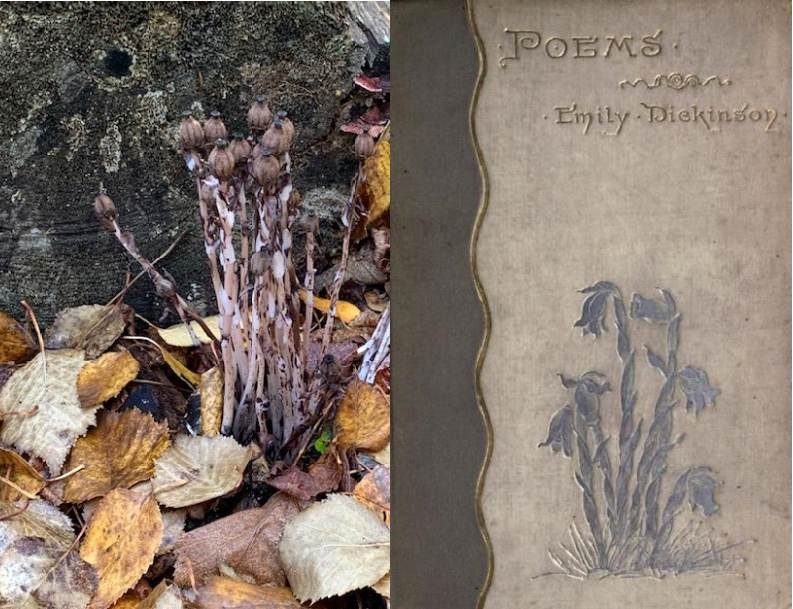
The first edition of Dickinson’s poems featured a picture of Indian Pipe flowers in bloom, but like all flowers, autumn, if nothing else, ends their term. Indian Pipe (also called Ghost Pipe) is a strange plant that doesn’t use photosynthesis, but rather gets its energy from fungus. The picture was chosen because avid botanist Emily liked this unusual plant.

.

3. As if the sea should part  by Emily Dickinson.  From Emily B. to her American admirer Emily D. we go. For all the mythos about Dickinson’s later years of not leaving her family home, does anyone ever ask if being cooped up in a house with a family half-heartedly uninterested in poetry was all that comforting to her? In her most vital writing years, Dickinson still roamed some physically—and mentally. I’ve had some fun over the years here suggesting musically and graphically that Emily Dickinson would rhyme with Sixties psychedelia. “As if the Sea should part”  is certainly mental traveling of the purest sort. The player for this performance is below, or if you can’t see the player, you can use this hyperlink.

.

2. The Listeners  by Walter de la Mare.  When I started this project I thought I’d be rocking out more often than it’s turned out to be the case. Part of that result comes from being increasingly unable to record with Dave or others, and some from enjoying the novelty of being able to score and play orchestral instruments. My version of de la Mare’s weird minimalist ghost story isn’t crossing the hardcore boundary, but this is  a rock band arrangement that sounds good turned up on your speakers. The player to test that claim should be below, or if not, this highlighted hyperlink will play it.

.