This summer, amid the seasonal lower traffic volumes for The Parlando Project, I’ve been featuring some uncharacteristic pieces where Dave Moore or I have written the words as well as the music. But today we’ll return to the proper mix, using a text by English Victorian poet, Alfred Lord Tennyson.
I saw today’s text first over at Kenne Turner’s blog, where it was included as a short stand-alone lyric poem entitled “The Dragonfly” in the midst of a series of excellent photos of varieties of this creature. Here’s a link to that post which will also let you read the text I used. Other blogs have published the same text under this title, and I assumed it was a uncharacteristic very short nature poem by Tennyson. Let me thank Kenne for bringing this poem to my attention.
Long-time readers here will know I like concise poetry, and this one, so concentrated in its charged notice of this strange yet charismatic insect in a moment of transition captured my interest immediately. Earlier this month I performed “The Dragonfly” along with Dave playing keyboards, and you’ll be able to hear how it came out below. Sure, it is a Victorian poem, though not excessively so. Just a few words might need 21st century explanation. That “sapphire mail” is the insect’s chitin exoskeleton portrayed as if armor, not a blue envelope delivered by some postman. “Crofts” is something of a Britishism and means a humble field. The moment Tennyson seems to be describing is the ending of the years-long nymph stage of the dragonfly, as the mature winged insect splits open its old hard exoskeleton emerging a moist new winged creature. In checking on the zoology of this, I read that dragonflies spend the majority of their life as immature, wingless, nymphs before becoming the strange fascination that we see, and only then think: dragonfly.
I’ve mentioned infirmities and transformations a good deal this summer, and I thought this transformation more clearly ecstatic in nature, and that it would be a good break from the more gothic material I’ve been working on recently.
So there I was, I had this text, cloaked in language and poetic diction that said “Victorian,” but also prophetically Imagist in its concise approach. I had music to perform it with, and then a decent recording that brought it into existence.
Summer, time to fly thro crofts wet with dew, and not just more screen time.
.
Then today, I decided to see what else I could say about this poem when I present it here. It was then that I found that it may never have been intended as a short poem, but was instead part of a long, very philosophic poem by Alfred Tennyson called “The Two Voices.”Here’s a link to that text. When I say philosophic, that might sound a bit bloodless, but Tennyson’s own working title was “The Thoughts of a Suicide” — and no, that’s not a literary plot, like “The Lady of Shalott.” It appears* that “The Two Voices” is something of a less-favored and less fully-achieved early attempt at the matter that produced what is thought of as Tennyson’s masterpiece “In Memoriam AHH.” So, “The Dragonfly” a simple nature poem? No, nature isn’t simple, even if beautiful. The matter Tennyson was grappling with was the unexpected death of his friend, supporter, and literary compatriot, Arthur Hallam, at the age of 22.
It would be appropriate to insert your favored curse word here. I’m an old man. The death of folks I know, then knew, is a commonplace of age, and painful, though touched too by a strange partnering with an idea that death is closer to me — if only demographically at this moment. But young, brilliant, helpful, a man with whom, it is recalled, would fall and roll down in the grass with the similarly young Tennyson, overcome by paroxysms of laughter at some bit of passing humor — how can one express that kind of loss?
Imagism says that you can enclose that unexpected death of a vibrant and cherished youth inside a short poem, made up of a moment of exacting and clarifying observation; a poem that is furthermore modest in its emotional expression and that doesn’t say what something like that event feels — showing instead what one examines with our two, small, dark eyes, our meager allotment compared to the giant multitudes of eyes that make up most of the dragonflies’ head.
Can it do that? I don’t know. Interesting to try. I sensed only this mysterious/glorious transformation when I first read “The Dragonfly” excerpted from it’s longer setting in “The Two Voices.” I really did intend for it to be a bit of a break here, but I’m left with informing you of my honest experience of this poem as I do regularly in this Project.
For some, the player gadget will appear below to hear The LYL Band perform Tennyson’s “The Dragonfly.” Don’t see a player? Turns out a lot of ways to read this blog won’t show that, so I provide this highlighted hyperlink to open a new tab window and play it as well.
.
*Given that I’ve only seen Tennyson’s “The Two Voices” in its entirety this afternoon, I’m not able to tell you more about it other than what I’ve quickly gathered. Victorian poetry doesn’t generally attract my attention, even if most of the Modernists that do attract me grew up during the Victorian era, and, even in rebellion, would be impacted by it.
Patience appreciated reader. You know we sometimes start one place here and then teleport to somewhere else near the end.
The NBA finals concluded last night, settling for this year the championship of the world’s premier basketball league. Best as I can tell, there’s not a lot of sports-fan overlap here, and to be honest my sports interests atrophied by the time I reached middle age to the point that it’s mostly a skimming of the sports news.
Still while researching something else last night I noticed a live-updating article on a news site for the finals game in its last quarter. I opened a tab in my browser, and in between reading other links germane to my research, checked back on how it was going.
A tied and then two-point, one-possession game eventually entered its final minute, and around there the Milwaukee team, possession by possession, started to assure its win. Even though it is a business, and even though the losers will get paid too, these moments in sports still build into an Aristotelian Poetics agony. One side is partly hoping no one screws up the increasing likelihood; the other side increasingly knows hopelessness. Compounding this, the obligatory strategies of the game mean the endgame is prolonged with timeouts for court position and play caretaking, and desperate, clock-stopping intentional fouls.
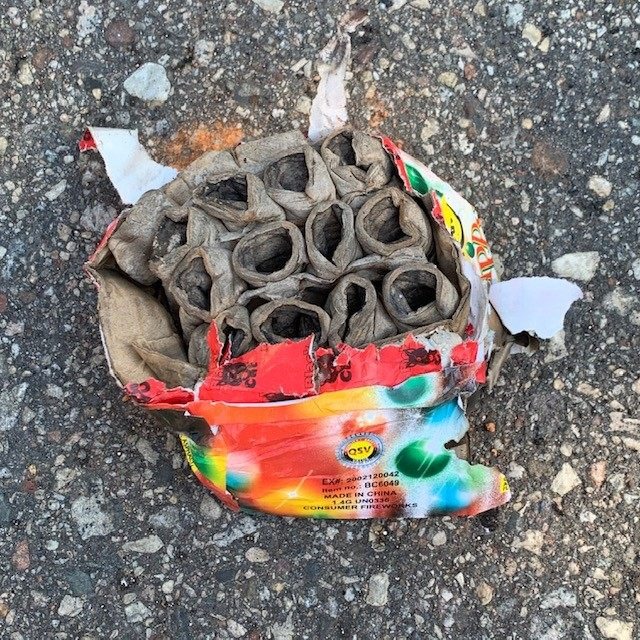
July remains of bang, light, spent.
.
And so, patient reader, it was then, as we continue our summer death, infirmities, and transformation tour here at the Parlando Project, that I thought of this song by Dave Moore that we had performed over a decade ago. Things sticking in memory is one test of artistic validity, and out of hundreds of different songs that Dave and I have performed since then, to recall this one seemed meaningful.
When I dug it out and listened to it this morning, I heard its infirmities: a simple rhythm-machine beat, Dave misses some intended notes in the vocal, my guitar part is not much. The combo organ sound that Dave uses is not hip or fashionable. But still, I think the piece did more than charm my memory. Near the end, Dave lets out a quatrain that still says something about our lives, about infirmities and death:
“You can’t make this up.
It makes up itself.
You can’t make it be
more than anything else.”
We all have our lies, our lives, our arts. We strive, and then someday, strived, to make them. Two out of the three are artificial, and yet from that we still try to discover truth. In the end, death makes up itself. Funny game.
One of the things this project is about is describing my experience of other people’s poetry and art, an experience which often intensifies as I inhabit some text in order to combine it with my music. Experiencing a poem in that way enforces a deeper connection, for you have to understand, in at least one way, that the author embodied something with their art. That’s my project, but ordinary readers will often find a level of experience with poetry they read too.
Does poetry exist to instruct or guide our experience of life, or does our experience of life or living with a poem vivify silent lines on a page?
Does poetry exist to instruct or guide our experience of life, or does our experience of life or living with a poem vivify silent lines on a page? Isn’t it likely a bit of both? It’s not always the poem’s fault if it doesn’t leap off the page and integrate with our selves, but then sometimes else we do connect with the poem’s experience with our own experience. When that happens, a poem — well — opens from its closed position in a book.
Heidi Randen’s own photo of the wild iris, which opens
.
Today’s piece finds me selecting for performance a part of a blog post by Heidi Randen where she describes such a bilateral interaction with a poem by Louise Glück, “The Wild Iris.” Suffering, observing suffering, feeling loss, observing loss, are some of the matter here. This poem helps Randen, and the poem’s potential is fulfilled by her connection. I took the final lines from her blog post and performed them as a “found poem,” deciding to overlay some form on it and applying my reading of it with the music from The LYL Band in order to make my own comment on it and to bring them to you.
The Poem, “The Wild Iris”
The poem
”The Wild Iris”
that opens:
”At the end of my suffering there was a door.”
The poem
”The Wild Iris”
that opens.
There is a joy after fear.
A door opens.
There is a joy after fear.
The door opens
into a world of light
and beautiful colors,
and you can breathe again.
Here’s a link to the Glück poem, which may bring you understanding or solace, or just a shrug. Below you may see a player gadget to hear my performance of “The Poem, ‘The Wild Iris.” However, some ways of reading this blog will not show the gadget, so here’s also a highlighted hyperlink that will open a new tab window to play the same LYL Band performance. The music today may be a little strange to some listeners since I wished to have unsettling elements mixed with reassuring ones. I also don’t know how you will react to the repetitions that are most of the form I imposed on Randen’s words. They too are part of the focused noticing* I intended for this.
.
*”Focused noticing” is a decent short definition of art, isn’t it.
Is it time to take a break from our sometimes intense presentations of poetry combined in some way with music? Well, here’s a little ditty about the lighter side of death, or rather the worship of dead rock stars.
Sure, it can be a honorable thing to give respect to those who’ve gone, to carry their artistic flag further when they can’t, but there is another side, the romantic admiration for the risks and the access to excess that often precedes the early death of musicians, writers, and other artists. The first duty of an artist is to survive. Society is not generally on the artist’s side until they become successful commercially, and even when it grants them that success, it can withdraw it and their support quickly too. To add to that burden with one’s own self-medication and distractions seems like a compensation to that state, but it doesn’t always work that way.
Poet, songwriter, alternate voice, and frequent keyboard player here Dave Moore wrote a short poem about how an older person might view with a strange kind of envy the tentative fame and unbounded experiences that others in our musical/generational cohort enjoyed. Sex, drugs and Rock’n’Roll once seemed to be jobs on offer in the want ads in our youth, even if it turned out the positions were already filled and the items already sold. I adapted Dave’s words, added a verse of my own, and wrote music for my performance of “They’re Not the Grateful Dead” some years back and thought you might enjoy it here. Oh, that “Grateful Dead” in the title? Translated folkie Jerry Garcia knew that this was a trad folk song trope where the dead magically and musically express some gratitude.
One thing I like about Dave’s lyric is that, outside of Jimi Hendrix he doesn’t pull in the big names, the Boomer rock’n’roll Shelleys and Byrons, the ones that are still featured faces in the rear-view mirrors looking at the music and times. Starting right off with Nicky Hopkins* is a bold move, but then Dave is a keyboard player.
My performance of this has a few flubs, but it’s hard for me to get more recording in right now, so we’ll make do with this older recording as is. The player gadget is below for many of you, but if you don’t see it, this highlighted hyperlink will also play my performance of “They’re Not the Grateful Dead.”
.
*Huh. Who? Those who didn’t ruin their eyesight fantasizing about debauched after-parties but by reading all the liner notes on every LP will know who Nicky Hopkins is.
Visits to this blog tend to go down on weekends, on holidays, and in the summer — so, congratulations if you’re reading this, you’ve managed to beat the crowds!
America is a young country, but after a bit of a slow start, we’ve been meeting our quota for poets, and by now the record shows a great variety and number of them. Who’s great? Who’s dispensable? Well, some days I wonder if any of that matters when poetry still has challenges getting traction on the slick surface of our nation. Still, one thing’s clear to me if I take stock of American poets, there’s no more American poet than Walt Whitman. That’s no accident: it was his life’s work to become the most American of poets. Few poets before and since have sincerely tried for that. Whitman did.
Whitman didn’t just want that personally. His poetry is full of invocations for other American bards to arise, with claims that the spirit of America would nurture and welcome them.
This Sunday is American Independence Day. Has he been right?
Our first piece today is one of Whitman’s best-known poems. In its litany of lines he shows us two things: that Americans love to sing and that America is the sum total of our varied labors.
Taking the last first. Whitman is going to concentrate on manual labor and trades in this poem. He could have written about other work and workers, even poets or professional musicians after all — but he says the songs he’s going to note are “those of the mechanics,” meaning the mechanical trades,* using the word in the same meaning that Shakespeare uses it when burlesquing the “rude mechanicals” and their ardently inept art in A Midsummer Night’s Dream. But Whitman is not making fun. He says nothing about the quality of their songs or singing, but the very length of his list indicates he values something in their number and variety. Overall (or overalls?) there’s celebration of masculine traits in the poem, though some work associated with women — and specific, specified work, not just sentimental “remember the ladies” stuff — is included in his list.
It’s fitting that in this summer month, as a holiday weekend approaches, that he ends his poem with a party, a get-together, but throughout “I Hear America Singing” songs continue in work, in comradeship, in love. I would wish you too just as happy a July 4th.
It’s complicated to judge if American poetry disproportionately influences the world in our time, but one doesn’t have to go hard to make the case that American music has done so in the time since Whitman’s death. Whitman speaks of poetry as a bardic art, and so he uses “song” and “poetry” interchangeably when he speaks of his art, even if later most have come to see these as separate arts and that it’s important to distinguish between them.
Whitman asked that — more than that, promised that — there’d be many significant American poets to come. He got musicians. Close enough Walt.
Checking on the predictions of two American poet-prophets: Walt Whitman and Langston Hughes
.
Some decades later, one of the poets that Whitman prophesied wrote an “answer record” poem to “I Hear America Singing.” In “I, Too” Langston Hughes, an Afro-American poet, decided to add one more labor example to Whitman’s litany. Hughes’ poem is sung from the position of a servant.** In Whitman’s 19th century time, many/most of the jobs that Whitman cataloged would have been self-employed, and it’s clear that Hughes’ worker isn’t. Furthermore, as an Afro-American his segregation from the “company” is double-more with his class status. Make the food, serve the food, wash the dishes — but you won’t eat in the room with the guests.
Hughes too is going to prophesize a future America then from his 1925 present. Don’t speak too soon, the wheel’s still in spin he says in effect about that stay-in-the-kitchen status. He’s going to spin that wheel.
Nearly a hundred years later*** how have things worked out with Hughes’ prophecy? Poets have written. Songs have been sung. Work from American political mechanicals has gotten us partway there to equality of opportunity, to recognized accomplishments, to appreciation of Black beauty.****
Is this an unpatriotic thing to say on this holiday, that our workmanship on some important civic matters is slipshod? I’m no prophet, but if I was one, I might say that some day we could build the temple in time where we can see beauty presently while being ashamed in the past tense, just as Hughes promises.
What Americans could build this temple? If not us, who else?
*I note that in his catalog Whitman mentions specifically house carpenters, the job his father held. He also mentions wood-cutters. Ezra Pound’s family had connections to the lumber industry, and in Pound’s poem “A Pact” about Whitman, Pound calls out Whitman as a wood-cutter while patting himself on the back as the more developed “carver” of wood, a job further down the supply chain and further up the artistic hierarchy. Sick burn Ezra.
**Details of this aren’t completely clear, perhaps intentionally. Hughes poem’s speaker could be enslaved, or he could be a paid domestic servant. He could even be a restaurant worker, a job that Hughes himself held for a short time. Early in his life, his poetry career got a boost when he left some poems at the table of diner Vachel Lindsay when that Illinois poet visited the establishment where Hughes worked. Lindsay read them, thought they had value, and touted Hughes as a result.
***When the country was younger, July 4th was a day for speeches on our history. Now, for me, so strange to be so old, and how disappointing how slow citizenship equity is. In my youth, it was common to speak of racial justice and full rights as being an American goal a hundred years old, using the end of slavery as the starting line. And now we near 100 years from Langston Hughes’ poem. The famous “arc of history” is such a long archway that one should wonder why it hasn’t collapsed in the middle.
****Speaking of I hear America singing: disproportionally the reason that strains of American music are known worldwide is due to Africans taken to these American shores. American singing, American music, has many tributaries, many are important, even the many-ness itself is important — but as I’ve said here before: I am an American musician. Most of the notes are black.
This has not been a month conducive to producing new content for this project, and I’m not sure about July and August either. At some point I’ll probably talk about some of the reasons for that, but I thought it’d be good to leave you with one more June piece, and it’s a fine summer song by a voice this project hasn’t heard from enough lately: Dave Moore.
Dave and I first performed as The LYL Band about 40 years ago, and we’ve kept at it over the years. Our typical encounters this century have been a sort of two-person song circle with each of us alternating in presenting a song, a piece most often completely new and unknown to the other. These first takes* get recorded, and one of them is today’s audio piece.
First takes with unknown material is not the way most bands work, and certainly not how they record. Bob Dylan worked with unknown, fresh material and new-to-it musicians in his classic years (and may still now, there’s just less documentation), often providing at best chord charts for assembled musicians or brief run-throughs. But Dylan would do multiple takes even trying different studios or musicians over time, trying get the right take.
It’s not uncommon for jazz musicians to do the same thing we do in their recording studio dates, though some feel that even with Jazz’s reverence for spontaneity that this is a practice brought forward for logistical and lowered recording-budget overhead reasons, not as a considered artistic choice. Miles Davis seemed to find this practice a considered choice though, and when one listens to a record such as Kind of Blue we are likely to give some credit to that choice, which Bill Evans likened to spontaneous Japanese painting in the original LP liner notes. Later on, Davis took to the pentimento-practice of having everyone improvising on themes and then letting later audio editing assemble from the mass of recorded playing a post-recording compositional structure. A record like Davis’ A Tribute to Jack Johnson assembled that way has a different vibe and timbre from Kind of Blue, but it works for me in its different way.
Are Dave and I musicians like Davis and his band members? No. Nor are we musicians likely to be called to a Bob Dylan session (note to Bob: call us anyway). Most of what we record on any one day isn’t worth more than a self-critical listen on our own parts. And of the rest? There are usually rough spots that even a bit of focused audio editing can’t excise. And then, sometimes something like “Hortensia” arrives.
If you accept (as I say often here) that all artists fail, then it can sometimes behoove one to make peace with failure. Do that, and then allow, then make possible, for the limited successes to arrive.
I often tend to overstate my guitar parts. I didn’t here. Dave’s keyboard skills at the time of the recording get some space, and while he’s not going to kick Bill Evans or Herbie Hancock to the curb, what he plays works. Dave’s vocals are usually more consistent than mine by a long shot, and his performance serves the song. I think Dave may have even improvised some of these lyrics during the performance — and this is the only performance of this song ever. And that serves the song too.
You see, I hear this as a summer song, a song of long days, rich days, that are still days, and must end in earth’s and fortune’s rota. “Now, sweet now” Dave sings. Yes.
I think I asked Dave what the song was about shortly after we recorded it. “The summer flower or the Roman woman?” I think he replied that it was more at something intuitive.
.
You can hear it with the player gadget below. Don’t see a player? This highlighted hyperlink will also play it.“Hortensia” is longer than most of our pieces here, but sit back with a cool drink and listen. Thank you hearty listeners and readers for sticking with this project!
.
*First, and in most cases, the only take. Since we haven’t focused on live performance much in our old age, we aren’t working up material for performance or developing a repertoire for that. Dave has been as prolific with words and with songs with his own music as I have been with musical pieces over the past few years. This means that there was always new material to be tried out, to be brought into existence, even if briefly and for one take.
A longish one this time. I’ll try to make it worth your while.
In the places I go it has been hard to escape Joni Mitchell and the 50-year anniversary of her breakthrough record album Blue this month. Mitchell is one of those artists like Emily Dickinson* or Thelonious Monk who people contemporaneously recognized as someone on the scene, someone whose work might appear at hand or gain mention — but then decades afterward the level of originality and importance of what they had done becomes more and more clear.
Mitchell’s Blue wasn’t immediately recognized as a classic, successful statement. Musically it’s a bit odd, even by the eclectic field of 1971 recordings. Though “singer-songwriter”** was a growing genre at the time, most of them would present their songs in a full band context on record. Instead, Mitchell’s record is spare, often just her voice and one instrument — and sometimes the instrument is a mountain dulcimer at that! She often used her voice unusually, with quick almost yodeling leaps in service of the originality in her melodic contours, and this was off-putting to some. One thing I remember about listening to Joni Mitchell LPs back in my youth was that the amount of volume in her upper register would rattle the plastic frame and enclosures of my tiny portable stereo’s speakers, producing a very unpleasant buzzing distortion.
To the degree that she was noticed in 1971, that she could be a figure who’s fame might outreach her record sales or rock critic esteem — it wasn’t just that she was a successful songwriter for others who could round-off her corners just a bit to present “Clouds (Both Sides Now),” “Woodstock,” or “The Circle Game” to a wider audience than their author could — it was because she was known as (this gets complicated, stay with me here) as the “girlfriend” of a lot of male rock stars. This got joked about. The now infamous Rolling Stone “Old Lady*** of the Year Award” in 1971, or a joke picture of a purported Joni Mitchell LP with a song listing of: 1. Crosby, 2. Stills, 3. Nash, 4. And Young.
Do those of my generation remember that? Did you laugh? I did. That’s part of the complication, but then I believe sex is only funny when you’re risking doing it “wrong” — and it is best if it’s funny some of the time. Dead serious and entirely secret? We might as well sign up for Brave New World industrial reproduction or efficient devices shipped in plain brown wrappers.
That said, now-a-days that 1971 behavior toward Mitchell is now viewed as belittling and a case-study in patriarchal attitudes in the “counter-culture.” Which it was. In the era’s defense I’ll say that the times were groping (should I revise that word?) toward an imperfect but different attitude toward sexual relationships. Just exactly what women would have to say about this wasn’t the first or second thing on the official list of speakers, alas.
It just so happens that Mitchell spoke up anyway, and mixed that with a kind of music which might have seemed just a bit odd or imperfect then, but now is seen as effective, important, and original.
And now it’s time to play Frank’s favorite history game. Folks are thinking about Joni Mitchell and 1971’s Blue here in 2021, but what could we see if we rebound off that 1971 time and look back 50 years from then?
Well, they do tilt their berets the opposite way. Edna St. Vincent Millay and Joni Mitchell
.
The poetry fans who are still with this post were wondering when I’d get to Edna St. Vincent Millay. In 1921 Millay had broken out as a young poet to watch, partly by that “being on the scene” presence in New York City in the era around and just after WWI, and by famously losing a poetry contest with a poem that many (including the contest’s winner) thought was the best of the lot. That poem was then featured in her debut book-length collection, and now it was time for the “difficult second album.” She planned that second collection to be what was to eventually become her book: Second April, a title that suggested that plan. But she was having trouble with her publisher, and eventually another collection came out ahead of it, just as the 1920’s began to roar: A Few Figs from Thistles.**** It’s a fair analogy: that book was Millay’s Blue. And like Mitchell’s Blue people noticed the author’s public persona not just the poetry. Millay became the exemplar of “The New Woman” of the 1920s, who were sometimes finding patriarchal marriage a doubtful institution, and flaunting disregard for traditional arguments financial and domestic for that. Speaking openly about erotic feelings. Creating their own art rather than settling for standby muse duties.
I’m not sure if even an incomplete list of Millay’s lovers was known to a general poetry reading public 100 years ago, and one can’t quite imagine Poetry magazine naming Millay “The Old Lady of 1921,” but the persona in A Few Figs from Thistles gave us that adventurer in love character that makes Millay and Mitchell echoing artists. But the original edition was a thin volume, chapbook length, and from things I’ve read this week it seems that Millay worried that it wasn’t substantial enough while Second April’s publication faced continued delays. A second version of A Few Figs from Thistles was hurriedly planned and issued, and some of the additions were standout poems in the collection as we now know it, such as the one I use for today’s audio piece: “Recuerdo.” Here’s a link to the full text of that poem if you’d like to follow along.
In her heyday of the 1920s Millay’s Modernist milieu and outlook wasn’t always reflected in her poetic diction. This may have helped her readership who were not yet used to, or appreciative of, free verse or other experiments in expression. Robert Frost or William Butler Yeats would also retain a poetry audience in this time with lovely metrical verse that expressed the modern condition, but Millay was (to my mind) not consistently as facile with metrical verse and more often fell back to fusty 19th century syntax and language,***** but she could also rise above those limitations. “Recuerdo” is an example of that. It has an effective refrain expressing two contradictory and relatable emotions: “tired” and “merry.” Those emotional words are contained solely within the refrain. The rest of the poem progresses in the Modernist/Imagist style: things and events are described out of order, and in a common Modernist trope in a mixture of tones and importance. How many love poems include a phrase like “smelled like a stable?” Yes, this is largely a love poem — why it even touches on the aubade formula of the pair’s night being interrupted by the dawn — but look again: love (or sexual desire) as a word or even as a direct description is not mentioned once! Yet many readers can sense and feel the limerence of erotic love all through the poem intensely. That is there in this objective and fragmented depiction. Remarkable!
But that absence does allow for some ambiguity. Is there some level of inconsequential going-through-the-motions experience available in a reading of this poem? Or at least some sense of transience in the experience, which after all is framed by the title which means memory in Spanish? I think that’s accessible there too. Suppose I was to present this poem by inventing a frame that imagines it was written by two drug-addled addicts hooking up for one night and to say that that emotion word “merry” in the refrain has some archaic meanings that are congruent with “high.” Same words, different effect in that frame. Or if the same poem was written with a title like “How I Met your Father.”
We do have one clue to Millay’s intent. There is an extant recording of the author reading this poem, and though it’s not very dramatic, it hints at a bit of ironic distance on the events in the poem, a sense of noting the paradoxical koan of memorable inconsequence.
Perhaps I overthink things, but the last stanza with the donation of fruit to the older woman who responds with words of gratitude was rich in ambiguity to me as well. An act of Christian charity, mixed in Modernistically with other random events and sights? Seems likely, but if I’m traipsing around tired and tipsy with my night’s hot flame and somehow, someway we’re carrying two dozen minus two each of apples and pears, their value isn’t exactly gold, frankincense, and myrrh. Is the older woman’s “God bless you” a simple expression of thanks or an implied suggestion that maybe the two younger lovers might want to kick in some spare change, which they consequently provide? Given the push-pull of political radicalism and romance in Millay’s work, can we be sure she doesn’t intend to portray something of the limits of the gesture to the old woman?
How many are thinking then that I’m an unromantic old cynic who has misunderstood and harmed this poem? Is there another group that says I’m not straightforward in my social and political analysis of the situation? Well, my fate is to be doomed to be in both states alternately and sometimes at once. That’s why I like this poem.
One knock against Millay and other New Woman poets of her time once the peak of her fresh fame wore off was that she wrote love poems, not statements about the important, complex issues facing us. Fifty years later, one knock about Joni Mitchell was that she was writing songs about two little people who don’t amount to a hill of beans in this crazy world. Both of those summary beliefs are incorrect — but then, what is it you are saying: love songs are simple?
Maybe for you. Not for all of us.
The player gadget to hear my performance of Edna St Vincent Millay’s “Recuerdo” will appear below for some of you. No player to be seen? Then this highlighted hyperlink will open a new tab window and play it. My music today isn’t very Joni Mitchell-ish (though later Mitchell, much past Blue, was a bit into synths). The vocal turned out to be a “scratch track” I kept because it seemed usefully spontaneous, even though I omit a few words in the poem’s text inadvertently.
.
*Dickinson wrote much of her work in the 1860s, and a small group of people knew of some of it though almost nothing was published in her lifetime. I speak here of the Dickinson that existed at the turn of the century after several volumes of her poetry with regularizing edits had been issued. Today she’s taught as one of the great American poets. Back when I was in school she was a charming slight oddity that seemed to fit in with some of the small, short poems the Imagists/Modernists produced in Millay’s time.
**Years ago I wrote a humor piece where I called this 1970’s trend “Singer Sewing-Machine” artists because so much of their ethos had airs of “back to the land/rent a house in Laurel Canyon/sew hippy blouses and embroidered patches on your jeans.”
*** “Old lady” and “Old man” as in “My old lady” were usages borrowed from what were the old-fashioned/outdated terms for wedded partners. Used in the more fluid arrangements by young people in the mid-20th century counter-culture they were supposed to be ironic statements of: partnership at least for now. Mitchell’s song on Blue“My Old Man” is an encapsulation of that moment.
****Back when I first presented a poem from that collection that so many of you liked this spring,“First Fig,” I was unaware of the origin of that book’s title. I wonder if my father who memorized Millay’s short poem but also studied to become a Christian minister in the Millay era would have known that Millay’s book title is from Jesus’ words in Matthew.
*****Her admirers can parse this as a Modernist use of older “ready-mades” which are being modified in the context of her 20th century verse.
Today’s audio piece is another simple arrangement, just acoustic guitar and voice, but the simplicity allowed me to move quickly from composition, to arrangement, and finally to recording an acceptable performance.
I only decided to record this text, by the English mystic, poet, and artist William Blake early this morning. This week was already scheduled for two important life transitions in my family by those older and younger, and this poem seemed to say something from that universal point in all lives when everything, when all, is change before us.
So, Blake cast this story as a lullaby, which is by design a calming song meant to accompany change from wakefulness and worry to sleep and the hallucinations, visions, or amorphous brain activity of dreams. The infant in his poem may not understand, may even dread this nightly change. It’s only a daily moment, but mysterious for one so new to experience, and so the poet-singer as parent is there to soothe the infant — and themselves. Here’s a link to the text of Blake’s poem that I used.
Is this only a story of an infant, or does the mystic Blake mean to say more about us? I believe he intends more. Infancy is only a starting point, an illustrative state before change. If we’ve been parents, we could recall our experiences in helping the infant journey from this beginning point. Blake wants to take us there to show us something.
And so it is this week. A grandmother is moving farther from memory and autonomy, graceful and befuddled, to a new care setting; and a teenager is moving too, earlier in life with more paths before them, yet more sure, and we don’t know how much to guide or understand. Yes, in-between are us middle-people who need to help both, and yet we’ve never been on exactly either’s path ourselves.
The lullaby is for the child and the parent. The parent and the child.
Typical “sandwich generation” work for women as illustrated by William Blake.
.
When I composed the music and performed “A Cradle Song” I thought it was from Blake’s Songs of Innocence and Experience. And it has been included in the Songs of Experience portion in some editions, but not by Blake himself. Blake even seems to have toyed with an additional stanza I didn’t sing or know, and the supposition is that today’s text may have been meant to be the Songs of Experience compliment to the other Blake Cradle Song that was engraved in Blake’s Songs of Innocence* — but that Blake changed his mind or was unable to complete the engraving for Songs of Experience. Both Blake cradle songs have been set to music: the Songs of Innocence one by Allen Ginsberg, the one I sing today by Benjamin Britten, but I have taken my own path and done my own music for today’s version of Blake’s “A Cradle Song.” You can hear it with a player gadget that some will see below, or with this highlighted hyperlink that will open a new tab window to play it.
.
*There are other contrasting, paired poems in the two books.
For not the first time here, I need to travel in a roundabout way in time and place to get to today’s piece. Last post, I discussed how little survives of the work of the ancient Greek poet Sappho: only a small handful of more-or-less complete poems, the rest fragments (some as small as a single word).
What caused us to then remember her at all, to collect and care about these fragments? I think it’s largely because the legends that grew up about her combined with the short verses that survive are intriguing. Yes, the ancient Greeks praised her formal poetic achievements highly, but what survives of her writing and biographic legends testify to a poet who lived and writes about love and desire. The compression of the lyric form mixes with the intensity of the erotic themes and the peak-a-boo of their historic fragmentation — the poems flirt with us.
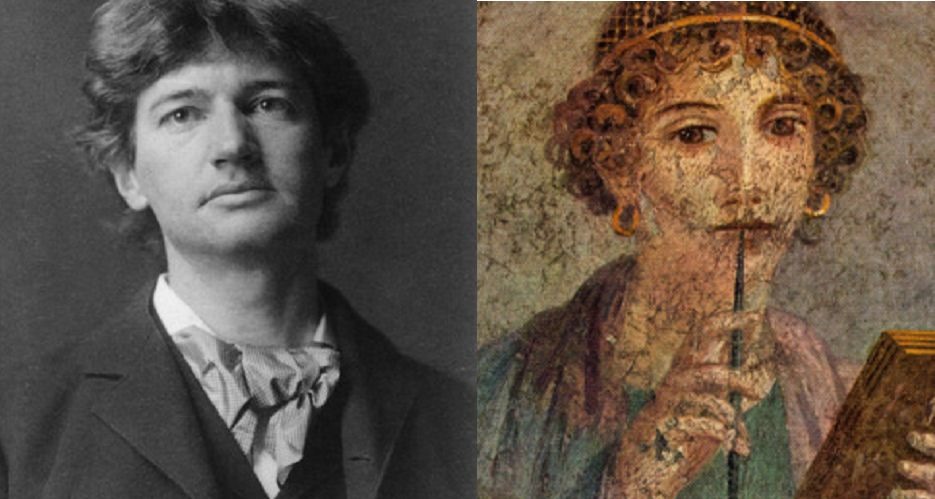
And now for the time-jump. We move to the beginning of the 20th century, from an exotic 7th century BCE Aegean island dweller to a Canadian, a poet with the name of Bliss Carman.* In 1894, Carman and a college friend published a collection of poems extolling the romantic carefree life: Songs of Vagabondia. Not quite as ecstatic as Whitman or Jack Kerouac, it none-the-less found a public and launched two sequels. Carmen followed this series up in 1907 with what became his most highly praised poetry collection, the audacious Sappho: One Hundred Lyrics. How’s that? We’ve established there’s only a handful of somewhat complete poems.
Bliss Carman audaciously invented his own extension of Sappho. Sappho is here depicted as being the first poet to chew on the cap of her pen while thinking.
.
Carman’s cousin, and fellow worker to establish a Canadian poetry, Charles G. D. Roberts, explained what Carmen did altogether briefly in an introduction to the book:
Mr. Carman’s method, apparently, has been to imagine each lost lyric as discovered, and then to translate it; for the indefinable flavour of the translation is maintained throughout, though accompanied by the fluidity and freedom of purely original work.”
One wishes for more explanation. Roberts’ account reads to me like one of those occultists who receive texts through spirit guides or translate ancient inscriptions by telepathic laying on of hands. However, in reading the entire book I get a sense of a different tactic with the same strategic goal that I’ve admitted in some of my translations and presentations with music: an attempt to make the old text in an old language uniquely accessible to some contemporary readers.
Yes, yes there are dangers in inauthenticity and willful anachronism. “Um, Actually” historical scholarship illuminates things too, but last time I said I understand and find value in those current readers of Sappho who wish to encounter her as if she was a modern gay woman. Carmen wanted his readers back then to get some sense of Sappho’s expression of unboundaried love that the fragments hint at if assembled just so.
His re-animated Sappho is more of a circa 1900 Pre-Raphaelite to Pre-Modernist** one. He eschews rhyme and doesn’t go all out for florid poetic diction. Most of the lines are his, not Sappho’s by any actual sense of translation, and perhaps they are best appreciated in the same way that dialog is in a historical novel. In research this week I understand there were some notes where Carman at least connected a portion of the poems with the corresponding cataloged Sappho fragments, but nothing like this was contained in the published book.
At it’s best, like today’s piece, you get a poem that wears its intent of patinaed timelessness lightly. Here’s a link to the poem’s text if you want to read along. I particularly like the image of the coupled lovers watching from the bedroom window unknowable ships whose ventures are now safe in port.***
For music today, I’ve turned not to the ancient lyre and flutes of Sappho’s time, but perversely to try for that timeless illusion using synthesizers along with my fretless electric bass. The player gadget may appear below to hear my performance of Bliss Carman’s “LXXXII Over the roofs the honey-coloured moon” poem. Some blog viewers will not show the player gadget, but then this highlighted hyperlink will play the audio piece if you click on it.
.
*I’ll admit it: the moment I read this name, I smiled. I couldn’t tell what gender. To modern ears “Bliss Carman” sounds like a florid pen name on a romance novel, or even a drag queen’s persona, but some reading and research staunched my snickering. In Real Life, he helped establish Canadian literary poetry and his career stretched from the establishment of the Canadian Confederation to the Modernism of the 1920s.
***Reminds me of Emily Dickinson’s “Wild Nights” poem with lovers “Futile — the winds — To a Heart in port — Done with the Compass — Done with the Chart!” Dickinson’s poem would have been somewhat freshly published when Carmen was working, and I wonder if he knew it?
The ancient Greek poet Sappho is one of the oldest poetic voices we have record of. Like the Greek epic poet Homer, her work likely predates written literature and was originally intended to be sung. How much more do we know about her?
Almost nothing for sure — or even by likelihood. As with Homer there are traditions and later stories about her, none of which are plainly based on first-hand accounts, all written centuries later. If one prefers to base their literary analysis on the text alone, that would be just about the only choice in Sappho’s case. Yet for many people not generally interested in ancient Greek poetry, Sappho is best known for being a lesbian writer — indeed the very term for that erotic affinity is derived from the Aegean Island where Sappho lived, Lesbos.
I’d need to be more knowledgeable than I am to discuss how Sappho’s lesbian identification came to be accepted as general knowledge, but some arguments are made using evidence from the text of her poetry. Which brings me to the next thing I was reminded of as I looked at using some of Sappho’s poetry over the past couple of weeks: there’s really very little of it. Very little of it.
Imagine you are a couple of centuries after some event which has erased a great deal of our formerly recorded literature. Suppose you were, in such a time, to try to assess the works of T. S. Eliot, Bob Dylan, or Emily Dickinson based only on other writers’ surviving references to them, references you can only hope will be buttressed with a short quote or two. Everything else would be lost. Sure, those commentaries in surviving texts would be tantalizing, testimony to the author’s greatness — but because they were written before some general loss of literature, they are painful too in their assumption that they needed then to be only pointers to something every cultured person would know.
In such a world of imaginary loss T. S. Eliot would be the “April is the cruelest month” and “bang not a whimper” guy without necessarily the rest of the poems that contained those lines in context surviving. And what could we make about a lost work about, what — cats? Dylan’s music* might well be lost, but a few pithy phrases would survive because so many others liked to quote him to make a point about their times. Some accounts would say he was a great performer, yet others would make fun of his voice. Dickinson? Perhaps a legend would survive of a lifelong, lovelorn hermit, since that makes for a good story,** but beside that we could have only a stanza or so of her short poems, her actual art retaining only the “greatest hits” lines that got quoted, “Hope is a thing with feathers,” “Because I could not stop for death,” and so on.
Sadly, this is what’s left of Sappho’s art.*** So perhaps it’s consolation during Pride month that we have presently imagined her as someone like those we know today: a breathing, living individual of desires and feelings.
Until this century there are only a couple of Sappho poems that were complete enough to consider as an entire work. Then in 2004 another mostly complete poem was added to the canon. The text was found incorporated into the structure of a paper-mache like mummy case that had languished in a European museum. The ancient makers of the mummy case had just recycled what was then garbage dump material, but this dump just happened to contain a manuscript from the 3rd century BCE of a poem by Sappho.
If you’d like to see the text in archaic Greek, a gloss in English, and several English translations other than mine, you can find it at this page. Alas, I can’t link to this section on the long web page that this poem’s entry is part of, but if you search for (Control F on your keyboard) Lobel-Page 58 you’ll jump to it.
*Sappho was a composer and lyre player. Some accounts have her as the leader of a school that taught music, which led me to translate the opening of today’s poem as a musical admonition.
**That summary of Dickinson’s life isn’t all that different rounded-off from the one I received in my youth anyway, even though our modern scholarship has established a roughly normal life for Dickinson, whose noticeable agoraphobia came after her literary work decreased.
***There doesn’t seem to be a single cause for so little of Sappho’s work surviving intact. The random acts of time alone would account for much of that loss. The famed lost libraries of Alexandria no doubt carried some of her work.
****Rimbaud, who wrote his entire influential corpus of revolutionary poetry before he turned 20, spent the last years of his short life as a merchant-trader in an Ethiopian branch office dealing in coffee.