The most popular Parlando piece for Fall 2019 is…

We’ve reached the top of our seasonal top 10 covering the pieces you most liked and listened to over the past three months, but before I reveal the top piece, let me cover one other area.

I know from growth in the audience that some of you are new to the Parlando Project. Because of that, every so often I should explain what this project does. We take words, mostly poetry, mostly other peoples’ words, not our own, and combine them with music we write and perform ourselves. Sometimes we sing the words, sometimes we don’t, sometimes we split the difference somehow.

By intent the poetry we use and the music we create for it varies. Most texts are used under public domain rules.*  What kind of music do we use? I try to make it a whole lot of different. I’ve never been able to answer the simple-sounding question “What kind of music do you like?” because the idea of liking one kind of music is just not in me. So be aware that you may run into music here that you don’t care for, either because of our limitations as musicians or your own tastes and expectations—and that may happen right after a piece you liked. The same applies to the words we use. There are over 400 examples of what we do here in our archives, so you can move on and look at another one anytime. If you wonder if we’ve presented a poem or author, search here and see.

OK, so who sits atop our Autumn 2019 hit parade? William Shakespeare that’s who. That’s no surprise considering that it’s his Sonnet 73 which begins “That time of year thou mayest in me behold” (but which I’ve always thought of as “Bare Ruined Choirs”  for its most famous image)—one of the longest-famed “autumn of one’s years” poems in English.

Shakespeare Sonnets1609 edition Title Page

Let England Shake-Speares. The title page of the first printing.


I wrote at some length about my experience of the poem in my original post here, but I’ll reiterate only one point: even though this poem resonates with many older people and older lovers in particular, it was written by a man in his early 30s. Consider all the exegesis of Shakespeare’s sonnets that seek to tweeze out his sexuality, incidents to fill out his biography, or the identity of the fair youth, the dark lady, or “who really wrote Shakespeare,” and consider that they were written after all by an actor and a famously prolific creator of opposite and varied characters. I too want to invest those sonnets with his experience, to believe that this great artist is letting me see his heart. How much is intentionally or unintentionally “real,” and how much is a good illusion? We may never know, but we have the art none-the-less.

Here’s the player to hear my performance of Shakespeare’s Sonnet 73 “Bare Ruined Choirs.”  And a sincere thank you for listening and reading this fall. I hope that some of the pieces we’ve presented have pleased you and illuminated some matter or another.


*This means that the poetry is usually from before 1924. I happen to like (and have grown to like even more via this project) a good deal of early 20th century Modernist poetry, but we’ll jump around to older stuff than that too. While we’ve done many of “Poetry’s Greatest Hits” over the years, I’ll use lesser-known poets and poems when they strike me as interesting.

Fall 2019 Parlando Top Ten, numbers 4-2

We’re now nearing the top of our look back at the most liked and listened to audio pieces this past fall. Yesterday we used words from a trio of women writers, and today starts off the same way. If you missed the original posts on my encounter with these texts and creating the music for them, I’m including a link to them in each of their notices in this Top Ten series, and those linked posts also will show or link to the full texts. The player gadget to hear the audio performances with original music is after each listing below.

4. Autumn by Emily Dickinson. We start off again with Emily Dickinson. I can’t help it, every time I go looking for some additional texts I run into a short Dickinson poem that fascinates, and that’s just the sort of thing I like to use here.

Oddly, this one isn’t the weird, sly, or mystical Dickinson. It’s just a light piece of occasional verse. In my original post I noted that Dickinson’s classmate and friend Helen Hunt Jackson could have written and published this sort of poem, and it’s the sort of verse that would have fit well in the newspapers and periodicals of the time.

Of course, her times weren’t placidly occasional as this poem seems to be—they were less so than even ours are. She grew up in a time that the U.S. political system was falling apart, unable to solve the social and economic addiction to chattel slavery based along racial lines. Her own father was a local principal in one political faction trying to grapple with this.*  The years of her greatest poetic output paralleled the bloody 4-year civil war that followed.

I can’t say for sure why Bob Dylan issued his Nashville Skyline  album in 1969—another war-torn time. In that LP Dylan dared to write the simplest, even corny, statements; and the singer who had snarled and howled his words at the height of his fame sung them in a tenor croon. Is there some truth—or at least momentary respite—in those sentiments? Opinions differ. Dickinson’s “happy autumn” poem reads like that to me. My suspicions are that it was a part of her capacious mind (no one can be fierce all the time), that she wanted to show (in this early poem) that she could do those expected kinds of verse, and that maybe it was a resting place for her (as it could be for us) from the changeable world that refuses to change.


Brancusi’s Golden Bird by Mina Loy. It was a blockbuster trade. The United States sent Ezra Pound and T. S. Eliot, both powerhouse Modernists with a reverence for old school classicism to the European side in return for a scrappy English up-and-comer Mina Loy and a future draft pick which turned into W. H. Auden.

Not quite as disastrously one-sided as the Babe Ruth for cash trade that happened 100 years ago a week from today, but then maybe the U. S. side thought that with William Carlos Williams, Robert Frost, and Wallace Stevens they were already primed to take on the post WWI poetic field.

And as I noted in my original post, this poem of Loy’s was published in the same issue of The Dial  that included a modest little contribution from Eliot: “The Waste Land.” You might have heard of that one.

It’s only lately that some have come to re-assess Loy. And talk about fierce, committed, and assertive writing by a woman—Loy could bring it. “Brancusi’s Golden Bird” is a high-energy hymn to Modernist art.

Mina Loy and Patti Smith

Separated at birth? Mina Loy and Patti Smith. Alas, Loy was more than a generation ahead of the electric guitar, a fault we’ve now remedied.


In the 21st century, Patti Smith, one of my heroes for demonstrating the uses of heroes, and a model for the value of guitars with poetry, has issued some below the radar explorations of various Modernist artists. Let her heart and mind go where it wants to go, but I do sometimes wonder if she’ll get around to Mina Loy, whose soul might resonate with hers.


Do Not Frighten the Garden by Frank Hudson. Yes, the Parlando Project continues to be about “Other People’s Stories.” That means it’s about how I react to others’ writing. There’s no lack of selfish pleasure in that. The thrill I get when I compose the right music for a text, or when I complete a translation of something from another language, or just perform a piece with some degree of satisfaction is more than enough.

And really, honoring other people’s work is important! If our poetry scene is only voices, however vivid and individual, speaking only their own words, then it risks being the silent forest for the trees.

In my defense, I offer that “Do Not Frighten the Garden,” is inspired by a phrase in one of poet Robert Okaji’s poems as I discussed in my original post on this. In all probability I wouldn’t have written my poem if I hadn’t read his poem. Writers in general are instructed to “Write what you know,” but like “Look before you leap” and “He who hesitates is lost,” opposites can be true. Particularly with the immediate lyric poem, there is another possible instruction: “Write what you didn’t even start to know until just now.”

And here’s my holiday wish to you, adventuresome reader and listener: that something we present here inspires you to see something differently or possible. Tomorrow we’ll be back with the reveal of the most popular piece this fall.


*I found out awhile back that Emily Dickinson’s father was a Whig and then Unionist Republican, which indicates that he was one of those that sought compromises that allowed slavery to continue while preserving the union. As far as I know, we have only small indications of Emily’s own views on these issues, but Amherst was not an all-white community, and while researching these things I found a link to a fascinating story of her father’s part in defending those who thwarted an attempted abduction into slavery of a local Afro-American woman.

Fall 2019 Parlando Top Ten, numbers 7-5

Continuing our review of the Top Ten most liked and listened to pieces this past season here at the Parlando Project, here are the next three.

My son likes to needle me by asking what old dead white men I’m presenting today on the blog. What could be my defense? I could respond that many of the poets whose texts I end up using were young when they wrote their poems—but he’s a teenager, and frankly the idea that Rilke wrote his poem “Autumn Day”  that seems to be about the restlessness at the onset of old age when Rilke was still in his 20s wouldn’t impress him. Someone in their 20s may not be ancient to him, but they aren’t exactly young in the way he is either.

And dead? That state is somewhat masked by literature. The writer, especially the poet, is always whispering in your ear. Perhaps we can tell by clues of language if they are ghosts or more present confidants, but they both whisper just the same. Will they lie pretty or tell the truth? Ghosts and the living do both. Are the living wiser, do they know all that the ghosts know and more besides? Only if they have listened to the ghosts.

Are they white today? Yes, plenty pale. I talked to my son this month about the arbitrariness of “Western Culture.” I asked him “Just how white was Socrates? Just how white was Homer?” This week the news announced some finds from a Mycenean grave dating from Homeric times, and the featured picture was a pendant engraved with an African goddess. Well, we don’t have Homer in the Top 10 today, though we do know—however misunderstood and thus transformed—that ancient Greek and Chinese poetry influenced our founding English language Modernists.

Hathor pendant from Pylos gravesite

An African goddess pendant found in an ancient grave in Greece.


And none of today’s trio are men today, which shouldn’t surprise long-time readers here.

7. Besides the autumn poets sing by Emily Dickinson. It’s remarkable how much Emily Dickinson, a woman born nearing 200 years ago can seem modern, maybe even more modern today than she seemed to her first readers at the turn of the 20th century. Back then she seemed the quaint and curious poetess, a little rough around the edges technique-wise, but bringing some charming homespun metaphors with just a bit of a gothic edge. Now we may read her as if she had time-traveled to read late 20th century European aestheticians and philosophers instead of Emerson.

I believe we’re more correct now. This old man has listened to the ghosts and they are often dunderheads regarding Dickinson. And besides, as I wrote in my original post about this piece, I think this poem is having some wicked fun with the old white male poets of her time.

As to the missing people of color, let me supply the answer to a clue in that original post. Though disguised by the acoustic music arrangement, I based the changes in my music for this around a cadence from Jimi Hendrix’s “Purple Haze.”


6. Song by Louise Bogan. Unlike Dickinson, I had nothing to reassess about Bogan when I first encountered her poetry while working on this project. Bogan’s song is as straightforward in its complexities and contradictions as Dickinson is sly. The stark emotional directness of Bogan’s poem challenged me as a singer. I decided to modify the text by using the classic Afro-American Blues line stanza form, repeating a line to add an opportunity for emphasis and shading.

I partially apologized for my voice needing to be the singer to get this song out as part of the Parlando Project in my original post. I try to not apologize for my musical limitations (doing so helps no one) but this is one of those pieces that I’ve composed for this project that I hope someone who is a better singer will take up.


5. November by Amy Lowell.  Speaking of the blues, this piece by the born rich and died much too young promoter of concise Imagist poetry Amy Lowell uses bottleneck* slide guitar, a playing method associated with blues musicians.

Which brings me to another side point: American music is American music substantially because it has had Afro-American music to anneal its soul. Strange that: the colonizers’ sin driven by not having enough healthy indigenous people to exploit brought forth upon this continent a new music which is its leading artistic glory. I can’t write a poem much less a sentence to properly express that.

As I wrote in my original post on this piece, I’m still coming to grips with Amy Lowell. I suspect those bohemians who disrespected her were right and wrong, but I have no idea of the proportions. This poem of hers is  quite good I think.


*I’d read about blues slide guitar, but I can still recall the first time I saw it played (in “The Sixties”) when a teenaged kid from the Twin Cities area named Don Williams removed from his authentic folk-scare Levi’s denim jacket pocket an actual severed bottle’s neck, tuned his guitar I think to open D, and played a John Fahey-ish rendition of Poor Boy (a long way from home).”  Reconstructing that moment, Don (like Amy Lowell) probably had access to material and cultural resources that I a poorer kid from a tiny town didn’t have—what a strange way for the blues to work!—but I remain grateful to this day for the introduction.

Fall 2019 Parlando Top Ten, numbers 10-8

It’s time to look back on the past season and to look once more at the most listened to and liked pieces over that time. We do this in the classic count-down method, moving from the 10th most popular to the most popular piece.

This time I’m going to link to the original post each time so that you can read the longer discussion of my encounter with the text, but if you’d just like to hear the recordings of the performance of the poems, the player gadget following each listing will do that.

10. October by Paul Laurence Dunbar.  When something makes these count-down lists it’s often hard to know if it’s the inherent interest in the author, the things I wrote in the post introducing the poem, or the qualities of the musical piece and its performance that account for that. In this case I think it could be a bit of all three. I wrote in my post about what I thought was an undertone in this seemingly happy autumn poem. Was that a misreading? I’m not sure, but it informed my solemn musical performance which may work even if you don’t share my sense of this supple poem.


9. Saint (Cecilia) by Stéphane Mallarmé.  I do generally get a good response to my translations from languages other than English, which encourages me to continue them here. This one was a real bear to wrestle with, and my post on it went into detail with the kind of problems I encountered in that process.

I highly recommend translation as an exercise for poets. Not only do you need to achieve a Vulcan “mind meld” with another artist when translating them, but the mental muscles activated to find the best English word in sense and sound are great ones to develop for one’s own writing.


Rilke Mallarme and Dunbar

Three poets awaiting the invention of the MacBook and the modern coffee shop with WiFi: Rilke, Mallarmé., and Dunbar.


8. Autumn Day by Rainer Maria Rilke.  Another translation that received good response this fall. Here I ascribe a substantial portion of that response to those looking for and appreciating Rilke poems, and finding some here. Of course, there may be many reasons for that desire to seek out Rilke, but I’m under the casual impression that he’s treasured for what seem to be life lessons to his readers. I noted in my post on this poem that it’s been a particularly popular target for translators, but you still may want to look at mine, or hear the way I performed it.

This poem of his is also an example of a theme: gardens and small agriculture, that I returned to again and again this fall. Perhaps it’s my own position in life’s passage that caused that, but there are a good number of autumn poems that are both about the experience of “cultivating one’s garden” and the valence of the ending of a growing season. Such is Rilke’s.


The most popular Parlando Project piece for Summer 2019 is…

Before I reveal the most listened to piece during this just past summer, indulge me in a little “shop talk” as I report a few things about how the listenership for the audio pieces and readership for this blog have been going this summer.

Listenership on the audio continues to be somewhat volatile. June’s listenership was pretty good, July’s was excellent, and then August’s listenership fell to average at best, and early September followed that August trend.

This could just be “noise in the signal.” Or it could say something about seasonal variations in listenership. Spotify Parlando audio piece listenership (which I get broken out separate from those that listen on the player in the blog posts and those who catch the audio pieces on podcast services like Apple Podcasts, Stitcher, Player.fm etc.) didn’t follow the pattern, rising throughout the summer. Spotify has just started allowing their podcast audio to be added to playlists with the newest version of it’s mobile app, and this could help in the future, as it’s a convenient way to collect favorites (or to be honest, skip the ones you don’t care for).

And that last factor could be part of it too. It could be that folks just liked the July audio pieces more. My series on Spoon River Anthology, performed particularly poorly in numbers of audio listeners, something I wouldn’t have predicted. I’m comfortable with the thought that the deliberate eclecticism of genres I use will lead to differing responses. Still, the abject listenership failure of what I think of personally as one of my best pieces: August’s “Fiddler Jones”  from that Spoon River series kind of bummed me out. Oh well, pieces sometimes get a second wind once they enter the long tail of our archives. Maybe that one will.

For a guy who likes data, the readership of this blog has a completely different trendline. That’s been on an upward slope ever since the launch of the blog, and then last April we had a huge readership jump during our U.S. National Poetry Month celebration, nearly doubling our best previous month’s readership. Readership held up all summer, and August, the same month that disappointed for listenership, set a new highest readership. There’s a week to go yet in September, and it’s already second only to that new readership high, and on track to surpass it before the month ends. Go figure…

So what was the most popular piece this past summer?

Back Yard by Carl Sandburg. Well this piece does sound pretty good too, and Sandburg is deserving of this level of attention. Not only does Sandburg not get enough credit for the Imagist integrity of his early 20th century verse, but this poem is lovely sounding. Sandburg’s “Back Yard”  is ready to take the fixative of the silver moon rain and change into a moment, which then changes into another moment—always still, always changing. Always still, always changing. Ah, life….

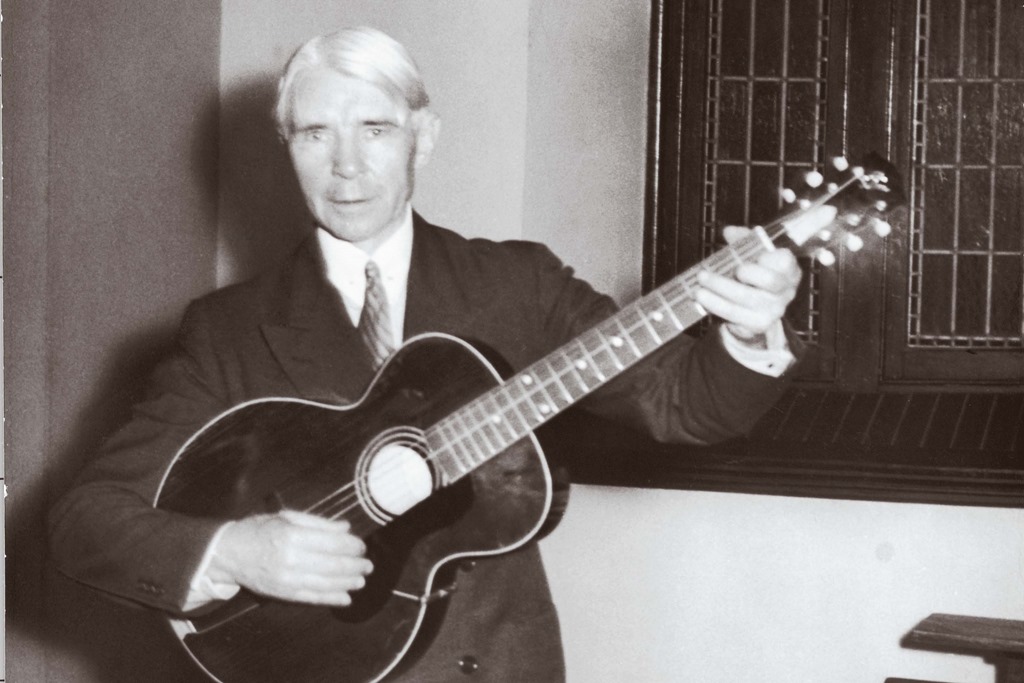
Carl Sandburg in living black and white

Americana artist looks to break through with his hip voicing of the Fsus chord


Things I find odd about how Sandburg has been judged: first there’s the judgement that he’s just not subtle enough, when I say those critics can’t see the subtleties—which if I’m right, proves my point; and secondly, the evaluation that his poetry is just broken up prose mislabeled as verse. That would be odd, Sandburg has an important secondary career as a popularizer of what we came to call “folk music” in the U. S. and was serious enough about developing his guitar chops that he asked Andres Segovia for a lesson. There’s music behind many a Sandburg poem, like this one, and composers more accomplished than I find it.

It may well be that the word-music of poetry and the music—of well, music—are two separate fields to be judged differently with different instrumentation, rules, and aesthetics. But until this is shown to be surely so, I tend to trust the judgement and tastes of musicians and composers over the judgement and tastes of literary critics and theorists on these matters.

Give a listen to Sandburg’s “Back Yard”  with the player below. If you’d like to follow along with the text, you can read it here. And really, thanks for listening and reading along as we encountered music and words here this summer in order to see what we find!


Parlando Project Summer 2019 Top Ten part 3

Is everyone aligning themselves with autumn already? Here we’re looking back at summer and the audio pieces that the audience made their most liked and listened to, and we’re getting near the top of the countdown, moving toward the most popular single piece of the past three months. Today we look at numbers 4, 3, and 2.

4. Summer Silence by E. E. Cummings. Another one from our “Before They Were Modernists” series, “Summer Silence”  is an early E. E. Cummings poem published when Cummings was a college sophomore at Harvard. One doesn’t usually associate Cummings with constrained poetic forms, but “Summer Silence”  was written in 1913 in the Spencerian Stanza form, long before he could have learned from Hawk or Susan.

I try to do the best work I can with recording the music compositions here within the rapid pace I’ve accustomed myself to with this project. My equipment is modest, and my recording engineer’s skills are too, but I make the effort. That said, this one was recorded on a cell phone sitting in a cabin on the North Shore of Lake Superior: just me, an acoustic guitar, and a few summer birds that you can hear at the very end that wanted to enjoy July there too. The text of Cummings’ poem is available in the original post linked in bold above.


3. Higginson’s June by Thomas Wentworth Higginson. From another series, one that started before this summer but carried over into it: “The Roots of Emily Dickinson.” Higginson is essential to the Emily Dickinson story, the literary insider who Dickinson sought out in what I think was an attempt on her part to verify the worth of her unprecedented poetry. They met at least once, but the rest of the relationship was carried on via letters, of which we have only Dickinson’s side of the correspondence.

From Dickinson’s replies and Higginson’s later recounting, it’s been summarized that Higginson “didn’t get it,” thinking that her work needed some further polish to appeal to the mid-19th century public. Here in the 21st century we feel pretty smug about Higginson, thinking him like the infamous record exec who passed on the Beatles.*

Higginson had a highly eventful life outside of the Dickinson connection, as I’ve talked about in another post, but one thing I discovered this year was that Higginson at least dabbled in poetry himself. I can find no context for the poem of his I used here, but I speculated that it could be something he wrote in his youth. Whenever and for whatever reasons he wrote it, it is a good short summer lyric. And coincidentally it’s opening two lines could stand as the better judgment of Dickinson’s genius as it does in his poem for summer.

The music for this one is as electronic as “Summer Silence’s”  is acoustic. The text of Higginson’s poem to June is also in it’s original post bolded above.


Indian Pipes and 1st Edition of Dickinsons Poems

Higginson wrote the preface and helped edit and promote the publication of the first collection of Dickinson’s poems two years after her death. The flowers on its cover are usually called Indian Pipes and they were said to be a favorite of Dickinson’s. It’s a truly odd summer plant, which my living wife found and photographed in Northern Minnesota this year. The other common name for this translucent apparition: the ghost plant.


2. For You by Carl Sandburg. I kept going back to Sandburg this summer, and you the readers and listeners came along with me. Why? I frankly find him healing.

I started off this project in 2016 with a Sandburg-based audio piece which also served as a memorial for David Bowie; and for the 3rd anniversary of that launch I used this Sandburg poem as a memorial to my late wife who died near the beginning of this century.

That either of those Sandburg poems could be used as memorials does not make them passive elegies, and “For You”  is future-focused—just as it is full of ghosts. I’m not familiar enough to say how English speakers in the British Isles, in South Asia, the Antipodes, or elsewhere feel of the current times and challenges; but in Sandburg’s America when I read or listen to “For You,”  I too feel our ghosts and feel our future—close—even if each are unreal as we stand before the great door of a year with great hinges.

The text of “For You” is here if you’d like to read along.


*”Guitar groups are on their way out” is the famous rejection phrase, attributed to Dick Rowe of Decca Records. In Rowe’s defense, Beatles producer George Martin has been quoted that the Decca audition performance was not very good and that he wouldn’t have signed them on the basis of it either. A few months later, Rowe took a tip from George Harrison and signed another of those guitar groups, The Rolling Stones. Sometimes you get a second chance.

Parlando Project Summer 2019 Top Ten part 2

Continuing the countdown of the audio pieces with the most listens and likes over the past summer, we’ve reached numbers 7, 6, and 5.

7. O My Darling Troubles Heaven by Kenneth Patchen. I do wish I had more pieces with Dave Moore in them this summer. My summer schedule, my studio re-org, and various unscheduled things have conspired against us, and Rudy Giuliani has either not had anything to do with this—or has of course been involved. *

Still, it’s nice to see this piece getting a good number of listens. Patchen helped found the mid-century school of poetry read to Jazz backing, something now considered quaint, but at the time it was being done it was considered impossibly pretentious or inconsequential or narcissistically individualist by many.

Well, either judgement means you shouldn’t be listening to this, but some of you are anyway.

Another good reason to be glad for Dave presenting this is that it’s a further corrective to the Modernist Gloomy Gus tendency. Patchen’s critique of mid-20th century culture was plenty down-beat, and his personal life had enough depressing challenges to reinforce that. But! But! But! His statements of love, the necessity of resistance, and of the joy of art superseding some dreary cultural cod-liver oil pitches for it were about overcoming that—or at least fighting it to a draw.

Musically, this is an older recording where the LYL Band plays in its almost-Jazz mode, which fits Dave’s vocal where he told us last June that he was intentionally trying to recall Patchen’s own phrasing from when Patchen read his work in the post WWII era.


Floating Man-Patchen

“If you see no hope at all, isn’t it sort of, well, a lie—all your talk about how human beings must love one another?” Painting by Kenneth Patchen


6. Grace Before Song by Ezra Pound. I presented three series this past summer where multiple posts presented different aspects of something. This charming poem was from the series I called “Before They Were Modernists” where I looked at work Modernists wrote before they found their place in the 20th century revolution in art.

Pound of course was the indispensable fomenter, editor, and promotor of literary Modernism in English, known for both his generosity and dismissive opinions.**  But this early poem of his is a prayer written in metrical and rhymed verse, and it’s soaked with poetic diction and antique words. Still sounds fine when sung, and if sincere, the poem’s sentiment is admirable however expressed.

If you haven’t listened to it, go ahead and see if you agree.


5. Memory of June by Claude McKay. Speaking of graceful rhymed and metrical lyrics, this one by Claude McKay is full-throated and sounds great. In my post on it in June I wondered if the tantalizing line “for one night only we were wed” might have been an encoded cry of a gay black man who knew full well that marriage was out of the question. In each of these countdown posts, I start the listing with a hyperlink to the original post if you would like to read more about what I said about my encounter with the text at the time.

That’s still an interesting question, but no answer to it is required to appreciate the poem. As with so many compositions this summer I was meshing acoustic guitar with bowed strings and some of my sparse naïve piano.


*I probably should refrain from introducing the impossible to determine quantum state of an American political figure to this cultural discussion, as many of the readers here won’t even know who I’m talking about.

**and eventually, his active participation in Italian Fascism. If one decodes their way through all the masks, certain ugly prejudices and nutball ideals are present in the man’s art—and also beautiful distillations and perceptions that I can sit behind his eyes and share with him. This sort of thing is why I’m sometimes glad that I’m constrained to present here the work of the long dead. If Pound was alive, you and I might well feel it our duty to oppose him in total. As best as I can tell, Pound seems of little use to current English-language Fascists.

In the arts, Pound’s early 20th century Modernist opinions made him the Marie Kondo of poetry. “If it doesn’t spark joy, throw it out” was not one of the famous Imagist rules, but it could have been.

Parlando Project Summer 2019 Top Ten part 1

It’s that time again, when we look back on the past months and see what pieces were the most liked and listened to this summer. I do it countdown style, so here we start with the 10th, 9th, and 8th most popular pieces this season.

10. Pods (Neponset) by Carl Sandburg.  Do I say Sandburg is the forgotten Imagist too often? Maybe, but to my mind this is one of the finest short Imagist poems I’ve come across in my wanderings through early Modernist verse. Another thing I keep trying to counteract: the idea that Sandburg is simplistic and that his verse is absent the levels of ambiguity and ineffability that “great poetry” is said to offer. This 7-line poem about a small Illinois village with gardens and the train passengers traveling to see scenic wonders is an example.

My family has to put up with an amount of interruption by the focused and repetitive work of producing these pieces. Listening to the process of composition, when it involves (as it sometimes does with me) a lot of trial and error is  trying—but listening to the final mixing stages is excruciating. I mix at modest volume levels, but I’ve been told that headphones are not to be trusted in that work—so they hear these pieces sometimes being wiggled this way, and wrung out that way, over and over.  Not a good way to appreciate a piece.

So, it was a surprise this summer when my wife came in and told me this one sounded like one of the best ones I’ve done. Maybe it made it to number 10 because it stands to be listened to more than once?


9. I Saw a Peacock by Anonymous.  Long a leading composer in the folk music field, Anonymous can also craft a pretty good Surrealist poem with a humorous trick: the line breaks lead you to connect the thing previous with the last part of the line—when the “real” and much more mundane connection (as opposed to the wondrously apocalyptic thing you believe you’ve heard) is in the next line, after a breath pause of the line break.

I’ve read that this poem impressed Margaret Atwood in her early childhood with the wonder that poetry could create.

I seem to be working more and more with string and other orchestral compositions this summer. Part of that is that I’ve always been drawn to things that mix the attack-envelope of percussion instruments with the varieties of note length that stringed instruments, particularly bowed string instruments, can create—but it’s also because I was able to afford some additional orchestral instruments to play via my guitar’s MIDI pickup or with my little plastic keyboard this summer.


Here Be Monsters

Didn’t work? OK, try Black Mountain school with polka. No? Dubstep Hildegard von Bingen! Hard Bop Thomas Hardy! Still coming? Tell the gunner to give’em both barrels then. No, no! Not those barrels…


8. For Once, Then, Something by Robert Frost. Here’s an example of why I’m particularly grateful to the hardy listeners of these pieces. While I’m constrained by difficulties in obtaining permission to present writings still in copyright, I hope that you can see that I vary the type and the outlook of the poetry and other writing that I can and do use. I try too to mix Poetry’s Greatest Hits with deep cuts from esteemed poets, and more than a little of the lesser-known but worth considering.

Of course, for some (Many? Most?) the idea of poetry as an everyday thing that is not some mix of fearsome and intended obscurity, snores-ville decorative excess, and hoity-toity crap for those with nothing better to do has already removed them from reading or listening here.

Well then, as I’ve described this project from the beginning, I combine these words, mostly poetry, with various music. While people might just ignore poetry, they actively hate music that they don’t like. That disgust leads some (Many? Most?) to cling to a genre of music they find most able to please them, and to mark other sonic places as “here be monsters”—hideous creatures that disrespect what is right in music.*

Music doesn’t know what’s right and proper. It just wants to sound itself.

So how many people are out there who want to hear even the beloved, famous, respected American poet Robert Frost chanted to a pulsating Electronic Dance Beat arrangement?

Well, if you are the kind of people who read, listen, follow, and help propagate what the Parlando Project does, there are enough of you to make this the 8th most popular piece this past summer!


*By the way, if you don’t like some of the audio pieces that are presented here, that’s OK, even expected. Given that I’m pushing my capabilities as a composer and musician, you might even agree with my intent, yet not wish to negotiate my actualities. That’s part of why I like to mention that we vary things: you may like the next one that comes out, or enjoy taking a look at the nearly 400 pieces we have in our archives.

The Parlando Project audio pieces are available on Spotify. With the current Spotify mobile app you can even create playlists of your Parlando favorites—and exclude your “not so much favorites.”

The Most Popular Parlando Project audio piece this past spring is…

Here’s something I’ve noted in the years I’ve been doing this: these quarterly Top 10 lists advantage pieces posted earlier in the season since they have more weeks to accumulate listens and likes. So it was quite an achievement for D. H. Lawrence’s “A Winter’s Tale”  posted near the end of February to make it to number 4 in our last-winter countdown, but it happens. After all, this time, “They Say Life is Precious”  released in the middle of May this year, made it to that 4th position in our spring’s list.

Still, past the earliest days after posting there’s a predictable drop off slope. Listens are “front-loaded” as people notice it as a new post or podcast, and after that it’s mainly the explorers and those who find things from a web search. I am gratified that many of you check out our archives and listen to the nearly 350 audio pieces we’ve already presented, but the sheer number of pieces means that the long-tail listenership tends to be spread between those hundreds of pieces, making repeat appearances in the Top Ten rare—but we have one this time, one all the way at the top.

And it’s that D. H. Lawrence piece, “A Winter’s Tale.”  I can see how: a large number of folks were still discovering and listening to it in March, and after the expected dip in April, more people actually listened to it in May than April. But I don’t really know the why.

D. H. Lawrence’s poetry* is not exactly forgotten, but he’s still better known as a novelist—but that could help if the interest in novelists is greater than that for poets.

Was it the music I wrote and played for it? My music for “A Winter’s Tale”  was rather explicitly ‘80s related, what with the piece’s arpeggiating synths and big reverbed drums. I do rather like what I accomplished there, both the recording and the ideas of the musical arrangement still sound good to me, and so perhaps they did to you. One memory I have of doing the piece was wanting to remember to make use of silence. I always need to remind myself to do that, and too often I don’t obey. Listening to Mark Hollis’ music as I wrote and arranged this piece may have made that reminder stronger this time.

Shakespeare-Hollils-Hendrix-Lawrence quadrent

OK, some of you guys must have helped make this spring’s Number One.


Was it the title? Shakespeare** seems to be a reliable boost to interest over the years (sort of like putting Jimi Hendrix on the cover of a guitarist magazine), and Lawrence’s title is shared with a Shakespeare play. Was it Lawrence or Shakespeare drawing those later listens, or the combined power of both?

Like I said, I don’t know why, but thanks for listening and reading this spring! There’s still a fair amount of In Real Life and studio re-organization putting pressure on the amount of new music I can put together, but I still hope to be dropping new audio pieces this summer and writing about my experience with the words.

So here it is, as we approach summer, the enigmatic story of D. H. Lawrence’s “A Winter’s Tale” that’s just a click on the player below away.


*I’ve called Carl Sandburg “The Forgotten Imagist.” His early poetry uses the Imagist rules, but despite the way he wrote, Sandburg as a person doesn’t “read” as an Imagist: an immigrant’s child who wasn’t seen in Paris and London, and who wrote often about the world of work and those who sought and were bound to it, he doesn’t seem the aesthete (even though he was, in part, that). D. H. Lawrence too doesn’t inevitably get called an Imagist, even though his verse shared some Imagist characteristics and he was published in the movement’s anthologies. Lawrence was never viewed as a theoretician or leader in Imagism, and socially he mixed with poets like Edward Thomas and Witter Bynner who were outside the movement. Is he too a forgotten Imagist, or just “Imagist-Adjacent?”

**One measure of Shakespeare’s strength to draw listeners is a piece I did taken from Shakespeare’s play “Twelfth Night”  which I still find embarrassing. After seeing what friend of the blog Weekesgaehl could do with her actual acting chops I figured I’d give it a go with a short scene from the play to frame a song found in it. The song turned out just OK, but my “acting” lead-in makes me cringe. Tragic fate and the draw of Shakespeare made sure a whole lot of people listened to that one—and continue to listen to that one—sustaining my embarrassment.

The Parlando Spring 2019 Top Ten Part 3

Now we’re nearing the topper-most of the top in our tip-top count-down of the most liked and listened to pieces this spring. Wait—did I just turn into a mid-20th century radio host? Out! Out! Commercial spirit! Timeless poetry knows no acne creams, Yardley scents, Thom McAn Beatle boots or white Levis. Well, maybe some of the music knows them—but honestly, it interrogates those pop intentions and asks us to re-evaluate that intent in the context of greater artistic accidents consciously or unconsciously evolved from the Modernist revolts of the last century.

No, no. Not that either. I mostly just want to make things that haven’t existed before, mix the known and the unknown, like and contrast the unlike, let poetry talk to music, and let music not shut up but talk back. As I do this, I look at things you and I and many others have looked at before and see if they’ve changed. And then sometimes I look at those poets whose names and poetry were writ in water.

It just so happens that our next three pieces in our count-down are from such writers, poets unknown to me, many literature students, and likely to you.

4. They Say Life is Precious. One of the principles of the Parlando Project is “Other Peoples’ Stories.” I don’t dislike memoir, self-narrative, words intended to establish or confess one’s selfhood. I couldn’t, or I’d have much less poetry to choose from to present here. But I feel that’s well served elsewhere, not just in literature but in blogs, podcasts, and social media. So, if and when we want that, we can find it. In the words of a wise boss I once had, it’s “ubiquitous everywhere.*”

What I do instead here is to encounter some other person’s words, see how they sound in my mouth, and ask myself what I hear, feel, and think when they are enthroned there.

I could suppose it’s a failure of a kind that a performance of one of my own poems is in this Spring Top Ten then. And indeed, I usually fall to using my own words when I find I’m behind in getting things posted because the research into the other writers adds to the tasks of writing, playing, and recording the music. “Well” I say to myself “At least I know that writer already.”

An unsafe assumption. We don’t really know ourselves effortlessly.

My favorite part of the music I did for this was the combination of bowed contra-bass with an upper register fretless electric bass part. What does that sound like? Listen below.


3. Everyday Alchemy. One of the things I love about this project is when I go crate-digging after poets I’ve never read and that I expect you haven’t either. Coming across this poem by Genevieve Taggard was one of those moments.

This is such a poem of sorrowful balance, yet it’s 11 lines contain a piercing analysis of society and its arrangements of obligations that are increasingly out of balance the farther down the chain one goes.

I’ve often spoken about the Confucian Odes  here, designated by the Chinese sage and his school as required instructional material for government functionaries. The Odes  are not, as educational poetry aids today might be, mnemonics of components, checklists or causes; but like “Everyday Alchemy”  they are mostly accounts of daily life near the bottom on the pyramid, a pyramid where the giant blocks of limestone are not lifted by alien magic.

If I were Confucius again, I’d select this poem as required reading. Anthology editors now, or of the future: include this poem! And in the meantime, you can listen to my performance of it with the following gadget.


Taggard's Bookplate

EX ARBOR, now dead with its ghost-pale sheets under a bookplate


2. Poppies on the Wheat. I reviewed the latest attempt at making Emily Dickinson cinematic this spring. TL;DNR: a mixed bag. The film had a consultant who’s a Dickinson scholar, something I’m not, and it’s likely they’ve read more and know more detail about Dickinson that I do. I wanted to cheer them on (forza Dickinson!)  and there were moments in the film where I could. But there were also moments, some of the funnier moments viewed (as intended) as comic bits, that made me feel like they were leading the viewers to misunderstand some of the characters I’ve covered in “The Roots of Emily Dickinson.”

I imagine the film creator’s response: “It’s a movie! Dramatic license! Evenhandedness isn’t entertaining!” Yup. Still felt unfair. It’s only after the movie that I’ve read more about and from Thomas Wentworth Higginson, the literary-connected “Preceptor” sought out by Dickinson who is thought to have misunderstood and underappreciated her genius. He’s used in the movie as a comic personification of The Patriarchy and White Privilege. The author of the second most popular piece this Spring, Helen Hunt Jackson gets one scene in the movie, where she’s portrayed as a vapid sentimental sort who Higginson prefers to the artistic rebel Dickinson.

Yes, that’s one of the reasons we so admire Dickinson, who is never sentimental, even if the 19th century seems to want and need sentimentality so badly. But that charge, of sentimentality, was also a sledgehammer used against most women writers of the age. The same slack I’d expect the film-makers would ask for in presenting their matter in the way present-day movie audiences might absorb it, is what I’d ask them to apply to Helen Hunt Jackson negotiating with her audience in her time.

Jackson’s “Poppies on the Wheat”  is a Wordsworthian sonnet whose argument in itself is a debate between practical commerce and the sentiments of memory and semi-wild beauty. Musically, it reflects a mood on my part this spring to put more focus on acoustic guitar. You can hear the result with the player below.


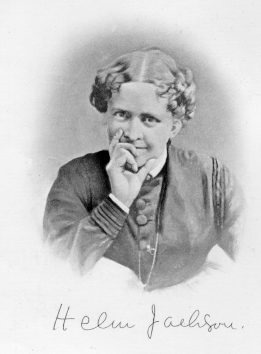
Helen Hunt Jackson defiant

Hard to tell personality from a picture, but those eyes and the start of a smile make Jackson look like she’s  about to dispute something or share a delicious secret.


That’s all but the most liked and listened to piece this spring, and I can tell you it was a run-away winner. Words from a famous poet or unknown one? Well, it’s sort of both. I’ll be back soon with that announcement.


*He laughed right after he said it, thinking it a fit pronouncement from the Department of Tautology Department.