Wild Grapes

I left a comment on the Fourteen Lines blog last month when I saw he’d posted this Kenneth Slessor poem. I didn’t know the poem, but I wrote that blog’s host that he and I may be the only Americans who appreciate Kenneth Slessor.

Slessor is an Australian poet, and Australia is a long way off, but then over in our hemisphere we’re not obligated to keep all the poets of the first half of the 20th century in mind either. I know little about his life other than the short-ish Wikipedia article. I did a more elaborate search a few years back, and I recall he was considered by some as a pioneering Modernist in his country.*

Some of his poems I’ve read don’t move me on encounter. There are elements in his verse at times that vaguely remind me of a troop of other British poets contemporary to Slessor in the U. K. What is that that leaves me cold in that field of first half-century British poets? Stilted, too formal language, non-vital metaphors, musicality that can only barely contest those first two failures. This could be my failing, my taste may not be yours, and another apprehension (mis or otherwise) of mine is that there’s a whiff of posh-boy entitlement and clubishness in too many. I’m a Midwestern American, I could be wildly misjudging this. I make no claim of authority.

But no matter that, because his best poems move me like few other pieces of verse can. They have Modernism’s Classicism streak, that idea that the poet doesn’t always presume to tell you what the characters in the poem think, nor does he directly tell you what to think about what goes on, even though the selection of what he portrays intends an effect.

I know nothing of Slessor’s poetic influences.**  In the Wikipedia article someone says he was compared by someone favorably to Yeats. I’d have to squint to see that one. Someone else said Baudelaire, and I can see that somewhat, though Slessor avoids the bad-boy-boast persona. Indeed, in my favorite Slessor poems, he’s not in them at all, he’s just the observer, and we only know him by his senses — which as we read those poems, become our senses.

Such a poem is “Wild Grapes.”  I can see and smell the marshy landscape, the broken orchard, and the sight, the shape, the texture, the musky taste of a wild black grape.

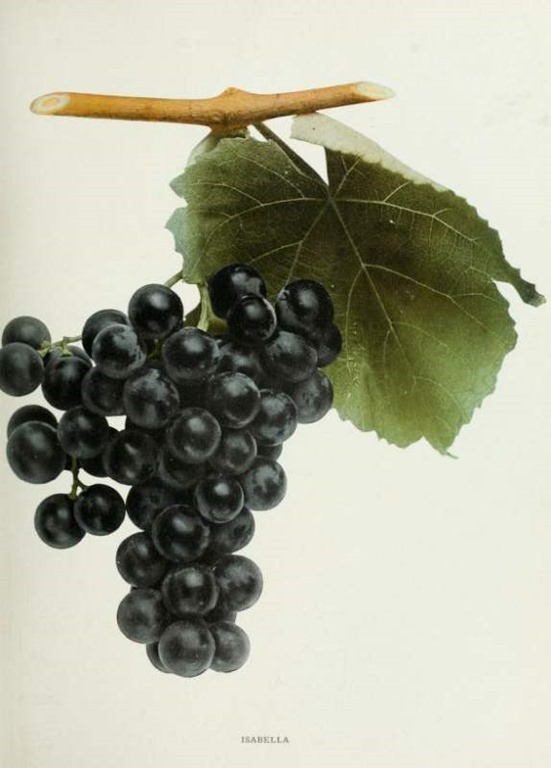
Isabella Grapes

Isabella grapes, not a greatly loved variety by connoisseurs.

.

Then as the poem reaches its penultimate stanza, a bit of mystery arrives. There is a sense there of a ghost, a “dead girl” named the same as the grape variety — and as the poem moves to its conclusion, seen as a union of the two, before we move to a final disturbing line.

Ending poems is hard — at least I find it so. I could generate a hundred good starting lines, and yet with the same effort still not come up with a single good last one. Slessor’s last line grabs me. There’s a reason the ghost’s spirit stays in the deserted place. Maybe it’s her similarity to that wild black grape. Or maybe it’s some emblazoned event, before the orchard was abandoned, its sweet fruits of apple and cherry still tastable and ripe. The poem’s voice only suggests: kissed or killed there. Is there a dichotomy, a distance between those two suggestions? Perhaps Slessor intended that — but here’s what I think: I read that line, implying an “and” not the written “or,” as a vivid allusion of sexual violence.***

You can hear my performance of Kenneth Slessor’s “Wild Grapes”  with an audio player many will see below. No player? This highlighted link will open a new tab with it’s own audio player.

.

*He wrote poetry between the end of WWI and the end of WWII, so not in the very first wave of Modernism elsewhere, but Australian culture might have lagged a bit from Britain, France, and the U. S.

**I can see Rilke and Robert Frost in his poetry, and there’s nothing outlandish to think he might be familiar with their work. A prominent object in this poem are grapes, and I thought of this poem by Rilke, and this one by Frost, which also feature that fruit — but I don’t know. Though my favorite Slessor poems are more sensuous, there’s an epitaph character sometimes that reminds me of a somewhat forgotten early American Modernist, Edgar Lee Masters.

***I suspect more women, from more experience of violence chained with sexuality, would see that reading. Slessor wrote “or,” and his typewriter had other keys if he wanted to use them. He could just be musing on a range of things and the unknowability of the lives on what sounds like a plot once occupied by lower-class settlers or convict exiles from Ireland.

Lambing (Night-Born Lambs)

Over the years I’ve presented a fair number of poems by authors well-known for their prose work — James Joyce, Thomas Hardy, Emily Brontë, D. H. Lawrence, and so on — but as I prepared today’s set of words for performance I thought of something I told its author, poet Kevin FitzPatrick, more than once: “If I came upon the matter of this poem, I’d probably choose to make it into a short story instead of a poem.”

That may sound like a harsh judgement. When I said this once, Kevin’s friend Ethna McKiernan once torted back at me sharply “It’s a narrative poem!”

Yes, I know that form. I may be personally more invested in the lyric poem’s momentary compression, but narrative is a perfectly valid approach. And if you look carefully at how Kevin writes, he subtly weaves into his work touches that are poetic extensions to efficient prose storytelling. I tried to explain to Ethna that I had a second part to my statement about Kevin’s poems like “Lambing,”  “…but you make it work when you make that your choice.”

This poem’s background is implied in small details within it, and Kevin FitzPatrick’s last collection strung together a series of poems portraying this part of his biography: in later middle-age Kevin’s life-partner Tina decided she wanted to run a small but diversified farm, and each weekend, Kevin would leave from his office job in the Twin Cities to this rural farm across the border in Wisconsin. Kevin was thoroughly a city boy, so many of the poems let us use his unaccustomed eyes to pay attention to the rural culture and tasks of this farm. One trait the poems often touch on: the web of interdependence and cooperation between the community of farmers and country dwellers around Tina’s farm. In “Lambing”  we meet Jim and Rose, neighbors and the former owners of Tina’s farm who are called to bring their knowledge to the incidents of the poem.

Kevin worked hard at keeping his narratives tight yet clear. Parlando alternate voice Dave Moore and I would give him notes, which Kevin was always gracious in receiving, and his solutions (not always ours) to problems we might note nearly always improved the poems.*  Unlike more elusive and allusive poetry I won’t have to act the village explainer to assist new readers to understand what’s going on in “Lambing.”

Instead, I’d like to point out that this isn’t just prose with more line-breaks. While not exactly a Robert-Frost-style blank verse poem, the Iambs with the lambs** put subtle music to this story. The sound of lines like “Their lantern lit up the shelter late” would in a lyric poem call attention to their sound, so don’t let the flow of the story overlook them if you want to pay attention to how this poem might work its way. And while not a compressed Imagist poem, the small details speak to that kind of poetic impact: Rose’s green dress shoes, the just-born lamb “like something discarded,” the nursing lambkin’s tail twirling like a gauge’s needle gone wacky.

Lambing illustration

Unintended in FitzPatrick’s spring-set poem, but this time of year I think manger/crèche.

.

Kevin FitzPatrick’s final collection, titled Still Living in Town,  contains more poems about his farm experience, and other things as well. It’s a fine, fine book, and its poems are as carefully straightforward as today’s example. Here’s a link to more information on his poetry and a place to buy this book.

I performed Kevin’s “Lambing”  today with a piano, drums, and keyboard bass musical backing. At the end of the poem performance there’s a short, less than two-minute, purely instrumental piece for synthesizer and arco bass which I call “Night-Born Lambs”  that was inspired by the experience of working on the performance of this poem, and from thoughts of Kevin. You can hear this pairing with the audio player gadget you should see below. What if you don’t see that player?  This highlighted link is a backup, and it will open a new tab with its own audio player.

.

*I forget who said it, but I always remember this rule-of-thumb: when someone points out an issue with a draft you submit for notes: “They are usually correct in seeing something is a problem, but that doesn’t mean that their suggested solutions are also correct.”

**Type-nerd note: depending on what typeface you read this with, that sentence could seem a puzzling typographic tautology.

Millay’s “The Little Ghost.” Does your garden have ghosts?

Last time in our Halloween Series, an A. E. Housman poem combined with music had death on a knife edge. Placed at the end of the growing year in northern places, Halloween comes at a time in a yearly cycle that suggests death. Note: that statement includes the word “cycle.” Humans have memory, and song, and eventually writing, so we know the turning round — the end of the growing comes before the white none of winter and before the regreening of spring.

Should it be so with death, that full nothing? Some hope and believe that so, though we can have no memory of that. But even one life has many turnings, places we pass through and leave. Today’s piece ends by portraying that we open and close gates of memory, gates that are no longer there.

Edna St. Vincent Millay wrote this poem of a non-threatening ghost. It’s an earlier work, and some see the ghost as a wisp of her not-long-departed girlhood. I’ll add that the choice of having the ghost appear in a garden speaks to the placement of Halloween in a harvest/leaving time of the year. Gardens have needs: nutritious soil, water, sun, and care. Perhaps they need ghosts from time to time as well?

The Little Ghost 1024

“She paused—then opened and passed through a gate that once was there.”

.

The music I composed and played for Millay’s “The Little Ghost”  shows South Asian influences, what with harmonium, tambura, and my vibrato note electric guitar playing. You can hear that combination of words and music with the audio player below. No player to be seen?  This highlighted link is an alternative, it’ll open a new tab with its own audio player.

They don’t stay in the sodden graveyard. Our Halloween series continues with “Unreal City.”

When I said Halloween series, did you assume that that would mean the sidelines and backbenchers rather than the serious literary poetry we sometimes take out for a musical spin here? Let me break through that expectation quickly with today’s selection from seven years of the Parlando Project — it’s a part of a literary poetic landmark, T. S. Eliot’s“The Waste Land.”

When it comes to dread, I’m not a fan of jump scares — I rather prefer the slow build — but did I frighten some casual readers who are reaching to click to the next web site already? I hear you muttering.*  “The Waste Land’  — isn’t that long, boring, indecipherable, so full of stuff you need footnotes for?”

OK, so you believe you have a fresher aesthetic than some old Modernist war-horse — but I do wonder if there isn’t a chill as sudden as a just unconcealed weapon or bared fangs, a suppressed shuddering beneath the contempt. “Is there going to be a test? Do I have to write an essay on what it means — pretending it means anything  to me?”

Schoolwork. Many learn to love and to hate poetry in that single place.

Done over several Aprils here on this Project, I used music and performance in my serialized presentation of the whole poem to remind us of the abstract ways that music makes us feel through non-literal modes, without explications and decoder rings. The unreal city section of “The Waste Land,”  sliding for now over the specifics of place names and time-jumping references, is just a nightmare of the possessed and undead, of a speaker so PTSD’d by a world decimated by violence, epidemic, and careless oppression that the masks have fallen off the faces of his city. The dark humor of friendly small talk is of dogs digging up corpses.

Additional advisories: wear sunscreen, and don’t look directly at the sun without the proper filter.

.

You can hear the performance of the unreal city section of “The Waste Land”  with the audio player many will see below. No player visible?  This highlighted link will open a new tab with a player that will let you hear it.

.

*Sure, you have that over-tape or closed shutter on your web cam, but rather than composing, recording, or researching new pieces, I instead have been listening to the microphones on your devices. I actually don’t care what you say about parents, children, partners, bosses, or coworkers. I’m listening with dread to what you say about my making the best of my voice and somewhat restricted musical skills. Dogs digging corpses out of the garden aren’t scary compared to those fears.

And of those infamous footnotes in “The Waste Land?”   Have you considered this: are they a frightened nerd being asked to show what he means?

The Terror of the Blank Page

I think today’s audio piece is something many writers will relate to, but since it’s one I wrote I’ll be brief later down the page in writing about my encounter with it. The top part of this post will be a process post about music and working “live in the studio” with Dave Moore again after a long break. Feel free to skip to the bottom if this process stuff isn’t your thing.

For many years I’ve taken time every September 18th to remember guitarist and composer Jimi Hendrix. This September 18th I planned to get together with Dave Moore to do what we’ve done off-and-on for more than 40 years: attempt to make music together as The LYL Band.*   For almost all that time we’ve done this in a peculiar way.

I have a space with various guitars, basses, drum pattern software, and a couple of keyboards. Dave comes there after I’ve setup the recording equipment. I start playing something harmonically simple (often a one-chord groove) and Dave walks up to a keyboard. I start with some words (usually something from another writer) as we play off the top of our heads while the recording software rolls.

After that, Dave hands me a sheet of paper with something he wrote or wants to play. Sometimes there are chords handwritten on the sheet, sometimes not. I ask for a key center. He starts off and I try to follow and figure out a part on the spot. We finish playing to that set of words. I hand Dave a chord sheet with chords written out, something I’ve composed or want to play. I start out and Dave tries to come up with a part on keyboards.

We almost never do second takes. We rarely present the songs to each other by playing the sections through to demonstrate before recording. This alternation of I, then Dave, leading a piece continues for a couple of hours with a short break in the middle to rest our hands and voices.

A great many musicians cannot do this, wouldn’t do this, are perhaps afraid to do this. It is not an exact way to accomplish the art of music. Many skilled folk, Blues, and Jazz musicians can do this if they choose to.**  Dave and I are not at that skill level. What comes out can be inarticulate, chaotic, of no use whatsoever. We give it permission to utterly fail.

Are we just lazy or eccentric. Well, maybe the latter, but the aim is to catch moments when something happens spontaneously that has a quality of that type of creation. You know the expression “Building an airplane while it is flying?” That’s the feeling when something coheres as we feel our way into the piece. I believe the best of the pieces that come out of this process may transfer some of that feeling to a listener later on.

When I work on the Parlando Project pieces I work as a composer, usually playing or directing most of the parts myself. It’s a thoughtful process, painstaking to a degree though I try to create more pieces rather than a few most perfect and maximally impressive pieces. There’s lots of do-overs, retakes, instruments attempted and rejected. What Dave and I do when we play together uses a very different part of the brain. I love the change, each type of music-making refreshes the other.

Epimetheus Unbound Cover picture

Part of collating the useable material from a session is creating a cover image. I had no idea who Epimetheus was until I encountered this Greek titan in a Longfellow poem that you may hear more about later this fall.

.

Today’s new audio piece

Back to today’s new audio piece. It’s the first thing Dave stepped up to the keyboards to play with me this past Monday. “The Terror of the Blank Page”  is a poem I wrote more than a decade ago during what the US liked to call “The War on Terror.” I think the germ of the idea may have come from finding out that Saddam Hussein had fashioned himself as a novelist and had several books published attributed to him as an author. The finished piece isn’t really about that, it’s about how we punish ourselves if we are writers for fearing and avoiding starting new work. What if it’s not the best idea? What if it’s bad, embarrassing, revealing of our faults as artists? In the end, I think my poem and this performance makes fun of that fear as it names some imagined incarnations.

The process I talked about above, the one that Dave and I use to make music quickly is a way to get out the door before the fear arrives to arrest us. To hear our live in the studio performance of “The Terror of the Blank Page”  you can use the audio player gadget below. No gadget? This highlighted link is there for those whose way of viewing this doesn’t show the gadget — it will open a new tab with its own audio player.

.

*Various other musicians have played with Dave and I from time to time in The LYL Band. Given our peripatetic musical path, it takes a special kind of musician to enjoy playing with us. One could easily say that a model for The LYL Band is The Fugs, an intently impolite band created around a core of two poets and assorted others. Don’t go listening to The Fugs recordings around your parents, your children, your school board censors, or anyone who can’t help but mention when your singing or guitar is out of tune.

**Two accomplished musicians who have used something like this approach are Miles Davis and Bob Dylan. Dylan’s classic mid-60’s ensemble recording sessions would start off pieces live in the studio which (just maybe) a music director of a sort had prepared the musicians somewhat for. He’d try a few takes, and if it didn’t work, he just went on to something else or some other combination of musicians. A record like Highway 61 Revisited  is corralling the best attempts to make chaos cohere. Miles Davis hired exceptional musicians with extraordinary ears and knowledge of the Jazz repertoire. Even though Davis was comfortable with charts and pieces with set forms and sections, he had periods when he worked with a roomful of musicians given little direction. He made a series of records from In a Silent Way  on that were mostly assembled after these live sessions by editing and collaging the best parts of this spontaneous playing.

That approach by Davis is similar to what I do with some pieces that Dave and I originate together in spontaneous live playing. I’ll add parts and remove or edit parts to create a resulting hybrid recording that contains live and composed playing.

From “The Windy City"

This Monday, Labor Day in the U. S., is a legal holiday which arose from the idea of a day to celebrate workers. Some see this holiday as being in conflict with May 1st, International Workers Day, but I myself have no beef with having two days to celebrate work and those that do it.

Poets and poetry are not, as a rule, oversaturated with attention to labor. Creative work such as writing is, in itself, labor — but the wages are so scant for poetry that it’s hard to see it as allied with such. Currently television and movie writers are on strike, but poets have little in the way of wages and rights to negotiate. If the weekend and the 8-hour workday were obtained through labor struggle, it’s hard to imagine poets picketing for a full honorarium for the 12-line sonnet, or chapbooks for sale on every bookstore shelf that stocks James Patterson books.

What I find less forgivable is that poets don’t write about labor as much as I think is due. Poetry’s Greatest Hits will tell us about mystery, death, love, war, dreams, desire, loneliness, family, friendships, every facet of our non-commercial relationship with nature, all the panoply of pain and joy. What poetry won’t speak of much is the third or so of our lives spent making or getting a paycheck.*  And I don’t think the situation for the subject of labor is getting better. Farm work, even if romanticized into shepherd tropes or the like, supplies many of the poems in the canon that speak of work. As the percentage of Americans engaged in, or even living among others engaged in that line of work decreases, we see fewer of those poems.

Around Labor Day or May Day, I often find myself dipping into the work of Carl Sandburg. Despite his less than illustrious education, not of the Ivy League but more a Row-Crop League college with hobo semesters, and attendance in The Front Page era of journalism, rather than sessions abroad and drawing room soirees. Sandburg was by intent a thoroughgoing Modernist artist, making it new as much as any of the early 20th century Americans, but his Modernist solutions and prosody get little respect currently. Maybe they’re right, though I find Sandburg can be effective for my purposes. Judge those things as you might, he does pay attention to labor and laborers as colleagues. He can portray all kinds of struggle in doing so, but also endurance, achievement, and harbored joy.

Before I get on to the piece I found in Sandburg to celebrate Labor Day, let me suggest a rough analog of the Bechtel Test.  Let me call it the Sandburg Test. To be clear, it’s not my suggestion that every poem has to be about work, about the things we do for our daily bread. But, if we are viewing an anthology or substantial poetry collection from a poet, to pass the Sandburg Test it has to have poems that deal with work in some substantial way. How does the speaker or characters in the poem relate to work? What are they doing that work for? What is it in presenting them that portrays something about life? What are the mysteries, sensations, and systems of that work?

What Sandburg poem did I choose? I picked a selection from the 6th part of a longer, multipart poem, “The Windy City.”   This one is sort of an extended revisiting of Sandburg’s Greatest Hit “Chicago,”  sometimes remembered as a boosterish paean to the great Midwestern American city, which it’s not — “Chicago”  is a poem about a city and a workforce in struggle. “The Windy City”  on the other hand is more mystic, and the section I chose is essentially a labor hymn. Physicists tell us that the things we see about us, solid things apparently, are in fact full of moving atoms and vibrating particles, their close motion making solidity. Sandburg’s windy city is such. The labor we celebrate on Monday, and do most every other Monday, is the gusty current that makes our world.

Carl Sandburg looks out on midcentury Chicago

Looks solid enough, but it’s made of something as transitory as work. Carl Sandburg looks out on mid-century Chicago.

.

My music for today’s piece is in my punk orchestral mode: simple musical structures making use of orchestra instruments and a few interlopers. You can hear it along with Sandburg’s words with a player gadget below. No gadget? Here’s a highlighted link, that’ll open even on Labor Day to present you with an alternative audio player. Want to read more of from the poem from which I selected today’s passage? Here’s a link to that.

Thank you for reading and listening. Thank you for the work you do when you’re not doing that. Yes, you may be paid for that, well or not, but our lives and communities are made out of that work. How can that not be mystical?

.

*My diagnosis of this avoidance is that poets may still feel an expectation that they should either be full-time poets earning a living from their poems, or if not that, rich enough to not need a “day job.” Their day jobs then are not poetic, and so don’t appear in their poems. Poets with academic jobs are a considerable middle case however. I suspect administrative policies and faculty politics still don’t seem poetic. Perhaps office-based work in bureaucracies is harder to press into non-humorous verse than the village smithy or a steel-drivin’ man?

Langston Hughes “Summer Night”

All too often there is someone dying that interrupts the summer. In my neighborhood, a musician* named August — even doubling the metaphors, named August Golden — was shot and killed last week. His friends speak highly of his kindness and good heart, and we don’t know exactly why he was killed when someone shot up a house concert in a backyard, wounding several and killing him. The story is the shooter came up, said nothing, fired a bunch of shots, and escaped running down an alley. There’s speculation that the attack might have something to do with the young gay and trans audience at the concert, and so — beyond the don’t-knows — that community has fears that this could be.

I’m thinking of August Golden on the anniversary of the poet Lorca’s killing in the midst of the Spanish Civil War. Revisiting Lorca’s story today to see if there was anything new — for example there have been multiple efforts this century to locate where the celebrated poet’s body was buried — I see that there’s also no agreement on who killed him in 1936 or why. It could have been Lorca’s politics, or because Lorca was gay, or even some personal dispute.

Today’s text is not by Lorca, but by his American contemporary Langston Hughes, a poem he called “Summer Night.”   You can follow along as I discuss my impressions with this link to the poem. Hughes doesn’t say what summer month this night was in, but it feels very much like August to me. In America, and its northern parts, August has endings all over it. Long daylight hours recede. The freedom of summer for the young approaches the beginning of school weeks. Autumn and cooler weather beckons, and I’ve started wearing a jacket on some early morning bike rides.

Langston Hughes in front of graphic

Young Langston Hughes, writer and poet, and one of the early proponents of “Jazz Poetry”

.

Hughes’ poem seems like that August of calendared endings, because he starts out with a litany of “lasts” in his poem. As in another Hughes poem I’ve presented here,“Railroad Avenue,”  what he sees is as much what he hears, and it’s full of music of his turn of the century youth: “last” pianos, a “last” wind-up Victrola record player playing Jazz, and the cries of others — or their absence — with a “last” crying baby ceasing to silence. This section ends with the whispers of a heartbeat.

Hughes’ poem continues with its speaker (for simplicity, let’s assume it’s Hughes) now refraining on the word “empty.” What’s this night empty of?**  Music and the companionship of voices. Hughes could have spent the entire poem describing tossing alone at night, but he doesn’t. He spends almost as much time on those things that depart in the poem. Maybe mechanical pianos don’t play in your neighborhood. Maybe it’s break-beats leaking from cars or punk rock not Victrolas, or the house on my corner that plays Mexican music on the weekend as folks gather under an awning on the front yard. This is what we miss when dying interrupts August. This noise that keeps us up, keeps us living.

For my noise tonight, I wanted to summon remote, leaking, night music. I decided to take a cue from the poem and use piano, but as I worked on the piece with my limited keyboard skills I chose to depend on sound design more than other musical ideas. The piano parts are simple triads, but mixed in the grand piano sound is a subtle melding of electric piano. And for the bass part, which was the musical line I followed when speaking Hughes’ words, I decided to mic my Epiphone Jack Casady hollow-body bass as if it was an acoustic instrument and to mix that with the electric pickup output the bass was designed to use. You can hear the result with the audio player below. No player?  This highlighted link will open a new tab with its own audio player.

.

*The stories told about August Golden make him out as an embodiment of DIY punk, the whole idea that you learn to make what you want to have happen by making it happen. I recently wrote of the same spirit as a large part of what animates this project.

**Expanding on that final section where Hughes also talks of desire and “Needing someone, something.” Hughes sexuality is something of a mystery. There are some who believe he was gay, and others who thought he was largely asexual. This poem was included in his first poetry collection published while Hughes was in his twenties, and we do know that in his Victrola-era youth he yearned to be a writer, while this was strongly discouraged by his father.

700

I released the 700th Parlando Project audio piece earlier this month. I consider this an extraordinary achievement. I’m unaware that anyone has ever done anything like this* at this scale.

Sometime around 2015 I had an idea: that while poetry and music had long been combined, the ways you could do that hadn’t been fully exploited. I thought of the strains of Modernist poetry that were presumed to be obscure and non-musical, and believed that they had musical elements that would allow those poems to seep into one’s consciousness under the decoration and repetition of music. And I thought too of dusty words safe in their paper alabaster chambers — obsolete poetry, or lesser-known poets — could some of them be asked to come out and sing and dance?

If one would combine these words with music, how could the music illuminate or vivify them? I knew there were answers that’d already been given, so I wanted to try some of the other answers and maybe even find new ones. I knew the traditions of Art Song a bit, admired much of that; but I sometimes felt that Art Song settings and performance styles, while beautiful, didn’t always communicate all a poem’s possible environments and emotions. I knew the old-fashioned mid-century traditions of Jazz and Beatnik poetry pretty well, and despite Rap owing something to those things ancestrally, Rap’s insistent flow of words sometimes seemed more demonstrative than denotative to my ear. Indeed those two traditions, Art Song and Rap, poles apart in cultural associations, often suffered from a similar flaw: they needed to demonstrate talent and skill in the singer or rapper to execute tricky stuff, vocal feats. I’m not against that per se, I just thought there could be more than that.

Musically I was more aligned with two movements, also closer than superficialities might lead one to suspect: “folk music” and what was called variously punk rock, alternative, and indie music. These two musical movements could allow virtuosity, but they didn’t require it. They knew that simple could be as effective as complex, that one could be both simple and distinctive, that expensive equipment and recording perfection wasn’t essential.

I originally thought that the Parlando Project could best be done by other people. I even pitched it as an adlib series of collaborations between various musicians, bands and ensembles with words that might not be overly familiar to them. Sensible radio network people listened and wisely chose not to try this. They were wise because such an effort has opportunity costs, and the results could fail embarrassingly. My idea was not a good bet and would take resources from safer bets.

So, I decided to try another route, one most consistent with my alignments: Do It Yourself. Like hootenannies, sing out, kick out the jams, get in the van, DIY is a way to bypass the might-have-been, the we’re-not-ready, we-haven’t-been-given-permission obstacles. My singing voice didn’t suit Art Song, my less than agile speaking voice didn’t suit Rap.**

Who’d write the music? Mostly, I would. Who’d perform the music? I planned to pitch-in on what I could play as things started out, but later it was often myself playing all the instruments. Who’d select the words and present them? I would. Who’d record the music? Me. Who’d promote this and call proper attention to it? Alas, mostly me.

The result? It got done, however imperfectly. Things that hadn’t even been imagined had realizations that now exist, that others could hear. What was beyond my imagination? How many writers work I’d have meaningful encounters with. Those writers are almost always long dead, yet the work of composing, performing, and recording these combinations with music means I have hours of collaboration with them. The poem I start out with is often not the understood poem I’d write about at the end — and frankly, my understanding sometimes changes after I finish presenting the audio piece to you. We understand poems, if we understand them, with our whole lives.

I’ve learned new things musically out of necessity. I’ve become a somewhat better vocalist. As a recordist, I’ve figured out some things that work well enough. Would the pieces be better if someone more talented in each of these fields did these things? In most cases, yes. But that didn’t seem the choice. The choice seemed to be: nothing, silence, possibilities that remained “how about/what if…” thoughts and nothing else.

Then there’s that last part of the DIY bargain, promoting this Project and bringing it to attention, something that was done badly. I’m a lousy self-promoter. Many artists are. When I get up the courage to do it — which I consistently fail to do — I often do it badly with insufficient skill at figuring out the hook that draws interest. It’s also quite possible that the general idea here: a variety of words (not always “poetry’s greatest hits”) combined with a variety of musical styles has a very narrow appeal. That musical eclecticism, a choice that suits me, I suspect reduces appeal. The listener who might like my simple folk music style examples will not care for the electronic pieces will not like the let’s give it a go live small rock combo stuff, will not care for the “Punk Orchestral” pieces, will not care for the weird drone and minimalist stuff, and so on. I fear it may only take one or two examples someone doesn’t like to end their engagement with the Project. Yet, I can’t help myself, all different kinds of music are always in contrasting discussions in my head.

In summary, as I look over the more than seven years I’ve been doing this, I’m left with pride at what I’ve done. The self-questioning and pitying part of my emotions whispers to me “No one else is astonished. Are you the fool for thinking it astonishing, or are they the fool for not?” The sensible me judges those self-whispers. Replies that a few hundred read or listen on the best days to things that would not exist otherwise. I’ve received kind words from some of you, and if I haven’t replied enough to those messages it’s because I’m so grateful for them I can’t think of adequate words to respond. Some readers and listeners have gone even further and re-blogged or re-posted some of the things from the Parlando Project on your own blogs or on social media, something that’s been important in growing the audience for this.

But still the question sits in my mind on my doubting days: literary poetry and approximately realized indie music are both smallish groups. The combination of the two may not be additive as in my initial hopes, but subtractive. It’s possible I’ve done the most substantial job ever toward a goal inherently of not-much-interest. Or that I’m not good enough at it. Sobeit, it’s what my soul wants to do, and if such doubts try to stay me from doing this, I’ll listen to them and try to continue.

Earlier this month, as this post sat in drafts as I wondered how embarrassing, needy, or self-aggrandizing it was, I saw this quote in a column by someone who I never really knew, though she was technically a co-worker.*** In a final column in a local arts and entertainment paper, The Dispatch,  that was itself folding its tents, long-time local radio host Mary Lucia wrote:

“Ultimately the world owes you nothing, but it’s OK to secretly believe it does.”

How can I tell if that’s true or not? I can’t even tell how I could tell. It’s one of those things that might take more than one lifetime to know. I remember that quote and  I remember the trio of things I wrote above examining myself: “embarrassing, needy, self-aggrandizing.” I may not have enough time in my aging lifetime to find out what is most true in the balance — and any younger person reading this, even you may not have enough time for whatever you bill out to the world. Doubt has value, doubt may keep you from doing something foolish, but as of now, doubt doesn’t tell me what else to do. If I’m a fool, I must do what fools do, or nothing.

The 700th Parlando Project Piece bw

I can’t draw for beans, but I’ve had fun generating illustrations this year using Adobe’s new AI technology that claims it doesn’t use uncompensated work of artists.

.

* New here? What’s this?   Words, usually literary poetry from a range of eras, combined with a variety of original music, with posts here discussing my impressions of the poets and poetry as I encountered them in the making of those pieces.

**More than 50 years ago, in my naïve solitude, I imagined a type of music that would use a chorus of rhythmically spoken words to represent music. I even composed a couple of short pieces that I imagined could be performed that way, and eventually a script for a short play that expanded on these ideas. A year or so later, I heard The Last Poets recording and heard something partway like what I had imagined. I looked with admiration at the beginning of Rap, but I honestly have to say that I haven’t kept up with it. Besides my lack of speedy vocal chops, and generational distance from the modern masters of this form, the word-music I hear in my head sounds more like Carl Sandburg and Langston Hughes. I’m just as generationally removed from that latter pair as from today’s rappers, only in another direction. I guess I’m just weird that way.

***She would come to work about the time I was leaving my shift at a radio network, so I knew her more the way ordinary listeners did, as an on-air host.

Lightly, from Aldus Huxley’s novel “Island”

Death is a funny thing, mainly because dying is treated so damn serious. Have you ever asked yourself this: are you afraid of death or are you afraid of dying? If you answer, “Well I’m afraid of death.” I ask you to further question yourself. Non-existence is easy, a gimmie, a non-task. Dying on the other hand? You can fear pain, suffering. You can fear what is left unremedied, unfinished, left undone. One can fear you will not do it well. That you will show too much or not enough emotion. You can fear you will do it too slow and draw out suffering — or have it happen too fast before one can set an agenda for the occasion.

This weekend is the anniversary of the official launch of the Parlando Project in 2016. This weekend is also the anniversary of my late wife’s death decades ago. Last weekend I learned that a poet/blogger who I’ve followed through much of the seven years of working on the Parlando Project has received one of those months-to-live diagnoses.*

In-between those weekends, someone posted the text I’m going to present today by Aldous Huxley. Here’s a link to where I saw it. The poster knew it as if it was a poem titled “Island.”   Instead, it’s a passage from Huxley’s last book, a novel called Island.  In using this as text I decided to call this short excerpt after a repeated invocation in the passage: “Lightly.”

I’m not very well-read when it comes to novels, but as a teenager I read Huxley’s best-known book Brave New World.  I loved the SF world-building of it even if I likely missed good portions of the satire at that young age. After that I tackled Island  as well, promoted on the paperback cover as an updated companion to Brave New World.  I don’t recall much about Island,  certainly not this passage. What could I remember? That Island  had a bunch of ideas to present, but since I read it so long ago and so young, I retained nothing else. Looking at synopsis’s online this week, it appears that Huxley was trying to synthesize a long fascination with Asian spirituality and philosophy and apply that to his contemporary mid-20th century Western world.

Island cover

I think this is the edition I read as a teenager

.

Today I was able to look at a copy of Huxley’s novel, and the passage, presented as I first saw it in broken lines as if it was free verse, is indeed a block of prose within it. I said Island  was Huxley’s last novel. He died of cancer a year after it was published.**   I don’t know if Huxley had received one of those “months left” estimates as he worked on Island,  but the passage spoken by a character in his final book could be the author speaking from, or to, himself —  a reminder of how he felt he should approach dying.

In the book it’s spoken to a woman who is dying, attended by her husband and family. As I read the larger section the excerpt was from, I thought of being beside my late wife as she was dying. Yes, in essence, the teenage me with my youthful experience, could not have read the same book.

I was only able to do that reading for context this afternoon, a day after I had already completed the new audio piece. Maybe that’s of little matter. After all, even shorn of context as I saw it online, it immediately resonated this week with my thoughts for my distant faintly-colleague. Perhaps you will find resonance as you hear it too.***

I made a couple small alterations to the excerpt to generalize it. Then I composed the music for it on acoustic guitar, playing that instrument in a somewhat pianistic style,**** and then combined the two in the performance you can hear using the graphical audio player below. No visible player? This highlighted link will open a new tab with its own audio player.

.

*This poet and blogger, Robert Okaji, has been mentioned elsewhere here in the Parlando Project blog. Besides being a fine poet in general, Okaji helped me by example and brief comment to continue developing my penchant for freely translating classical Chinese poetry, something he also did. Sometimes we would adapt the same poems from the same literal glosses, producing two facets, two impressions, of the Tang Dynasty masters. I never met Okaji, though I’m glad I got to see him read his work online once during the pandemic.

Here’s a link to his graceful announcement of his diagnosis.  Wishing you the best living Robert: lightly.

**A darkly comic touch to Huxley’s death. His fame from Brave New World  was still considerable in the Sixties. After all, in many ways, his book was more relevant to the US/British culture in that era than its quasi-competitor 1984.  Another late work of his, The Doors of Perception about the benefits of psychedelic drugs (also a subplot in Island)  was a pioneering examination of that idea — and the source for a Californian rock band’s name a few years later. But instead of Huxley getting the few days of reassessment that would normally have attended his death, he got bupkis. You see, he died on November 22nd, 1963, the day the American President was assassinated. The world’s news-hole was filled with non-literary matters.

***As it turns out, this excerpt has been shared numerous times that I found when I searched for information about the words this week. Sometimes the passage retains its prose layout, other times it’s presented as if it is a poem. A small point, but most of the online quotes have slight wording differences from what I saw in a 1975 edition of the book I looked at today.

****By using the whole neck of the guitar and alternate tunings, one can expand the pitch and timbral range of the acoustic guitar beyond that of the more folk-song style pieces I present here otherwise.

Complexities of Memorial: Kevin FitzPatrick’s “Survivor” & Carl Sandburg’s “Grass”

A great many countries have holidays honoring their nation’s soldiers, often with an emphasis on memorializing the dead of past wars. The United States has two such holidays, a Veteran’s Day on the date of the WWI Armistice and the one that arrives this weekend, Memorial Day.

Long time readers here will know I’ve presented a lot of soldier’s poems in this Project, and poems otherwise about wars. This is fitting, war as a poetic subject matter goes back to Homer and further.

Many soldiers’ poems are at least ambiguous about the worth of war, some are outright harrowing. But that’s poets. Outside of poetry, many in the US have developed a particular carefulness in speaking of our wars, a hesitancy to speak honestly about those ambiguities mixed with a deadened obligatory reverence for veterans — a reverence with no other required obligation or attention. Yet we have these two holidays.

Well, do we have such an obligation to remember the horrors of war and the hard-won realities the warriors helped enforce? Asked this way the answer is suggested: yes, we do. For this year’s Memorial Day, I’m going to present two poems that suggest something else in addition.

The first one is by poet Kevin FitzPatrick, who I’ve been memorializing since his death in late 2021. Kevin was not a vet, but he helped with the arrangements that led to his father Bernard FitzPatrick’s memoir, A Hike Into the Sun,  about his WWII experience as a prisoner of war in the Bataan Death March. Let me briefly summarize that, for those for whom this is ancient or foreign history: In the early days after Japan declared war on the US, the Philippines came under attack. The fighting was fierce, with Americans and Filipinos resisting without anything like sufficient logistical support to hold out very long.

After they surrendered the near 70 mile march began, with brutal mistreatment and wanton execution of captives adding to the suffering of the weakened and injured soldiers. Forced labor for the duration of the war followed for those who survived the early days. Death counts vary, ranging from 5600 to over 10,000, continental American soldiers and their Filipino comrades. WWII had many accounts of human depravity. This was one of them.

Kevin’s father survived the march, survived the years as a POW doing forced labor, and then wrote his book about it in the 1990s. That’s only background, this isn’t what today’s poem is about. “Survivor”  is about his son Kevin visiting his dad in the 21st century while the infirm father in his late 80s was in a care home. How much can someone like myself know about Bernard FitzPatrick’s experience?

It just happens that one of the Parlando Project’s mottos is “Other Peoples’ Stories.” That motto also admits, understands that I (and you) can only partially understand others’ experiences, even if poems and performances might inform us somewhat.

I’m not going to spoil the ending of the poem, you’ll need to listen to my performance in order to hear it. Without spoilers I can say that when I first heard Kevin’s poem, when he read it in draft form, his tale of a chair transfer reminded me of my time working in nursing homes and like Ray was performing those kinds of tasks, but the ending took it another place I didn’t expect the poem to go. You can hear my performance with the audio player below. If you don’t see that player (some ways of reading this blog hide it), this highlighted link will open a new tab to play it.

.

Knowing how Filipinos and US troops suffered in the hands of the Japanese, what does the ending say? There’s no secret right answer, this isn’t a pop quiz. Instead of defining a clear answer, let me supply another poem in a performance I shared here many years ago before some of you followed this Project. I think of it as a great Memorial Day poem because for it to achieve its greatness you need to think about it, think about what it implies in the compressed story it tells. The poem is Carl Sandburg’s “Grass.”   Coincidentally, Sandburg was a veteran of the Spanish-American war, the conflict that made the Philippines an American Commonwealth up until independence just after the ending of WWII around 50 years later. Sandburg as a soldier wore Civil War era heavy woolen uniforms while stationed in tropical Puerto Rico, and his commander was a Civil War officer. That’s how close his time was to the bloody American Civil war whose battles are mentioned. “Grass”  was written when the bloody battles of WWI, also mentioned, were contemporary events.

Kevin FtizPatrick and Carl Sandburg

Kevin FitzPatrick and Carl Sandburg. A couple of poets imply some things you’re not likely to hear elsewhere this Memorial Day

.

Sandburg’s poem in its short duration reminds of the costs of war — but what does his ending mean? Does it mean it will be best all-tolled when we have the option to forget their sacrifice? Does it simply observe that time passes, and we will forget, eventually? Is he saying that more wars, more bloody battles, obscure the dead of past wars? Chances are you won’t hear any of those statements in any Memorial Day commentary or post — but you will hear about Memorial Day discount savings, and rote uncomplicated praise for service.

Here’s the audio player for The LYL Band performing Carl Sandburg’s poem “Grass”   live several years back. And here’s the backup link for it.

.

More of Kevin FitzPatrick’s poetry is available at this link. His father Bernard’s book is linked here.