She Dreams of Sewing Machines

I wondered what I’d do for this April’s U.S. National Poetry Month. I’ve usually done something to observe it, though what I do may not be similar to other places. The audio pieces here almost always use literary poetry we combine with original music, so appreciation of poetry is business as usual there. What about writing poetry? I’m not a big fan of overt poetry prompts, instead working from a personal expectation that anything in life or art worth creating a poem over will let you know; and while I write sometimes about the process of creativity, I’m not a creative teacher. I’m also not promoting my own poetry — an honest, necessary task, just not one that I’ve chosen to do much of. Similarly, I’m by present resolution non-commercial with the music I create here. The current music business situation is difficult enough that the least troublesome and most assured way to make nothing from music is to start with, and keep to, the goal of doing exactly that!

So, what to do this April? I’d considered a close-focus theme, or the presentation of the work of a particular poet, but I’ve recently tested my appreciated readers a bit with a long series on the mystery of a musician’s scrapbook that came into my possession decades ago. Enough long- form for a while I think.

Online, I asked for requests, and got one: anti-fascist poetry. I’ve been bending somewhat away from my usual “you can get your complete diet of politics many other places” practice due to my nation’s current situation, which frankly disgusts me in the present and frightens me in its extrapolated expectations; but as a practical matter I almost always use older Public-Domain-status words for the poetry texts I combine with music here. Unlike our current Twenties, the last decade to be called The Twenties (where PD status generally ends) had yet to come upon that brand of authoritarian superiority.*

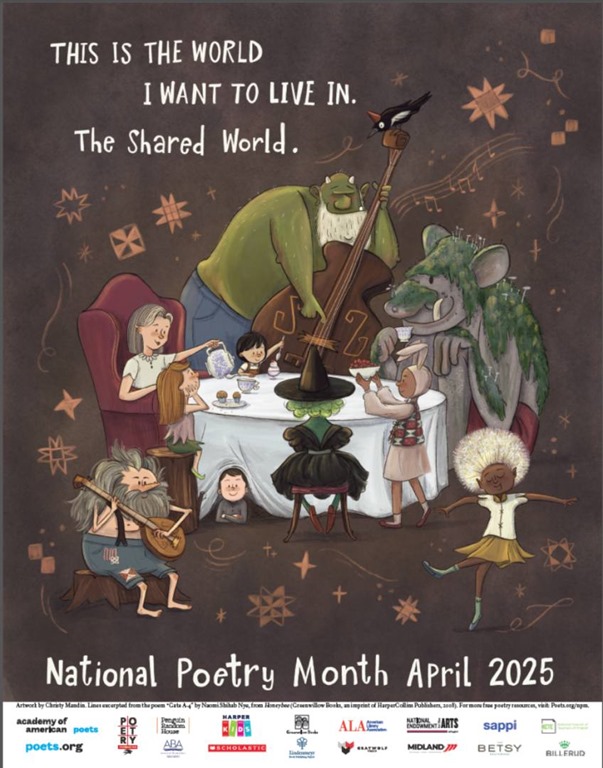
I found my solution by looking at the materials made by the organizers for this 2025 National Poetry Month. I saw that this year’s theme takes off from a line in a Naomi Shihab Nye poem “Gate A-4”  which offers me a suitable theme for the Parlando Project this April in this country in this year. That line is: “This is the world I want to live in. The shared world.” So, there will be some civic poetry on civic issues. There will also be poems of varied shared experiences. I haven’t completed any translations from other languages recently, but if I don’t get to that this month (and it’s usually a very busy month) I may feature some of my favorite not-originally-in-English poems from my past decade’s work.

2025 National Poetry Month Poster 1080

This year’s poster by Christy Mandin.

.

To start off #NPM2025 I’m going to do something that’s not representative of what this Project normally does: from the start we’ve focused here on other poets’ poetry, even though Dave or myself could’ve supplied a great number of song lyrics and poetry to be recast as such. That decade-long primary practice is not followed in today’s audio piece — instead, it’s a sonnet from the Memory Care Series I’ve been writing for several years — some of which have been performed here in draft form. Though I wrote these words, it doesn’t really violate this Project’s maxim: “Other People’s Stories,” because it’s the tale of a daughter with a mother descending deeper into dementia, and of the connections and slow-motion mourning the course of this disease assesses.

Earlier this month I performed Alice Dunbar Nelson’s “I Sit and Sew”  a civic poem about a woman who wished to help the war-distressed and injured. Sewing was a bitter consolation in that poem — but in today’s sonnet, sewing is an image of a different, though still bittersweet, connection. You can hear my performance of “She Dreams of Sewing Machines”  with the audio player gadget below. If you don’t see any such gadget, it’s likely because you’re viewing this blog through a reader that suppresses showing it, and so I offer this highlighted link as an alternative.  It will open a new tab with its own audio player.

Return here throughout April to see what other, varied poetry, music, and performance styles I can complete and add to our shared world, or just use the blog follow feature.

.

*Arrogant ignorance, prejudice, persecution, vain greed for glory and gelt — that all existed before the name fascism, and that may still provide some PD poems. The pieces that I have nearer to completion are more about the human experiences that we all share, and by telling of them we by implication speak against callous disregard.

Kevin FitzPatrick’s Farewell

Nearly 50 years ago when I moved to the Twin Cities I fell in with a group of Irish-American writers — only they didn’t call themselves that, they called themselves the Lake Street Writer’s Group, and when my friend Dave Moore wanted to roughly categorize them back in those days he’d say many of them worked as bartenders. And so, at first, their monthly meetings would be at a bar table, I think the first one I attended was at the Artist’s Quarter, a bar and music venue.

Time and writing changes one, and so it changes groups of writers. Over the years some wandered off to other pursuits, or to other cities, and one or two died. In its last decade of existence, the group winnowed down to four people. Dave Moore and myself, and two other poets: Ethna McKiernan and Kevin FitzPatrick.*  None of us remainers were bartenders. Dave worked for a co-op grocery after working in bookstores. I worked for a public radio network. Ethna ran an Irish-Arts store until it needed to close, and then worked as a social worker. Kevin had a job with the state labor department, but he spent every non-workday at his life-partner Tina’s farm across the border in rural Wisconsin.

The poet I perform today and his last book.

.

Kevin was a healthy seeming guy, able to handle the manual small-farm work in contrast to his desk job. During that decade our little quartet of poets would hear Kevin recount his latest news from the farm, and then we’d hear what he’d transformed out of that when he showed us drafts of poems about the odd turn his post middle-aged life had taken. In this series of poems an office-worker who grew up in the Cities was encountering country labors, mores, and situations, being befuddled or making sense of them.

Kevin’s poems were narrative, and he had a real knack for that form, particularly in his talent for drawing characters in a few words and letting you get a sense of them in a stanza or two.**  One of the charming characters we met as the series of poems spun out was the farm dog: an incongruous poodle named Katie — not a Collie or German Shepard, not any other breed you’d naturally think of protecting the flock and farm. The poet didn’t invent that detail of the farmstead’s dog, but the poet knew a symbol when he came upon one.

Farm dogs are pets with job descriptions, but I don’t think Katie was a herding dog in a professional sense, any more than Kevin was a professional farmer. Still, there were in the poems a sense of Katie being an intermediary between the livestock and the bipeds, and she was portrayed as a useful watchdog and companion when Kevin needed to return to his workweek office job.

In Kevin’s poems we learned that Katie had gotten sick; and though it strained budgets, she had gone through some veterinary treatment. Then, at one month’s meeting, we learned that the poodle farm-dog had succumbed to her illness.

The Kevin FitzPatrick poem I perform today came shortly thereafter. For me, this poem works well, even though intellectually it could seem maudlin or sentimental if summarized. We should be wary of such reduction — poems are much more than AI summaries. Kevin undercut the merely weepy here with his dry sense of humor and understated anger — and then too there’s the poem’s sensual detail: a man at work with the remains and memories of a working dog, the corpse as light as a cardboard cutout, the unthawed March cold.

The poem’s ending has extra poignance for me: it was not that long after the poem was written, and the collection that contained it, Still Living in Town,***  was published, that Kevin unexpectedly took sick and died. I think I remember talking with Kevin — before that knowledge on either of our parts — about liking the final part of the poem, how it implies that when the fear and final of death might come to the poem’s speaker, that the dog’s spirit, preceding over the hill, that hearth and home animal in-between livestock and us humans, would be there faithfully there to assuage the fear of what may be nothing in an empty darkness. I call the piece today “Kevin FitzPatrick’s Farewell”   because to me its writer ended up making that statement while writing a poem about a farm dog.

Kevin heard a couple of my performances of his poems, and his feedback was that I overstated them — and my performances were certainly different from his. He had that drier Robert Frost reading tone down whenever I saw him do public readings, mixed with the kind of Irish wit that evidences just a slightest eye twinkle and unvocalized “a-ha!” while it spears some folly with an off-hand brickbat or dagger. So, to honor that contrast between us I had to fire up the electric guitar and make the speaker in his poem a little shoutier than Kevin. You can hear that performance of mine with the audio player below. No audio player to be seen? Listen: Katie is barking that you can use this highlighted link that will open a new tab with its own audio player.

.

*Kevin and Ethna took to hosting a poetry reading every St. Patrick’s Day. The last ones not at some Lake Street dive bar, but at a more tony academic site: The University Club near St. Paul’s Summit Avenue. I’m not Irish, but personally I don’t favor the mandatory cute intoxication elements endemic to that celebration, so I preferred a spotlight on that culture’s poetic side. As the holiday approaches this year, I’m planning to get to Ethna’s poetry too in time for St. Patrick’s Day.

**I admire conciseness. I’ve sometimes compared Kevin’s poems to the narrative poems of Robert Frost. While Frost’s longer blank-verse narrative poems have their power and richness, it’s not the mode that I read for pleasure. Kevin’s rural life poems take more after Frost’s shorter narrations like the “Mending Wall.”  And Kevin’s poems make more use of humor than Frost’s do.

***That book, and others, are available via this web site link.

Racial Relations and gender play in the 1940s-‘50s scrapbook, Part Ten

Early this morning, I was reading a blog of a modern avant garde poet who has lots of philosophic theories about prosody, and there this quote of Walter Benjamin’s is brought up: “To write history is to give dates their physiognomy.”  Well, yes, I thought, that’s what I’ve been doing in this Black History Month series. This scrapbook, its photographs, ephemera, ads, and clippings from newspapers — all a picture of the history of an American Black man: Lawrence Kasuth “Hank” Hazlett, a musician and singer who lived from 1911 to 1990. That scrapbook that had come into my hands portrays his nation-touring time in the 1940s and a residence in South Minneapolis in the 1950s. When it comes to civil rights or diversity, we tend to see change, or the preceding things that needed to change, from a later vantage point. The scrapbook documents such a preceding time, and the sort of things that musician Frank Zappa liked to call “mutations” — the tiny breaking of norms. But, isn’t it just a scrapbook?

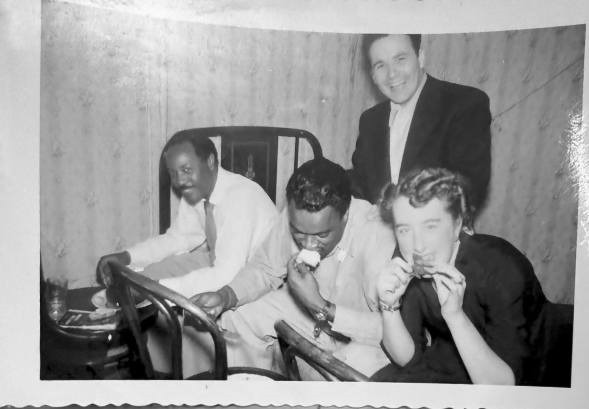
There are pieces in the scrapbook that may give us a glimpse into what its maker noted and selected to save. In the last post, we saw a picture of Hazlett playing on stage with a white bass player with the hippest of truncated neckwear — but overall, the performance photos show black musicians with him, playing (as far as I can see) to black audiences. Yet, here’s a photo from the scrapbook that stood out from that segregated norm:

Bedsitting photo

.

In this photograph two black men (the one on the left appears to be Hazlett) are sitting on a cheap enameled-bedstead bed eating. Sitting on the same bed is a white woman and behind those three, a white man in a dark suit is standing. Black and white, men and the woman are smiling. It looks like an inexpensive hotel room, and maybe they’re all on tour.

Jeannie and her Boyfriends promo

On the back of the postcard they wrote: To Edith and Hank. So nice meeting you, it’s a pleasure to be an entertainer along with you. Jeannie Bill and Don

.

The scrapbook also collects this promotional picture postcard for an act called Jennie and her Boyfriends, who issued a single 45 RPM do-wop style record in 1959. Jeannie in the promo picture has a completely different hairstyle and hair-color, but it’s plausible this is her and one of the members of her trio in the bed-sitting photo.

Also in the last post in the series, we showed some clippings in the scrapbook of Black entertainers working to defeat limiting stereotypes, but one thing that struck me was that the scrapbook also contains clippings showing white entertainment figures. Ephemera in the book, like that MGM W2 form from ’44 and Los Angeles addresses for Hazlett make me think that he might have had at least tenuous connections with some of them during the 1940s. Here’s a page from the scrapbook showing a clipping featuring Lana Turner, which may have been included because its caption says Turner likes Duke Ellington records.**

Lana Turner likes Eillington records

Lana Turner isn’t into vinyl, she’s spinning shellac.

.

These are old clippings, sometimes from lower-res reproduction, and occasionally I’m misled by the ambiguities of race in the photographs. Take this one of Jean Parks found on this page with both white and Black entertainment figures. I figured she was white.

Jean Parks et al

Find the second Afro-American woman on this page.

.

Those who’ve followed this blog will know that I was immediately saying to myself “Who’s Jean Parks?” The story outlined from asking that is as rich or richer than the story of Bruce Dybvig from earlier in this series. WWII military service put a crimp on the supply of male musicians — so just as with other occupations, there soon arose a number of female bands — Rosie the Riveter, only with saxophones. Popular pre-war bands often enough had female singers, and there were a smattering of woman pianists (and small-group guitarists) — but women playing horns, reeds, drums in big bands— important featured instruments in those ensembles — I can’t think of one. Then came the war and mobilization. All of a sudden there were groups entirely made up of Black or white lady musos sprung full borne from the brow as it were.

One of those was Eddie Durham’s All-Star Girl Orchestra.   OK, now we’re studying history, so we have to do dates. It’s Victory over Japan Day, the war is over. In NYC a sailor grabs a nurse in a crowd without her consent, starts kissing her in front of a cameraman, and everything thinks this is splendid because the immense horrors of world war are over — and the, you know, sissy stuff  of regular old living is to return. The All-Star Girl Orchestra are in the middle of an engagement on the opposite coast, in Oakland California. The link above says that manager Durham sees that the men are going to return — and just then, dissolves the act. Well, sort of. Some remainder is rebranded around singer Jean Parks. As it turns out, the post-WWII years will be tough for all big bands — and all-around, the all-girl band thing doesn’t survive the peace.

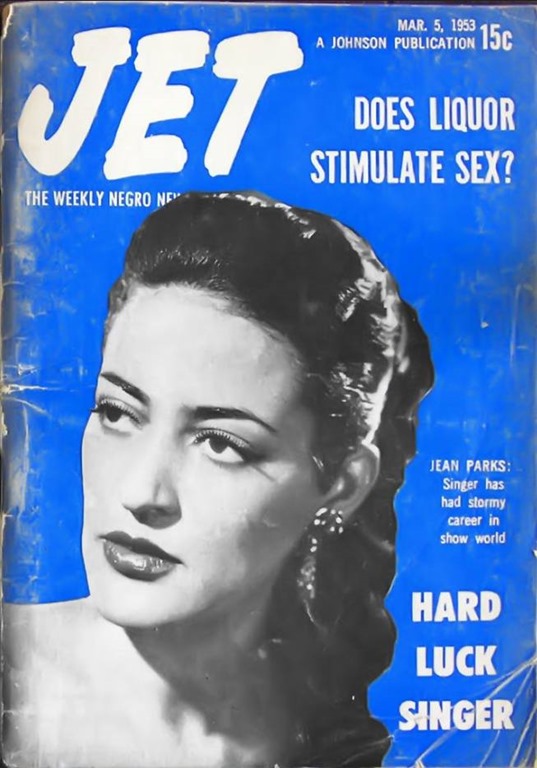
And here’s what happens when Parks meets the world of The Fifties. Just look at the bad-girl triple-double implied and indicted in this paragraph: Black, caught with a 6-foot-tall platinum blond “friend”/roommate, sex-work — and drugs? We got’em all: reefer, opium, cocaine. Other than a Communist Party membership card signed Mr. and Mrs. and documents linking her to a plot to cancel Howdy Doody, this is complete “All-Star” material.***

Parks arrestHard luck singer Jean Parks Jet cover

Seeing that other headline on the Jet cover, and suddenly I’m a teenager in the back row of the classroom muttering to a classmate “I must be drinking the wrong kind of booze.”

.

Two other pictures in the scrapbook seem to tell some kind of story about connections between the races, likely in Minneapolis in the ‘50s. There’s this snapshot, pasted on the same page as the similarly posed picture I speculated last time might be of a child of the Hazletts. I have no idea who Maxine is, or who’s Chuck. But as with the other pictures and accounts in today’s post, I’d reckon that mixed race connections like this had elements of risk beyond just social disapprobation. White school integration riots, Emmett Till, the beating and burning of the Freedom Riders buses, all were contemporary with the scrapbook.

Maxine Chucks wife

.

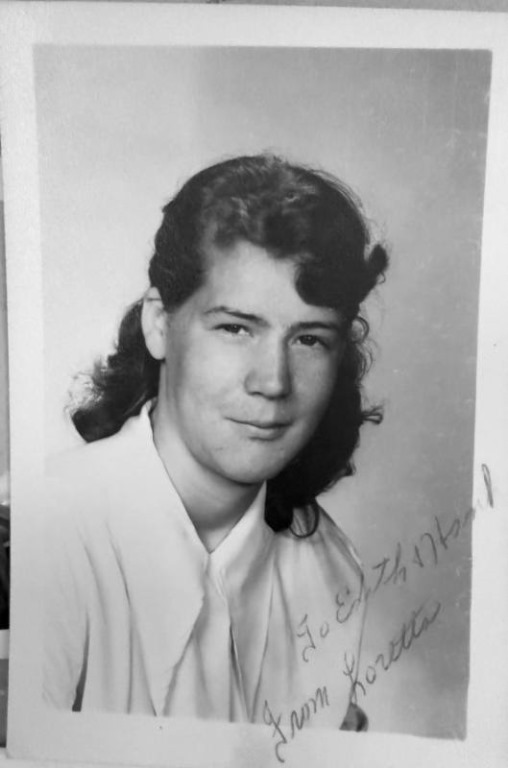
Then there’s this picture, inscribed to Hank’s wife Edith and so presumably from the early 1950s. So many of us have awkward school-picture-day photos, but I found this one more arresting than awkward. This is hard to detail, so I’m going to be more awkward than the picture, where after all Loretta is smiling and seems comfortable with themselves: Loretta looks quite masculine. Unattributed, it could easily be a 20-year-later photo of a mullet-head male guitar player in someone’s high school rock band. Burn-out the long-point blouse collar and retouch the long tresses in the back and it would be a 1950s boy who wants to grow up to play in Elvis’ band.

Get Back Loretta

Loretta.

.

There’s no other context other than the inscription and being in the scrapbook. Looking at Loretta’s photo this month I immediately thought of “Get Back,”  the Beatles lyric. Some of you may be singing the applicable verse in your head now that I’ve said that. My second thought: I’d love to know Loretta’s story, but there’s next to no chance I ever will.

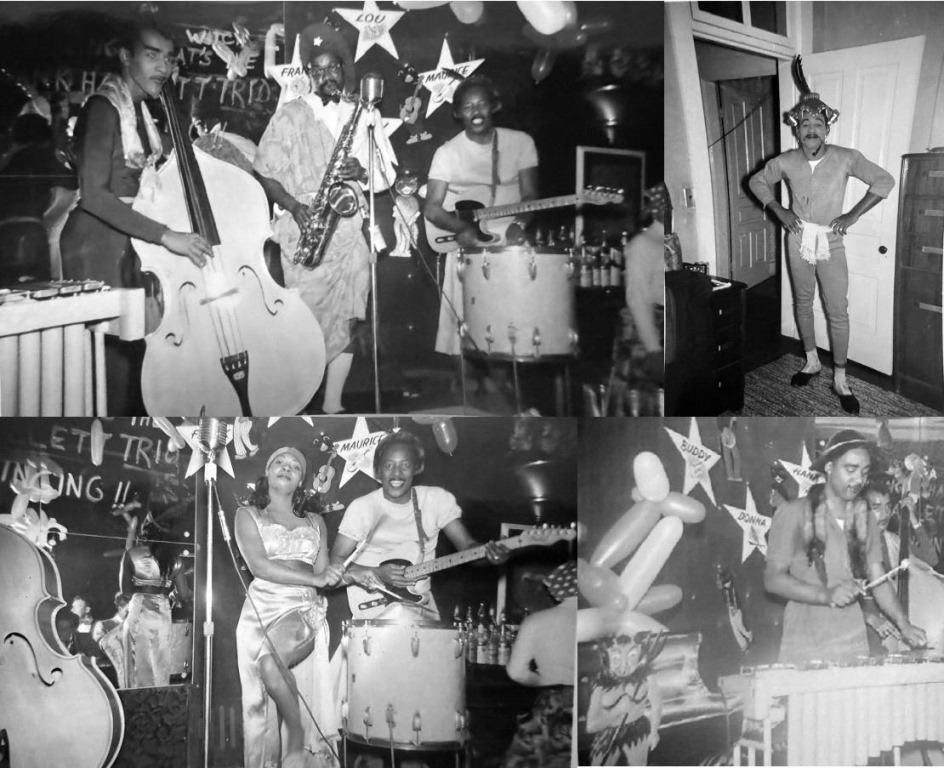
And now a transition that may or may not be apt. There are several pictures of Hank Hazlett, and Hazlett with his Trio, dressed in drag. I can’t place the club stage shown in most of the pictures. The Telecaster he’s playing says this is likely during the Fifties when he’s largely working out of Minneapolis, and it may be a Minneapolis club. Everyone looks like they’re having a good time, and dressing in drag is a multivalent act that can be meant to convey different things.

Drag performance Hank Hazlett Trio

..

Everyone seems to be having a good time. Of course, right now we know it’s supposed to mean danger to children, and therefore we must let rich folks get richer so they can stop those goings on, because…religion. That’s a very serious opinion, mandate and all — you ought to pay attention to it instead of looking at this approaching 20,000 word series on — what? — a scrapbook about a Black musician who few have even heard of. And the scrapbook is mostly pictures,  where’s the meaning in them? Of course, then there are these other Walter Benjamin quotes: “Those who do not learn how to decipher photographs will be the illiterate of the future” and “We collect books in the belief that we are preserving them, when in fact it is the books that preserve their collector.” Benjamin’s life, which we know more about than Hank, or Edith Hazlett’s, or Loretta’s life, could be called in to rebut those quotes. In a corporeal sense, he had little future, books didn’t extend his human, breathing, skin-coated living. But Benjamin did have his quotes, groups of words that might work like poems to let us see something new, and there are even some who will read philosophy at length.

There’s a new musical performance today, taken from a piece of folded and unfolded paper that was pasted into the Hazlett scrapbook. Did Edith carry it? Did Hank? On it, in faded pencil, are written 6 quotes, 6 maxims that someone wanted to carry in order to carry on. They are from a mixed-bag of writers, numbered 1-6 on the page, and in which order I read them in this performance: M. B. Whitman, H.D. Thoreau, Lloyd C. Douglas, Helen Keller, Herbert Kaufman, and Ambrose Bierce.

You can hear that performance with the audio player below. What? No player to be seen? Well, there’s injustice, carelessness, and cruelty we don’t see, and that’s a bigger deal than a couple of minutes of me dressing up in weird Jazz-band drag and reading some inspirational quotes — but you could use this highlighted link which will open a new tab with its own audio player.

.

*Marv Goldberg mentions that the Cats and the Fiddle might have had some involvement with the 1945 MGM Judy Garland film The Clock,  which would have been several years and lineups past the original Cat’s quartet burst of Hollywood film appearances in 1938 — those all even before they had made their first appearance on recordings. A 1945-released film would have overlapped the time that Hazlett was in the Cats, could explain the 1944 W2. Mysteriously, I distinctly recall seeing a clipped advertisement for that movie when I first looked into the scrapbook years ago, thinking I should check the film out — but for some reason it isn’t in the scrapbook now.

**Frank O’Hara poetry fans will note Turner is fully upright and operational in this photo.

***Like The Clock ad, I also distinctly remember seeing an article about someone in entertainment arrested for prostitution when I first looked through the scrapbook years ago. It too is missing now. The scrapbook was part of at least one move, and when I look at it now, I have to take care, as it’s falling apart. I now suspect that might have been more on the Parks case. The All-Star Girl Orchestra could have shared bills with the Cats in Hazlett’s time — they played the same theater circuit during WWII.

Arcadian Ewes (Ca’ the Yowes to the Knowes)

Today is Robert Burns’ birthday, which I hear is much celebrated in Scotland. While this Project has done over 800 audio pieces over the years, none of them (before today) have used Burns words. Why not? It’s a personal limitation of mine: his poetry uses a lot of Scottish words and dialect, and I have a hard time doing that.*

But, at last, I’ve finally snuck in a bit of Burns. And while it’s not as novel, I’m also using a set of words I wrote for the bulk of today’s performance, though the Parlando Project remains overwhelmingly about experiencing other people’s words. The second part of “Arcadian Ewes”  is a draft version from a work in progress: The Memory Care Sonnets.  Drafts of other poems in the series have appeared here before, but for those new to this, they tell the story of a daughter visiting and caring for a mother with increasing dementia.

While hearing the original account of a daughter and the daughter’s friend going for a weekly singing session at the memory care facility last fall, I was somehow struck at the time with the story’s Arcadian sensibility. That’s a place I know from this Project. Poetry and folk-song is rich in Arcadia: there are shepherds, flocks, meadows, love, peril, loneliness, peace, gifts, songs, a sense of time ever-present without fences, taking place over the hills and away from our actual daily lives. Here, in the sonnet, the shepherdesses go to the place, gather their flock of singers. What songs will they sing?

Even as I was writing the poem the refrain of Burns’ song that now begins the recorded performance was in my mind. I can’t quite account for why, other than the song for some reason often brings me to tears — and I can’t fully explain that either.

Ca the Yowes status Dunfries Scotland

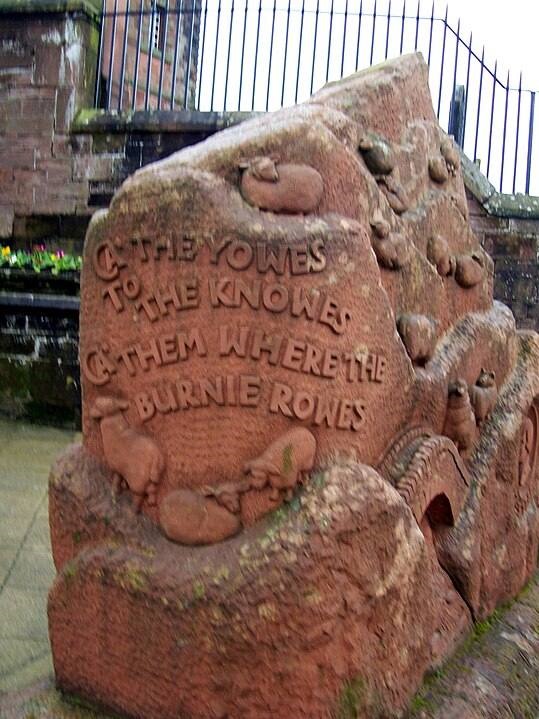
Today’s musical piece begins with part of a Robert Burns’ song  displayed on this monument in Dumfries Scotland
(photo by: summonedbyfells via Wikipedia)

.

“Ca’ the Yowes to the Knowes”  was collected and reshaped by Robert Burns in the late 18th century.  He published at least two versions, and the folk process has given us other variations, including differences in how much of the Scottish accent and wordage is retained. As a text though, it generally isn’t a sad song. The song’s shepherdess, taking her ewes among the hills seems happy enough in her labor, but happier yet to find a swain in her Arcadia who promises her unending devotion and care. That story isn’t sad now, is it — unless one dotes on how love’s promises aren’t always faithful, that human lives are not unending. But as I said above, poetic Arcadian time doesn’t end, and maybe that contrast with human time is the essential sadness. Perhaps it is those elemental parts of Burns’ story, of the care for the carer, is what linked it to my resulting poem of the daughter taking care of the mother.

However inexplicably, I believe it’s the music that makes me cry when I hear that song’s tune. Music, that same powerful class of thing that is the balm that restores a connection to the mother on one of her “bad days” of deeper withdrawal in the sonnet. The music for the performance you can hear below doesn’t hew exactly to the old song’s tune, for I don’t know if I could have stayed with the reading if it did. You can hear my performance with the audio player gadget below. Has your audio player strayed away over the hills? No, just some ways of reading this blog suppress displaying it, so I also offer this highlighted link which will open a new tab with its own audio player.

.

*That lack of the ability to hear and then repeat back sounds bedevils me several ways: it’s often relied on in musical endeavors, and it’s long frustrated me in my desire to speak other languages, or even pronounce some names correctly. I suspect it’s a neurological quirk of my brain.

Journey of the Magi: or the Wise Men were following a star, not four stars

Are blogging and social media as much about complaints as they are about praise? I can’t say for sure on that. One reason there: my personal appetite for a good rant or jeremiad has limits. But sometimes — even when the subject is something you’re fond of— within a negative review, you might see something new you never appreciated.

The Christmas season ended yesterday with Epiphany, the Christian church calendar date on which the Three Wise Men, kings or soothsayers from the East, legendarily visit the newborn infant god-head.

It’s a favored event for painters of Christian religious scenes, since it has the rich aroma of an Incarnation appearing in a rude stable, and yet at the same time it allows the depiction of exotic, wealthy, well-attired prince/priests bringing gifts to the child. The Renaissance artists often loved depth of detail, and this gives them so much to depict.

For the holiday season at the end of 1921, T. S. Eliot wrote a poem for this last day of the 12-days of Christmas. In his “Journey of the Magi”  he exercises one of his youthful talents: flavorful disjointed poetic dialog expressive of different human aspects infused with sound and high and low cultural references. His poem is a poetic monolog by one of the Wise Men — but it omits the moment in the paintings: the worshipful giving of gifts to the baby Jesus. You can read the full text of the poem at this link if you’d like to follow along.

Instead, the poem opens with a bad review of the travel to Bethlehem. To paraphrase, the first stanza: look, we had it good in our temperate-zone palaces, servants bringing us cool sherbet treats, and now we’re out here where it’s either too hot or too cold, in a place no one knows how important we are.

In the poem’s second stanza we do get in words some of the matter of those Renaissance paintings — you could see the brush-hand of a Bruegel in it. We smell the landscape, there’s a little stream, a water-mill, a singular white horse, a tavern with the (later post-mortem) pieces of silver being gambled for, drinker’s feet tripping over wine-skins, There should be a saint, and angel, or the Holy Family in this painting too, resplendent in the foreground — but our speaker leaves any of that out. I love the Yelp review that ends this stanza: not the max-stars that everyone is urged to leave: “(you may say) satisfactory.”

In the last stanza Eliot’s monologist gets to hint at the piety that would later take over that poet’s outlook. After all, the Three Priests or Kings or Sages that have traveled so far are not believers in the story, only esoteric knowers. Their testimony is that they know the Christian incarnation is important, but they don’t know or believe why. Our speaker says, recalling the trip on the sore camel’s back across the desert, moor, and mountains, just that he has some sense that his former comforts, his kingdom, his belief, his place in things, his magic, has been changed some way. What comes next after the death of his homeplace belief? He doesn’t know, but somehow he senses it’ll be better.

That’s often a good story isn’t it — that kings are just a convention, a shared or temporarily-enforced belief?

Anbetung_der_Könige_(Bruegel,_1564) 800

Speaking of Bruegel, here’s a painting of the Adoration of the Magi by him. Looking at the king in crimson on the left: from the expression on that face, I think we can imagine he’s the speaker in Eliot’s poem.

.

Even though today’s poem is written of events remembered in the past, I’m late with this piece. I performed it yesterday, on the suitable date, but it was nearing the stroke of midnight when I laid down the last track. This morning after breakfast and grocery shopping I mixed the version you can hear below. I thought about putting in caroling bells or angelic voices in the arrangement, but as I worked with Eliot’s words I figured it might be better to decorate it with some Silk Road instruments, ones that might have been heard in the better stops on the Three Kings’ journey: the oud an the santoor. But there’s also a drum set, a piano, and an electric bass — and I can’t figure out how a camel could carry those! You can hear my performance of “The Journey of the Magi”  with the audio player below. No player seen? You’re not too late, it’s just the way some ways of viewing this blog suppress showing that, so I offer this shining star, or rather highlighted link which will open a new tab with its own audio player.

.

.

Millay’s Thanksgiving

There’s a long tradition in poetry of civic poetry — poems not meant for an audience interested solely in the interior intimate experience of the poet, but speaking to larger, more public themes. I suspect modern poetry doesn’t do this mode directly much, even though some individualist poetry infers that purpose. American poetic Modernism began with an emphasis on the concrete, the thing specific: red wheelbarrow, ripples in a pool, a certain Chicago cat-fog, an exit on the Metro on a rainy day. Yet, a focused subject can still be an example that stands for more.

If the subject is small though, perhaps we poets expect our audience most often to be small too, compared to a variety of other, popular arts. But this was not always so. Longfellow and Whitman expected the nation to listen to their poems of democratic virtues. If the literary set eschew the mode, song-lyricists and non-literary poets will still assay it.

Just under four years ago, a poet Amanda Gorman who has written civic poetry, delivered a poem at the last U.S. Presidential inauguration, speaking of the nation’s fears, hopes, promises. The mode of the next Inauguration has changed. I’m not expecting poetry. Some will think, more-the-better — who wants a poet spouting off what I should think.

Why not, are they not citizens? What are the occupations that are allowed to speak?

Nearly 75 years ago. American poet Edna St. Vincent Millay wrote a long poem for the American holiday of Thanksgiving. She expected a good-sized audience: it was published in the Saturday Evening Post, a weekly general interest magazine, the one that often featured Norman Rockwell paintings on the cover, that claimed Ben Franklin as its founder.

Millay NFTG

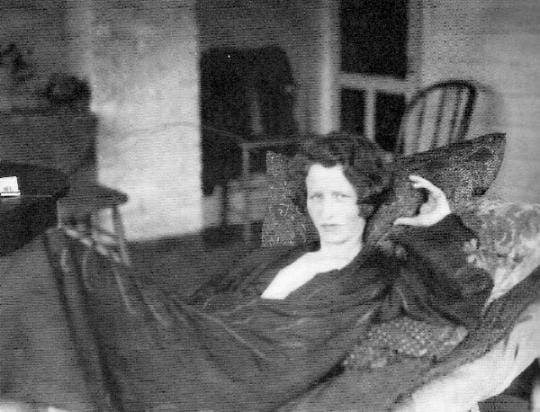
The most often used pictures of Millay show the young romantic adventurer. I’m also fond of this one that seems less all that. The poem which I perform excerpts from today was the last one she published before she died at age 58.

.

I’m sure there were specific things on Millay’s mind, geo-political, American issues. She writes five years after a war ended with two A-bombs. How long would be the peace? In 1950 there was another war going on overseas in Korea, there was a “Red Scare,” and to a large degree some deficiencies in American equality of opportunity were so far off to the side that too few even thought of them as political issues to address then. Millay didn’t cite any of that directly.

Instead, she wrote about how she thinks we, the citizenry, were feeling, assuming a general agreement that might be hard to gather today. Thanksgiving is a dual holiday occasion: it’s our harvest festival, a time to give thanks to what our work brought us, and it’s also a holiday to give thanks for what we’ve come through: it originated in a time of Civil War, and it commemorates the hardy survival of some early 17th century boat-people who landed without papers and survived on American shores. Millay’s Thanksgiving thoughts were more toward the latter than the former.

What will ring true in some American hearts this year will be her words of hopes dashed or at least deferred. Can one give thanks for having hopes that were unfulfilled? Can we at least forgive ourselves for hope? Her poem exists in that question. In the excerpts I performed today for this musically accompanied piece you can hear below, I focused on that sense, felt in my bones. “Cunning and guile persist; ferocity empowers” Millay writes. The lines that stand out for me as a Thanksgiving prayer this year are “Let us give thanks for the courage that was always ours; and pray for the wisdom which we never had.”

As civic prayer goes, that’s humble, but it has some bite in it.

You can hear my performance of portions from Millay’s “Thanksgiving…1950”  with the audio player below. The full poem’s text is at this link. No audio player gadget to be seen?  This highlighted link will open a new tab with its own audio player.

.

.

Ten Cents a Bushel

I seem to have the kind of mind that, unbidden, sees connections. Probably drives some acquaintances around the bend, but regular readers here will have become accustomed to this. After all, this Project is about making a connection — likely unintended connection — between literary, page poetry and musical performance. Still, even though it relates to a mental reflex of mine, there’s “making,” work, involved in that combining.

So it was, that this month I went consciously looking for a connection, one I thought I might find between our American election results and the fear and despair around that event with the early 20th century era which I often look for to find free-to-reuse words to set and sing.

Where and what to look for in the era if trolling for such a connection? I wanted a short poem to leap out at me, one that I’d immediately flash on, in hopes it would attract even the casual listener here with a sense of recognition. I started paging through my Sandburg, who remains one of my personal models, but found no strong candidates I haven’t already performed.*  I next moved on to a 1930’s volume A New Anthology of Modern Poetry  edited by Selden Rodman. Rodman is one of those little-remembered figures I enjoy encountering in the Project, a litterateur and socialist activist who admired American Modernists — so connections right there.

The selections in Rodman’s volume look like an index of this Project’s authors, I counted 37 poets whose texts I’ve used in the nearly 800 published Parlando Project pieces.** His lively introduction promised what I was looking for, connecting the artistic discontent with old literary modes and tactics with social change and discontent.

Eagerly, I read on, looking for that flash of connection with the way folks I know are feeling this month. I read some fine poems, some I might even use someday here, but nothing came out of that quick skim and read that hit me with my sought property: “This sounds like it could have been written today.” Why not? When those poets wrote of their social injustices and feared outcomes the details of their times didn’t match closely enough to the details of our times.***   “It’s just details, what about the essence?” you might think. I thought that too, but I wanted listeners to feel it  from the poem I was looking for. Details usually aren’t ephemeral in poetry, they are often the source of its emotional power.

If I’d left it there you wouldn’t have a musical piece to listen to today. But then I recalled Edwin Ford Piper, a man whose work I discovered earlier this year. Piper’s family settled in frontier Nebraska just after the American Civil War. He grew up there, knowing rural settlers, ranch-hands, and farmers at the turn of the century. To keep this a reasonable length, here’s a link to some of what I wrote about this deserving of more current attention poet earlier this year.

Ten Cents a Bushel

Here’s Piper’s poem I performed today as it was published in his collection Barb Wire

.

Piper’s poem “Ten Cents a Bushel”  is about a small farmer. I doubt I have any readers who commercially harvest corn by hand, though some may have experienced something close enough. There are still agricultural workers, but modern field workers are usually employees, not caught in the exact resident small-farmer serfdom that is the center of Piper’s poem.****  I went with this poem anyway. In doing so, I accepted failure on my goal — at least so far — I didn’t find the brilliant connection between eras I was seeking. But if the poem’s details are off-target to today’s burdens, they are still powerful details. Piper’s poem lets us feel those details in our muscles and smell them with our noses, and the essence of the poem’s world, the repetitive stress of its rural Sisyphus’ burden, is something I expect some tired people can feel this month.

Today’s music? I prefer to call myself a composer, not a musician, even though I operate numerous real and virtual instruments in making these pieces. Modern digital recording allows me to maximize my inconsistent skills and to do with guile and planning what fingers and breath couldn’t accomplish. Be assured: “composer” sounds like a pompous title to me too, while “musician” retains the nobility of the worker. But there’s an element of my personality that sometimes tells the composer-me to back off with the theory and a build-the-musical-piece-with-ideas workflow, and barks “I just want to play!” Weeks like these, or times when I can plug into a loud amp and welcome that power vibrating in a room brings that energy forward. Today’s piece started with two inexpensive electric guitars and a bass playing loud in a room. The lead guitar I played is a Squier Jazzmaster, a model that wasn’t designed for loud, sustained-note playing, but can be forced to do it under volume by an elderly guitarist who can’t rip out rapid flurries of notes. You can hear that performance, my speaking Piper’s account of this November farmer’s harvest while playing more my mood than worked-out musical ideas by using the audio player below. No player? The bank hasn’t foreclosed, some ways of viewing this blog suppress the audio player gadget. This highlighted link is an alternative that will open a new tab with just an audio player of its own.

.

*I’m not disenchanted with Carl Sandburg. My results in this browse through his work may be because he doesn’t really do fear and despair as a predominant emotional frame. This may still be a good attitude to assay in these times, but not what I was specifically seeking. If you want Sandburg for this moment, perhaps this previous Parlando Project performance will serve you well.

**One blind spot: Rodman (who had considerable interest in Black Caribbean culture and history) didn’t include any of the Harlem Renaissance generation of Afro-Americans. I must resort to an academic meta-cultural term of art when I consider that: WTF.

***I did think this week about how to compare the injustice and fears which I naively thought I could measure between the 1930s and our time. I’m certain the levels of injustice were massively greater then. The fears? Even given their Great Depression, fascist governments, genocide factories, and a coming World War — I can’t say our fears are lesser.

****I started to write a conclusion here that would need to spin out more than a thousand words to do it justice. Such an epic would point out that those early 20th century rural farmers caught in an economic squeeze by powerful business forces up the supply chain from their crops, founded radical, effective, and practical political movements: The Farmer Labor Party, the Non-Partisan League. In the same parts of the land that today wave the red flag and the red hat, a very different rural political force was electorally successful. What’s with the same fields bearing different fruits in these two eras? That’s more than a blog post, something for someone with skills beyond mine. One naive half-formed theory: was there something about the largely immigrant-or-child-of-one, practical farmer or small-town-dweller of a century ago that saw through urban sharpies and charlatans, and focused on specific economic remedies?

The Three Friends: an audio play adaptation of a Walter de la Mare short story

I indicated last time that I had another piece I wanted to present before Halloween by Walter de la Mare, that British master of the subtle supernatural. It took a bunch of concentrated effort to produce something of a realization of it, but it’s as ready as I can make it in time. How’d it come about, and why was I not sure I could promise it?

I use the Internet Archive often as part of this “not just non-profit — it’s non-revenue” Project. One of the things the IA has is a large library of scanned public domain literary works,* which affords me a handy way to look through “many a quaint and curious volume of forgotten lore.” In the run up to Halloween I made a note to see if there was some Walter de la Mare work I could use for my Parlando Project purposes.

This Project lets me not only explore the well-known writer’s and musical composer’s habit of procrastination, but also the reader’s and researcher’s branch of that foible too. I put that book search in my I’ll-do-that-tomorrow bin for about a week. “I’ll get around to it” I told myself.

And then in mid-October some numbskulls hacked the Internet Archive causing it to go largely offline for more than a week. When the scanned book section returned to availability, I was already into making other new work for this year’s Halloween series, but a few days ago I was finally able to access some additional collections of de la Mare’s work from the IA. In looking through those, I found that Walter de la Mare wasn’t only a poet. He also wrote short stories, which like his poetry, exhibit his dry sense of the strange. “The Three Friends”  is one of his shortest published stories — short enough to work into one of my short-format audio pieces.

Walter de la Mare in front of a microphone

When Walter de la Mare worked the mic, he had a whole radio network to support him.

.

“The Three Friends”  is dialog-centric, and in less than a day I was able to jury-rig up a three-person play out of it — but who’d be my voice-acting ensemble? It was less than 72 hours until Halloween. I’d have loved to have used Dave Moore’s voice, but my production schedule is catch-as-catch-can, and I didn’t know if I could corral him in time. My wife agreed to play the part of Lacey, the tavern keeper member of the three friends, assuming she wasn’t completely worn-out from her work and the rest of her life. Last night she stepped up to the mic and recorded that part in a quick pass. I made a logistical compromise and recorded the other two parts with my own voice, also working quickly.**  By about 9 PM last night I had the dialog recorded.

Between then and about 3 PM this afternoon I worked on the audio production of the recordings, selecting a bit of instrumental music (from my last-weekend exploration of a new audio software feature) to serve as a plausible theme music for “The Parlando Project Theatre of the Air.” The 19 hours from first opening up the microphones to an audio play ready to upload weren’t all Project work: I did go to sleep after midnight, I got up at dawn and did a bicycle ride to breakfast, and early this afternoon I made another bike trip to the grocery store — but there was a lot of production work trying to meet the needs of this format that isn’t what the Project normally does. “Radio play” music production isn’t the same as recording and mixing a 3-minute song, and I had to learn how to apply my computer audio tools in a slightly different way. If you haven’t done audio production, it’s a heap of tasks even to get a half-way polished result: finding environmental sound effects, balancing levels, fixing the most egregious dialog glitches, deciding if any pauses are too long or too short, and so on. The result of this experiment is good enough to present, though I note things that I would have liked to do better.

So, what’s the story our actors are presenting for your ears today? Two friends are casually talking about a problem bedeviling one of them. That troubled man, Eaves, has been having reoccurring dreams or visions. His friend Sully tries to make light of it, but in the course of their evening they meet up with the third friend who works in a tavern, Miss Lacey. They talk over Eaves’ problem: you see Eaves thinks he has pierced the Samhain veil. Has Eaves seen, will he tell of, “the undiscovered country from whose bourn no traveler returns?”

Well, it’s de la Mare. Most writers would break out the purple pen to write such visions, de la Mare wants to make a more subtle (and human) observation. The orchestra (well, the piano trio) has started to sound. Take your seats and listen to the short, 10-minute world-premiere performance of the audio play “The Three Friends”  by using the audio player below. What, has someone tall with a large hat sat in front of your audio player gadget? I provide this alternative, a highlighted link that will open a new tab with its own audio player.

.

*The Internet Archive has also taken an aggressive stance to works that are not clearly in the Public Domain. That activity is controversial and has had some legal judgements handed down for rights-holders. I won’t take your time to go into all that, but its scanned PD literary archive is a treasure for readers and researchers.

**Oh, if only I was one of those skilled voice actors who can call up entirely different vocal timbres to create distinctive sounding character voices! I tried to mitigate the lack of distinction between Eaves’ and Sully’s voices both being portrayed by mine by using stereo separation on today’s audio

Rilke’s Black Cat — and expanding the pie in the face of translations

Is today’s piece the Parlando Project’s surrender to the Internet’s pervasive cat fancies? No, this is a very serious piece of cultural distribution — and it’s Halloween fans, that grave and gothic lot, that we’re serving with content this month.

I do fresh translations into English as part of this Project semi-regularly. Translations bring benefits, important ones that would fulfill that serious…cultural  claim. Since poetry exists in nearly every society* no matter the language spoken, translation allows us to casually absorb more outlooks as readers. And as proud as English speakers can be about the home-team’s innings in verse, a great many poets have taken tactics, forms, and inspiration from writers that wrote in other languages. Adding to the corpus of translations then, is a service to readers and poets.

A couple of the poets I’ve translated here have almost nothing available online in English, a few more, little. Rilke, who wrote today’s piece in German is not such a case. He’s a favorite poet of many English-speaking readers, and has had many well-known translations. But even so, adding another Rilke translation is like adding another human perception of a piece of his writing. All translation comes with a viewpoint and a path taken by the translator to the point of translation. My viewpoint is not particularly learned. I’m not an expert in German literature, and I don’t speak German beyond a few phrases. While I happen to like my approach to writing or performing poetry (most poets get little love for their verse other than self-love, so we’d better have that regard to do the work) that’s about all I bring in qualifications to translating.

My translation approach is primarily image-centered. I want to try to absorb what the poet is seeing, and feeling and transfer that portrayal of sensation into contemporary English. I usually don’t try to convey the parallel sensation of the poems word-music in its original language, but I will give some weight to a sequence of the images as they convey the poem’s argument, the thing I call “the music of thought.” I do like there to be some English word-music in the end result, but as with my original poetry in English the images shouldn’t suffer much just to make some formal lock-step.

Which brings me to the other benefit of translating, the reason I recommend translation to every poet, to every creative-writing class: translating forces you to consider choices made by the original poet intimately, and to make subsequent English-language choices that are not dictated at origin by your  desire to tell your life-story or outlook. This separation allows you to practice, in separation, the craft of poetry.**

I took on Rilke’s “Black Cat”  because it seems like an apt Halloween poem — after all, it does start out with the cat being described as an apparition of mysterious supernatural powers.***  As I dug into the poem there was one mystery I didn’t solve: how much is Rilke joking with us? Is this cat a dark vision, a domestic cosmic black hole with a gravity that absorbs light? A real Rilke scholar might have a learned opinion on this, but I am not that person. The Rilke poems I know, and famous Letters to a Young Poet  essays seem utterly serious — I’d say almost to a fault as weighed by my own tastes. There’s a certain kind of Rilke fan, like a certain kind of Robert Bly fan, that makes me wary of the seriousness with which they take their precepts and scriptures.

Black Cat

The Internet was designed so that scientists, the military, and government could exchange ideas. And cat pictures like this one I found there. Well, the cat pictures came later, but I’m sure it was in the design. Now, who’s my dark little existential vision of non-being that meets my gaze…

.

But as I translate Rilke I occasionally find images that seem to fall into slapstick. Did Rilke intend this, or is that my own path, my outlook, reflecting off the surfaces of poems? Seriousness is indispensable to slapstick after all. My favorite part of this poem is when the frustrated viewer of the black cat resorts to enraged stomping about. Last time we had a poem about the pathos of black & grey ghosts seeming to manifest in a dark house. Is this dark cat a solemn symbol of ever-so-serious human-condition dread — or an excuse to burlesque the frustration of life we cannot fully control, things we cannot perceive clearly, yet are stuck trying to figure out anyway?

Black Cat Translation

This is what I came up with for today’s performance

.

It may not be what we’d wish, but as Rilke gets to his last line, I smile. We try to see in the darkness, we might try to command capricious cats, but in the end we’ll all be extinct as prehistoric insects captured in amber crystals — but at least by translating Rilke (or other poets) we can see our gaze in their gaze.

To hear my spoken word performance of my fresh translation of Rilke’s “Black Cat”  you can use the audio player below. What, has a black cat crossed your screen and obscured any such audio player gadget?  This highlighted link will open a new tab with its own audio player.

.

*Do historians and anthropologists know of any documented society that didn’t have a form of poetry? I’m neither — but I don’t know of one. If so, this seems a strange fact in the face of poetry’s peripheral place in modern American culture. Is poetry just an archaic skill, like how to make a stone knife or knowing which fungi are safe or sacred to eat?

**Current online language translators (Google’s seems particularly good) are generally adequate at giving you an English-language gloss to start with. For key words conveying images in a poem, online foreign language dictionaries can drill down into further insight. The translator’s job isn’t just turning some decoder ring though: the job is to find effective English language poetry to hold the poem you’re translating.

***Admitting my lack of portfolio to do so, there’s a third reason to do my own translations: I want to avoid — even for my “absolutely-no-profit” Project — taking other writer’s work that isn’t free for reuse. Rilke’s work is in the public domain in the U.S. — but this isn’t true of most English translations of it.

Heaven and Hail

I sometimes think I’m working against gathering a larger audience for this.

Twice in the past month or so I’ve had an opportunity to speak in passing with poets about what I do with the Parlando Project. I’ve got my elevator pitch carved out: “I combine poetry, usually literary poetry not intended to be performed, with original music in different styles.” Both poets came back with this replying question: “What kind of music?”

Maybe I should start hitting that word “different” with hard emphasis — but Midwesterners know that kind of spoken underline could be parsed in our regional argot as cloaked disparagement. If I was to say:

“I’ve written a piece for a string quartet in which the instruments are placed on the floor and filled with nuts and seed. A herd of squirrels is then unboxed and will proceed to chew through strings and tonewood for the course of the musical evening.“

The Midwesterner is bound to reply “Oh, that sounds different.”

Squirrel Quartet 3

For Friday the 13th: presenting the unexpected, not gnawful, just “different,”  the Squirrel String Quartet.

.

Now, I believe both of those poets this past month are perceptive, I read it in their admirable poetry. If they miss the word “different” it’s because many people have strong feelings about the music they care about.* Long before reaching the age of those poets most listeners have strong affinities for some music and equally strong dislikes for the sounds that they don’t wish to put in their ears. The idea of combining poetry with music is attractive, but what kind of music is an unavoidable point in describing the Parlando Project, and I can’t encapsulate that. Elevator pitch? If I tried, I’d be out of breath and walking up flights of stairs. To both poets I was reduced to trying to start my response with “That’s my problem: it varies.”

Readership of the blog posts here continues to increase through the years, while listenership to the audio pieces has been for the last half of this Project’s life flat to somewhat lower. This bothers me, and I have theories, but one that seems particularly plausible is that the variety itself turns off listeners. One day acoustic guitar folk-scare strumming, the next day some kind of synthesizer sound, a garage-rock quality electric combo, something like Jazz, small orchestral ensembles, Blues slide-guitar, or alt tunings in a matrix somewhere between John Fahey, Joni Mitchell, and Sonic Youth. And then on the third day, a combination of one or more of the above.**

How well do I (who much of the time needs to play or score all the parts) present that variety? I think my own judgement approximate, but it goes like this: on good days I think I do it well enough, on bad days I feel embarrassed by the faults in execution and conception I hear. So, my limitations are a factor here, but even if I was a master of all these forms, I think the problem would remain. In this theory it takes only one or two “bad fit” musical pieces for a new listener’s taste to judge the work has no value, and no further listening occurs.

What will I do about this? I don’t know. I can’t help the eclecticism — it’s been in me since my youth*** and I don’t think I want to try to scrub it out.

Today’s musical piece comes from that “We’re a garage band, We come from Garageland” mode — looser still in that like most of the LYL Band pieces presented here over the years it’s spontaneous, not the execution of parts each instrument is supposed to play. As keyboardist Dave Moore says at the end, the words are “a personal experience story,” an exception in the Other People’s Stories texts the Parlando Project finds, experiences, and presents. Just over a year ago a storm with 60 mph winds and golf-ball sized hail struck Minneapolis. Overall, it caused 1.1 billion dollars in damages. On my roof, my shingles were totaled (the classic hail-storm result), windows were shattered, and there were plenty of cracks in the siding from the wind-driven hail. As “Heaven and Hail”  tells it, it took months, well into the winter, for overwhelmed builder crews to get all the home damage repairs completed in my neighborhood.

Last year at this time work started on fixing the damage at my place. One experience amid the hammers, ladders, and supply pallets: hearing one of the crew’s boomboxes playing a record of garage rock classics all sung in Spanish. Another Rosetta Stone moment, like reading those cereal boxes in French.

To hear this short account of the storm and aftermath you can use the audio player gadget below. No player? This highlighted link is an alternative that will open a new tab with its own audio player.

.

*Neither asked me —and few people ask me — “What kind of poetry?” With non-poets, I ascribe that to the lesser interest in poetry as an art and therefore a lack of strong likes and dislikes.

**This leaves out the subjective qualities of my voice, something which I recognize is of overwhelming importance to most listeners.

***”Top Forty” rock’n’roll radio was extraordinarily broad in “The Sixties™” and I was listening to the classical music station and a country-western station along with that format. Hootenanny was on TV, folkie music was part of church camp. Other than the occasional cross-over hit I’d hear on the radio, the Jazz waited a bit to creep in late in my youth. Eventually the smart programmers figured out that a pop music station that played a “button pusher” record would cause the listener to switch to a competitor. I’m the odd-duck that when I hear a record I don’t like, right after one I do like, I want to hear the third and maybe fourth or fifth record played, particularly if any of the small sample (liked or not-liked) is something I don’t think I’ve heard before.