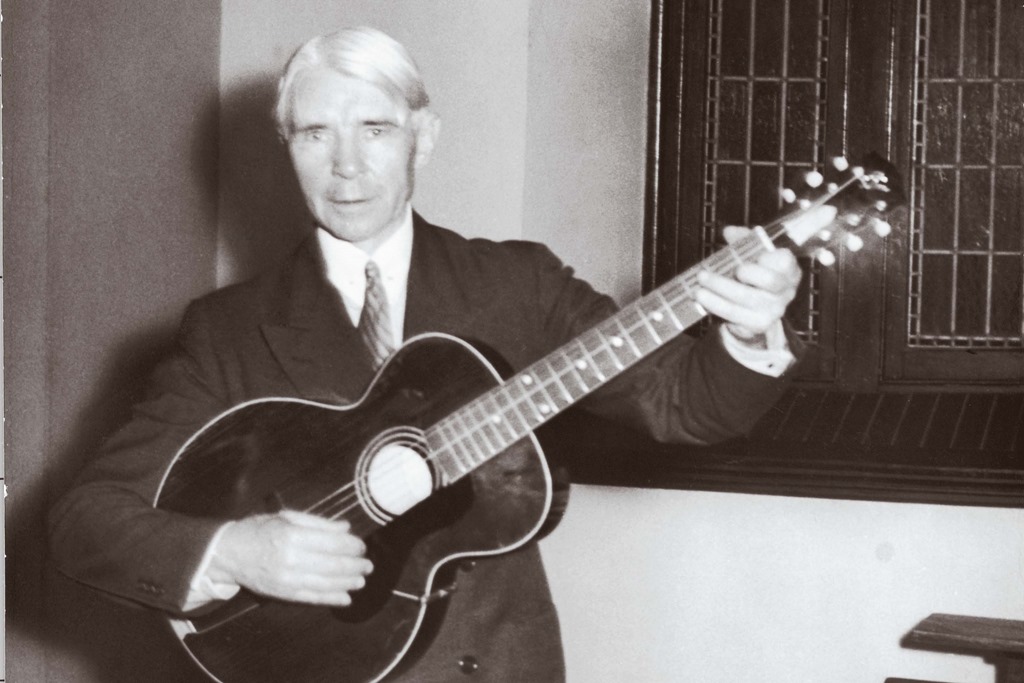
Carl Sandburg. I get the impression that he’s been filed away as a folksy peculiarity, a 20th century and less-original echo of Walt Whitman, an artist not worth considering these days. Readers of this blog will know I find him otherwise: a first-generation English language Modernist, just as concerned with making it new as anyone else in that movement.
The young Josh Homme and Kim Deal get lessons from some old flannel-clad grunge guitarist.
Here’s a piece using words by Sandburg for Halloween. I’ll note that almost alone among the first-generation Modernists he sometimes writes poems about, perhaps even for, children. “Theme in Yellow” can serve as both. Of course, since we’re all “obsolete children” the audience isn’t limited to them.
Anyway, it’s a good piece for the holiday that’s about the whimsy of fear and how far from reach we can hold death. Oh, and in our modern America, it’s also about candy, for which the Jack O’ Lantern’s teeth were meant to warn us.
Sandburg’s poem is just slightly old fashioned—the harvest festival aspects of Halloween are now abstracted from most of us, though it was in Sandburg’s personal experience. But we might still dress our stages with straw, and with cobwebs and lanterns, setting our fears as old.
May all your fears be old.
Today’s music has lots of electric guitars (seven tracks, four different guitars) mostly because I’ve been missing their sound. Lots of coordination to get all that traffic running—and I don’t know if I did right by it—but it was fun while I had time to make some noise this afternoon. You can hear the results with the player gadget below, and if you’d like to read Sandburg’s poem while you listen, it can be found here.
Today’s text is a poem that works in the common garden using another poet’s central image. Christina Rossetti’s “An October Garden” is three lines in when she reveals that her garden isn’t growing nervous grazing watermelons—that what she observes there is the last rose of summer.
Irish poet Thomas Moore seems to be the writer who first struck that coinage, or at the least popularized it. His 1805 short poem called “The Last Rose of Summer” was soon set to music based on a traditional Irish harper’s tune, and the words and sentiments with the associated music has been sticking around ever since.* Moore’s poem is both dark and sentimental, a combination of ingredients that continues to impress audiences. Summarized to its core outlook, it’s a poem about surrendering (at least metaphorically) to loss.
Writing down to the bones & roses: “When the last rose of summer pricks your finger…”
What distinguishes Christina Rossetti’s use of the image from Thomas Moore’s? Rossetti’s is a bit shorter. It’s an unusual form sonnet, just 14 lines, vs. Moore’s 24. Rossetti’s sonnet form is neat: a pair of equal 7-line stanzas and an ABBAACC rhyme scheme. But furthermore, her take on the image is somewhat ambiguous. For one thing she notes there are other, more hardy flowers still around too, but her eye’s on that last rose, and however puny and forlorn it might be, she’s one for the roses and not them. Although no one would confuse her poem with a Modernist poem in the Imagist style, her presentation of the rose is more objective and there are fewer “feeling” words, and in their place: more observational words.
If one abandoned the structure she used, one could “translate” Rossetti’s poem into a free-verse Imagist poem fairly easily. But let me note one more thing about the structure: one could easily think that a need for rhymes has forced some word choices. The last rose “which cold winds balk” reads to me first and last as a forced rhyme. The literal sense is that the winds are still holding-back against this puny but still budding rose, but that’s not a strong statement (absence of the cold winds is less concrete than their presence). The other possibly forced rhyme is repeated twice:** “rosebud which uncloses.” This one is so awkward that I am still evaluating how it works. What a weird way to say what one could say simply “opens.”
There’s a dirty little secret about rhymes. More times than poets will admit, the need to make a rhyme will force a poet into a choice they otherwise wouldn’t make. There are times that rhyming need works like Surrealist tactics such as “exquisite corpse” or randomization techniques, it throws chaos and noise into one’s intent. When the result fails to set off sparks, it’s experienced as forced, a failure—but when it does work, the poem or phrase takes on a new freshness.
So which is “uncloses?” I’m still not sure. If one allows the oddity of the word, and asks what it could say that’s different than “open,” it’s saying that the last rose is making a choice in blooming, knowing that colder fall and then winter to come will make its feeble bloom even shorter. It suggests it’s choosing to not stay closed or to not close back up against the cold and bleak.
Musically I doubt my setting will do for Rossetti’s poem what music did for Thomas Moore’s, but it did give an excuse to break out the Mellotron sounds again. Musical instruments can accumulate associations, and for me nothing says sitting in an English garden like this wobbly keyboard instrument that tried to imitate orchestral instruments; and while failing in verisimilitude, succeeded in sounding like a memory of them.
My performance of Rossetti’s “An October Garden” is available with the player gadget below. If you don’t see the player, you can find all the audio performances here on Apple Podcasts, Spotify, or most other podcast sources. You can find them at such places by searching for “Parlando – Where Music and Words Meet.”
*In that Wikipedia page that I linked above for the text of “The Last Rose of Summer” I draw your attention to the lower sections where the extraordinarly wide range of use and allusion the tune and the text has had is listed. A personal favorite is Robert Hunter’s grief-filled variation “Black Muddy River.”
**There’s an old Jazz improvisor’s trick that when a player flubs a note or makes a wrong choice when improvising, that a way out is to repeat it, or even make it a motif.
Did Emily Dickinson mistake her tone, her presentation? This question occurred to me as I went off into the deeper, album cuts* of Dickinson’s work looking for autumn poems this fall. Her early poem, titled on posthumous publication “Autumn” is charming and very much in a mainstream short poem tradition of the day. If she was seeking publication or just checking in on an honorable hobby of an upper middle-class** young woman, it would do.
The next Dickinson Autumn poem I found and presented,“Besides the Autumn poets sing” is still charming, if self and otherwise referential in a sly way. If I was to “translate” it into the diction and particulars of New York in the 1950s it could be written by Frank O’Hara. I believe she intentionally means that poem’s opening word: “Besides,” and that is not a careless rendering of “beside”. That little “s” makes it a poem about what the poets of her time did “Besides” (meaning “in addition to,” or perhaps “surplus too”) Autumn, not merely poets rendering in verse the season while metaphorically writing en plein air. That makes the poem an expression of what is other than, or in opposition, to what a leading American poet of Dickinson’s day like William Cullen Bryant was writing.
If I was to read this poem in isolation, if it came to me “over the transom” would I make that assumption? I’ll be honest: I suspect most times I’d miss it. I’d hurriedly read the poem as another simple Fall season lyric. I’d miss that “s.”
Did Dickinson intend this slyness, if I’m right in my more careful reading? My understanding of her character is yes, she did. I could be wrong. If writers, if poets, can misunderstand how their tone will be read, certainly us readers, busy and full of our own prejudices, can also do our part to misread or read ourselves into their work.
But then I came onto this remarkable Dickinson poem, one that’s frankly strange on the surface: “The name of it is ‘Autumn’.” Even now, over 150 years after it was written, this makes no pretense to being a conventional poem.
The first thing I noticed was that as a poem of fall, it doesn’t really work—or work the way we expect a poem on that subject to work. Yes, fall leaf color is a common trope for landscapes that have this event.*** But this poem goes overboard if that is all it’s trying to do. Yes, many of the autumn leaves are red, and yes we can say they are blood red. But if that was what Dickinson was intending, and if repetition of that trope might add to its power, I think many readers would think it’s overdone.
And so my first thought was, that must be Dickinson’s intent—to over-do it—because I now trust Dickinson as an artist, and feel from reading her that she often is seeking some doubleness in her expression.
But before I continue with my sense of the poem, let me alert you to two other readings that have been put forward to explain what this unusual poem is on about. The first is that it’s a poem about a particularly deadly section of the American Civil War in the fall of 1862. Historically aware readers often wonder why Dickinson (unlike her contemporary poetic revolutionary Whitman) doesn’t deal with this deadly domestic war directly. Unlike Whitman she didn’t live in close proximity to the battles, but she was the daughter of a politician who had been caught up in the slide into this war, and an avid reader of the journalism of the day. The Civil War reading says this is her recasting of the slaughter of these battles.
If one accepts that idea the images make sense, a strong argument for it. But I’m unsure how Dickinson, even as an aware news-reader, could have received this explicitly gory battlefield scene. I’m unsure that the Republican newspapers she read would have featured detailed descriptions of the slaughter.**** The only way I can imagine Dickinson having an opportunity to pick up these specifically blood soaked slaughter/war images would be if the somewhat self-sufficient semi-rural Dickinson homestead slaughtered their own animals for food and Dickinson (who came to be responsible for the gardening food aspect of the homestead) observed that.
The other reading is that this is a menstruation poem. Likewise, the images can be fitted to that conception. And while we know nothing of Dickinson’s gynecological history (which as readers we need to know, along with the sperm and motility counts of all male authors) there is no barrier here regarding Emily Dickinson’s experience and knowledge, and so I think this one is more likely.
The third possibility is that Dickinson did intend this to be another autumn poem, just with stronger imagery; and if she may have misread how the poem’s tone would be encountered by others, that by this time in her life she didn’t care. She could intentionally have brought in those things other, modern, readers have seen in it, warfare and menstruation, and created one of those bidirectional images where the thing signified and the images used to illuminate it are of roughly equal importance. One clue to that is that she’s once more making use of quotation marks. “The name—of it—is ‘Autumn—’” the first line seems to say we need to examine that word. What could we find on examination? One thing I, the punster, finds is “Awe-tum.” The other thing she may be saying is: “Well, it’s got a common name we might find unremarkable, a mere label for a season, but it’s serious business to nature.” Then, all that blood—and in my reading, the intimate linkage to human fertility—is to make that case, to drown that conventionality.
In such a case, the imagery takes over from the subject. If in the process of composition, the poem became not about autumn but about menstruation, then autumn becomes an intense outward image for what would have been a private, if widely shared experience.
Given that frankly feminist examination of literature is no longer a rare thing, I wonder how unprecedented this was poetically as a subject? Anyone know of any poem preceding Dickinson’s that has a plausible focus on menstruation? A passing line in the old ballad “Willie O’Winsbury” doesn’t compare to this level of imagistic intensity.
Rather than some colorful fall landscape photo, here’s Anne Briggs whose singing helped bring the ballad “Willie O’Winsbury” to the fore.
Well, all that talk, and the comic incongruity of mansplaining my experience of Dickinson’s poem, but this poem is lovely again as word-music. Dickinson is famously sing-able, so I was charmed to put even my shaky voice on the line here. I keep thinking I’m building up to a big-time orchestral score or a mass of synthesizer lines, but today I’m musically down to just acoustic guitar once more. This past week, I found online an entire 90 minute coffeehouse set by Tom Rapp and Pearls Before Swine, and the melody today is similar to one used in Rapp’s “There Was A Man.” I even planned singing a couple of verses of that song in a sort of a round with Dickinson’s, but I couldn’t make that work.
The text of Dickinson’s poem is here. My performance of it is available in a player you should see below, or on most podcast platforms or Spotify as the Parlando Project.
*(in geezer voice) In my day there were musical collections sold on disks, and they had to have a bunch of songs, not just the hits. A kind of wireless streaming service called “radio” sometimes played cuts that weren’t the ones that you’d pick out for your playlist. It was a primitive existence, but we didn’t know any better back then.
**It’s not straightforward to place the mid-19th century Dickinson household in class hierarchy. Clearly they were a prominent family in their town, so in the context of Amherst, likely the 1% for the latter half or more of Dickinson’s life. But Amherst also wasn’t a wealth center, thus my approximation.
***It occurred to me as I looked at my series of autumn poems I’ve been presenting this month, that there are large portions of this globe that don’t have the “theater of the seasons” that Dickinson’s Massachusetts and my upper Midwest share. The whole leaf-turning fall colors event is a big deal and traveling to rural areas where the largest canvases can be seen is a thing here. One academic paper behind a paywall that I found an abstract for even suggests that fall-colors tourism in the mid-19th century to New England places like the Franconia Notch might have contributed to this Dickinson poem.
****The political career and situation of Dickinson’s father is too complex a subject to detail today. He was a unionist Whig, who supported the compromises with slavery-states meant to prevent the Civil War, while likely opposing the practice of slavery itself. When the Whig party died out it was largely absorbed into the newly founded Republican party, which included those who were more militantly opposed to slavery and such compromise.
Dickinson’s father stood with the compromisers who thought preserving the union primary over the more aggressive anti-slavery factions of the Republicans. It was the election of the first Republican President, Lincoln, who presented himself as unifying those two wings of his new Party which was the proximal cause of the outbreak of the American Civil War—in other words, the slaveholders in slave-holding states figured Lincoln wasn’t serious in acceptance of the ex-Whig and unionist wing of Republicans and that he would allow the more abolitionist wing to take power.
Once the war broke out, there was considerable agitation in the North to settle with the Southern slave states, either to reform the pre-war union or to accept the formation of the new slaveholder Confederate nation. A prime argument for this was the deadliness of the ongoing war. So, in general, Republican papers in the day would not have been in the business of publicizing the grizzly nature of the warfare instead of bloodless gallantry and sacrifice.
Since we’ve re-established that Emily Dickinson can do simple, here’s a lovely poem of hers that introduces more than a touch of “meta” to her poetry.
This poem’s first line starts the meta thing right off. You could quickly read the opening word as “Beside” without the s, and then the poets are singing in the presence of Fall. I suspect Dickinson wished to include that element but subvert it. “Besides” means in this context “beyond that, in addition to.” So, there’s this thing: “Autumn” that poets sing about that is what? Well, it’s prosaic (i.e. prose and routine, not poetry and unique/charged). It’s small: “few,” and “little.”
Next stanza, the song now riffs with “few:” “A few…mornings,” “A few…eves.” Dickenson’s diction is still casual here, but she drops a couple of unusual adjectives with that repeated pair of fews. Unusual adjectives are often a weak crutch in poetry. Throw together some out-of-the-blue random adjective with a noun and you’re suddenly all surreal, poetically mysterious and creative—but more importantly, do these unexpected modifiers create a charged image?
“Incisive mornings,” is a bit of a play on words. Incisive here means not just perceptive, as in the coolness and lack of light predicting winter’s shorter days and lack of warmth: but taken in its other meanings, its winds are cutting and daylight is being incised, removed. “Ascetic eves” also speaks of removal, evenings no longer long with lingering light and it hints at spiritual matters this removal may reveal.
The second stanza ends with two references to poets, presumably examples of the ones mentioned as the poem opens: William Cullen Bryant, an older poet contemporary with Dickinson, and James Thomson, a Scottish poet of the 18th century. Neither are well-known today (though Bryant was a very important American cultural figure in his time). Dickinson mentions them and says that the stuff in their supposed Autumn poems are “gone.”*
In the context of these two stanzas, Dickinson is saying: the existing poets aren’t telling us much about autumn. I think that Dickinson’s sly inclusion of those two concise, precise, and original adjectives is cutting. She’s showing that in two words she can say more about autumn than they can in some long-winded poetry.
Sheaves get mentioned in passing in Dickinson’s poem, so I get to exercise my love for Dutch painting
The second half of the poem has Dickinson unleashing her style of poetry against these musty odes. The third stanza’s word-music is just wonderful. I won’t dance about its architecture today—you can just read or listen to it—I’ll only point out that the end-words “brook” and “touch” have a lovely rhymish echo, even though they aren’t even slant rhyme. This stanza has the superb line “Sealed are the spicy valves” which partakes of the musicality but is an elusive image too. As I read it, I thought of gardeners in our climate planting garlic cloves this time of year, but garlic was not yet a thing in Emily’s New England. After an hour or so of trying to decode the image, to determine what specific spice plant in Dickinson’s time and place is referred to,** I now think this a more generalized image of withered flowers. “Valves” is used only one other time in Dickinson’s poems, in the more famous “A Soul selects her own Society” poem where they appear as “the Valves of her attention.” “Spicy” I’ve judged now is just a biologic/erotic reference to flowers pollination role. We may read the valves anatomically in various ways, but eyelids*** may be intended, as in the closing two lines of the stanza.
The final stanza is Dickinsonian too: nature in Dickinson’s poems is often personified in comical and non-charismatic species, here squirrels. Comically, her thoughts on the matter of autumn and poetry will be of great interest to the squirrel, and in this image she’s pointing out her non-existent status as a literary figure compared to Bryant et al.
It could just be a handy, casual sentiment to finish the poem, but Dickinson may be earnest in her concluding phrase: her mind is the sun that can illuminate the lack of sunlight as Winter solstice approaches.
Mostly acoustic guitar for the music performance today, though if you listen in the background you’ll hear a little harmonium and tambura. You won’t hear it in the rhythm or the instruments timbre, but I put a hidden reference to one James Marshall Hendrix in the music. You can read the full text of Dickinson’s poem here as you listen with the player gadget below.
*Thomson wrote the lyrics to “Rule Britannia,” and Dickinson is likely referring to his long Miltonic blank verse poem called “The Seasons” in her 16 line one. Bryant’s poetry may be largely forgotten, but his former cultural salience is still honored with a lot of school, street, park, and place names in the U.S.
**As an adult, Emily ran an extensive garden in the largely self-sufficient Dickinson family homestead, and in her youth she studied botany and produced a remarkable herbarium book filled with precisely identified plants—so it’s not crazy to think that she could have had a specific plant whose lifecycle she understood. A full-fledged farm field operated right across the road under Emily’s window at the homestead. The “sheaves” in Thomson’s poem wouldn’t have been abstract to her either.
*** If one wants to get more biographical in reading the poem, Dickinson famously went for treatment to Boston for some tantalizingly unspecified “eye problems” a few years after this early poem was written.
I sometimes wonder if I overstress the mysterious, even mystical, element in Emily Dickinson. Perhaps I’m overcorrecting for the too-limiting image of the charming eccentric writer of little poems that was her package-label when I first learned of her in the middle of the last century. I’ve since wanted to put the small print somewhere on the Emily Dickinson carton: contents may be unsettling during reading. Sold by weightiness, not boastful volume.
But Dickinson was at times a writer of lighter verse, enclosing seemingly cast-off poems in letters to friends. Her classmate (and in Dickinson’s lifetime, more literarily successful) friend Helen Hunt Jackson would write and publish casual poems about the seasons or travel. When Dickinson wrote this way, was she bending her art to expectations for women of her time, or was she expressing a playful side of herself? Humor, as in satire and incongruity, is an essential part of Dickinson’s verse, even her darkest verse. When it’s employed without mysterious, ambiguous themes, that same sense of humor can produce a poem like today’s “Autumn” by Dickinson.
Even the part of me that loves to search for deeper meanings and undercurrents has trouble finding them in this poem. If forced to rely on that I could offer that her concluding remark that “Lest I should be old-fashioned, I’ll put a trinket on.” could be read as a comment on the loosening of plain-style 18th century Puritanism in Dickinson’s time. But let’s be serious: this is lighthearted, an example of the “happy Autumn” poem, and such things can make good songs.
Tiny clusters of turning leaves, like splatters on a green drop-cloth.
So I tried not to weigh this one down: major chords, acoustic guitar, bass, low Mellotron strings, and a touch of piano with the sustain pedal down. You can hear it with the player gadget below and read this short poem in its entirety by clicking this link.
I was at the Midstream poetry reading series last night, and by choices, I therefore had to miss out on the wisdom that would be passed on by the elder chieftain of my nation who was speaking in the same town that night.
It’s often thought that age heightens certain perceptions, certain outlooks. In age one has a feeling for repetitions, the way that ox-turning time keeps bending back on itself so that the place one is plowing is beside the past and the future is just one row next over. There’s also a lessening of thought of one’s own self, which after all is a diminishing asset, one’s storehouse filled only with memories that the rats nibble at all night long.
So I missed what our aged chieftain said. From these considerations of age I’m sure he could hardly find time to speak of himself, which matters less and little; and instead he likely spoke from his heart, wise from his own failures far exceeding those of the younger ones, of how we can forgive and remember, and how our nation can continue to be born, cared for, urged on.
Instead I heard fellow poets read. Oh, we fail—as all artists do. We talk of ourselves, even us older ones. And when we take a break from that we talk of others imperfectly. We speak too softly, too loudly. We forget to reach for the music, or we do stretch for it and then fail to hold onto it. We search for beauty and come up with the same things over and over again, and how can we make that interesting? We are gloomy, forget to laugh, and hold our work back for funerals.
A graphic representation of the wisdom of poets such as myself
It was an older crowd last night, almost enough to make me feel younger for the couple of hours we were together. Today’s piece, Rainer Maria Rilke’s “Autumn Day,” as much as Shakespeare’s piece from last time, seems to speak of the experience of age, but Rilke is much more directive. One doesn’t often see a poem so full of “You” statements as the final stanza of this poem is. I’m not sure of the idiomatic nature of “you” in German, the language Rilke wrote this in. There’s some sense that the rhetorical you in the poem may be directed at oneself: so Rilke speaking to Rilke; but as I read this poem, I can’t escape the sense of Rilke speaking to me, and as I perform Rilke’s words in my translation, I expect that you, particularly if you are an older person, will hear it as speaking to you, so concisely do those last five lines seem to outline this stage in a lifetime.
If you’re curious to see a number of other translations and the original German, see this link.
But here’s why you come here and have read this far into this post: Rilke wrote this in his 20s. These are not the biographical autumnal musings of an older man, and I’m not sure it’s even a poem adopting that persona. I almost translated the title here as Harvest Time but chose to stay with “Autumn Day” because the copious other English-language translations used that for the title and using a different title would not allow searchers to find my fresh attempt to carry Rilke’s work into English.
Those who’ve followed my previous translations from other languages will know that I stress trying to express the imagery the author uses in a way that communicates to the modern English reader. Since that is my prime concern, I don’t make much of an effort to try to reproduce any of the word-music from the other language, but this time I did keep to a feeling of iambic pentameter for word-music’s sake. Much of my difference from other translations* was trying to sharpen the harvest imagery Rilke uses in the opening seven lines. The overall effect I aimed for was to clearly convey the weight and fullness of harvest bounty.
The final five lines converge more into a consensus with the other translations. One divergence: I read in one German speaker’s comment on their translation that “Alleen” (translated by many as alleys or avenues) was what they would call the tree-lined boulevards predominate in Rilke’s time. Not only did this strike home with me, who bicycles each day on tree-lined streets in my own town and time, but it seemed to be the linkage called for with the poems final image of following the restless wind-blown leaves on the pavements.
So back to this poem that may be read as a meditation on later life written by a 20-something. I think Rilke was trying to convey the harvest feeling, the fall into wintertime and that cyclical fallow season. Even as a young man he was able to convey this feeling an old man might appreciate. He didn’t need to be an old man to know this, he just had to read the book of nature which is older than all of us.
I often laugh as I think I’ve come across some wisdom from old age. “Aha! I’m just a slow learner” I exclaim.
To hear my performance of my fresh translation of Rilke’s “Autumn Day” use the player below.
Before I reveal the most listened to piece during this just past summer, indulge me in a little “shop talk” as I report a few things about how the listenership for the audio pieces and readership for this blog have been going this summer.
Listenership on the audio continues to be somewhat volatile. June’s listenership was pretty good, July’s was excellent, and then August’s listenership fell to average at best, and early September followed that August trend.
This could just be “noise in the signal.” Or it could say something about seasonal variations in listenership. Spotify Parlando audio piece listenership (which I get broken out separate from those that listen on the player in the blog posts and those who catch the audio pieces on podcast services like Apple Podcasts, Stitcher, Player.fm etc.) didn’t follow the pattern, rising throughout the summer. Spotify has just started allowing their podcast audio to be added to playlists with the newest version of it’s mobile app, and this could help in the future, as it’s a convenient way to collect favorites (or to be honest, skip the ones you don’t care for).
And that last factor could be part of it too. It could be that folks just liked the July audio pieces more. My series on Spoon River Anthology, performed particularly poorly in numbers of audio listeners, something I wouldn’t have predicted. I’m comfortable with the thought that the deliberate eclecticism of genres I use will lead to differing responses. Still, the abject listenership failure of what I think of personally as one of my best pieces: August’s “Fiddler Jones” from that Spoon River series kind of bummed me out. Oh well, pieces sometimes get a second wind once they enter the long tail of our archives. Maybe that one will.
For a guy who likes data, the readership of this blog has a completely different trendline. That’s been on an upward slope ever since the launch of the blog, and then last April we had a huge readership jump during our U.S. National Poetry Month celebration, nearly doubling our best previous month’s readership. Readership held up all summer, and August, the same month that disappointed for listenership, set a new highest readership. There’s a week to go yet in September, and it’s already second only to that new readership high, and on track to surpass it before the month ends. Go figure…
So what was the most popular piece this past summer?
Back Yard by Carl Sandburg. Well this piece does sound pretty good too, and Sandburg is deserving of this level of attention. Not only does Sandburg not get enough credit for the Imagist integrity of his early 20th century verse, but this poem is lovely sounding. Sandburg’s “Back Yard” is ready to take the fixative of the silver moon rain and change into a moment, which then changes into another moment—always still, always changing. Always still, always changing. Ah, life….
Americana artist looks to break through with his hip voicing of the Fsus chord
Things I find odd about how Sandburg has been judged: first there’s the judgement that he’s just not subtle enough, when I say those critics can’t see the subtleties—which if I’m right, proves my point; and secondly, the evaluation that his poetry is just broken up prose mislabeled as verse. That would be odd, Sandburg has an important secondary career as a popularizer of what we came to call “folk music” in the U. S. and was serious enough about developing his guitar chops that he asked Andres Segovia for a lesson. There’s music behind many a Sandburg poem, like this one, and composers more accomplished than I find it.
It may well be that the word-music of poetry and the music—of well, music—are two separate fields to be judged differently with different instrumentation, rules, and aesthetics. But until this is shown to be surely so, I tend to trust the judgement and tastes of musicians and composers over the judgement and tastes of literary critics and theorists on these matters.
Give a listen to Sandburg’s “Back Yard” with the player below. If you’d like to follow along with the text, you can read it here. And really, thanks for listening and reading along as we encountered music and words here this summer in order to see what we find!
Is everyone aligning themselves with autumn already? Here we’re looking back at summer and the audio pieces that the audience made their most liked and listened to, and we’re getting near the top of the countdown, moving toward the most popular single piece of the past three months. Today we look at numbers 4, 3, and 2.
4. Summer Silence by E. E. Cummings. Another one from our “Before They Were Modernists” series, “Summer Silence” is an early E. E. Cummings poem published when Cummings was a college sophomore at Harvard. One doesn’t usually associate Cummings with constrained poetic forms, but “Summer Silence” was written in 1913 in the Spencerian Stanza form, long before he could have learned from Hawk or Susan.
I try to do the best work I can with recording the music compositions here within the rapid pace I’ve accustomed myself to with this project. My equipment is modest, and my recording engineer’s skills are too, but I make the effort. That said, this one was recorded on a cell phone sitting in a cabin on the North Shore of Lake Superior: just me, an acoustic guitar, and a few summer birds that you can hear at the very end that wanted to enjoy July there too. The text of Cummings’ poem is available in the original post linked in bold above.
3. Higginson’s June by Thomas Wentworth Higginson. From another series, one that started before this summer but carried over into it: “The Roots of Emily Dickinson.” Higginson is essential to the Emily Dickinson story, the literary insider who Dickinson sought out in what I think was an attempt on her part to verify the worth of her unprecedented poetry. They met at least once, but the rest of the relationship was carried on via letters, of which we have only Dickinson’s side of the correspondence.
From Dickinson’s replies and Higginson’s later recounting, it’s been summarized that Higginson “didn’t get it,” thinking that her work needed some further polish to appeal to the mid-19th century public. Here in the 21st century we feel pretty smug about Higginson, thinking him like the infamous record exec who passed on the Beatles.*
Higginson had a highly eventful life outside of the Dickinson connection, as I’ve talked about in another post, but one thing I discovered this year was that Higginson at least dabbled in poetry himself. I can find no context for the poem of his I used here, but I speculated that it could be something he wrote in his youth. Whenever and for whatever reasons he wrote it, it is a good short summer lyric. And coincidentally it’s opening two lines could stand as the better judgment of Dickinson’s genius as it does in his poem for summer.
The music for this one is as electronic as “Summer Silence’s” is acoustic. The text of Higginson’s poem to June is also in it’s original post bolded above.
Higginson wrote the preface and helped edit and promote the publication of the first collection of Dickinson’s poems two years after her death. The flowers on its cover are usually called Indian Pipes and they were said to be a favorite of Dickinson’s. It’s a truly odd summer plant, which my living wife found and photographed in Northern Minnesota this year. The other common name for this translucent apparition: the ghost plant.
2. For You by Carl Sandburg. I kept going back to Sandburg this summer, and you the readers and listeners came along with me. Why? I frankly find him healing.
That either of those Sandburg poems could be used as memorials does not make them passive elegies, and “For You” is future-focused—just as it is full of ghosts. I’m not familiar enough to say how English speakers in the British Isles, in South Asia, the Antipodes, or elsewhere feel of the current times and challenges; but in Sandburg’s America when I read or listen to “For You,” I too feel our ghosts and feel our future—close—even if each are unreal as we stand before the great door of a year with great hinges.
*”Guitar groups are on their way out” is the famous rejection phrase, attributed to Dick Rowe of Decca Records. In Rowe’s defense, Beatles producer George Martin has been quoted that the Decca audition performance was not very good and that he wouldn’t have signed them on the basis of it either. A few months later, Rowe took a tip from George Harrison and signed another of those guitar groups, The Rolling Stones. Sometimes you get a second chance.
It’s that time again, when we look back on the past months and see what pieces were the most liked and listened to this summer. I do it countdown style, so here we start with the 10th, 9th, and 8th most popular pieces this season.
10. Pods (Neponset) by Carl Sandburg. Do I say Sandburg is the forgotten Imagist too often? Maybe, but to my mind this is one of the finest short Imagist poems I’ve come across in my wanderings through early Modernist verse. Another thing I keep trying to counteract: the idea that Sandburg is simplistic and that his verse is absent the levels of ambiguity and ineffability that “great poetry” is said to offer. This 7-line poem about a small Illinois village with gardens and the train passengers traveling to see scenic wonders is an example.
My family has to put up with an amount of interruption by the focused and repetitive work of producing these pieces. Listening to the process of composition, when it involves (as it sometimes does with me) a lot of trial and error is trying—but listening to the final mixing stages is excruciating. I mix at modest volume levels, but I’ve been told that headphones are not to be trusted in that work—so they hear these pieces sometimes being wiggled this way, and wrung out that way, over and over. Not a good way to appreciate a piece.
So, it was a surprise this summer when my wife came in and told me this one sounded like one of the best ones I’ve done. Maybe it made it to number 10 because it stands to be listened to more than once?
9. I Saw a Peacock by Anonymous. Long a leading composer in the folk music field, Anonymous can also craft a pretty good Surrealist poem with a humorous trick: the line breaks lead you to connect the thing previous with the last part of the line—when the “real” and much more mundane connection (as opposed to the wondrously apocalyptic thing you believe you’ve heard) is in the next line, after a breath pause of the line break.
I’ve read that this poem impressed Margaret Atwood in her early childhood with the wonder that poetry could create.
I seem to be working more and more with string and other orchestral compositions this summer. Part of that is that I’ve always been drawn to things that mix the attack-envelope of percussion instruments with the varieties of note length that stringed instruments, particularly bowed string instruments, can create—but it’s also because I was able to afford some additional orchestral instruments to play via my guitar’s MIDI pickup or with my little plastic keyboard this summer.
Didn’t work? OK, try Black Mountain school with polka. No? Dubstep Hildegard von Bingen! Hard Bop Thomas Hardy! Still coming? Tell the gunner to give’em both barrels then. No, no! Not those barrels…
8. For Once, Then, Something by Robert Frost. Here’s an example of why I’m particularly grateful to the hardy listeners of these pieces. While I’m constrained by difficulties in obtaining permission to present writings still in copyright, I hope that you can see that I vary the type and the outlook of the poetry and other writing that I can and do use. I try too to mix Poetry’s Greatest Hits with deep cuts from esteemed poets, and more than a little of the lesser-known but worth considering.
Of course, for some (Many? Most?) the idea of poetry as an everyday thing that is not some mix of fearsome and intended obscurity, snores-ville decorative excess, and hoity-toity crap for those with nothing better to do has already removed them from reading or listening here.
Well then, as I’ve described this project from the beginning, I combine these words, mostly poetry, with various music. While people might just ignore poetry, they actively hate music that they don’t like. That disgust leads some (Many? Most?) to cling to a genre of music they find most able to please them, and to mark other sonic places as “here be monsters”—hideous creatures that disrespect what is right in music.*
Music doesn’t know what’s right and proper. It just wants to sound itself.
So how many people are out there who want to hear even the beloved, famous, respected American poet Robert Frost chanted to a pulsating Electronic Dance Beat arrangement?
Well, if you are the kind of people who read, listen, follow, and help propagate what the Parlando Project does, there are enough of you to make this the 8th most popular piece this past summer!
*By the way, if you don’t like some of the audio pieces that are presented here, that’s OK, even expected. Given that I’m pushing my capabilities as a composer and musician, you might even agree with my intent, yet not wish to negotiate my actualities. That’s part of why I like to mention that we vary things: you may like the next one that comes out, or enjoy taking a look at the nearly 400 pieces we have in our archives.
The Parlando Project audio pieces are available on Spotify. With the current Spotify mobile app you can even create playlists of your Parlando favorites—and exclude your “not so much favorites.”
One of the nice things about this project is that I’m still running into poets that were essentially unknown to me. This is like one of the joys of my youthful musical life: digging through used LP records or a bin of “cutouts” looking for an interesting title, some compelling cover art, or an intriguing song listed, and bringing home a record that as far as I could tell, no one else knew.
In theory this process is easier now, expansive catalogs of recordings available instantly for streaming, but I’m not sure if my son or anyone currently young will do a revised version of that. I suppose part of that was the imminence of the next object, the foot-square cardboard housing with or without wear, perhaps with someone’s name scrawled on the corner against sibling or dorm room misappropriation of the thing, or the shameful diagonal corner amputation, branding the still shrink-wrapped “cutout” record a failure of expectations.
But for poetry, particularly for poetry before 1924 that is in the public domain, there is no lost former ubiquity of sources for discovery of the less-known or passed by, and happily the Internet makes them near alike in availability: Robert Frost and Edna St. Vincent Millay—or Fenton Johnson and Charlotte Mew. And so I can come upon work by Louise Bogan who published just over 100 poems in a long 20th century lifetime where she was perhaps best known then as being the poetry editor of the New Yorker magazine for a few decades.
Louise Bogan. I got nothin’ snarky to say today.
I’ve only started to sample her work, but she has a very interesting voice. One could compare her to Millay, and like Millay a complex examination of love and romance seems to be a prime subject, and like Frost she uses metrical and rhymed verse while having a thoroughly Modernist outlook.
Other than the vagaries of fate and the culture of her time, there’s no reason for her work not to be better known. Take today’s example. “Song” is as condensed in expression as it’s title might lead you to expect. It’s a love song of a kind, but its kind isn’t conventional. Unlike some other poems of Bogan’s, there’s also not a single unusual poetic or high-culture signifying word in it. It could have been written yesterday, and it could be sung yesterday as a song for general non-literary or art-song consumption, streamed on Spotify* or iTunes.
And of course, thanks to the magic of the Parlando Project, it now is. Also thanks to the current limitations of the Project, I had to sing it, but then it’s better that it’s sung than not. If somewhere out there there’s a charismatic singer for this, that would be wonderful.
Bogan’s “Song” is a request, a command, a begging cry, a lament, a report, a prayer, a need, a meditation, a love song. You can hear it with the player gadget below. The full text of “Song” is here. You may note that I come in singing with stanza two in the version I present. I think of this song (as I performed it) as a repeating cycle capable of expressing all of those things above, so it can start with either stanza. I also repeated the opening lines of each stanza, a tactic ingrained in me by blues singers.
*Speaking of which Dept. The audio pieces featured here have been, from the beginning, available from the same places that you get podcasts, such as Apple podcasts and the like. Spotify also has podcasts in it’s app, and as of late this summer you can add Parlando Project pieces like this one to a Spotify playlist on the Spotify mobile app, which seems like a good way to spread the news about what the Parlando Project does.