The Naked Truth

Last time I had a chance to record a new piece using guitar, I rattled the bones of a Jazzmaster amid synth keyboards played with the same guitar. Monday I had another chance. My studio space was quiet, I could have made it loud – or I could open a sensitive microphone. Organic, wooden music? I uncased an acoustic guitar. I do like the directness of that instrument. I have microphones setup for recording in my studio space, so it’s as simple as opening a preset template on my computer recording software, arming the tracks, and clicking the red screen button.

The contrast that resulted could have been even greater. I tend to attack the strings on an acoustic guitar pretty hard. I use a flat pick, but I’m most often not strumming the way other plectrum players do. Instead, I skip from string to string, not striking them consecutively or with a “boom chuck” alternative strum either. I use that single flat pick’s point to do in succession what a “finger picking” guitarist does.* Many years ago when I tried to learn how to finger-pick, I noticed that many patterns didn’t strictly require that you strike two or more strings simultaneously, and I just spontaneously started to move the single point of a flat pick around to play what I would have done using thumb and fingers.

I had a new song to record – really new. Over the weekend I decided to crack open my old paperback of Paul Éluard’s Capitale de la douleur, Mourir de na pas mourir , Éditions Gallimard, 1966. The book’s entirely in French, and I can’t remember what bookstore I found it at in Iowa. As I’ve mentioned occasionally here, I had the impression that French poetry was an important influence on English Modernist verse, and living in a state (Iowa) that retained some French place names and seeing French on signs and labels when I visited Canada for fishing trips as a kid made me feel that French was a logical second language for me.**

Somewhat like finger-picking, I was a washout studying French in school. I had a terrible time pronouncing the words anywhere near correctly, and the introductory classes I took in high school and in my foreshortened college years had nothing to do with the French poetry I wanted to get ahold of.

So, kind of like guitar playing, I just went self-taught. Back in the 20th century I brute-forced my way through a handful of poems with a French-English dictionary and vague memories of basic French syntax and grammar from my school-room failure. Eventually, it was just easier to get the poetry already translated, where and when available.

It was only once the Parlando Project got underway in the twenty-teens that I returned to translation. Nearly all the English translations I had read are not in the public domain and free to reuse. And furthermore, I found that not every poet’s work I was interested in had even been translated extensively into English. This was true for many of the Dadaists, and I was also somewhat surprised that it was true of Éluard.

Éluard, as best as I can tell, is a big deal in Modernist French poetry. Present at the creation of Surrealism. Not just an important avant-gardist, admired for his love poetry too. Patriotically valorized for being a stalwart member of the anti-fascist Resistance during WWII. But none of that makes him all that important in America.

I wanted to go through the early poems collected in my book that would be in the public domain. Many of them do not have English translations I can find propagated on the Internet. I used my limited French vocabulary to scan them for what looked like interesting lines, and concentrated on the shorter ones that fit this Project’s needs.

I took the ones I picked out and put them through machine (computer) translation. Machine translation has gotten much better in the past few years,*** but it still doesn’t produce poetry. What it does produce seems, to my inexpert eyes, to be mostly accurate glosses of the literal poem. My job is to take those words, discern what they are trying to represent, and to make that into a poem that will seem vivid to a modern American reader.

In that process I would find even a pristine word-for-word translation inadequate. I want to translate the sequence of images as much as the words, and I want the result to have some musical or incantatory power (even if I don’t usually go so far as to try to duplicate a meter or rhyme scheme).

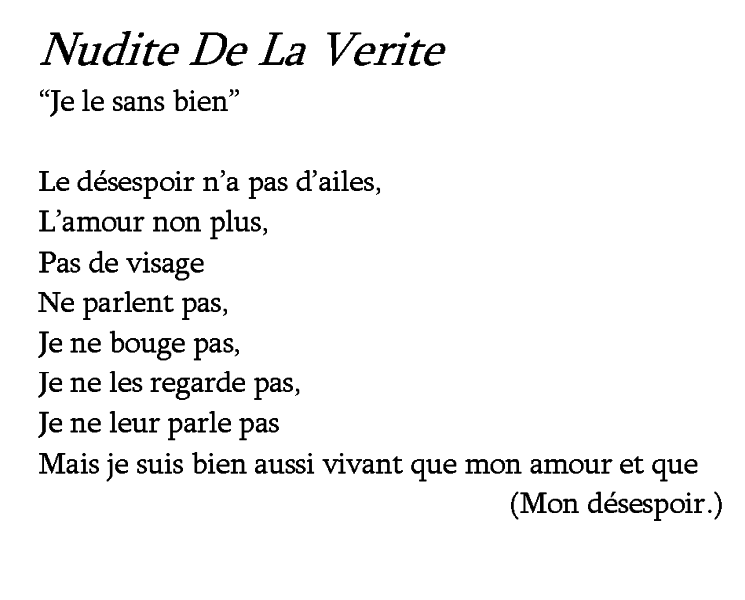
The Naked Truth in French

The poem, “Nudite De La Verite,” in its original French

.

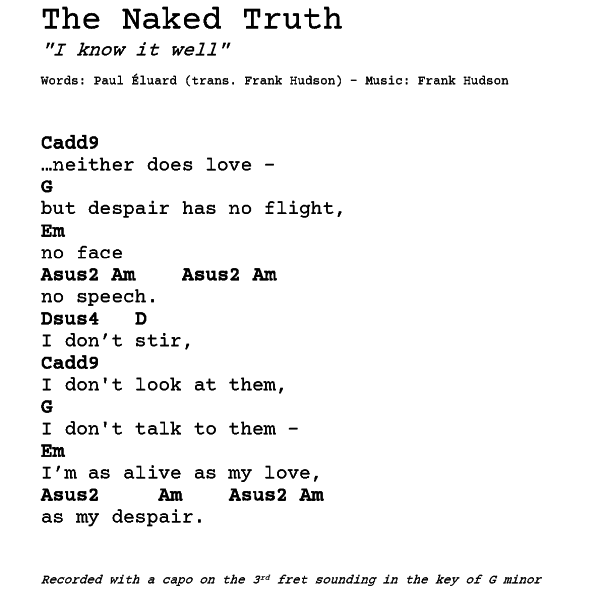
Éluard’s “The Naked Truth”  was not hard to work with. There’s not much wild imagery to it. There is the image of the incorporeal state of despair that has no wings in the literal translation. I decided to sharpen that to “no flight,” both to link it with the rest of the short catalog of always-present no-action and so that the sound of “no flight “ can better flow into the “no face” that follows.

I really wanted that negative flow about resistance to despair, and for that I made the most significant choice to change the sentence structure of Éluard’s text, which has the line stating despair at the start followed by the line about love. I reversed the order, putting the line about love first, almost as an interrupted side-thought that prefaces the statement about despair that we will momentarily think is what all the adamant stubbornness is about – until we get to the payoff at the poem’s end.

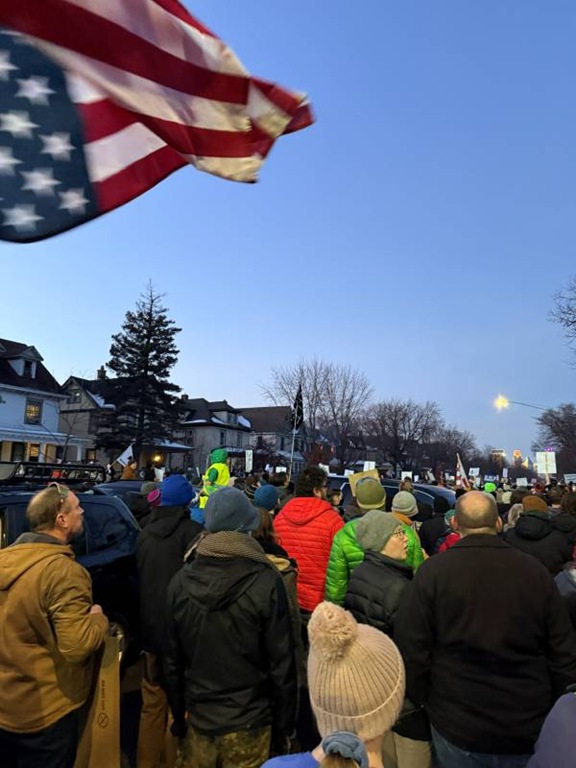
Perhaps this isn’t the best choice? It’s not the order Éluard wrote down in French, and I want you to know that I changed that order. I may have been influenced by the way I, and many others feel – particularly in my town – with the current regime and its performative cruelty and callousness. Goddammit, we might see this through this little poem: a hope that our level of our despair at those things must be equal to a level of love.

The Naked Truth

My version in English, presented as a chord sheet for those that want to sing it themselves.

.

You can hear my musical performance of my translation/adaptation of Paul Éluard’s “The Naked Truth”  with the audio player below. What? Has any such audio player taken wing the way your despair or love hasn’t? Well, I offer this consolation: a highlighted link that will open a new tab with its own audio player.


.


*For the added volume and sharp attack, some guitar finger-pickers use picks too, but different ones than a flat pick – typically a plastic thumb-pick that fits ring-like, but over the distal part of the thumb, and metal or plastic picks somewhat like half-spoon thimbles on one to three fingers. Others use some combination of fingernails and flesh. I have terrible nails and my skin can only allow me to play a limited amount of time with my thumb or fingers on bass. I tried to use fingerpicks as a guitarist, but found them finicky to manage.

**If I was a kid in my present residence, it would be natural to have gravitated toward Spanish. While my town has a significant number of Francophone African-Americans, Latin American Spanish is often in the air around here, and whenever I delve into Latin American poetry I find great riches.

***I suppose these computer-translations could be called Artificial Intelligence of a kind.  The AI label gets thrown on a wide range of things these days both for promotion and disapproval. In my defense I’ll point out that computer translations aren’t “generative AI,” the thing that (deservedly) gets the most heat. When I type Éluard’s French into a machine translation entry box I’m not asking it to generate some reheated reprocessed slop of other, uncredited, artists’ work in order to present the pretense of originality. I’m asking it to do what I did when thumbing through my French-to-English dictionary, along with making some effort at producing an understandable syntax order for the resulting words. As for other AI issues: I casually assume my request to render a 35-word poem has a modest carbon footprint.

I still end up working with French-to-English dictionaries to check significant words, to see examples of the words or phrases in use, and to make at least an effort at understanding possible idiomatic usage. Would it be better if the poetry was translated by a bilingual poet with extensive knowledge about early 20th century France? Yes, but I’m not sure that Éluard’s fate has given us that – and so I make my efforts.

Dolphins (Heroes)

I live in a city where 12-string guitars are over-represented. Since I’ve only lived in Minneapolis for 50 years, I can’t say for sure why that’s so. Folk-revival pioneers Leadbelly and Pete Seeger, likely the ur-source for the instruments post WWII use, have no direct connection, but by The Sixties™ this powerful but awkward branch of the guitar family had a nexus of players here. The guitar playing other two sides of the Pythagorean Koerner, Ray, and Glover trio played 12-string. Leo Kottke made the beast a virtuoso instrument while working the small clubs and coffeehouses of the Twin Cities. John Denver had fallen in love with a Minnesota girl and played a lot of 12-string (and who can say what is the cause and effect there). By the time I arrived in the Seventies, Ann Reed, Peter Lang, and Papa John Kolstad also played 12-string in small venues. The year my ten-year-old Pontiac rolled into town, a local college student, Steve Tibbetts, was self-recording his first LP featuring 12-string landscapes pebbled with percussion over which roamed howling electric guitar wolves.

At that point I owned my J C Penny’s nylon string guitar and a weird amorphously shaped Japanese electric guitar I’d bought at a flea market and for which I couldn’t yet afford an amp.  Accommodating my new hometown, I soon felt I should get a 12-string guitar. A year or so after arriving I managed to afford a Cortez 12-string acoustic which was sold as a sideline item at the local Musicland record store. My memory was it cost $79. Designed to outwardly look like a “professional” instrument at the lowest cost, it could have been the music equivalent of costume jewelry or a stage prop. As these sorts of things go it wasn’t as bad sounding as modern forum-dwelling guitar aficionados would suspect, and mine had pretty good “action,” reasonable string height to allow easier fretting.

Later in the Seventies I added a DeArmond sound-hole pickup and I played this guitar with the LYL Band, and for the rest of the 20th century. With their double sets of strings, 12-strings sometimes warp and self-destruct under the increased string tension – but cheap and cheerful as the Cortez was, it’s held up, though the top has bellied-up over the years.

I eventually got a better 12-string, but I kept the Cortez around. A few years back I set it up to use Steve Tibbetts stringing variation where most of the octave strings are replaced with unison strings.*

Now let’s jump the month just ending, January 2026. As a writer I can’t paper over the immense mood shift this entails: from oddities about the types of guitars, to lives being mangled by intended government action.

I still feel unable to write fully about my reactions to the many injustices and atrocities that are incurring at the hands of thousands of federal agents that are roaming my city and the rest of Minnesota this winter. The first of the murders this month, the shooting of Renee Good in front of her wife happened on the street just across the alley of my home office and “Studio B.” If I hadn’t been wearing headphones and working on music for this Project I would have heard the gunshots – instead, it was my wife who rushed in to tell me. As of the end of the month, we’ve had a non-fatal shooting and one more murder by the federal agents, and a daily grind of sufferings. I won’t be the one to try to catalog all the careless to cruel things that are happening day after day. It sorrows me, and perhaps you, and at least for now, this information is available elsewhere. Nor will I offer enough praise for the ordinary people in this city who are trying to mitigate that suffering and plead for its ending. I will call out one thing many of them are doing: they’re seeking to be “Observers,” the term that has come to be used for folks who feel called to witness and record with their phones what our own government agents are doing to the people living around us. Think about this for a moment as you read this: these Observers are intending to go to where cruel things are being done by armed bullies who will use their weapons – issued along with pledges from their leadership that they will face no consequences – to rough up, to detain with and without charges, to attack with chemical and “less-lethal” munitions, to in two infamous cases, to kill them. Folks were doing this before Renee Good was killed – and after she was shot, more signed up. After the next murder of Alex Pretti pushed to the ground holding his cell phone camera: more again signed up.

I think of the incredible bravery of the American Civil Rights movement of the mid-20th century, and this is like unto that. But here’s something else I think concerning that role, something I don’t recall being written much about yet. There’s a chance that these observers are going to see armed agents of our government kill someone in front of them, and they’ll be tasked with recording that. The infamous murders of the Sixties’ Civil Rights movement happened in darkness and rural separation, though the corporal brutality of clubs, dogs, and firehoses was done in public and was sometimes filmed.

Along with bravery, that’s an additional heavy burden to take on. And some are now carrying that specific burden. We have memorials to Alex Pretti and Renee Good, but I want to stop and think of those that witnessed their killings, and what they must be carrying in their minds. My mind is once removed, however close to me these things happened, and yet it’s filled with conflicting and intense reactions – but they were there, in that instant as this happened. Dozens of people in my city, some intentional observers, some protesters, some just bystanders, are carrying that as I write this.

So, the name that most often arises in my heart this month after the many insults to justice and mercy isn’t one of the detained or murdered, but is instead, Rebecca Good, Renee Good’s spouse, who was apparently observing ICE action on the broad avenue near her house and mine. When the federal agents came up to their car and began to hassle Renee, Rebecca tries to draw their attention away from her partner. In that moment, I read her actions as saying: detain me, let Renee get away, throw me down onto the ice and snow and get a few punches or sprays of mace into the eyes while you strap cuffs on me. Rebecca can’t get in as Renee puts the car in drive, the doors are locked. On one of the videos you can hear her say “Drive babe,” allowing herself to be left behind with the agents. And then the shots.

You hear her voice in another video, moments later, sitting on the side of that broad road just behind my house, saying that they’ve killed her spouse, and moaning that she was the one that suggested they move to Minneapolis. I should transcribe her exact words, but I can’t bear to watch that video again just for journalist precision tonight.

Another jarring transition I can’t engineer now. In between Renee Good’s murder and Alex Pretti’s, and thinking of Rebecca and other survivors, and of the witnesses, observers, I somehow fell to thinking of a song written by another 12-string guitar player of The Sixties,™ Fred Neil, “The Dolphins.”   Neil’s songwriting was a mixture of earnest and off-hand, an unusual combination. “The Dolphins”  is a somber wail about the cruelty of the world compared to the swimming pods of the famously playful aquatic mammals, and it’s just a handful of words.** Neil’s career was one of those “better known to other musicians” ones, and his song was covered by others back then, particularly those who played the 12-string guitar. Now if we move onto the Seventies – that off-brand extension of The Sixties™ – I’ve always thought that when another songwriter who played a lot of 12-string guitar in The Sixties, David Bowie, had to have been thinking of Neil’s song when, in the midst of his Cold-War-Berlin masterpiece “Heroes,”  he has one of the lovers kissing next to the armed guards around that inland city’s border wall think of dolphins again.

Fred Neil had a rich baritone voice, and David Bowie was a talented singer. I, alas, am mostly singing things here myself, yet I wanted to make a realization of those two songs while thinking of Rebecca Good, and others I didn’t (and still don’t) know how to number and name in this time. That would mean no first-rate vocalist, and I also decided to go primitive on the 12-string guitar, using that old Cortez 12-string. As the song progresses I strummed that 50-year-old box loudly, and I didn’t necessarily want a pretty 12-string with a rich sound.

.


*One of the features of the Cortez is a “zero-fret,” a still unusual feature that brings two benefits: it insures optimum string height in the “cowboy chord” first position area for easy playing and allows greater freedom in using different gauge strings at the player’s whim. Conventional 12-strings use a thinner string tuned an octave above the regular string for the low E, A, D, and G strings. Steve Tibbetts (like Leadbelly) instead uses two regular gauge, unison not octave tuned, strings for some of the courses. My Cortez 12-string has unison D and G strings.

**Neil’s choice of the dolphins, however casual it seems in his song, was a serious one. He drifted out of the music business in the Seventies and spent the rest of his life working on a dolphin support/conservation project.

Jade Flower Palace

National news and household events continually waylay my attention. Dejected gutters, palace intrigues throwing glances on complicated and duplicitous political alliances, and a middle-schooler with the sniffles—how can one weigh these things against this small but welcomed audience here for music combined with (mostly) poetry?

And so, I found myself short of material as I got ready to record with the LYL Band this week, a problem that the domestic, the national, and the poetic world combined to answer.

My wife had sent me a poem from the Confucian Odes  recently, a loving gesture gratefully received, and as beautiful as it was, I wondered about the poem and its English translation because of my work here. As the news sticks its tongue out at me with screen-edge notifications (mutterings about the Emperor and his possible private derangement issuing from the far-off capitol) I read again some of those Confucian Odes,  an ancient anthology designed to instruct not just scholars or poets, but politicians and bureaucrats.

What an odd idea. I suppose distributive requirements in American colleges still require some exposure to literature for those who will eventually serve in those roles, but this anthology was considered core material in Imperial China. And the Confucian Odes  are not grand works of moral or civic uplift, rather they are compressed, tiny reports of humble activities, decisions, and situations. They sometimes imply or depict correct behavior, but they don’t explicitly end with a moral. Their lesson may be, in the largest part, that the reader must study them and find the lesson in the everyday.

How different would our emperor or his retainers be if this was their schooling?

One collection I read mixed in later classical Chinese poems with some of the Odes.  It was here that once more I was pulled in by Du Fu, one of those aspiring bureaucrats who was steeped in those odes, but who lived centuries later at a time his country was in rebellion and upheaval. The Confucian ethos elevates faithful service, but who was to be served was shifting with the tide of rebellion. Reading Du Fu’s poems from the 8th Century as a small-part-citizen witnessing an empire disrupted in folly can have eerie resonances.

Late Thursday night, worried about material to record the next day, I began to translate Du Fu’s “Jade Flower Palace.”

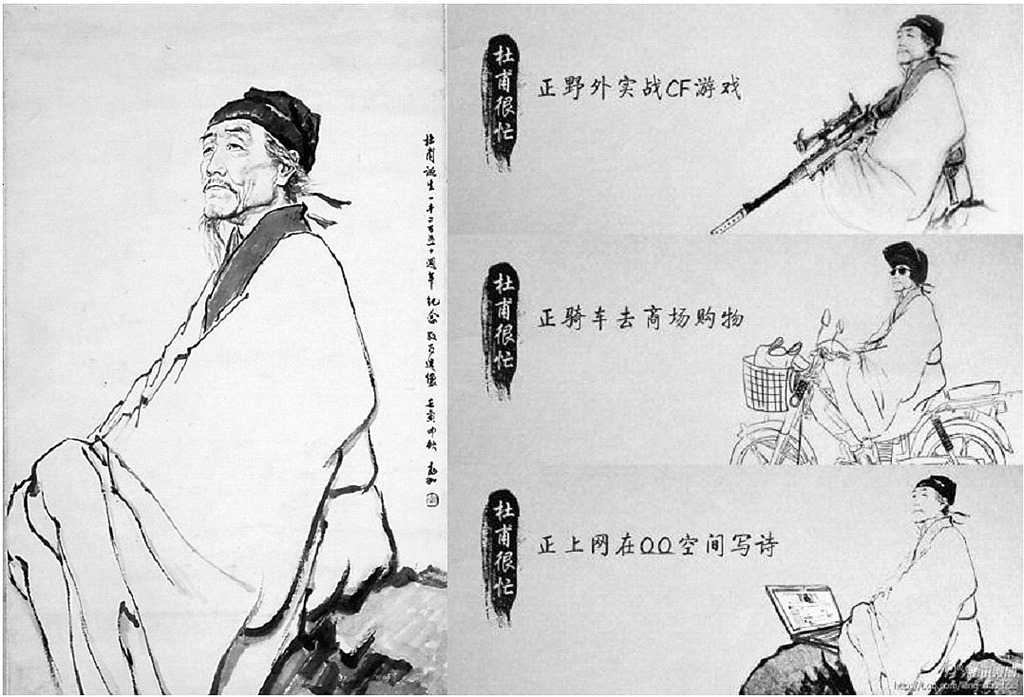
Du Fu and his Memes

If time is boustrophedon, wrapping back next to itself, then Du Fu may still be with us.


I could not find a clean literal translation of the original ideograms for the entire poem, only for about half the lines. I was able to find three previous English translations, which I could at least triangulate for the parts I didn’t have the raw stuff for.

Looking at what I had, I noticed that Du Fu was making constant juxtapositions, comparisons of contrast. Even the opening lines had water pushing and wind sighing and reflecting. That seems conventional, even a commonplace like “oh no, the wind and rain” in an English folk ballad, but it’s followed by a jump to rodents running through a roof, so close to a translation of the English idiom “bats in the belfry.” I decided to take Du Fu as intentional here. Events may seem to push you, or you may sigh and accept them, but “Rats are running in the rafters.” The ruin is real, and for that matter, your mind may reflect that too.

What follows is partOzymandias  without Shelly’s political radicalism, and part ghost story. A ruined palace, once as lush as Mar-a-Lago, haunted by ghosts. I was puzzled by the “green ghost fires” referred to in this section, what with my limited knowledge of Chinese culture. Those three words are wonderous, but I still don’t know exactly what Du Fu is describing. Are there actual fires, lit as protection from ghosts (akin to the tradition of ghost lights in theaters)? Why green? Is it brightly colored moss or overgrowth in the ruins? Is Du Fu seeing luminous ghosts (instead of hearing them as he does later in the poem)? I can’t tell. Looking at some online material on Chinese ghosts, I see that this end of August/beginning of September period is sometimes celebrated as “ghost month” in China, and various things are done both to connect with or protect oneself from various spirits. Offerings, such as burning a pile of currency may be left out. I have no idea if that goes back to Du Fu’s time, but in our current world, the thought of a burning pile of greenbacks to keep one safe from long dead rich people sure seems like a vivid image. And water is running over the palace’s roadways. Just what is the sea level of Mar-a-Lago if global warming isn’t only a political question?

Green Ghost Fires

“Green ghost fires” The “ghost light” on the dark Fitzgerald Theater stage and money being burned as part of the Chinese Ghost Festival


As you listen to “Jade Flower Palace”  perhaps you’ll want to pay notice to Du Fu’s subtle use of juxtapositions. More so than the other translations I read, I sought to bring those forward in mine. Translators seem to differ on Du Fu’s final lines, and that was a part where I didn’t have a literal translation to draw from. As midnight approached, I left two alternatives for my decision of what the final line should be to follow “There are many paths away from here.” It could be “How long are any of them?” or “None of them go on forever.” In the morning I decided that I would keep both, another juxtaposition.

In the performance on Friday I used this as our band warm up, where we loosen up our old and demented fingers, a cold first take. I repeated the first two lines once more at the end both to emphasize that they should be heard as more than commonplaces, and as a reminder (to invert a proverb of mysterious origin) that history isn’t necessarily instructed by rhyme, but repeats.

To hear the LYL Band perform Du Fu’s “Jade Flower Palace,”  use the player below.