They tell us: yesterday was the last hot day of the year, with temps peaking above 90 F. The summer night ended, like a fair or exhibition with fireworks lightning and booming thunder, and the coolness of fall seems to have arrived today. The urban trees here have just a touch of autumn colors on the edges of avant-garde branches. A city’s pretense is that it is artificial, a human-made place, but the trees are here to remind us.
The above cartoon presented without further comment.
.
I’ve said that when I look at what pieces were the most liked and listened to each quarter that the results often surprise me. The Parlando Project takes words (mostly poetry) and combines them with various original music. For practical reasons,* the poetry we use is largely in the public domain, poets whose reputation has usually settled to a stable level. We’ve done many pieces from such poets that retain readership into our century: Dickinson, Frost, Yeats, Stevens, William Carlos Williams, Eliot, Millay. I also enjoy reviving work by poets that once had considerable readership, but who have fallen out of favor or esteem: Longfellow, Teasdale, Sandburg for example. And there are poets that have higher profiles in the UK than here in the US: Edward Thomas and Thomas Hardy. And there’s my translations or adaptations of work outside of English: Du Fu, Li Bai, Rimbaud, Rilke.** That’s a big world of material, and my attempts good, bad, and indifferent are up in the archives for all to hear. But then there are the wildcards, the poets that only indefinitely reached and failed to retain much regard.
Apparently, Robert Gould Fletcher is one of those. He was identified early on as an Imagist, a form of early English language poetic Modernism that I think has values worth revisiting. Curious, I dipped into a couple of his many books from the first half of the 20th century and found a short nature poem that intrigued me. As I worked to set it to music my city had a summer storm whose aftermath was a striking yellow/green/brown sky tint. In the heat of that evening I started to recast Fletcher’s poem, producing a result that’s a “after a poem by” or “inspired by” work — but it wouldn’t exist without Fletcher.
Despite Fletcher’s non-existent current literary standing and my own low profile as a poet, “Yellow Air” was the most listened too and liked during our past warm summer. I wouldn’t have predicted that, which is a pleasure.
You can see Fletcher’s original text and the full text of my subsequent version along with guitar chords which you might use if you want to sing it yourself by clicking on this link to the original post. Or you can hear it straightaway with the player below.
.
*Submitting writers may know how slow and inconsistently editors will respond. Well, I found the response asking for permission to present poems here was even worse. If an unsought grant was ever to fall from the sky for this Project, I’d ask first for someone to bug and cajole rights holders for the rights to present more recent poems here.
**How much have we done this? Over 600 times! And all of the results are still available here via the archives. If you just want to sample the music more rapidly without my comments on the encounters with the text, the most recent 100 or so are available as podcasts on Apple podcasts or most other places that offer podcasts. Note that the Parlando Project podcasts are just that: the typically less than five-minute audio piece. From time to time I’ve considered a more conventional talking-about-stuff podcast, but I’m unconvinced the interest would replay the work on top of the research, composing, and recording effort that goes into this Project.
There were fewer audio pieces presented this past summer, so I’m going to abbreviate our traditional Top Ten review of the past season to reflect that — but I still kind of like this part of the Project, as I get to see what pieces got the most response. Like the Parlando Project in general, the most popular pieces tend to be quite various, and it’s often the pieces I’d least expect that bubble to the top. As a proper Top Ten, we’ll look at them as a countdown, starting with the 10th most liked and listened to one and ending with the most. The bold headings are links to the original posts in case you’re new here and would like to read what we said then.
Very briefly here are the pieces that make up numbers 10 through 6.
10. Arthur Hoehn by Frank Hudson. In the summer doldrums I felt free to include more of my own words. This is a short elegy for a classical music DJ who worked the overnight hours. I’m quite proud of the final lines of this one.
.
9. Staying the Night at a Mountain Temple by Li Bai. Another of my loose translations of a Tang Dynasty classical Chinese poem. I based my translation on my understanding of Li Bai’s (his name is also rendered as Li Po) general outlook. An example here of how I work with orchestral instruments.
.
8. Stratocaster by Frank Hudson. Really, this project is usually concerned with other people’s words, but this sideways ode to an ingenious radio repairman whose swoopy electric guitar design was enshrined in the Museum of Modern Art got a good amount of response.
.
7. The Dick and the Dame by Dave Moore. Alternate voice and keyboard player here Dave Moore says some of this is adapted from Robert Coover, but this really holds together as a poetic liturgy for pulp noir. Also I got to wail on guitar.
Getting ready to lock up my bike late this summer, and my attention is drawn to a message on top of the post.
.
Now let’s move on to the top 5 and say just a bit more about each of them.
5. From Cocoon forth a Butterfly by Emily Dickinson. We’ve done lots of Dickinson poems here over the years. Though we did this one in summer, it talks about harvest time. While poetically condensed, Dickinson observes harvest workers and the proverbially productive bee and contrasts them with a no doubt lovely, but also somewhat unoccupied butterfly. Is Dickinson, the poet, the butterfly? I’m not so sure. My understanding is that Dickinson’s domestic duties in her mid-19th century household, while less than those of poorer families, were also not insignificant. Is the butterfly then poetry, or the poem she’s written, or a fancied life of a full-time artist which she wasn’t? Dickinson ends with this point: at the end of it all, however joyful or laborious, is the Sundown, which is Extinguished. Like the Preacher in Ecclesiastes, I’m thinking she sees vanity in the whole scene.
.
4. To Whom It May Concern (Carry Them Away) by Kevin FitzPatrick. Dave and I both admired Kevin’s poetry and outlook, even if neither of us wrote like him — but then as I said elsewhere here this summer, too few poets write like Kevin. Here’s a short poem written entirely in another’s voice, whose words Kevin the poet recognizes deserve repeating, deserve attention, deserve concern. If I don’t write like Kevin, that essence, that principle, is part of what I do here with the Parlando Project.
.
3. Palingenesis by Henry Wadsworth Longfellow. Poets today read Dickinson (should) and Whitman (must), but few literary poets will admit to reading Longfellow now. Dickinson and Whitman are great rebels, geniuses of make it new. Longfellow worked in traditions, replanting them in America. If you want to rebel with your attention and consider Longfellow, I’d suggest the shorter lyrics. Was this lyric referencing Longfellow’s wife who died too young in his arms? I can’t say for sure, but I used it to reference my late wife who also died too young more than 20 years ago.
.
2. Generations by Frank Hudson. This is a tiny poem in a tidy setting. I’ve been noting recently the lack of perspective in many older persons’ views of the young. Old people are supposed to supply that perspective, to know from intimately observing things over longer time that stuff thought new is just a variation or a carrying forward of the flow of society. Instead, I see all too many who want to proclaim some past got it right and the present is a decadent signal of end times. So, in this short piece I cast myself as the sage of advice to the young, but with a twist.
.
What was the most popular piece this summer? Come back tomorrow for the answer.
I’m usually not very articulate about my own work, and part of the benefit of this Project’s aim to largely present other people’s poetry is that I can better express my experiences with others’ work than my own. This may be why I am envious of those who can speak effectively about their own art.
More than a dozen years ago I was reading an interview with a novelist Willy Vlautin who also wrote songs and performed with an Americana/Indie rock band called Richmond Fontaine. In explaining his art this is what Vlautin had to say:
It’s sort of a gamble, one’s life. Where will you fall, what are your weaknesses, will they kill you? If you’re hurting, will people help you or take advantage of you? Will the people you love, love you when you need them to? The mistakes you make, they could ruin you, set you off on a bad run. Hell, I think about all that all the time. Nothing makes me sadder than someone hurting and then being done wrong or worse by someone who’s aware of that.”
As you might imagine, Vlautin was not writing cheerful stuff,* but the observation about the human condition, its fears, and the dangers of how others can react to failings in ways deserved and undeserved seemed honest. Humankind differs somewhat on what constitutes crimes and failings, and the hierarchy (lowerarchy?) of such acts and outcomes, but we seem constitutionally subject to the reaction that the bad or unlucky person deserves their fate — or here’s the odd intensifier — deserves more and more bad outcomes, stacked on in order to prove or instruct them in how bad their choice or fate was.**
It seems to me that Vlautin takes this internally as well, or at least wants us to consider that. That’s something I resonate with myself. The fear, much less the result, of failing someone I care about is nearly disabling for me. I fear this enough that I will not do things for others, little things, things others find routine, because I fear doing them badly.
Reading Vlautin’s interview answer soon caused me to write this sonnet all those years ago, combining Vlautin’s thoughts with my own on these matters, the result merging sins of omission with sins of commission, confronting the fears of both as honestly as I could.
Just as with the last piece here, I found that sonnet among the thousands of song-sheets I went through late this summer from my studio space. Unlike the last one, I think Dave and I attempted to perform this poem as a song years back to little success. After finding the song-sheet, I did a revision of the words and changed the music a little bit. This afternoon I had just over an hour in my studio space to record it. I focused on simple accompaniment, just acoustic guitar to maximize my chances of getting a completed performance, and that worked well enough that you can hear it below. Because the piece’s outlook is stark, the spare music may help reflect that.
There are direct quotes from Vlautin in my sonnet, also some subtle changes to his phrases, and then too my own interpolations.
.
A player gadget is below for many of you, but some ways of viewing this blog will suppress that, so I also offer this highlighted link which will open a new tab to play it.
.
*In another interview he says he had pictures of John Steinbeck and the Jam on his childhood bedroom wall. His brother bought him his first guitar and told Willy to “Write about what hurts and haunts you. That’s pretty much what I’ve done ever since. Along the way, I somehow forgot to write about the girls and the parties.”
**Perhaps a small part of the choice to pull this piece out of the pile today has to do with the bizarre news that a couple of governors have decided that some folks suffering from poverty, fear, and abuse should be secretly trundled off in busses to other states in the course of increasing their suffering or insecurity — and with the further aim of using their arrival to instruct other governors or mayors to do what, I’m not sure. Articles indicate that one beef the two governors have with the other jurisdictions is that they aren’t making others already there from similar situations in these other states more fearful and uncomfortable. Am I to infer the theory here is that making folks more uncomfortable, less secure, and more confused will improve their luck and the wisdom of their choices? Or that the other governors or mayors will by this action understand that the two “put’em in busses and dump them outstate” governors are demonstrating their better administrative acumen?
I’m presenting a song of summer desire today even as that season ebbs away, but first a little catching-up on the status of this Project for those who follow it regularly.
I planned to produce fewer Parlando Project pieces this summer for a number of reasons. It’s become harder to find composing and recording time, or to focus when it can be found. Audiences drop off markedly every summer anyway, and I had some long-put-off tasks that I thought needed to be attended to. Those tasks? Not even half complete, but a couple of things got done.
I felt I needed to replace the nine-year-old computer I use to write what you read here as well as the final audio mixing and polish for things recorded in my studio space.* I wanted to keep to a reasonable cost for this replacement, but I also wanted to spec it so that it could last in the roles I use it for, for the rest of whatever this Project’s lifespan will turn out to be. To accomplish this I stayed with my usual tactic over the past 30 years in selecting parts and assembling the replacement computer myself. I did a Ship of Theseus build using some old parts I had, which reduced the cost.** This new machine is now in service once I installed, configured and re-registered a whole bunch of software that this computer needs to run.
Another task? For more than a year I’ve wanted to deal with nearly 3000 song sheets that had accumulated in my studio space where I record with others as well as my own acoustic instrument recording. Poet, keyboard player, and alternate voice of this Project Dave Moore has been amazingly creative this century, and when I record with him I most often get sheets of lyrics with some hand-written chord symbols. You’ve heard a smattering of his original compositions here, but over the past two decades we’ve attempted hundreds of pieces of his. I’ve nearly matched Dave, as the more than 600 completed pieces I’ve released here show. With orchestral instrument scores I don’t notate by hand, working instead on the computer — but my guitar-based pieces tend to be not-unlike Dave’s, except that my paper sheets usually have neater printed chord symbols. Still, there’s my marginalia of chord voicings and capo positions etc. Thus, the thousands of sheets of paper. Late this summer I sorted through the whole bunch, determining the half or so that would be good to convert to computer storable files, and then scanning them.
Today’s piece is a result of that second large task, as I was often running into pieces on the paper sheets that I hadn’t thought of in years — and even a few that I don’t recall even attempting to perform. “Summer She Has No Lover” was a sonnet that was written in 2010. I’d written it as a literary page poem but seeing it in the studio space pile of papers made me think that I must have once considered creating music for it — and so that’s what I proceeded to do. The recording was quickly done (studio space time is still limited), but I think the results convey something of the flavor of the piece as our summer ends.
Sonnet means “little song” and so why not sing it? “Bechirp” is my own word.
.
You can hear my song performance of “Summer She Has No Lover” with the graphic player gadget below, and if you can’t see that, with this backup highlighted link. I can’t say what level of productivity I will be able to wring out of this autumn for the Parlando Project, but my present intent is to increase the number of pieces and posts from what I was able to do this summer, so look for new pieces soon. Another question remains to be answered: will I have time to do more complex compositions? We’ll just have to see.
.
*The old one was still working fairly well, but some components on computer motherboards can start to fail after a decade or so of service. I’d intended to accomplish its replacement early in the summer, but to show that expected service life is worth considering ahead of failure, I had to replace an aging water heater and washing machine that both stopped working in June and July.
**Given that this Project is assuming a Venn diagram audience that has interests in poetry and often non-commercial musical genres, it’s probably pushing it to think that anyone reading this is interested in computer parts too, and choices here are just as controversial as music and poetry can be among the cognoscenti. I decided it would reduce costs and still be safe for future roles by using an 11th generation Intel I7, and an ASUS Z590-Plus motherboard which uses the inexpensive/widely available DDR-4 memory and PCIe 4 solid-state-storage drives, and for video I bought a Nvidia Quadro card which is not worthwhile for gaming that I don’t do, but which can drive up to 3 QHD screens if I ever upgrade to those in the future. I went for 32 gigs of RAM and a 1 TB PCIe 4 SSD. The one truly “lux” component I bought was a Seasonic power supply, based on good experiences with them over the years. Total: $785.95. I was able to use an existing Antec Silencer case that weighs as much as an e-bike, an existing CD-DVD drive, and a year-old mechanical hard drive used for audio and video project storage which I simply moved over from the incumbent computer. My keyboard, mouse, and screen remain unchanged.
I wrote a short piece a few years ago, which goes like this:
The Temple of Summer is guarded by two pillars:
Memorial Day for those who gave up their lives in war,
And Labor Day for those who gave up their lives in peacetime.
This Monday is American Labor Day.* What constitutes a laborer, a worker? Someone who works for someone else, who doesn’t own their own business? Are poets and musicians workers, or small businesspersons? These things are not simple — after all, that musician-derived term “the gig economy” shows that grants of independence can be superficial. Anyway, let me defer that discussion and say that poet and musician Carl Sandburg was a worker, knew he was a worker, and understood work. It should be no surprise that I’ve chosen to present three poems from his 1916 breakthrough collection, Chicago Poems for Labor Day — or for any working day if you read this later. They’re observed and written in the situation of their time, but let’s not dismiss their concerns and experiences as outdated this Labor Day — at least, not without hearing Sandburg out.
How many times, even today, when someone seeks to portray the working class, is a white male presupposed? Sandburg doesn’t make that mistake as his “Working Girls” will show. My wife, a nurse, came home this week concerned around a strike deadline, and it’s safe to say that women have carried proportionally more of the stress of the past few years in the workplace. She tells me her coworkers are riven by this announced possibility. Some of the most stressed, see this as adding to their stress; others see this as an attempt to remedy some of what’s wrong in their field. Sandburg sees a dialectic in his river of working women, though his poem’s more about the general wearing-down of a life of work.
“Happiness” is probably the best-known of the three Sandburg poems in today’s piece. It’s significant to know that Sandburg is a 1st generation immigrant, and he writes continually of the immigrant experience in his poetry. I don’t think it’s too hard to translate from Sandburg’s immigrants to today. My weekend summer nights here in my neighborhood feature accordion music as this poem mentions, though the singing is in Spanish for my ears. Oh, my wife and teenager sometimes have trouble sleeping, and then there’s this noise. I have trouble sleeping too, but I also hear this Sandburg poem in my head, accompanying from his time the Mexican songs from the yard three houses down the street.
Consider this on a holiday: no one feels leisure like a working person.
“Muckers” may take a little translation. When I was growing up, closer in time to Sandburg’s than today is, a ditch digger was not a job description so much as a derogatory term. It stood for someone who had no ambition, no skills, no ability to advance. If you lacked those things, you might be cursed to become “a ditch digger.” It was essentially workplace hell — and the inhabitants, damned by their sins of omission. My father once preached a sermon I can recall from my youth in which the dignity of a ditch digger’s work was proclaimed. The detail he spoke of then, the part I can remember, was that some care as well as muscle was required to carve out a stable and straightaway ditch.
Sandburg’s poem takes a red-wheelbarrow to the job site, writing (as he would often do) an Imagist poem concerned not just with concise precision in the observation, but more at why so much depends on what is observed. And he’s got a punch line, one anyone who’s ever suffered through the worthlessness of unemployment will understand.
Together these three poems I perform today celebrate those who give up their lives in peacetime. “You dreamy poet,” some may be saying now, “That’s the way of the world. Don’t you know?” Oh, Sandburg knows. He went to work at 13. I was self-supporting at 18. The difference between us and some other poets is that we’ll write and sing about this. It’s as universal as love and heartbreak, near as universal as death, and it’s the mundane ground upon which poetry and music and all the arts are stroked upon.
Carl Sandburg: proud to be the guitar strangler, rockin’ maker, stacker of tracks of wax, hex-string player, and folk-rock maven of Modernist poetry.
.
My musical performance is longer today than most Parlando pieces, but then it does present three poems and asks for a quantity discount. After working out and executing the acoustic guitar and “punk orchestral” setting of Emily Dickinson last time I wanted to plug in a Stratocaster and wail a bit, and so what you’ll hear today is a live electric guitar performance recorded then. One production oddity I’ll note: I recorded the two chordal “rhythm guitar” parts after the lead melodic part. The player gadget to hear the performance is below for many of you, and I provide this highlighted link for those viewing this blog in ways that cannot display the graphical audio player.
.
*My teenager reminds me that “Labor Day” is not the international workers day that is May Day. I remind them that American Labor Day came out of the labor movement too, and no matter how you parse things, having two days to celebrate work and workers is not too much, no more than we should be embarrassed in America to have a Veterans Day and a Memorial Day.
How much did Emily Dickinson want her poetry to be understood? I can’t be sure, but I suspect she wanted it to be both puzzling and understood.* While she didn’t publish to any extent in her lifetime, she did send by mail or otherwise share poems with friends. The conventions of Dickinson’s 19th century America may be different, but it’s possible that not everyone understood each poem, or even welcomed the arrival of those poems’ enclosure, but these acts indicate that she had elements in her poetry that asked for a public place for her work.
The posthumous publication of a large selection of her poems in a series of books at the end of the 1800’s did find ample volunteer readers though. Selected from her handwritten manuscripts by outside editors and somewhat regularized, they were also presented with tacked-on titles and within subject sections like“Time and Eternity,” which however criticized by current scholars helped frame her work for her first posthumous readers.
There’s a certain kind of Dickinson poem, often with a touch of gothic whimsy, that most easily attracts a general readership. Others feature proto-Imagist observations that continue to delight readers. While there were other American poets of Dickinson’s time who had a substantial non-academic readership, now more than a century-and-a-half later, few read any other than Dickinson and Whitman.**
Having a general readership should discount no one’s literary merit, but snobbery may ask to have its say. If Dickinson is a poet admired and even read by those who are otherwise unattracted to poetry, this can be introduced as evidence against her worth as a true poet.
Given that, I have been noticing someone on behalf of the Emily Dickinson Museum has been regularly posting short Dickinson poems on Twitter asking for those who come upon them what their interpretation of these poems are. Few of the Dickinson poems this Twitter docent shares are the well-known “Greatest Hits” of Dickinson. Many are eight short lines, and those lines are often full of Dickinson’s oddest syntax and metaphysical musings. Being asked for an on-the-spot interpretation freezes many a reader as much as an armed robbery would — but at least in such a street encounter one likely knows where one’s wallet and valuables are. While I’m old enough to have grown accustomed to my own misreading of subtle poems that my fears of embarrassment are diminished, even I am hesitant to offer a Twitter reply. And this is true even though I’ve already performed some of Dickinson’s poems of that sort. What this series of Twitter posts demonstrates most vividly I think is that a great deal of Dickinson, though a time-tested popular poet, verges on incomprehensibility. So why did Dickinson write such poems?
My theory is that Dickinson was seeking to record in these cryptic short pieces certain moments of personal insight. Why take the time to versify them then? There’s evidence that Dickinson had a musical mind, and containing them such may have been a combination of the matrix of natural “music of thought” and the practical mnemonic virtues of verse. Dickinson was known to write short poems down on household scrap paper, indicating that thought was going on during domestic workdays. Perhaps I’ve come up with this mentally-drafted commonplace-book theory in that I spent some of my ordinary working life composing poetic stanzas in my head that were informed by things I was seeing and thinking while my hands were occupied. Such work is not necessarily “public poetry,” though in Dickinson’s case it now can be viewed by us strangers far removed by Dickinson’s time and place. Here’s her poem. You can be one of those strangers.
In memory of my feelings. Dickinson’s austere compression here.
.
So what was Dickinson on about with her poem known by its first line: “From Us She wandered now a Year?” I’m not sure, and I’m sort of comfortable with that. What is clear? It doesn’t have the attraction of imagery. “Wilderness” is totally undescribed, not rising to the level of an image, and “feet’ and “eye” are the only other concrete nouns in the entire poem. There’s no clear sense of where or when this poem occurs. While there’s some sense of separation or change as of the first phrase, the poem evokes no clear-cut emotional tone. “She” and “Us/We” are vague characters, though I read the latter as a general evocation of humanity. Dickinson’s eccentric capitalization invites us to consider many words as philosophic entities, not a “wish you were here” note about a traveling friend.*** Thomas Wentworth Higginson and Mabel Loomis Todd, her posthumous editors, put this poem in that “Time and Eternity” section, and invented a title “Invisible” for it, which indicated they didn’t know what she was on about either.
Do I have an impression? I think the poem’s “She” is Transcendentalist Nature, which as I understand Transcendentalism is essentially the revered manifestation of the true universe and any Creator. “Wandered now a year” is the unstoppable progression of seasonal time which goes forward over any barren obstacle that might stop a corporal creature (Wilderness) or without any memorial break for death or state of nothingness (Ethereal Zone). The second stanza says we cannot not fully understand this, though we may have some autumnal intimation at some part of this cycle, where we “took” (in) this “Mystery.”****
I could be wrong, but a worthy enough meaning. Still, the overall effect remains its stark unsensual expression. Few of the normal pleasures of poetry are found in these eight lines. No imagery, no statement of the senses meant to invoke feelings in the reader (other than mystification perhaps). Word-music alone is there in Dickinson’s hardwood-seat pew hymn-meter, the thing she used to write her own hymn book. This is a highly intellectualized and discorporate poetry, but as I said at the beginning, I don’t know if Dickinson intended us to read it. If not, then Dickinson’s feelings and experiences being left-out are beside the author’s point. After all, she herself may have sufficiently felt them, and this artifact is meant only to evoke that memory for herself. I, this other human today, have this overall emotion evoked: awe at the dexterity of her mind.
Today’s performance has music I composed and played in my “punk orchestral” style along with 12-string guitar. I’m using simple musical structures for the orchestral instruments, but I tell myself I can do so in the same way that guitar combo bands using a few root-V chords can none-the-less communicate something. It’s a brief poem that I represent in a short musical piece you can hear below with the graphical player, or in its absence this alternative highlighted link.
.
*This is a common, if not always acknowledged goal of poets: to be worthy not just of a reading, not just of some understanding, but to be worthy of a deeper and more careful and caring reading. That’s a lot to ask for words, even beautiful sounding words.
**I considered adding Poe to this exceptions list. Despite my own efforts, I doubt I could make a case for Longfellow retaining 21st century readership.
***Possible that there’s a specific lower-case “she” and this poem is more simply a “missing you” poem? I’ll offer this aside my theory, that if Dickinson felt that toward specific shes then it could occur to her to personify a manifestation of at least a conceptual Godhead as “She.” It’s possible to be thirsty and thoughtful.
****Sandy Denny’s song “Who Knows Where the Time Goes” would be an example of a more elaborate and sensuous expression of the same sort of thought. It’s also a feeling I tend to get each fall, which may help spur my Septober Energy, where I set out to harvest what creative energy I have.
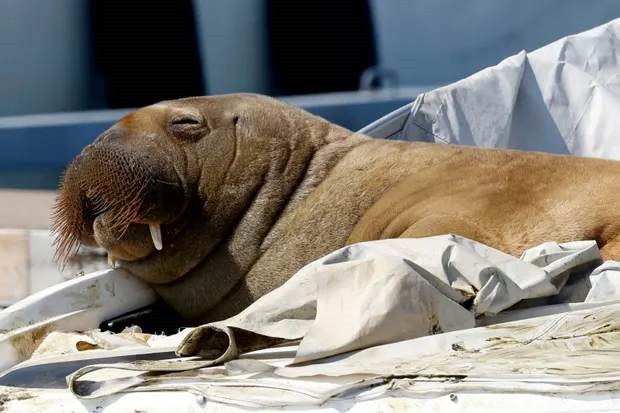
I shared with my wife, who has many concerns bearing down on her this summer, recent video clips of Freya, a celebrity lady walrus who’s lately been hanging out in Oslo Norway’s harbor. Freya is a young 1300-pound mermaid who spends around 20 hours a day sleeping while carelessly lounging on marina boats, sinking a few with her what-the-hell-I’m-wiggling-aboard anyways. During the other four hours Freya chases ducks and swans. The marina also has kayakers and paddleboard riders which she also likes chasing. Recent videos have caught her eating one of the swans,* but perhaps thinking of her beach-body figure, she’s skipped eating the humans so far.
“Twenty hours of sleep…” my wife responded. “goals!”
Hot Girl Summer: Freya, in her liminal state between 20 hours of rest, bird and clam eating, boat wrecking, and being adored by her Norwegian fans.
.
Now as far as I know the great American poet Emily Dickinson never got to observe a walrus. On one hand, Emily did have a privileged life as the child of a successful lawyer, but then it was the 19th century and they had fewer smartphones, washing machines, lawn tractors, induction stovetops, and air conditioners. At least in her youth her parents believed strongly in self-reliance and careful household finances, and so distained servants, since after all they had a pair of daughters who could do that work. If we think of the later-life Emily Dickinson as the housebound hermit, you may not know that the younger Emily Dickinson divvied up the household work so that she had more outdoor chores compared to her sister.
One of the things I learned when I visited the Emily Dickinson house a few years back was that across the main road in front of the Dickinson house the family also had a field they farmed. And then on the house’s main lot there was an orchard and food garden which were largely the creature of Emily and her mother. Harvesting hay from the field was probably men’s work, but I was told that Emily would be tasked with bringing the harvesters water and food during their work. All that came back to me as I read this charming poem of Dickinson’s that is generally known by it’s first line: “From Cocoon forth a Butterfly.” Here’s the full text of the poem if you’d like to follow along.
There are three or four characters in this little poetic drama. There’s our Butterfly (joined by others of her kind later), a “notwithstanding bee” who is proverbially occupied pollinating and presumably making honey, and the harvesting men. The fourth character is animated by the poet herself, a flower which despite being a plant is described as “zealous,” waving in a summer breeze for an afternoon.
Our main character, the Butterfly is described as if she’s an idle lady. She seems to have no task, something she flaunts in the poem. The field workers, the men, have obvious tasks. That hay won’t harvest itself. The bee, a cliché of purpose. The flower is a bit more ambiguous. If we assume Dickinson chose zealous carefully, the flower may be ardently worshiping the summer day or perhaps it’s divine author, shuckling in vegetative prayer.
Which character does Dickinson identify with? Maybe a little with all of them, if not entirely with one. If one has farm tasks (or for that matter the artistic tasks of a poet) the idle lady making a show of her leisure isn’t your model, even if you may feel a bit of envy — and yet poetry can be charged as like a butterfly, a piece of beauty that seems to do nothing. The men are doing useful work (see Robert Frost on mowing in this poem) but though Dickinson tends a garden this haying is not her work. Same for the bee. Dickinson no doubt knows the bee’s work, appreciates it too, but it’s not her work. We know Dickinson is highly knowledgeable about flowers, and often makes them the subject of her poems, but this zealot flower? If she’s serious about that characterization, she stands outside that level of belief.
The closing stanza, like her more famous “I’ll Tell You How the Sun Rose” poem resolves this separation from her, the observer of it all — Vanity of Vanities, all is Vanity — and so the purposeful actors and the purposeless Butterfly will all be gone by end of day. Emily the poet remains, as does her poem if we take the time to observe with her again, many days and decades later.
Before I leave you with an opportunity to hear my performance of Dickinson’s “From Cocoon forth a Butterfly” I want to put in a note here about the lack of activity here this summer. I share some of the concerns of my spouse, and I am also trying to reevaluate this Project to see if I can make what I do here more useful, or beautiful, or something. Traffic and listenership always drops off in the summer, so a good time to reevaluate, and you may see fewer new pieces until autumn.
To hear my performance with original music you can use a player gadget many will see below. Don’t see any gadget? This highlighted link is here as a backup for you.
.
*Showing a connoisseur’s appreciation for the swan greater than William Butler Yeats’ I’d say. Yeats only looks at his swans, and yet the great poet distains at putting his tusks into one like Freya. Walruses also eat clams, which as far as I know have never moved Yeats to poetic transport. Apparently, Norway has a problem with lots of invasive clams, which may be why Freya has been hanging out in Oslo.
Are you new here? If so, this is what the Parlando Project does: we take words (other people’s, mostly poetry) and combine them with a variety of music we compose, create, and perform. I find this fun, and I also find that even more than reading another person’s poem — even reading it aloud — performing it illuminates corners inside the text that I might otherwise overlook, so I write here about that experience. Then when you listen to the pieces you get to hear the poem in this new context to freshen your appreciation of poems you know, or to allow you an entry into a poem previously unknown to you.
Most of the time I’m faithful to the texts I use to create these pieces. Oh, I might take a part of a poem and make it a refrain/chorus, or I may select some tasty phrases from a prose paragraph so that expresses something more sharply, as if it was a poem — but my usual idea here is to honor some poet or their poem no matter how famous or little-known it is.
John Gould Fletcher is shelved in that little-known section these days, even though he was associated with writers and movements that are still studied, still read (at least by those interested in early 20th century American Modernist poetry.) I wanted to look at some of his work because I read that one of those associations was with those pioneering Modernists who took to calling themselves Imagists. Imagism was often that 2:40 punk-rock single of a hundred years ago. Instead of spendthrift merely decorative language, rhyme, and imagery, the Imagist poem wanted to get right down to it: direct treatment of something observable, not some ideal distilled from abstract thoughts imagined or philosophically proposed. No extra points would be scored for extra words. Rhyme, while not forbidden, was also not the main point. If rhyme led to extra words, those unneeded ones, it was worth discarding.
The musicality of poetry wasn’t thrown out, but like Modernist music, Modernist verse wasn’t interested in the old formal beats so much.
Best as I can tell from my early readings, Fletcher’s personal interpretation of Modernism and Imagism was not the same as others. He didn’t write much in hyper-short forms, while many of his fellow Modernists published whole collections, or sections in collections, made of sub-20-line poems. At least at first glance, Fletcher cared more for sound and less for freshness and concreteness in his imagery than others.
This Project likes shorter pieces, even more so now because my time and opportunities to compose and record are less than in the Project’s early years. In reading through a couple of Fletcher’s collections from a hundred years ago, I did come upon this short poem that was part of one of those roman-numeral separated sequences like other Modernists used. “Heat” seemed an attempt at the short Imagist poem to me. Here’s how “Heat” goes:
As if the sun had trodden down the sky,
Until no more it holds living air, but only humid vapour.
Heat pressing upon earth with irresistible langour.
Turns all the solid forest into half-liquid smudge.
The heavy clouds like cargo-boats strain slowly against its current;
And the flickering of the haze is like the thunder of ten thousand paddles
Against the heavy wall of the horizon, pale-blue and utterly windless.
Whereon the sun hangs motionless, a brassy disc of flame.
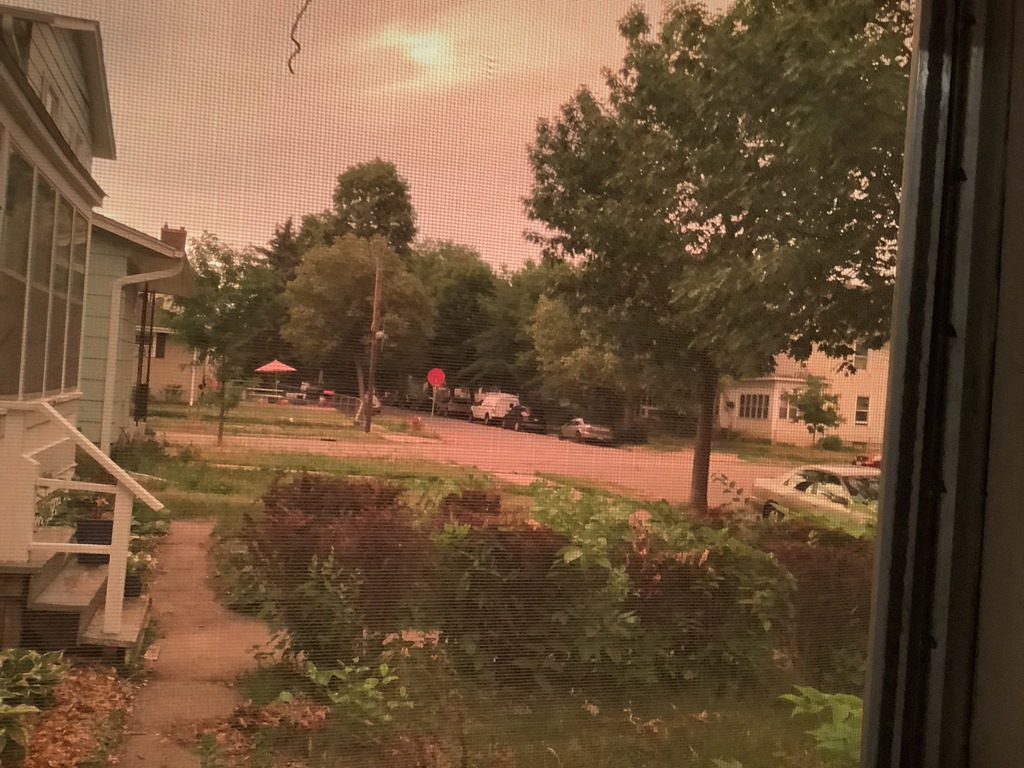
Short as it is, it’s a little wordy and formal in its manner of speech compared to other Imagists, but a palpable feeling is evoked in the description. I could have performed “Heat” as it is above — but then a week ago tonight, I was sitting on my front porch after a summer thunderstorm when the entire outdoors started to take on an intense yellow cast.*
It was hard to get a modern digital picture of last Tuesday evening’s sky with a phone. The smartphone kept correcting the heavy yellow and darkening cast to that sky, and as I looked at the photo preview on the phone I wondered why my phone wouldn’t believe me as it showed things brighter and blue. I resorted to using a much less smart device with a lesser digital camera to get this.
.
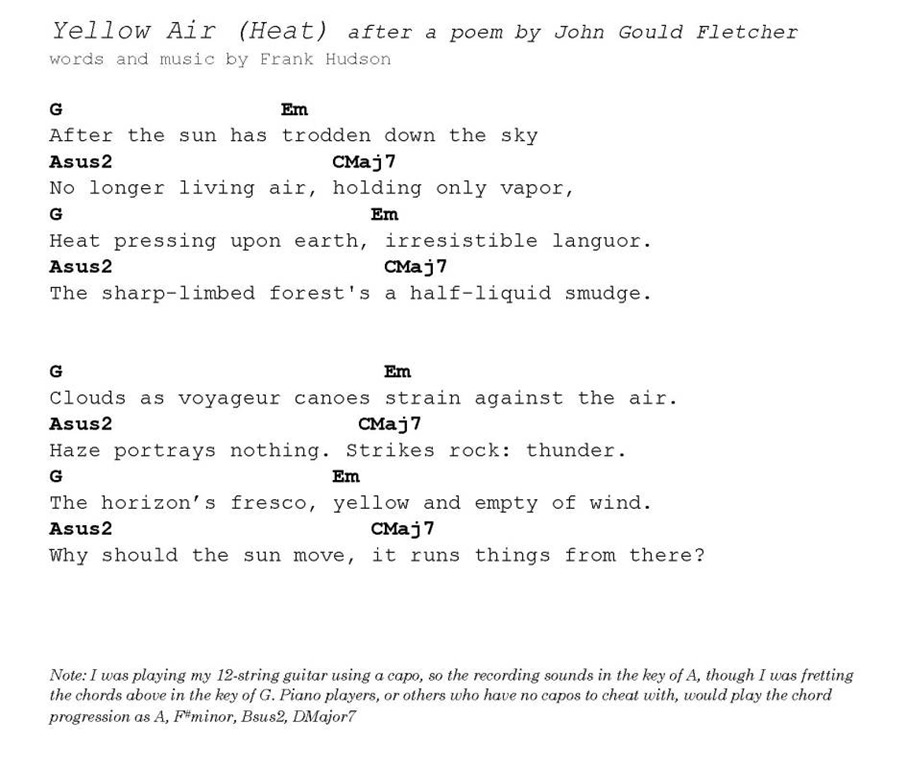
I decided then and there to use Fletcher’s poem to remark on that experience. This recasting went through a few drafts and produced this reuse of some of Fletcher’s words in a different poem:
Here’s “Yellow Air” with chords in case you want to sing it yourself.
.
What did I change? I wanted my own yellow air in a hot, humid summer experience to be portrayed. Though I retained many of Fletcher’s original words and phrases, my variation is present tense and uses a much less literary/formal sentence structure. Mine’s 61 words — Fletchers, 80. The clouds as ships image is borderline cliché and Fletcher’s “cargo-boats” wasn’t specific enough to fight that, so I substituted my own upper-Midwest image: the 18th century indigenous cargo-boats of our region, the voyageur canoe — still reflected even today by those who use their modern canoes to carry themselves and gear into the Boundary Waters for camping. I wanted a more definitive ending too, and so ended my “After…” poem with the sun portrayed as a ruling strong-man who doesn’t care that the sky is yellow and the heat and humidity oppressive.
What I kept, or even tried to bring out was Fletcher’s word-music. Rhymes near and perfect were increased in number and paused on, and I tried to make this variation more easily singable than Fletcher’s more prolix lines.
You can hear the resulting song with the player gadget below, or if that won’t show up in your way of viewing this blog, with this backup highlighted link.
.
*The Twin Cities Weather Service explained last week’s yellow sky cast this way: “Behind thunderstorms in the evening, high clouds remain. The setting sun emits light that is bent with longer wavelengths. While the blue (shorter) wavelengths are scattered out, the yellow-orange-red part of the spectrum remain, thus producing the sky we’re seeing tonight.”
It appears that no one reads or is concerned with American Modernist poet John Gould Fletcher these days. I came upon him in a passing mention that he was associated with Imagism, a pioneering English-language Modernist style that I find worthy of sustaining. Turns out this was only the half of it: in Fletcher’s “associated with” resume, later in the first part of the 20th century Fletcher was associated with a southern American ruralism movement known as The Agrarians which then morphed into The Fugitives who furthermore helped birth — not sheep or lambs — but the monastic New Criticism that reigned supreme when I was in school as a young man. I’ve learned only a little about Fletcher, so don’t make me out to be an expert on him, but this linked short bio is much better than his sparse Wikipedia entry for flavor and detail, and it makes it sound like sometimes Fletcher’s “associated with” was a brief prelude to a falling out.*
“Tell you ma, tell your pa, gonna send you back to Arkansas!” Fletcher traveled and lived overseas early in the Modernist era, but spent the last part of his life back in his home state of Arkansas. Here in 1924 he could pass for “Remain in Light” era Brian Eno don’t you think.
.
Thanks to the wonderful collection of scanned books at the Internet Archive I’ve spent this month looking through two of the nine books that Fletcher published in the era surrounding WWI. My impressions are early and will be subject to change, but he seems to be writing in a different mode than other early American Modernists that I admire and have presented here.
Like early Pound you can see elements of Victorian era poetry remaining in his verse. He’s generally less interested in short poems of specifically observed moments than many Imagists. His free-verse often has a definite beat and attention to sound — using, a century ago, word-music techniques that a skilled modern slam poet might select today. Reading poems like today’s selection, I could imagine a live in-you-face-off between Vachel Lindsay and Fletcher in their primes in front of a raucous audience.
He’s a more genteel poet than Lindsay, and among the 19th century influences I see in what I’ve read so far are Whitman, Rimbaud, and William Blake, and today’s selection will help illustrate that I think.
Fletcher’s “America, 1916” comes in near the end of his 1921 Breaker and Granite poetry collection. This “America” is a six-page prose poem that, like the poems that precede it in the collection, attempts to sum up the state of America in 1916, but ends, in the final section that I performed, rhetorically like one of Blake’s prophetic books sung to the word-music of Rimbaud’s The Drunken Boat.** There are no good online sources for the full text of this poem, but I’ll link here to a Google Books result that may allow you to read the whole thing.
Is there a prosaic political point to this poem? In the context of the rest of the poem it could be reduced to a call for America to enter World War I — which though the war had been raging for two years in 1916, was something that wouldn’t happen until a year after the poem’s date. But like Blake’s America, a Prophecy (which after all includes specific contemporary references of the American Revolution) Fletcher’s poem is doing so by making a more esoteric call for an elusive greater spiritual body of America to be born.
Is America still in an extended, excruciating, labor toward that birth? I’m no prophet, I won’t tell you, but I’ll do my best to give voice to Fletcher’s 100-year-old-words. The final sentence of the poem is one place where I made a slight change in Fletcher’s text. Weirdly, in a way I can’t quite pick out the intended significance, Fletcher ends his piece with “thou shalt arise, perhaps in vain shalt seek, to rule the earth!” As a prophecy of the subsequent “American Century” this could be counted as a palpable hit. Here in 2022, I sought to echo the internal subtlety of Bob Dylan’s opening line to his “License to Kill:”*** “Man thinks ‘cause he rules the earth he can do with it as he pleases — and if things don’t change soon, he will.” With Fletcher’s last line I did it mostly by repeating the “in vain” twice more to add weight to the dangers of vanity.
I performed only the closing section of Fletcher’s “America, 1916” today because composition and recording time are hard to come by right now. Lots of drums and I was able to play my own horn section this time thanks to getting short-term access to a better set of virtual instruments than I previously had at my disposal. You can hear my performance below either with a graphical player many will see, or with this backup highlighted link provided for those who won’t see a player.
.
*The bio mentions bipolar disorder, which might help to explain the bursts of output and the periods of disengagement.
**Stop the presses, ah, blog post — whatever. I’ve just discovered that the prose-poem style used in this and some other pieces in Fletcher’s collection are “Polyphonic Prose,” a term most associated with Amy Lowell, who Fletcher was specifically aligned with at the time. This short notice of Lowell’s use of the form in Poetry Magazine, November 1918 shows Fletcher highly praising that poetic form two years after the date of “America, 1916,” but before the publication of the collection in which I found Fletcher’s poem. Lowell (and to a lesser degree, Fletcher) credit a contemporary French poet Paul Fort as the inspiration of this form. At least in the Wikipedia article on Fort, Rimbaud is not mentioned as a direct influence on Fort, even though I heard Rimbaud word-music in Fletcher’s expression of the form.
One unusual thing I did this spring to celebrate National Poetry Month was to re-release 31 pieces from the early years of this project. This was a way, despite reduced time and opportunities to create new pieces, to still celebrate and demonstrate the various poems and music combinations of the Parlando Project.
As part of this April celebration, I spent more time that I thought I would creating “lyric videos.” I figured I would just put in a couple of pictures in a video file and place the words to the poems on the screen in time with their appearance in the music, but they got a little more elaborate.
How popular were they? It doesn’t look like YouTube counts as views any plays of those videos from the inside-the-blog-posts thumbnail images, but it does count those who found them on YouTube itself. Given that sub-set it does count, the most popular of the April Poetry Month videos was our Parlando version of Yeats’ “He Wishes for the Cloths of Heaven.”No surprise there: William Butler Yeats’ poetry is welcome to so many ears around the English-speaking world. If I was to look at most viewed posts (a metric I don’t use in these Top Ten lists) four out of the top ten most viewed posts so far this year are concerning Yeats’ poems. Yeats is a Poetry’s Greatest Hits poet.
The most listened to and liked piece this past spring was an Irish poem, but it wasn’t by Yeats. It was one of the April Poetry Month re-releases though, “Night, and I Traveling” by too-little-known Belfast-born poet Joseph Campbell (who also published under the name Seosamh MacCathmhaoil).
I’m partway through a biography of Campbell that was an Anniversary gift from my wife. From it I’m getting more of a sense of the young man who wrote this poem — a poem which is remarkable not just for its tightly compressed and effecting scene, but for being published in 1909 so that it might be counted not just as the work of the first Irish poet to use free verse, but also as one of the earliest published examples of Imagism. It wasn’t until 1913 that F. S. Flint and Ezra Pound published their “A few Don’ts by an Imagiste” and laid out the three famous Imagist suggestions/rules, but before that in London Flint, Pound, and T. E. Hulme had been working out how to radically strip back poetry to a fresh, precise, and direct essence in the months before Campbell published “Night, and I Traveling.”
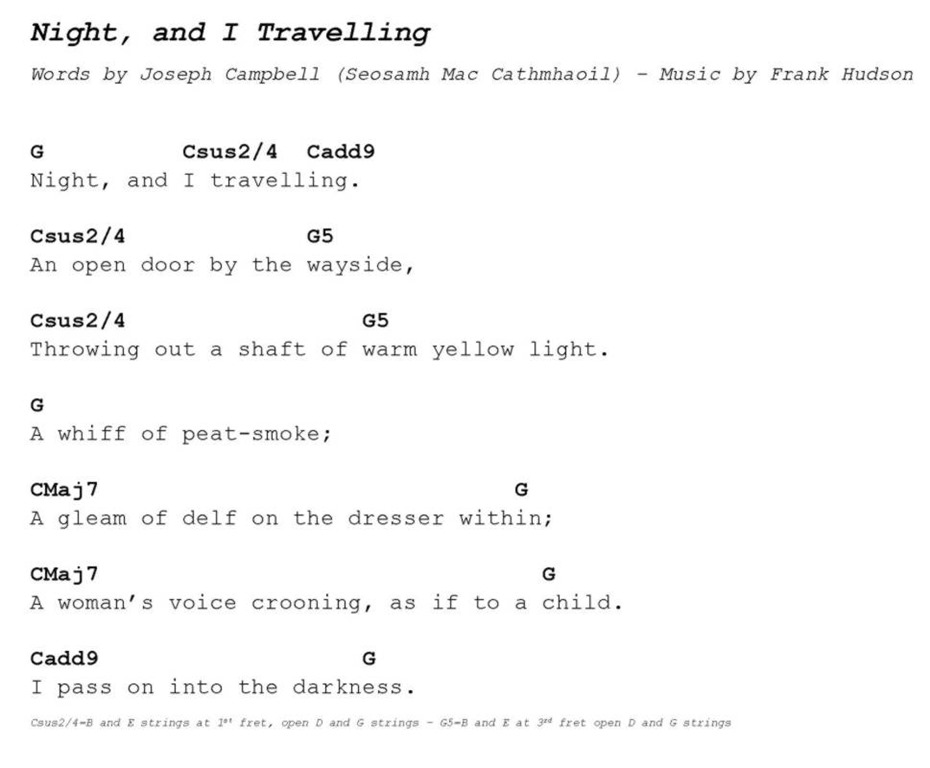
The chord voicings I used for the 12-string guitar part here are bit unusual.
.
I now know that Campbell was in London and meeting with those incipit Imagists in that first decade of the 20th century. Alas I don’t know how junior a partner he was in their meetings, but “Night, And I Traveling” is to my judgement as fine an early Imagist poem as the more famous and anthologized ones, arguably a more worthy example because of its empathetic attention to the isolated rural woman in a still-colonialized Irish hut in place of Pound’s damp impressionistic leaf-faced Paris Metro riders published four years later.* The biography, Joseph Cambell Poet & Nationalist by Norah Saunders and A. A. Kelly, reminds us that Campbell liked country walks at night. Campbell wrote: “Night walking — all my best thoughts, I find, come to me that way. Poetry, like devilry, loves darkness.” Devilry? Campbell did write some of the supernatural, and would mix Christian and pagan mythologies —but in this one, this night, he stays in our earthly plane. Am I reading too much into the poem to note the poem’s only simile has the lone woman crooning “as if to child” when there is no child depicted? Is that child dead? Or perhaps emigrated to America?
Not as popular as Yeats on YouTube, but here’s the “lyric video” I did for this piece
.
You can hear my performance three ways. The “lyric video” is above, an audio player gadget should be below, and this highlighted link is a backup for those ways of viewing this blog that won’t show the player. Thanks again for reading about these encounters and listening to our combinations of music and words.
.
*Make of this connection what you will: Pound and Campbell would both eventually be imprisoned by their own countrymen for acts during wartime.