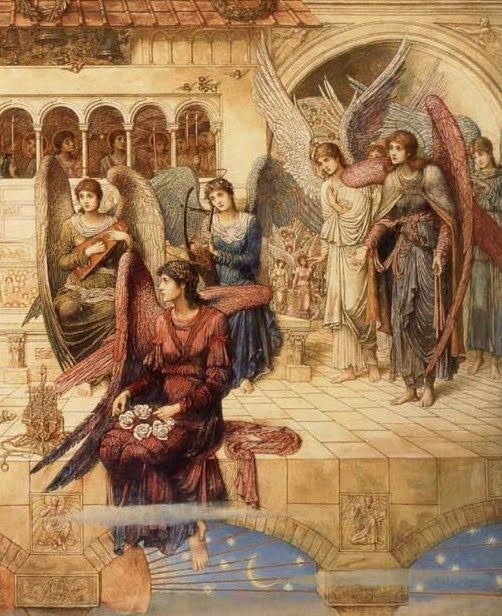
To His Coy Mistress

I can’t remember exactly when I first encountered Andrew Marvell’s “To His Coy Mistress,”  but it was far enough back that I earnestly identified with the poem’s narrator and his desires to find or convince a romantic partner.

That poem I read then is not the poem I read today, but even back in my misty youth I probably appreciated the wit of it along with the point of its argument. When I took a quick look at how “To His Coy Mistress”  is currently viewed, I see that appreciation for the poem’s wit and artifice has increased in the past few decades. It may not be possible to determine just how invested Marvell was in convincing the lady in question versus showing off his poetic chops, or even how sincere he was in his variation on the classic “carpe diem” argument that if you don’t go to bed with me, now!,  that you (currently comely love object) clearly  don’t realize that you’ll be a rotting corpse soon.

How romantic that! Here’s a box of candy too—by the way, do you know that such foods high in sugar and fat will likely lead to cardiovascular and other diseases—not to mention tooth decay and gum disease? No? Well, let me tell you….

I’m not sure how often throughout history that real and actionable knickers came flying off at this idea—but poets love it. If love, death, and beauty are the  poetic stuff, any chance to mix all three is impossible to resist.

I normally feel I have to come up with some supposition to perform one of these pieces, and what I decided here was that as a polemic, Marvell’s poetic swain means it. Which doesn’t mean he isn’t going to have some fun talking about it. Even my teenager/reader could smile at that exaggeration of the delay of traveling to India to look for jewels first,*   but did I appreciate then the auction-like absurdity bidding up the hotness of his sweetie? Do I hear a hundred years? Two-thousand! Do I hear a-three…a-three…a-three—thirty-thousand,  sold!!

Andrew Marvell and Mick Ronson-two chaps from Hull

Random blokes from Hull: Andrew Marvell and Mick Ronson. Ronson looks like he just saw the cartoon below; Marvell, like he just burped.


But I think he’s serious with the unforgettable and oddly accented “At my back I always hear/Time’s wingèd chariot hurrying near.” And deflowering worms and cremated dusty lust may be over the top, but he’s not beneath crypt-keeper humor in this.

Carp Breathalyzers!

Carpe Diem! I think this is taken from a Dick Guindon cartoon. There are those who think that Dick Guindon was one of the greatest one-panel newspaper cartoonists ever. We call some of them Minnesotans.


As the poem rushes to its conclusion, I think some of the urgency passes beyond the bar of exaggeration for humorous effect. The poem’s last two couplets, which I think sincere, are as strong in my estimation as the more famous and remembered ones earlier in the poem.

For all of Marvell’s “To His Coy Mistress”  “poetry’s greatest hits” status, isn’t it odd that we don’t remember what I think are the poem’s four strongest lines, the ones that the poem ends with? Is it all about the chase and not what happens when we catch?

Here’s the player to hear my performance of Marvell’s poem with the LYL Band:


*It wasn’t until this month as I worked on this that I found out what the poem’s companion to the Indian Ganges trip,  “by the tide of Humber,” was on about. Turns out that the Humber is an estuary/river near Hull in northeastern England. It happens to be where Andrew Marvell was from, as well as (a few centuries later) Mick Ronson, the guitarist/arranger for David Bowie.

No Common Ground

We’ll be back soon with words we’ve adapted from well-known and not-well-known writers, but it seems like a good time* to post this recent performance of a Dave Moore song.

I was looking at some other poems and words apropos of winter, Black History Month and romantic love yesterday. I think I’ve found some too. You should see some of what I make of this later this month.

Still, I made the decision to use “No Common Ground”  late last night—Dave doesn’t even know it’s going up here—and so I haven’t given him an opportunity yet to tell you anything about it. I’m going to even that out by not telling you anything about his words myself either. The song speaks for itself.

But of course I have to say something, so I’ll talk about the musical performance. This started out with Dave singing it live, one-take. There was a “scratch” keyboard track too that he played as he sang, as well as the drums. I took this performance and created the arrangement you’ll hear below, adding bass (both electric bass and bowed contrabass), a string section, a few electric guitar licks, a synth pad, and the vibraphone part. The whole thing is around a dozen tracks, which by modern digital recording standards is not complex, but then my goal here was to make it sound no more complicated than conventional rock combo instrumentation.

In the course of the Parlando Project I’ve grown attached to writing bowed string parts while retaining a conventional rock’n’roll rhythm section. When I charge myself with putting on airs, I argue with myself that I grew up on Leiber and Stoller productions which used strings, and that Charles Stepney** and other R&B producers extended this idea.

Strings in Rock'n'Roll

Common Ground and basso ostinato.  Leiber and Stoller at the piano, and standing behind: Lester Still, Jerry Wexler, the Coasters, and Ahmet Ertegun. On the right side: Charles Stepney, a composer/arranger/musician who should be better known.


Real orchestral composers will recognize that I’m not all that sophisticated in my parts here, and most always elsewhere in this project too. Part of that is working within my limitations and resources—but part of that is intent. To hear the intent and Dave’s song, use the player below.


* No broadcast joint-congressional speeches or elderly rich and tender egos were harmed in the making of this song or post. Offer void where prohibited. Opinions are worth actual cash value only. Contents may settle during shipment. Free your mind and your ass will follow. The best lack all conviction, while the worst are full of passionate intensity. The modern day composer refuses to die!

**Long-time readers here know that I’m a bit of a bug about Charles Stepney. There’s a lot I don’t know about him and his work, but some of his arrangements connected with me from the first time I heard them in 1968. There’s a bit more about him here, here, here, and here. I wasn’t thinking about it when I was looking for a instrument to carry a more percussive melody line in the arrangement and chose the vibraphone, but vibes were composer/arranger Stepney’s original instrument.

Five Kinds of Truth

Many things have sideways value. Poetry for example. Its mnemonic features give us poems to remember things, like the number of days in a month. And words have their own music, so much so that even verse in a language we don’t know can sound beautiful in an abstract way.

Politics too and public events, for all we toil in or tire of it, has sideways virtues. I’m not much of a philosopher, but a poet like Wallace Stevens still pulls me into philosophic thoughts with his word music and his choral structures. And it seems to me that our current political world, even without intent, is calling us to think about belief. Not just what we believe (a question we sometimes do not pause to ask), but what are the consequences of our beliefs for ourselves and others.

Since the Parlando Project is about poetry meeting up with music, I’m not going to attempt a grand 500 word summary that lays out a philosophic framework for answering such questions today—I’m probably not capable of it—but I am going to offer a new Dave Moore song that makes a useful list to remember, has some nice music to it, and could lead you to ask a few questions.

Dave’s song is called “Five Kinds of Truth.”  In my introduction of it today I’ll ask you to consider what the lyrics speak of as “truth” instead as “belief.” Philosophically, or in any strict sense, those two terms: belief and truth aren’t the same thing. But informally and humanly we equate and relate these two things all the time.

Nite Owl The One Question Nobody Wants to Ask

Could one fit Rilke’s “Letters to a Young Poet” into dialog balloons? Nite Owl #1, art by Joe and Andy Kubert, written by J. Michael Straczynski


Here’s what Dave said about how he came to be inspired to write “Five Kinds of Truth:”

After loyally refusing to read the prequels written by others for Alan Moore’s Watchmen  series for years, I finally broke down when they showed up at the library.

Copyright loyalty aside, they were really very good.

J. Michael Strazinski did a particularly great job with the Nite Owl character, and during one of the soliloquies in search for identity was the concept of 5 Kinds of Truth.

Which I lifted and rephrased because it was too good not to.

Concepts his, words mine.”

So, what did Dave do with this, and what did the LYL Band do to accompany it? Use the player below to find out.


Willie Murphy (Is Always Playing on the West Bank)

A couple of weeks back a local music legend Willie Murphy died. I’m going to ask indulgence from this blog’s overseas audience, because unless you were around Minnesota in the last 50 years or so, you’ll likely have no idea who Murphy was—no, it’s even more location specific than that—I believe you need to have memories pinned within a few blocks of the intersection of Cedar and Riverside avenues, in a Minneapolis neighborhood near the Mississippi river known as The West Bank.

Many years ago the West Bank was a Scandinavian immigrant enclave, and it is now the home to Minnesota’s largest Somali community. But my story today is in-between, in the second half of the 20th century, when it was home to a thriving bohemian culture, immigrants of a slightly different sort.

Shortly after I moved to Minnesota, I got work at a hospital there, and when I had enough money saved up, I took classes at the University of Minnesota which spans the two banks of the river. I came late to the West Bank scene, but I absorbed the stories of those nonconformist young immigrants who were homesteading something that was called “the counter-culture.” The counter-culture was Willie Murphy’s job, as much as musician: putting together bands, recording other musicians, inaugurating live music venues, working and networking the scene.*

Willie and the Bees photo by Dave Ray

Willie and the Bees getting down somewhere in the past


But he was a musician too. Sang, played bass, guitar, and piano. Interpreted a lot of great R&B and wrote some good songs himself.

He was never the businessman. He engendered some of the things that entrepreneurs like to claim they do, but he never got the cash rewards. It’s a complicated story and I don’t know all the details—but I do know that he was an artist making art on his own terms right up until his last months of his 75th year. In one trope of musician’s slang, musicians “make the gig” or “make the scene.” Murphy lived that literally: he made a lot of gigs, helped make a scene.

Willie Murphy Angel Headed Hipster

Angel headed hipster. Murphy in his later years, still keepin’ on.


Mine’s a complicated story too. I eventually fell in love at the same time with two people who lived on the West Bank. There was music most nights and every weekend at a couple of coffee houses, a short-lived jazz club, a music school, and several bars, all of them within four or five blocks. And for my literary side, besides the University, there was Savran’s bookstore, which was well stocked with small press publications and poetry in several languages. In one’s Twenties many are imprinted on the culture encountered then, but the West Bank in the ‘70s seems an especially strong tattoo—and nostalgia fades in reverse.

Most change happens slowly enough that you never see it happening. One day you look over your shoulder and you see everything behind you isn’t there anymore.

Or you pick up a paper and see that Willie Murphy has died.

Most change happens slowly enough that you never see it happening. One day you look over your shoulder and you see everything behind you isn’t there anymore.

Or you pick up a paper and see that Willie Murphy has died.

I felt I needed to write about this, regardless of how well I could do it. The song I wrote “Willie Murphy (Is Always Playing on the West Bank)”  has in-jokes and puns that only West Bank habitués will understand. In the first verse I twisted a line from Ginsberg’s “Howl”  that also supplied the name of Murphy’s last band. Punned-in the name of some West Bank bars in the second verse, gave a shout-out to Koerner Ray and Glover in the bridge, and got in a sideways nod to the West Bank’s Mixed Blood Theater before I finished.

A week ago, I sprung it on the LYL Band and we gave it a go, with Dave Moore supplying his piano part off-the-cuff. You can hear it with the player below.


*Murphy recorded an LP with “Spider” John Koerner back in the 60s, and produced Bonnie Raitt’s first LP in the early 70s. Willie and the Bees was an integrated R&B band that mixed funky jazz and danceable grooves for a decade or so from the mid-70s into the early ‘80s.

The Trees are Down

I indicated when I first presented a poem by Charlotte Mew this month that I’d talk more about her life, but what I know is so limited and sad that I’ll try to condense things.

She was born into a family that had more than its share of illness and mortality. Three siblings died in childhood, two were institutionalized for insanity. Her father died “without making adequate provision for his family” according to the Wikipedia article, leaving her mother and surviving sister to try to scrape by in late 19th Century London. She appears to have been socially awkward and eccentric. Eventually her mother died, and then her sister, with Mew ending up being the final caretaker for both. After the death of that final sister, Mew herself was unable to care for herself. She was institutionalized and committed suicide by the decidedly unromantic method of drinking Lysol.

There is so much unanswered detail in her story. For example, the two surviving sisters are said to have vowed not to marry for fear that the insanity might be hereditary. My now largely forgotten medical knowledge/experience wonders what the exact elements were of these early deaths and the cluster of undifferentiated mental illness. Quick, idle thoughts fall to something like Huntington’s Disease.

Anyway, during her life Mew was something of a writer’s writer. Thomas Hardy and Virginia Woolf both championed her and apparently got her a government stipend for support. She was not prolific, and she didn’t write grand poetic epics or found a new school of poetry or critical theory. Still from the first time I read her poems this year I was easily struck by how different they often were. In her era there were a lot of Modernist poets who were shockingly different then—and who often still retain easily seen uniqueness today. Gertrude Stein, E. E. Cummings, Mina Loy, Tristan Tzara, Marianne Moore, Wallace Stevens, H. D., and William Carlos Williams made individual showy breaks away from fusty tradition in the time Mew was writing her poetry.

But Mew wasn’t really a Modernist as they were, not in any card-carrying sense. Her breaks from poetic orthodoxy were sometimes subtle and sometimes seem artless in both the good and bad senses of that term.*

Today’s piece “The Trees are Down”  is a good example. Although I didn’t include it in the reading, it starts with a biblical epigraph from Revelation:  “—and he cried with a loud voice: Hurt not the earth, neither the sea, nor the trees—” What follows starts off as if it’s miscategorized prose, as casual as a diary entry, a letter, or blog post. But it soon adopts a subtle rhythm, something like F. S. Flint’s “unrhymed cadences,” with a little symphony of sound verbs and some mixed in background sound from the workmen felling trees.

A Plane Tree in London

A London plane tree. Poetic enough…


But Mew will turn from this abruptly, rather than developing that sound and theme, almost literalizing the cliché “red herring.” She recalls finding a dead rat—not at the site of the tree work, not recently—just a rat’s carcass once encountered some “long past spring.” And she remembers thinking that even this “god-forsaken thing” should be alive in spring.

rat carcass

…not quite as romantic as a majestic tree.


Then she leaves this odd aside and begins a passage of irregular rhyme and near rhyme, once more looping in a sample of the workmen’s cries (“Down now!”). Nearly every phrase has end-rhyme, but we are made to wait seven phrases for a rhyme between “fine grey rain” and her return to that seemingly unconnected dead rat with a remark that except for this strange connection with the rat carcass and the death of the trees “I might never have thought of him again.”**

And then she changes once more, back to the unrhymed cadences mode as she begins to introduce her final theme. Her cadence strengthens in her last stanza, and she closes with the introduction again of a series of end-rhymes. She makes her closing case so clearly that I feel no need to make any paraphrase. That case borders on the sentimental I suppose, and I’d guess that any of the few reading “The Trees are Down”  in Mew’s own time would see it as that in their context.

Today, when we encounter those same words Mew wrote, we might contextualize them differently. First, we may not be expecting Mew to sound like a fine regular poet with even meters and regular rhymes. Nor are some of us requiring she make it new in some bold way that makes a revolutionary show of novel ways of speaking and writing. We’re are more likely than readers in Mew’s time to be comfortable with poets speaking in unique and personal but merely human terms about events up unto death. The strange anecdote of the dead rat controls the sentimentality of the death of the great and stalwart trees. We may even see a subtext here, one we’ve come to increasingly realize: that of men callously controlling and seeking to reign over and reign in nature.

In the same way that we now read what had once been seen as inconsequential “relationship issues” in the poetry of Millay or Teasdale and see important social dynamics, we might read “The Trees are Down”  now a hundred years later and see an ecological perspective.

To hear the LYL Band perform Charlotte Mew’s “The Trees are Down”  use the player below.


*Harold Monro, who published Mew’s first book of poetry in 1916, tried to describe this difficulty in Mew’s je ne sais quoi “No argument, or quotation, can prove that the poetry of Charlotte Mew is above the average of our day. She writes with the naturalness of one whom real passion has excited; her diction is free from artificial conceits, is inspired by the force of its subject, and creates its own direct intellectual contact with the reader. Her phraseology is hard and concentrated.” For a modern appreciation of Mew’s style see Molly Peacock here.

**I wonder if Mew, an upright human towering over the dead rat is being compared with the those-who-are-about-to-die trees towering over the humans beneath them.

The Changeling

Have you heard the name Charlotte Mew? I hadn’t until I came upon it in Herbert Monro’s 1920 Some Contemporary Poets  this month. Last post I presented Walter J. Turner, another now-forgotten early 20th century poet found in Monro’s book-length survey of his era’s British poetry. While I doubt we will ever see a full-fledged W. J. Turner revival, with Mew I think there’s room for growth in interest. She’s that unusual and that good.

I’ll probably spend more time on what I’ve found out about Mew when I present another piece, but to hit some highlights: she cut a notable figure even among the unconventional artists of Bloomsbury, wearing tailored men’s suits and displaying a wide-ranging intellect. Mew was both parodied for her eccentricities and praised. Among her literary admirers: Thomas Hardy, Virginia Woolf, Sara Teasdale, Ezra Pound, Siegfried Sassoon, Walter de la Mare, and Harold Monro himself, who published her first collection of poetry.

Charlotte Mew

Maybe she looks like Gene Wilder as Willy Wonka, but read/listen anyway…


Why haven’t I (and likely you) heard of her? Fame forensics is a fraught subject. She’s one of those authors that straddles the centuries, though she didn’t start publishing poetry until the 20th. Some of her subject matter looks backwards, and individual lines will sound like they could be from a Victorian-era poet. Even so, her poetic style is her own. She uses uneven line lengths and unstable rhyme schemes, yet they don’t fall into doggerel. Mew died in 1928 and was not active in publishing in the last years of her life, so as Modernism was taking over she may have been just a bit “yesterday’s papers.” She may be one of those cases where her career didn’t rise high enough and maintain sufficient altitude to carry her glide-path into the second half of the 20th century. But like her admirer and champion Hardy, Mew is another one of those poets who at first, in some superficial respects, can seem old-fashioned, yet her core outlook is modern and unconventional. If one comes upon her work today and doesn’t expect her to sound like T. S. Eliot or Wallace Stevens, her uniqueness can still deserve your attention.

“The Changeling”  is a fairy story of the chilling variety, more “Belle Dame sans Merci”  than Disney. It’s Peter Pan meets Tam Lin! Like some other Mew poems I’ve already read as I start to look at her work, it’s extraordinarily easy to see modern psychological and sociological analysis in it’s situation. The narrator’s outsider sensibility is right there from the start, and the lure of the old wild natural world makes the order of the urban home and nursery regimen seem like a riot against that.

It’s Peter Pan meets Tam Lin!

Despite there being no regular line lengths or stanzas, I found it reasonably easy to set Charlotte Mew’s “The Changeling”  as if it was a folk song of the “Tam Lin”  variety. Alas, as is the case with many of my favorite old ballads, the result is lengthy by song standards. To compensate and decorate the time while you hear Mew’s tale unfold, I’ve added things that a handful of adventuresome British Isles folk-revivalists might have added 50 years ago: there’s tambura, sitar, and my first effort at playing tabla drums.*

So brew up some tea or elfin grot and listen to “The Changeling”  with the player gadget below.


*I tried an inexpensive electric sitar a few years ago, but never got the hang of it. I now play sitar and tambura using a MIDI guitar, retuning when desirable. For my attempt at tabla today, I didn’t use a drum controller or pads, but instead triggered the drum hits and pitches with my MIDI guitar as well. As I should always do, I offer my apologies to the real masters of those instruments who have given me much listening pleasure over the years.  On the other hand, my 9 minutes or so today is a short piece compared to many traditional South Asian numbers.

Memo from (W. J.) Turner ‘There Came a Lion into the Capitol’

One thing I loved doing to stretch my culture and entertainment dollar back in the 20th century was to go to a used record shop and look for unusual records. The more disorganized and undiscerning the shop, the better for my purposes then—since the lowest price was important, and whatever the time spent, it was enjoyable.

It felt so good to come home back then, less a dollar or two, but with a record by someone I’d barely heard of, or never  heard of. What would it sound like? What would they be trying to express? There’s a universe of art out there, commercial and not, music, words, every art. What hides itself, unlooked at, unheard, while our summarized cultural attention is elsewhere?

This project has allowed me to do the same thing with the poets of the early 20th century.

One way to find the overlooked is to read contemporary journalistic accounts of an era. They are unfiltered by later consensus, and focused on the day to day of their day, not overly informed by the judgements of history (which aren’t complete, much less unerring). And so, I’ve spent time this week reading Harold Monro’s* 1920 book Some Contemporary Poets.  Monro is himself a poet I thought might be an interesting minor writer to examine. Instead, his book led me to at least two other writers that I found immediately interesting. Today you get to hear something from the first of them.

Monro didn’t much like Walter J. Turner, who he refers to as W. J. Turner.** He leads off his book’s short notice on Turner by saying that Turner was “Rumoured in literary circles” as “a genius.” Monro then wastes little time getting on to disputing that, saying that Turner has only learned “the ‘tricks of the trade’ in the neo-Georgian school.” So facile but vapid? No, Monro, extends his critique to Turner’s technique too: “Simple monosyllabic epithets like cold, dim, dark, pale, wan, bright, grey, still, occur in all he has written to such excess that they cloy the reader’s memory like some unwanted tune.”

I happen to think that one of the common faults of poetry is its resort to too many and too uselessly fancy a set of adjectives, so I looked at a few Walter J.Turner poems. I didn’t have to go far to see one that called to this reader’s memory for some—who knows?—unwanted tune.

I haven’t found out much yet about Turner’s life, but those rumors of greatness back in 1920 largely came from William Butler Yeats—a blurb any lyric poet would be glad to get. Turner isn’t as fluid a poet/word-musician as Yeats is (is anyone?) but he seems to have been struck by the fanciful, exotic and even occult aspects that are one thread in Yeats. Today’s piece “’There Came a Lion into the Capitol’”  shows this.

Walter_James_Redfern_Turner_bust_by_Lady_Ottoline_Morrell

Besides poetry, Turner wrote music criticism.


Turner published that title in quote marks, but I can’t find the literal phrase he might be quoting exactly. Lions and rulers and rulers’ seats are a rich trope of metaphor in general, but he may be referring to Cassius speaking about Julius Caesar in dialog from Shakespeare’s play. If so, his poem is very impressionistic, mentioning nothing that links it to Caesar, to Shakespeare, or any particular time or place.

The poem is entirely fantastic, in the strict sense of the word. The title lion somehow materializes from the page of a book (Shakespeare’s plays? The Bible***  or some equivalent? A spell-book? Some other book of lore?) and an apocalypse occurs. By the last stanza, planet Earth is gone and cold space is left.

Musically, I may have unintentionally copped a bit of the sound of one of my favorite used record store finds, the masterpiece of one of the great overlooked Afro-American-led bands of “The Sixties,” Love’s “Forever Changes.”****  My playing and arrangements don’t reach that level, but the orchestration of “Forever Changes” is what comes to my mind when I think of acoustic guitar mixed with a horn section, so maybe one of those dark-horse used records from long ago did become a muse here.

loveforeverchangesLion Cover

Hey, what happened to the rest of the band? A classic LP cover and my W. J. Turner parody of it.


To hear my performance of Walter J. Turner’s “’There Came a Lion into the Capitol’”  use the player gadget below.


*H. Monro is not to be confused with H. H. Munro, the other writer whose penname was “Saki.” Monro and Munro were contemporaries. This might have been embarrassing at literary get-togethers!

**Not to be confused with J. M. W. Turner. He’s the painter.

***Lions appear in the Bible from the Old Testament to Revelation, but though the title phrase sounds like it could be in Revelation, I haven’t found an English translation that has it.

****The group Love was led by Arthur Lee, not to be confused with ace guitarist Albert Lee, who in turn is not to be confused with Albert Lea, the county seat of Freeborn County in south-east Minnesota. If you haven’t heard Love’s “Forever Changes,”  you should. “Forever Changes”  sold next to nothing—and the lyrics and some of the melody lines are unusual enough to explain that I suppose—but the LP’s arrangements are so rich and attractive that it’s difficult to imagine the real-world timeline that we actually lived through, the one where this wasn’t one of the biggest records of 1967. In our still ongoing time continuum, maybe Flying Lotus or Frank Ocean ought to do a tribute mixtape.

Red Rooster

Here’s a poem and poet with a mystery.

“Red Rooster”  was written in 1917. It’s an Imagist poem, a good example of how this pioneering school of poetic Modernism might present things directly, without nearly as much scholarly allusion as later Modernism was prone too.

The same year this poem was written, its poet was published in Poetry  magazine, the beacon of mainstream American Modernism, alongside poems by Ezra Pound, Vachel Lindsay, and William Carlos Williams. Three years later the author had a collection published, containing over a hundred poems. Poetry’s editor, Harriet Monroe, speaking from her post-WWI maps-being-redrawn time, called that book “This miracle” and “A richer promise for the new age than may be read in treaties and decrees.”

Other reviews? That book-length collection had a forward by Imagist Amy Lowell who said of the work:

When one reads a thing and voluntarily exclaims ‘How beautiful! How natural! How true!’ then one knows that one has stumbled upon that flash of personality which we call genius.”

So, immense promise, now an assay of genius—though Lowell also cautions that within the collection “Inadequate lines not infrequently jar a total effect…” That first book went through at least seven printings and two other poetry collections followed shortly thereafter.

Go ahead, drop down to the bottom and listen to “Red Rooster”  now. It’ll be interesting to encounter it before you know more about the author.

Red Rooster

Willie Dixon & Howlin’ Wolf said ”No peace in the barnyard, since the little red rooster been gone.”


Who was the author, the poet with the mystery attached? Hilda Conkling. How come you (likely) haven’t heard of her? Well, we discussed “Donald Hall’s law” here last year. Hall said that most poets, even most poets who win awards and are published in the usual ways, are forgotten by 20 years after their death. There’s that. And Conkling had a short career, no more new poems from her after 1924, though she lived until 1986. But here’s the most significant reason: Conkling wrote “Red Rooster”  when she was seven, her first collection was published when she was ten, as her output was already dropping off, and she gave up creating poetry entirely at age fourteen. A teenaged poetic legend like Arthur Rimbaud would be Sophocles writing Oedipus at Colonus  in comparison.

Both Lowell and Monroe considered Conkling’s age, and both thought the case of Hilda Conkling might tell us something about childhood and poetic genius. The case for pre-adolescent children creating art has been argued a great deal since then. Art critic Herbert Read encouraged thorough arts education for school-children in the 1940s. Kenneth Koch taught classes where children were exposed to poetry and urged to write it. Koch wrote a couple of books to encourage this in the 1970s, and by that time the idea of arts for children was spreading out generally. In the early 1980s Dave Moore and I had heard so much of this that Dave (raising a precocious Hilda-aged child himself at that time) wrote an LYL Band song called “Kids”  where the indignant child artists claimed, “we’re the natural poets, so shut up…” But despite that subsequent educational movement, Hilda Conkling is still a strange case: she started at age four, by the story, spontaneously, not as a pre-school exercise. Her father left Hilda’s mother around the same time, and Hilda told her mother that she’d composed a poem, which she then recited to her as a gift. The poems over the next decade followed the same process. Hilda’s mother was a writer and college literature professor who had exposed Hilda to books and music from an early age. One assumes Hilda learned to write later in childhood, but she would always recite each new poem to her mother, who would write them down.

Your first thought may be same as mine, that Hilda’s mother composed or helped to compose the poems. That’s possible, even probable, though the mother denied this, and said Hilda was always careful to correct any mistaken transcriptions. Amy Lowell deals with the issue by pointing out the childish elements in some of the poems as proof that they were genuine. But that speaks not at all to the idea that the mother improved or regularized the poems, or that some poems, even if they had a germ of an idea from the daughter, had elements that the literature professor mother further developed. It’s not hard to imagine an aiming-to-please daughter accepting some of what the mother transcribed and read back to her, even if it wasn’t what she had said, because she liked her mother’s changes, or didn’t want to disappoint or displease her.

The other accepted plot point in this story is that Hilda’s mother asked Hilda to write down her poems herself as Hilda turned 14, and then Hilda’s poetry stopped. That argues for the importance of the collaboration both as motivation and as conscious or unconscious editorial assistance. There are theories that Hilda may have had a disability which made writing her poems down difficult for her, but no additional life-evidence is offered to indicate that. The suggestion that Philistine and patriarchal society may have pressed the creativity out of the child has been offered. No one seems to have considered that Hilda might have continued to write poetry after age 14 but kept it to herself (a not-uncommon teen-age practice).

So much to wonder and doubt in this story—but we’re left with the best of the Conkling poems, such as “Red Rooster.”  Could what’s good in it be unintentional? In the opening observation of the rooster, the metaphors have just the right taste (comparing the irradiance of the bird’s feathers to wet rocks and to boat hulls seen through water). The poem’s turn and development in the last few lines seems even more remarkable. The rooster as symbol of masculinity is time-honored, but we’re ¾ way through the poem before we leave objective and immediate observation to have the rooster characterized as both proud and foolish, and foolish like unto Joseph leaving his family with his “coat of many colors.” The concluding couplet is just great poetic invective. Did a seven-year-old write that, intuiting not just the nature of the conflict in her home, but a vibrant, time-resonating metaphor for it? Was Hilda a 20th Century Mozart, or a prolific creator that sometimes landed a lucky strike? Or was it help from a wronged-by-a-man ghostwriter/mom? As a reader I don’t care. “Red Rooster”  doesn’t read as unintentional, as a random combination—but then again, we readers are great pattern-seers, as anyone who’s worked with things like automatic writing or cut-up discovers.

My best guess is collaboration, a child and an adult seeing and sharing the world together. That, like this poem, could be extraordinary too.

Here’s my performance of “Red Rooster.”  Give a listen to it with the player below.


To the Roaring Wind

Fifty years ago I picked up a copy of The Collected Poems of Wallace Stevens  in a college bookstore. It was a paperback edition, and looking at the price, I can see why I might have selected it. The cover says $1.45 if you can believe that. Cheaper than a record album, and chock full of more strange words and mysterious lyrics than any batch of LPs that might sit in a dorm room in 1969.

Collected Poems of Wallace Stevens

Yes, $1.45!


I’d probably run into a few Stevens poems before then, but my actual teenaged poetry bookshelf had no other entire volumes from Stevens early 20th century Modernist cohort yet. After reading it, I immediately set out to write poems that looked and sounded like Stevens for the next few months.

That edition started off by reprinting Stevens’ first collection, Harmonium,  from 1923. And now after a pause of decades, works from that year are now in the public domain and available for presentation.*

So now 2019 is here, and 1923 is freed for reuse. By sad coincidence, I learned last night that David Shove who organized a long-running and well-loved monthly poetry reading series had died on New Years Eve. And so that evening I started reading Harmonium,  until I finished it this morning, thinking of David Shove and his dry humored manner as he would introduce poet after poet to an audience, and how I’ll miss that. The obituary said that the monthly reading that would have happened tonight may still go on, but to my shame, I couldn’t face a crowd of people tonight.

I learned last night that David Shove who organized a long-running and well-loved monthly poetry reading series had died on New Years Eve.

Unlike crowds, with art you can allow your feelings to shake and settle into a form. It’s a smaller group, just yourself and sound. So I plugged in my Telecaster and started working on a droning riff to accompany the last poem in Stevens’ Harmonium, “To the Roaring Wind.”  Supporting the guitar I played—well, why not—harmonium, double-tracked cleanly and through a fuzz-box. I then improvised the vocal tracks using Stevens’ words as best as my voice would allow today while thinking of David and those readings.

Wallace Stevens is the Lemony Snicket of Modernists, in love with unusual words, and in the 13 words of “The Roaring Wind” one is “Vocalissimus.” Heard in passing it may remind you of “vocalization,” but someone with an education in Latin has supplied a further, more exacting, explanation.

If souls hover around, David Shove and those that sound with him, this is for them. The rest of you with mice and screen-fingers can hear “The Roaring Wind”  using the player below.


*A somewhat complicated story, but in the U.S. a law was enacted in 1998 that changed the term of copyright long after the works were created. For a few commercial properties this extended their revenue potential, but for a large portion of poetry and other non-commercial work it only helped make them largely unavailable for re-vitalization.

Gacela of the Dark Death

Here’s a piece using a fresh translation I made this month of a Spanish poem by Federico García Lorca. I’m sure there’s much to say about Lorca from those that know his work better than I do. That group of Lorca admirers includes many other artists whose work I respect, so it’s about time to present something by him here.

I’m told that a Gacela is a traditional Spanish form, but that Lorca’s poem follows the form only in spirit. Because Lorca was executed during the Spanish Civil War, not long after this poem was written, some view it as reflecting his experience of the war, but I get the impression that death elements were present in Lorca’s work even before the war. While encountering this poem in order to translate and perform it, I came to believe there’s a compound commentary on human mortality and more here.

Federico_Garcia_Lorca

Federico García Lorca, a poet with open heart dreams


The poem opens and closes with a refrain that ends with a strong, bloody, and yet ambiguous last line carrying the image of a boy wanting to cut his heart. I chose not to overdetermine that image because I believe its ambiguity should remain. It could be an image of desire, or of self-harm, or emotional outreach—so let it be any or all of those things.

The middle portion of the poem, which I chant rather than sing, has a tone in my reading that has humorous elements, even if that seems to go counter to other readings of the text I found. When this section starts with what sounds like folk aphorisms about the dead, I take them as dark humor. In the next line “No quiero enterarme de los martirios que da la hierba” I decided for the only time in my translation to intentionally make the image stronger to American readers, by making the hierba, the grass, “leaves of grass” to connect to Whitman and his great image forged in the American Civil War. I can’t be sure, but I spent a long time on that stanza’s moon with a snake’s mouth image, “la luna con boca de serpiente” and what with the punch line about that mouth always working before dawn got me asking the question if this was a vampire image, which I decide to refer to sideways by determining that fangs were what serpent’s mouth means. Consistently in this stanza Lorca is giving us death images, but he’s also saying he doesn’t want to hear them.

I think the next stanza is meant to be humorous too, starting off with the wanting to sleep (perchance to dream?) for a moment to maybe as long as a  century—but “pero que todos sepan que no he muerto,” “let everybody know I’m not dead” as I translate it. Yes, like Hamlet he wants to compare sleep and death, but he’s playing with it. I’m at a loss if the “pequeño amigo del viento oeste,” “little friend of the west wind” is referencing something. It sounds almost like a children’s story or lullaby. I think this stanza’s concluding line is so wonderful that it transcends mood and attitude: “soy la sombra inmensa de mis lágrimas,” “I am the immense shadow of my tears.”

This stanza’s concluding line is so wonderful that it transcends mood and attitude: “soy la sombra inmensa de mis lágrimas,” “I am the immense shadow of my tears.”

The final chanted stanza before we return to the sung refrain also seems to me to be playing with death. Are we meant to take the insects here as accomplices of the grave’s earth? But this sounds like a boyish schoolyard dispute “He threw ants at me!” And what’s with the scorpion claw? As a northern North American I don’t deal with actual scorpions (hey, tropic readers, let me tell you about black flies…) but isn’t it the stinger that’s the weapon? I’m left wondering if there’s some idiom here that I just don’t know, even some kind of schoolboy pestering like unto a “noogie.”

And then the poem returns to a variation of the refrain, mysterious, beautiful, and I think serious. As to the intent of the poem, I felt I could perform the mystery and commit to the humor I found in the middle section without knowing the poem’s heart entirely. I think you can listen to it the same way. It is a darkly playful meditation on death? A comment on the outbreak and casualties of a civil war? Or is it a longing for childhood life and adventurous dreams? Or a love poem to a young man in Lorca’s life at the time the poem was written? Walt Whitman could sing all those things together, so why couldn’t Lorca?

I felt I could perform the mystery and commit to the humor I found in the middle section without knowing the poem’s heart entirely. I think you can listen to it the same way.

Musically, I sought to contrast the two refrain sections from the poem’s middle one. I was going to play my nylon string guitar for a Spanish flavor on this. Sadly, when I opened its case this week I found that its bridge had come completely off the top. Oh well, my battered Seagull Folk guitar had to stand in. My orchestration brings a bassoon part forward.

You can hear my performance of my English translation of Federico García Lorca’s “Gacela of the Dark Death”  with the player gadget below.