Let Us Live and Love

A while back here there were several episodes where we discussed songwriters as literary figures, using the springboard of Bob Dylan getting the Nobel Prize for Literature. Dylan was the third songwriter to receive this award, preceded by William Butler Yeats and Rabindranath Tagore. But the Nobel prize is not really all that old, and the idea of the singer-songwriter is older. We know little about how the ancient Greeks performed their poetry, but accounts consistently say that it was accompanied by music, and in the case of at least Sappho of Lesbos, it’s specified that the lyricist played the lyre as well. Similarly in ancient Hebrew, David and his harp, or the west African griots and their Koras, and so on.

So, despite the idea that lyrics sung to music mark an inferior art, or that performing poetry to music is an affectation hardly to be endured, history says this was not always so. Of course, the way it’s done can please or not please, and it’s still possible that such performances are an obsolete form that we’ve now superseded with hugely popular and culturally significant poetry chapbooks and small press poetry collections—I kid! I kid!

Today’s piece is by just such a singer-songwriter, an Englishman born in 1567, Thomas Campion. He wrote his lyrics, wrote music for them, and was an accomplished lutenist, so the chances are that he was discovered by John Hammond and played the authentic Elizabethan blues music he misheard from 78 r.p.m. discs of Catullus. Well no, doubting Thomas, once more I Kyd.
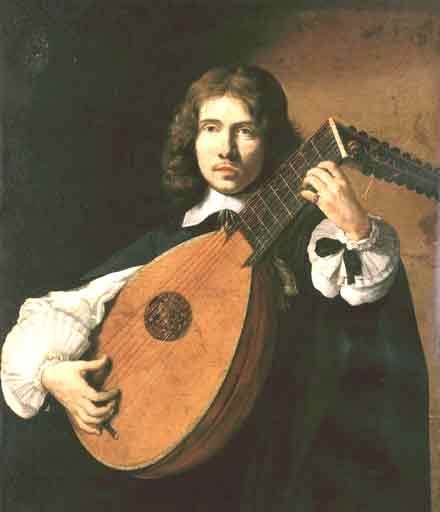
Thomas Campion with Lute

Poetic Campions compose. Thomas Campion with his lute.
If he looks glum it’s because it’s two centuries until Martin Guitars is established, and 350 years until the Telecaster.

He did write lovely songs, in a style I can’t come up with a way to present. “Let Us Live and Love”  was one. You can hear it sung beautifully to his tune here. So instead of exploring my counter-tenor range, I’m going to go with a sort of loose skiffley blues in my performance.

I’m going to lean on my blues audacity hard here, because the poem is addressed to the singer’s lover, Lesbia. Beavis and Butthead style giggles are breaking out in the back, I can hear you.  Turns out Campion took the lover’s name and the idea for his first verse of his lyric from a Latin poem by classic Roman poet Catullus, before taking off on his own thoughts on the matter. Classics scholars explain this by saying the Sappho of Lesbos’ association in classical times was more at a widely experienced lover, not necessarily a lesbian one.

Catullus Comforting Lesbia over the Death of Her Pet Sparrow and Writing an Ode

OK, OK, forget the one about you might as well have sex with me.
How about this, we’re all going to die, just like that bird, and…


Another category “Let Me Live and Love”  could be put in would be a “Carpe Diem” poem, which is not the Department of Natural Resources limit on the number of bullheads you can catch, but is more Latin meaning: “seize the day,” which in the case of poems usually doesn’t mean seize the day for fishing. Instead, Carpe Diem poems usually offer this proposition: “We’re all going to die, so you might as well have sex with me.” Seriously. Poets have actually made that seem like a smooth line.

The twist Campion puts on Carpe Diem is to bend it around a bit. His song has it that you already love me, and that makes the idea that we’re all going to die bearable. That’s at least a little more flattering.

To hear my performance of Campion’s “Let Us Live and Love”  use the player below.


The Heart of the Woman

There’s two things that attracted me to T. E. Hulme, the lesser-known Modernist poet and theoretician that I’ve featured a few times this summer. The first is the sense in his poetry and critical writings of the limits of humankind. The other is his poetry’s surprising modesty and restraint, something embodied in the very brevity of its poetic expression and his images linking the mundane and the cosmic.
 
This was a man who wanted to overthrow hundreds of years of poetic tradition, and a person whose stubbornness kept him in trouble with authority figures throughout his youth, and yet Hulme expresses himself in these spare lines, as if the first lesson he’s teaching himself is to know his own limits. This seems to be Hulme’s problem with Romanticism as he saw and opposed it: humankind is not limitless, though our imagination says otherwise.
 
Today’s piece, William Butler Yeats’ “The Heart of the Woman”  moves in opposition to that outlook, but not in opposition to that expression.
 
Here in North America, many in the southern region are spending this week either cleaning up from a massive hurricane or clenching their jaws in anticipation of an even larger one due to strike this weekend. Peaceful, Rousseauean nature this ain’t. Hobbes is is a weatherman.

Hurricaine Irma

“Come in she said, I’ll give you, shelter from the storm.”

Yeats’ poem is as measured and modest as one of Hulme’s, though it is rhymed and metrical. When one is a good as Yeats is at that, one hardly notices the form. 12 lines, not even a sonnet in length. Like Hulme, this is no great ode of endless argument. On the face of it, it’s a love song, a basic trope of Romanticism, the reason we talk about human attraction and pairing as “romantic.” Its images are centered on a couple embracing.

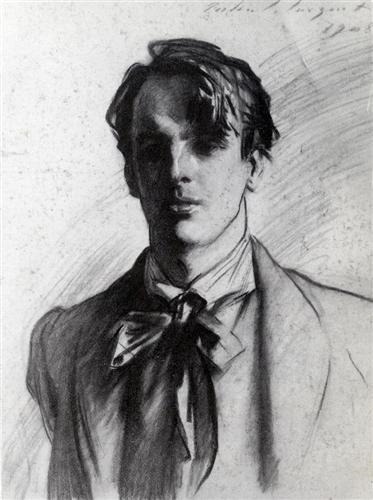
Yeats by Sargent
Why Mr. Yeats, I didn’t realize you were, well, dreamy, without your glasses

But look closely in those dozen lines. The woman who’s singing it, has left religion (“prayer and rest”) and family, and has followed a lover’s invitation into what is introduced as “gloom”. Merely the dark of night?

No, in Yeats’ lovely line, darkness is found inside the “Shadowy blossom” of her hair which will hide the lovers from the “bitter storm.” Now we are fully in the Romantic world, where our own darkness may be willful, wishful, blissful, ignorance of the “hiding hair and dewy (blurry) eyes.”

Are there any more Romantic and romantic three lines as Yeats’ final three that conclude this piece? If there are, I can’t recall any at the moment. That the simple murmurs of human breath can seem to equal a hurricane’s—is that glorious or folly or both?
 
In the spirit of defying human limits, this is the first time you’re going to hear me sing a Parlando Project piece acapella. And though Yeats’ poem doesn’t rule out the same romantic faith on the part of the “he” in this poem, I’m somewhat troubled by the idea that romantic devotion is presented here as female, from the poem’s title onward, so I’ll undercut that by singing this. My less-able singing voice is one reason that we chant or speak-sing a lot of Parlando Project material, but my young son’s carefree acapella singing is reminding me of the value in the singing voice. To hear “The Heart of the Woman,”  use the player gadget below.

Trenches St Eloi

I was talking with my wife this weekend. She’s reading a memoir about current military deployments (and redeployments) and she said a Wilfred Owen poem was mentioned in it.

“Well, World War I was the last war to be covered by poets.” I replied. Which is not strictly true of course. World War II generated a number of poems I’d love to share here, but I have no time to try to track down the rights issues to use words that still may be under copyright. And I suspect other wars have generated other poems since then, even if I don’t know many of them. But that’s not what I meant.

World War I was the last war to be covered by poets.

What I meant was that WWI was the last war in which a considerable portion of the English-speaking public looked to poetry for meaning and consolation regarding the battles and their losses. I’m not sure if they looked to poetry more than journalism or political oratory, but I believe that poetry then still operated somewhat in the same theater as these other words when addressing current events. Longer forms of literature, such as novels, tend to lag events substantially, changing or fixing our view of things afterwards, instead of framing it while the picture is still moving. I think of two epithets, for journalism and then for poetry: “The first draft of history” and “The news that stays news.”

I think of two epithets, for journalism and then for poetry: “The first draft of history” and “The news that stays news.”

This morning, my son wanted to show me this brilliantly parsed cartoon summary of the Iliad. The narrator there has a lot of fun with the meandering and seemingly arbitrary plot of that Greek epic poem, but it struck me that it’s possible that the ur-version of the Iliad might have been written contemporaneously to the events, only to be shaped afterward like a collection of old news dispatches repurposed for later use.
 
So, this is a long tradition in Europe from Homer to the war poets of WWI, for the battles and the experience of the battles being reported in poetry.

Why has this use of poetry, to report current and crucial events, fallen away? The first explanation that occurs to me is we have other media to do this now. Film, radio, video, and now cellphones capture the moment without pretending to rely on subjective art. The Imagists who forged their poetic theory in the years around WWI, would seem to have lost their territory as their theory won the war. A cellphone or nose-cam video of the bomb exploding follows two out of the three famous Imagist rules: The “thing” is treated directly, there are no unnecessarily words (indeed there may be no discernable words at all), while more or less ignoring the less-noticed third rule (the one we at the Parlando Project keep pointing to and speaking about), the one that asks for musical phrasing.

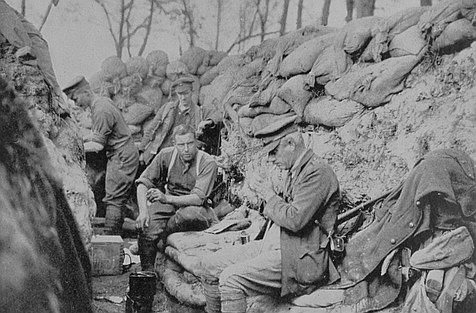
Hulme's company in the trenches at St Eloi
This photo shows men in T. E. Hulme’s Artillery company at St. Eloi in 1915

  
Poetry, like painting, is no longer necessary for reportage. Modernists often chose to respond to this by a movement into abstraction, conveying thoughts in motion and novel conceptions, seeking to demonstrate what can be meaningful without meaning.

Today’s piece “Trenches: St. Eloi”  is attributed to T. E. Hulme, a man who helped form this Modernist revolution and died before he could live in it. I say “attributed” because, like Homer, he did not write it down. The exact attribution is “Abbreviated from the Conversation of Mr TEH” when it was published by Ezra Pound, and it may have been Pound who chose what to transcribe or how to lay out the transcription. My guess is that some of the language sounds like Hulme (the unusual, but so perfect word choice of “pottering,” the homey image of trench soldiers strolling compared to the shoppers on the busy London street of Piccadilly), but the overall arrangement sounds like Pound to me.
 
We know pretty much the where and when that is being talked about, more than we know of the actual history of Troy. Hulme got a chance to relate these details while in an English hospital after being wounded in the spring of 1915 in trench warfare in St. Eloi. He recovered, returned to the war, and to his eventual meeting with a German artillery shell that ended his life.

T. E. Hulme may have said it, Ezra Pound may have edited it and written it down, but to hear me perform it with my musical accompaniment, use the player below.

Fall 2017 Parlando Project Top 10

It’s time to report the most popular audio pieces posted here over this increasingly busy summer. Before I get to this season’s Top 10 countdown, I want to thank everyone who has listened, followed, liked, or shared our posts and audio pieces on social media or on other blogs. I don’t have time (or perhaps the talents) to do all the promotion that some other blogs do, so it’s the kind words and enthusiastic work that you readers/listeners do that has spread the news about this combination of various words with various music.

Lots of changes from our last Top 10, so let’s get started. There should be a player gadget after each piece on the list, so you can easily hear the audio combining those words with music we create and perform as part of the Parlando Project.

10th place? Turns out it’s a three-way tie for 10, and since the three pieces demonstrate the variety I seek to present here, let’s just dispense with tie-breakers and list all three audio pieces that are tied at number 10..

“Sonnet 18”
  is, so far, our only Shakespeare selection. Shakespeare is, or course, inescapable, and setting Shakespeare’s sonnets to music isn’t a rare thing either, but one of the good things that comes from the Shakespeare phenomenon is that a listener can hear a lot of different takes on one text. I choose to bring out the brag in this one.

“A Summer’s Night”  uses a poem by Paul Laurence Dunbar, the first widely published Afro-American poet who died tragically young in 1906. A lot of Dunbar’s success during his lifetime was with dialect pieces which he had ambiguous feelings about. He sometimes said that he wished to be known more for his poetic work in standard English, something that “A Summer’s Night”  demonstrates.


“On the Troop Ship To Gallipoli”  demonstrates a small bit of artistic courage on my part to pay tribute to the real-world courage of Rupert Brooke, who died in service to his country in WWI. The “Great War” redrew the world’s maps, overturned several empires, and it also drew a literary dividing line, as post-war poetry embraced Modernism which made the poetic stylings of Brooke seem decades old only a few years after he wrote them. Those who lived through that time often adapted to the new ideas of modern poetry, but Brooke never had that chance. So, in this piece I recast a late fragment of Brooke’s words as if it was an Imagist poem.

In 9th place, we have “Zalka Peetruza (who was christened Lucy Jane),”  which uses a poem by journalist and poet Roy Dandridge, who coincidently like Dunbar, was another Ohio Afro-American. By evidence of this poem, Dandridge deserves to be better known than he is, as it’s a tart observation of the art of getting over while Black, in this case by passing one’s self off as exotic.

8th place goes to a bit of a surprise, my slightly Beefheartian musical setting of two sections of Gertrude Stein’s “Tender Buttons.”  Don VanVliet (Capt. Beefheart) and Gertrude Stein were both uncompromising artists who hoed their own rows, so I viscerally made the connection in creating this piece.

7th is Sir Walter Raleigh’s damning litany “The Lie.”  It’s a poem I’ve loved since my youth and I don’t think one has to add much musical vengeance to amplify Raleigh’s words. 400 years old, and still pissed off.

6th slot goes to one of my translations, Rainer Maria Rilke’s “The Dark Interval.”  I did this translation a few years ago, and it was intended to be a somewhat freer variation. As I learn more, I think my assumptions on what the poem was getting at were wrong, but this looser version got 20 more listens that it’s more literal translation I also presented here this summer.

Halfway to number 1, at number 5, is Parlando Project alternative reader Dave Moore’s tale “I Was Not Yet Awake.”  Dave also plays many of the keyboard parts you hear here, including the organ part on this.  “I Was Not Yet Awake”  is short for a story, but longer than many pieces we present here. Dave’s story is so well told that it still managed to pick up a lot of listens this summer.

At number 4, dropping down from two straight appearance as number 1, is “Frances,”  a teenaged George Washington’s acrostic love poem. That’s still a marvel, as week after week I look at stats and see that it’s still getting listens, long after its appearance here last February.

Top 3 time! In position 3 is “The Death of Apollinaire,”  my translation of Dada principal Tristian Tzara’s surprisingly sincere eulogy for the multi-national poet and critic Guillaume Apollinaire, who invented the term “Surrealism” and helped weave together many of the strands of European Modernism before he died from complications of wounds he suffered in WWI.

And in position #2, up one place from 3rd in the last Top 10, is Dave Moore enigmatic song “Love and Money.”  It may offer an American answer to the question the Beatles once asked in “Can’t Buy Me Love.”

adlestrop Station

“The steam hissed. Someone cleared his throat. No one left and no one came…”

Position number 1 is another return, and an even higher rise in the chart due to the large number of listens over this summer: “Adlestrop,”  British poet Edward Thomas’ famous moment on train platform on a hot June 24th 1914, were nothing much happens, but everything palpably is.

The poem portrays the train’s stop as unscheduled, but research into train schedules (see them here in this blog post at The National Archives) says otherwise. Adding this element was a conscious choice by Thomas.

It’s a much-loved poem for many reasons. Some find extra resonance in the lines describing calmness in the tiny village train stop, the literal calm before the storm of WWI, and that’s a fine thought for those that hold it, but I believe the poem exists beyond those associations. “Adelstop’s”  closing lines are sublime even without that particular war, that particular trauma to that specific nation, and as it was, to the ending of the life of its author Thomas, who became another of the poets killed in that war.

Sky

I describe the Parlando Project as various words (mostly poetry) combined with various music. The limits on the music portion are largely the limits of my own musical abilities and those of the LYL Band, but I try to stretch those limits as much as I can. The words we’ve used have been poetry more than 90% of the time, but I like to mix up eras and writing approaches there too. Today’s piece uses words that weren’t published as poetry, but they are instead taken from an interview with Laurie Anderson published in The Believer  magazine about 5 years ago. The interviewer (a couple of whose interjections I’ve included) was Amanda Stern.
 
Just before the small section I used from the interview, Anderson was relating that artists do not necessarily need to invent something new themselves, rather they can use art to just call attention to things that already exist. That’s an idea that we honor here with the Parlando Project. Instead of endless creating and featuring new sets of words that Dave or I write, we instead largely seek to pay attention to the work of others. That thought, attention versus creation, led Laurie Anderson to her meditation on the sky that I have now combined with my music for today’s piece, “Sky.”

Laurie Anderson and electric violin

American artist Laurie Anderson:  famous long ago for playing electric violin…

Part of what attracted me to this was her attribution of her sky meditation to growing up in the American Midwest, in a town without big mountains or large bodies of water. In such matters I could easily resonate with her feelings, having been similarly enraptured myself by the sky blue and clouds or the black with serious stars in my youth in Iowa. The book of nature has few words and a lot of blank spaces, but it reads deeply if you look at it.

The book of nature has few words and a lot of blank spaces, but it reads deeply if you look at it.

While I write this, I’m still reading more about the last episode’s author, pioneering English modernist T. E. Hulme, finding out that he felt the need to change his art after spending time on the Canadian Great Plains. Certainly, there was sky where he grew up in England, but the sky of great open places, with its null, yet present reflection on the earth, is the whole garment, after which having seen it, one can be reminded of it, even if all one currently has is a tattered swatch.

Laurie Anderson gives some advice to young artists—might work for old ones too.

 
I cannot describe Laurie Anderson fairly in the space I take for these things here. There are no other better-known artists like her, and so resorting to record store clerk shorthand such as: “She’s like Garrison Keillor combined with Yoko Ono and Andy Kaufman and…” is so strained it doesn’t really get the point across. I can see the lineage from Dada though the developments of 20th Century art in her work, but after all, everyone has influences and comes upon things they resonate with, just as Laurie Anderson’s way of combining spoken word with music is an influence on me.

Anderson’s spoken voice phrasing and speaking style is one of the distinctive things about her audio art. Some describe it as a monotone, but I’d say that’s incorrect. Yes, there’s a compression of affect, but that doesn’t mean there isn’t considerable impression of mood and attitude in it. Perhaps she’d ascribe that to Midwesterness as well. Even her non-pitched performance speaking has in intensely lulling cadence and music to it, not just hypnotic in metaphor, but very much in the mode of the spell-casting of a stage hypnotist.
 
That shouldn’t work—and as much as I love her work, in larger doses I sometimes find it hard to retain even sub-conscious attention throughout the whole work—but with the right amount of attention, it’s extraordinarily powerful stuff.

As she has developed her audio style over the years, she’s added singing and a strong use of electronic voice modifications. As far as I know, she’s one of the pioneers in the use of that electronic voice manipulation. I even considered using some of that in “Sky,”  but opted instead for a more straightforward presentation.

To hear my music accompanying words excerpted from this print interview with Laurie Anderson, use the player below. The whole interview, is also a great read for any artist.

Like John A Dreams

Today’s selection was also recorded a few years back, and is more conventionally in that “poet reading beat poetry while a band backs the poet up” school of performance. While that’s one of the influences that has led to the Parlando Project, I didn’t want to confine myself to that style, and if you’ve been following along here with what we’ve done over the past year, you’ve heard some of the other approaches we’ve taken.

As I’m in a busy end of August, I don’t have time for much commentary on this piece, but I don’t think it needs it either, which is part of why it’s here today.  This is a story set distinctly in South Minneapolis and the early 21st Century, and it talks obliquely about the time of falling in love with my wife. The Riverview Theater mentioned in the poem is still a going concern, a neighborhood single-screen movie house that shows movies near the end of their theatrical release without concentrating on any one cinema genre, leading to marquee billings like the one the poem mentions, a series of titles that often seem like little Dada poems to me.

Riverview Theater 1

Minneapolis’ Riverview Theater: Dada poem generator or movie house marquee?

  
Outside of the localism of the poem, the main obscurity in it is the title: “Like John A Dreams.”  That’s a reference to one of my favorite speeches in Shakespeare’s Hamlet.  In the play’s Act II, the hero Hamlet is asking why he cannot take action on the death of his father, and he rebukes himself as “Like John A Dreams, unpregnant of my cause, and I can say nothing…” John A Dreams was apparently a stock folk character in Shakespeare’s time, a foolish character who lived in his imagination and ignored more pressing reality—a character flaw all writers should be able to appreciate.

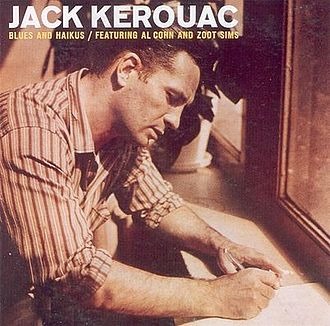
Blues and Haikus Jack Kerouac record cover

Parlando influence Jack Kerouac. “Beat poetry while a band backs the poet up”

Allen Ginsberg once recalled Jack Kerouac reading Hamlet aloud, and in particular this speech, with special emphasis in his voice when he landed on the “John A Dreams” charge.
 
So, if you’re a writer or other artist, Hamlet’s speech is for you. Your life is quite possibly bifurcated between that artistic thing you do and the life you press aside to do it. Art is often about making “and” choices. Life is often about making “or” choices.

To hear the LYL Band perform “Like John A Dreams,” use the player below.

Two Views of a Lunar Eclipse

We seem to be in a month of sky omens in the Midwest, with the Perseids meteor shower and a solar eclipse following one after the other. Perhaps because solar eclipses are rare, poems about them are rare too. I’m going to cheat then, and present two pieces about lunar  eclipses, a slightly more common event that occurs when the Earth comes between the Moon and the Sun, blocking the moon‘s reflected shine.

I’ll lead off with one written sometime in the 19th Century: Thomas Hardy’s sonnet “At the Lunar Eclipse.”   I remember the moon-trip photos, taken near the middle of the 20th Century, looking back at Earth, where for the first time, we could see our planet whole. Hardy reminds us, a hundred years before that, that we could see our whole Earth in a shadow play during the lunar eclipse.

Whole Earth Catalog

For the first time we could see the big blue marble
…also, composting toilets!

 
Optimists at the end of the 1960s thought these whole Earth pictures would help us understand our solitary yet majestic unity and common cause. Hardy, though he had only the Earth’s shadow during an eclipse to work with, is not so sure.

The LYL Band’s performance of this Hardy poem is a live recording from a few years back and it strains to reach “bootleg tape” recording quality, but still I hope it retains some vitality.  And since this Hardy poem is referenced in the next piece, I’m going to give this rougher recording an airing.
 
Though neither I or the Parlando Project had anything to do with it, if you’d like to hear a restrained and lovely simple solo voice and piano sung setting of the same Hardy poem, you can view it here. To hear the LYL Band performing our louder version of Hardy’s “At the Lunar Eclipse” use the player just below this.

My own lunar eclipse piece is set in our century, and in my Midwestern place. I start off by musing on the same planetary shadow play that Hardy wrote of, but wondering if we were our planet, might we make sport of our standing between the sun and moon, as we did as children when the film strip broke in class, or the slide tray of vacation photos needed to be changed, by making hand shadow puppets in the light. Then, as the blood moon eclipse neared totality, and the dark was dark, save for the streetlight at the end of the block and a houselight here and there left on, every hand up and down the street raised itself to the heavens, holding their lit smartphones, as they took pictures of the moon blocked by ourselves on our planet.

2015 Blood Moon Eclipse

A blood moon eclipse. “Can immense mortality but throw so small a shade?”

Unlike our last pairing, the perennial face off between Marlowe’s Shepherd and Raleigh’s Nymph’s reply, my poem “Lunar Eclipse – The Earth in Transit between the Moon and Sun”  isn’t really an “answer song” or a diss on Hardy. In a lot of ways I wanted more to simply update the scenery of Hardy’s poem. Oh, and that title is awkward, but enough listeners didn’t know the mechanics of a lunar eclipse, that we are in the middle on the earth blocking the Moon from the Sun.

What did I mean by the last line? Well, as I sometimes do, I wanted to mean several things. I wanted to say we thought we could capture this cosmic event that had stopped our routine in with the birthday pictures on our smartphone camera roll. I wanted to say, as Hardy did, that we are seeing the whole of our planet, the lives of all our neighborhoods, yet it is only one disk in the wide sky. I wanted to say that our present, particular lives: all our details, our family, our neighborhoods, our homes—though they are the way we experience living—are but one transit of life. Maybe I wanted to say something else that even I wasn’t sure how to say? If so, I wouldn’t know. Sometimes that happens in poems.

Again, we have the LYL Band performing this piece, but it has better recording quality. To hear it, use this player just below.

The Nymph’s Reply to the Shepherd

There’s a long tradition of “the answer record” in pop music, where another artist responds to a hit record with an opposing viewpoint. Christopher Marlowe’s 1593 “The Passionate Shepherd to His Love”  (our last post) received a similar diss from Sir Walter Raleigh with his “The Nymph’s Reply to the Shepherd,”  which is today’s. Who will folk-rock the mic harder? Feel free to re-listen to Marlowe’s inning before considering Raleigh’s reply, Marlowe’s player is just below:

As I mentioned last time, these poems with their shepherds and lovers, called Pastorals, were proudly artificial, and set in a completely stylized and relaxed world of affection and sufficiency. You may find any desire to dwell in this unreal world strange and old-fashioned, but perhaps we imagine now another kind of locus amoenus/“pleasant place” to dream of going to, to escape the world.

Christian_Wilhelm_Ernst_Dietrich_-_A_pastoral_landscape_with_Diana_and_her_Nymphs,_1754

“Then he was all about rural handicrafts all of sudden. Was he even interested in me?”
“Well, it’s not like taking care of sheep is that hard. A child with a tambourine can do it!”

 
Raleigh’s “The Lie”  has already demonstrated here that Raleigh had no patience with romanticism. So, he’s primed to take on “The Passionate Shepherd,”  but he also notices another weakness in Marlowe’s argument: the Shepherd promises pleasures, presumably mutual pleasures to his lover, but he isn’t stopping there. He’s going to demonstrate his commitment by throwing an entire Etsy shop at her: beds of roses, caps, vests and belts made from woven wildflowers, wool dresses and wool lined slippers. And bling! Gold buckles, coral and amber buttons.

So, Raleigh composing the nymph’s reply has three arguments to make. All those hand-made crafts on offer? Doesn’t move me Shep. Outdoor animal husbandry? Not as romantic as you make it out to be in May, and those wool slippers better be warm if I’m going to be traipsing after some sheep come January. Lastly Shep, you’re all hot and bothered about me now, but just how lasting is all that? I appreciate the offer, but let’s just say I’m keeping the wool lined slippers and you can go try your line on some other nymph?

Wool Lined Slipper

I’m not even sure what a kirtle is, but I understand cold feet at night

Musically, this is another piece inspired by a 1960s folk-rock sound. I was thinking specifically about the musical style of Fred Neil’s Capitol records as I arranged this. I used a minor key chord progression somewhat related to the major key one I used for “The Passionate Shepherd,” and once again I sung this one. Raleigh, if downbeat, is just as lyrical as Marlowe in his answer. Marlowe has pretty lines like “By shallow rivers to whose falls/Melodious birds sing madrigals,” but Raleigh has “The flowers do fade, and wanton fields/To wayward winter reckoning yields.” So, use the player just below to hear Sir Walter Raleigh’s response in song.

The Passionate Shepherd to His Love

Let us leave the Modernists for a moment, for a trip to an imaginary land, a locus amoenus, a pleasant place, within whose bounds certain things hold true: love brings simple riches and complex pleasures ignorant of inconstant affection, and where the cares and complexities of cosmopolitan life, brutal prejudice, and other social constructions fade away.

Such a place can have many names. To the Surrealists it was the unfettered confusion of certain dreams. To the west coast optimists of the Sixties and their cross-Atlantic vibrationalists, it was a new Eden of decorated affection and open-mindedness. To a resident of fetid Elizabethan London, it was the pastoral, a demi-countryside where love was free and the rent non-existent. Shepherds, Pan and Panopticon, willed willing partners to their bowers. It seems like a nice place to visit—and in the mind, even more so.

Christopher Marlowe must have written this pastoral love poem sometime before he died in 1593 (baring any occult forces of the Twilight variety, or the posthumous inspirations that allow Oxfordians to confound Shakespeare’s later plays) but it wasn’t published until a few years after his death. It’s a full-throated exhortation in the pastoral style—with a slippery set of gold-buckled feet at the bottom of its argument as we’ll soon see, though that may not matter. Not only is it lovely sounding, even read flat on the page, the whole point of the imaginary pastoral world and the locus amoenus is that it isn’t real, that it’s the place we want to lie in and be lied to sweetly, within.

Marlowe and Peel

“And we will all the pleasures prove.”  The 19 year old Marlowe and the 29 year old Peel.


In the spirit of all this, today’s audio piece is one of the few Parlando Project selections where I sing, as you can’t really declaim “The Passionate Shepherd to His Love.”   Musically, I chose to use some of the production techniques popular among dreaming optimists in the Sixties, where John Peel’s Perfumed Garden  would be another locus amoenus, another imaginary place, where, in fetid times, we might want to go. This week, 50 years ago, John Peel performed his final  broadcast of that accidental and influential radio show.

To hear Marlowe’s“The Passionate Shepherd to His Love”  performed as if it was a cut being played on the Perfumed Garden, use the player that should appear below.


Raleigh In the Dark Tower

Today’s post uses a very short poem about a famous doomed adventurer written by a too-little-known early modernist soldier-poet.

The words’ author, T. E. Hulme, is a name I kept running into as I read about the connections between modernist American and Irish writers in England at the beginning of the 20th Century. Many of those connections can be traced to a group of writers and artists, led by Hulme, who congregated in London beginning around 1908. It’s there that Ezra Pound, soon to be literary modernism’s greatest promoter, met Hulme, who many view as modernism’s originator. The argument for preeminence comes down to classic one:  who thought of it first vs. who practically introduced it.

So far here I’ve concentrated on Pound’s role, but as I began to look at this circle, I must consider Hulme’s impact as well. And then a few weeks ago, through the wonderful blog “Interesting Literature,” and its founder Oliver Tearle, I finally read some of Hulme’s poetry, his own practical application of his ideas.

T E Hulme

T. E. Hulme, the man whose brief poetic spark set off Imagism


If there’s a reason I hadn’t read Hulme yet, it may be that his poetry isn’t as well known, and there is very little of it—and what there is, is little twice: about 25 poems totaling about 260 lines. That’s right, as disciples of Bill James will quickly recognize, the average for a Hulme poem is shorter than a sonnet, just a bit more than 10 lines. His short poems, as much or more than other famous short Imagist poems like Pound’s “In A Station of the Metro”,  Williams’ “The Red Wheelbarrow”  or Sandburg’s “Fog”  challenge the reader to find worth and significance in a few words and a putatively mundane subject. Today’s piece uses the words of Hulme’s “Raleigh In the Dark Tower,”  and is something of an outlier in Hulme’s poems, as it’s subject is not so ordinary.

I used Sir Walter Raleigh’s “The Lie”  earlier this month, and in writing about this extraordinary condemnation of human failings, I told you what every English schoolkid of certain generations would have learned or known about Raleigh: that he was an Elizabethan English hero, and yet he was executed by the English government.

Raleigh Tobacco Tin

Also to blame for Duke basketball fans


Once more I’m going to have compress Raleigh’s life into shortcuts, some of which are matters of dispute. He lived in a time of brutal Christian religious wars and is said to have witnessed both the St. Bartholomew’s Day Massacre and to be captain of the troops ordered to perform the execution of prisoners after the Siege of Smerwick. He was lifetime soldier of fortune and entrepreneur, a cross between James Bond and Richard Branson. He popularized the potato and smoking tobacco, and so can be blamed for lung cancer and my spreading waistline. His expeditions pioneered European settlement of North Carolina, which means he is partially responsible for both Michael Jordon and insufferable Duke basketball fans. He twice led English expeditions into Guyana in South America, without which we would not have Davey Graham and acoustic guitars tuned to DADGAD. Oh, and he was a writer.

Even during his three separate confinements to the prison in the Tower of London, Raleigh wrote. Or perhaps he wrote because of his confinements? He wrote the first volume of a monumental attempt at a history of the world during one prison stay, but his release ended the chance of the series continuing.

To present Raleigh, Hulme in his conciseness, give us just these few lines:

Raleigh in the dark tower prisoned
Dreamed of the blue sea and beyond
Where in strange tropic paradise
Grew musk

For my music for “Raleigh In the Dark Tower”  I used acoustic guitar and a string quartet. To try to bring out the dream half of Raleigh’s prison I tried to perform a second, higher, vocal line. To represent the prison half of Raleigh’s experience, I repeated the words a second time, as a prisoned day would follow another prisoned day.

More depends on Raleigh’s life than depends on a Red Wheelbarrow, but Hulme lets that be only understood. And Hulme’s Imagist philosophy, a “dry hardness”, would urge fewer romantic dreams and more direct observation, but even in his few words, he allows this prisoner the immediacy of his dreams and voyages.

Raleigh would be executed for serving the amoral interests of his country too well, and Hulme would die a soldier on a WWI battlefield believing to the end in the causes of a war that was soon portrayed as absurd.

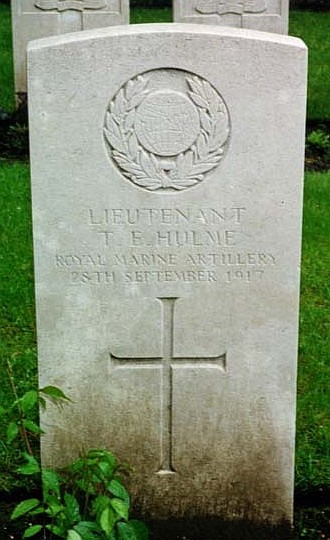
Hulme grave

Another soldier-poet whose leaf WWI cut short


To hear my music and performance of T. E. Hulme’s “Raleigh In the Dark Tower,”  use the player below.