Today’s selection was also recorded a few years back, and is more conventionally in that “poet reading beat poetry while a band backs the poet up” school of performance. While that’s one of the influences that has led to the Parlando Project, I didn’t want to confine myself to that style, and if you’ve been following along here with what we’ve done over the past year, you’ve heard some of the other approaches we’ve taken.
As I’m in a busy end of August, I don’t have time for much commentary on this piece, but I don’t think it needs it either, which is part of why it’s here today. This is a story set distinctly in South Minneapolis and the early 21st Century, and it talks obliquely about the time of falling in love with my wife. The Riverview Theater mentioned in the poem is still a going concern, a neighborhood single-screen movie house that shows movies near the end of their theatrical release without concentrating on any one cinema genre, leading to marquee billings like the one the poem mentions, a series of titles that often seem like little Dada poems to me.
Minneapolis’ Riverview Theater: Dada poem generator or movie house marquee?
Outside of the localism of the poem, the main obscurity in it is the title: “Like John A Dreams.” That’s a reference to one of my favorite speeches in Shakespeare’s Hamlet. In the play’s Act II, the hero Hamlet is asking why he cannot take action on the death of his father, and he rebukes himself as “Like John A Dreams, unpregnant of my cause, and I can say nothing…” John A Dreams was apparently a stock folk character in Shakespeare’s time, a foolish character who lived in his imagination and ignored more pressing reality—a character flaw all writers should be able to appreciate.
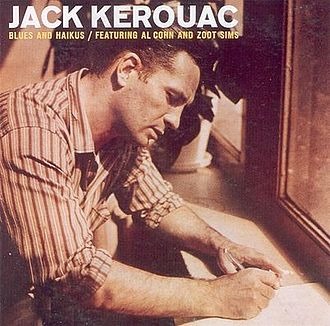
Parlando influence Jack Kerouac. “Beat poetry while a band backs the poet up”
Allen Ginsberg once recalled Jack Kerouac reading Hamlet aloud, and in particular this speech, with special emphasis in his voice when he landed on the “John A Dreams” charge.
So, if you’re a writer or other artist, Hamlet’s speech is for you. Your life is quite possibly bifurcated between that artistic thing you do and the life you press aside to do it. Art is often about making “and” choices. Life is often about making “or” choices.
To hear the LYL Band perform “Like John A Dreams,” use the player below.
I said I would change things up last time, and by stepping back a few years, today’s piece does that.
How much different is “She is Sleeping on the Boundaries of the Night” from the last few posts? First off, we’ve left off from war. This is a love poem. Death appears in it only briefly passing—so fast it passes, as it can in a poem, you might not even notice it. And rather than being a piece by another poet, the words here are mine. We live here at the Parlando Project with the idea of presenting “other people’s stories,” but I also want variety, so I’ll make the exception this time, and present part of my story.
One of the modernist/Imagist ideas that Ernest Hemmingway liked to use in his early stories was to leave an essential detail out of story, and then to strive to write it so well that the power of that detail would become present subliminally.
In a classical aubade lovers are always awaking in a field and forgetting to check for contact dermatitis
“She is Sleeping on the Boundaries of the Night” is an aubade, a traditional form of love poetry. An aubade features lovers awaking at dawn, and the poet lamenting that their night is over, so they must now part for their un-enchanted days. What do I think is different in my aubade?
Sixteen years ago, my wife died after a short and painful illness, not yet 44 years old. I cannot tell you all that means, but one thing I experienced in my grieving process was the question of where one goes from that stopped thing. After all, you are definitively stopped, you have no momentum in any direction, unlike in the normal flow of life. You can stay stopped, or move off in any direction.
I moved, and was moved, in the direction of falling in love again. There are some difficulties in that direction, knowing of love’s inescapable impermanence. Like the lover in an aubade, I knew now, deep in my soul and body, that love means that parting is intensified.
In the end, “She is Sleeping on the Boundaries of the Night” is a love poem that hardly mentions death. I was trying to do that modernist/Imagist thing. Is death still there?
Alas, the other thing that I left out, is that other person, lying beside the speaker, stuffed with dreams no doubt with all the richness, sadness and choices of their life. My love poem fails, as some do, in that respect. Can it remain unsaid my partner chose to move, and move me, as well?
Today’s piece is musically a bit different as well—there’s an antique 20th Century beat box rhythm used for one thing. To hear the LYL Band perform “She is Sleeping on the Boundaries of the Night” use the player gadget that should appear below.
“The River Merchant’s Wife: A Letter” has a very complicated history. I can’t even say “Ezra Pound’s ‘The River Merchant’s Wife”— though he’s often listed as the author.
Let’s begin, as a river or a journey might, at the beginning. Back in the 9th Century in China there were two great poets. One of them we’ve already met there: Du Fu. He was known for his wisdom and level-headedness. The other was Li Bai (his name is also written in western letters as Li Po and Li Bo, and in Japan as Rihaku) who was known for his more excessive existence. In China both have been continually revered, but in early 20th Century Europe or America, they were nearly unknown. Only scholars interested in off-beat subjects knew of these men’s work.
One such scholar was an American, Ernest Fenollosa, who had traveled to Japan and become deeply immersed in Japanese culture, and as a sidelight to that, he also was exposed to Chinese culture. Early in the 20th Century, Fenollosa was one of a group of Americans living in England. We’ve met others here who were part of this “reverse British Invasion” of Americans: Ezra Pound, Robert Frost, T.S. Eliot—and you’ll soon get to meet another, H.D. Fenollosa then died in 1908, still in London.
Here’s were something fateful happened. Fenollosa’s widow, for some reason, gave Ezra Pound a bunch of her late husband’s papers. Pound was a young man who was trying his damnedest to start some kind of artistic movement in London. In the papers were scholarly prose translations of Li Bai’s poems done by Fenollosa and two of his Japanese associates, Mori and Ariga.
Ernest Fenollosa, deeply attracted to fur; and Li Bai, more into silk
Pound fell upon these scholar’s notes. He’d already sought out other old poetry for inspiration for his revolution (much as the Pre-Raphaelites had looked backwards for something fresh), but in this old Chinese poetry he found what he was looking for. It was concise. It was free of centuries of cruft that English poetry had accumulated. And Pound naïvely felt that the poems themselves grew out of the ideograms for their words, Chinese characters which had evolved from drawings of objects. He had found his poetic revolution. Poems should be constructed of little more than images. Not images in the sense of elaborate similes or strained allegories, images in the sense of a presentation of the direct observation of the poet, unadorned. Pound published what he created out of those scholars’ notes as a ground-breaking poetry collection “Cathay,” and he quickly began to compose his own modernist poems using his epiphany.
If Fenollosa hadn’t died in London, and if his widow hadn’t given this tranche of papers to an artistic provocateur such as Pound, it’s possible that Li Bai would be no better known in English today than he was in 1908, and it’s even more likely that poetry in English from that point on would have evolved differently.
If Fenollosa hadn’t died in London, and if his widow hadn’t given this tranche of papers to an artistic provocateur such as Pound, it’s possible that Li Bai would be no better known in English today than he was in 1908, and it’s even more likely that poetry in English from that point on would have evolved differently.
Seems like a miracle when such things line up, doesn’t it? Well, here’s something as miraculous: though “The River Merchant’s Wife’s” source was written over 1200 years ago in a culture so far removed from America that the childhood legend was that one would need to dig a hole through the center of the Earth to get there, even though it comes to us filtered through non-Chinese scholars, and even though the particular words I’ll use today to express it were written by an avant-garde poet whose work remains little-read and understood today, many people have an immediate deep emotional response to this poem the first time they hear it.
Isn’t that odd? All that strangeness in customs, place-names, time, provenance—and yet more: it’s a poem of female desire written in the voice of young woman by a man, and translated and transformed by men. And yet, woman and men, young and old, hear it, and they feel the pangs of desire and separation just as much as any 8th Century resident of China—even though the poem, following the tenants of what Pound would call “Imagism,” barely mentions the speaker’s emotions (“bashful,” “desired,” and the only present-tense one, “hurt.”)
I know I felt those things when I first heard it, aged perhaps 21 on a sad journey with a young woman. I hear it now as an old man too, and think once again of my friend John, and of China. The place, Cho-fu-Sa, that the river merchant’s wife says she will go out to meet her husband is, I’m told, hundreds of miles from her village in the poem. What is such distance to the heart?
To hear my performance of “The River Merchant’s Wife: A Letter” use the player gadget at the bottom here. Since this post is already long, I’m not going to talk much about the music today. The higher-pitched string instrument you’ll hear is my approximation of the pipa, a traditional Chinese lute. There are many moving recitations of this poem available online, but to see an entirely light-hearted modern translation of “The River Merchant’s Wife” after listening to mine, view this one.