Millay’s Tavern

In my Human Seasons, I awoke to the first cold morning of fall, and I thought that this just completed Edna St. Vincent Millay musical piece would be just the thing to release and write about today. Oddly, I had started working on the music for this in the midst of summer. Millay’s poem is one of those that sits up on the page asking to be sung, and from such temptation I’d worked up the basic musical idea back in a time when I could hop on a bicycle just wearing the clothes I was wearing around the house. This morning I needed a wind-proof beanie, three layers across my torso, and I had to wiggle into tights. An old man getting into tights is a rickety procedure, a vignette unfitting association with carefree bike rides.

I asked myself yesterday “What did this song need?” How dressed? How many layers? I have been presenting a lot of songs recently featuring acoustic guitar, and the tracks I had from summer were just my voice and guitar – acoustic, yes, but at least there was some variety in that it was my large-bodied 12-string. I pick the 12-string harder than most, hitting the strings with more of the flat-pick surface. This produces a bell-like clang, and I thought I’d underpin that sound with some gamelan gongs. I then added a bass line and thought about a top-line riff. For some reason – woodwinds,* and I played the left-channel part using one of my sampled “Virtual Instrument” libraries with my MIDI pickup guitar. I tried to mix this oboe part to a realistic level as it would be if this was an actual acoustic ensemble playing this live instead of myself playing track by track in a “one-man-band” format. The gamelan gongs? I wanted them distant, as if they were outside the tavern window in the scene of Millay’s poem. The final mix of the song works best on headphones or modern ear-buds, so go ahead and put those in your ears if you have a set handy when you listen.**

If you’d like to read the full text of Millay’s poem, here’s a link to that.

In these musical choices I was trying to bring out the mystery I sensed in Millay’s words. “Tavern”  could be read superficially as a desire to run a bread-and-breakfast or the like, perhaps somewhere in the Maine of Millay’s childhood. A nice enough way to understand the poem, but Millay put in something that undercuts reading it as a New York Times style section feature on charming getaways: a repeated reference to this inn she envisions being specifically for “grey-eyed people.”

If one searches for what “grey-eyed” might signify, you’ll get the usual cold under-contextualized information that search engines offer up. Grey is a very rare eye color. OK, is Millay saying she’s going to market her inn with some “Think Different” focus on gathering unusual people, perhaps the artists, writers, and bohemian figures of her youthful 1917 Greenwich Village times? Not impossible, but why then does she write about learning from the grey-eyed “long ago.” Is there something else about having grey eyes? There are results that say that eye color is supposed to be a sign of wisdom, including some that report it as an epithet applied to the famously wise Greek goddess Athena. OK, she learned something from the grey-eyed, but that seems an obscure way to say that, though evoking an air of generalized mystery with this grey-eyed matter seems to be part of her intent. The whole casting of her tavern in the poem doesn’t seem selective. It’s near the top of some mountain, but it would seem to be a welcoming place for all who come upon it. Is the voice in her poem going to ask everyone to take off their sunglasses or tinted contacts to see if they’re allowed in “Tavern.”  I don’t hear those that arrive pleading at the door: “Look, my fake ID says my eye color right here!”

Another sense I got from this poem is that it was possibly in conversation with another poem, one by Christina Rossetti, her poem called “Up-Hill.***”   I don’t know if Millay knew this poem, but it’s not so unlikely. In this case then the grey-eyed are the souls ascending up some mystic mountain toward a heaven or afterlife. They are grey-eyed because their eyes are clouded in the moments after death. One other, allied, possibility for why grey-eyed: her mid-19th century ancestors might have been pictured as early photographs, faces whose colorful eyes would all be rendered in shades of grey. Our poems, our songs, our memorialization, our celebrations around a table – these are to bring colors back to the grey eyed.

Grey-eyed in Carl Van Vechten’s photo, Edna St. Vincent Millay.

.

You can hear my performance of Edna St. Vincent Millay’s “Tavern”  with the audio player below. No player on your mountain? Damn your eyes, or rather the way you’re reading this blog which might suppress showing a reader – but this highlighted link will open the door, or new browser tab, with its own audio player.


.


*It would have been subconsciously, but perhaps the mixture of oboe, 12-string guitar, acoustic bass, and unusual percussion may have been a ghostly presence in my mind from the times I saw an admired the musical ensemble named Oregon that used that mix of instruments.

Which reminds me of a tavern joke: An ego and a super-ego walk into a Freudian bar. The bartender says, “I’ll need to see an ID with that.”

**I used to have time and opportunity to check my mixes on various ways to listen to them. I particularly miss my old car for this, as it had a great stereo for revealing aspects of a recording mix. In my current living situation I often have no opportunity to mix my recordings on external speakers, much less give them a quality check with these extraverted noisemakers. A check I still do before release: listen to a new song on at least one pair of mobile-device ear-buds, which I assume are the most typical “hi-fi” system for modern listeners.

***If you have the time, the song version I made of Rossetti’s poem is a favorite recontextualization of mine. You can see and hear that at this older post from the Parlando Project at this link.
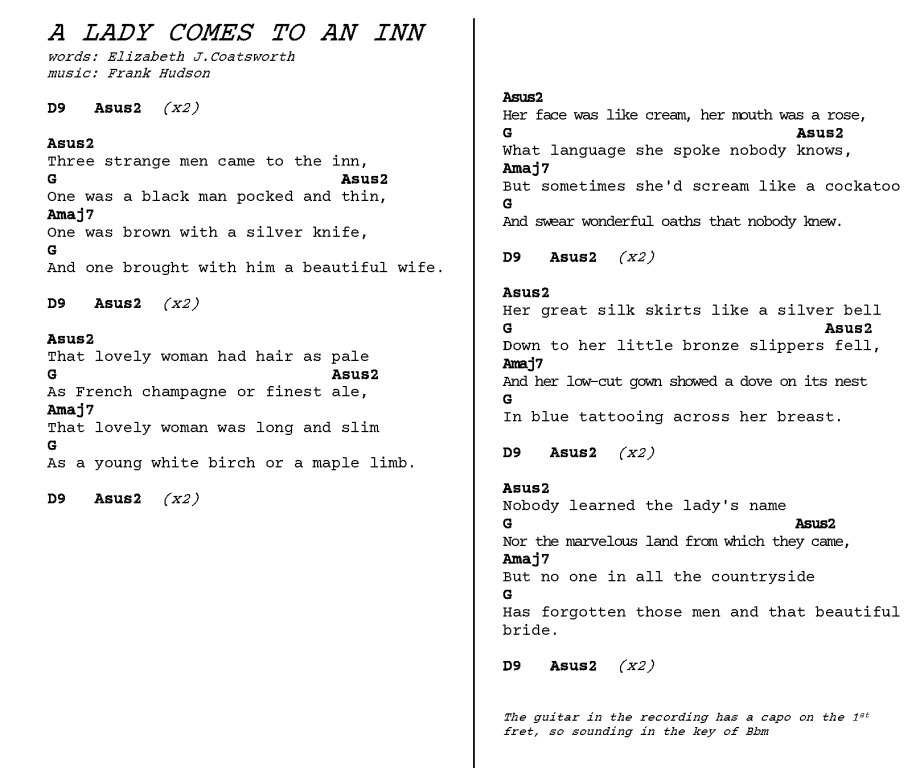
A Lady Comes to an Inn

We first meet any poem as a stranger. And in going through Louis Untermeyer’s Modern American Poetry  for this year’s National Poetry Month series, I often met on its pages poets I knew nothing about. Elizabeth Coatsworth was one. This poem of hers, “A Lady Comes to an Inn”  is emblematic of that – starting with strangeness, ending with wonder.

The poem begins when a quartet of strangers comes to an inn. Two of them are described as men of color, a third gets even less description, but he has a wife – the “lady” of the title.

The rest of the poem is observations of that lady. Normal expectations and timeworn poetic tropes may blind us as she is first described. First, we’re told her hair is pale and somewhat transparent. Is she just blonde or perhaps white haired? Well, twice we’re given images of translucency: champagne and ale. Perhaps that’s a trick of the light, but even if the number and pigment of hair strands change with age, they’re still opaque. Perhaps the poem’s descriptive inventory of a lighter hair color, creamy complexion, and a rosy mouth hew so closely to many a poem and folk-song’s conventions we’ll be lulled into this opening as so much boilerplate.*

A Lady Comes to an Inn

Likely not intended, but I was reminded by the title of this poem of the old ethnic-joke form that starts with a group of nationalities or religions who walk into a bar and….

.

Things start to slip by the third verse: she speaks a language “nobody knows.” Does she speak this unknown tongue only some of the time, perhaps with her three companions, or is that unknown language her only one? The poem’s not clear on this, or even what the speech of the three men is like – they’re silent for all we know. This third verse has the two lines that “sold” the poem to me on first reading: “But sometimes she’d scream like a cockatoo/And swear wonderful oaths that nobody knew.”

Now we’re fully in strangeness. The cockatoo screech must have been startling, though no startling of those who have met these strangers is noted, and the oaths that may be understood as curses only from their musical tenor or other context, are said to be “wonderful.”

I get a sense of beguilement by the strangers, and the fourth verse may be to indicate that: the poem’s observer is gawking down the woman’s décolletage to read her tattoos. And what’s with those “bronze slippers?” Poetically fancified way to say brown shoes? Or are they really metal shoes. Weird. And no one can obtain the lady’s name. Language barrier? Beguilement? Since the other three in the quartet of strangers are unremarked on after the first stanza, the lady is holding everyone’s attention. Nobody knows where the lady and the others have come from, though it’s surmised it’s “marvelous.”

And then the poem and its strangers skip town, and the poem is the sum of the inn’s countrysider’s remembrance.

Let me be honest. On first reading I was picturing a quasi-Romani/”gypsy” encounter, and I even thought the poem might be seen as vaguely racist in an exoticist manner. Rather, I believe we’re supposed to get that sense – but the poem doesn’t say Roma explicitly, and easily could. That’s a misdirect. I think the countrysiders may even think the travelers are Romani at first. Taken more carefully, with a little more attention, I can see an unwritten final verse where a gray and time-jumping Rod Serling steps out from behind the inn to give us a benediction about being hospitable to strange travelers.

Did Coatsworth intend extraterrestrials? Modern readers might see that in the spaces between what she outlines in her poem: the thin extended limbs, pale skin, the indecipherable language, the metal shoes – ET, your inclusion in an important Modernist poetry anthology has come through. But in the early 1920s when Coatsworth published this poem, I think were more at fairy folk in her intent.

I spent an afternoon today reading more about Coatsworth’s interesting life and other literary work. Untermeyer makes much of her world-traveler resume in his anthology’s introduction of Coatsworth, and from further study it does look to be remarkable. As a young woman in the early 20th century she rode horseback across the Philippines and traveled widely in China and elsewhere in Asia – as well as the more common European “Grand Tour” stuff.** Though starting off as a poet for three book-length collections, she was a prolific writer in a variety of genres, including children’s literature and fantasy. Her most remembered work is an early Newbery Medal winner, The Cat Who Went to Heaven,  a children’s book with unusual subject matter melding extensive dharma talk with a Charlotte’s Web plot published in 1930. One of the highlights in today’s research was reading a couple of accounts by Coatsworth’s daughter, poet Kate Barnes, who writes about what her mother was like and the life she eventually led in rural Maine.

I wanted a contrast with the slower, sparer music I have used for the first two episodes; and when I had an hour in my studio space Friday, I quickly recorded three energetic takes of the music I wrote for “A Lady Comes to an Inn.”  Kate Barnes writes her mother wrote quickly,*** and that rhymes with my usual recording necessities these days: the first thought had to be a good enough thought. When I went to mix the resulting tracks, I realized I had a problem. I had played my jumbo 12-string guitar, and that beast when I pick it at a rapid tempo produces a lot of clashing harmonic content. It took a few tries using some mixing magic to temper that issue with the recording you can hear below using the audio player gadget. Has the audio gadget left for fairy land or Aldebaran? No, it’s just that some ways of reading this blog glamor the display of such a player, and so I provide this highlighted link that will open a new tab with an audio player.


.


*The lady’s elongated thinness also described may not stop the reader at first either, but the young maples in my yard would also say otherworldly if their branches would describe a humanoid limb.

**Her travels included “off the beaten path” journeys, and I theorize that she would have likely experienced herself, as a woman, being the exotic, mysterious, traveler at times.

***Coatsworth’s spouse, writer Henry Beston, was the opposite, a much slower writer who needed solitude to work. Mother/housewife Coatsworth might have needed that work-fast-with-inconstant-time-available outlook for external reasons, but daughter Barnes thinks it was intrinsic to her nature. Coatsworth published around 100 books and told her daughter that she had published the most poems of any poet of her era if you excluded the para-literary sorts like Edgar Guest

Down the Songo — Summer: Still Rowing, Still Dreaming

Does the summer feel like it’s gone by like a dream, one of those dreams where the ungainly night-plot finds its own winding path? I started this summer with a May Day suggestion to remember to write of our workday labors, and then too, I presented back then a cover song marking my teenager’s last childhood summer. And now it’s Labor Day weekend, and I’m going to present a poem that is the antithesis of paid labor, another poem from the 1894 Songs of Vagabondia  book by Bliss Carman and Richard Hovey. We’ve already heard from Carman this month, now let’s sample some Hovey.

Richard Hovey is another of those pre-Modernist era poets who wrote in the final years of the 19th century. Because his work falls before the Modernist revolution and the ascension of American poets to a preeminent place in English language literature there’s lesser interest in it, but with a figure like him I think of a bright young man living in an age that felt stirrings of desire to form its own poetic styles.

His Songs of Vagabondia  struck a carefree chord in its time. Tennyson, Longfellow, or Robert Browning would have presented a very serious life that should be attended to. The Vagabondia poems, with intent, fail the Sandburg Test I’ve proposed to assay poetry collections. If my beginning-of-Summer cover song asked the listener to indulge in “That Summer Feeling,”  these poems concur. There’s no Winter and barely an Autumn there. No work or studies either. Instead, we have flirtations and libations, the comradeship of likeminded friends, and here the open road and heart are spent without anything much in one’s purse or paycheck.

For this Hovey poem from Songs From Vagabondia  I chose to create a denser piece of music, a presumptuous rock band ensemble with two drumsets, electric bass, piano, two electric guitars, along with string synth and wind instrument parts. For a Labor Day holiday song about an aimless trip down a Maine river, I spent quite a few hours working to form this into shape. I’m not sure I produced the perfect arrangement after all that, but I enjoyed the process.

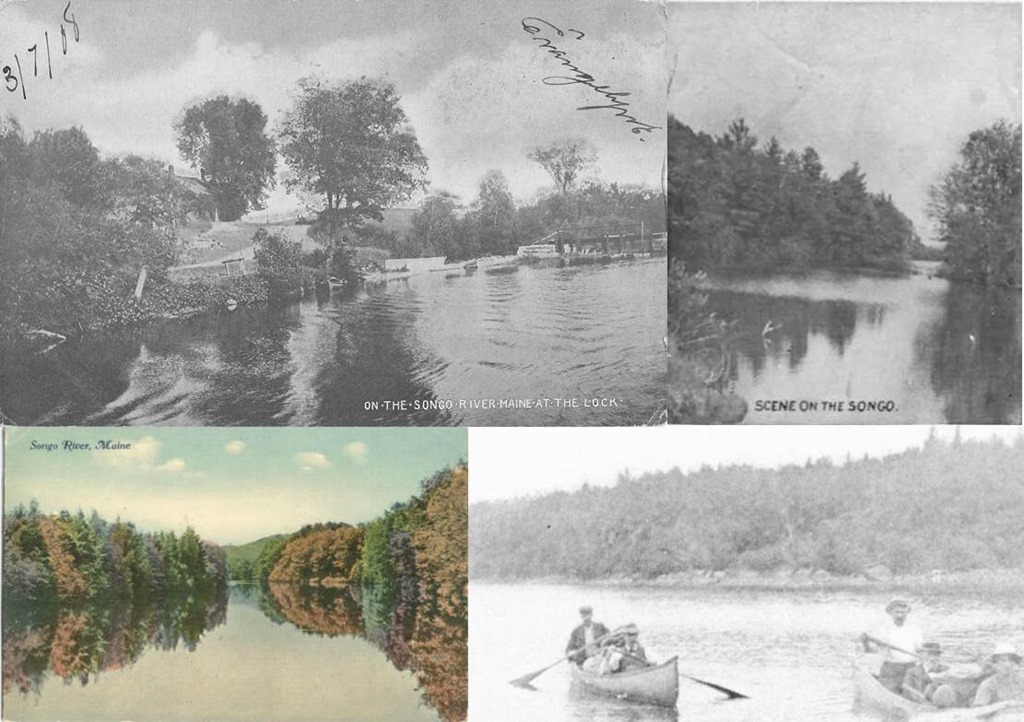
Songo River 4 pictures

These Songo river photos look like they could have been taken within a decade or so of Hovey’s poem. Looks bucolic in these, but others show passenger steamboats (one named for Maine’s poet Longfellow) plied the river too.

.

The Songo in Hovey’s poem is a short river in Maine, but the Songo connects a large lake and some other bodies of water — and though I don’t think the poem mentions it, it had then (and still has!) a hand operated set of locks and a swing-away draw bridge constructed in 1830.*  Hovey’s poem makes this river sound rural and solitary, but having never been to Maine, much less the Maine of the late 19th century, I can’t say how busy it actually would be. The poem’s voice says someone is using oars for propulsion, so even if this is an aimless pleasure trip, there’s work involved just as there was in my recording the song I made of the poem. At the end of the poem there appears to be someone else in the boat, as the poem’s voice cries out “Kiss me” unexpectedly. Who is the other there? Could this be a Hendrixian excused kiss of the sky-blue-water-sky? Maybe, but a lover would be the likely (if unprepared for) guess. The unprepared suddenness of this ask seems dream-plot strange to me.

In my performance I turned the poem’s remarks about the experience being dreamlike into something of a refrain to further emphasize that element for someone who might hear this once as I perform it. I also removed one short stanza from the poem’s original text in the interest of shorter performance length. You can hear the full band performance of “Down the Songo”  with the graphical audio player you should see below. No player?  This highlighted link is an alternative that will open a new tab with its own audio player.

.

*This short modern video shows the continued remarkable operation of the manual lock and drawbridge. Yes, these are hand-cranked mechanisms!  So, Sandburg Test met with this post, there are necessary folks working a job on this river, even if unmentioned in Hovey’s poem.