Since I’ve been keeping track, one thing has been consistent with the most popular piece each season: it’s been by a poet not widely known or read in the United States. So previously we’ve seen on top after a season of your listening: my translation of Dada principal Tristan Tzara’s “The Death of Apollinaire,” the better-known-in-the UK Edward Thomas’ “Adlestrop,” the too-often overlooked Chicago Modernist Fenton Johnson’s “The Banjo Player,” and “Frances,” the teenage love poem by George Washington, whose career as a poet never really took off.
This has happened even though I’ve featured (multiple times) most of the popular canon of pre-1923 English-language poets touched by the Modernist movement of the 20th Century: Frost, Yeats, Sandburg, Millay, Pound, Williams and Eliot.
Pat yourself on the back: the listeners here are open to a variety of writing, and they don’t necessarily need to have a name they already know attached to the words.
Still, it’s surprising that it’s surprising that we have Emily Dickinson coming in at the top spot this past summer.
Dickinson (along with Frost and Yeats) seem to be special cases with The Canon, in that all three have retained some level of popular readership and presence in that still-existing oral-tradition of memorization, even into our current century, without being denigrated into the bin of “not-great poetry.”
Our Summer 2018 most liked and listened to audio piece is “Ample Make this Bed.” Like many Dickinson poems it’s extraordinarily compressed, just eight lines—and like so many of her poems it invites us in and then mystifies us. Most of us have made a bed, and some of us have even been instructed in how to complete that task correctly. Here, with “Ample Make this Bed,” we may get six lines into the eight and we haven’t left domestic normality other than the ironic satisfaction with a job, that if done excellently, will stand forever. Ah, if only any domestic housekeeping task can stand ‘till judgement day, rather than the few hours until it needs to be done again!
The poem’s final two lines are so modestly telling and beautiful. Until them, no rhyme—and then internal rhyme and end-rhyme rush in! And the synesthesia of “yellow noise,” an image which could have been informed by Dickinson’s mysterious medical syndrome which included photophobia, but needs no biographic detective work to strike us boldly.
Is “Ample Make this Bed” about death, domestic drudgery, love, or the unstoppable passage of time? Emily Dickinson seemed to have taken care with her poetry, to make it ample and arranged to last until judgment day, so it’s likely intentionally undetermined—or mystically, exactly, all of those things united.
Musically, I’m quite proud of my music and performance of all the various parts with this one. If you missed it last July, why not go ahead and listen to it now. And if you like it, please let others know about what we do here.
It was an odd summer traffic-wise for the audio pieces of the Parlando Project, with listens quite slow in the first half of the season, and then picking up to the point that August listens were a near record. That increase in traffic (new listeners?) may be why we had no older, pre-summer audio pieces that made this season’s Top 10 (though one, “Poetry,” made a valiant run at it).
As we’ve done the last few Top 10 lists, we’re going to count down in trios until we get to number 1, starting with number 10.
10. Crushed Before the Moth. The Bill James style stat-freak in me has threatened to do a poet/listener batting-average post on which writers seem to get the most and least response. Without really running the numbers, my impression is that Emily Dickinson, who like Frost and Yeats retains a general readership as well as scholarly cred, still doesn’t always hit it out of the park in listens when the audio pieces use her words.
I’m reminded here of one of my favorite bits of baseball trivia, what pair of brothers hit the most major league home runs? The true baseball fan will have many candidates to choose from. The three DiMaggios? (Dom was a very good player, and some have heard of Joe). Or the Alou trio (who once made up an entire outfield of brothers). Or Boyers, Boones or Alomars. But the answer is Hank and Tommy Aaron. Hank had 756 home runs, Tommy crushed only 13—but add it up, and the Aarons come out on top not just alphabetically.
Emily Dickinson’s sister-in-law and confidant, Susan, is not a famous poet, but she shows a bit of the same Emily Dickinson flare in her poem we used for this. Emily has that Hank Aaron level achievement, but Susan had her at bats too.
9. Seventeen Almost to Ohio. In the several years I’ve been doing this, I still love how pieces arise obliquely as I look for material and research its context. At the end of July, I was looking for more info on Mina Loy, the fascinating Modernist whose work was forgotten for decades and now seems to be attracting increasing scholarly interest. This led me to a tape made in 1960 of Loy being interviewed about her work. The interviewer, Paul Blackburn has now entered that vale of forgottenness himself, but besides being a serious poet with a strong interest in the audio value of poetry, he was a promoter of other poets, so I naturally feel an affinity for him. The Loy interview tape has moments of interest, even though Loy seems distracted and at times uninterested in her own long-past work, and Blackburn, true to our Other Peoples’ Stories ethos, encourages her, but doesn’t fill the gaps by yapping-on himself about, well, himself—as I fear I would have done. Yet, for a minute or two, he does do that, and this ad lib description of hitchhiking trip from his own youth was so striking I had to form it into what it sounded like to me, a beautiful little poem. It’s one of my favorite pieces from last summer as well as for the listeners here.
8. Plum Tree Blossoms on 40th Street. The vast majority of the words used here for the audio pieces are not mine. That’s by intent. Both Dave Moore and I have written since our teens, but when I started the Parlando Project I thought that the special jump, the bridging of a gap, that occurs when you perform a piece and others listen may be intensified if the performer too is making the jump across the gap to the writer, just as they are asking the audience to do. This summer’s top 10 will violate that principle three times, probably more than it should.
A number of things I’ve written this year have focused on memory and time, and how they can be experienced in odd ways. How we can intensely experience a past event as if it’s still going on in its full dimensionality, or in “Plum Tree Blossoms on 40th Street,” how we may fill in sensory information and intensity in remembered events long after they have happened, even though at the time they were occurring they seemed mundane. The routine of biking to school is to my son is just another day to him now, but it can be transformed into something else much later. Artists believe they can access that special intensity and meaning instantly, without nostalgia and the confining frame of memory, and that may be a necessity for their work to be created—but in another sense, what’s the hurry?
Increasingly, I am comprehending the miracle of Emily Dickinson. Fifty years before Ezra Pound and T. E. Hulme constructed a compressed modern poetry replacing conventional imagery with fresh and direct observation, a woman in a rural town in the woods of Massachusetts had already practiced their innovations over a thousand times.
Through a series of happy accidents, Dickinson’s poetry was preserved and published at the end of the 19th Century, just before the Imagists launched their Modernism—but even then, she was still like one of those unexploded bombs dug up by a construction crew decades after the war. Even after publication, the framing of her poetry still obscured it. Her posthumous editors cleaned up her punctuation and gave the poems titles, and on the page they looked so normal. As these were poems by an Emily, they were clearly the work of a woman, and so they were read as women were generally understood, even when not pressed between the boards of a poetry book. And Dickinson herself designed her poems to draw you in with their modest length, their frequent use of pious hymn meters and stanzas, their homey rhymes. Even into my mid-20th Century lifetime, it was perfectly possible to be aware of Emily Dickinson’s poetry and not be awed.
“Hey Joe, there’s a big chunk of metal buried way down in the mud! Here, listen when I give it a bit of a whack with my pipe wrench…”
They still run across stuff like this from WWII around Europe. Decades old, and they can still go “Boom!”
Some early 20th Century Modernists looked more closely, and maybe saw some of what was there. Carl Sandburg straight-out called her an Imagist in a poem. I am unaware of how much attention the other early Modernists gave to Dickinson, but just on a promotional level, it might not be advantageous to talk much about poems written decades ago when your brand is “Make it new!” Remember too how Pound jabbed at Walt Whitman in his tribute poem: Walt Whitman you were a hacker out there in some unharvested forest, I’m a fine wood-carver able to bring out the finest detail. Dickinson’s near-rhymes and loose but familiar meters may have been read as imperfections to Modernism.
It took the last quarter of the 20th Century for Emily Dickinson to finally be seen, and we are still seeing more now as we look closer. What if, back in the mid-19th Century when Dickinson was creating this unprecedented expression, one had been able to talk with her about it? The value of writers’ groups, seminars, and MFA programs is not universally acknowledged, but most think these things at least have some effect on those who participate.
It just so happens, that occurred. Dickinson’s letters to Thomas Higginson give us some of her ideas, but as I read that correspondence I see Dickinson adopting masks, some playfully, some for protection. And Higginson, as varied as he was, was not, as far as I know, a poet, and therefore there was no chance that he would use Dickinson as a model for his own writing. But Dickinson’s long-time friend, neighbor, and sister-in-law Susan Gilbert Dickinson was a writer who dabbled in poetry.
Like Emily, Susan Gilbert was smart, was allowed some access to education, and wrote poetry
No other person saw as much of Emily Dickinson’s poetry while she was still alive as Susan. It’s also probable that no other person other than Emily Dickinson’s sister Lavinia (who seems to have had no artistic interests) was as intimate with the author. There is even speculation that there was an erotic bond between Susan and Emily. Besides the pant, pant passages in the letters between them, Emily praises Susan’s intelligence and cultural companionship. Given what must have been the loneliness of Emily Dickinson’s creative innovation, amplified by the cultural limitations for women in her time, we may all owe a debt of gratitude to Susan Gilbert in helping sustain Emily Dickinson.
Today’s piece uses a poem by Susan Gilbert Dickinson that shows some of the same elements one finds in Emily Dickinson’s poetry. Given that the prolific Emily Dickinson experimented with her expression, if “Crushed Before the Moth” was slipped into some complete poems of Emily Dickinson volume it would not seem entirely out of place.
What elements of “Crushed Before the Moth” are Dickinsonian? A short line length (six syllables, though not Emily’s familiar 6/8/6/8 hymn stanza). Alternating rhymed lines with unrhymed, though here first and third not second and fourth, and the rhymes are all perfect rhymes except the final “moth.” Even the use of a Bible verse (Job 4:19) is not unprecedented in Dickinson, who though a religious dissenter, was steeped in a Christian religious culture.
The poem begins, just as many of Emily’s poems will, with a close observation of nature. In Job, the moth is only a passing metaphor, in Susan’s poem it’s an actual moth, looked at closely enough to see the texture of its body in the evening. The moth is treated here as an Imagist would. It’s not some intellectual counter, a rote symbol only standing for something else, but an actual animal in an actual evening. The second stanza continues in the same vein, the moth the morning after, though with more characterization.
The concluding three lines, though they contain the only Emily-like slant rhyme, are the least like Dickinson’s poetry. That kind of envoi ending with a clear and orthodox moral lesson is not something Emily would write in her mature poetry, and the “Is this thy stronger host” line sounds unnatural and stilted.
Still, this might be the first poem ever written that imitates Emily Dickinson’s strengths and innovations. That Susan Gilbert Dickinson was a more orthodox Christian than her friend, and like all of us, not the genius that Emily Dickinson was, doesn’t keep her “Crushed Before the Moth” from being an effective poem.
I’m back to acoustic guitar for today’s performance of this piece, which is available using the player below.
You may have noticed fewer new pieces posted here over the past month. There are a variety of un-interesting reasons for that, but one cause is worth a post, even if it’s not representative of what you usually find here. Think of it as a “make up post” for the missing activity this July.
This month I traveled to Massachusetts with my family and some friends. My concerns with this project have lead me to cast some recent trips as literary pilgrimages. Since our expedition was a mixed-age group of five, that wasn’t all that we did of course, and many of my memories of this trip are more about fellowship with the rest of the travelers, and not just with the connections I sought with long-dead writers. But let me focus on the literary highlights of this trip today.
Boston/Cambridge
We stayed at the Parker House hotel, which was well situated and has a long history connected to the culture of the city. Operating since before the Civil War, it was the meeting site for the Saturday Club, where the region’s considerable 19th Century culture elite met. And for desert, the Boston Cream Pie was developed there too! The current hotel building doesn’t go back to those days, it dates to the 1920s, but since two of our party were 21st Century people, there was plenty of historic charm along with a good night’s sleep to be had there. Alas all that masonry or other infrastructure issues meant the WiFi service was at 1920s level too, so my blog activity was minimal during the trip.
My companion book for this trip was Matthew Pearl’s The Dante Club. I was delighted to find our hotel and the still-standing (though it’s a Chipotle now) Ticknor and Fields publisher and bookstore building just down the street were locations used in the book. The book is ostensibly a mystery novel, but what it actually does is attempt to recreate post-Civil War Boston and Cambridge as it would have been experienced by the prominent local poets of the time. Particularly in the opening chapters this requires the reader to struggle with their 21st Century sensibilities. Pearl uses excerpts from these authors’ books and letters repurposed as spoken dialog to convey that time’s sensibilities, and I found that slow going. Not only am I a 20th Century Modern in my own literary sensibilities, but I also believe that their ordinary conversational speech would not be the same as those fountain pen strokes. In the course of the book, Pearl violates every one of Elmore Leonard’s rules for good writing—though they were only the rules that worked for Leonard, and even he admits exceptions. The plot too is somewhat creaky, though that’s a common fault for mysteries.
Am I not tempting you to read this book? On the contrary, I eventually found it captivating. As we moved about Boston and Cambridge, and as I read more of the authors it references, the level of historical research Pearl put into this became apparent. I now want to try his current book, a sequel, that is apparently set among the Pre-Raphaelites, to see if his magic works when you aren’t walking around in the characters’ footsteps.
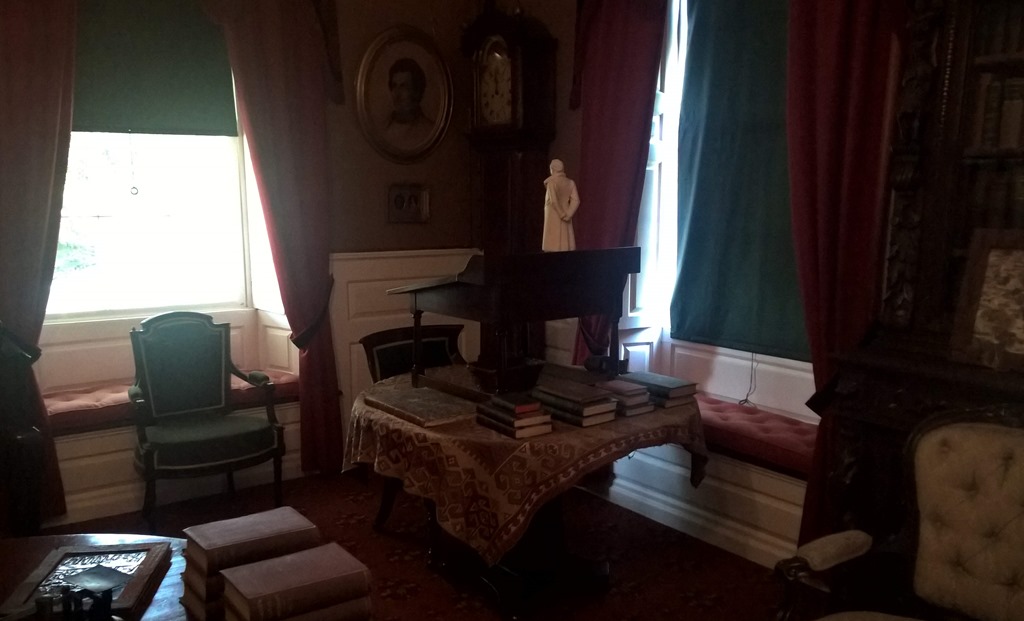
Henry Wadsworth Longfellow’s oh so modern standing desk. The small statue on top? Goethe.
Pearl’s book is largely responsible for our visit to Longfellow’s house in Cambridge, and for me taking the time to check out Longfellow’s now unfashionable work. We walked through the room there where Longfellow’s beloved wife was sealing envelopes containing locks of their children’s hair with help from her daughters one summer’s day when the sealing wax melting candle caught her dress on fire. The room where Longfellow rushed in and tried to smother the fire engulfing his wife with a rug and his body. He suffered burns from that fire, painful and life-scaring (that bushy beard wasn’t just a fashionable affectation), but not fatal as were the ones that took his wife’s life by the next day. The room he rushed from? His writing room, with it’s nowadays in-fashion standing desk (a tactic he shared with Hemmingway), a room decorated with carved Goethe, Dante, and Shakespeare, all looking at him, asking him to “Let us, then, be up and doing.” I now read his work and think of what it does not say in what it does say.
Provincetown
When told we planned to go to Provincetown, someone asked my wife “You know how wild it is don’t you?” Well, yes, it’s extraordinarily crowded on a summer day with people from other New England places looking for a change of scene, and gayer than a Pride parade. The main street is full of establishments that cater to the not-quite-needs of no-purpose-but-the-change visitors, and the milling throngs are deep in thought of how good a time they are having verses their expectations.
We got off the ferry and had a tasty early lunch of hip-casual fusion food in a place with a patio covered in sand that had a view of the beach, and past that to the ocean that which can’t be bothered with time, which is always visiting, and therefore isn’t a visitor.
We then picked up rental bicycles, and after reminding one brave member of our expedition that riding a bicycle is, well, like riding a bicycle, we took off on a five-mile jaunt up to the highest point on this area of the cape. There’s a widow’s-walk porch atop the visitor’s center at this high point, full of fresh breezes and a view of that ocean again, beside which lie grassy sand dunes that meet that wind with ardent curvatures. I’ve read that the higher water levels and fiercer storms of our human-heated climate have damaged these features, but to us, visitors, it still read as wild and timeless.
After a good long meditation with wind and outlooks, I was reminded of my reason for going to Provincetown, and we set back on bicycles for the town again too look for the house once owned by Susan Glaspell and her husband George Cram Cook. My paternal grandparents are from the same south-eastern Iowa location that Cook and Glaspell grew up in, and though as far as I know they had no direct participation in The Davenport Group, Glaspell was a cousin of my grandmother.
Back in 1915, Provincetown was what was called an artist’s colony. That term is now somewhat outdated I think, but the concept is timeless. Artists, writers, musicians, and the like look for somewhere unfashionable, perhaps a bit run-down, with cheap rents to reduce their overhead while they work on things that won’t bring in a steady cash-flow. These artists naturally knock into each other, igniting collaborations and idea sharing. Often those unfashionable areas gather value, and before you can invent the term gentrification, the upmarket consumers, who though they might bring disposable cash to spend on art, bid up the rents and crowd out all but the most financially successful creators of art.
But all that hadn’t happened yet. Cook and Glaspell settled in a house on the main street, the street we now find full of folks looking for a good day or weekend, walking and driving fender to footsteps so thickly that it was hard to even walk our bikes up to the address. Back in 1915 the couple had redecorated the house’s interior with bright colors and Charles Demuth had sculpted them a sundial for the yard held skyward by a nude statue of my cousin Susan.
Here’s where things get uniquely interesting back in 1915. What could this little group of artists do while waiting for the paint to dry, or while you waited to afford a replacement for the worn ribbon in your typewriter? They decided to put on plays. Whose plays? Well, they were writers, weren’t they? Let’s write them. A stage? Look, we have artists, they should at least be able to wrangle some lumber into a set. They were given the lower floor of a former fish house that was situated on the end of a dock out over the timeless ocean to use.
What did they know and didn’t know, and did that matter? Theater in the United States was a commercial enterprise, exclusively that. This was before broadcasting, and a huge enterprise existed, with theater chains from Broadway to the small cities across the country to supply those things that could make money by presenting live entertainment. In one way, theater was tremendously broad, but it was also predicated on presenting what was going to work for that big audience. In poetry, music, and art, the Modernists were experimenting, trying things that weren’t supposed to work to see if, in fact, they could. Driven by Cook and organized by Glaspell, this little cadre of artists began trying to do that with drama, but I doubt they had any idea of what would happen when they tried this, way out on the Cape, with at first only their friends in the audience.
A disheveled man who shared a rented room in the town, down on his heals and with an already well-established reputation for alcoholism claimed he had a bunch of plays in his trunk. “Trunk plays” is theatrical lingo for old work that might be revived if a need arises, but this was an actual sea trunk he was hauling around with him, stuffed with unproduced work. In an artists colony, many writers would claim they had good stuff already written, just waiting for the world to discover, but then as now, some of this would be an empty boast useful to get someone to pay for the next round.
It fell to Susan Glaspell to arrange an informal table reading of a play from that trunk. Worth a chance, since the new company was short of material and game for anything.
Remember it’s 1915. Europe had Ibsen and Strindberg, sure. The Abbey Theater in Dublin had started a few years before. Some around the table would be well-travelled and would even know their work. But this is America, and this was a hanger-on in a little beach town artists’ colony. The author with the trunk was too shy to read his own play, someone else was deputized, and the author sat in another room as the reading commenced. The guy’s name was Eugene O’Neill, and the play, Bound for Cardiff.
Glaspell wrote about this more than a decade later, but she recalls that right away they knew they had something. Bound for Cardiff, a play set on a tramp steamer, was performed in their makeshift playhouse at the end of a pier that year. The sound of waves, wind and gulls, the murk of fog and evening chill did not have to be added with theatrical tricks. The smell of the sea wafted up through the cracks in the dock floorboards.
The Provincetown Playhouse had its first star playwright, and Modernist American drama had its starting point. And in Glaspell and Cook, they had the organizers who could keep the artistic cats herded and pick up new strays. Within a year Glaspell, who had co-written the first play the Playhouse had produced, wrote Trifles, a seminal work of Feminist drama.
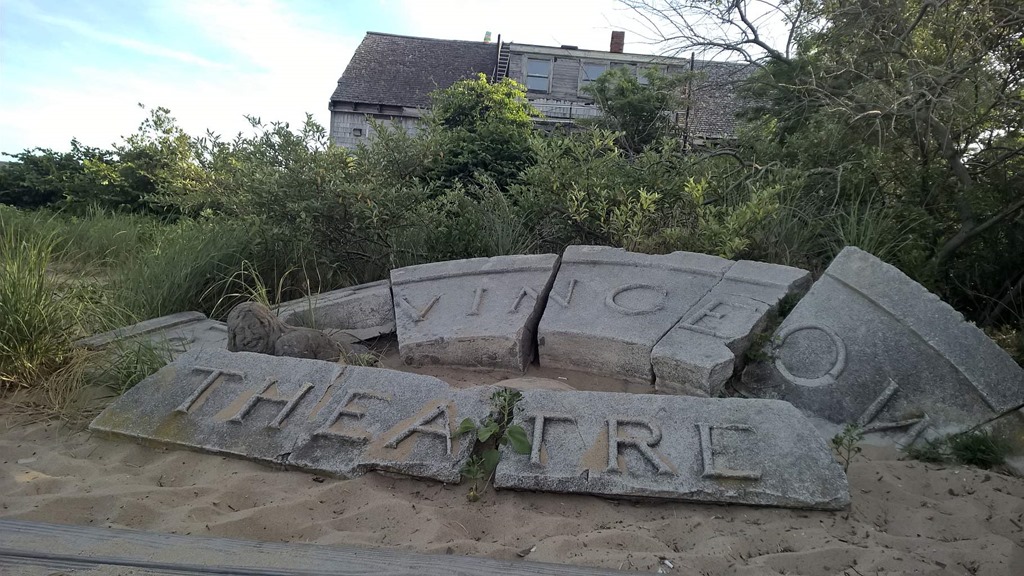
I believe this remaining sign is from a later theater, not the rustic fish-house. However when I was taking this picture a charming older lady walked up and asked if we knew what it meant, and was pleased and surprised that we knew about Susan Glaspell and the original Provincetown Playhouse.
That weathered makeshift theater building on the end of the dock could never have timelessness, though it apparently stood for some years after this. Cook and Glaspell took their organization to Greenwich Village and continued with seasons there as the Provincetown Playhouse for the next decade. There’s more to this story, but I bring the curtain down by noting that while scanning a book of plays the Provincetown Playhouse produced in the towns wonderful small library, I saw that two poets from this month, William Carlos Williams and Mina Loy, once performed on stage in a two character play there.
Amherst
This was my prime target for this trip, as the Parlando Project has lead me deeper into not understanding Emily Dickinson, which I’m still finding an interesting place to be. Emily Dickinson spent almost all of her life in Amherst, much of it living in her family’s house. Not being a Massachusetts native I had no idea where Amherst was, or any sense of what I’d find. My first surprise was how rural the region seems to be. We entered into the town on a winding two lane road that reminds me of those paved highways that followed what were once wagon rutted dirt roads and before that indigenous footprints.
The Dickinson Homestead. Emily’s front window is the one on top floor left.
The two neighboring houses that make up the Dickinson site are imposing as you pull up to them, reminding you of her family’s prominence in the town. Early on in our tour I learned that the present lot is actually smaller than the holdings in Emily’s time. Across the road running past the house’s front door and under the sight of Emily’s room’s window, the Dickinsons had a hayfield that they cultivated. And the garden that Emily tended, the accomplishment that she was most recognized for by her peers? It was much larger in size and scope than I had imagined, though only a conventional, more modern, grass lawn grows there now. There were flowers, though not in an organized English garden sense, but also a large vegetable garden used to feed the household and a remarkable orchard which the guide told us included fig trees—trees way outside the zone that should survive New England winters due to some ingenious horticultural tricks. Although they were Puritan stock who thought household servants would be a stain on a family’s industriousness, the Dickinsons did hire some garden and field help due to the size of the holdings. None-the-less it was the household’s women who managed the gardens, first Emily’s mother and then Emily herself.
Not only the grounds, but the house’s interior has been redone and revised since her lifetime, and our guide was scrupulous in describing what parts reflected the original arrangements. Emily’s bedroom, where she did much of her writing, and where she stored the hand-made booklets that became the prime source of her ground-breaking poetry, has been recreated in considerable detail however. It’s a bright room in the daytime, and the table by the window where she wrote and revised at night, has a whale-oil lamp that would have been a luxury in her time, but must have facilitated her incredible productivity during the 1860s.
The biggest surprise was the second house, built for Emily’s brother and his new wife next door at the behest of Dickinson’s father. That sister-in-law, Susan Gilbert Dickinson, should not be overlooked as a factor in Emily Dickinson’s genius. They had a close friendship from the time Emily’s brother started courting her, and like Emily, Susan was unusually well educated for a woman of her time and place. Besides emotional bonds deep enough to cause modern speculation about a sublimated or overt lesbian relationship, Emily seems to have used Susan as one of her trusted readers to give her feedback on her revolutionary poetry. For a woman so far out on her own avant garde as Emily Dickinson was in the middle of the 19th Century, Susan may have been indispensable.
This second house, “The Evergreens” remained more or less as it was in the late 19th century, and to a large part has not been restored. It’s spooky, you feel almost like you’ve broken into an abandoned house with wear and lack of maintenance left intact. That feeling is even stronger when the tour takes you to the floor where the bedroom of Gib, Susan Gilbert Dickinson’s youngest child was located. In 1883, at age 8, Gib died of typhoid. Afterward the room was locked and kept closed by his distraught mother. Decades later, when the house was finally turned over to the group that now conserves the site, the room still contained a small boy’s toys and his clothes still neatly tucked away in the dresser, some of which are now tenderly displayed as you walk past the door.
I could speak of more, but those were the literary high points of my trip. I hope to return with normal service in August, combining various kinds of original music with various words (mostly poetry). To tide you over here’s the most popular Emily Dickinson audio piece with listeners here so far, “We Become Accustomed to the Dark.” Use the player gadget below to hear it.
I’ve been unable to do as much as usual with this project for the past month for several reasons. One of those reasons was a trip to Massachusetts, which if this was a normal blog would have already generated posts of the travelogue sort. However, this project is about two palpable things, music and words (mostly poetry), that can’t handily be walked along, though you can tour their containers and neighborhoods. Perhaps that trip, in an indirect way, will generate pieces yet this summer.
I was finally able to visit Amherst and the house where Emily Dickinson lived nearly her entire life—and today’s piece uses words from one of Dickinson’s poems—but long-time listeners will know that Emily Dickinson is already a favorite source for words here.
No house, no state, not even any time or country can explain the genius of Emily Dickinson. For reasons of brevity, I’ll try to summarize by saying that she created and entirely new form of poetry, powerfully compressed, elusive and still approachable, and wholly without precedent. The things scholars can trace as influences can be found in her poetry, but no one else made Emily Dickinson poems out of that same stuff. And her poetry has largely not become obsolete. Over 150 years after it was written it still seems modern, maybe even more modern today than it seemed to the early 20th Century Modernists 100 years ago.
Ample? The specific standing for eternity. Emily Dickinson’s restored bedroom in Amherst
I’m attracted to shorter poems that unpack into larger things, and “Ample make this Bed” is that. It’s short even by Dickinson standards, eight lines, 34 words. If one pauses to puzzle at this meaning, the imagery of the grave is what comes to many reader’s mind. It can be read as a shorter companion to one of Dickinson’s most famous poems “Because I could not stop for Death,” but with a bed replacing the longer poem’s subterranean dwelling. However, besides its greater concision, “Ample make this Bed” is using another poetic form, one different from her longer poem.
An aubade is a poem where two lovers wish for the morning to never arrive. Since it is, in fact, arriving, they will deny it, wishing for their night together to remain forever. By using this traditional poetic trope, Dickinson has thrown a rich ambiguity into her 34 words. Although Christian religious belief has its variations, the traditional judgement day is the day of eternal salvation and the universe’s perfection. “Ample make this Bed” compares the morning of divine perfection to the morning that separates the lovers in an aubade.
Is this a statement that the sensuousness of human love can be judged greater than eternal salvation? Or is it a puritan statement that any such love will face its final end and judgement? Could it even be both, balanced on a knife’s edge?
Look too at two of those 34 words describing possibilities of this bed. Its Mattress, where the body rests, may be straight. The body has a straightaway lifetime. The Pillow, where the mind inside the braincase rests, may be round, a circular line that doesn’t end.
Dickinson puts her poetic thumb on the scale with the most beautiful line in the poem: “Let no Sunrise’ yellow noise.” The poem has been puritan with its rhymes until this line, although elusive near-rhymes are present in the first stanza. Now it lets in richness, a rhyme internal to the line, before proceeding to the final perfect rhyme in the last line. Besides the line’s sound, the dawn of eternal judgement is— what?—so much noise. If Keats’ second inversion is so, then beauty is truth—and Dickinson may be indicating her thoughts on the matter.
Musically, I performed this in waltz time and I repeated the first stanza to add some sense of the eternal. Most of you can hear the performance with the player gadget below, but some ways of reading this blog won’t show it. In those cases, use this highlighted hyperlink instead.
We now come to the top half of our count-down of the most listened to and liked pieces during the past three months. But what if you’re new here, and you wonder what this Parlando Project does?
In short, we take various words, mostly poetry, combine them with original music, and perform them. My intent at the start was not to do this the same way each time, to vary our approach as much as we could. We’ve been doing this for a couple of years, and there are now over 220 Parlando Project pieces available here if you search through our archives. From time to time, as I look at what we’ve done, I seem to notice a “style” developing, and while I have no objection to that arising organically from my predilections and limitations as a musician, performer or composer, when I hear that I usually ask myself “What can I try that’s different?”
The poems are not always the famous ones, I like to mix in some “deep cuts,” but it just so happens that these three recently popular ones are all pretty well-known, but maybe we can bring something new to them?
In position number four we have Emily Dickinson’s “We Grow Accustomed to the Dark.” Last time I talked about how I’m finding that Modernist poetry in English moved from a recognizable natural landscape freshly observed in it’s early poems to a more interior landscape, another darker country where new dialects of language and syntax seemed the natural tongue of that region. It may well be that WWI, with its unstoppable socially-accepted murders, was a cause for this change. The rise of Freud contributed too. But more than half-a-century before WWI, and decades before Freud published, Emily Dickinson, spurred by American Transcendentalism and her own individual genius, was exploring some of those same places.
When Dickinson gets furthest inside her own head and tries to use her mutation of mid-19th century language to describe it there, she can be inscrutable; but when she’s half-way there like in this little masterpiece, she’s exploring poetic areas that won’t be visited again until the 20th Century.
This is another of the pieces where I think my music works particularly well. Perhaps you’ll agree. Player below:
Funny how these count-downs seem to form a sequence. From Dickinson’s dark we move to the third place piece, by that little-known poet William Shakespeare, with one of his sonnets about The Dark Lady, “My Mistress’ Eyes are Nothing Like the Sun.” When we wasn’t supplying titles for late 20th Century Sting CDs, or writing a play here and there, Shakespeare wrote a collection of sonnets that are full of ideas woven of memorable phrases.
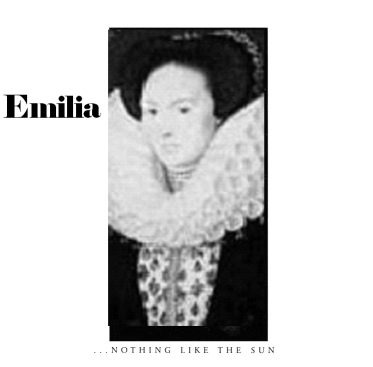
Emilia Lanier, musician, poet and possibly Shakespeare’s Dark Lady.
I’ve always loved the sonnet, even shared a few of mine here. It just seems the perfect length for a lyric poem, long enough to develop two or three ideas costumed as images, but not so long that one will find them frayed and soiled at the cuffs before it’s done.
Hear my performance of Shakespeare’s Sonnet 130, “My Mistress’ Eyes are Nothing Like the Sun” with the player gadget below.
And now we’re up to the second-most popular piece this past quarter, Marianne Moore’s “Poetry.” Shakespeare’s poem in slot number three declares his love by saying the things his beloved isn’t. Poet Moore’s poem about poetry starts off famously by saying she “too dislikes it,” and goes on to tell us what she feels works an doesn’t work as poetry, including the poem’s other famous line about poetry’s goal, to show “imaginary gardens with real toads in them.” I think here again of those early Imagist poems, with their unromantic and ordinary things made into central images: T. E. Hulme’s red-faced farmer standing for the moon or Aldington’s poplar tree as a young woman or F. S. Flint finding the moon taking on the terror of a WWI Zeppelin raid. Toads all, ordinary nature, not the battalions of classical gods or the obligations of sentiment.
This piece’s popularity on Spotify continues steadily, as with “Sky” from earlier in the count-down, I wonder if it’s the short, somewhat generic title that brings in curious listeners there.
My initial idea of the Parlando Project did not have my voice as the only reader, and the first voice you hear in this version of “Poetry” is Dave Moore who’s been the voice in a number of pieces over the past two years. The other voices in this performance are two fine poets who’ve spent a lifetime raising toads to see what works in their gardens: Kevin FitzPatrick and Ethna McKiernan. Hear them read Marianne Moore’s “Poetry” with the gadget below.
That leaves us only the number one to count-down, the most popular piece this past spring. It’s not a well-known poem, and it’s not by a well-known poet. See you back here soon for that.
Continuing on with our count-down of the most listened to and liked audio pieces from the Parlando Project during the past quarter, we’ve now come to numbers seven through five.
At number seven this time is an example of how the Spotify listeners differ from the blog listeners. This piece received only a handful of listens on the blog this past spring, which isn’t unusual, as “Sky” was posted there last summer, and blog users tend to listen to the latest posts unless brought here by a search engine. On Spotify though, “Sky” has seen steady action, and enough plays there to make it one of the most listened to this spring..
I like the idea and outcome of looking at the Midwestern sky that multimedia artist Laurie Anderson explained in an interview that I quoted to make the words for this piece, but I’m not sure what attracted all the action on Spotify for it. Is it the short, somewhat generic, title perhaps? As we’ll see later this month in the countdown, another of the Parlando pieces with a one word title was very popular on Spotify in the past few months.
Well, no matter blog readers, here’s “Sky” brought to your attention by the listeners on Spotify.
One of the Parlando Project principles is “Other People’s Stories.” There are a good number of Internet locations where people post their own poems, and blogging in particular is often autobiographical. I could do the same, but I have a contrarian streak, and I find responding to other people’s words and figuring out how to perform them interesting.
I don’t dislike autobiographical blogs, I subscribe and happily read a handful of them myself. If prodded, I can go on way too long about myself, just as I have a tendency to do on any subject, and having had my first poem published almost 50 years ago, I’m certainly not against revealing my own poetry. “Other people’s stories” is a choice I find helpful, that’s all.
I will use my own poetry/lyrics in the audio pieces here from time to time, though I like it when they are my words about other people, such as the number six most popular piece last spring, “Anglers.” This is the story of my father and his youngest brother’s sport fishing, something they spent many pleasant days doing before my father became too old and frail for his beloved outdoors. Those days seemed timeless even as they were occurring decades ago, and those lakes have become mysteriously reflective in memory now. So, in writing of them I added notes about passing between dimensions.
I’m proud of how this came out, and glad so many have taken the time to listen.
These Top Ten lists often include well-known poems by well-remembered poets, but that contrarian streak in me likes to look at those less remembered and see what might be of interest there. Richard Aldington is one such case, a writer who was active in the pre-WW1 London circle that created Modernist poetry in English. Coming in at number five on this spring’s list is this charming poem of his “The Poplar.”
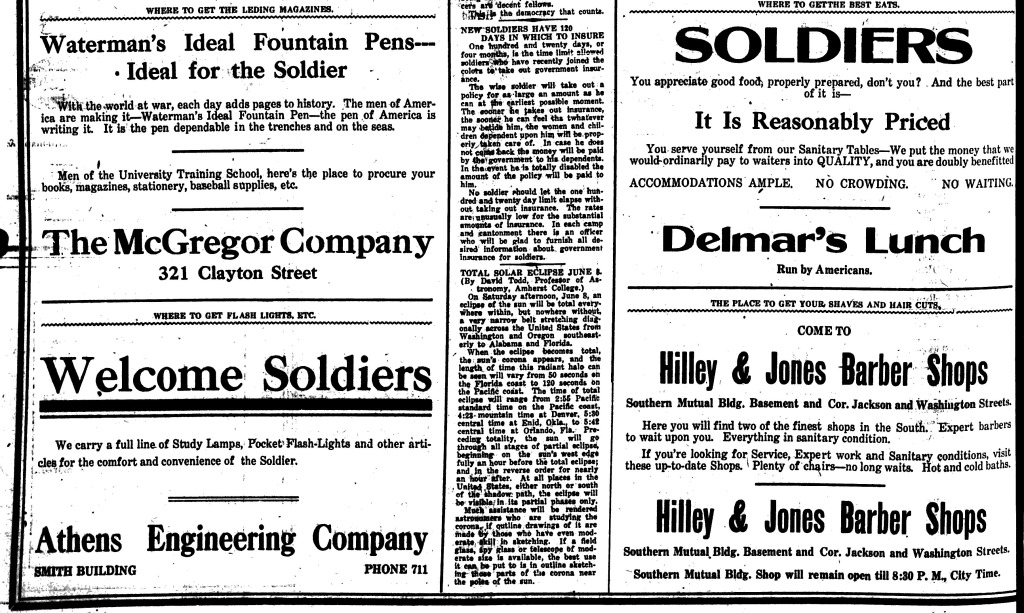
62 years before REM was formed in that town, astronomer David Todd asks artists in Athens Georgia to sketch the June 8th 1918 total solar eclipse. Note the ads pitching goods to WWI soldiers. “Delmer’s Lunch – Run by Americans”
Since it is easiest for me to use poems here that are in the public domain, the newest ones are often from that Modernist revolution that occurred in the first two decades or so of the 20th Century. There are weeks when I think I must be living 100 years ago more than in 2018, as I look for and read poetry from that era. Do I find this a refuge from 2018? No. The horrors of WWI (which impacted Aldington, who served, significantly), the realities of racial, class and gender attitudes then, mean this was no golden age. But what does surprise me reliving the genesis of English Modernist verse as I read their work now, is how they employed broadly accessible images in their Imagist poetry.
The post-1920 High Modernism that was largely used to represent the Modernist movement when I first encountered it is full of obscure references, exotic words and locations, events so far into the imagination and the special dialects the poet chose to reflect those inward locations, that a reader is confronted by a world they can’t comprehend the landscape of, much less the meaning of what occurs there. There can be beauty and insight in this, but it’s a world that assumes one will come prepared, well-equipped with poetry expedition gear and maps.
But before all this, as Modernism was forming itself, the poems are still in a world much like the one inhabited by the general reader, like this graceful and musical one. Give a listen to Richard Aldington’s “The Poplar” below.
Other peoples stories. How can I connect sky-watcher and eclipse sketch promoter David Todd to poetry? Todd was a pioneer of “eclipse chasing” as well as a theorist of life on Mars. His wife, who documented his trips to view eclipses was Mabel Loomis Todd. Back in the 1880s Mabel had a scandalous long-running affair with Emily Dickinson’s brother, who lived next door to Emily. After Emily’s death, Mabel Loomis Todd was the person who saw to the publication of Emily Dickinson’s poetry. And when we return soon to continue our count-down, we’ll have a poem from Emily Dickinson.
As I’ve done most quarters, I like to look at the most played and liked pieces during the past season and report back here. Usually a few of the results surprise me, they aren’t always my favorite pieces or even the ones that I think came off best.
I do this in classic countdown fashion, so we start off with number ten and move in the next few days up to the number one. The audio pieces for the Parlando Project can be consumed a number of ways. Some listen to them here using the audio gadget on the blog, but others listen by subscribing to us through any of the leading podcast services. The audio pieces are the same, but the blog allows me to write about the pieces in a much richer manner than I can with any of the leading podcast services. However, if you, or someone you know might be interested in just the music and words, this is a handy way to get them on your phone or other handheld. So, if you just want the tuneage, search for Parlando – Where Music and Words Meet on iTunes, Spotify, Google Play Music, or any of the other podcast services. You should find our audio pieces in their podcast sections.
On to the countdown…
Coming in at number Ten is one of the two pieces from May that gathered enough likes and listens to make it, despite having a shorter time frame to do it in, “Letters to Dead Imagists and A Pact.” I often like to look at who influences the writers we feature here, and this piece lets me do that with short poems from two poets: Carl Sandburg and Ezra Pound. Sandburg tips his hat first to Emily Dickinson and Stephen Crane, while Pound, rather grudgingly, acknowledges Walt Whitman. Despite being contemporaries with similar lifespans, despite both having connections to the American Midwest, despite Sandburg’s use of the early 20th Century Modernist/Imagist poetic practices as promoted by Pound; these are two very different men outside of their work with pen and typewriter. Interestingly, it’s Sandburg’s work that has an obvious Whitman influence though it’s Pound that points to him. Though Pound thought Whitman too careless in his craft, he’s the one that chose to give Whitman his due here.
Speaking of Imagists, at number Nine, we have the poet Hilda Doolittle and her “The Pool.” Pound acted as a high-handed branding consultant would with her, reading her poetry and then scrawling at the bottom of her manuscript her new brand: “H. D. Imagiste.” Doolittle writing henceforth as H. D. went on to a long career, and I’ve read that Hilda herself didn’t care much for the connotations of her family name anyway. Maybe that marketing advice helped, but early H. D. work like “The Pool” is striking short poetry mixing concreteness and mystery, so maybe it was an inspired choice to use the short and less defined H. D. for a pen name.
Musically, I really like what I came up for this one too.
“Now is a time for carving…” Pound once decried “the exceedingly great stench” of Whitman’s poetry
At number Eight, let’s welcome to our stage the man who Pound said in our number-ten-holding poem “broke the new wood” in free verse poetry: Walt Whitman. What an odd image for Pound to use! In looking at why he might have chosen that image I found out that Pound’s family established itself in Wisconsin by building a thriving sawmill there, so it may be that Pound is liking Whitman to a pioneering lumberman, bold in seizing the ground and resources he found there, while Pound seems to say he pictures himself more as a William Morris style furniture craftsman or perhaps even as a skilled woodcarver.
Straining at connections, because I love this photo so much: folksinger Carolyn Hester once recorded Whitman’s “O’ Captain,” but the 3 session men behind her appeared on many great folk records of the 60s: guitarist, Bruce Langhorne; bass player Bill Lee, father of filmmaker Spike Lee, and in the middle. the harmonica player with the shayna punim cheeks is known to trivia buffs as the father of Jakob Dylan, the leader of the 90’s band The Wallflowers.
Whitman’s “When Lilacs Last in the Dooryard Bloom’d” is one of a pair of elegies Whitman wrote responding to the assassination of President Abraham Lincoln, and the one I prefer to the other: “O Captain! My Captain!” regardless of the feelings some have for that other Whitman poem’s use in the movie Dead Poets Society. Furthermore, Whitman’s lilacs here are one of the reasons that T. S. Eliot’s landmark of High Modernism “The Wasteland” begins in spring with that very flower blooming “out of the dead land.”
We’ll have numbers Seven, Six and Five coming back here soon. So don’t touch that dial—wait, this is the Internet, you can touch the dial any time you want—but do check back, as we continue our countdown of the most listened to and liked audio pieces combining various words with original music here over the past season.
A few posts back I dropped a performance of Walt Whitman’s “Poets to Come,” a piece where Whitman precisely states his understanding that he’s shown a new mode for poetry and allied arts, but that this new mode of expression will only be fully exploited and explored by artists in the future.
And of course, as Americans we’re still living in his future. And Emily Dickinson’s future. And Ezra Pound’s future. And to a degree we have yet to acknowledge, we’re living in Charley Patton’s future as well (more on that last one later).
So, in “Poets to Come” Whitman foretold his legacy, but did Pound and the other founders of modern poetry in English fully acknowledge their American predecessors? I’m not sure, this is an area I haven’t studied yet. I’ve already mentioned in earlier episodes that Pound and his British allies seemed eager to point to modern French as well as ancient Greek, Chinese and Japanese influences in their Modernist verse.
Could Pound have been embarrassed by his American origins? Could could Englishmen T. E. Hulme and F. S. Flint have sought to emphasize the continental sources of their new aesthetic to compensate for their decidedly non-posh class status? That would be rash for me, who is not a scholar in this field, to claim on speculation. The strongest evidence in Pound’s case would be that as a man living outside the U. S., his cosmopolitan outlook was well-earned by his travels. Being drawn to the work of LI Bai or Sappho, or the French Symbolists requires no apologies.
Modernists who remained in America may have voted with their (metrical?) feet to more frankly explore the 19th Century American roots of modern poetry. A personal favorite of mine, Carl Sandburg certainly did this. That some of Sandburg’s longer poems sound too much like Whitman’s word-music has, I believe, disguised the degree that Sandburg was a committed Imagist, capable of writing spare, no-wasted word examinations of present objects in the Imagist manner. In his no-less than duality, Sandburg was the first successful poet to combine the innovations of Dickinson and Whitman.
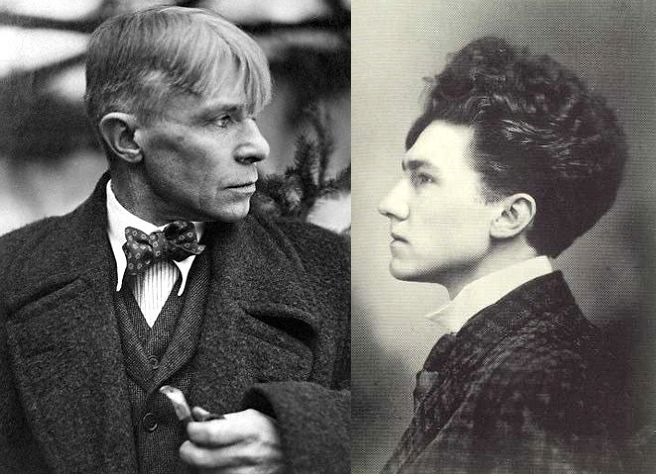
Young Modernists in suits: Carl Sandburg and Ezra Pound
Today’s piece combines two short poems, the first by Carl Sandburg and the second by the indispensable Modernist promoter Ezra Pound. Sandburg’s part “Letters to Dead Imagists” speaks fondly and perceptively about Dickinson and then moves on to tenderly remember Stephen Crane as a poet, who, like Sandburg, tried to combine Whitman with Dickinson. By calling them Imagists, the term Pound used to promote his “make it new” style of poetry, Sandburg is directly endorsing their claim to being pioneering Modernists.
In the second part “A Pact” we move on to Ezra Pound’s altogether more cranky voice, where he allows that Walt Whitman had broken “the new wood”, as if Whitman was some sawmill man who had roughly hewn some timber, which he contrasts to his, Pound’s, task and skill, which is to carve it artistically.
Know your Modernist family trivia: Ezra Pound’s grandfather started this bottled water company
I’m unsure how much Pound knew about Whitman’s background, so when Pound talks about the “pig-headed father” I at first assumed that famously stubborn Pound was only projecting his own considerable intransigence onto Whitman. But the poem’s closing image, an extended riff on wood and timber, indicates that he may have known of Whitman’s father’s trade as a carpenter. Pound’s own family had connections with the lumbering industry. So in the end, when Pound proclaims that he and Whitman share “one sap and one root” he’s allowing they share the American grain.
We had a real Minnesota whip-saw this week, the aftermath of a 15-inch snowstorm as the week began and a day in the 50s as it ends.
Much digging out of cars, and wheels doing the whistle-spin on the ice beneath for three days. It’s been a long winter, but “Sometimes It Snows in April” as Prince once sang.
Today, when it reached the lower 50s, people were out in shorts and T-shirts, with snow still covering yards, with the low rubble of white ruined walls still on the streets where cars had once been imprisoned. This is how Minnesotan’s celebrate unbelievable spring.
Now this Saturday brings the anniversary of Prince’s death, which was as unbelievable as Spring. I was looking for another poem to combine with music, and I reminded myself I hadn’t done an Emily Dickinson poem yet this April, and there can be no full celebration of U. S. National Poetry Month without Dickinson. As I looked, I came upon this poem, and it seemed right.
“Dear March” has one of Dickinson’s bold apostrophes, but instead of death or some other imponderable, it’s Spring that gets to be portrayed as the caller, one who gets welcomed at the door with old-school manners. There’s delightful wit in this: the March winds portrayed as being out of breath, it must have walked the long way to get here! “I got your letter, and the birds.” But being Dickinson, she will add her slant. Just past halfway she bemoans the colorless landscape of winter that she’s been left with, as if it would be her job to color it in: “There was no purple suitable/you took it all with you.”
“There was no purple suitable, you took it all with you.”
I think again of Prince, and I think this is the poem to do.
The poem continues, and we can now understand that the wit has an undercurrent. Someone else is knocking. It’s April, more visitors—or are they both suitors? “I will not be pursued!” Dickinson is now ambivalent to more Spring, to more young man’s fancies. She’s not answering the door “He stayed away a year”—well so did March. The poem ends in ambivalence. She should doubt the constancy of these Spring suitors even with the flirting, the flattery and the gifts they bring, but then there’s joy in blaming them for their absence now that they have returned.
Prince: performer, songwriter, impresario, but I’ll think of him as the patron saint of studio rats
,
I don’t want to stretch things too far here, but there are a couple of similarities in Dickinson and Prince. Both known for wearing one color (white and purple). Both enigmatic to the public (“The Myth” and “The Glyph”) and increasingly reclusive. And both were capable of being prolific and artistically self-sufficient, though this is not as rare for poets as it is for musicians and songwriters who could (as Prince did) write and record all the parts. In the end, they are both American originals, not copies of anyone before or since.
To hear my performance of Emily Dickinson’s “Dear March” use the player below. And let folks know about what we’re doing here, combining various words (mostly poetry) with original music in different ways. It’s #NPM2018, and you can dance to it.








 Frank Hudson