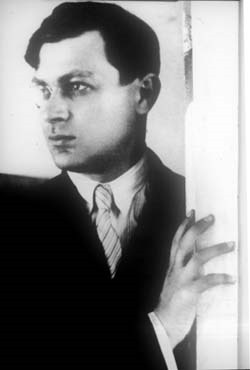
Imagine this for the background and education for a poet. The poet is committed from a young age to see things exactly, so much so that they become fascinated with the very neurological functions that are the foundations of perception. In college, they study with the foremost psychologist in America, but they don’t stop there. They go on to study medicine at Johns Hopkins, stopping just short of a medical degree. The poet then decamps to the hottest art scene in the world where they discuss art with the painters who are revolutionizing how we depict reality in a frame, and this poet sees right away who are the great visual artists in this scene, with legendary precision. The poet’s next task was to use the ideas of this visual art revolution, along with ideas about how human thought and perception really work, to create a new kind of poetry.
You’d expect this poet would produce extraordinary work. She did. You might also expect this work to be revolutionary in its technique. It was, and still is. You might expect that you will want to seek out and hear this work, to experience what this background and conviction could bring to poetry. You might expect this writing to share with you exciting new ways of seeing. Well…
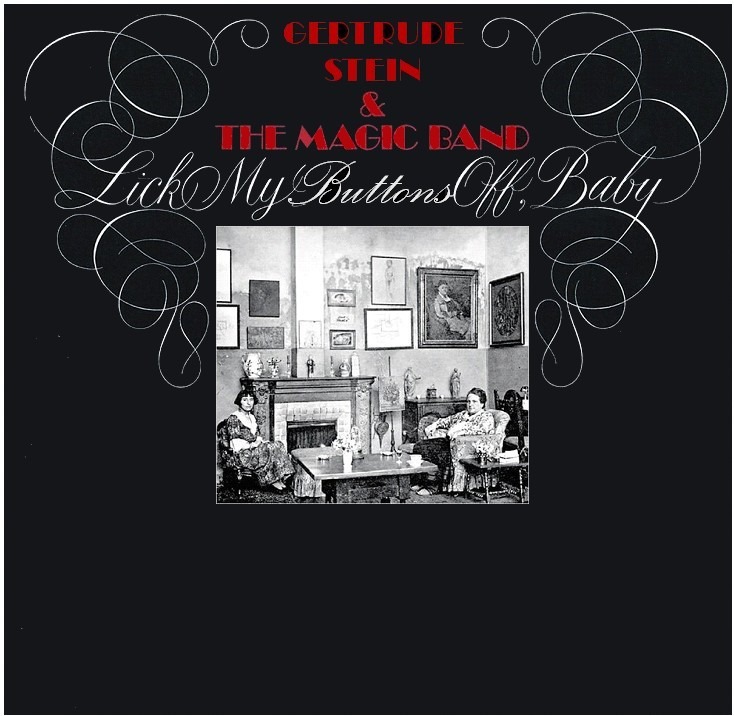
What percentage of my audience knows both who Capt. Beefheart and Gertrude Stein are?
Today’s piece uses the words of that poet, Gertrude Stein, from her 1914 collection “Tender Buttons.” Even within the Modernists of her time, it was controversial, and it remains so today. Stein didn’t shock with her imagery like some of the provocative work of Dada and Surrealism. The radically condensed poems of the Imagists sometimes raised concerns that anything so seemingly simple and without the decorative rigmarole of 18th and 19th Century poetry couldn’t really be worthwhile art, but the Stein of “Tender Buttons” was even more suspect. The imagists might withhold the complexity behind their shortest poems, but the words themselves were often plain-spoken, comprehendible on an immediate level—too quickly so, in some apprehensions, to be art. Here, the Imagists seemed to say, is the red wheelbarrow, the crowd at the Metro station, the stars above the Clark Street Bridge. I’m not giving you anything more, and you can take in these few words and shrug and say “so what?” for all I care.
Stein went further. In “Tender Buttons” she wanted to project the messiness of real thought, real glancing perception, sticking to one thing only as repeated words that chorus and then disappear, only to appear a few poems later in the collection, but mostly moving from one atom of perception to another.
It’s as if, rather than speech recognition on a modern smartphone, that Stein turned herself into a human “thought recognition” device, registering in words not only the stream of consciousness but a stream of unconsciousness as well.
It’s as if, rather than speech recognition on a modern smartphone, that Stein turned herself into a human “thought recognition” device, registering in words not only the stream of consciousness but a stream of unconsciousness as well.
This is a brave idea, but what emerges from this sounds at first (and for many, at second, and then for as many times as they care to try) like nonsense. The words are plain, at the phrase or sentence level they can even seem to be intelligible, but as a whole, they seem to add up to nothing. Our brains are hard-wired to make patterns out of information, and so confronted with a chunk of “Tender Buttons” this function may strive to make out coherence until one’s brain hurts, or it may just stop a few lines in and reject it as a failed experiment, perhaps even a fraud.
This is where I think that the Parlando Project’s secret weapon, music, can help. Music may have charms to soothe the savage beast of “I need to understand how these words fit together right now; and if I cannot, I will withhold my listening participation immediately.”
Musically I have put these two pieces from “Tender Buttons:” “Glazed Glitter” and “Suppose an Eyes,” against music from my memory of Capt. Beefheart, whose work helped me accept fractured non-narratives even while (perhaps because?) his were set against similarly fractured music. Alas, I lack the ability to emulate the timbre of Beefheart/Don Van Vliet’s voice as I declaim Stein’s words, but I assure you I’m hearing Don Van Vliet’s (or perhaps Kevin Coyne’s) voice in my mind as this piece nears it’s conclusion with the chant of “Little sales ladies, little sales ladies, little saddles of mutton, little sales of leather…” The Parlando Project has always promised to surprise you with the variety of what we present, but we cannot promise you immediate delight all the time. If you like this piece combining two uncompromising artists, be sure to share us with the social media buttons you should see, and if you don’t like it, check out the other pieces already here or to come, as we use other types of music and other sets of words.
To hear “Two from Tender Buttons,” use the player below.