In memory of Lawrence Ferlinghetti: The world is a beautiful place

Some people live so long as to make time and its boundaried eras seem a foggy measure. Such a man was Lawrence Ferlinghetti, the American poet, painter, and bookstore owner who predates and post-dates the Beat poetry scene — or for that matter the Hippie scene, and our century’s activist eras and its search for peace and justice. If you are a fan of generational short-hand (I’m not) you will notice that every one of those eras was widely denounceable as impractical, delusional, and in most ways inferior to those that came before that.

Perhaps I should remind all that Ferlinghetti was 101 years old, and would have been 102 next month. That means: he knew the Roaring Twenties and whatever we have begun in these Twenties. To any of you XYZ believers, that means he was a member of the Greatest Generation. This man, Ferlinghetti, attached philosophically during the entirely of my own longish life to anarchism and pacifism was a WWII vet, who enlisted before Pearl Harbor, who served during the Normandy invasion, and who, when moved to the Pacific theater, was able to view Nagasaki shortly after the atomic bombing. Philosophical pacifism of a most visceral kind.

“Thank you for your service” is the reflex response nowadays. Surely due, but I think also of his post-war service, helping promote a new more vernacular American poetry via his work, encouragement, bookstore and small press. His own 1958 poetry collection A Coney Island of the Mind  was immensely popular,* and seeing it or Allen Ginsberg’s Howl and Other Poems  (which Ferlinghetti published**) in their paperback black and white form was once a common marker in smoky apartments during my youth.

Around the time this Project was beginning I performed a couple of Lawrence Ferlinghetti poems live with The LYL Band. I’d actually hoped to get permission to post those performances someday, but emails to City Lights garnered no replies. Hearing today of his death, and thinking of his life that well-lived, I thought inescapably of this poem of his from A Coney Island of the Mind entitled “The world is a beautiful place.”   I’ve decided to post our performance here in the spirit of gratitude and in memoriam.  If any rights owner objects, let me know, and I will remove. The player gadget for our performance is often below, but this highlighted hyperlink will also work if you don’t have the gadget on your screen. If you want to read silently, or read along, here’s a link to the text of Ferlinghetti’s poem.

.

Want to hear another version of “The world is a beautiful place?”

Here’s Ferlinghetti’s own reading of today’s piece. You can buy a copy of A Coney Island of the Mind from City Lights via this link.

.

*Some accounts say Coney Island  is the most popular poetry collection ever published in English. I’m not sure of that.

**Was Howl  a big “get” that he was lucky to land for City Lights? Not exactly. He was put on trial for publishing it, and Ferlinghetti figured he’d go to jail. The Fifties judge, to some surprise, ruled it not obscene.

A Negro Speaks of Rivers

A hundred years ago, a teenager is riding on a train to Mexico. He’s just left his high school in Ohio. He’s Black. Most of the school was white. When he was in Junior High, the class was asked to elect a class poet. The teacher suggested it should be someone who understood rhythm, and so they elected him. Ah huh…but then he’s also done well at school and now his teachers are suggesting college. That poetry that he had been elected to is sticking with him, literature too. The first successful Black American poet Paul Lawrence Dunbar had been from Ohio. He thinks “This is possible.”

The teenager is traveling alone on the train. He’s already accustomed to that. If his poppa was a rolling stone, then his mom was moss. They’d split up before he entered school. His father moved far about, following his business interests, and he was the one in Mexico the young man was traveling to. His mother had left him when he was a young child in the care of his grandmother, and then the grandmother died just as he became a teenager. After that, he and his mother tried to reconnect. Mother. Son. Perhaps the deepest tie there is. It didn’t quite work.

The train crosses the Mississippi, the indispensable dividing river of America. He watches out the train window. A train line is a story someone wrote. A river is history — it’s there even if you don’t know it is. But the young man knows more history than many young men knew then, or that many know now.*  In particular, he knew that Abe Lincoln, scuffling for work as a young man, had manned a freight-loaded flatboat down that river to New Orleans in 1828. His freight was goods in crates, and New Orleans at the mouth of the Mississippi was a commercial center for goods. While there young Lincoln sees another market, another type of goods: Black people being bought and sold as livestock.

How ignorant was the young Lincoln of slavery? There were a small number of slaves in the Illinois County Lincoln was traveling from.**  The slave market in New Orleans was Americas largest. Perhaps slavery was mostly a story someone told Lincoln before that.

Back in 1920, our Black teenager on the train pulls out the handiest scrap of paper he can find, a letter from his father. On the bare places of that paper, outside his father’s words, he composes today’s poem. He’s going to Mexico City to spend some time with his father and to ask him if he’ll help pay for college so he can study literature.

They spend a summer together in Mexico. Father and son. So often there’s a deep tie between such, but in this case it didn’t quite work. In the end this was the deal they negotiated: yes, he’d help his son with college — but no, he had to study something useful:  engineering.***

The young man tries to hold up this agreement. He enters Columbia University in New York City to, yes, study engineering. It doesn’t work. The young man drops out of college and begins working as a bus-boy, but he’s writing poems, and in June of 1921 W.E.B. DuBois’ The Crisis  magazine publishes today’s poem, the one he wrote on the back of his father’s letter on the train: “A Negro Speaks of Rivers.”   In 1925 it also appears in The New Negro anthology which I’m using as a theme here this month. Here’s a link to the full text of the poem.

Our young man was Langston Hughes. Today’s post is a story based on the little I know about how he came to become a writer. Stories are something we have to write, we engineer them, we build them, lay them out. But, history? History is a river. It’s there whether you know it or not. Surely it goes on, whether you know it or not. Shouldn’t you know it? Shouldn’t I know it? Shouldn’t we know it?

Langston Hughes Grave

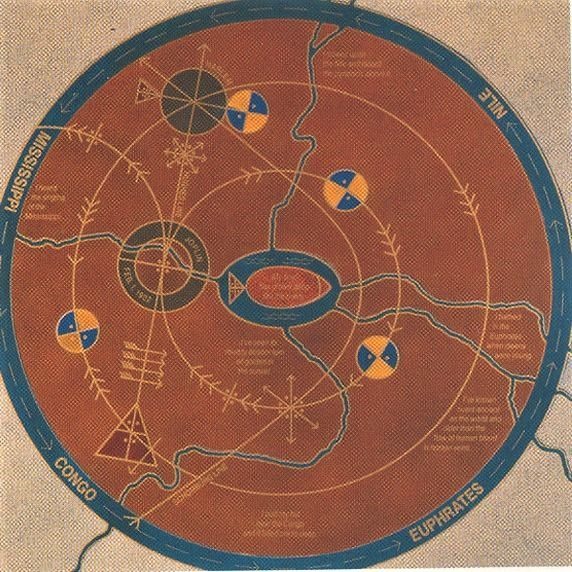
Full circle. After Hughes died in 1967 his ashes were interred in the the middle of this mosaic depicting “The Negro Speaks of Rivers” on the floor the lobby of the Schomburg Center for Research in Black Culture in New York.

.

The player gadget to hear my performance of Langston Hughes’ “A Negro Speaks of Rivers”  is below. If you don’t see the gadget, not to worry. This highlighted hyperlink will also play it.

.

*Indeed, somehow our teenager knew more about Black history than many would have in his time, and the chance that he learned much if any of this in school was low. Forty some years later when I was a teenager, I asked my Freshman Western Civ. teacher an innocent question: “Were the ancient Egyptians Black?” He seemed startled at the question. Hughes was hip to that question in 1920.

However interrupted and strained Langston Hughes’ relationship with his family was, he must have been pointed in some directions by them. A chief source was likely that grandmother who took care of him until she died when Langston was 13. Did she know stories or history? Well, Hughes’ grandmother’s first husband was Lewis Sheridan Leary, who died during the 1859 Harpers Ferry raid just before the Civil War.

**This post says 13 enslaved people of the population of nearly 13,000 in Lincoln’s Sangamom County.

***I’ve also read that part of Langston Hughes’ father’s issues with his son was that he thought Langston effeminate, and Engineering (than, as still now) was a mostly male field.

Langston Hughes’ Dream Variation

Returning now to the poets presented in Alain Locke’s 1925 The New Negro  anthology, we’ve come to the poet I most associate with the Harlem Renaissance, Langston Hughes. Though he was born in the Midwest and traveled some, Hughes actually lived for much of his life in New York City, unlike some others associated with that artistic flowering. And though Locke’s book concentrated on young, up and coming writers for the most part (Hughes was 23 when The New Negro  was published) Hughes’ literary career continued on a more or less continuous path until his death in 1967.

So, if I was asked “Name a Harlem Renaissance poet.” My first answer would have always been “Langston Hughes.” And if Locke’s book is the launch point for that, Hughes was as prominent as any other young writer featured there and then, even if in 1925 he had yet to publish a single book.

Young Langston Hughes

Young Langston Hughes. Hey Pharrell, pretty sharp work on those fedora creases don’t you think.

.

This makes it strange then when I went to do a little research on how Hughes was judged during his 40 plus years as a literary artist. The summaries I read often point out that he was down-rated during his career, and to some degree up to the present day. Why? Well, he did have to go through the dangerous 1930s when political engagement was expected of writers, and like some others he had to handle the double-bind of associations and sympathy for the Russian Revolution and Communism and then later criticism of its faults. Many of the promotors of The New Negro  era were so focused on up-lifting the race and demonstrating high-culture acceptance that they were uneasy about Hughes’ embrace of a wider range of Afro-American experience. And finally, there seems to be an element of purely literary judgement he shares with Carl Sandburg and Walt Whitman (two of Hughes’ influences) that what he wrote was judged as too simpleminded and unironic. Sure, the high-culture critics would essay: that kind of poetry might have readership broader than many, but it doesn’t fit the literary criteria ascendant as the 20th century unrolled.

Today’s piece, “Dream Variation,”  one of Hughes’ poems printed in The New Negro,  is a short nature poem. Here’s a link to the full text of it.* Like a lot of lyric poetry, you can read it quickly and superficially with some pleasure. It has rhyme and its rhythms.  It counts off some pleasant if not overly spectacular word-music. The first time through you may think it’s just pointing out a commonplace, something one could summarize as: “Hey, it’s nice when it sunny and you’ve got a day outside. And then a summer night when you finally go to bed — that’s nice too.”

Wait a minute. What’s with Hughes’ title: “Dream Variation?”   First off, that seems to say that kind of summer carefree pleasure isn’t something the poem is experiencing right now. Like Wordsworth’s daffodils, the poem’s speaker is experiencing this mentally, as if in a dream. That’s a different thing isn’t it. In the same way that a love poem about lost love is not the same as a poem about present love, this is a poem containing longing. Many of us are reading this during this February in North America. Likely you may relate to that state the poem is actually portraying.

I have no way of knowing what the weather was like when Hughes wrote his poem, but Hughes estranged father lived in Mexico where Hughes visited him before embarking for New York City and the beginnings of his literary career. So that titular variation may be a dream not only of passing seasons but of lost places too.

But there’s another way that variation means. In music it’s when a composer modifies elements of an established motif and we see it morph into a new related shape. Do you see what Hughes does here in his short poem? There’s a statement about dancing, arms wide and accepting, in the sun — and then resting in the evening “beneath a tall tree.” An interlude, when inside the body of the poem they express that this is “my dream” — not what they’re doing as they speak the poem. Next we learn that the “bright” day is now described as “quick” and the following “cool” evening is now “pale” evening. And finally, the real metamorphosis: the poem’s speaker is now not “Beneath a tall tree” — there is just a tall tree that remains as night comes.

This variation is subtle and somewhat undefined, mysterious, once you notice it. Is this a statement of the poem’s speaker’s absence from the warm place, that in the variation he’s no longer present? Has the speaker’s life, the proverbial “quick day” ended? Or, is it something even stranger: in the dream he’s no longer the external dancer beneath the tree, external to the day, external to the night, but now he’s become them?**   In dream logic it can be all those separate things at once. That’s part of why a dream experience can be so striking!

In this poem, like in some of the poems of Sandburg that I’ve presented here, I maintain that the simple language and seemingly straightforward scene of the poem has misled some readers and some critics. If I was encountering this poem as if I was translating from some Tang Dynasty Chinese classical poet, I would be aware that the poem may not be whamming me on the head about “Look it’s clever metaphor after metaphor! My, how complex a plot I can stuff into my poem! I bet no one ever said anything as complex as this ever before!” Perhaps the assumption is that a working-class Afro-American or the son of a Swedish immigrant can’t be thinking anything more complex than class-struggle position papers.

In my performance of Hughes’ “Dream Variation”  I consciously sought to bring out the mysterious element here. Stubbornly the harmonic progression I composed sticks closely to a core around the D note of the scale. Chords move between major and minor however and there’s a rub up and down with a D# Major7. The player to hear my musical performance may appear below, but if you don’t see it, this highlighted hyperlink is another way to hear it.

.

*I used the text as printed in Locke’s anthology for my performance as it’s in the public domain. The version I link to is later and includes some, well, variations. In the newer version taken from Hughes’ Collected Poems,  the title has become plural, “Variations,”  “the bright day” has become “the white day,” and a couple of other smaller changes were made. One could speculate that the “bright day” vs “white day”  could have been suggested by an editor as less confrontational.

**And I haven’t even entered into the significant racial aspect that is there as well. The dark night in the poem’s first experience as being first external to the poem’s speaker and being one with it in the second “Black like me.” As an Afro-American poet, Langston Hughes almost certainly intends this, and it may be the most consciously intended message he wished the reader to receive: that poem’s journey via its variation is from experiencing one’s Blackness as externally to an internalized appreciation of it, and that later revision from “bright” to “white” for the first instance of the day underlines that reading.  I featured the above reading not to obscure that, but because our particulars as persons bleed into our commonalities as people. When William Butler Yeats or Joseph Campbell speak of being colonialized Irish, it’s not just about their particulars. When Du Fu speaks of being overcome by great events, it’s not just 8th century China that has felt that. When Emily Dickinson’s mind grasps onto a flower or abstract thought and sees its edges always curling, she’s not reduceable to a bourgeois New Englander. And so to when Langston Hughes speaks about being Afro-American in 1920s America. And frankly, I’m hesitant to assume an Afro-American identity as a performer of Hughes’ poem, even as I want to bring it forward to your attention.

Update: An alternate primary reading that the first dream variation is an unachieved dream and that the second is a reflection of the reality of Afro-American life colored by racism seems widespread. Widespread enough that I wonder if Hughes wrote of his intent or understanding of his poem’s meaning at some point. For example many of the alternate readings say the poem’s second dance and whirl is work-a-day and likely menial work inside a Capitalist and Racist system that wouldn’t value Hughes. Hughes experience and political thoughts could be consistent with writing a poem that expressed that. As much as I should doubt my reaction to the text of the poem as printed in 1925, I’m still not seeing that as being the inevitable and singular reading of the second variation, but I offer this update as a self-confessed non-expert on Hughes’ work and because I suspect not a few students come here via web searches to seek insight into poems, and so they should be aware of this other reading.


The Snow Fairy

When it comes to pieces for Valentine’s Day, there’s a great deal of love poetry to draw from. And it’s not uncommon for those love poems to be sonnets — after all, that form has been used from the times of Petrarch and Shakespeare for poems about passionate relationships. The course of love is often complex and unstraightforward, and fittingly most sonnets contain a volta, or turn, where the poem shifts from one aspect to another, a feature that is useful for portraying the alternating currents of passion.

For today’s piece I’ve used a distinctive winter love poem by Afro-American and Harlem Renaissance poet Claude McKay. In this poem, “The Snow Fairy,”  McKay uses an unusual form, a double sonnet, a pair of 14-line poems that allows additional volta/turns. Here’s a link to McKay’s text if you’d like to follow along.

Claude McKay 2

poet Claude McKay as a young man

.

“The Snow Fairy”  opens with a fine sonnet about a winter snowfall. If one was to read it as a stand-alone poem it wouldn’t seem truncated or insufficient by itself, but McKay wants to present it as part of a pair, and as we’ll see it’s both foreshadowing — and in a time-twist, the actual conclusion of the poem chronologically. Sonnet I has the snow, as per the title, personified as fairies, a kind of otherworldly being that may have connotations of light-heartedness or simple wonder. But note a very subtle shift in the supernatural creatures fluttering down in the second quatrain: “As though in heaven there was revolt and riot.” The merely fantastic in the opening quatrain has taken a more consequential air. I’m not sure how many readers notice this, but to me this is an unmistakable reference to Milton and Satan falling after the war in heaven in Paradise Lost.

Third quatrain, and we’ve switched our attention to the poem’s speaker, who’s gone to bed without mention of any other person, and awakes to view the once individual fairies/fallen angels, now lying still, yet joined together after their night long whirling dance. In the concluding couplet, as often in a Shakespearean sonnet form like McKay uses, we have a turn. We’ve spent our focus up to now on these snowflakes, but in the couplet he tells us by the end of the day they’ve melted away.

In sonnet II, the poem’s speaker flashes backwards in time, connecting via the memory of the first sonnet’s night of winter snow. He’s reminded of a “you who came to me upon a winter’s night” as did our snowflake/fairy/fallen angel creatures did in sonnet I. In sonnet II’s second quatrain this couple are like our snowflakes of the first sonnet, tossed and dancing in what he tells us is passion. In an echo of the third quatrain of the sonnet I, in the same quatrain of sonnet II, they are tenderly joined and bedded.

And then the turn, the volta: faster even than the by midday melting snow of sonnet I, at the break of dawn the partner is gone, leaving the poem’s speaker alone to be the writer of sonnet I, watching the snow fairies fall in winter.

Read with modest care, the story told in the most minimal of sonnet sequences is plain. Love is wonderous. Love joins us, un-times us for a time — and then, whether parting by the single night or death, it is “stol’n away.” But are there additional undercurrents?

I sense there’s a question in the last row of readers out there, and over the Internet I can’t tell if it’s snarky, sincere, or asked hesitantly: “The title is ‘The Snow Fairy.’   Is this two guys hooking up? Is McKay gay?”

Even today when the acronym for non-heteronormative affections and gender extends ever outward, such answers aren’t always simple binary switches, but yes, it seems generally assumed that Claude McKay had erotic connections with other men. McKay never “came out” in a way that folks in our lifetimes do. In the context of this poem, the question may be focused to a subsidiary question, is “The Snow Fairy”  a coded statement of his sexuality, written so that that those who know would know, and the others would not?

One could write an essay longer than this post, but on balance my reading is that, like his equally lovely summer-day-long love poem “Memory of June”  this feels as if McKay is describing the difficulties of gay people being able to form lasting relationships when that was desired in his time. The subtle turn from fairies to Miltonic fallen angels in sonnet I also seems to be signaling outsider status. There’s also a possible significance in the title snow fairy being singular while the snow fairies/snowflakes are multitudinous. But was “fairy” a clear signaling word? It seemed like that to me when I first read this poem, but upon research that’s ambiguous. Terms used for gay people have a history of emerging and shifting over time, both inside and outside the community. Fairy as a slang word for an effeminate man seems to have emerged in the mid-to-later 1920s,*  and was in common understanding by 1940 or so, but this poem was published in 1922. That means that it might  be too early for it to be understood by other gay people generally, or even McKay, as signaling. On the other hand, it seems likely that a general reader in 1922 would not  read fairy = gay when seeing this poem on the page then.

But in another way, is that the only thing that matters about this poem? No. Love and desire is both complex and unitary. Passing love, passing sweetness, unrequited desires, loneliness for absent lovers — put all the genders, nationalities, races and practices together in one snowbank and you can’t separate out the unique snowflakes. We love and we are gone is one whole part of humanity. Perhaps that’s why Valentine’s Day is but a day?

I performed Claude McKay’s “The Snow Fairy”  in this simple arrangement to get it done in time. I had another version with basic tracks of a more full-band arrangement, but this one with just 12-string acoustic guitar and bass was easier for me to complete. To hear my performance, use the player gadget below — or if you don’t see the player this highlighted hyperlink will do the job too.

.

*Somewhere in my research I found citations that seemed to narrow it down to this between-the-wars period, at least for significant usage, but alas I’ve lost my cite notes on that, and, this blog post indicates fairy = gay may have origins as early as the 1890s.

The Sky Is Low

This little poem by Emily Dickinson seems at first so slight, little more than a tiny winter nature lyric using the risky literary trope of the pathetic fallacy* deftly enough that it doesn’t cloy. The language is almost entirely simple and plain-spoken, but in such a short poem the words that aren’t entirely clear may reward further attention.

The Sky is low manuscript

Dickinson’s handwritten manuscript for today’s poem from the collection of Amherst College.

.

The Imagists that came decades after Dickinson’s work weren’t much for the pathetic fallacy, but if one ignores that element— something possible to do because it’s so swift and unpretentious about it — this poem does work like an Imagist poem or like one of the models Imagism sought to emulate, the classical Chinese short poem.

Let’s start right at the first line, and the first word that requires some figuring out. “The sky is low, the clouds are mean” sets our stage. A “low sky” and “clouds” would indicate that this poem’s day-moment is overcast, but what does “mean” mean? It would be easy to think it’s saying, pathetic-fallacy-wise, that the clouds seem angry and spiteful. I think many modern readers will hear this sense primarily, and I cannot eliminate that Dickinson intended that at least as an undercurrent, as it seems a pair with the complaining wind we meet in the second stanza. Yet, in the context of the sentence that makes up the first stanza, my best thought is that she is presenting the clouds as a secondary definition of “mean” (now somewhat obsolete) as shabby or stingy. The image she’s setting up is that it’s overcast, but it’s not a snowstorm, there’s only a modicum of that mentioned: a specifically singular “flake of snow,” so that may be all these clouds are producing.

Our snowflake does have feelings. From its actions, aflutter in the wind and singular enough for the eye to want to follow it as an individual, it seems indecisive about what route to take over the landscape. It might fly high (“across a barn”) or low “through a rut.” It’s frozen (sorry, can’t help myself) in a moment in the poem and we never find out. In its concise way, Dickinson’s snowflake is like Robert Frost’s chiding portrait of his friend Edward Thomas: two possible roads, and the snowflake thinks it’s important to choose one.

The pathetic fallacy gets stronger as the second stanza begins. A cool or cold gusty wind is presented as if it’s complaining for hours on end. For an old/weak bicyclist like myself who tires of headwinds that seem to always be in my face no matter that one has changed direction, this is an ascribing of malice and forethought that I can appreciate. If you look at Dickinson’s own manuscript, you can see that she considered using a legalistic term**  “some parties,” but “some one” seems the broader and better choice. Here, in a different aspect from the snowflake who thinks it has at least a binary choice, it appears the wind is saying it’s been diverted or prevented from something.

In this small poem’s presentation, these two things are joined. The snowflake thinks it can decide, but we know the wind will send it where it directs, but the wind thinks it has been in someway enjoined. Pathetic fallacy aside, it cannot choose, meteorological forces and barometric lines will send it where they will.

In the last two lines, Dickinson doesn’t tell us how it comes out — she refuses to leave her poem’s lyric moment. Her final line brings one more uncommon word choice. It has it that “Nature, like us, is sometimes caught/Without her diadem.” A diadem is a ruler’s crown, worn to signify that the wearer, well, rules, decides. Once more, the pathetic fallacy is invoked: nature is the decider, but for the poem’s moment they have momentarily forgotten to put on the device that lets them take on that power — but in a tiny aside (“like us”) Emily Dickinson says we actual humans, who can actually think, feel, decide are sometimes also in this situation, we may blithely follow what seems like a free will choice or complain that we are forced into our directions. Which is it, really? Did you forget your diadem?

Read this poem, or many an early Imagist poem or classical Chinese poem, and it may seem a miniature painting of a mundane scene. We may be charmed briefly, or we may think, “Oh, that’s too slight to be a thoughtful poem.” Did Dickinson consciously or unconsciously intend what I see here? The number of times she was able to pull off effects like this poem can produce, and the subsidiary writings demonstrating how she thought***  indicate that even if she didn’t consciously work out the complexities underneath her simplicities in some grand and lengthy inner symposium, she put herself in the place where she could receive and express these charged moments.

As usual, I’m going to perform “The Sky Is Low”  with some original music. The player gadget should be below, but some blog reading software won’t show it. If so, this highlighted hyperlink will also play my musical performance.

.

*The pathetic fallacy is the tactic of ascribing human emotions and thought to inanimate objects or forces. Despite the literal words of this poem, it’s not debatable that snow does that, and the wind doesn’t really have some angry dispute.

**I’m not sure how many scholars have considered that Dickinson grew up in a family of lawyers, and even though as a woman that field was not open to her, it’s likely that some of that was picked up by her avid mind.

***Long footnote ahead! What can we gather from how Dickinson used this poem that might indicate how she considered it? This poem was “published” in a personal letter to the wife of a couple that were long-time friends of Emily. The husband in the couple was Josiah Holland, a medical doctor and lay preacher. By the time this poem was written in 1866, Josiah had become a well-known journalist, lecturer, poet, and author. He was a principal in the Springfield Republican  newspaper which famously published seven of Dickinson’s poems during her lifetime. He had just published one of the first full-length biographies of Abe Lincoln, and would a few years later found and become the first editor of Scribner’s Monthly.  His wife, to whom the letter with the poem was addressed, Elizabeth Holland, has no known literary work — but read the letter by following this link.  Here one may get the sense of how another important literary personage who Emily Dickinson interacted with, the formidable Thomas Higginson, remarked about how Dickinson wore him out. The amount of philosophical legerdemain, reference, and zen parable in this short letter is striking to me. Did Dickinson expect Elizabeth Holland to understand that letter?

Emily Dickinson’s correspondence and friendship with the Holland couple seems to have been one of the most stable and ongoing in her life, equal to those who were Dickinson’s blood relatives. Whatever bonds were between them, this letter shows the expectation of considerable intellectual understanding, and for “The Sky is Low”  to be enclosed indicates that Dickinson had goals beyond the simplistic for it.

William Carlos Williams’ Thursday

How many poems celebrate the poet’s dream, or dreams? This one doesn’t.

It’s fair to say that American poet William Carlos Williams had a curmudgeonly streak. In this poem from his 1921 collection Sour Grapes  he holds the line for the style that early Modernists had championed to break free from the poetic fancies that preceded them. By the 1920s the Modernists were moving on to new things, and it’s safe to say that many of them had developed new fancies. Indeed, in three-years-time the first Surrealist Manifesto would be published. The Surrealists went further than our usual sentiments about the value of an individual’s personal dream presented in the context of following one’s dream with the idea that it would integrate into our plans for work or a place in society. The Surrealists didn’t want to domesticate one’s dreams to society, they wanted to bring the full wildness of dreams to the fore and let society make whatever of it.

But, here’s Williams’ poem “Thursday,”  which you can find by following this link. First off, I see that he uses very plain language here, and there’s little trickery or poetic obscurity in his manner of speech either. There are no references to ancient myths, no quotes from Latin or Greek, or even Elizabethan English. He starts by noting the ubiquity of dreams, and at least for the purposes of this poem, he doubts their worth. I like the choice of words he uses here for why he’s going to skip the value of his dreams aspirational or Surrealist: “carelessly.” In other words: I don’t care about that all,  at least in this poem’s now. Instead, he spends the body of the poem inhabiting the body of the poet — as we the reader may too if we come along with Williams.

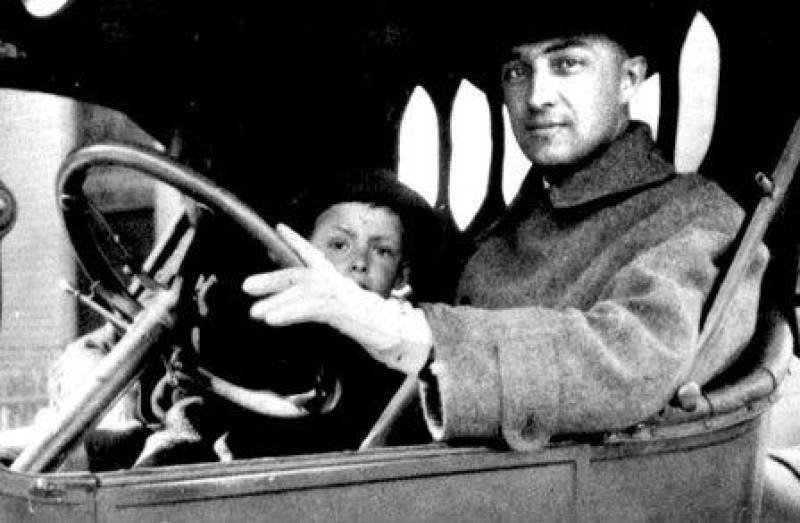
WCW at the Wheel

WCW at the wheel. “Yeah, but I’m driving and we’ll have some good ol’Imagism and none of that pretentious stuff.”

.

This is part of what I found intriguing when, as part of this project, I revisited the original English-language Modernists early work. I loved Surrealism as a young poet. I liked Dada referencing nothing and T. S. Eliot referencing whole libraries. But before those evolutions existed, what Modernism first used in English to break free and “make it new” was very concrete and radically simple: the presentation of the experience of brief charged moments that could include the revolutionary act of taking notice of the mundane and unexalted.

Like just a “Thursday”  in Williams’ life, in your life, in mine.

The player gadget to hear my performance of Williams’ “Thursday”  should be below, but if your blog reading software doesn’t show it, this highlighted hyperlink will do the job too. More work with piano this time and a return of an orchestra section. I keep hoping to return to more fierce electric guitar soon here. We’ll see.

The Snow Is Deep on the Ground

Today’s piece is a winter poem for troubled lovers, but in the wandering tradition of this project, we’re going to go somewhere else on our way there.

Next week there is to be an inauguration of a new American President. It’ll be the 13th new President in my lifetime. Though I remember witnessing all these inaugurations in part through news reports, photographs and recorded footage; to the best of my recall, I have only watched two as they happened. Which ones? Most recently, I watched Barack Obama’s first inauguration in 2009 while working in a place with a newsroom; and then, before that, as a schoolchild I watched John Kennedy’s inauguration.

I believe this is so because in our democracy we have a tradition of our Presidential terms ending and beginning uneventfully and with a comforting regularity. It’s not that we citizens ignore that there’s a new President, but the event itself happening is largely unremarkable.

Kennedy’s inauguration in 1961 was contemporaneously recognized as a post-WWII milepost, the Presidency passing to a young former enlisted man in that war, moving us beyond a country ruled before by 19th century men. As I said, I was a schoolchild. My class watched it on a single gray TV set placed up high in front of our schoolroom instead of our usual lessons. I don’t think I was alone in the audience for that event in thinking it was important to pay attention to what was said, watching for news of a new era we knew was new.

Obama’s election and inauguration said something about America recognizing it had changed its evaluation of people of color.*  It’s become a mark of sophistication and analysis to say that was an illusion, disproven by everything wronged people and close examination brought forward then, and since then. I thought, and think, we’re in the midst of things. If more know that now, the marker post of Obama can still tell us where we’ve come from and where we can go.

Is it a coincidence that both of those Presidential Inaugurations had a poet read a poem as part of the ceremony? That’s not a common choice: Kennedy was the first President to ever do so, and only one other President, Clinton, did so besides Obama.

Now, as it happens, I hope to watch the Inauguration next Wednesday, because this one seems more precious to me, more extraordinary, something not to be taken for granted. I will not watch it expecting or requiring great words — no need anyway, because the event alone now has a greatness thrust upon it. Yet coincidence or not, there will be a poet, a particularly young one, reading next week: Amanda Gorman, all of 22 years old.

There are several videos of Gorman reading on the web, but I wanted to bring forward what she says here about her poem for Independence Day, which starts with Phillis Wheatley and mentions that she’s speaking in the Washington-Longfellow house that day. It occurs to me that Gorman seems to be essaying a kind of civic American poetry that Longfellow might recognize.

.

So, now I’m ready to return to today’s piece, one using the words of American poet Kenneth Patchen’s poem “The Snow Is Deep on the Ground.”   If you’d like to follow along with the text, here’s a link to the poem. “The Snow is Deep on the Ground”  seems to fit my times, and perhaps it fits yours too, and so we may think of it as my unofficial poem for this January’s Presidential Inauguration.

What did Patchen intend with the repeated image here of deep snow? As a northerner I know one thing it portends, a restriction of movement, and it’s often too a trope of accumulated time. I read something now in the image that Patchen may not have intended, restricted as I am in movement by our current epidemic and having just endured a cloddish act of insurrection deep in whiteness. It seems, or we hope it is, that that “war has failed.”

Patchen says the snow is beautiful though — but specifically it’s beautiful in a fallen state,  something meteorologically and theologically true in Patchen’s poem.

The poem’s third stanza has muffled terrors. What a strange and yet strong line “Only a few go mad” is! And the whiteness “like the withered hand of an old king” undercuts any sense of simple winter landscape beauty. To say twice “God shall not forget us” implies this is in question, doesn’t it?

The poem has it what we know more than we know by faith: our love, our lovers. How beautiful it is to be loved, to love. And to know that after talking of politics in a world where lies and flags are used as shields and lances to beat each other with!

My performance of “The Snow Is Deep on the Ground”  can be heard with the player below, or if you don’t see that, with this highlighted hyperlink. The musical core today is my naïve piano playing, over some drums and small percussion instruments. To add some character to the string bass part I doubled it with a synth-bass. Thanks for reading and listening, particularly as my ability to produce new pieces is reduced right now.

.

*There was something else about that Presidency. I’ve lived a long life, and yet in all those years Barack Obama is the only President I’ve ever had who was younger than me.

William Carlos Williams’ January

Recently I mentioned I might return to the Modernists of 100 years ago who inspired a lot of the material I’ve used here over the years. And indeed, I read two early William Carlos Williams collections early this new year looking for material as I prepared to do that.

And then, as a novel from 1925 warned: “Somewhere back in the vast obscurity beyond the city, where the dark fields of the republic rolled on under the night….” and we’re borne ceaselessly into Make the Confederacy Great Again. Doomscrolling overcame me, and my concentration scattered without need for pepper spray. Unlike some others this week, I don’t want to play-act armed revolution — and despite the abundant wrongs and injustices of my government, I’m not even enthusiastic about the real thing. If I can’t bear up under the tedium of actual politics and its incremental proposed solutions, why then must it follow I would want the excitement of the barricades?

I had to sidestep new pieces for a while. Yesterday I was granted a few hours in which I might work on them, and so I felt compelled to return to what I had thought of using for the new year, and this poem from American Modernist poet William Carlos Williams was on the top of the stack. It’s called “January,”  and it was published 100 years ago this year.

Young Wiliam Carlos Williams

As to doomscrolling vs. poetry, Williams said: “It is difficult to get the news from poems, yet men die miserably every day for lack of what is found there.”

.

By some caprice of the muses, this century-old “January”  seems to address my situation in this one. Williams speaks of the distractions outside himself as he continues to write, and to winter’s “derisive music” he replies he’s still “bound to my sentences.” I can’t be sure what specifically inspired this poem. Williams could simply be sick of winter, that season that litters itself all over the landscape and then freezes itself in place. Or it could be speaking of his place in the Modernist movement, which was gaining traction culturally while (in Williams’ judgement) it wasn’t recognizing his part in it sufficiently.*

For our own arts, that’s an indispensable act for us: to stay committed to our work. Beside the world’s events that tell me that what art does is not quick acting enough to serve as a vaccine for our society, beside doubts that I should be better at what I do before presenting it, beside my own particular guilts that I should spend less time doing these things and more at promoting it, there’s no work to fail or be ignored unless one does one’s work.

I had to work quickly on the music, relying on some things that have become stylistic standbys for me in this Project: bowed strings (contra-bass this time), electric piano, electric guitar, and drums. In his poem, Williams develops the idea that the distracting winter wind is playing music to interrupt his own word-music. He describes this music as featuring the chromatic scale interval of the fifth. Reading the silent poem, you might think he’s talking about a dissonant interval since he also says twice the winds’ music is “derisive.” But the fifth is instead a sweet interval, even if one plays minors or major scales against it or piles on fuzzy overtone-rich distortion. From a musical perspective, I’m thinking Williams is saying that even the winter winds are not as cutting, honest, and to-the-bone as he wants to write. They’re derisive because they are merely sweet.

The player gadget to hear my performance of Williams’ “January”  should be below, but if you don’t see it, this highlighted hyperlink is another way to play the musical piece. If you’d like to read the full text of the 1921 poem, this is a link to that.

.

*The collection this poem appeared in was titled Sour Grapes.  Williams thought — and some later critics began to agree with him — that American cultural critics were more enamored of WASP writers and overly eager to establish their own Ivy League version of the Oxford-Cambridge hierarchy for poets and poetry. Williams’ father was raised in the Dominican Republic and his mother was from Puerto Rico. Now of course, both Williams and some guy named Trump both went to the University of Pennsylvania, which is officially in the Ivy League. While Williams did post-graduate travel and work in Europe too, unlike some other American Modernists he was committed to making his poetry speak in, and to, an American way.

Once more it’s hard to concentrate on music, poetry, art.

There isn’t going to be any new encounter with a set of words, nor any new musical combination with them today. I’ve mentioned during the last part of 2020 how this project that has brought me much joy and surprise has become more difficult for me. There are complicated reasons of little general interest that contribute to this, but this week there are again public events that have made it harder for me to concentrate on work.

Unless you are meditating in a cave somewhere, and only check in here as religious penance, you may easily guess what events this week have waylaid me. I feel compelled, for no logical reason, to bear witness to them, to watch them closely over the Internet at my shelter-in-place distance. Yesterday and certainly today that Internet will be filled with opinions. Well, that’s always so isn’t it — even if it may be to some degree even more so today. If you need opinions, you can drink of them until you are falling over swollen with them. I won’t fault you if you do, because I have read and will read some of them myself. I say this only to say that there’s no shortage of them, and so I will be brief and circumspect.

I declare this International Patchen

Painting by poet Kenneth Patchen who was also a pioneer in melding poetry and music, so don’t take this as some universal pronouncement. .

.

I revere democracy. Not because I think it incapable of monstrous acts. All governments are so capable, and if they exist for more than a brief moment, history testifies that capability will be exercised. Not because I think that our particular U. S. government structure is divinely inspired. Not because I’m likely to agree with what the majority of fellow humans believe about a great many things. I revere democracy because its evils are our evils, its good is our good — and that good is redeemable to outweigh the bad in us.

Whether the actors I’m observing are dressed as a Senator or dressed in a jokey t-shirt and a red half-billed hat, the desire — no, the actions — so brazenly presented and recently taken in the cause of maintaining the rule of a man so roundly rejected by our voters are obviously counter to that reverence. The Capitol building, the august chambers, are just symbols. Since many of us are writers, we know symbols can have a heft even if imagined, but still the real thing being attacked should be certain: democracy.

That’s right:  the symbol has bricks and glass, the real thing is something we need to hold in our hearts and minds, another thing that’s a verb not a noun.

Instead of a new piece, here’s one I’ve presented before, by another Reverend of Democracy, Carl Sandburg. Don’t miss Sandburg’s subtlety here. He admits right off that we can be a mob. When he says “The Napoleons come from me and the Lincolns.” He doesn’t merely mean that the notables, the big figures of history arise from the crowd. Sandburg means to contrast Napoleon who quickly became a military dictator with a Lincoln. We can bring both forward.

Here’s a link to the text of Sandburg’s poem, and my performance of it is available in this highlighted hyperlink, or via a player gadget you may see below. I still hope to be back with new pieces soon.

.

Shakespeare’s Sonnet 97 “How like a Winter hath my absence been”

What with Longfellow last time and Shakespeare this time, I’m thinking I’ll return soon to some of the more surreal and avant garde 20th century authors whose work has entered the public domain. That would be the New Year’s thing to do — but then once one penetrates the archaic language of this old sonnet, it gets plenty weird.

Sonnet_97_1609

How this poem looked in 1609. I note that most versions of this poem I find online replace the question marks in the opening sentences with exclamation points. I wonder why?

.

How many come here, perhaps via a web search for help in figuring out what some hard-to-understand poem might be on about? Well, here’s the usual “homework helper” summary of Sonnet 97:

The clever bi-amorous poet character* in the sonnet starts out bewailing that it’s winter and he’s away from his beloved. But wait, a few lines in, it’s summer, or maybe autumn harvest time, but the poet started out talking as if it’s wintertime because he misses the beloved so much and that makes it seem as bad as winter.

There you go, a greeting-card worthy poem when reduced to that meaning: “Miss you so much, summer’s like winter because of that.”

But all that ignores the strangeness of it. Don’t put this in your school work if you have a conventional teacher only looking to see that you’ve taken the effort to decode Elizabethan English,**  but is it just possible that the poem is really written in wintertime, or that the portrayed states of winter and summer in this poem are not actual, look-at-the-calendar fact? ***

That supposition that this poem is actually set in summer (or maybe autumn) has to be vague, because the statements about seasons in the poem are spread between four seasons: winter, summer, harvest-time and then near-winter fall — but the actual imagery Shakespeare goes with is much more at pregnancy**** and birth, and he’s not subtle about it at all, working a number of angles on that idea, and with a specifically  patriarchal slant on pregnancy.

Here’s what he says about what his state and season is in this poem: “teeming” (breeding with no concern of to excess), “increase,” “bearing” (and wanton at that), “burthen” (an archaic term that puns on birth, and was used for cargo in a ship’s hold, which the poem notes is owned by the principle, the prime, of the shipping company who has in that way impregnated the cargo), and outright “wombs,” “issue” (a legal term for children), and “orphans” (children again, though patriarchally, orphans from loss of just the father) and “un-fathered fruit” (from what little I know of horticulture and pollination, possible — but in this context, more orphan or bastard status being inferred). Shakespeare doesn’t really care to nail down if it’s summer or harvest because it’s not a calendar season he’s depicting. He’s been impregnated, and magically given birth perhaps more than once from this impregnation.

Now in terms of gender fluidity (no snickering in the back row — and Ms. Rowling, no passing notes you can’t share with the rest of the class) this is outrageous imagery, and something that I’ve seen no other reading of the poem address, though it seems to me overt enough that someone must have noticed it.

What is his point? What’s he getting at? I think the “issue,” the “orphans,” are the poet’s poems, even including this sonnet itself. His beloved is absent, so he shouldn’t be productive (maybe even an undercurrent here of infidelity or artistic parthenogenesis) and at least for the purposes of this poem he is exaggerating the patriarchal attitude that the father (not our fecund womb-bearing poet) owns the children, or if there be “issue” that isn’t his, they aren’t worthy.

There’s also a potential class layer here too, isn’t there. If the “Fair Youth” addressed in this and other sonnets is indeed a titled patron, that purported “only begetter” may be a fancy whose sexual politics shouldn’t be overlooked.

In that reading, it may really be winter outside, as on this late December day in my state it certainly is. And there may be a longing for an absent beloved, but the poet is writing the winter, writing the separation, teeming. I think Shakespeare may be playing with that claim that poetry without a patriarchal father is a dull song and illegitimate. As for us, we should write down our dark verse on the pale leaves of winter, and may you find pleasure in your own ever-fleeting year!

To hear my musical performance of Shakespeare’s Sonnet 97, “How like a Winter hath my absence been,”   you can use the player gadget below or this highlighted hyperlink that will also play it.

.

*Modern scholarship has generally come down on the side of thinking that Shakespeare’s sonnets are an invented work, using and playing changes on conventions of Renaissance sonnet topics and plot lines. But the desire to know “the real Shakespeare” still leads a great many to comment on what these poems, seemingly intimate and confessional, say about the person who wrote them. I’m going to write as if the poem is Shakespeare speaking as himself for simplicities sake, as writing “the character of the poet who is writing this poem” is too awkward to keep repeating.

**I wonder how many immigrant and Afro-American students realize that they have a possible advantage in appreciating and interpreting the archaic English of Shakespeare’s time in that they already have a contemporarily developed and working code-switch skill regarding language.

***When I first read this poem I thought of the Twilight Zone episode “The Midnight Sun”  in which (spoiler alert) two women are approaching death on an Earth that is growing ever hotter, only to have the twist ending be that it’s a near-death fantasy of our heroine on a planet that is instead growing ever colder.

****Human pregnancy having a 9 month term could account for some of the seasonal ambiguity and the poem not being clear about it being winter, summer, harvest mid-autumn or near winter/late fall.