What do you remember of someone who died 20 years ago? Not enough. That is loss. I do remember her kindness, her empathy and help to others, our bodies close together, our youth, our follies, more mine than any of hers.
Today is this blog’s 5th year launch anniversary. It’s also the 20th anniversary of my wife’s death.
Does grief lessen with time? I think it does for most people. It’s not a place most want to make home; and as a vacation spot it’s going to get some no-star reviews. Does loss lessen with time? Not objectively. After all, survivors have over time accumulated additional lost experiences that they have been deprived of. But even that is complicated in honesty. Other things, or one hopes that other things, come in to fill the low and missing places. Those low and missing places are still there, like Pompeii under ash. And like there, there are entwined bodies now made hollow places, suitable for casting.
Do not feel sorry for me. Since then, I met someone, we married, we had a child. I get to encounter words, mostly poetry here, compose music, and make some combinations of those real, as best I can, so that you can hear them. Despite infirmities, despite those low places, my store of gratitude is large.
And my loss is far from unique. Unless you are one of my younger readers, you no doubt have lost several you had some level of closeness to. How many, and how close, varies I suppose. In the immediate depth of grief, we probably feel our loss personally, as we still feel every unique part of it. That’s a forgivable illusion, though all grief connects absolutely.
A few weeks ago I wrote the poem that is the text for today’s audio piece. The core image came to me rather forcefully asking to be cast, and the poem followed close at its heels. Last month I got to perform it with Dave. I don’t find this performance as good as I would like it to be, but then that may be my personal opinion and expectations that it be good enough for the occasion. The day to share it with you is today, and it’s the best version of it I have at this time.
The text of the poem used for today’s piece.
.
“I Am Laughing in the Dark Underground” proceeds by revealing and describing the core image that came over me and caused the poem to be created. Why was I laughing? I knew first only that I was. In dreams or images, one sometimes acts in ways that you would not write consciously, incongruous ways. After creating a first draft of the poem, I began to think that I was laughing out of the incongruity itself. The feeling I was having was neither frightening nor pleasing, but it was mysterious, and I somehow knew the laughter was important.
The mystery of it was largely made up of where was I, and the answer was clearly nowhere I could tell. Nowhere is anywhere. Anywhere is all of us.
My original sentiment in the experience of the image was that the “you” in the poem was maybe my living wife, and then my dead wife, but while the image was still present, I began to see I wasn’t supposed to know for sure, and that it was also others. If grief is universal, if it connects absolutely, then in this place it’s your you too — you grieving, your lost one or ones. I sensed those presences without there being any normal sensory device other than the smallest disturbances in background noise.
I chose to end the poem on the laughter, the necessary laughter, the missing laughter, the laughter that was there in me as I sensed this place. What does that laughter mean? It means what laughter means to you or me, all the time, not some special meaning when in the transport of this image, but ordinary laughter and its multitudinous events and occurrence.
The player gadget to hear “I Am Laughing in the Dark Underground” will appear for some of you below. No sight of it? Then this highlighted hyperlink is another way — it’ll open up a new tab window to play it.
Let’s start another roundabout Parlando story. We’ll move from one less-famous poet to another lesser known one through a third one. You’ve heard of the third one.
When I was a teenager and started writing poetry I was quite surprised that I did that. Surprised, and impressed with myself. Writing poetry wasn’t something anyone else I knew did; that meant that the nature of my achievement was clouded, obscured. That singleness added to my sense of achievement with those first poems. I recall sending off a poem to something that presented itself as an Iowa poetry contest. My expectations with that weren’t clear either, but eventually I noted that I wasn’t contacted as the winner.
I considered that result. I thought I was writing poetry and was therefore in the cohort of the greats in poetry anthologies and textbooks. Yet, apparently, I wasn’t even the best poet in my small lightly populated state in a random year. Puzzling.
Well, I was in the cohort of those that wrote poetry, I just didn’t grasp then how large the numbers that unusual choice would total up cast against the population of the world. I have the same blank opportunities to solve when writing a poem — then as well as now — as prize-winning poets, or those who have reached the minor levels of success poetry is allowed in our culture. What achievement the result reaches — or the different, more quantifiable, question of what level of recognized achievement it reaches, that’s what differs. Still, I’m their equal before I begin.
Emily Dickinson may have had similar questions. When she reached out to Thomas Higginson, the Atlantic magazine contributor, with her packet of verses, she presented herself as wondering about the level of achievement she had reached. Many wonder now if she was being coy, but do we know what she knew, or what she suspected about her poetry? Dickinson’s situation was different from mine* in that though she lived in a smallish town, it was a college town, and so we know that some others in her circle had literary interests, even if her immediate family apparently didn’t. Her friend, eventual sister-in-law, neighbor, and increasingly suggested love interest Susan Gilbert wrote poetry and read Dickinson’s verses. Dickinson also made a habit of sending some of her verses in letters and with gifts to others, though I don’t know enough about how they reacted to that verse. Higginson testifies that she tended to wear people out.
But Emily Dickinson was not the most successful poet from her small town during her lifetime. Another woman, almost exactly the same age, eventually became a well-known writer and poet in her time.
That writer, born Helen Fiske, was a grade school classmate of Emily. Unlike Dickinson she fell into the usual path of marriage and motherhood, marrying at 22. Her first husband Edward Bissell Hunt may have been a remarkable person himself. Dickinson herself thought so. Dickinson wrote in a letter after meeting her friend’s husband that he “Intrigued her more than any man she had ever met.” Edward Hunt was a military engineer, and when the Civil War came, Edward Hunt set to developing some sort of self-propelled torpedo. It was while working on that secret weapon he was killed in an explosion at the Brooklyn Navy Yard. Eventually she remarried, adding the second married name as Helen Hunt Jackson, and became a successful writer. Among those that spoke well of her poetry was Ralph Waldo Emerson and that same Thomas Higginson who Emily Dickinson reached out to.
Wikipedia says that Louisa May Alcott, Sidney Lanier, James Russell Lowell, and Christina Rossetti all had poems anonymously included in this collection too.
.
In 1876 while visiting Amherst Fiske sought to encourage her childhood friend to submit a poem to an anthology she was working on that was to be called “A Masque of Poets.” This anthology had a gimmick: none of the included poems was to have an identified author. The reader was going to have to encounter the poems each without the authors reputation or a preconceived notion of what that author would be on about. As it turned out, Helen Hunt Jackson had to work hard at convincing Dickinson to allow one of her poems to be included. In the end, Dickinson’s poem was given a special place in the order of this book, as the last poem in the collection (other than a long verse novel that makes up the last half of the book).
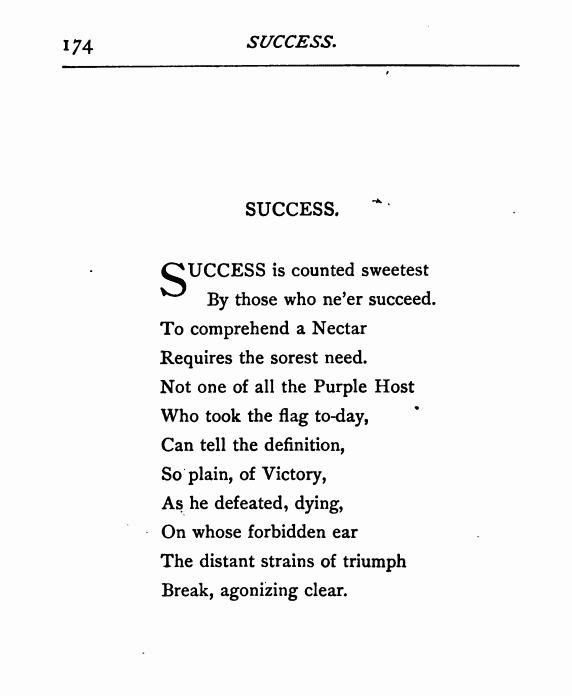
We leave this part of our story with an oddity: Emily Dickinson almost never saw her poems in print while living. Perhaps the most widely seen exception to this was her poem that appeared without her name in The Masque of Poets, and this happened because of the efforts of her friend and successful poet who we now have forgotten. What Emily Dickinson poem was it? The one that begins “Success is counted sweetest/By those who ne’er succeed…”
Here is Emily Dickinson in print. But no name.
.
So now let us return to Helen Hunt Jackson and her poetry, now little known and even littler read. Today’s audio piece, “August” is from her sonnet sequence containing a poem for each calendar month. Here’s a link to the text of the sonnet.
Jackson’s view of August is distinctive, and it’s far from upbeat for this last month of summer splendor. She starts by calling it silent** (save for the somewhat sinister connotation of insect hums). She calls what color August has “pathetic,” “vain,” and “artifice.” And loss of summer is at hand. Besides being widowed at a young age, Jackson had more than the usual 19th century history of young death of siblings and children. Perhaps that undercurrent of loss informed this cold pastoral of a warm month.
Content aside, this poem’s sound is exquisite, with assonance and internal rhymes richening it. Many lines break, or can break, in the middle, which I decided to accentuate in my performance. I found it a better poem than its forgotten status and elements of 19th century poetic diction would have it be.
The player gadget to play my musical performance of Helen Hunt Jackson’s “August” is below for some of you. If you don’t see that player, this highlighted hyperlink is another way to play the performance. I’ve been working with some larger arrangements and noisier stuff in the past week, so it was a nice change for me to perform this piece with only acoustic guitar and a little subdued bass. Besides my music, I added one extra line of my own at the end of Jackson’s sonnet, my small exchange writ in water from one unknown poet to another.
.
*Oh, there’s those little matters of differences in talent and level of innovation. But let’s leave that off for now.
**I am noticing much less birdsong in this dry August from the dawn choirs of let’s say June.
It’s time once more to perform the brilliance of Emily Dickinson. Today’s text, “Answer July” is Dickinson in her seeming simple mode. Read quickly, it might strike one as almost a nursery rhyme or maybe as one of those playful listing or counting folk songs. Here’s a link to the full text of the poem.
But when I looked again, “Answer July” appears to be a debate or interrogation between nature’s seasons and the consciousness of souls, a rather strange thing to put into such a brief and unfancy piece of poetry. Emily Dickinson loves strange, and if you’re a reader or listener who’s stuck around here, you’re comfortable with it too. What’s being debated here?
It starts with the poem’s speaker — let’s call them Dickinson, though obviously, it’s a creation of Emily Dickinson, and as its creator she knows more than this character — demands of nature’s mid-summer month of July just where certain summer things are. July, like a party in a legal dispute or sidestepping debater replies that the things that would allow it to produce those summer things are not in its control. There could be a supply chain issue, and maybe the real problem is with its supplier: the spring month of May.
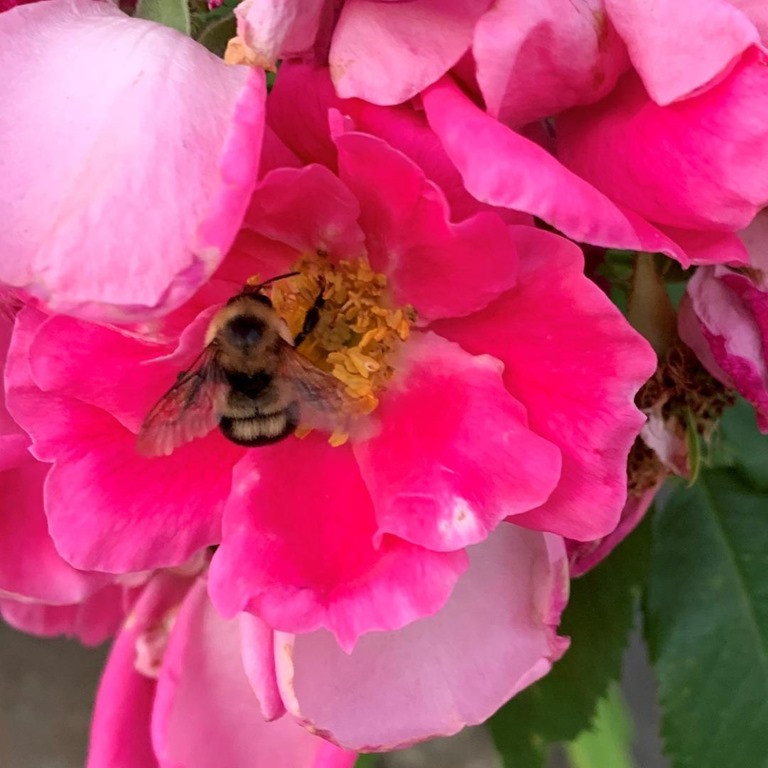
Where is the Bee — Where is the Blush? Got it right here Emily.
.
May is called in. “Nay,” says May. Tell me about supply chain issues! I’ve got suppliers too, like winter. Subpoena the jay, a winter bird.
The jay is sworn in. Look I need food in the winter they testify. Where’s the leftover autumn corn, the periods of hazy-thaw less-severe cold, and those burred seeds still in their protective casing? The implication here is that we could next look to question fall, though by now we suspect fall will blame summer. And round and round we would go.*
Dickinson gives us two lines that may be a break in the circle. When July, the first month/season to be questioned ends their reply, I think July suggests that May/spring is not a calendar month, but instead a creature of the questioner in the poem. The syntax is broken and unclear here, so who speaks each word is uncertain — but at the time I performed it, I went with this understanding (in paraphrase): July replies (answering to Dickinson’s opening line of questioning) “You’ve called on me to answer. Well, I’ve got one for you, ‘Where is May?’ Come on, you (thee) answer! Because I know what you should answer when asked about where things spring from: ‘It’s me.” That is, Dickinson, July questioner, is responsible.
I could be wrong on that somewhat convoluted reading. It could also be July saying “If May was here, they could answer your question for you (thee) and for me too.”
And then again, as the poem ends, the jay has a cryptic answer to where it can find its winter sustenance: “Here — said the Year.” Unlike summer, winter seems like a time of scarcity, but nature provides the jay what they need. There the implication is that Dickinson’s original complaint to July about where are the summer things she wants is being answered by the jay saying that nature will provide, if your soul seeks for things rather than asking for it to be summer ample and at every hand. This reading of the last line is what drew me to my more complicated reading of the earlier “Answer Thee — Me —” line. The poet Dickinson is telling the character of the questioner in her poem that it’s not the seasons that provide, it is the soul that seeks that finds. She is her own spring, summer, harvest and survival.
Musically I had some fun with this one. On one hand the harmony is simple, a I V progression, but I used some less-common voicings for the Ab (it’s an AbMaj13) and Db (a DbMaj7) and I played sitar.** Why not! Emily loved strange, and if you’ve stuck around here this summer, you have to have some tolerance for that. The player gadget will appear below for some of you, but don’t ask July where it is if you don’t see the player. Instead, click this highlighted hyperlink, which will open an new tab-window and play my musical performance of “Answer July.”
.
*Once again, I’m working on my theory that Emily Dickinson’s sharp intelligence was surrounded by a family that worked as lawyers, and that may have provided a frame for some of her poetry. As I write this there happen to be many supply chain issues ascribed to the impact of the Covid-19 pandemic and other causes, but neither legal precedents nor logistical savvy is the real subject for this poem, rather it’s about a Transcendentalist understanding of how the soul must partner with nature.
Emily Dickinson herself was also a gardener and the Dickinson household raised a wide variety of food and feed crops. Any farmer or gardener knows that it’s not just the calendar page that brings in food and crops, but effort and seeking.
**Well, not exactly. I’ve never owned a real sitar. I have owned an electric sitar with a plastic rounded bridge that sought to emulate their buzzy sound. I’ve used MIDI “virtual instruments” that allow a guitar or keyboard to play sitar notes with attempts at following sitar articulations. Today’s piece uses a Line6 Variax guitar that has a sitar sound setting, and it tracks guitar string vibrato precisely, a necessity for this piece’s main sitar line motifs.
Patience appreciated reader. You know we sometimes start one place here and then teleport to somewhere else near the end.
The NBA finals concluded last night, settling for this year the championship of the world’s premier basketball league. Best as I can tell, there’s not a lot of sports-fan overlap here, and to be honest my sports interests atrophied by the time I reached middle age to the point that it’s mostly a skimming of the sports news.
Still while researching something else last night I noticed a live-updating article on a news site for the finals game in its last quarter. I opened a tab in my browser, and in between reading other links germane to my research, checked back on how it was going.
A tied and then two-point, one-possession game eventually entered its final minute, and around there the Milwaukee team, possession by possession, started to assure its win. Even though it is a business, and even though the losers will get paid too, these moments in sports still build into an Aristotelian Poetics agony. One side is partly hoping no one screws up the increasing likelihood; the other side increasingly knows hopelessness. Compounding this, the obligatory strategies of the game mean the endgame is prolonged with timeouts for court position and play caretaking, and desperate, clock-stopping intentional fouls.
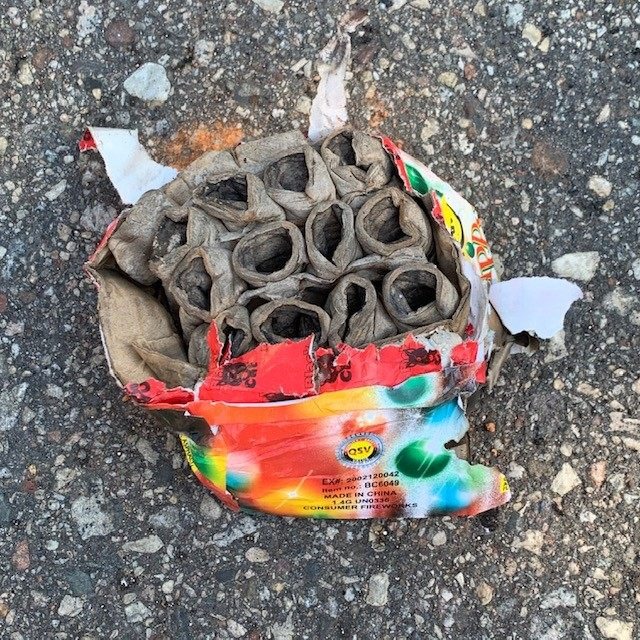
July remains of bang, light, spent.
.
And so, patient reader, it was then, as we continue our summer death, infirmities, and transformation tour here at the Parlando Project, that I thought of this song by Dave Moore that we had performed over a decade ago. Things sticking in memory is one test of artistic validity, and out of hundreds of different songs that Dave and I have performed since then, to recall this one seemed meaningful.
When I dug it out and listened to it this morning, I heard its infirmities: a simple rhythm-machine beat, Dave misses some intended notes in the vocal, my guitar part is not much. The combo organ sound that Dave uses is not hip or fashionable. But still, I think the piece did more than charm my memory. Near the end, Dave lets out a quatrain that still says something about our lives, about infirmities and death:
“You can’t make this up.
It makes up itself.
You can’t make it be
more than anything else.”
We all have our lies, our lives, our arts. We strive, and then someday, strived, to make them. Two out of the three are artificial, and yet from that we still try to discover truth. In the end, death makes up itself. Funny game.
One of the things this project is about is describing my experience of other people’s poetry and art, an experience which often intensifies as I inhabit some text in order to combine it with my music. Experiencing a poem in that way enforces a deeper connection, for you have to understand, in at least one way, that the author embodied something with their art. That’s my project, but ordinary readers will often find a level of experience with poetry they read too.
Does poetry exist to instruct or guide our experience of life, or does our experience of life or living with a poem vivify silent lines on a page?
Does poetry exist to instruct or guide our experience of life, or does our experience of life or living with a poem vivify silent lines on a page? Isn’t it likely a bit of both? It’s not always the poem’s fault if it doesn’t leap off the page and integrate with our selves, but then sometimes else we do connect with the poem’s experience with our own experience. When that happens, a poem — well — opens from its closed position in a book.
Heidi Randen’s own photo of the wild iris, which opens
.
Today’s piece finds me selecting for performance a part of a blog post by Heidi Randen where she describes such a bilateral interaction with a poem by Louise Glück, “The Wild Iris.” Suffering, observing suffering, feeling loss, observing loss, are some of the matter here. This poem helps Randen, and the poem’s potential is fulfilled by her connection. I took the final lines from her blog post and performed them as a “found poem,” deciding to overlay some form on it and applying my reading of it with the music from The LYL Band in order to make my own comment on it and to bring them to you.
The Poem, “The Wild Iris”
The poem
”The Wild Iris”
that opens:
”At the end of my suffering there was a door.”
The poem
”The Wild Iris”
that opens.
There is a joy after fear.
A door opens.
There is a joy after fear.
The door opens
into a world of light
and beautiful colors,
and you can breathe again.
Here’s a link to the Glück poem, which may bring you understanding or solace, or just a shrug. Below you may see a player gadget to hear my performance of “The Poem, ‘The Wild Iris.” However, some ways of reading this blog will not show the gadget, so here’s also a highlighted hyperlink that will open a new tab window to play the same LYL Band performance. The music today may be a little strange to some listeners since I wished to have unsettling elements mixed with reassuring ones. I also don’t know how you will react to the repetitions that are most of the form I imposed on Randen’s words. They too are part of the focused noticing* I intended for this.
.
*”Focused noticing” is a decent short definition of art, isn’t it.
Is it time to take a break from our sometimes intense presentations of poetry combined in some way with music? Well, here’s a little ditty about the lighter side of death, or rather the worship of dead rock stars.
Sure, it can be a honorable thing to give respect to those who’ve gone, to carry their artistic flag further when they can’t, but there is another side, the romantic admiration for the risks and the access to excess that often precedes the early death of musicians, writers, and other artists. The first duty of an artist is to survive. Society is not generally on the artist’s side until they become successful commercially, and even when it grants them that success, it can withdraw it and their support quickly too. To add to that burden with one’s own self-medication and distractions seems like a compensation to that state, but it doesn’t always work that way.
Poet, songwriter, alternate voice, and frequent keyboard player here Dave Moore wrote a short poem about how an older person might view with a strange kind of envy the tentative fame and unbounded experiences that others in our musical/generational cohort enjoyed. Sex, drugs and Rock’n’Roll once seemed to be jobs on offer in the want ads in our youth, even if it turned out the positions were already filled and the items already sold. I adapted Dave’s words, added a verse of my own, and wrote music for my performance of “They’re Not the Grateful Dead” some years back and thought you might enjoy it here. Oh, that “Grateful Dead” in the title? Translated folkie Jerry Garcia knew that this was a trad folk song trope where the dead magically and musically express some gratitude.
One thing I like about Dave’s lyric is that, outside of Jimi Hendrix he doesn’t pull in the big names, the Boomer rock’n’roll Shelleys and Byrons, the ones that are still featured faces in the rear-view mirrors looking at the music and times. Starting right off with Nicky Hopkins* is a bold move, but then Dave is a keyboard player.
My performance of this has a few flubs, but it’s hard for me to get more recording in right now, so we’ll make do with this older recording as is. The player gadget is below for many of you, but if you don’t see it, this highlighted hyperlink will also play my performance of “They’re Not the Grateful Dead.”
.
*Huh. Who? Those who didn’t ruin their eyesight fantasizing about debauched after-parties but by reading all the liner notes on every LP will know who Nicky Hopkins is.
Just last month I was writing here about how alternate Parlando voice Dave Moore and I used to perform pieces live and unrehearsed. Infirmities, personal matters, and a little thing called the Covid-19 epidemic meant we haven’t been able to do that for 18 months — but today we did that again.
Rusty? Yes. We’ve always been rough and ready, which means we persevered today because we love our common attempts at spontaneous performance, even though your ears will be spared most of them. Personally, I’m overjoyed to hear Dave’s keyboards mixing in with my guitars again. Perfect or imperfect is another, subsidiary, matter.
Here’s the very first piece we performed today, using for a text one of the sonnets I’ve written this year about infirmities. My sonnet, “Until Memory is Only Forgotten,” tells about an older woman with Alzheimer’s disease which has removed, and is removing, many of the layers of her memory, and who is traveling from the Memory Care Unit where she is presently living to visit siblings back in the farming community where she grew up.
Pictures of the Gone World. The young woman who raised blue ribbon dairy cows.
.
Long time readers here will know this Project normally features us presenting and performing texts by other authors, but since summer tends to bring in a smaller audience, I may be using more of our own texts when I can find time to present work here this season.
I chose to tell this woman’s story without following a time-line, because as with memory (even a degraded one) the scenes aren’t linear. Dave and I repeat some motifs in our playing, just as the subject of the poem sees different crops in the fields and can only see corn and speak again to her daughter-driver of that crop; yet in unmarred memory she recalls her Jersey dairy cows like the other Memory Care Unit resident who can still tout his Holsteins. Structurally this is a free-verse sonnet, though I think the old patterns of iambic pentameter remain rustling distantly in the fields.
Here’s the sonnet used as the text for today’s audio piece.
.
The player gadget to hear The LYL Band performance of “Until Memory is Only Forgotten” will appear below for some of you. If you don’t see it, you haven’t forgotten, you’re just reading this in a mode or reader that won’t show such things. That’s OK, this highlighted hyperlink will also play the performance.
This has not been a month conducive to producing new content for this project, and I’m not sure about July and August either. At some point I’ll probably talk about some of the reasons for that, but I thought it’d be good to leave you with one more June piece, and it’s a fine summer song by a voice this project hasn’t heard from enough lately: Dave Moore.
Dave and I first performed as The LYL Band about 40 years ago, and we’ve kept at it over the years. Our typical encounters this century have been a sort of two-person song circle with each of us alternating in presenting a song, a piece most often completely new and unknown to the other. These first takes* get recorded, and one of them is today’s audio piece.
First takes with unknown material is not the way most bands work, and certainly not how they record. Bob Dylan worked with unknown, fresh material and new-to-it musicians in his classic years (and may still now, there’s just less documentation), often providing at best chord charts for assembled musicians or brief run-throughs. But Dylan would do multiple takes even trying different studios or musicians over time, trying get the right take.
It’s not uncommon for jazz musicians to do the same thing we do in their recording studio dates, though some feel that even with Jazz’s reverence for spontaneity that this is a practice brought forward for logistical and lowered recording-budget overhead reasons, not as a considered artistic choice. Miles Davis seemed to find this practice a considered choice though, and when one listens to a record such as Kind of Blue we are likely to give some credit to that choice, which Bill Evans likened to spontaneous Japanese painting in the original LP liner notes. Later on, Davis took to the pentimento-practice of having everyone improvising on themes and then letting later audio editing assemble from the mass of recorded playing a post-recording compositional structure. A record like Davis’ A Tribute to Jack Johnson assembled that way has a different vibe and timbre from Kind of Blue, but it works for me in its different way.
Are Dave and I musicians like Davis and his band members? No. Nor are we musicians likely to be called to a Bob Dylan session (note to Bob: call us anyway). Most of what we record on any one day isn’t worth more than a self-critical listen on our own parts. And of the rest? There are usually rough spots that even a bit of focused audio editing can’t excise. And then, sometimes something like “Hortensia” arrives.
If you accept (as I say often here) that all artists fail, then it can sometimes behoove one to make peace with failure. Do that, and then allow, then make possible, for the limited successes to arrive.
I often tend to overstate my guitar parts. I didn’t here. Dave’s keyboard skills at the time of the recording get some space, and while he’s not going to kick Bill Evans or Herbie Hancock to the curb, what he plays works. Dave’s vocals are usually more consistent than mine by a long shot, and his performance serves the song. I think Dave may have even improvised some of these lyrics during the performance — and this is the only performance of this song ever. And that serves the song too.
You see, I hear this as a summer song, a song of long days, rich days, that are still days, and must end in earth’s and fortune’s rota. “Now, sweet now” Dave sings. Yes.
I think I asked Dave what the song was about shortly after we recorded it. “The summer flower or the Roman woman?” I think he replied that it was more at something intuitive.
.
You can hear it with the player gadget below. Don’t see a player? This highlighted hyperlink will also play it.“Hortensia” is longer than most of our pieces here, but sit back with a cool drink and listen. Thank you hearty listeners and readers for sticking with this project!
.
*First, and in most cases, the only take. Since we haven’t focused on live performance much in our old age, we aren’t working up material for performance or developing a repertoire for that. Dave has been as prolific with words and with songs with his own music as I have been with musical pieces over the past few years. This means that there was always new material to be tried out, to be brought into existence, even if briefly and for one take.
A longish one this time. I’ll try to make it worth your while.
In the places I go it has been hard to escape Joni Mitchell and the 50-year anniversary of her breakthrough record album Blue this month. Mitchell is one of those artists like Emily Dickinson* or Thelonious Monk who people contemporaneously recognized as someone on the scene, someone whose work might appear at hand or gain mention — but then decades afterward the level of originality and importance of what they had done becomes more and more clear.
Mitchell’s Blue wasn’t immediately recognized as a classic, successful statement. Musically it’s a bit odd, even by the eclectic field of 1971 recordings. Though “singer-songwriter”** was a growing genre at the time, most of them would present their songs in a full band context on record. Instead, Mitchell’s record is spare, often just her voice and one instrument — and sometimes the instrument is a mountain dulcimer at that! She often used her voice unusually, with quick almost yodeling leaps in service of the originality in her melodic contours, and this was off-putting to some. One thing I remember about listening to Joni Mitchell LPs back in my youth was that the amount of volume in her upper register would rattle the plastic frame and enclosures of my tiny portable stereo’s speakers, producing a very unpleasant buzzing distortion.
To the degree that she was noticed in 1971, that she could be a figure who’s fame might outreach her record sales or rock critic esteem — it wasn’t just that she was a successful songwriter for others who could round-off her corners just a bit to present “Clouds (Both Sides Now),” “Woodstock,” or “The Circle Game” to a wider audience than their author could — it was because she was known as (this gets complicated, stay with me here) as the “girlfriend” of a lot of male rock stars. This got joked about. The now infamous Rolling Stone “Old Lady*** of the Year Award” in 1971, or a joke picture of a purported Joni Mitchell LP with a song listing of: 1. Crosby, 2. Stills, 3. Nash, 4. And Young.
Do those of my generation remember that? Did you laugh? I did. That’s part of the complication, but then I believe sex is only funny when you’re risking doing it “wrong” — and it is best if it’s funny some of the time. Dead serious and entirely secret? We might as well sign up for Brave New World industrial reproduction or efficient devices shipped in plain brown wrappers.
That said, now-a-days that 1971 behavior toward Mitchell is now viewed as belittling and a case-study in patriarchal attitudes in the “counter-culture.” Which it was. In the era’s defense I’ll say that the times were groping (should I revise that word?) toward an imperfect but different attitude toward sexual relationships. Just exactly what women would have to say about this wasn’t the first or second thing on the official list of speakers, alas.
It just so happens that Mitchell spoke up anyway, and mixed that with a kind of music which might have seemed just a bit odd or imperfect then, but now is seen as effective, important, and original.
And now it’s time to play Frank’s favorite history game. Folks are thinking about Joni Mitchell and 1971’s Blue here in 2021, but what could we see if we rebound off that 1971 time and look back 50 years from then?
Well, they do tilt their berets the opposite way. Edna St. Vincent Millay and Joni Mitchell
.
The poetry fans who are still with this post were wondering when I’d get to Edna St. Vincent Millay. In 1921 Millay had broken out as a young poet to watch, partly by that “being on the scene” presence in New York City in the era around and just after WWI, and by famously losing a poetry contest with a poem that many (including the contest’s winner) thought was the best of the lot. That poem was then featured in her debut book-length collection, and now it was time for the “difficult second album.” She planned that second collection to be what was to eventually become her book: Second April, a title that suggested that plan. But she was having trouble with her publisher, and eventually another collection came out ahead of it, just as the 1920’s began to roar: A Few Figs from Thistles.**** It’s a fair analogy: that book was Millay’s Blue. And like Mitchell’s Blue people noticed the author’s public persona not just the poetry. Millay became the exemplar of “The New Woman” of the 1920s, who were sometimes finding patriarchal marriage a doubtful institution, and flaunting disregard for traditional arguments financial and domestic for that. Speaking openly about erotic feelings. Creating their own art rather than settling for standby muse duties.
I’m not sure if even an incomplete list of Millay’s lovers was known to a general poetry reading public 100 years ago, and one can’t quite imagine Poetry magazine naming Millay “The Old Lady of 1921,” but the persona in A Few Figs from Thistles gave us that adventurer in love character that makes Millay and Mitchell echoing artists. But the original edition was a thin volume, chapbook length, and from things I’ve read this week it seems that Millay worried that it wasn’t substantial enough while Second April’s publication faced continued delays. A second version of A Few Figs from Thistles was hurriedly planned and issued, and some of the additions were standout poems in the collection as we now know it, such as the one I use for today’s audio piece: “Recuerdo.” Here’s a link to the full text of that poem if you’d like to follow along.
In her heyday of the 1920s Millay’s Modernist milieu and outlook wasn’t always reflected in her poetic diction. This may have helped her readership who were not yet used to, or appreciative of, free verse or other experiments in expression. Robert Frost or William Butler Yeats would also retain a poetry audience in this time with lovely metrical verse that expressed the modern condition, but Millay was (to my mind) not consistently as facile with metrical verse and more often fell back to fusty 19th century syntax and language,***** but she could also rise above those limitations. “Recuerdo” is an example of that. It has an effective refrain expressing two contradictory and relatable emotions: “tired” and “merry.” Those emotional words are contained solely within the refrain. The rest of the poem progresses in the Modernist/Imagist style: things and events are described out of order, and in a common Modernist trope in a mixture of tones and importance. How many love poems include a phrase like “smelled like a stable?” Yes, this is largely a love poem — why it even touches on the aubade formula of the pair’s night being interrupted by the dawn — but look again: love (or sexual desire) as a word or even as a direct description is not mentioned once! Yet many readers can sense and feel the limerence of erotic love all through the poem intensely. That is there in this objective and fragmented depiction. Remarkable!
But that absence does allow for some ambiguity. Is there some level of inconsequential going-through-the-motions experience available in a reading of this poem? Or at least some sense of transience in the experience, which after all is framed by the title which means memory in Spanish? I think that’s accessible there too. Suppose I was to present this poem by inventing a frame that imagines it was written by two drug-addled addicts hooking up for one night and to say that that emotion word “merry” in the refrain has some archaic meanings that are congruent with “high.” Same words, different effect in that frame. Or if the same poem was written with a title like “How I Met your Father.”
We do have one clue to Millay’s intent. There is an extant recording of the author reading this poem, and though it’s not very dramatic, it hints at a bit of ironic distance on the events in the poem, a sense of noting the paradoxical koan of memorable inconsequence.
Perhaps I overthink things, but the last stanza with the donation of fruit to the older woman who responds with words of gratitude was rich in ambiguity to me as well. An act of Christian charity, mixed in Modernistically with other random events and sights? Seems likely, but if I’m traipsing around tired and tipsy with my night’s hot flame and somehow, someway we’re carrying two dozen minus two each of apples and pears, their value isn’t exactly gold, frankincense, and myrrh. Is the older woman’s “God bless you” a simple expression of thanks or an implied suggestion that maybe the two younger lovers might want to kick in some spare change, which they consequently provide? Given the push-pull of political radicalism and romance in Millay’s work, can we be sure she doesn’t intend to portray something of the limits of the gesture to the old woman?
How many are thinking then that I’m an unromantic old cynic who has misunderstood and harmed this poem? Is there another group that says I’m not straightforward in my social and political analysis of the situation? Well, my fate is to be doomed to be in both states alternately and sometimes at once. That’s why I like this poem.
One knock against Millay and other New Woman poets of her time once the peak of her fresh fame wore off was that she wrote love poems, not statements about the important, complex issues facing us. Fifty years later, one knock about Joni Mitchell was that she was writing songs about two little people who don’t amount to a hill of beans in this crazy world. Both of those summary beliefs are incorrect — but then, what is it you are saying: love songs are simple?
Maybe for you. Not for all of us.
The player gadget to hear my performance of Edna St Vincent Millay’s “Recuerdo” will appear below for some of you. No player to be seen? Then this highlighted hyperlink will open a new tab window and play it. My music today isn’t very Joni Mitchell-ish (though later Mitchell, much past Blue, was a bit into synths). The vocal turned out to be a “scratch track” I kept because it seemed usefully spontaneous, even though I omit a few words in the poem’s text inadvertently.
.
*Dickinson wrote much of her work in the 1860s, and a small group of people knew of some of it though almost nothing was published in her lifetime. I speak here of the Dickinson that existed at the turn of the century after several volumes of her poetry with regularizing edits had been issued. Today she’s taught as one of the great American poets. Back when I was in school she was a charming slight oddity that seemed to fit in with some of the small, short poems the Imagists/Modernists produced in Millay’s time.
**Years ago I wrote a humor piece where I called this 1970’s trend “Singer Sewing-Machine” artists because so much of their ethos had airs of “back to the land/rent a house in Laurel Canyon/sew hippy blouses and embroidered patches on your jeans.”
*** “Old lady” and “Old man” as in “My old lady” were usages borrowed from what were the old-fashioned/outdated terms for wedded partners. Used in the more fluid arrangements by young people in the mid-20th century counter-culture they were supposed to be ironic statements of: partnership at least for now. Mitchell’s song on Blue“My Old Man” is an encapsulation of that moment.
****Back when I first presented a poem from that collection that so many of you liked this spring,“First Fig,” I was unaware of the origin of that book’s title. I wonder if my father who memorized Millay’s short poem but also studied to become a Christian minister in the Millay era would have known that Millay’s book title is from Jesus’ words in Matthew.
*****Her admirers can parse this as a Modernist use of older “ready-mades” which are being modified in the context of her 20th century verse.
There’s another repeat author in this segment of our spring 2021 countdown of the most listened to and liked pieces here over the past three months. More than that, the number 4 and 3 positions are held by two installments drawn from the same poem, parts of my long serial performance of “The Waste Land” that wound up this year. It makes sense then to deal with them together.
4 What the Thunder Said Part 1 and What the Thunder Said Part 2 by T. S. Eliot As much as I enjoyed the challenge of taking on the range of Eliot’s poem and making explicit its implicit musicality, “The Waste Land” is not what many of us go to for poetry comfort food. The last section of the great poem was by all accounts written while Eliot was hospitalized with what is now considered depression. Most of his poem is a horror story, still and all twice-baked crafted, written by a man whose meticulousness had him working in a bank — and then revised by Ezra Pound, as merciless an editor as ever existed. That part of the poem can seem a cold-case puzzle to be solved, the likely source material for a volume by Dan Brown. It’s not.
It’s a series of songs made up of the overheard and the remembered bits caught inside Eliot’s educated mind, half in Parnassus and half in a Hogarthian vision of early 20th century London — and then we get to the last part of the poem, “What the Thunder Said,” which is more Eliot’s own song, a long somewhat improvised song that was written, he later confessed to Virginia Woolf, in something of a trance, without even bothering to understand what he was writing. Up until then the poem, however despairing or dark, has been crowded: voices, characters, changes of scene. This last part is Eliot alone with himself. The waste land, the desert title-place that we only meet in this last section, isn’t the condition of post-WWI England or Europe, the waste land is Eliot alone with himself in only lightly-disguised self-pity, which eventually leads to a final expiation in its concluding portion.* The accelerating four sections of “What the Thunder Said” that I presented this past April are the journey of that mind.
You can hear the performances of Part 1 of “What the Thunder Said” here with this highlighted hyperlink, or if you see it, with the player gadget below.
So, what’s the next poem in our countdown after all that sturm und drang?
.
Seriously, singing poetry can be an even deeper inhalation of a poem. Here’ are my chords if you’d like to sing this poem of Dickinson’s.
.
2 How Many Flowers by Emily Dickinson Just Emily: gardener, avid botanist, Transcendentalist meditator, a legal mind filing a concise argument in the case of the universe, folding her words up. It takes me a minute and a half to sing it.
I had some fun in my original post on this imagining how close she came in her poetic diction to writing an early 20th century Imagist poem, but we may have little trouble translating on the fly from her 19th century-isms to the vivid moment she observes: the observed or unobserved flower, the present and presence — and the future, their scarlet freight. Like much great poetry, maybe like all great poetry it doesn’t need me to prattle on about it, it just needs you to sing it, to carry that scarlet freight.
The player gadget that many of you will see is below for “How Many Flowers” by Emily Dickinson. Can’t see the player in your reader or browser view? Here’s the alternate highlighted hyperlink.
*Unlike the other 3 parts, the 4th part of “What the Thunder Said” didn’t get the listens and likes to make this top 10, possibly because of its length or general disinterest or dismay from the audience in its rough, less-exactly recorded nature. Still the electric guitar playing that builds from about 3 minutes in and finally becomes the brief solo that starts at 4:45 is as pure a piece of musical-emotional expression as I’ve ever played.