William Carlos Williams “The Birds” and what nature sounds

Something about the Spring I noticed this year — oddly, this year as an old man who has had a full lifetime of Springs — is the intensity of natural sounds in my city. There’s a tendency, demonstrated in many poetic tropes, to make nature a portrait or a silent movie, putting nature in contrast to the noise of our civilization’s hum and bark.

I ride my bicycle nearly every day off to a café to have a breakfast, sometimes early enough to feel like the single soul on the street, but by the return trip certainly part of the city waking and doing: kids on their school bus stops, sometimes with a parent, sometimes waiting with their own cohort only, folks holding coffee flasks unlocking their car doors to go to work, a few other bicyclists, including those on big front basket bakfiets or long-tail rear-seat-shelf bikes holding small kids, this observant cargo watching whatever in the morning beneath their pastel helmets. The human noise is slight and clicking. In such mornings we are more like crickets rubbing their wings.

But the birds! When most of those humans are making only accidental noise this early, and the kids waiting for the yellow bus aren’t always talking, perhaps practicing quiet for the ordered schoolroom, the birds are singing at the tops of their voices in the morning. Like miniature feathered fiddles, their song cuts through larger sounds, it insists on being heard. “Ladies, I got your genetic material here!” “This is my and my kind’s tree!” “Whatever this is, this Spring, I am here, and I’ll use my breath to say it!”

Like us bipeds lacking much fur, other mammals aren’t sounding much. Yard bunnies are suspicious and quiet. The squirrels don’t chirp, and their little feet make quiet footfalls. The dogs on leashes: all nose-leading in an alternate sensory dimension. But the frogs and toads are singing out too — whole amazing choirs of them, all wanting to contest Emily Dickinson’s Nobody with a harrumph and high whistle of who they are.

So, it is this Project’s nature to add sound to page poetry. Today’s audio piece is just me alone with a Telecaster electric guitar during a hurried session early this Spring to put down some musical ideas. In the poem that I’m combining with my music, “The Birds,”  William Carlos Williams follows Imagist principles, melding a moment into concrete images. Given that we’ve just had a set of rainy days throughout the long holiday weekend in my city, I resonate as Williams poetically paints the bird-morning wet as undried paint.

Is the world not “wholly insufflated” as he says at the start? The bird song is breathing into our world — nature is not silence, but poetry aloud.

Strange Powers Magnetic Fields photo by Heidi Randen 600

My wife found these* stapled to poles around our neighborhood on Sunday.

.

You can hear my performance of Williams’ “The Birds”  with the player gadget below. No gadget to be seen? This highlighted link is an alternative that will open a new tab with its own audio player. Want to follow along with the text of the poem? Here’s a link to that.

.

*This bird couple’s heads are superimposed over a human pair of heads from the cover of The Magnetic Fields Holiday  album. The quatrain quoted below is from a song found there “Strange Powers.”   Despite being a substantial Magnetic Fields admirer myself, I had never seen this album cover.
Sexton!

For a cluster of reasons, it’s been increasingly difficult to create new audio pieces for this Project. For one thing, having done over 750 of these pieces during the past 8 years, a lot of musical ideas, poets, and poems have been explored already. For another, my increasing age and high-mileage body have decreased my stores of reliable energy and dexterity. But one other reason is that I no longer have a predictable and luxurious access to times when I can record something that involves a microphone. Oh, I still get such time — but I don’t always know when it’s coming — and so an opportunity may arise, and I’m committed to something else, or it comes about and I’m weary and spend it napping or resting my aching old frame, or it opens up, and I have nothing prepared to record.

This frustrates me even as I realize that what I do have to bring to the Parlando Project in terms of resources and time is something to be grateful for.

Yesterday I had foreknowledge of one of those recording times coming. I collected two things I wanted to do something with: a well-known poem by Emily Dickinson and another musical piece that I wanted to record just for my own personal enjoyment. As I sat down in my studio space to record my musical performance of the better-known Dickinson poem, I noticed on my music stand a chord sheet for a lesser-known Dickinson poem I had done the music for early this spring: “Sexton! My Master’s sleeping here. ” “Sexton!”  hadn’t been recorded, even though it was ready — I didn’t have the time in early Spring as I rushed to do all the pieces on the children’s verse theme I had chosen for National Poetry Month.

Dickinson’s “Sexton!”  is an early Spring poem, a season that arrives at different times in different climes, but I figured that I needed to record it right away if I was going to keep it at all timely. I grabbed a dreadnaught guitar (a larger, more powerful sounding guitar than my usual instrument) and quickly refreshed myself on how I had intended to perform “Sexton!”

I was so eager to record on this occasion when the restrictions to making a sound had fallen away that I ripped into the piece at a reckless tempo. A choice or a mood? Moot point, I had to get on with it. Thinking about that tempo today I also wondered if my teenager’s hardcore punk listening had seeped into my mental metronome. But then “Sexton!”  does start with an exclamation point, and the whole poem is that: an exclamation of Spring.

Of course this is Goth Emily — so even if her poem and performance are as short as a cut by the so-rapid punk bards of San Pedro The Minutemen, there’s context crammed into 90 seconds. Here’s a link to Dickinson’s poem if you want to follow along. What do we find in those words?

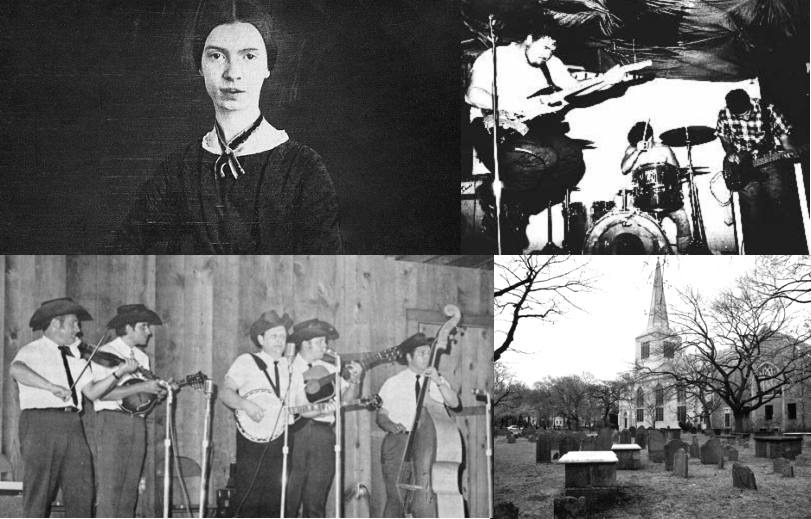
Dickinson-The Minutemen-Ralph Stanley and the Clinch Mountain Boys-graveyard

This is what you come to the Parlando Project for: stuff that’s stuck on each other like cockleburs.

.

A sexton* takes care of church grounds, typically including a graveyard. The sleeping Master’s bed chamber is therefore likely a grave. Spring has come with flowers and birds expecting new life.**

Spring isn’t stopping to reflect on this, like the tempo of the song it’s got work to do. Dickinson is in a churchyard, but it’s full of death departed and life arriving, not dogma. What replaces that dogma, sermon, homily? Bird-troubadours, secular Spring-song: its shortness, its insistence. You can hear my performance of Emily Dickinson’s “Sexton!”  with the graphical audio gadget you should see below. No gadget?  This highlighted link is a backup that will open a new tab with its own audio player.

.

*By anachronistic coincidence, the poem’s sexton made me think of Anne Sexton, a 20th century American poet. Poetry is like a cocklebur: its tropes and metaphors will stick to anything.

**More coincidental connections: in considering Dickinson’s poem in the context of a song I thought of this Earl Sykes song, best-known from a Ralph Stanley bluegrass version, called “A Robin Built a Nest on Daddy’s Grave.”   I wonder if Sykes knew Dickinson’s poem, or if there’s some third source that both the poet and the songwriter tapped for this springtime combination. My Dickinson poem-now-song would make a good medley with Sykes’ song —and good bluegrass high vocals and harmony would certainly spruce up my rough-hewn singing performance.

The Sparrow

Paul Laurence Dunbar is most often introduced as the first successful Afro-American poet, and I guess I’ve just followed form by starting this post that way. That statement is more-or-less true. I’d suppose a case could be made for the primacy of Phillis Wheatley who published a book of poems with some notice in the 18th century even before American Independence. And then too, there’s the question of success levels. Dunbar was able to publish more than a dozen books, got praised by some white literary critics and established poets. Figures in Afro-American culture put him forward as a leading Black poetic voice: Frederic Douglass, James Weldon Johnson, pioneering Black orchestral composers William Grant Still and Samuel Coleridge-Taylor.

As noted in Anne Spencer’s elegant short eulogy poem linking him with other died-young poets, Dunbar was only 33 when he died. Carl Sandburg was just 6 years younger than Dunbar, Robert Frost was but two years younger — both of those poets survived into the 1960s. Dunbar died in 1906 after being debilitated by illness and a series of personal crises. By the time the Harlem Renaissance came around to start making Afro-American artists chic, Dunbar was more than a decade dead. How much more growth and new circumstances could have accrued for Dunbar!

That we still remember him, that a couple of his poems, “We Wear the Mask”  and “Sympathy (I know why the caged bird sings),”  survive to be widely read and considered, should be counted as a success.*  “The Sparrow”  is not as well-known, but I’d note that it both comments on the Afro-American experience and a more generalized human experience.**

“The Sparrow”  is a poem about being sent joy, being sent song, being offered the peace of fellowship, being offered something — and being too callous, or too ignorant, or too busied with the things that aren’t joy and song. In the course of this poem, it may be simply drudgery that is keeping the poem’s singer from noting the bird. Even non-unpleasant rote life can obscure those offered gifts. And oh yes, oh yes,  it can be fear and prejudice that shuts them out too.

The Sparrow

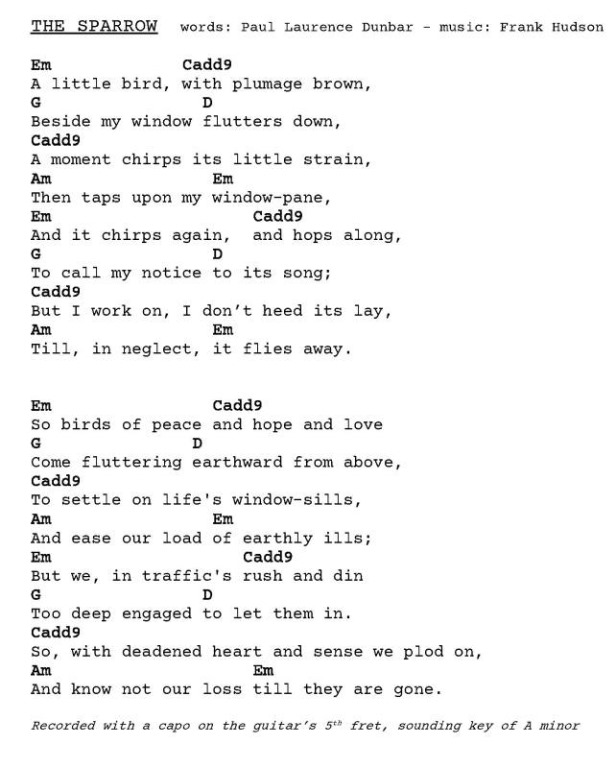
Guitar chord sheet for those that want that want to perform my song setting of Dunbar’s poem.

.

Beyond his remembered poems, I think often of Dunbar’s own life as a sheaf of strong metaphors. His mother was born enslaved. Sensing somehow that her son had a talent as a child, she herself learned to read to help him along, so that eventually that son wrote of that caged bird and of today’s offering sparrow. After publishing his first poetry collection, Dunbar sold it while working at his job as an elevator operator in his hometown of Dayton Ohio. He would offer it to his passengers migrating a few floors up or down inside his elevator cage.***  He grew up in Dayton with a couple of bicycle mechanics, Orville and Wilbur Wright. Orville was his school classmate and helped Dunbar find a publisher for that poetry collection. After eventually attaining some notice for his poetry and public readings of it, Dunbar got a job in the Library of Congress. Around that time his mortal illness was diagnosed as tuberculosis. I read today that he thought the dust of the books in the library made him — the man who could once charm musicians with the way his poetry sung off the page — choke and cough. He descended into his illness and depression for the foreshortened rest of his life. Three years before he succumbed, those bike mechanics made and flew the first airplane, and some of mankind slipped the surly bonds.

Someone had to be the first men to compose flight — but flying or caged, we need to sing, need to hear the singer, even after they’ve flown away. As Dunbar’s “The Sparrow”  has it in its ending line we often “Know not our loss till they are gone.”

I composed the music for Dunbar’s poem earlier this week, and dedicated much of today to completing the arrangement you can hear below with the audio player you may see below. No player?  This highlighted link will open a new page with its own player so that you can hear it. You may notice that I changed a few words in Dunbar’s poem while singing it. Some of the longer sentences didn’t give the song (or at least this singer) enough space for breath — and where rhyme didn’t demand it, I unconsciously changed a couple bits of the 19th century poetic diction as I strove to bring out the poems meaning as I sung it. That’s generally considered a fault in classical song settings, but I come from a looser folk songwriting tradition where that sort of thing is allowed. Here’s a link to the poem as Dunbar published it with all his words and syntax intact.

.

*To be known for a single poem, to have that carried by others, even in part, in reader’s memory, is an achievement I’d say. I can remember having a discussion with Kevin FitzPatrick some years back when he put forward that Dylan Thomas should be weighed by only being known for one poem — or maybe just that one poem’s refrain. That’s an arguable assessment, but even accepting that, that’s more than many poets, including prize winning-poets, achieve years after their death.

**In dealing with Autism Spectrum Disorder I often think of Dunbar’s poem of Black code-switching to seek acceptance or protection from mainstream white culture, and apply it to the ASD tactic of “masking” to seem more neurotypical. Dunbar’s caged bird never has to say it’s a metaphor for Afro-American experience to Black folks, but caged hopes are not an exclusive experience. I’ll split hairs on thin ice to mix those metaphors re: cultural appropriation vs. cross-over impact.

***Further risking flippancy on my part, it could be argued that the Wright Brothers invented the airplane, but the enterprising Paul Laurence Dunbar invented the elevator pitch.

All These Wild Geese Poems – and how one of my music pieces migrates

The route today’s musical composition took to existence was almost comically round-about. I added a new virtual instrument (VI)* drum set this week, one with a drier, more retro sound. I decided I should try it out. I grabbed an acoustic guitar track I’d recorded weeks ago, but not used for anything, and went to creating a simple drum track using the new kit’s sounds to see how they meshed.

It sounded pretty good, but that track-of-convenience guitar part had bleed from other stuff into the acoustic guitar mic, and so I used a tool I have that extracts a chord progression from an audio file, and then had that extracted progression played with a VI piano.

That cleaned things up enough that I figured I should make a little instrumental piece with this. Why not complete a trio and play some bass? Just over my shoulder in my little bedroom-now-home-office sits a Squier fretless Jazz bass.** I love its sound, but my old fingers need to be in good shape to get a clean sound out of it. Yesterday, my fingers were feeling strong, so that’s what I grabbed. I found a bass motif and played it in my best attempt to fit into the “pocket” of the drum groove.

A great musician or a more meticulous recordist might have perfected this, but something in me accepts a certain looseness and imperfection. Even if I’m recording one track at a time in one-man-band mode I’m often looking to get that spontaneous live-take feel, and my resulting trio had that I thought.

At this point my little house was filled with a half-dozen late-stage teenagers, all looking to have an autonomous time playing video games and watching YouTube. I holed up in my little office to let them be young. Might as well look to add another VI to my trio — if nothing else, to pass the time. The computer I work with virtual instruments on doesn’t have speakers, only headphones. Returning to the world between the cups of the headphones, I wouldn’t be bothering them.

What could be that another instrument? I decided to try cello. What articulation should I choose? My cello VI has a dozen or so articulations to choose from: different bowing techniques, styles for flowing legato or choppy stabs. I auditioned a few, and found two finalists I liked with the existing trio. Two roads diverged within a wood. Which one to take? I decided I’d use both  of the finalists.

I set the cello part to echo the keyboard part, a simple choice. I often enjoy simplicity in music, and my use of orchestra instruments often reflects that. I’ve taken to calling some of my pieces “Punk Orchestral” for this reason. Hey, ho, let’s go!

It was 11 PM by the time I finished the instrumental. The teenagers decided to decamp for a Perkins restaurant*** in a late-night post-modern way. Listening to the rough mix of the trio with the cello section I now thought this is good enough for a Parlando Project piece — I just need to find a poem for the words. I didn’t have much collected for possible imminent use. I had some Emily Dickinsons, but I fear I’m doing too much of Dickinson lately, as much as I like the results. I tried a Robinson Jeffers, but the mood of the poem didn’t match the jauntiness of the music’s groove. Then I tried a short poem I’d drafted in June, inspired by watching waterfowl in my city’s urban parks, lakes, and ponds. That fit!

All These WIld Geese Poems text

The poem that became today’s lyric

.

I revised the music slightly to use with these words. Guided by the instrumental’s chords and using my imperfect voice, I devised an expeditious melody. I tried a couple of takes singing the words, and found that my poem sung better with some mild editing of its text. It was around midnight when I tracked the final vocal take you can hear today before going to bed. It was just after that final tracking that a comic turn happened. The drum track, the new VI sound I started with, that, which had inspired the course of this composition, stopped playing, muted itself. A bug perhaps? But in the early AM hours I decided it sounds better without the drums, as the other instruments now have absorbed the groove conception I started with within themselves.

Today I mixed the resulting piece “All These Wild Geese Poems.”   Mixing involves placing the instruments within the soundfield in stereo width and volume depth, and using other audio processing on their dynamic envelopes and frequency ranges. I then created the final mix using some computer tools to adhere to current streaming services loudness levels, and uploaded it to the service that shares my audio to play here and on the podcast platforms of Google, Apple, etc.

A Goose as Ratso Rizzo 600

You, poet, you’re not much of a goose, or much of a Yeats either, so get out of my way!

.

“All These Wild Geese Poems”  takes off from the many romantic poems about geese, cranes, swans and such large waterfowl. The urban geese I meet in my city nature are instead cantankerous beasts, and I thought our contemporary poems often take a similar stance, no pristine “Wild Swans at Coole”  musings for these birds — more at the famous Dustin Hoffman Midnight Cowboy  “I’m walkin’ here!” self-involved swagger with a limp. You can hear the performance with an audio player below if you see that, or with this alternative link that will open a new tab with an audio player.

.

*Virtual Instruments are precisely recorded sounds of the various notes and timbres of a physical instrument. Either by using compositional scoring, or the computer equivalents of that; or by playing the notes with a MIDI controller equipped keyboard or guitar, one can make reasonably convincing performances of instruments that one cannot play or afford in real life.

**I play interesting but relatively inexpensive guitars. Squier is an entry-level brand devised by Fender to sell low-cost versions of their famous instruments. Back in the 20th century any aspiring player found with a Squier was considered non-serious. “Real musicians” used “pro instruments” — but in the past decade or so the quality of the better Squier instruments has increased substantially.

***Perkins restaurants are like a Denny’s. Big menus with lots of senior-citizen specials and tastes —but open early and late for the time-expanding young person.

Breakfast in a Pandemic

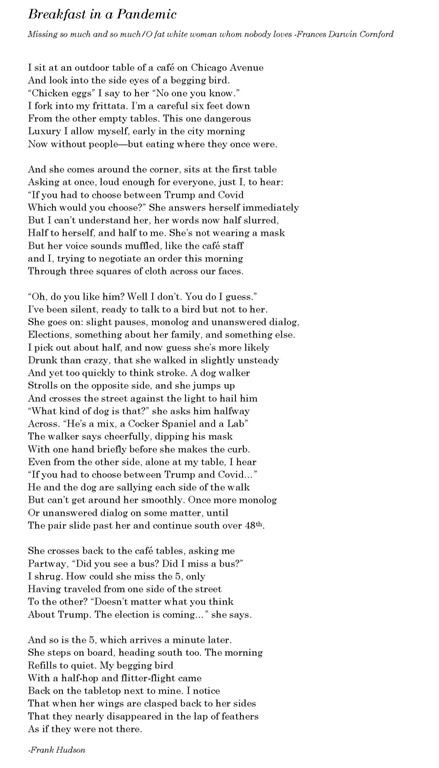
Can we accept a little fall-off from Rilke last time to something I wrote?

As long-time readers here know, the Parlando Project is about “Other People’s Stories.” Dave and I both write words as well as music, but I find it interesting to examine how I experience other people’s words, other people’s outlooks and visions. This project’s focus for the past four years  has been an exploration—often into writers I didn’t know, or writers that I, and perhaps you as well, think we know because of what we have been told about them.

I was able to run this piece past a fine poet Kevin FitzPatrick,*  before it reached the form you’ll read/hear today. He noted that I was working in my Frank O’Hara mode, and he’s right. For me in my 20s, O’Hara helped me integrate the French Surrealists with the American mode of Carl Sandburg,**  with a Modernist touch of exoticism I’d retained from love of the English Romantics.

I had to remind Kevin that a big influence on this poem was his own poetry, about which a reviewer once said included so many “poems with other people in them.”  Why, oh why, is that so rare? How many poems are about the poet’s own head space or solitary meditation on nature? Of course, that landscape can’t be avoided. And yes, some very good poetry can be written in that less populated country. Readers here will know how much I’ve come to admire what Emily Dickinson did. Though we now know that her life was not entirely that cloistered myth that once was used to define her, does her extraordinary corpus of poetry ever include another human character speaking for themselves?

So, my poem starts out like a nature poem, albeit in an urban setting, and then another character breaks in and changes the poem. The music I composed and performed seeks to underline that. And a disease pandemic is, after all, a natural metaphor for our separation.***

Breakfast in a Pandemic

A long poem for me these days. Some thought it could be shorter and some thought it could include even more detail . They’re both right, but that’d be another poem I decided.


In the text of the poem I use an epigraph from Frances Darwin Cornford’s “To a Fat Lady Seen from the Train.”   Dave wondered if that might put off some readers. His concern has merit. Cornford’s poem (better known in Britain) is an earworm best known for being disliked. I have not seen anything from Cornford about what her intent was with the poem, and perhaps she had little conscious intent, thinking of it only as a catchy triolet. However, I think it’s a kind of pointed  failed encounter and is written as such.

As I said above, the music here tries for contrast, with acoustic guitar and then drums and bass with a smattering of woozy strings and distant woodwinds. The composer in me isn’t sure the composition or the performer achieved all of his intent. The middle section may be taken at too fast a tempo. My late father who hated poetry read too fast would certainly think so. But I remind myself that plenty of modern spoken/chanted word is taken at a rapid pace, so maybe not.

The player gadget is below, so you can listen and decide for yourself. Stay well, valued readers and listeners!


*Alternative Parlando voice and keyboardist, Dave Moore had some helpful suggestions on it too.

**I don’t know what O’Hara thought of Sandburg, but I wouldn’t be surprised if it wasn’t favorable. Sandburg might have seemed too straight, and too yokel. But Sandburg was working often in the mode of Whitman and Hart Crane which O’Hara also was (along with O’Hara’s French language influences).

And did you know that Whitman’s oh so American ‘barbaric yawp” was a formative influence on French Vers Libre? I didn’t either until this project’s exploration.

***At least the existence of this poem means that this pandemic of our age won’t be as little covered by poets as the big 1918-1919 flu pandemic that poetry ignored.

Brancusi’s Golden Bird

It’s perhaps my favorite scene in D. A. Pennebaker’s Bob Dylan documentary Don’t Look Back.  Pennebaker has setup this narrative as Dylan tours England in 1965, introduced with shots of British music newspapers touting the teen-aged Donovan as Dylan’s rival. My well-remembered scene is shot in Dylan’s Savoy hotel room, where boffins can pick out various UK music figures sitting about and talking. In the background, there’s Donovan himself, tuning an acoustic guitar as Dylan asks if there’s anyone in the British Isles that is a poet like unto Allen Ginsberg. Dominic Behan is offered. Dylan says nah. Donovan has tuned up and launches into his “I’ll Sing a Song for You.”

“That’s a good song” Dylan chimes in as Donovan sings, and though eyes behind Ray-Ban shades he still seems to be paying respectful attention. Someone says “He plays like Jack man,” not a slur, but referring to Ramblin’ Jack Elliot, the legendary folkie and predecessor to Dylan in the Woody-Guthrie-continuation field.

Dylan takes the guitar from Donovan and launches into “It’s All Over Now, Baby Blue.”  The guitar has gathered a capo and Dylan has lost the shades. Donovan lights another filter cigarette and chews on his nails, figures how to be cool.

Now, “rating” Dylan songs is subjective and subject to mood, even for any one person. For this one person, It’s All Over Now, Baby Blue”  gets a lot of respect: a song about love using politics as a metaphor or a song about politics using love as a metaphor? The best metaphors are like that, the thing and the representation can flip places.

So besides the people-watching and the music in a movie about a songwriter that actually has little music in it,* the gist that’s often drawn from this scene is an unhelpful but crucial tip: if you’re ever in a song pull, don’t sing your song just before 1965-vintage Bob Dylan if you can help it.

OK, so I’ve already drifted back to 1965, let’s keep drifting backwards to 1922, and you’re a Modernist poet, not a singer-songwriter. You’re about to be published in The Dial,  the sort-of-successor to the mid-19th century American Transcendentalist house organ, now publishing the cream of Modernism in art and literature. Let’s get specific, the “you” you’re playing as you travel back in time is Mina Loy, a woman who’s au fait with the avant garde and whose poetry remains strikingly original even today. Yes, the Modernist movement is going to have its problems with women as artists, but Loy seems fierce.

Brancusis own photo of The Golden Bird

There are lovely color pictures of Brâncuși’s sculpture, but this is the artist’s own photo, which has a certain monochromatic mystery to it


And the Mina Loy poem that goes into that issue of The Dial is a glorious ode to a visual Modernist: one of Constantin Brâncuși’s series of bird sculptures “The Golden Bird.”  Loy’s poem has something the pre-WWI Modernists often had, a joy at the new way of looking and expression.**

The lesson of the Dylan’s Savoy Hotel room is true but unhelpful here. The November 1922 issue of the Dial leads off with a new publication of a poem called The Waste Land”  by T. S. Eliot. You might have heard of it.

The Dial November 1922
Antiquities dealers ask for more than $1,000 for this back issue


Art of course isn’t a competition. “Rating” art is a silly pastime that gets sillier the thinner you try to slice it. The emotional/intellectual transfer happens between art and audience or it doesn’t. Still the unhelpful rule would hold that if you’re trying to make an impression as a Modernist poet, holding up your “read me” sign next to what gets rated a masterpiece isn’t the way to go.

Now, almost a hundred years later, readers and critics are starting to look again at Loy, whose entire career was overshadowed compared to others she worked beside. How successful was her art? There’s no fixed record, because that assay happens every time it’s read or listened to. I think this tribute to Brâncuși stands up, even though it no longer benefits from the early 20th century shock of the new.***

Musically, today’s performance marks my annual tribute on the anniversary of the unfortunate death of the American musician and composer Jimi Hendrix. Each year for September 18th I plug in a Stratocaster electric guitar and try to channel a little of Hendrix’s bird in flight. Hendrix was enormously interested in the electric guitar’s timbral possibilities, so I tried to make my guitar part reflective, chirping with bird song, and gong-like in turn. You might easily think: this is my Savoy hotel room moment. You could be right, but I persist. My performance of Loy’s piece praising Brâncuși’s sculpture is available with the player below.  The text of her poem is here if you want to follow along.

If you ever find yourself, regardless of the unhelpful rule and your careful plans, as a Donovan next to someone as a Bob Dylan, one choice is: go ahead anyway. I’m glad Loy did.


*Yup, it’s true. The movie is forever showing Dylan about to go on stage and then it cuts to another backstage scene. This may have been necessary for music-rights issues, but the movie Pennebaker got was all the more unique because of this.

**RaulDukeBlog has sagely commented here about the gloomy-gus nature of so much of 20th century High Modernism. T. S. Eliot’s poem helped turn it that way, even if it was a personal expiation to break out of that. Two World Wars and surrounding atrocities certainly didn’t help cheer up the arts, and our present state is damp with sodden things that can only be dried with some fire that joy sparks. Another reason to go back earlier in Modernism, and to look at the kindling of artists like Loy and their pure enthusiasm for breaking out of entrenched tropes.

***A famous anecdote about Brâncuși’s work has it that at one point when the statue was being transported to the U.S. the customs officials refused to believe the abstract form was a sculpture at all, and it was instead classified as a metal ingot.

“Hope” is the thing with feathers

We don’t usually associate Emily Dickinson with metapoetry or with the widespread sampling and recontextualizing such as found in T. S. Eliot’s “The Waste Land.”  But this poem from Dickinson, one of her best-known, could be engaging in something we could call that.

The poem starts off with a clear indication of reference, by putting its first word in quotes. Based on Emily’s unusual but internally consistent style, I don’t believe that she’s using quotes to indicate hope as concept, as an ideal (she capitalized words to indicate that sort of thing). If it’s a quote, she’s referencing someone else. Who said this “Hope?”

My chief candidate would be the poet and poem from our last post, Emily Bronte and Bronte’s poem “Hope.”  If you read and listened to “Hope”  in our last post you’ll know that “Hope”  isn’t a hopeful poem at all. Dickinson’s poem, on the other hand, is often viewed as praising hope, but if you read/listen to them together, Bronte’s poem sheds a different light on the much better-known “thing with feathers” poem.*

Dickinson seems to start where Bronte ended. Bronte’s hope has feathered wings, and it uses them to soar to heaven to never return. Dickinson starts with “hope” only specifically given the potential for flying away, but Dickinson has “hope” sticking around. Some read the feathered aspect of Dickinson’s image as cute, like a pet songbird, a friendly image, but I don’t think Dickinson does cute much, and I’m not sure she’s doing it here.

Punk Monk Emily

My wife sent me this and I believe the illustration is by Wendy MacNaughton.

.

What Dickinson says about hope in the rest of the poem has been read as outright praise, but if we take that fly-away-and-feathers link between Bronte and Dickinson, we should be alerted that there may be more shading the situation.

Hope and Hope is a thing with feathers

For those who’d like to read along, here’s today’s text and the Bronte poem it may be referencing

.

Dickinson’s hope sings without words, which is a statement of great ambiguity from a poet. Abstract sound that goes beyond meaning is part of poetry’s power, yes, but “without words” may also say that, for good or ill, hope is generalized and not realized by the specifics of the situation. A song without words could be like advice that things will always get better, always turn out fine. A friend or advisor that always tells you that; whose non-specific hope is constant and never relenting can be a “not today please!” thing after all.

The second stanza is an extended metaphor of the hope-birds sweet song in a storm. “Plucky little bird! Good for it!” Is one reading. But there’s an odd line in there that must be weighed too. If the storm is bad enough the bird might be abashed, embarrassed, Dickinson says. Why would that be? Is the hope-bird, shy, timid? Bronte’s hope is said to be in her poem’s first line, and that turns out to be a very severe flaw as Bronte develops it. Could it be even darker? Did the hope-bird say listen to my hope-song in the storm and not fear—oh, how embarrassing—category 5, your town is wiped out by the tornado or hurricane?

Am I being Debbie-downer here? Could be. But how else does one explain the “abash” in that line?**

The last stanza begins still carrying over that metaphor: hey New Englanders (and Minnesotans!) if it’s cold, the frozen center of winter, you can still hear the magical hope-bird. Out way beyond land on the strangest sea? You can hear it. The hope-bird is operational in any and all conditions!

More won’t-shut-up testimony about the hope-bird there. Is this fulsome praise? Recall Dickinson’s famous definition of poetry: “If I read a book and it makes my whole body so cold no fire can warm me I know that is poetry.” And in Wild Nights Wild Nights  she speaks about adventuring on chartless wild oceans. Not to paint Dickinson as an inner stone-cold Goth here, but cold and strange are not what she seeks to avoid. Dickinson says the hope-bird keeps “so many warm.” She doesn’t say everybody or herself.

What do I make of Dickinson’s concluding couplet? Many readings see it as a comment that hope isn’t self-serving, the crumb being reward for a pet or a tamed or otherwise human-habituated bird. Dickinson (unlike Bronte, whose hope is portrayed as fickle and even cruel) has just made much of hope’s seeming ubiquity. If we take it that she’s commenting ambiguously on someone else’s hope or Bronte’s portrayal of a fickle hope, she could have undercurrents in those last two lines. She may be saying “My hope is wild and unpredictable, maybe not as specifically feral and cruel as Bronte’s, but my hope is not my pet, not at my beck and call.”

Of course, a great deal of this reading depends on thinking that when Dickinson put hope in quotes she meant to refer to the title of Bronte’s poem whose protagonist is highly skeptical about hope. There’s another thing she might be quoting, a special use of the word. When Dickinson entered Mount Holyoke the students there were highly encouraged to make a sincere profession of religious faith. At the end of her single year there, Emily Dickinson was still in a small group that refused to make that profession. The school had a classification for those hard-cases. They were put down as “Without hope.”

Here’s my performance of Dickinson’s “Hope’ is a thing with feathers.”  Use the player below to hear it if you see that, or if you don’t, this highlighted hyperlink can play it.

.

*Somewhere in my reading this spring someone tipped me off to consider Bronte’s “Hope”  as an influence on this poem of Dickinson’s. I did, and this is what I found following that tip. However, I can’t find any note I made about where I first read that there might be a connection. I owe someone.

UPDATE: Thanks to another blog’s discussion of this poem, I think I’ve rediscovered where I may have read of this connection between poetic Emilys and “hope.” It could have been this post by Nuala O’Connor.

**I’m truly hesitant in this regard. I do believe in the intractable nature of the human condition, and I think Dickinson does too, but I don’t want to discount hope or “the peace that passeth all understanding” as a necessary part of dealing with those things.

Emily Bronte’s Hope

If Emily Dickinson had no real models for the revolutionary poetry she developed, she did have other poets she could look to. We know from her letters that one of them was Emily Bronte.

English author Emily Bronte and her two sisters Charlotte and Anne all wrote poetry and then novels, but Emily seems to have been the most avid poet of the trio. Starting in childhood Emily Bronte created along with her sister Anne a fantasy world they named Gondal in which they spun tales of adventure. At least some of Emily’s poetry was connected to that world, and so it’s possible that today’s hopeless piece titled “Hope”  is part of some fully imagined plot and isn’t autobiographical.

Emily Bronte

Emily Bronte. Plotting what to do to that useless hope when she’s uncaged?

One of America’s great contributions, an Afro-American contribution in large part, is The Blues. The Blues reaction to misfortune is almost inevitably to battle that misfortune in some way: to mock it, to hip others to it, to talk back to it and tell it that the speaker knows the score and may even settle that score with it some day. Most American Blues aren’t “woe is me, I’ve got it bad, and I’d rather be dead” it’s “I can tell you how much trouble I’ve encountered, but I’m still here.”

Emily Bronte is mocking too, but she’s mocking hope itself, not the unspecified troubles that have figuratively imprisoned the poem’s speaker. Hope is portrayed throughout as an external character, and that character is a pious creep, totally uninterested in easing the pain of the imprisoned speaker.

Still you have to hand it to Emily Bronte here. This is a rather impious poem from a preacher’s kid, even if it’s a character from her imagined world and this is only a momentary lament. Perhaps that’s part of what attracted Emily Dickinson to this fellow Emily. Dickinson is also a great mocker.

Does today’s Emily Bronte poem remind you of a well-known Emily Dickinson poem? Check back later this week and we’ll try to follow up on that—but until then, here’s today’s audio piece Emily Bronte’s “Hope.”  The player gadget is below for some of you, but if your blog reading software doesn’t show it, this highlighted hyperlink will also workFull text of Bronte’s poem for those who would like to read along is here.

.

Self-Pity

Like Thomas Hardy or James Joyce, D. H. Lawrence is another writer remembered more as a novelist than a poet, though he published multiple books of poetry in a variety of forms in the early 20th Century.

He’s hard to place in the various “schools” of poetry of his time. He was published in Imagist anthologies, but he is also sometimes grouped with the Georgian Poets who eschewed free verse, though he often wrote free verse. He sometimes wrote compressed epigrams like the one I present today. “Self-Pity”  looks like a Modernist short poem on the page, but it doesn’t aim to work like most of those poems on the reader or listener.

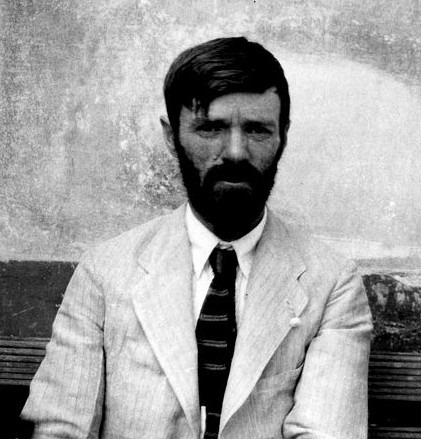
DH Lawrence  by Bynner

1923 photo of D. H. Lawrence by Witter Bynner


Oh “Self-Pity”  uses all the devices of poetry, save for rhyme. It’s loosely iambic with anapestic moments in meter, though the line lengths are uneven. This is consistent with much free verse, which still wants the beats of the words to be felt, without lock-step marching drills. It has a vivid image (the frozen, falling bird). It has a repetition (“sorry for itself”).

Why then does it seem different from other Modernist poems? Contrast Lawrence’s “Self-Pity”  to two other contemporary-to-it very short poems: William Carlos Williams’ The Red Wheelbarrow  and Carl Sandburg’s Fog”.  “The Red Wheelbarrow”  puzzles readers to this day about its message, other than it wants the wheelbarrow to be clearly real. I think it’s about the beauty and dignity of work and its tools, but perhaps I’m wrong. You may not draw any meaning at all when you first hear or read “The Red Wheelbarrow.” “Fog”  attracts immediately with its metaphor of silent fog and haunches-poised cat. It may seem to you at first a show of how metaphor cleverly works. “Wow, fog and a cat, I never thought of them together. Cool.” It’s only if you hold the poem longer in your mind and heart that you may ask why the fog/cat is at the harbor, that it’s not a pampered pet, but a feral or work animal.

“Self-pity”  is more directive. Many who hear or read it will get the point the first time. Yes, that frozen dropping bird is a vivid image, but it doesn’t lead off the poem, it comes after half-way, and it’s meant to work not as something the poet saw, but as an imagined image to illustrate his point.

Which way is the right way to go about it? That’s for you the reader/listener/writer/performer to decide. The Internet tells us some folks find the direct and pointed message of “Self-Pity”  helpful to them. I myself could stand to be reminded of it sometimes. Literary poetry of the 20th Century gradually made the decision to go with the non-directive imagery way, not with the more frankly didactic aims of Lawrence’s poem. Current writers and readers will get to re-decide this issue for our maturing, teen-aged, century.

“Self-Pity” was used in a Hollywood depiction of military training.  I imagine a Pythonesque skit where John Cleese or Graham Chapman submits other poetry to raw recruits. “I saw the best minds of my generation destroyed by madness, starving hysterical naked!” “Suppose an opponent comes at you armed with plums. So sweet. So cold. What would you do?” or “You are a pair of ragged claws scuttling across the floors of silent seas.”


What do I think? After all, this is the Internet. I must  have an opinion!

I’m eclectic. I don’t want poetry, or any art, to always work in the same way, to stop surprising me. If I could send myself back and offer advice to Lawrence on his poem, I’d tell him to spend more time on that bird before he tells us what the bird means. By not giving me the sense that a real human stood cold or bundled up or on the warm side of a window and watched that instant, that small bird, ruffling their feathers to hold what warmth was still there before the perch became its last, the poem loses potential power for me.

Thomas Hardy may have imagined his winter darkling thrush entirely as a useful image, but I feel that encounter with his bird. I’m convinced Rilke actually looked at an amputated and archaic torso of Apollo and wanted to see its present state fully before he delivered his reaction. I think Lawrence wanted to make a point, and that bird was a useful slide in his deck.

But that may be sentimentality on my part, and too much of that can be stifling and predictable. And perhaps the poem would loose some of it’s epigrammatic power. How often we see by opposition.

Musically, I spent a good deal of time on the drums/percussion for this track, trying to pull out the vibe of “Self-Pity’s”  meter. With the rest of the music I tried to balance my reaction to Lawrence’s resolution while transmitting the assertion of the epigram itself. To hear it, use the player below.


The Wood-Pile

Robert Frost is every bit the master of word music as Yeats and Millay. What makes Frost stand out is that he was every bit the thoroughgoing early 20th Century modernist as any of his free-verse contemporaries, while retaining an ease with accentual syllabic meter.

Here’s an example of Frost handling a subject just as a free-verse Imagist would. His aims, his presentation, hold to the Imagists’ principles. He deals with the thing directly (as we shall see, two things, but still…), and there are no tacked-on metaphors, no stock comparisons, no extraneous “poetic” language. Context is shown, but not explained. He loosens and varies his meter, so the poem sings and never seems to be a shackled march. At 40 lines, it’s a bit longer than Yeats’ poem considering “The Wild Swans at Coole,”  but Frost’s extra detail is even more specific and concrete than Yeats, though both begin their poem with the poet walking in a rural wetland. Yeats slough is a well-known place to him, conditioned with 19 previous visits. Frost is far enough into his swamp to not know exactly where he is, and so experiences what he sees with a first-time immediacy. Yeats’ slough then contains tradition, Frosts’ the more Modernist “Make it new!” place.

Though presented as one simple rural scene and story, “The Wood-Pile”  is more at two poems, though each part speaks to the other. As Frost’s tale starts, we are in the midst of one of his characteristic journeys, just as we are in other famous Frost poems. There’s a need for decision (“Turn back” or “go on farther”) and his choice, also made in other Frost poems, is to go on regardless of whatever doubts brought the question. If he’s lost in the dark by a wood on a snowy evening, keep going. If you come to a fork in the road, pick one and go on. If you’re walking in a swamp in winter and your foot is sometimes falling through the frozen crust, well, keep going “and we shall see.”

And so, here he sees his bird. No Keatsian nightingale, not Millay’s elusive flying swans with their awkward dangling legs and cries, nor Yeats’ majestic 59 swans, but a small bird. This bird becomes a mirror to the poet. Frost’s bird too must make choices in direction, and the poet, sensibly, thinks the bird’s guided by fear. “Keep something between little me and the big lummox trodding through the winter swamp,” he humansplains. And there’s a bit of humor at human’s expense as the poet muses that the bird, like humans with their self-importance, may think that the only reason for Frost to be out in the swamp is to go after the little bird.

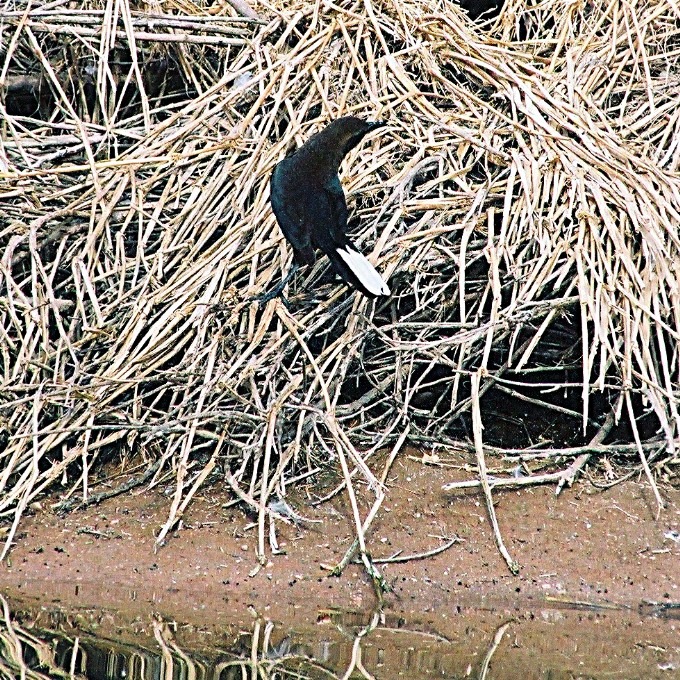
Gackle with white tail feather

“He thought I was after him for a feather—the white one in his tail”


But, we don’t know why Frost is out in the frozen swamp explicitly. The only reason he’s given, or will give, is the Imagist poets’ reason: “and we shall see.”

The bird leads Frost to the second thing the poem wants to present: an abandoned fire-wood cache. Here Frost zooms in close. Every detail of the cut wood and the once neatly stacked and propped wood-pile is stated. Frost turns forensic, like some New England Sherlock Holmes: this pile has been abandoned for years. Mature vines have grown through it.

wood-pile

“The slow smokeless burning of decay”


Here is another context left unsaid. Why would someone abandon a purposeful wood-pile in a swamp? Frost leaves it for us to be detective and to solve the mystery. This isn’t some lot of fire-wood left temporarily to be gathered later in the day, care has been taken to stack and prop it.

The only thing I can think: someone once built a shack (now completely disappeared) on the swamp land. Frost muses, sardonically, that only someone so busy with “fresh tasks” could abandon such effort in cutting and stacking. Does he mean to say, “only a fool would be so industrious to cut and stack this wood and yet not notice he was building his shack on a swamp that would not support a homestead?”

Now, the small bird with his “little fears” and oh-so-human misapprehensions of reality—and now, the steadfast Frost of miles to keep going, even if you may be lost, are set in contrast to this choice. Your fears may lie to you—but so will your optimism.

I once heard an astringent biological statement that the length of our lives can be reduced to a slow-burning chemical reaction. Frost’s last line here is a sad and beautiful analog to that truth.

Turn back or go farther? Go on, and we shall hear my performance of Robert Frost’s “The Wood-Pile”  with my original music. Just use the player below.