The Pool

With a poem, mystery and ambiguity can be often served best alongside brevity. H. D.’s “The Pool,”  which supplies today’s words, is a fine example of this. It’s a condensed tale of an encounter that takes seconds to read, but longer to absorb.

We last met H. D. (Hilda Doolittle) here with her tiny but fierce poem “Oread.” In that case, the title let us start off the poem knowing the main character of the poem. “The Pool”  offers us no such clue with it’s somewhat generic title, and it throws us in the deep end by beginning with a question: “Are you alive?” Five spare lines later it ends still listing questions: “What are you..?” It’s called “The Pool,” but the unnamed thing in the pool seems the subject.

Hilda Doolittle Fashion

H. D. with a more timeless look than her spouse.

Go ahead, listen to the musical performance of “The Pool”  now (the player is below), because encountering it in mystery is important. The poem is so short and yet multi-faceted, I repeat some of its words, extending the listener’s experience of the words a bit longer, encouraging you to not let go of them too fast.

H. D. must have intended this to be mysterious. Various “solutions” have been suggested, though they would reduce the poem to a riddle. When I first read it, I assumed the object the poem’s speaker is questioning in the pool was a fish, taking the metaphor of it quivering “Like a sea-fish” literally—but would someone describe a fish as “like a fish?” Over at the always “Interesting Literature” blog a commenter suggested it could be H. D.’s unborn child, an ingenious solution, consistent with the quivering and the water and possibly with the “banded one” epithet for the object, if one thinks of the womb as a band. H.D. was pregnant for the first time in the year the poem was published, and if this is part of the poet’s intent, the opening question is achingly poignant, since that pregnancy ended in a miscarriage. But if that is the largely intended experience to be drawn from the poem, H. D. has given us no internal clues in the words to lead us there without knowing now obscure biographical details regarding her life and the poem’s publishing date.

Is that meaning there unintentionally? That’s certainly possible. The New Criticism writers assumed intent, honoring the artist, but modern Deconstructionists would find this a moot point. It wouldn’t even matter to them if H. D. had written the poem a year or more before it was published, before her pregnancy, as a reader could choose to experience the poem as about pregnancy with no intent on the part of the author.

My second reading of the poem takes from another context, H. D.’s love for classical Greek lyric poetry. Any situation involving looking into a pool and becoming entranced with what one sees suggests strongly the myth of Narcissus. At the very least from H. D.’s other work, we can assume that H. D. would have recognized the likelihood of this reading. But if this was her intent, why not call the poem “Narcissus?”

In the tiny amount of words in this poem, the net and the “banded one” are all that lead us away from Narcissus. Is this poem in fact a representation of a modern experience stated directly with no excess words in the manner of the Imagist credo? If so, what could one see in a pool that is banded and is like a fish. Some crabs have banded leg markings, that possibility exists, and the “I touch you” line takes on a new context if one imagines the crustacean strangeness and pincher-claw danger of touching a crab in a tide pool to see if it is alive.

red banded hermit crab

“I touch you”—or not. A banded hermit crab.

Or the modern, direct experience could be intended as an echo of Narcissus, a moment when the speaker of the poem sees their reflection in water and assumes, as Narcissus did in the myth, that this thing in the pool is an entrancing other. And the net then, an expression of the inability to capture our selves. Interesting Literature suggests that the “banded” could be the net interrupting the reflection with its strands. An echo then of a Narcissus’ reflection, and Echo is the name of the nymph who tricked Narcissus into the reflection lock.

That would explain why the poem isn’t called “Narcissus.” In this modern encounter, the speaker doesn’t lock forever in contemplation of the unknowable reflection, spending five lines there, aware of Narcissus’s plight. The net becomes the thing that, this time, breaks the spell. And what of the “banded one?” Is there a pun there? I didn’t see it reading the poem on the page, but my overlapping voices in the performance made the phrase sound like “abandoned one.” Narcissus wouldn’t abandon the entrancing reflection, and by extension, is bound by his attraction to his perception of himself.

Perhaps H. D.’s “The Pool” is all of these things, perhaps even something else as well. Mystery and ambiguity is sometimes best served by brevity. Go ahead and listen to my performance of “The Pool” again, it may reflect something else. There’s two ways to hear it. Some will see a player gadget below, but other ways of reading this blog won’t display that, and so I offer this highlighted hyperlink which will open a new tab window and play it.

.

London between rain showers

Last night I saw the London production of “The Girl from the North Country.”  The play’s production illustrates well how context can change a work of art.

I traveled 4,000 miles to see a play in London written by an Irishman integrating work by a Jewish iron-ranger with a British cast portraying a multi-racial rooming house in what was once Minnesota’s second largest city in the 1930s. The Irish playwright is Conor McPherson and the integrated work was 20-some songs by Bob Dylan.

How much went wrong in such an enterprise? I suppose plenty. I could see seams, but it seamed not to matter much. The core idea, of placing Dylan’s songs in the context of the 1930s worked well. Songs you believed needed to be set in the beatnik early 60s or the cultural turmoil of the around 10 years we don’t name as a decade after that, or  against the Reagan/Thatcher or Christian fundamentalist revival and so on, lived inside different lives anachronistically.

Is it a Dylan musical? Not really. Minutes taken out of context could look like that somewhat new form, the Jukebox Musical, but the dramatic material is darker and more substantial than the kind of utilitarian connective material in a Jukebox Musical’s book. This is play with music, not music connected by play. The songs are all sung by the actors, and the musicians are all on stage, sometimes mingling in tableau. In one brilliant little piece of business, a drum set placed upstage has various actors in the cast sitting at it and banging out simple but effective Basement Tapes backing.

In the best moments, the songs (or portions of songs, few are sung in anything close to their entirety) function like an ancient Greek chorus, or at least as I read those classic Greek plays in English translation. The play (or book if you must) reminded me of Eugene O’Neill, someone I have not read or seen in performance  in decades. Poetic dialog was uttered often, but character context kept this from being overly artificial (it’s a very unusual cast of  characters).

The parts are well sung, and the all-acoustic band with period-correct instruments does well. Same with the acting, which ranged from excellent to good, in a performance that demands a lot from it’s cast. As an evening of theater my wife and I thought it was transcendent, as theater should be. At the end of the performance, about a third of the audience jumped up in standing ovation, followed slowly by another portion, perhaps a third again. As we walked out we heard the reaction of some of that sitting third, disappointed at what has been a very well-reviewed production. I have no idea what the London-usual is for ovations, but in the Twin Cities, everyone stands almost all the time.

My wife doubts it will ever have a U.S. production. She thinks the material is too dark to appeal to audiences seeking uplift for their expensive theater tickets. I’d add that the play’s plot is very indirect with lots and lots of dead ends and shaggy dog story elements. If one is open to that (as I am) this doesn’t hurt anything, but some will miss the comfort of standard story through-lines. By chance I saw “Three Billboards Outside Ebbing Missouri”  on the plane trip over, and its Irish screenwriter, Martin McDonagh, also setting his story in America, has a similar shaggy storyline, and asks for similar emotional commitment for unexpected sharp plot turns. McDonagh’s screenplay however, treats  most of its characters, most of the time, as morons. This is not a metaphorical epithet. I found it puzzling and ultimately disrespectful for no good effect that so many in “Three Billboards”  were played as being so dumb.

By contrast, in “Girl from the North Country” McPherson has two characters who frankly have mental disabilities, and yet even they are offered more discernment and respect from their author creator in his play.

You do not have to be a Dylan fan to enjoy this play, but you do have to accept a tale that starts with all in trouble  and finishes with things worse for almost all, and with a singing of “Forever Young” that could cause you to never hear the song the same way again.

 Keats Pharmacy crop

Actual storefront in Hampstead. A sour joke:
vaccination against consumption was not available to apothecary/surgeon John Keats

Today we paired my wife’s love of nature with my love of Keats by visiting the Keats House near Hampstead Heath. Keats House is the duplex that was Keats last rental home, and the place where he wrote many of his best poems. There are few real Keats artifacts, but the house contains some of them and replicas of others. Seeing Keats marked-up Milton books, covered with underlined passages and marginalia in Keats own cramped hand was one highlight. I’m no expert on early 19th Century English living standards, but the  living quarters seemed surprisingly middle class adjusted for the time considering what I knew of Keats struggles with money.

My wife caught a break in the grey gloom and rain showers to spend some time roaming the heath while I nursed a cup of tea and started some blog posts and people watching. I have no Bob Dylan to share today, but here’s a version of John Keats “In the Drear-Nighted December” performed by the LYL Band.

The Poplar

We’ve already met most of the small circle of poetic Modernists that assembled itself in London before World War I. From the United States, H. D. (Hilda Doolittle) and her one-time fiancé Ezra Pound; and from England, the combative and influential T. E. Hulme, and the risen from poverty F. S. Flint. Other poets, William Butler Yeats, T. S. Eliot and Robert Frost, touched them tangent in England, but were still bent with the gravity of what Flint called, and Pound promoted, as Imagism. If you’re new here, you can check our archives (now almost 200 audio pieces) and you’ll find all of them represented.

Today we use the words of the man we’ve left out, Richard Aldington. Another Englishman, he married the American H. D. in 1913. He worked with Pound to promote T. S. Eliot. Unlike T. E. Hulme, he survived WWI, but many said his combat experience changed Aldington, and retroactively the diagnosis of PTSD has been associated with him.

His long career had more than a few bridge-burning episodes, all disputes which I know not enough to have an opinion on. Partially because of this, Aldington is not well-remembered as a poet, even though at the start of the Imagist movement he was universally considered a principal.

Richard Aldington in sweater

Aldington, wearing an example of regrettable fashions of the early 20th Century


Like his partner H. D., Aldington looked to, and translated, classical Greek poetry; and like Pound he was fascinated by Chinese and Japanese compressed poetic forms, and produced work connected with these traditions. Today’s piece, “The Poplar”  isn’t one of those poems. In some ways “The Poplar”  reminds me of F. S. Flint (that other too often forgotten early English Modernist), as it’s free verse in Flint’s “unrhymed cadences” mode. It’s blissfully easy to read. It’s homey and unfussy images remind me of T. E. Hulme. It’s odd now that we think of Modernist poetry as requiring obtuse and learned images, when it’s founders like Hulme and Aldington in this poem have no images that wouldn’t be clear to a grade-school student.

Musically, today’s piece has a core guitar part that I played on a small acoustic guitar I’ve owned for 35 years now, but instead of “real strings” (which in my case would be “virtual instruments” where various notes and articulations of actual acoustic string instruments are sampled and then played by a keyboard or a guitar MIDI controller) I used a virtual instrument which sampled a 1970’s vintage keyboard “strings” instrument. I feel the dual falsity of this instrument, a simulation of a simulation, produces something that has its own validity. I also wanted to use a harmonium, but I don’t have that available as a real instrument or a sampled one. The closest I could come was a slightly modified “toy organ” patch which had some of the wheezy reed timbre I wanted.

Enjoy “The Poplar”  by using the player below. Even though it’s from the dawn of modern English poetry, it remains fresh because it’s not that well-known; and it doesn’t ask you to enter some dimly-lit labyrinth of images you cannot decipher. Yes, elusive images can have their pleasures, but so do these.


A reminder to regular readers of this blog

I’m traveling some this month, including another visit to London. This will reduce my production of new audio pieces at times. When I return, there are plans to see what Dave Moore and the LYL Band can bring forth, but in the short-term there’s likely to be additional setup work that goes into that. I’m mostly twice a week with new pieces here, but there may be some longer intervals.

Did you perhaps check-in looking to see if anything’s new? “Literature is news that stays news” said Ezra Pound. Although I learn things as I do this, this is not a blog with an over-arching narrative, and most pieces here can be read and listened to in any order. You can try the blog search box to hunt for poets, or just browse through the archives listed by month on the right.

Another piece of business. Why, for a blog that keeps talking about Modernists are there no modern authors? Don’t get me started! For all intents and purposes, U.S. law prevents me from using anything written after 1923. In theory, I might be able to get permission from rights holders. In practice they largely ignore me when I try to figure out who that might be—or I’m knocking on the wrong door. Luckily, I find the early Modernists still have a lot to show and teach us, but still…

And the most popular piece here last season was…

Musician jokes have a cruel streak, though most musicians love them.


“How can you tell if there’s a drummer knocking at your door?”

“Because his knocking speeds up and slows down, and he doesn’t know when to come in”


“Did you hear about the banjo player who played in tune?”

“Neither did I.”


“How do you get an electric guitarist to turn down?”

“Put sheet music in front of him.”


Here’s my favorite. A doctor, a lawyer, and a musician each win 100 million dollars in the lottery. The doctor is all smiles and says, “Oh, this is great! I don’t have to worry any more about arcane billing codes and insurance bureaucracy. I can just treat my patients!”

And the lawyer claps his hands on hearing, and says, “I’m going to just take all my cases pro bono and never again have to represent someone just because they can hire me.”

The musician though is downcast, he says, “Well, I guess I can keep gigging until the money runs out.”

The most popular piece for the Parlando Project this past Winter was Fenton Johnson’s “The Banjo Player.”  Johnson’s poem is essentially another musician joke, but one elaborated with some telling details observed from Johnson’s early 20th Century life.

The banjo is an African-American instrument, something often forgotten in my time until a few folklorists made efforts to set things straight. Fenton Johnson, born in 1888, just one year after Papa Charlie Jackson, knew that world before the guitar picker became the bluesman.

PapaCharlieJackson_GetAlong

Hype-man ad copy circa 1924 for the first ever to record self-accompanied blues .


Yes, he’s poking a little fun at his banjo player, but Johnson’s real case is for his value. It was a cold 20 and icy this March morning, and Johnson says the banjo player’s music is welcome “as the violets in March.”

And the section where I do a bit of a sticks and harmonica breakdown is the heart of the poem: children, who won’t even be able to pay the banjo player dimes like the adults in the saloon, love him like Santa Claus.

Here’s an irony darker than the joke of the banjo player who doesn’t know what a troubadour is. Fenton Johnson, Chicago’s pioneering Afro-American modernist poet had a life a bit like those three in the lottery joke. There was no 100 million, but he was born into an Afro-American family that had somehow accumulated some wealth. He was able to attend college. He dressed well, drove his electric motor car around the city. Like our joke’s doctor and lawyer, he wanted to use his good fortune and talents for good, to raise the status of Black Americans, the present task then for the early 20th Century “Talented Tenth.” And so, he established literary magazines, hoping to start a Chicago variation of the Harlem Renaissance, to promote the arts. But he was also like the musician in the lottery joke. Slowly, as literary magazines often do, those enterprises drained his efforts and his finances. He spent the last half of his life living on diminished means, his pioneering verse forgotten by all but a handful in Chicago.

There’s probably a good novel, play, or movie in Fenton Johnson’s story, but here at the Parlando Project we ask only that you listen for a few minutes to the compressed expression of poetry and some music, best as I can make it. The player is below.


Well that’s it for our look back that most liked and listened to pieces this past Winter. I’ll return soon with some new audio pieces.

March 2018 Parlando Top 10 Part 3

We return with the next three in the count-down of the most listened to and liked audio pieces of last Winter. Like last time, all poets who worked in the 19th Century, but in this group, all men.

Two out of the three today are from the British Isles. In may be no surprise, given its head start in English literature, that Britain is an outsized contributor both in words to be used and the Parlando Project’s reader/listenership.

I’ll be taking my second, short low-budget trip to London this month, and I’m frankly not sure what I will find this time, other than planning a side-trip to Margate to see the Turner art museum there and its small exhibition commemorating Eliot’s “The Wasteland” which was partially written in Margate. I’ll no doubt re-visit the Blake room at the V&A, and who knows, maybe I should try to find that alley beside the Savoy Hotel?

JMW Turner Waves Breaking on a Lee Shore at Margate

The London forecast calls for rain, hopefully not JMW Turner stormy though!

4. Ring out Wild Bells

When I posted this for New Year’s I noted Tennyson’s level of fame when alive, something that even the most popular Instagram poet cannot reach now. What I found out afterward was even more intriguing, that this section of his long poem “In Memoriam A.H. H.”  has become a tradition in Sweden to be read at the turn of the year, sort of how the Times Square ball-drop is ceremoniously repeated in New York, or how Guy Lombardo would once appear with his Royal Canadians near the top of the hour on TV to play a Scottish tune.

As evidence of Tennyson’s fame, I noted that my little Iowa hometown had a major street named for him when it was platted back in the 19th Century. Eventually the town and it surrounding farms were settled largely by Swedish immigrants. The Tennyson and bell-ringing tradition in Sweden started in 1927, long after the town was founded and settled, but wouldn’t it have been good in the town’s heyday if the farmers, shopkeepers, and schoolchildren had gathered on the sides of the street on New Years Eve to hear a poem?

Instagram poets get knocked for the shortness of their verse and it’s focus more on remediation than demonstrating literary skill. Tennyson built “In Memoriam”  into a book length series of poems, but his focus too was on remediation, in his case, of grief.


3. The Wild Swans at Coole

Yeats was Irish, and for decades I’ve met monthly with a group of poets the majority of whom were Irish-Americans. Yeats seems to have seamlessly transported himself between the 19th and 20th Centuries, changing so smoothly that he could not be observed changing. Somewhere around the turn of those centuries he decided that poetry should be chanted (not sung) to music, and yet we seem to know little about how exactly that sounded. Contemporary reports (and that’s what we have, there are no recordings I’m aware of) were decidedly mixed, even derisive, and Yeats eventually set that quest aside. The recordings of Yeats reading that we do have are from decades later, and in them there may still be traces of that concept audible in his, by then unaccompanied, reading style.

Yeats warns listeners that his chant may not necessarily enchant.

Reports also tell us that Yeats suffered from a difficulty carrying a tune, much as I do. His chanted, not sung, idea did not come from that he tells us, rather it came because conventional art song had too much ornament and melodic elaboration, deducting from the inherent music in the words.

In the course of the Parlando Project I take various stabs at what Yeats was trying to do, recreation in the literal sense, trying to create from the ancient and natural connection between music and poetry some combination that doesn’t privilege one over the other. Sometimes it’s spoken word, sometimes it’s “talk-singing,” and sometimes I think it necessary to sing.

I avoid apologizing for my musical shortcomings. It never mitigates anything anyway, and I’ve always found the humble-brag distasteful. I’ve hesitated at—and decided against—releasing performances most often because of failures of my singing voice. This performance came close to staying in the can. At times it works, not from my skills, but because there’s a certain match in the failings in the voice and the meaning of the poem.


2. My Childhood Home I See Again

One last 19th Century poet, an American. Long-time readers here will know that US President George Washington’s teenage love poem “Frances”  has been a surprisingly persistent “hit” with listeners here. It didn’t make the Top 10 this season, but we now have another Presidential/Poetical contender in Abraham Lincoln. If Washington was all youthful alt-rock persistence, Lincoln is more goth, with a downcast you-can’t-go-home-again tale of all he finds missing when he re-visits his hometown in his thirties.

Lincoln’s “My Childhood Home I See Again”  was very close to the popularity of the Number 1 this season. If didn’t count the substantial Spotify plays the Number 1 received, Lincoln would have topped this season’s list.

I posted this for what was once a common U.S. holiday, Lincoln’s Birthday. Also on this season’s Top 10 are the Tennyson New Year’s post and Rossetti’s Christmas song posted on Christmas Eve. Not sure if this is a trend, but listeners did like the holiday poems this winter.


Tomorrow, the most popular audio piece.

March 2018 Parlando Top 10 Part 2

An artist named Linnea Hadaway made a book earlier this year. It had no words in it. She said it had no words because it was about listening.

Today is International Women’s Day, an arbitrary thing like all special days, months and years. I can hear some grumbling off in the distance as some read this: “Another one of those special-interest things. I go to poetry and music to get away from that faddish nonsense.” There’s consistency in that opinion: if one is upset at “identity politics,” dividing the world in halves is just as deplorable as dividing it into tenths or smaller.

Are there dangers in division? There certainly are. But I don’t see these sorts of things as division, but as requesting attention—and attention is what art, and this Parlando Project is about. You see, life is incarcerated in the ultimate special interest group, the ultimate identity, political and otherwise: our own selves. Breaking the cellular barrier to spill our selves, or enticing us into opening a tiny pore to stare across at the skin holding another self inside another world, the still unexplored world we share, is the whole of art.

There is no apportionment so small as to be smaller than that. There is no way out but the way of art, to pay attention. Our ears cannot see, they can only listen.

No planning in this, but the next three audio pieces in our Top 10 count-down of the most liked and listened to pieces this past winter use words written by women.

Carrington 3

Surrealist Leonora Carrington captures the Parlando Project recording another audio piece


7. We Grow Accustomed to the Dark

I think I’ve used more Emily Dickinson pieces for words here than any other writer. I didn’t plan it that way. I’m not sure that Dickinson planned it that way either. Obviously, she meant what she did, assiduously creating and collating the more than a thousand short and engagingly enigmatic poems that we now see as a cornerstone of American poetry.

But as a careerist she’s a mess. She showed some of her work to friends and family, but like most friends and family they probably saw them as artifacts of the ordinary Emily, that stubborn particular. Perhaps they understood or didn’t understand her poems better than we do; but we, her current readers, believe it’s the later.

She had a lucky break with Thomas Wentworth Higginson, the critic and social activist who answered her letter and saw something there. Even in the intellectual ferment of Transcendentalist New England, how many would have? The posthumous publication he shepherded, made possible the Dickinson we have today. But did he understand her art? We, as posterity, think otherwise.

So, like the woman in “We Grow Accustomed to the Dark”  Dickinson pressed on, walking, almost straight, and like the bravest, aware that the comedy of striding face-first into a tree was possible.


The Emily DIckinson Internal Difference

I was there! What a concert! The music was good too.

6. A Certain Slant of Light

I didn’t think about this while writing the music for and performing “A Certain Slant of Light”  and “We Grow Accustomed to the Dark,”  but these two Emily Dickinson poems are companion pieces. The Dark poem is more clear, even comedic, the Light poem more mysterious.

In my original post I decided to not talk about what I think the poem means. In some ways, I think that’s true to the poem’s “Where the Meanings, are.” I had fun with the mock psychedelic rock poster I created to illustrate it, but I think the core experience of the poem is the same that some were seduced into having by ingesting drugs, the insight that the universe’s meaning may be unknowable and its substitute only available by fiat.

Cure the cod-sitar sounds, and stereotyped sparkle-eyed hippie whooshing “Oh, Wow!” Of course, we must laugh. This is an insight available even to the young that can apparently be induced by mere intoxication.

But it’s true. It may be easier to see the borders of truth if one comes upon it without chemical aids; but even true, it’s an insight that’s hard to integrate into an active life and compassion. Dickinson integrated it with these little packets of poems. “None may teach it,” she says, but I can let you see my experience of it.


5. In the Bleak Midwinter

And one slot higher in the countdown, a woman who isn’t Dickinson, but is roughly her contemporary, English poet Christina Rossetti. Her’s is a Christmas and Christian poem, faith is her fiat; and a shaped and received story is her poems plot.

As this post talks about division, opposites—and how, if one distrusts them, one must cross them, sometimes listening, rather than shouting at them to come down—“In the Bleak Midwinter”  is all about divisions and opposites, and where they fail to hold.

In the moment of Rossetti’s beautiful song, even if earth is iron and water stone, heaven cannot contain God, nor can the earth sustain winter or meagre poverty.

I remember someone asking one of the earnest folk-singers of my generation (alas, I can’t remember who) if a song could change the world. Their reply was something like, “Of course not, but during the time the song is being sung the world is changed.” Perhaps an argument for longer songs, better memories, or us slowly learning how to integrate the experience of art into the rest of our lives.


I plan to return tomorrow with the next three in our Top 10 count-down of the most popular pieces over the past Winter.

March 2018 Parlando Top 10 Part 1

It’s time for that quarterly exercise where we look back for the most popular audio pieces here at the Parlando Project over the past season. I’m going to follow the format we used last time, and break the countdown into four episodes. I base the popularity on the number of likes following their posting here, and the streams the audio pieces received directly from the blog, or on iTunes, Spotify, or other podcast sources. Let’s start the count from the 10th most popular as we move up the list to number 1:

10. Rosemary

Even though these pieces were listened to in the Winter for most of our listeners*, Edna St. Vincent Millay’s words have a kind of spring-cleaning of the heart vibe, and so may be apropos for opening the windows and letting the curtains blow around—or at least they will in a few weeks when it warms up here in the northern part of the northern hemisphere. I awoke to 10 degrees Fahrenheit and snow and polished ice myself today.

I rather liked the music I wrote and performed for this one, just as I have liked going back to Millay to reassess the strengths she brought to poetry. Millay’s popular reading audience, once substantial, hasn’t completely disappeared, and there’s a welcome re-assessment of her poetry starting in academic circles.


9. Stopping by a Woods On a Snowy Evening

I’ve featured Robert Frost’s words quite a bit here, perhaps to atone for my dismissal of him when I was a teenager as the kind of worthy poetry in our schoolbooks that we needed to move beyond. Two things were key to my learning to love Frost: his uncanny ability to write lyrical verse that sounds natural, and my finally noticing the dry wit and stoicism that underlies most of his work.

Frost, alone of his American generation, has retained a level of popular appeal and critical approval. He’s double-edged in maintaining that. Some are captured by the surface of his poetry, hearing and maintaining in their memory the catchy moral-of-the-story “big choruses” of Frost. In this poem, it’s the “I have promises to keep, and miles to go before I sleep” at the ending. Others listen carefully to the verses, the parts other than the lines we most remember, the parts we can come back to and find that we’ve forgotten were there. When I came to work musically with this poem, I’d forgotten those. There’s no lovely woods to see in this dark night. He may be lost. He’s so dark and alone that he can hear snowflakes sweeping across snowbanks between the jingle of his rig’s harness bells.

Musically, I was obligated to add shaker bells percussion to stand for those harness bells, but then, more obscurely, I decided to add a South-Asian tambura drone for the sweep of snow.


amedeo-modigliani-pierre-reverdy

Modigliani’s portrait of Pierre Reverdy


8. Clear Winter

I was a terrible French student in my little Iowa high school and my little Iowa college. I seem to have no ability with languages, and less than no ability to handle those accents and the reforming of the mouth that makes speaking a foreign language possible. But I love poetry translation. I feel like a paleontologist removing the clods of sediment from a skeleton. Slowly, painstakingly, there it is, just as it was in its moment of sudden! But then my task shifts, and I must become the process of fossilization, to find the minerals of English that can fill in for the sinew and feathers of it’s original language.

I had a great time with the challenge of Pierre Reverdy’s “Clair Hiver.” I’m unsure of the accuracy of the “tea-kettle” section of my translation, but I fell in love with it, and could not abandon it, even if the light behind Pierre Reverdy’s eyes cannot reach the little anteroom behind mine.


*web stats I get for the streams tell me I have as many recent listeners in Australia as I have in Texas—and one listener in New Zealand. Bret, please tell Jemaine that there’s a lot of good stuff to read and listen to in the archives you’ll see listed by months on the right.

My Mistress’ Eyes are Nothing Like the Sun

Last time we made some fun of Shakespeare’s honest love poem, his Sonnet 130, “My Mistress’ Eyes are Nothing Like the Sun.”  Well today, let’s give it it’s due.

The fun was that if was a poem meant to attract or hold a lover, it’s, well, not complementary—but there’s no evidence internal to the poem or external to what little we know about its writing, that says that was its intent. It’s one of Shakespeare’s sonnets that was written to “the Dark Lady.” Great title that. We may feel put off if the meaning of a poem isn’t clear to us right away, but in love and biography, most of us love a mystery. Let’s examine that mystery a bit.

First bit of mystery: it’s not clear exactly how autobiographical the typical Elizabethan poet, such as Shakespeare, intended their poetry to be. The idea of art as a mode of direct self-expression has become increasingly more common in the past 200 years, but it wasn’t necessarily the mode of the 16th Century poet. Showing off one’s language skills and elaborate allegorical metaphors while speaking of popular and entertaining subjects scored points in the game then, and it was less about biography that rhymed.

Poets of that era liked to revisit the same subject over and over, because playing on the same topical court let them measure themselves against each other. And so it was when writing a series of sonnets about love troubles.

But no author can avoid the personal entirely. This has lead to the detective game to identify the “Dark Lady.”

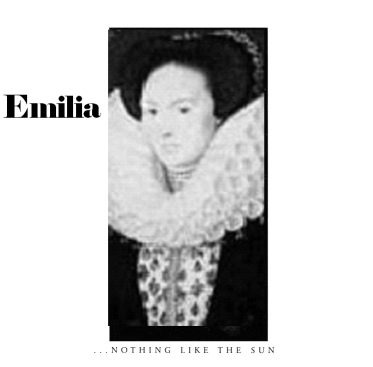
A leading solution is Emilia Bassano Lanier. Like a lot of Elizabethans, a fascinating character of which only scattered but intriguing facts are known. She may have been Jewish, North African, or Italian. Family described as “black” in Elizabethan times. Had connections to the same theater and artistic world that Shakespeare did in London. Musical family. Her father helped Queen Elizabeth with her lute when she was a young girl. Emilia wrote the first book of poetry published by an Englishwoman, and she seems remarkably independent and kick-ass. She even makes it onto the lists of the people who “really wrote Shakespeare.”

Nicholas Hillard possible Emily_Bassano
This may be a portrait of Emilia Bassano Lanier

Shakespeare wouldn’t be the first writer to use a person they knew as a model for a literary character as an in-joke that his crowd would get, or just as a handy way to gather a matrix of characteristics. And yes, Shakespeare and Lanier might have been a thing.

It’s fairly clear that Sonnet 130 is another answer record/dis cut like our dueling shepherd poems from the same era. However biographical or invented, the poet is telling us that as far as his love is concerned, all the bullcrack about white skin, golden hair, and rosey cheeks doesn’t get his motor running. There is that breath “reeks” thing in his poem, but I’m not sure it was automatically funky in Shakespeare’s time. The word comes from the Middle English word for smoke or steam—so not necessarily stinky breath, just not literally like perfume.

Elsewhere in the “Dark Lady” sonnets Shakespeare praises “black beauty.” Was the Dark Lady Black in the modern sense of the term? I don’t know if we can say for sure. Sub-Saharan Africans were in England in those times, including a trumpeter who was part of Elizabeth’s father’s court.

Meeting of Henry VIII and King Francis 1 c1520 with John Blanke shown

Birth of the Crewel? Henry VIII and the king of France take in a WWF tag team match.
In the upper left of this tapestry, on trumpet, is John Blanke, also spelled Blak

Was Shakespeare “answering” one particular poem? One doesn’t have to look far for targets, but some point to a poem set to music by William Byrd “Of Gold All Burnished:”

Of gold all burnished, brighter than sunbeams,
Were those curled locks upon her noble head
Whose deep conceits my true deserving fled.
Wherefore mine eyes such store of tears outstreams.
Her eyes, fair stars ; her red, like damask rose ;
White, silver shine of moon on crystal stream ;
Her beauty perfect, whereon fancies dream.
Her lips are rubies ; teeth, of pearls two rows.
Her breath more sweet than perfect amber is ;
Her years in prime ; and nothing doth she want
That might draw gods from heaven to further bliss.
Of all things perfect this I most complain,
Her heart is rock, made all of adamant.
Gifts all delight, this last doth only pain.

The poem’s 9th line might be a mondegreen, as it makes sense if the last words aren’t “amber is,” but the perfume “ambergris.” Who wrote the words? That’s not stated in the book which published Byrd’s piece in 1589, but a modern musician and relative of Emilia has put forth the idea it’s a poem by Emilia Bassano Lanier, though I can’t access any cite for his evidence.

Maybe I should have tried to make a lute sound here for the music, but it’s 12-string guitar, bass, a small string section and just a bit of recorder back in the mix for Sonnet 130. To hear it, use the player.

Already a Broken Heart

Are there more poems about love than any other topic? I’ve done no study, but I think that’s likely.

Now, are the majority of the most prestigious poems about love? I strongly suspect they are not. If one looks at the top of the list compiled from mostly American modern poetry anthologies completed by Emily Temple for LitHub, less than a quarter are love poems—and this is so even if one loosely counts poems like “Prufrock” as love songs on the misdirection of the title.

Another thing I would expect to find, if one focusses on the poems concerning love, is that most that remain are about how love has gone wrong.

Perhaps that can be laid to the principle in Tolstoy’s famous line about families “Happy families are all alike; every unhappy family is unhappy in its own way.” Perhaps there is more varied material in love’s absences and discontents.

The Lovers by René Magritte

Why yes, I agree these pillowcases seem to have adequately high thread count, but I was shopping for a duvet cover.


Can this relative rarity have other causes? Could it also be that it’s harder to write a good love poem? Mere gushing has its limits, as true as it may be to love’s initiation. Honest love poems have their dangers, as they ride on a delicate balance point. My favorite episode of the BBC Elizabethan-era sitcom “Upstart Crow” has Shakespeare trying to explain that sonnet 130 “My mistress’ eyes are nothing like the sun” is a good love poem. Sitcom Shakespeare explains:

“Conventionally, love sonnets are ridiculously flattering. They make absurdly overblown claims for the beauty of their subjects. Well, we wouldn’t want that, would we? The love I show you in my startlingly innovative 130th sonnet is greater, because it recognizes your flaws.”

“Next time bring me sweets.”

No spoilers here. “Who The Bard! Me the Bard!”


And then there’s the episode’s ending when Kit Marlowe defends Shakespeare on a morals charge with a surprising legal defense. I won’t spoil that.

“Already a Broken Heart”  is my own attempt at an honest love poem/love song. If even sitcom Shakespeare has troubles with honest love sonnets, I won’t claim success. Furthermore, I’m hesitant about the performance, as I’m asking my singing voice, the only one I have available in my production process, to do things it’s not good at. Sometimes I hear it as honest, and other times I hear it as insufficient. A better singer or singers could do much more with this.

Use the player below to hear “Already a Broken Heart.”