Madame Sosostris

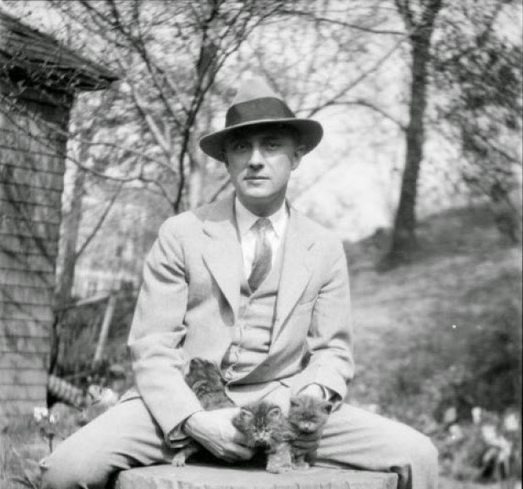
Look at a picture of T. S. Eliot. Chances are you’ll see a proper English gentleman looking back at you. You might suspect a teacher, or if not that, a bank officer. By the time he wrote “The Waste Land”  he’d been both, and the later job was considered by some in the Modernist circle a small scandal from which he needed to be rescued. Respectable, English, settled—you would trust him with your money or your child’s education.

T S Eliot looking very donish

T. S. Eliot in costume to play Harry Potter’s great-grandfather


Eventually Eliot became a British citizen, a confirmed Anglican Church believer, and a canonized poetic figure. So that man in the picture is what he intended to become. But the man who wrote “The Waste Land” wasn’t him yet, even if he could dress up as him for a portrait. What he was, was a thirtysomething American trying to engage a European culture that itself was now refugee after an unprecedented World War, a man also in a disastrous marriage and suffering from “doctor’s orders” depression.

Except for the World War part, one could, from some standpoints, look at this and file Eliot’s situation under “first-world problems, see also: middle-class white male.” And while WWI had profoundly changed Europe, Eliot seems to not have had any direct experience with the war, unlike many of the Modernist circle, so you could add to that “survivor’s guilt.” Let’s just center in on that depression part. That’s apropos, depressives are often told that their real situation is not as bad as all that.

I’ll blindly wager that many, probably most, reading this have suffered at some time from depression. Considered as a disease or syndrome, it’s a very common one, like aging or pregnancy—it’s not some rare, god-sent, lightning strike calamity. Yet, that’s not how it’s most often experienced. A depressed person feels trapped in themselves. One thing that is common to many in depression is the distrust of any judgement or decision. Whether it’s your own, or some outside others’, whether it’s a judgment of praise or damnation, you distrust that it’s true and fear that it is.

The Hanged Man

Is he being punished, or just looking at the world another way?


As we reach the “Madame Sosostris” section of “The Waste Land”  we meet a fortune teller, a line of work that should be helpful to one in this depressive trap. In Eliot’s intended scheme for the poem, she serves as a Deus ex Machina to introduce, as part of a pseudo Tarot card reading, some mythological themes of the poem. But if we are to understand the emotional core of “The Waste Land,”  which is the poetic expression of a person suffering from depression, the undercutting of her authority begins right away. If Madame Sosostris is some kind of enlightened and advanced being, she’s suffering from a mundane head cold. Her patter as she reads the cards is perfunctory, only occasionally rising to the level of oracular obscurantism, and she all to quickly jumps out of her clairvoyant trance to the details of delivering some work for the comically named “Mrs. Equitone.” There’s no relief, no reliable guidance here.

To hear my performance of  “Madame Sosostris”  from T. S. Eliot’s “The Waste Land,”  use the player below. We’ll be returning to “The Waste Land”  as April, National Poetry Month (#npm2018) continues, but our next post will be celebrating a special milestone in the Parlando Project.


The Road Not Taken

As we continue our celebration of National Poetry Month (#npm2018), today we present one of America’s most loved poems, “The Road Not Taken”  by Robert Frost.

This poem is loved, but like many of our lovers, it may not be understood. We think it means, as we think they mean, what they mean to us.

Some love the poem as an endorsement of going against the tide. If an article or personal story includes the line “the road less traveled by” that will likely be the point they are making by referencing this famous poem. So common is this understanding that many people think that phrase is the title of the poem.

Some think of it as a slightly less sure poem that reflects on a common life experience. Many of us can look back at some seemingly mundane choice that we’ve made that has had far-reaching consequences in our lives: that class we took on a whim, that meeting that occurred only because we were late or went to the wrong place, that failed idea that lead to a much better one, and so on. We often love a poem that reminds us of ourselves and the common beats of our lives. We may even be flattered by that.

Robert Frost was adamant that neither of these was the poem he wrote. And if I’m to honor my mid-century teachers—all schooled in the close reading of that then only-slightly-old “New Criticism”—I’d have to say that Frost is right, that’s not the poem he wrote.

As I recounted in my presentation of one of Britain’s favorite poems, Edward Thomas’ “Adlestrop,”  Frost was attempting to make a generalized joke derived from a particular foible of his British friend.  Thomas, who Frost encouraged to become a poet, was a naturalist, and as he and Frost walked around the Cotswold countryside, Thomas was often unsure about the old and sparsely marked paths and lanes that wander through that landscape. He wanted to take Frost to the best locations to see wildlife, and when he took the wrong path, he would regret it and puzzle all the more the next time he came to a fork or crossroads.

Robert Frost against the wall

To you it’s a nature walk, to Frost it’s a way to notice your peccadillos


In the poem Frost wrote, the vacillating description of whether there is any actual difference in the roads to choose between at the time of the choice, is meant to describe the difficulty in making that decision. That’s consistent with that second reading of the poem about how seeming arbitrary decisions can have unexpected effects later. We don’t know what meetings to be late for or which whim will turn out fruitful at the time.

It’s the poem’s last stanza that sets out Frost’s poem, in place of ours, despite it ending in the two lines (“I took the one less traveled by, and that has made all the difference”) that are used to sum up the first two subjective readings. First, the conclusion revealed there is stated “with a sigh.” This is not an “I took my own path, and that’s what made me what I am today,” or an “I didn’t know it then, but that mistake was a lucky break” recollection. Those are statements of triumph or benevolent fate, and we don’t make either of those “with a sigh.” And even more subtly, there’s a trick in the two lines before the last one, “Two roads diverged in a wood, and I—I took the one less traveled by.” Did you notice it?

Perhaps the musicians, the poetic or the score-reading kind, or actors will notice it. Frost has the speaker, announcing his oh so firm and final conclusion stated from the certainty of comically exaggerated “ages and ages hence” to repeat a word. It’s almost a stutter. He doesn’t say “and I took the one less traveled by.” He says “I (pause) I took the one less traveled by.” It’s the slightest tell, isn’t it? It’s not the shouty Townshend/Daltry “why don’t you all just f-f-f-fade away,” but the speaker is still divided about what road he should have taken. Frost called the poem “The Road Not Taken”  after all, not “The Road Less Traveled.”

As it sometimes is with our lovers, we may have misunderstood what he said by misunderstanding how he said it.

Robert Frost Fear of Roads cover

Not the cover to his “More Songs about Woods and Snow”


Musically this started with an idea: do Robert Frost as if performed by the Talking Heads. I came to a fork in the road part way into recording it when it came time to add the keyboard part and I wasn’t able to lay down a part that helped the song. As a result of that choice, I didn’t really use the early David Byrne vocal mannerisms either. In the end I think it’s a clean presentation of the poem, sung. When I noticed the “I—I” thing today after recording the vocal and had finished a final mix, I went back and was pleased to find that hadn’t missed the two I’s, but then I recalled the “I, I, I, I, I!” vocal riff Byrne repeatedly interjects in “Psycho Killer”—so there’s still possible version someone could do to bring that out!

To hear the road I took with this, use the player below.

Hyacinth Girl

Since April is National Poetry Month, let us return to that April epic of  High Modernism, T. S. Eliot’s “The Waste Land.”  Readers here will know that I’ve made great use of the works of the pioneering Modernists, that generation that formed itself on both sides of the Atlantic in the years before the outbreak of WWI.

We’ll continue to talk about them later, but for now I’ll point out that one thing they all shared was a commitment to shorter works with new imagery often drawn out of immediate contemporary experience. Given how I later encountered Modernism in Mid-20th Century American schools, I have been surprised at how simple, how commonplace, were the materials they used for their fresh imagery. Subtlety and ambiguity were not forgotten, but they were not belabored.

To “make it new” in this pre-WWI era, it was often to radically simplify. If traditional poetry was referred to, it was not the grand epics or the most serious verse of the past centuries, but the highly compressed Chinese and Japanese forms, Greek lyric fragments, or vernacular verse from folk traditions.

Modernism as it mutated after WWI had no such concentration. Grand themes and grand works were once more the best goal. Allusions to tradition abounded. As High Modernism marched forward toward my own Mid-Century youth, its poetry began to take an air of post-graduate knowledge as a pre-requisite to understanding or enjoyment.

Eliot’s “The Waste Land”  is a landmark for this change. I’m not an Eliot scholar. I won’t presume to psychoanalyze him accurately at the biographic point where he wrote this, with some key editorial re-shaping by Ezra Pound. As I said when I presented the opening section of “The Wasteland”  here last April, the poem is clearly informed by personal depression. Since a large percentage of contemporary people have experienced depression and grappled with it, parts of “The Waste Land”  communicate with us on an emotional, associative level even if we don’t understand it in a “pass the exam” way. This is good for the poem.

T S Eliot at the blackboard

I’ll show you fear in a handful of chalk dust! Evidence of T. S. Eliot trying to invent Sudoku.


Eliot’s complex, even maddening, use of distancing tactics in “The Waste Land:”   the rapid dislocation of location, time, speakers, and national language, along with a plan to make everything a possible reference to something else—usually something old and not mundanely immediate—is not at all like the pre-WWI Modernists. Still, that didn’t keep that sort of older Modernist style from breaking in every so often.

Today’s piece “Hyacinth Girl”  is one such part of “The Waste Land.”  If it had been presented as a standalone poem in one of the early Imagist anthologies it would have fit right in. There’s no post-graduate work necessary here, as was demonstrated by an 80s college-rock band who conceptionally used the same trope with no need for footnotes.

Not Eliot’s, nor my “Hyacinth Girl,” and not Winter Hours’ either. This is the original version by Ward 8, a predecessor band that make it sound more like the Velvet Underground.

Studied academically and considered as a part of the rest of the poem, Eliot’s “Hyacinth Girl” section needs not to be experienced this way, directly. One can consider any intended connection to the Greek myth of Apollo and Hyacinth and their tragic Frisbee accident with homoerotic overtones. I did so just yesterday, reading some papers and summaries of papers which if nothing else made me conscious of how often gender is unknown and shifting in “The Waste Land”—but I did this long after recording my performance of “Hyacinth Girl.”  I didn’t feel the need to revise it in the light of the papers or the classical reference, no more than I needed to know if it refers to Eliot’s girlfriend, or his wife, or a young man who was killed in WWI. Pound had once said that the image is “that which presents an intellectual and emotional complex in an instant of time.”  Eliot seemed unsure that it should be only that, if that was enough, which lead him and Modernist poetry to some strange places and practices, but it didn’t stop such direct poetry from breaking into “The Waste Land’s”   manifesto of High Modernism.

To hear my performance of this part of Eliot’s “The Waste Land,”  use the player below or with this highlighted hyperlink with will open a new tab window and play it. It starts out with just acoustic guitar and voice, but eventually some bass, strings and piano arrive. What would additional parts of “The Waste Land”  sound like if combined with eclectic original music? Stick around during #npm2018 as we’ll be letting you find out.


.

Introducing National Poetry Month to Music

Here’s what we do here, usually a couple times a week: we combine original music written for the occasion with some words, which are usually poetry someone else has written.

Of course, poetry. The compression of poetry lets us fit the words into shorter pieces and leave room for some notes. And, of course music, because every poem has a music within it, even when hidden, that wants to come out.

There are lots of ways to do this, and we do many of them. The reader will speak the words, sing the words, chant the words. The music can be simple spontaneous band recordings or more elaborate compositions recorded a track at a time until the larger sound-field is filled in.

There’s something about that push and pull of combining words that want to sing with music that wants to say something. Even when I’m doing it casually and off the cuff as a musician or a reader, I can feel the two parts wanting to connect, asking to connect, demanding that the other half listen!

If you look at the over 190 audio pieces we’ve already published here you’ll see that we don’t usually feature our own words, though Dave and I have written poetry for decades. Even when we do use something we’ve written, it’s usually about someone else.

There is nothing intrinsically wrong with poetry about your own experience, but I’ve often felt that something extra is felt when the poetry tries to cross that gap from one person’s head to another person’s lips—that kiss you feel with the momentary connection that begs you to find its meaning. And music too, created silently inside the shadowed choir-loft of a musician’s head, becomes itself only when touching a little membrane of sensitive skin inside another’s ear before it can become part of the dancing bones.

krimmel-quilting-frolic-1813

The Internet’s shown up with poetry again, and there’s them musicians with’em this time!


Using other people’s stories, other people’s words—this lets us experience the poems with you. Encountering poetry with music lets us meet them with only the expectation that something will happen.

I’m planning to present more audio pieces here during April’s National Poetry Month (#npm2018) than ever before, so check back often. And don’t forget there are lots of poems with differing music, from the most familiar to the unknown, already here in our archives to check out.

When Lilacs Last in the Dooryard Bloom’d

We’re about to begin April’s National Poetry Month in the U. S., but I’m going to begin celebrating #NPM2018 today with a piece that’s a good way to start things off, the opening two sections of Walt Whitman’s “When Lilacs Last in the Dooryard Bloom’d.”

Large-Blue-RGB-National-Poetry-Month-Logo
We’re aiming to present even more audio pieces than usual this April
Use the Follow button to make sure you get a notice as they drop


National Poetry Month isn’t just for American poems or for American poets, but if it was, Whitman would be all the more inescapable. In the middle of the 19th Century, he and Emily Dickinson forged two original styles whose sounds and tactics can still be found in contemporary verse—Dickinson, with small lines in small poems that bind-up with puzzles immensities; Whitman with long lines and epic poems that offer a catalog of exultation. One sees a single, small thing and says it represents the universe, the other beholds the diversity of the world and says it’s really one thing. Complementary opposites.

Both were working at a prodigious pace during the 1860s, during America’s great Civil War. On April 14th of 1865 Abraham Lincoln, the US President during that war, was shot. The next day he died. Within weeks Whitman had produced the first published version of this poem along with other poems about Lincoln and the ending of the Civil War which he published as “Drum Taps.”  It would not be like Whitman to hold his thoughts on those great events inside. In contrast, Tennyson’s epic elegy on the death of a beloved friend, “In Memoriam”  took him more than 15 years before he published it.

At over 200 lines in its entirety, “When Lilacs Last in the Dooryard Bloom’d,”  taken as a whole, would exceed my usual mode here. I prefer my audio pieces more the length of the 45 RPM single records of my youth. So today, I present only the first two sections of Whitman’s poem. Whitman’s voice changes over the course of this long poem, but in these opening sections Whitman (albeit in free verse) is sounding somewhat like the poets his modernism would break from. Save for the absence of rhyme, his language here would not sound out of place in Tennyson (or even the earlier Romantics, like the Shelley of “Adonais.”)

Whitman's Parent's House

Is this the dooryard? Whitman was visiting his mother’s house when he heard Lincoln had died.
He stepped outside and saw the spring lilacs in bloom.


I did the same thing, presenting only the intro section, last April for the poem I believe is most responsible for April being National Poetry Month, T. S. Eliot’s The Wasteland,”  which begins memorably “April is the cruelest month…” Those that can finish that first sentence may recall it continues “Breeding lilacs out of the dead land.” So, Whitman’s elegy and Eliot’s poetic apotheosis of High-Modernism written over 50 years later, both begin in April, and with lilacs.

We’ll be revisiting territories in “The Wasteland”  later this April, but today you can start where Whitman started his poem, and from where Eliot got some of his inspiration for his. Musically, this one is fairly simple, but I hope effective: acoustic guitar and piano with a little low synthesizer groan eventually joining in. Use the player below to hear it.


Side-Walks

Here’s a tribute to a couple of other American originals who are inspirational to this Project.

“Side-Walks”  is the second piece here using words taken from a Laurie Anderson interview. In the earlier piece, Anderson was talking about how the sky of her Midwestern childhood taught her to realize that she was “nothing and everything.” Today’s words are quoted from a 2015 interview where she’s talking again about childhood, but particularly her childhood as she can revisit it in memory.

The phenomenon she talks about is extraordinarily common, while still extraordinary: the intense memory of childhood, rich enough that one feels they are experiencing it in fully dimensional, traversable, 3D space, with access to senses other than vision (such as smell and touch).

If you don’t feel you have this ability, Anderson suggests a method to engender it in her story. Although, I took this account of hers from a written interview, anyone familiar with Anderson’s speaking style from her work, may hear it in her performance voice, that slow, measured coo that never rises in intensity or volume, and varies only in a slight, auditory smile that can indicate any number of stances without determining one.

As I mentioned last time I used Laurie Anderson words, her performance voice is hypnotic, and influenced as I am, I can sort-of imitate it, but choose not to. But as I listened to this piece over and over as part of the mixing process, I began to realize that I was somewhat imitating the performance style of another influence of mine, Ken Nordine.

At some point, in another post, I’ll probably need to discuss Ken Nordine at some length, but hearing that echo, I said to myself “I bet no one has ever connected Laurie Anderson and Ken Nordine. Wait until I tell everyone about how these two unique American artists have these striking similarities!”

Ken Nordine-Laurie Anderson

Nordine and Anderson. What if I’m not a spoken-word artist, but a listening-word artist?


Because I write, my mind immediately starts writing, all in my head, all the ways their work connects. Both are native Midwesterners, who can carry that mindset to any cosmopolitan location. Both use that very even speaking style in performance, with Nordine allowing just slightly broader bemusement to sneak into his affect for contrast to Anderson’s often present, but more muted, smile. Both use music in combination with their hypnotic words, but both will choose music that is not calm, conventional “music beds.” Both love the sideways movement from one topic to another that seems alternately random and deeply meaningful, and both enjoy the shaggy-dog story conclusion that doesn’t overdetermine which.

I pop Laurie Anderson and Ken Nordine into a search engine, and find…

I’m too late. Laurie Anderson has been listening to Ken Nordine since her Chicago childhood. She’s a fan (her late partner, Lou Reed, too), and she knows Nordine influenced the development of her concepts.


Here’s a single dip into the 50 years or so of Ken Nordine’s audio pieces


Well then, let’s go back to Anderson’s story of how she can revisit a vivid childhood time, as many of us can. Her story is vivid too, even if she’s telling it off-the-cuff in an interview, not in performance, but what I found most striking were her conclusions. A couple of centuries ago, William Wordsworth wrote Intimations of Immortality from Memories of Early Childhood,”  the poem that ends with the line “Thoughts…too deep for tears.” Do we think that means, too sad for tears—and, if so, what does that mean? Or is it, as Wordsworth had it in his ode, the “meanest flower”—or as Ken Nordine and Laurie Anderson speak it, is it that smile, however broad, that is deeper?

The player for my performance of this brief story Laurie Anderson told is just below.


Conlon Nancarrow

A great deal of what you hear me play here is made possible by a 1983 invention, MIDI (Musical Instrument Digital Interface), a standard for communicating musical commands. MIDI lets me create piano parts I can’t play with my non-pianist fingers. I tell MIDI what to play, and MIDI then instantly responds by playing those notes on an instrument so I can see if they fit.

Given MIDI, I as the composer can have the equivalent of a pair or more of pianists willing to play as simply or complexly as I want them to, and not only are my MIDI pianists totally compliant, they can be preternaturally skilled as well, willing to play odd rhythmic displacements or impossible fingerings.

In the years between WWI and WWII, a young musician of no great wealth or social background was studying composition in Boston. He was said to have crossed paths with some of the giants of 20th Century music there, including Walter Piston, whose Harmony  book I once started many decades ago, and Nicolas Slonimsky whose book on scales later became a huge influence on John Coltrane and Frank Zappa.

However, the titanic forces of world events would soon sweep him away from all this. In the 1930s he joined the Abraham Lincoln Brigade, Americans who volunteered to fight the Fascist forces seeking to overthrow a republic in Spain during a war that served as a beta-test for World War II. This was a complex event, but all we need to know for our young man is that the anti-Fascist coalition was defeated, and the survivors who had fought for the Spanish Republic ended up as men without a country.

Earlier this year I was reading some 1939 writing by Herbert Read where he was appealing for support for a plan to transport these Spanish war survivors from French refugee camps to Latin America. Our young man, who’d hobnobbed with key musical theorists before becoming a “premature anti-Fascist,” soon found himself in Mexico City, perhaps as a result of this plan.

It was there our exiled young man took a technological step as a composer. He chose to write his music using “player pianos.” Player pianos, also called “reproducing pianos,” were a home entertainment fad from the era before better quality electronic recordings. An elaborate clockwork rolled a scroll of punched paper across mechanical sensors inside the piano which then drove the hammers to strike the piano strings. Scrolls of piano music, some recorded and played by the famous performers of the early 20th Century could be purchased, and when inserted into the home player piano, and played back with musical fidelity.

Our young man’s name was Conlon Nancarrow. Over the next few decades he exploited the player piano, not for parlor entertainment, but to create striking Modernist music of otherwise unplayable complexity. He was hip to new varieties of rhythm and harmony not only from other 20th Century “serious composers,” but from Jazz too—and the mathematical structures of Bach-like cannons were well suited to the looping scrolls he would punch himself. He wasn’t reproducing music someone played, he was producing music he conceived and punched into the controlling scrolls.

In the first few decades of his work Nancarrow had no funds, no grants, no copyist/assistants, no local orchestral resources to realize his musical ideas; but this one artist, a player piano, and his own score-roll punching could produce work needing only himself and his ideas to sound inside his small Mexican apartment.

Except for it’s painstaking, mechanical, cuckoo-clock handwork, what Nancarrow did is schematically like how one can use MIDI today. In a tip to this heritage, MIDI scores are still shown on the lit-up computer screen like player piano scrolls.

Nancarrow Piano Part MIDI score

“Stuck in holes which once were dots”
One of the piano parts for today’s piece shown in MIDI “piano roll” notation


In 1969, using the high-fidelity home entertainment media of its age, an LP record of Nancarrow’s works was issued on a major, well-distributed record label (Columbia, the record company of Miles Davis, Bob Dylan, and Gary Puckett and the Union Gap). That’s when I first heard him. Acclaim in avant-garde music circles, and some grants and touring followed until his death in 1997.

In some ways the typical Nancarrow piece sounds like an artist who when finding out the vast capabilities of his new technology decides to use all of them. At once. A lot. Typical tempos sound like someone playing a recording at the wrong speed—and backwards. The number of simultaneous notes can be overwhelming, the intervals jarring, the rhythms insane. It’s challenging you to understand it, and it’s not a matter if you want to, you likely cannot. As with some avant-garde music, repeated listening (if one allows it) can increase comprehension of the ideas, but Nancarrow is never going to be shoving Billy Joel off the piano bench in popularity.


“Punched polyphony in a row” A Nancarrow scroll plays.


No, the reason I wrote this to celebrate Nancarrow isn’t because I think you’ll like his music, or even because he’d figure in any Desert Island Discs episode in my future (though through castaway days one might find the time to try to untie all the knotted ideas in a Nancarrow piece). No, it’s because I admire that kind of audacity and perseverance.

I originally wrote music of an acoustic guitar “folk song” sort, even though the poem sought to make use of eccentric meters and a tricky rhyme scheme to reference some of Nancarrow’s ideas. Today’s version has new music I wrote which fits the words better. Using MIDI-controlled pianos, it’s sort of “Nancarrow-lite” musically. To hear my audio piece for “Conlon Nancarrow,”  use the player below.


I Hear an Army

Metaphors, implied or direct, are a form of an equation. If E=mc2 or 2+2=4 then should fog=little cats feet? Well, not exactly. But for some poems the metaphor, the image and “what it means,” is surprisingly equal at each side of the equals sign.

Here’s a poem that Ezra Pound included in the first Imagist anthology in 1914, written by someone we don’t normally think of as an Imagist, or even as a poet: James Joyce. While Joyce didn’t consider himself a member of the Imagist movement, his fellow Modernist Pound considered this work consistent with its principles.

Oddly, the case for Joyce as poet instead of the instigator of the modern literary short story form and the creator of increasingly avant-garde novels has been largely carried forward by folks (like me) who wish to combine words with music. The James Joyce poem I first knew, “Golden Hair,”  came to me from Pink Floyd founder Syd Barrett’s lovely setting written in the 1960s and used beautifully a decade or so ago to begin Tom Stoppard’s play “Rock’n’Roll.” Today’s words from Joyce, “I Hear an Army”  was set to a complex piano accompaniment by famed 20th Century composer Samuel Barber along with two other Joyce poems as his 1939 Three Songs” (Op. 10).”

James_Joyce_Kicks_out_the_Jams

James “Blind Boy”Joyce kicks out the jams


As words, “I Hear an Army”  is very musical (the consonance of “whirling laughter” alone is exquisite!), but that element wasn’t rated as highly by mid-20th Century critics who redefined poetry as a literature of complex and hermetic language. Still, its central image shows a bilateralism that I’d like to point out. I think most will see this first as a love song with a strong and strange metaphor of loneliness and separation from one’s beloved as feeling like the invasion of a grotesque and threatening army. Loneliness=as oppressive and overwhelming as an invading army.

But what if we reverse the equation? Is an invading army, this oncoming hoard, this force of arrogance, also like the absence of love, the sundered heart and the steeled will? Invasion, war=separation from love and our beloved—separation for not only the invaded but the invaders.

When an image can sustain this kind of bilateralism, it gains tremendous power. Maybe not mass times the speed of light squared, the force that hung over my youth, cleaving dreams, and whose blinding flame is seeking to haunt us again, but power none-the-less.

Vase or Faces

Vase or faces? Bilateralism in imagery.


Not to dis Barber, a giant, but I think there’s room for a different way to present “I Hear an Army”  combined with music. If you use the player below, you’ll hear my original music for this, not Barber’s. Some take the Barber at rapid tempo, horses at full gallop. I don’t have a score to say what guidance Barber gave for that, but there’s a power in slowing dread—after all it’s a cinematic cliché to show an onrushing threat in slow-motion.

My predominant accompaniment for “I Hear an Army”  is a vocal chorus using different vocal timbres, including a low part using Himalayan Tuvan throat singing where two pitches are sung simultaneously. Other than the two short rock band interludes, the only “instrument” used is electric bass.


Ruined Refrigerator

Cleverness in poetry or writing can be a mixed blessing. While poetry without cleverness can be bland and unexciting, poetry with too much of it can seem a show-offy exercise exhibiting the most exorbitant self in self-expression.

Unlike my pleasant puzzlement with H. D.’s “The Pool”  last time, I can speak with authority about the author’s intent on today’s piece “Ruined Refrigerator,”  because I wrote this set of words. A short aside for those that are new here: this isn’t the way the Parlando Project generally works, we’re normally about “Other people’s stories,” our audio encounters with other author’s words.

But since I wrote this I can say a bit about how this worked with “Ruined Refrigerator.”  This started out as a sonnet I wrote in 1978. I’ve always been attracted to the 14-liner. It’s just about the perfect size to develop a point with a turn or even two, while still asking for concision. The 14 lines can be divided in many eccentric ways into stanzas, sections, and rhyme schemes. And since Shakespeare used it for his best poetry, you have a mighty model to measure up against.

The problem with the sonnet and Shakespeare as a model is that it can fall into clever complexity. Shakespeare was intoxicated with flowery language, language that loves using extra words and similes to express itself. Given the youthful vigor of the mostly modern English of Shakespeare’s day, and Shakespeare’s genius, this is not as tiresome in his best poems as it would too often be in those that were written after him.

Artists already have too much to worry about, but perhaps we should be more careful when we invent something, as any imitators will exploit all the faults in the invention—and so, eventually Shakespeare’s poetics can descend into “poetic language” that violates the call to concision that lyric poetry should heed, and to merely clever works that exercise the skills but not the aims and ends of great poetry.

I can tell you that as an author, writing clever poetry is great fun. Finding what you believe is a new way to say something is wonderful. Engaging in the music of thought where a theme emerges in a surprising and even mysterious way is as great a joy in words as it is when composing music. Fitting the stuff of a poem into the puzzle of meter and rhyme and stanza forms takes effort, but like any number of enjoyable crafts, it’s satisfying. The dance of metaphor as it leaps back and forth from the compared thing to the thing can feel in creation almost God-like.

These things have degrees of difficulty and achievement, yes, but the greater difficulty is engaging an audience for them. What is enjoyable and satisfying to the author is not necessarily the same to the reader or listener. Too little cleverness and the result is bland, too much and the reader will decide: too much effort for too little reward. Or they may read on and decide that it’s much ado about nothing. What the author thinks is clever, based on their effort and self-evaluation, seems mundane to the more sophisticated reader or obtusely obscure to the naïve one. Audiences don’t love or hate cleverness, they just want it to be worth their while.

were_only_in_it_for_the_money_bottom

Subliminal inspiration? Lower section the “We’re Only In It for the Money” album cover
created by Calvin Schenkel, Frank Zappa and Jerry Schatzberg 1967.


“Ruined Refrigerator”  may suffer from these issues, from failed attempts at cleverness. I wrote a complete draft around 40 years ago*, and I must have liked the “deep ecology” idea enough that I revised it 15 years ago. So far (small) audiences haven’t cared for it much. Maybe that’s my failing, or maybe it’s the audiences’—though I believe the audiences were good ones. Maybe on the first day of spring in a time when global warming is on more minds this will make more of a connection?

As an artist, you can negotiate a treaty with that failure, knowing that all artists fail—sometimes, depending on the audience. Artists can succeed with some audiences by making the choices that will certainly cause them to fail with others. One can always choose to fail better or differently. The important thing is to try, in the way you think best to try.

Here’s my performance and try of “Ruined Refrigerator.”


*A note on the 2004 draft I have of this says the first draft (lost) was from 1978. But I also recall stealing the germ of the idea from a Gary Larson “The Far Side” one-panel cartoon, though I have not been able to find that cartoon, and “The Far Side” was first published in 1980.

London between snows

One more post where we slide the Parlando Project and “other people’s stories” to the side and become more like a conventional blog. Last night in London was a blustery snow squall, but as Minnesotans who know that the Theater of the Seasons plays in Repertory, we were up and around throughout the day. Our target was the area around the Strand and Trafalgar Square to hit the National Gallery. We really only struck Trafalgar Square a glancing blow, though it seems an impressive urban plaza. As we approached through the flakes and gusts, I pointed to the back of the column and asked my wife why they had a monument to Captain Crunch here.

Admiral or Captain

Nelson’s Column in Trafalgar Square, and close up of the statue at the top


Faux-naïve humor aside, some of the best parts of the day were the little things. As we passed a small library I saw a poster in the window about Sylvia Pankhurst, the most radical of that suffragette clan. Inside was a small exhibit detailing the middle of her career in anarcho-syndicalist circles which lead her to a steadfast effort to warn against the rise of Italian Fascism in the years between the wars. Some of the exhibit showed the efforts to extend Fascism to Britain through local London groups, which included the information that the library building itself had been formerly the headquarters hall of the Italian Fascist organization.

Shortly after entering the National Gallery we noticed these mock Roman mosaics on the floor leading into the central gallery. At first glance, one assumed they’d be the sort of stolid decoration museums are known for—but wait, is that Bertram Russell? Winston Churchill? Turns out they are a set of witty between-the-wars comments on the modern virtues. “Don’t tread on Gretta Garbo…” sings Ray Davies in my mind.

Lucidity with Bertram Russell

Lucidity on the ground in mosaics


We’d come for a Pre-Raphaelite exhibit which showed how much these original hipsters loved to put mirrors, particularly convex mirrors, in their paintings. At the exhibit I learned that the art Academy the PRB bros rebelled against had been in a wing of the National Gallery building, a museum then full of the lush late Renaissance paintings loved by the 19th Century. As young rebels are wont to do, they instead looked to the earlier painters with their sharp Colorforms palette.

We took a side-trip down the Strand until we came upon the Savoy Theater and then the grand Savoy Hotel. Our bootheels had to do some wandering, but, sure enough, we found the alley where the “Don’t Look Back”-“Subterranean Homesick Blues” was filmed, and where more than a hundred years earlier William Blake had lived and worked on his Dante “Divine Comedy” etchings as he lay dying. We couldn’t see the Thames to confirm if flowed like gold, what with all the buildings the years put there between Blake’s place and the river, but you could still see Dylan and Allen Ginsberg standing in that alley.

The Savoy Alley yesterday and today

Click the link in this caption to learn more about Angels in the Alley by the Savoy Hotel


That evening we went to a mostly Mozart concert at Saint Martins in the Field, which was fine. Now that I actually try to write string parts and play them via virtual instruments, it was nice to see hands play the articulations from a front-row seat. But, before the concert, we ate at “The Crypt” beneath the church, which is not just a goth-sounding marketing name, but the actual crypt, complete with grave markers. My wife wandered about the area, reading the grave markers, noting one for a five-year-old child.

Everything in the past is beneath and beside us. Everything in the future is too, but we cannot see nor feel it yet.