Dream Big

There’s an old joke that goes like this:

Alarmed Customer: What’s a fly doing in my soup?

Waiter: I believe that’s the backstroke sir.

Part of the humor here derives from the order brought to the chaotic event of an insect in the diner’s food. The waiter is able to observe the fly and classify its actions from an altogether different perspective. And the rest of the humor comes from the waiter willfully, or otherwise, misunderstanding the customer’s complaint as a mooted question.

Rhythm, a primary component of music and poetry, shares that ability to reshape chaos. The day after I saw the Emily Dickinson film biography “A Quiet Passion”  I returned to the same theater complex to see Chasing the Trane,” a documentary about musician John Coltrane, a man whose work and life story has carried me across many a low place. You could predict most of the talking heads (what director Warren Beatty once called, perceptively, “witnesses” in his John Reed biopic “Reds”)  that appeared in the Coltrane film. Coltrane’s children talk about their parents. Winton Marsalis and Cornell West are obligatory we suppose. A pair of Coltrane biographers chip in their perspective. The surviving members of Coltrane’s great combos, Reggie Workman and McCoy Tyner, talk briefly. Sonny Rollins, Coltrane’s great contemporary, and Benny Golson, a musician who first knew John Coltrane as a fellow teenager in Philadelphia, are especially insightful.

And then John Densmore, the drummer from the 60’s rock group The Doors speaks. OK, I can hear a few saying “What’s he doing in a John Coltrane biography?”

The answer is: swimming in the rhythm of Elvin Jones (the great drummer of Coltrane’s greatest band). Like the original Homer who wrote our fly in the soup joke, Elvin Jones could converse with whatever new melody, whatever mistaken-for-mere-chaos invention, that John Coltrane or Eric Dolphy could invoke. Densmore watched him do that on the bandstand closely, and then applied what he learned when he later was called to add order to the Dionysian deconstructions of The Doors’ lead singer, Jim Morrison, a man who had the touch of a poet quickly smothered by drink, drugs, and uncharted celebrity.

Densmore’s part in the film is to add to the thought that John Coltrane lived as if  he could converse with the universe and approach its Creator with what he had heard from it. Densmore’s addition: but it’s the drummer that is the witness that this is happening now, in the time we are all beating. Coltrane may swim out in the tide of the cosmos, but Elvin Jones knows what stroke he’s swimming.

John Coltrane and Elvin Jones

Elvin Jones and John Coltrane: a conversation with infinity and time


I call today’s audio piece “Dream Big!”  June is the month of graduations and their obligatory talking heads delivering commencement addresses, most of them deputizing themselves as present-day Ralph Waldo Emersons with mature advice for the audience. However, “Dream Big!”  doesn’t present the tale from some sundry gray eminence—instead it has some words from a young man, the British musician Kiran Leonard, who asks us to look at the dream of Herman Sörgel.

Kiran Leonard

Kiran Leonard: quiet is the opposite of thoughtful

Kiran Leonard’s music takes several forms and may still be forming, but his words that I adapted for use with my music in “Dream Big” were taken not from a song, but from a short statement broadcast by the BBC. In it, Leonard uses Sörgel to encourage us to take on creative projects we think are beyond us. Good advice for young people—but I also took it as good advice for this old man as I started the Parlando Project in 2016, and needed to contact some hopeful audacity. And now, this week, as I am readying this post, I need John Coltrane and Herman Sörgel, Emerson and Kiran Leonard levels of such hope as I mourn the needless death of a young man and our pretentions that we can do nothing about it.

To hear more of Kiran Leonard’s music you can see this live set from last year here, or view the promotional videos for songs from recent albums here and here, or read this interview/introduction/review. To hear my performance of “Dream Big!”  use the player below.


Her Final Summer Was It

I got to see the Emily Dickenson biopic A Quiet Passion”  this month. I can recommend it with a warning: this is not a work that intends to be friendly or easy to digest. It does present a reasonable estimation of what may have made up Dickinson’s life experience, showing it with enough detail to be (for me) very moving. However, it also tries to show the intellectual ferment of Dickinson’s time in a very strange way, by spending a fair amount of the movie’s running time having people converse with each other in an extended series of Oscar Wildean epigrams.

A-Quiet-Passion

This movie has no car chases or flying magician CGI battles

 
Of course, I have no way of knowing how people spoke in 1860 Amherst Massachusetts, but I doubt they spoke like this: epigram after epigram, back and forth like a free-style 19th-Century rap battle. What I guess the director/screenwriter is trying to do is give us some sense of Dickinson’s mind and the minds of others she paid attention to—Dickinson’s poetry is full of epigrams and busted epigrams after all. What he does is artificial, but then having folks read Emerson or other Transcendentalists out loud would be artificial too.
 
Another part that is harrowing is the time spent on the routines of death and dying in her time. Given Dickinson’s own gothic tendencies, this is not only defensible, it may be indispensable in conveying her outlook. And Cynthia Nixon’s performance as Dickinson is very very good.

So go see “A Quiet Passion”  if you would be interested in a portrayal of a what Dickinson may have been like as a person and what drove her as an artist. But do not go to see it if you want a friendly, straightforward introductory film biography that would introduce you a writer you have not yet committed your interest to.
 
For once I’m happy that this is a long preamble to today’s piece, Emily Dickinson’s “Her Final Summer Was It,”  because I do not really want to talk much about the work itself, as I don’t think I can speak a well as Dickinson’s own sparse words. I found in it great resonance to my own experience, particularly a summer 16 years ago—but as with all things we present here, the intent is not to dwell on my own life, but to connect to and impact yours. I hope I do the work justice.

Her Final Summer was it MS

Dickinson’s own hand-written manuscript of “Her final Summer was it”

You can hear my performance of “Her Final Summer Was It”  by using the player below. If you’d like to hear other Emily Dickinson pieces interpreted by the Parlando Project, we have done four other Dickinson poems with music here.

Sonnet 18

We’ve made it to more than 90 posts into the Parlando Project without doing any Shakespeare, which I believe may be some kind of record. It’s not an intentional slight, it’s just that we’ve been busy with other words.

I grew up in a little Iowa town named Stratford, the same name as Shakespeare’s birthplace, and this coincidence instituted by land speculators a hundred years or so before, impressed on me the importance of poetry. This was not the only misapprehension of my youth, but it was long lasting one, as here I am countless decades later, delighting in words being costumed in music.

Avon RiverBoone River

Two summer’s days: one of these is the Avon river through the forest of Arden in England,
and the other is the Boone river near Stratford Iowa in the U.S.


Today’s episode uses the words from Shakespeare’s Sonnet 18, “Shall I compare thee to a summer’s day.”  Like many Shakespeare pieces, there are lots of performances of it around, which is one the of the values of Shakespeare—you can contrast your performance against others. Many performers of Sonnet 18  like emphasize the wit in it; and wit there is, with it twisting around the idea of comparing one’s beloved with the beauties of nature, which is developed further as the idea that the inconstancies of nature necessarily include aging and death.

Others like to embody the sensual in the poem, the lush language. The third line ends with “the darling buds of May,” a phrase, good enough to be swiped for the name of a fine Welsh 90’s indie-rock band. I don’t think you can escape from that musical language. The entire second quatrain uses near and exact rhymes for each line, a sound that rubs and slides against the ear.

I made two choices in emphasis that differ from others. First, I wanted to bring out the brag in this. The speaker in this poem, who the author is at the least pretending to be, is claiming that he can make his beloved immortal by the power of his verse. No small claim—but in Shakespeare’s case, it’s not bragging if you can do it. And to add to the swagger, I stressed the beat a bit more than I might usually. I made the speaker a little less coy, a little less playful, and little more assured that he’s more than the “upstart crow” that he was seen as by some early in his career when he was writing his sonnets.

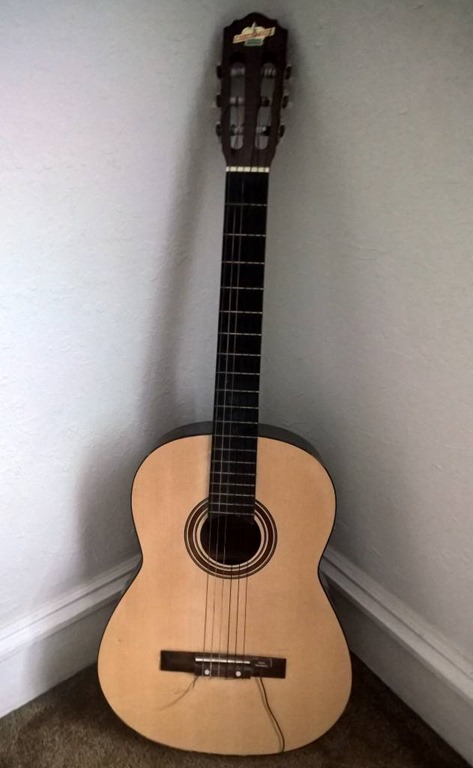
Musically I declined to use my main instrument, the guitar, this time. Once I had the drums and bass down, I thought they were enough to support the words on their own, so I added only some scattered piano chords to help outline the harmony.

To hear my performance of Shakespeare’s “Sonnet 18, Shall I compare thee to a summer’s day”  use the audio player that appears below. Today’s piece is quite short, less than two minutes long, so it’s a good way to sample what the Parlando Project is doing. If you like it, we have more than 90 other audio pieces available here using various words combined with various music.


A Summers Night

A couple of posts back we had a piece with words by Roy G. Dandridge who got called the “Paul Laurence Dunbar of Cincinnati.” Today’s episode’s words are by the Paul Laurence Dunbar of Paul Laurence Dunbar.

paul-laurence-dunbar

Paul Laurence Dunbar. Young, Gifted, and Black.

Dunbar grew up in Dayton Ohio, the Afro-American son of former slaves. In his town’s high school class of 1890, he was friends with another guy, a white guy, one who had varied enthusiasms. This other guy was a snappy dresser for his time, wearing newfangled wing-tip shoes, bowler hats, and a sporting a dashing waxed handlebar moustache. When the mandolin had a popularity boom, Dunbar’s classmate dude had to learn to play it, and he apparently drove his family around the bend as he practiced. Then later, the dude became interested in printing, and so designed and built his own printing press. He got so attached to printing and publishing that he dropped out of high school to start his own print shop with his brother. Then a couple of years later, the modern bicycle was invented, and his mechanical ability branched out to building, selling, and repairing bikes.

Dayton HS class of 1880 labeled

Dunbar with his high school class. Dunbar is in the upper left, our mystery dude in the shadows in the back.
And what’s with the guy on the left in the front row, shouldn’t he be in a band or something?

But let’s step back to that printing business. Paul Laurence Dunbar was already writing poetry as a high school student. After graduation, his family’s lack of funds and racial discrimination kept him from going to college, but he hungered to get into print. Our dandy, mandolin playing, designed-and-made-his-own-press print shop guy went into business with Dunbar and printed a newspaper that Dunbar edited and wrote for, even while Dunbar was still in high school–and then he used his connections in the business to get his classmate’s poems collected and published two years after Dunbar graduated from high school.

Dunbar’s books gathered attention. James Witcomb Riley, Frederick Douglass and William Dean Howells reviewed him favorably. By the end of the 19th century he had toured England, gotten a job with the Library of Congress, and written the lyrics for a Broadway musical and collaborated on an operetta, becoming the first widely known modern Afro-American poet before he was 30 years old. The 20th Century awaited him.

Then he contracted tuberculosis. His health declined, and though he tried to continue to build on his career, he died in 1906 at the age of 33.

He should have been one the older generation of the Harlem Renaissance of the 1920s. He could have taken his mastery of the lyrical 19th century style, and like Yeats in Ireland, transitioned seamlessly into the forms and topics of modernist poetry.  Alas, none of that was to be.
 

Dunbar’s “A Summer’s Night”  is a lovely, sensuous lyric. If one goes beyond the Victorian-drenched term “maiden” used almost as a refrain in the opening lines, and the slightly precious “perfumed bosom” of the southern breeze that closes the first half of the poem, the flitting last half that closes with carousing fireflies staggering home in the dark is just gorgeous It’s my hope that using our Parlando Project tactic of performing these words with music lets one more easily accept the sentiment of the more archaic words.
 
So, what happened to our mechanical aptitude dude, the guy who’s printing press began printing Paul Laurence Dunbar while they were High School classmates, helping launch the career of America’s first widely known modern black poet?

Wright Bike

This bike looks pretty sweet even today. Dig the mono-tube rear stay, the tri-plane front fork, and the flipped moustache bars.

Turns out bicycles were one of the seed technologies of the 20th century. Our dude knew how fabricate his own stuff, and make it strong and light. The dude was named Orville Wright and he and his brother Wilbur took the modest profits from their printing and bike businesses, and three years before Dunbar died, they designed, built and flew the first airplane. There was a lot of disbelief that a high-school dropout from a hick town could do any such thing. Pioneers like Paul Laurence Dunbar and Orville Wright had to do it,  otherwise no one would believe it.

To hear my performance of Paul Laurence Dunbar’s “A Summer’s Night”  with music, use the player below. And thanks again for liking, following, and sharing.

Adlestrop

Remember that “Reverse British Invasion” that happened 50 years before the Beatles landed in New York in 1964, when American modernist poets landed in London just before the outbreak of WWI?

One of those American poets was Robert Frost, and he soon struck up a friendship with an British writer Edward Thomas. Thomas was in his mid-30s by then, and he was writing this and that for whoever would pay, but he was not writing poetry. Frost and Thomas enjoyed walks about the Cotswolds together. Frost was encouraging Thomas to write poetry. On his part, on the walks Thomas would often puzzle at which country lane to take a crossroads, and Frost noted that.

Last summer I had the opportunity to take my own ramble about the Cotswolds with my wife. My itinerary was mixture of bicycling with some linkages between sections via train. During the biking part of the journey we often found ourselves lost. Just as with Thomas and Frost back in 1914, there seemed to be few straightforward crossroads and few road makers on the country lanes.  It was the hottest summer week in recent record in England that year, and at one train station stop the arrival of our train kept falling farther and farther back off-schedule as the trains were slowed and sometimes stopped by the fear that the heat would buckle the rails.

Well there was nothing we could do about it. We spent the next hours just sitting in the Kingham railway station in the heat we were somewhat accustomed to, watching the wind play with the trees and foliage, listening to the birds.

Kingham rail station

A few hours listening to the trees, breeze and birds at Kingham


This month in 1914, Edward Thomas had a train ride that stopped “unwontedly” in at the small Cotswold village of Adlestrop. Despite being a beginner at poetry, Thomas seemed to immediately grasp the modernist concepts, perhaps because he had no outmoded Georgian and Victorian habits to break.  His June experience lead him to write today’s piece, named after this village rail stop: “Adlestrop.”

adlestrop station sign

No rail stop in Adlestrop today, just this sign and bench remain. The present stop in Kingham is 3 miles away.


Thomas’ “Adelstrop”  has most of the markers of a modernist poem as Frost was writing them. It’s metrical, but not so strictly as to call to much attention to that. It’s rhymed, but again, the rhymes are not showy. There are no “hey look at me, I’m a clever simile or metaphor for something” tropes. In the place of that is the clean presentation of an exactly observed moment in time, peaceful, off the clock, yet clearly set in a time when the countryside’s nature and the train were in equilibrium. Thomas didn’t know it, but the moment in the poem gathered context after he wrote it, his village train-stop happened only a few weeks before WWI broke out, and England and Europe would be changed forever.

Robert Frost had returned to America, but he sent his friend a poem he had just written, one that was inspired by their Cotswold walks together, The Road Not Taken.”   Frost’s poem famously ends with the lines:

Two roads diverged in a wood, and I—

I took the one less traveled by,

And that has made all the difference.

It’s been Frost’s fate that his irony and dry wit, as well as his uncompromising assessment of human nature, has often been missed by his readers. I first read “The Road Not Taken”  and thought, as do many to this day, that this was a simple homily— a boast that taking one’s own, perhaps less popular path, is the road to success and happiness. But read again, more closely, Frost was gently making fun of his friend’s indecision, Thomas’ puzzling at if there are meaningful differences between the two choices in their rambles.

Thomas, though himself a discerning poet, missed Frost’s intent as well. He thought it was reminder of the necessity of making correct decisions, and he warned his friend that readers would misunderstand it. At the same time, Thomas was mulling his decision regarding enlistment in the British army, which was grinding up men at a prodigious rate against the weapons of modernist war. He enlisted, and within a few weeks of deployment in France, he was killed by a bullet through the chest.

Sometimes when I compose music for one of these pieces, I find at the end that I have written something that reminds me of another piece of music, one I can’t quite place. Often when I solve this internal puzzle there is a mysterious connection revealed. The music I played and recorded for Edward Thomas’ “Adlestrop” reminds me a bit of the Edgar Broughton Band song Evening Over Rooftops”—and the hidden connection for all that (different but shared) flanged and phased melody over an insistent strum,  is that like Thomas’ fine poem, they both are hymns to the eternal moment.

To hear my performance of “Adelstrop,”  use the player below. And another reminder that you can use the social media share buttons here to let other people know what the LYL Band and myself are doing here at the Parlando Project.


Zalka Peetruza

Here’s a piece with words by a poet I knew nothing about until this year, and still  now know next to nothing about: Ray G. Dandridge. Born in 1882, Dandridge grew up and lived his life in Cincinnati Ohio, and I read that he was sometimes called “The Paul Laurence Dunbar of Cincinnati,” presumably because he shared the Afro-American ancestry of Dayton, Ohio’s Dunbar.

Dandridge was bit younger than Dunbar and he lived and wrote for twenty years after Dunbar’s death, but he remains less well-known and less read today than Dunbar, perhaps because he seems to have never traveled outside of Cincinnati. In his youth, he was partially paralyzed by polio, and he supplemented what he could earn writing by taking orders for the local coal company.

Perhaps Dunbar’s best-known poem is We Wear the Mask,”  a supple lyric that sings the—at the least—duality of needing to present a composed face while living with the realities of racism. Today’s episode, “Zalka Peetruza, Who Was Christened Lucy Jane”  is one of Dandridge’s best-known poems, and it also deals with this burden of duality, but Dandridge takes on another layer of intersectionality by making his subject a black woman. Dandridge’s Zalka has found herself, rechristened as a non-American exotic, dancing “near nude” yet wearing even more layers of Dunbar’s mask.

Josephine Baker1

Perhaps Josephine Baker made the exotic mask work for her?

For my performance of Ray G. Dandridge’s “Zalka Peetruza, Who Was Christened Lucy Jane”   I fired up a turgid synthesizer patch to carry much of the lead line over a swaggering beat, and you can hear  it by using the player that appears below. If you like this you can make use of the social media sharing buttons to let others know what we’re doing here at the Parlando Project.

Frutiger

Here at the Parlando project we say we’re where music and words meet.  Sometimes words sing without overt musical notation. Sometimes music speaks to you without speech. And since Dave and myself also play the music heard here, it gets to speak for us, we get to say this music. Every musician, whatever their level of talent, skill, and knowledge gets to experience this.

Today’s piece, “Frutiger”  is an elegy for an artist, Adrian Frutiger, a typographer who created typefaces, the shapes of letters we might use to spell out words. Typography is an unusual art in that we may invest in words a great deal of meaning but the actual ink-shapes that present them on a sign or a page may seem immaterial to that process. Like the music we sometime forget to hear in words, those little carved paintings of letters may disappear below our attention, but their legibility, and even their subtle pointilliste shadings in blocks of text, are still part of our experience of printed words.

Frutiger’s most widely used typeface design bears his own name, and it often chosen for signs because its letter forms excel in legibility during inclement weather or from a distance. For example, one of the Frutiger typeface’s  distinguishing features is use of square dot on top of the lower case i, which gives it a tiny advantage in the necessary discernable gap between the letter and the dot. In the words of the “Frutiger”  piece, I call that out as if the square dot was a diamond rotated (“diamond” just brings in more meaning) and lets me vaguely pun on the Eye of Providence.

Frutiger Sample

A line from today’s piece “Frutiger” in the like-named typeface

Three minutes in, and this little elegy’s words are over, but I start a guitar solo. At two minutes in length, that solo will be shorter than the spoken word part, and it was only indirectly called forth by those words.

That solo says what? Loss? Anger? An urgent and puzzled prayer? A man using his limited musical skills? A patient LYL Band allowing it to occur?

All I can say is that says what I was feeling that day, and today.

To hear today’s audio piece “Frutiger,”  use the player that appears below.


Love and Money

Poetry turn-offs? There are lot of them. There’s the fatiguing stretching of language that can wear one out. There can be an air of paradoxical “Let me tell you what I think/you wouldn’t understand” attitude. While modernism has greatly reduced this, there remains an expectation of grand subjects treated solemnly—but then the modernism that gives us a wider choice of diction and subjects, also may hand us a confounding abstraction of words that refuse to work the way we’re accustomed to having words work.

Every one of these things has kept me from enjoying poems, and yet I’ve committed every one of these annoyances myself with my own writing. But what if we could relax, what if we could be told right at the outset that you won’t be tested on the meaning of the poem?

As it turns out, our culture has done that. We call this experience of poetry, without any need to immediately stand and deliver meaning, song lyrics.

With the Parlando Project we often test this theory by applying music to some well-known poetry meant for the page. This pulls the poetry off its silent ink and puts a human voice in it, letting you hear the sound and tenor of the words—but the music adds something else we’ve been culturally trained to do by decades of modern songwriting: it lets us experience the meaning of phrases within the song lyric in a subconscious, non-linear way. As listeners to songs, we sometimes grab the chorus or “the hook” first, and only later begin to appreciate how the verses are shading the experience of the refrain, and in-between times, the music lets us unselfconsciously tap our foot or shake a tail-feather.

Slave freedom paper2

Find the cost of freedom. In this case, a bit less than $172.

I hear alternative Parlando voice, Dave Moore’s “Love and Money”  less as a page poem and more as a song. Over various listens, I think I have drawn some tentative meaning from it. When I first heard the opening lines, I thought I was hearing part of an Afro-American slavery story, where freed slaves sometimes found themselves obligated to buy the rest of their family, because in that outrageous framework, property rights were the only rights that might be honored. As the song progresses, it’s jumps elsewhere, including a verse clearly set in this century. I hear the concluding verse as back in times of slavery, or some equivalent evil time, but the journey from beginning to end exists with a refrain that “our only chance comes down to love and money” and a wicked interlocking riff between Dave Moore’s electric clavinet part and my own Telecaster guitar.

So go ahead and listen to Dave Moore’s “Love and Money”  by using the player below. You won’t be asked to write an essay on it or anything.

Grass

In the last post, I presented Ezra Pound’s rant about the society that lead so many to their deaths in WWI, deaths that included several of his own modernist artistic circle. Taking it personally, Pound exclaims that their “fortitude as never before” for change and their “frankness as never before,” lead only to equally great “disillusions”. He sees lies and liars leading others into the war and their sacrifices, and only liars as triumphing.

Speaking repeatedly about liars and lies and illusions, Pound’s “These Fought” would not be a very popular choice for a Memorial Day speech then, just as it probably would not be one now. If you agreed with him, you might enjoy his precise inventory of folly. If you didn’t, you’d say he was unappreciative of his friends (and so many others) sacrifice, and that his disbelief in the stated high motives for the war could be mere cynicism. I can hear what some voices must have said then (and would say now): “You can complain about what is imperfect, perhaps even foolish, but what’s your solution, other than to stand to the side and write poems?”

Alas for Pound, he did propose a solution. It was a solution chosen by many others disappointed after WWI, a fresh modernist conflation of race hate, nationalism, technology and authoritarianism, the fascism that lead to WWII.

Commonwealth-war-graves-WWI-cemetery-Belgium

What place is this? Where are we know?

Today’s episode: “Grass”  by Carl Sandburg is just as pure a modernist, imagist poem as any by Pound, but it’s statement about the sacrifices of war is more indirect.

Sandburg has a reputation as a clear-spoken poet who makes his points straightforwardly, as if plain words mean simple thought. I believe this is mistaken. Sandburg’s mind was not a simple, unicameral mind.  Sandburg was leading multiple lives at once during the WWI era. He was writing, sometimes under a pseudonym, for radical leftist/labor IWW publications, while writing for the mainstream Chicago dailies, while writing modernist poems. When Sandburg was protesting the jailing of IWW antiwar activists, and writing today’s compressed, Imagist, “Grass,”  Sandburg had also published a long, Whitmanesque populist and blood-thirsty poem “Four Brothers” lauding the urge of Americans to go overseas and put the German Kaiser’s head on a pike. “Grass”  too has its echoes of Whitman—not the martial revolutionary Whitman, but the Whitman who wrote of grass as “the beautiful, uncut hair of graves.”

So, this is a complicated and perhaps self-conflicted man who is writing this, and when we move in “Grass”  from the catalog of history’s deadly battles, ending with two great battles of WWI, Sandburg’s poem takes a turn.

In two years or ten years, what is this sacrifice? In“Grass”  the places of these battles become nowhere. Is this a hopeful statement, that after this “War to End All Wars,” we will now be able to forget war? Is this an anti-war statement that would say, as the radical Sandburg or Ezra Pound would have said: that after all such strife, the liars and those that run things will continue to run things anyway, as if the war settled nothing? Is it a statement of reconciliation to come, when elderly soldiers from opposing sides meet and speak of their common experience and equally lost comrades? Is this a statement of the democratic socialist Sandburg, that the forces of inevitable Marxist proletarian revolution will come and obsolete all that was before? Or is it a cool and detached statement that all human efforts are transient?

I don’t think it’s an accident that this divided man wrote a poem about the sacrifice of war that lets it be all those things.

To hear the LYL Band present Carl Sandburg’s “Grass,”  use the player below.


These Fought

The lives, outside of art, of artists bear only a mysterious resemblance to their work. The concentration of time that must be brought to creating work drains many a writer’s life of incident. And so, an artist like Emily Dickinson can lead an outwardly constrained life while creating an inward empire. Or the man who would eventually be charged with the establishment of the first modern democratic republic could be, as a teenage poet, a love-struck supplicant. Nor does general good character align with artistic success—saints can write bad poetry and flawed people may write good poetry.
 
Today’s post features the words from an American who as much as any single person launched Modernist poetry in English. His associates and admirers, added to his detractors and opponents, make up an encyclopedia of 20th Century English literature. In the first part of the 20th Century, some of them would be profoundly influenced by his artistic ideas, and some would even be directly edited or personally mentored by him. One hundred years ago, in 1917, Carl Sandburg would say of him:

“All talk on modern poetry, by people who know, ends up with dragging in Ezra Pound somewhere. He may be named only to be cursed as wanton and mocker, poseur, trifler and vagrant. Or he may be classed as filling a niche today like that of Keats in a preceding epoch. The point is, he will be mentioned.”

Pound would live more than another half a century after this, his literary revolution flowing outward until few could see back to its instigator. And there’d be reasons his influence would be discounted: by the end of WWII, when Modernism, no longer insurgent, was about to become the established artistic order, Ezra Pound was a 60-year-old man confined in an outdoor steel cage open to the elements, awaiting to be charged as a war traitor with a likely sentence of execution.

Ezra Pound Booked for Treason

This guy is most responsible for English literary modernism, but that’s not what got him arrested.


The customary quiet and inward life of a writer, even an unnoticed one, looks good in comparison.

Though this treatment was inhumane, and the charge not without controversy, it was not unsubstantiated. Pound had spent the years leading up to WWII making common cause with the European Fascists that the United States eventually fought in that war, and when that war was being fought, he broadcast eccentric propaganda in his native English in service of his adopted country of Italy and Mussolini. Furthermore, his attraction to the Fascist cause was not an accident, a casual side-effect of his adopted country of residence. Pound wholehearted seemed to believe in the crackpot and yet deadly racist theories bolstering Fascism.
 
Remember earlier this month when we talked about the popular folk song celebrating Jesse James, versus the reality of James’ life as a racist terrorist?  Pound lacked the actual bloody hands of a Jesse James, but not the thought behind them.

So much more could be said on this, but that would take more room that we have today, and besides your thoughts and judgements on matters like this, as I said when talking about Jesse James, are more important than mine. Not only are they more numerous, but you are likely younger than me, and will get to use those judgements on things like this to guide your life.

Today’s audio piece, “These Fought,”  was written by Pound at the height of his fame and good influence—not after WWII, after WWI. Unlike some younger Modernists, Pound did not actually fight in WWI, but situated in England during that war, he saw the patriotic recruitment and the creation of cases for the war, a war that soon became mechanized slaughter beyond all previous imaginings, and he lost friends in that staggering slaughter. So, in “These Fought”  Pound caustically calls out the cases for the slaughter, and leads us to note that bravery in fighting WWI, or fortitude in opposing it, were in some sense equal in valor and, alas, equal in success.

To hear the LYL Band perform this, use the player below.