Heat

Just after the start of the 20th Century two teenagers met at the University of Pennsylvania. One was 16 years old, a smart and cocky boy without much in the way of money, who had somehow managed admission to the University at such a young age.  The other was 15 and the only daughter of an astronomer and professor at the college. So devoted was the girl’s father to his astronomy, that it’s told that his wife needed to come by during the colder months with a kettle of hot water to unfreeze his eyelashes from the eyepiece of his telescope. This professor was the enlightened sort of early 20th century father who believed in women’s intellectual equality. He dreamed that his daughter would become another Marie Curie.

However, the two teenagers soon fell in with each other, and science was not in their bond. Poetry and the arts were. A year or so later, a new freshman arrived at the University to study medicine. That freshman was William Carlos Williams, and he would complete his studies and become a pediatrician and family doctor who practiced for decades in Patterson New Jersey while writing purely modern poetry. The boy and the girl fell in love, and were secretly engaged, knowing that the boy’s lack of money and established career would prevent the girl’s father from giving permission of them to marry.

Real Genius Jordon or HD
The 1985 movie “Real Genius” is a documentary of this meeting between two teenagers in college.


The girl grew up and was sent to Bryn Mawr, a woman’s college that was known for having a tough “men’s curriculum,” following her father’s hope that she would become a scientist. There she met Marianne Moore, who also became a noted modernist American poet, but at Bryn Mawr she failed in her studies. The American oracle Barbie would later proclaim: “Math is hard!” and a career in science was out.

But wait. What of that cocky boy? Oh no, he’s gone to England! And double oh no, he now engaged to another woman there. After all this, we can now begin our story again.

This now young woman who had already met and befriended William Carlos Williams and Marianne Moore, went to England to meet back up with the young man she had fallen in love with as a teenager. The young man was Ezra Pound, and the young woman was Hilda Doolittle—but she wouldn’t be much longer.

Young Ezra Pound2HD

Sorry, “Real Genius” its really about how Tears for Fears was uncool, but now is kinda cool.
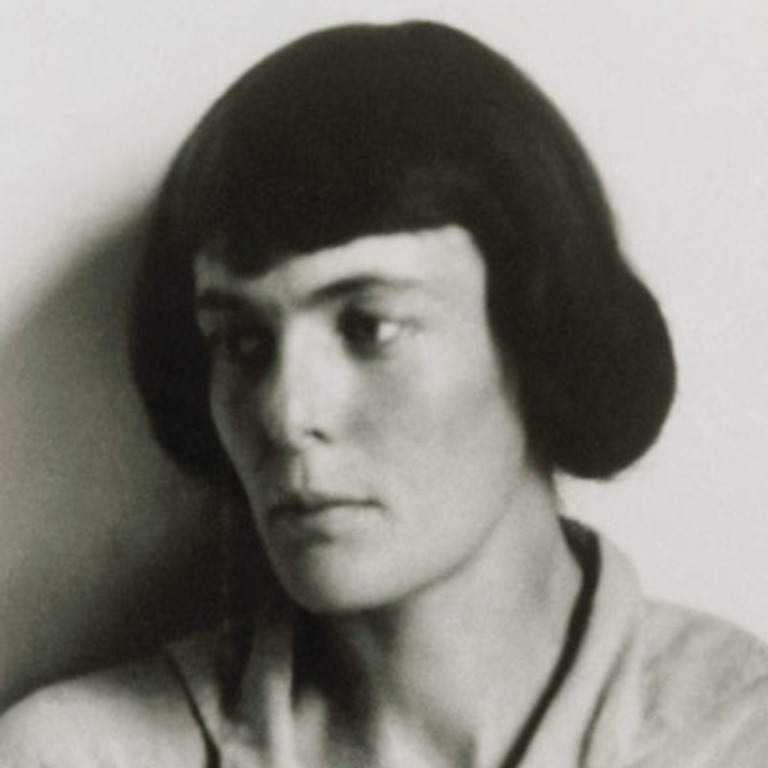
And here are the real and young Ezra and Hilda.


Pound was in England trying to stir up a poetic revolution, something that would forge past the reformation of William Morris and the Pre-Raphaelites and give poetry a fully modern cast. Hilda showed Ezra some of her new poems, and Ezra did three things that he would do repeatedly for other poets in the next couple of decades.

He immediately recognized that Hilda was writing the kind of fresh, spare, honest poetry that he thought necessary to break the grip of the past. He would see to it being published.

After admiring it, it took his pencil to it, and slashed out parts of the already concise poems. I can hear some of you drawing a breath on that, considering the sexual politics, ready to cry “Asshat!”—but that’s Pound, even with poets of genius: cut it, pare it down, make it new, not one extra word. A few years later he’d do the same thing to T.S. Eliot, and the surviving variorum manuscripts show why Eliot called Pound “The Better Maker” of The Wasteland.”   Pound’s editing pencil seemed to teach like the sensei’s stick, and once shown, poets like Hilda Doolittle and Eliot understood how to do the same thing themselves.

And then he took that editing pencil and signed Hilda’s poems “H.D. Imagisite.”

That last move was another part of Pound’s talents. He was probably more successful in launching other poet’s careers than he was his own. He had a shrewd promoter’s eye. “Imagiste” or “Imagist” was the name Pound would give to the modernist poetic movement that would during the years of WWI as radically reshape English poetry as the war would reshape the maps of the world, and here he was saying, rightly, that H.D.’s poems would be the ne plus ultra of that movement. As a name, H.D. was as pared down as the new poetry would be. If he’d lived long enough to see video screens with 1024 lines, he could have said calling them HD for “High Definition” was a tribute to his call for seeing things truly. And H.D. masked Hilda’s gender, still important in a world where women were widely thought to be incapable of great art. The former Hilda Doolittle didn’t object. She’d never liked the family name (“Do-Little” she thought it scanned) and besides, her sexual identity and friendship affinities were at least HD.

Let me admit that this post is unfair to H.D., the writer of the words of today’s piece. We’ve gone past my customary length limits and we’ve only barely touched on H.D.’s talents and extraordinary life. I’ll need to revisit her work soon and give H.D. her due.

What can I say about today’s piece “Heat?”  Well it’s an appropriate July poem, and the titular heat, in true Imagist fashion is both a closely observed thing: actual summer heat, and an image that, without simile or extra framing, is imbued with complexity. Last episode we had Pound/Li Bai, two men, showing desire and longing in the “River Merchant’s Wife”  with only a few actual named emotions or feelings. H.D., the better Imagist, shows female desire with not a single named emotion. The poem’s final phrase:

that presses up and blunts

the points of pears

and rounds the grapes.

is sensuous beyond words—it’s only 13 words to be beyond after all—and with four p and s sounds it holds four kisses.

To hear my performance of H.D.’s “Heat,”  use the player below. And thanks again for the likes and the social media shares!


The River Merchants Wife

The River Merchant’s Wife: A Letter”  has a very complicated history. I can’t even say “Ezra Pound’s ‘The River Merchant’s Wife”— though he’s often listed as the author.

Let’s begin, as a river or a journey might, at the beginning. Back in the 9th Century in China there were two great poets. One of them we’ve already met there: Du Fu. He was known for his wisdom and level-headedness. The other was Li Bai (his name is also written in western letters as Li Po and Li Bo, and in Japan as Rihaku) who was known for his more excessive existence. In China both have been continually revered, but in early 20th Century Europe or America, they were nearly unknown. Only scholars interested in off-beat subjects knew of these men’s work.

One such scholar was an American, Ernest Fenollosa, who had traveled to Japan and become deeply immersed in Japanese culture, and as a sidelight to that, he also was exposed to Chinese culture. Early in the 20th Century, Fenollosa was one of a group of Americans living in England. We’ve met others here who were part of this “reverse British Invasion” of Americans: Ezra Pound, Robert Frost, T.S. Eliot—and you’ll soon get to meet another, H.D.  Fenollosa then died in 1908, still in London.

Here’s were something fateful happened. Fenollosa’s widow, for some reason, gave Ezra Pound a bunch of her late husband’s papers. Pound was a young man who was trying his damnedest to start some kind of artistic movement in London. In the papers were scholarly prose translations of Li Bai’s poems done by Fenollosa and two of his Japanese associates, Mori and Ariga.

Ernest FenollosaLi Bai

Ernest Fenollosa, deeply attracted to fur; and Li Bai, more into silk

Pound fell upon these scholar’s notes. He’d already sought out other old poetry for inspiration for his revolution (much as the Pre-Raphaelites had looked backwards for something fresh), but in this old Chinese poetry he found what he was looking for. It was concise. It was free of centuries of cruft that English poetry had accumulated. And Pound naïvely felt that the poems themselves grew out of the ideograms for their words, Chinese characters which had evolved from drawings of objects. He had found his poetic revolution. Poems should be constructed of little more than images. Not images in the sense of elaborate similes or strained allegories, images in the sense of a presentation of the direct observation of the poet, unadorned. Pound published what he created out of those scholars’ notes as a ground-breaking poetry collection “Cathay,”  and he quickly began to compose his own modernist poems using his epiphany.

If Fenollosa hadn’t died in London, and if his widow hadn’t given this tranche of papers to an artistic provocateur such as Pound, it’s possible that Li Bai would be no better known in English today than he was in 1908, and it’s even more likely that poetry in English from that point on would have evolved differently.

If Fenollosa hadn’t died in London, and if his widow hadn’t given this tranche of papers to an artistic provocateur such as Pound, it’s possible that Li Bai would be no better known in English today than he was in 1908, and it’s even more likely that poetry in English from that point on would have evolved differently.

Seems like a miracle when such things line up, doesn’t it? Well, here’s something as miraculous: though “The River Merchant’s Wife’s”  source was written over 1200 years ago in a culture so far removed from America that the childhood legend was that one would need to dig a hole through the center of the Earth to get there, even though it comes to us filtered through non-Chinese scholars, and even though the particular words I’ll use today to express it were written by an avant-garde poet whose work remains little-read and understood today, many people have an immediate deep emotional response to this poem the first time they hear it.

Isn’t that odd? All that strangeness in customs, place-names, time, provenance—and yet more: it’s a poem of female desire written in the voice of young woman by a man, and translated and transformed by men. And yet, woman and men, young and old, hear it, and they feel the pangs of desire and separation just as much as any 8th Century resident of China—even though the poem, following the tenants of what Pound would call “Imagism,” barely mentions the speaker’s emotions (“bashful,” “desired,” and the only present-tense one, “hurt.”)

I know I felt those things when I first heard it, aged perhaps 21 on a sad journey with a young woman. I hear it now as an old man too, and think once again of my friend John, and of China. The place, Cho-fu-Sa, that the river merchant’s wife says she will go out to meet her husband is, I’m told, hundreds of miles from her village in the poem. What is such distance to the heart?

To hear my performance of “The River Merchant’s Wife: A Letter”  use the player gadget at the bottom here. Since this post is already long, I’m not going to talk much about the music today. The higher-pitched string instrument you’ll hear is my approximation of the pipa, a traditional Chinese lute. There are many moving recitations of this poem available online, but to see an entirely light-hearted modern translation of “The River Merchant’s Wife” after listening to mine, view this one.

The Oven Bird

With today’s post, we’ve reached the 100th official episode of the Parlando Project, where we mix words from many sources (mainly poetry) with various kinds of music. For the 100th piece I’ve decided to feature an older recording of mine, almost 10 years old, of my performance of Robert Frost’s “The Oven Bird,”  because it marks some of the initial ideas that lead me to this ongoing Parlando Project.

Parlando Project 100th audio piece

the Parlando Project has posted 100 audio pieces combining music and words


Frost’s “The Oven Bird”  is a devastatingly accomplished lyric poem written early in the 20th Century. The rhythm of the lines both grooves and varies itself, like the best music, and the rhyme scheme is elaborate, yet it never falls into forced rhyme. Frost’s language here is so plainspoken, ironically saving the fanciest and longest word for the poem’s last line. Frost is as rigorous a modernist as any of his contemporaries in the Imagist school. He’s as willing as any of them to hack away all the overused and overgrown 19th century “poetic language” and to use no word more than needed, but he does it here while writing a sonnet in rhymed metrical verse that sounds as natural as any free verse.

Allow me to indulge for minute my musical interests for a moment. What Frost does here (and elsewhere) is like what John Coltrane did shortly before changing his focus to what was to be called “free jazz,” where melodic freedom was stressed by radically simplifying the underlying harmonic structure. Coltrane wrote and recorded the most devilish difficult set of rapid chord changes constantly shifting the harmonic center, an obstacle-course of a composition called “Giant Steps”,  and then proceeded to improvise over it as if it was no matter to him to make those changes. Like Coltrane, Frost could seem free, natural, and innovative, while writing inside a constraining form. This sort of kindred accomplishment speaks to what attracts me in the Parlando Project to equally privileging music and words.


“The Oven Bird”
  has a reputation as a downbeat poem, and while Frost will not sugar-coat the human condition, I did not, and still do not, find it so. In “The Oven Bird”  Frost draws our attention to a bird that sings on, past the promising days of spring, and whose song is none-the-less, loud and insistent, even though he’s singing in a season where he might well feel out of place and out of time for song. Then in the closing section we’re first told that the future holds the fall season—and by extension, both the fallen state of man and the death cycle of nature—and “the highway dust is over all.” Some have read that line as Frost noting the coming of the 20th Century roads that will close out even more forest and bring some measure of end to the natural world. I think instead the “highway dust” is more at a statement of the death of all living things (dust implies in my reading “to dust”) and that dust is the dust of a set, laid out, road.

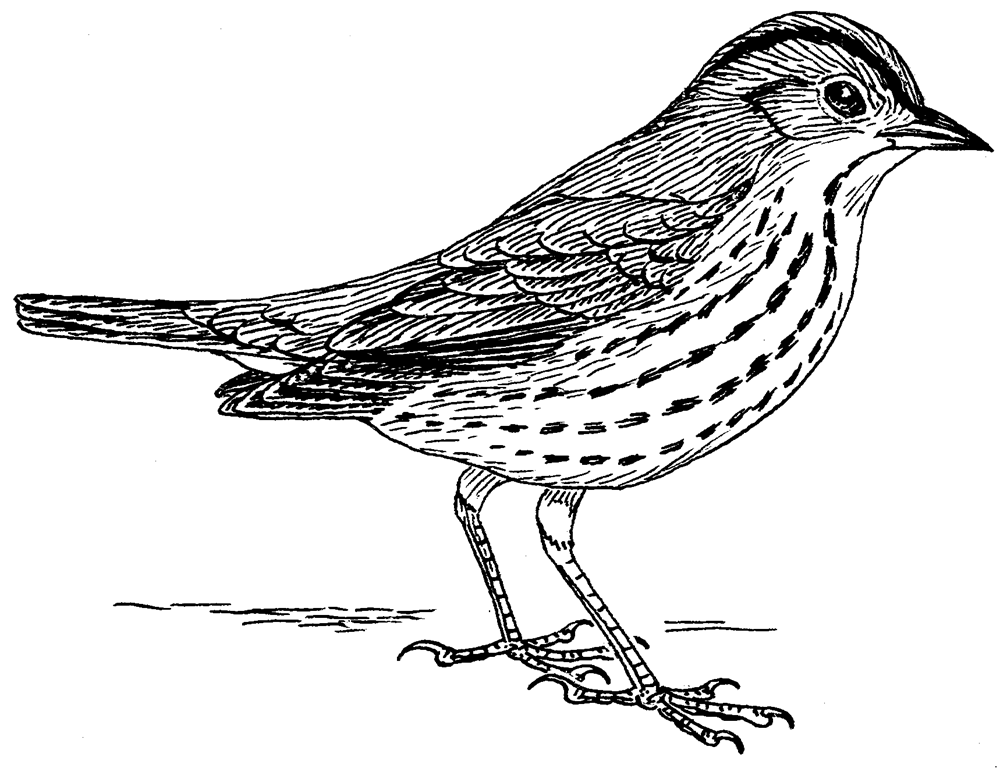
Oven Bird

The oven bird: “He knows in singing not to sing”


Finally, Frost hits us, and me specifically near 10 years ago, with his conclusion—one that says much for this project that seeks to find “The place where music and words meet.” He says those of us, also mid-summer and mid-wood who listen knowing these things, sharing the bird’s predicament, should know that the bird has these teachings to pass on to us, “He knows in singing not to sing” (a zen koan of a line) and that the present question is “what to make of a diminished thing.” What a progression to this, from the plainest language with simple words never more than three syllables long, singing us the oldest cycle known to self-conscious humans—and then Frost gives us a line suitable for meditative thought and a question.

This is where I break from those who see this as a despairing poem about death, failure and decline. The poem asks what to make of that, offering the example to loudly sing.

To hear my performance of Robert Frost’s “The Oven Bird”, the 100th offical audio piece posted here as part of the Parlando Project, use the player below. “The Oven Bird”  performance is voice and acoustic guitar, but if you listened to others,  you know that the music and poetry we use varies. If you haven’t listened to other audio pieces in this project, check out the monthly archives for more. And if you like this, hit the like button or the follow button, and share this post or this blog address on your favorite social media channels. Those who’ve already done so help keep Dave and I encouraged to create new material, and you have helped grow the number of people listening to pieces from “Parlando – The Place Where Music and Words Meet.”


Implications of Fireworks

Today in the United States is Independence Day, a day celebrated with summer cookouts and fireworks explosions. Like many obligatory holidays in our modern age, what we are celebrating becomes obscure. Yes, Americans know it’s Independence Day, but what we think of as we celebrate is a mélange of things.

What makes up this celebratory mixture? We celebrate the warmth of summer, particularly here in the northern parts of the US where eating outside is a special season. Our children are celebrating what still seems like an endless summer away from school. Stores have banners of firecrackers and flags luring shoppers who have the day off from work. And we celebrate a diffuse patriotism affordable because America is a preeminent, powerful nation. Our modern patriotism is not short of convictions—far from it, our country is prominently divided by convictions—but that too is possible by the relative wealth and power of today’s America.

signing the declaration

“Yes, treason against the crown and the divine right of kings, and we could all hang tomorrow,
but  can I add a part about dispensing with the noisemakers? I could use a little sleep tonight.”

But the event we are celebrating is a sharp and definite thing. 241 years ago a group of Americans started an anti-colonial movement, and in the furtherance of that, they soon were to found the first modern republic. Those who did this many years ago perhaps did not know, or even think of themselves as anti-colonialists. Some merely had issues with particular colonial authorities and decisions. Some were indeed bound up in an immense evil of colonialism, human slavery exploiting yet other peoples and nations. Still, we should seek to understand them as their idea became understood through the Declaration of Independence they signed today: that the rights of kings and empires were not heaven’s design—rather, human rights were.

And as their rebellion against kings and empires evolved, it strikingly lead—not to the setup of a new king, or a new, locally-sourced strongman—but to a new form of government, a republic. Once again, these were not perfect men—their government “Of the people, for the people” was at first for white male men of property—but they were men of such devotion to the republican idea that they would not let even the worthiest of their lot become king. That was unprecedented, and even in all the time since, not one in ten or one in a hundred rebellions immediately ends in such a way.

I know not all who read this are Americans, but those are the two remarkable things that we celebrate here in my country today. And of these two things, the second is the most rare, and the thing we must take care to carry within us: that winners are not rightfully kings.

That reminds me, there was another Independence Day tradition, one that has fallen by the wayside: the patriotic speech in the town square. I guess I’ve just revived that. Today’s audio piece is based on another text by Dave Moore, but it’s my music and performance of it. When I asked Dave about “Implications of Fireworks”  a few years back, he indicated it was more or less a diary of his impressions of a July 4th he had experienced. As filtered by Dave’s mind that day, those holiday explosions, cracks, and meat smoke brought different, less celebratory, feelings. If our independence was won with cannon and gun fire—if it’s maintained today by the same, and also with bombs made of seeds of sunfire—it is also must be maintained by, and be for, something more than that.

To hear my performance of Dave Moore’s “Implications of Fireworks” use the player below.

A New Colossus

The end of the poem I feature today (“A New Colossus”)  has become, slowly, over years, a sort of fourth American credo to go with the Declaration of Independence, the Constitution, and Lincoln’s Gettysburg Address, and yet it’s only its last lines that are widely known, thanks in part to a lovely musical setting of that part of the poem by popular songwriter Irving Berlin.

As a person who has edited other works for length to fit them into the focus of the Parlando Project, I can see why Berlin made his choice. The ending is  the payoff of the poem, a charged and memorable statement.  Most poets could only hope for as much as this: that many readers or listeners will remember at least a line or two of of what they wrote, even after hearing it but once.

The Old Colossus

Look, I know it’s a marvel of  classical Greek engineering,
but as an American. I think Jolly Green Giant and peas.

I am going to present the whole poem in my setting however. It’s only a sonnet, a 14 line poem after all, and there’s some good stuff in the setup. First off, it’s an independent American poem to its core, starting by dissing the glories of ancient European culture and one of the “7 Wonders of the Ancient World.” And its author, Emma Lazarus, also stands forthrightly for the power of women to express a controversial political opinion, though this poem was written in the 19th Century when women had no right to vote.  Although this is not a modernist poem, such as those that would be written 40 or 50 years later, the lesser-known part of the poem contains one powerful compressed image, a flame of fiercely desired freedom that is “imprisoned lightning.”

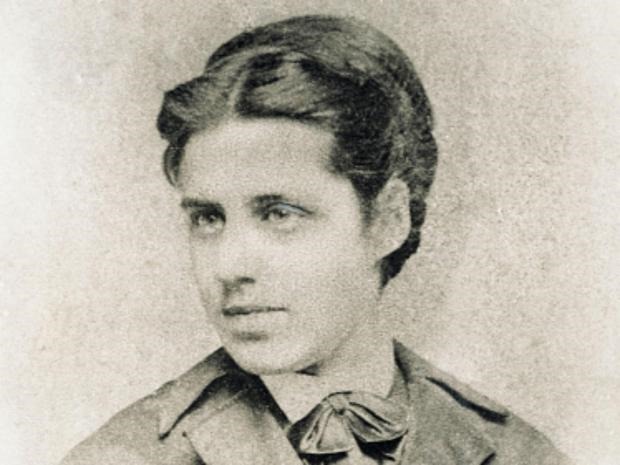
Emma Lazarus

For Emma, Forever Ago. David Bowie was thinking of her in his last work “Lazarus”

Honoring that lightning image, I’ve chosen to not present this piece as a musty patriotic homily, but as the impassioned cry that it was meant to be—and besides, the sentiments of this poem are likely now as controversial as ever. Irving Berlin presented the excerpted ending as a chorus of hope. I take the whole of it and storm it with Telecasters, drums and bass.

To hear the audio piece, use the player that appears below.

Wally Wood

Back when I was kid there was something we were taught to be concerned about, our “vocation.” This was somewhat like the perennial question “What do you want to be when you grow up?” but with a religious and spiritual aspect.

As the word “vocation” suggests, we, while still children, were asked to consider our calling, what task God would ask us to do with our lives. Yes, there as an expectation inherent in that, that some of us would find that we had been called by God to become Christian clergy, but at least in my small town and church, this was not set out as the answer most of us were to find. It was assumed that each of us would obtain a distinct answer fitting to our talents and the universe’s needs.

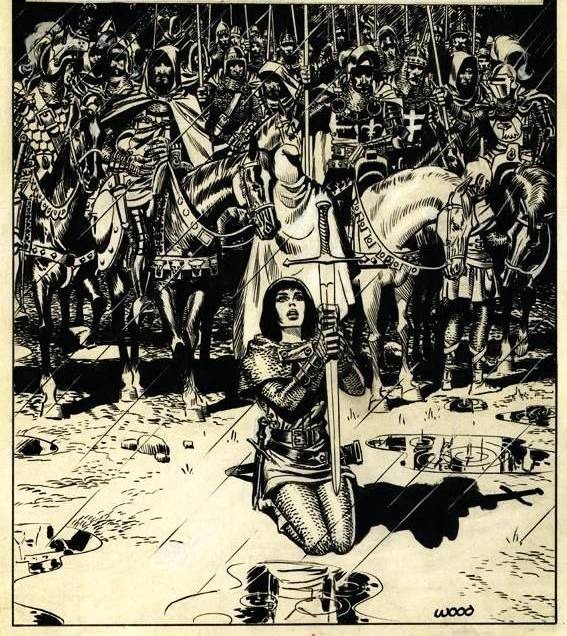
Jesus BaptismWally Wood's Joan

Religious paintings depict a calling as a clear and vivid action,, like in a comic book

The folks who provided religious instruction in my town were practical people, and I couldn’t picture any of them expecting us children to be visited by spirit birds, or hear mystic voices to lead our country into battle. Rather they expected a small inner voice to whisper to us that we should be family farmers, or mechanics, or nurses and so forth. In my family, I could look to a grandfather who I never knew, who was called to the Christian ministry, or to an uncle who followed his father’s path, or to the more complex stories of my parents, whose vocational path I’ll defer talking about for reasons of space now. It never occurred to me, but I could have asked my teachers or myself about my great-grandfather and namesake, who would have had to have been called to be a common laborer by this scheme. Somehow this talk of calling and vocation seemed a bit grand a process for that.

I never knew what to answer that question with until my late teens when I decided that I would be a poet. That’s certainly a grandiose enough answer for this religiously-infused process, but even in my naïve youth I knew that meant I’d be doing something else beside that with my lifetime. So, a calling, but no answer to what I wanted to be when I grew up.

Most decisions to become an artist of any kind expose a person to things that will mess up one’s life. First off, you are going to do something that is likely unlikeable—you are going to privilege your own interpretations of our common life as somehow more valuable than modest silence or undecorated space. Even successful artists most often have a majority of people judging what they produce as not worthy of their time, or generically replaceable by something similar but different from what you do. And these odds of rejection, combined with the concentration of effort needed for much artistic work, make many artists defend their self/center with self-centeredness.
  
So there, as so often here in the Parlando Project, I’ve violated one of the principles that I set out to follow: I’ve spent time here with my story, talking about myself. Alternate Parlando Project presenter Dave Moore avoided this in today’s episode “Wally Wood”  which Dave gave the longer title “Wally Wood’s Co(s)mic Philosophy.”

Here’s what Dave had to say about the piece:

“Wallace Wood was one of the great comic book artists of the fifties and sixties.  His detail work for EC Comics and Mad is still astounding to look at.  Like many, he was also an alcoholic, and increasingly bitter as he aged.  His words in the song are from a late interview in some fanzine.

I can’t draw, so far be it from me to draw conclusions about success or happiness.  Or the scope of a talented artist’s frustrated Fifties ambitions.  What strikes me most are the words ‘And yet’ after a pause.  No matter what he says, no matter how things ‘work out,’ it was worth it for me and all the thousands of others who enjoyed his work.  Go look him up, you won’t forget him.”

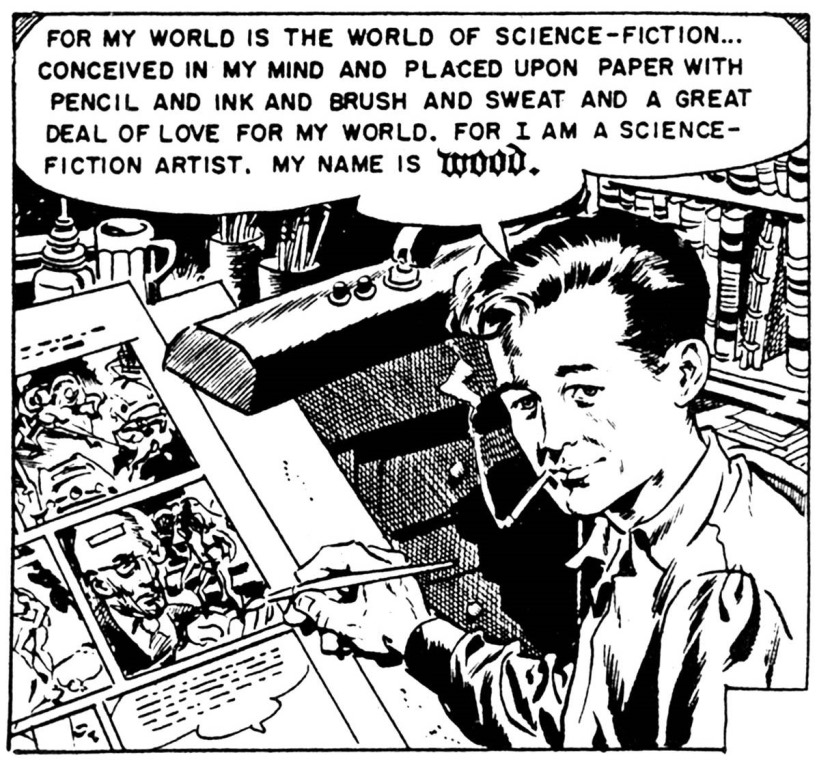
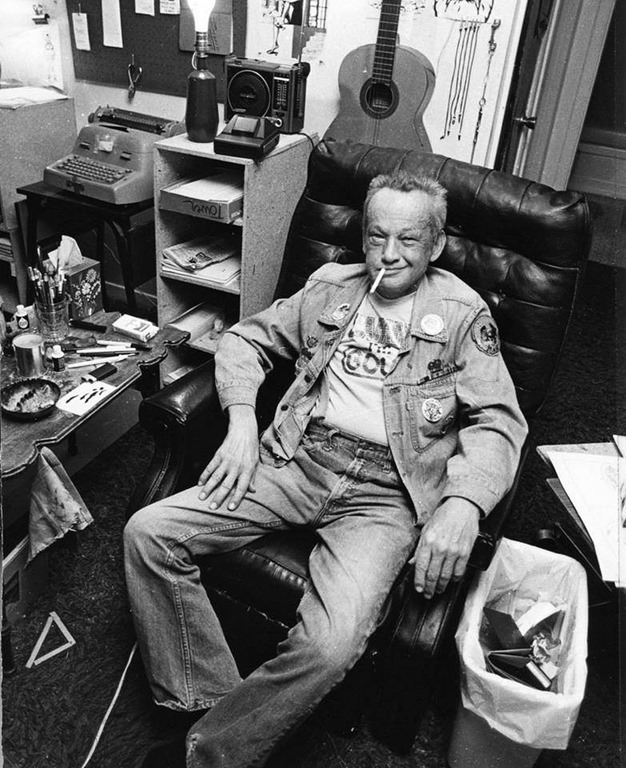
Wally Wood Self PortraitWally Wood - Art Ain't Pretty

Wally Wood, combustible master of line

What did Wally Wood add the “And yet” to? Listen and find out, using the player below.

Summer Is Icumen In

I sometimes like to ask musicians who sing folk songs “What is the oldest song you play?” As a person attracted to traditional English folk music at an early age, I often marveled at the gloriously old traditional ballads collected by Thomas Percy and Francis Child. There’s something interesting to me about singing not only “other people’s stories,” but very old stories at that.

Turns out that they are likely not all that  old. Most of them are no older than Shakespeare, and despite many antique words and usages, they are in more or less modern English. That’s old, but it’s not old like Homer, Sappho, some of the Chinese poems I’ve set to music here. Today’s piece, “Summer Is Icumen In”  was nearly as old to the typical Child ballad author as Shakespeare is to us.  You can say it’s words are written in English, but that’s only English within the broadest of meanings, as the words are even farther removed from the language we speak than Chaucer’s.
 
Unlike the now lost ancient Greeks’ music to accompany poetry, we even have the 13th Century music and a notated arrangement to present it sung as a canon or round.

Summer Canon [Reading Rota] - caption: ''Sumer is icumen in''

Old joke. Q: how do you make a guitarist turn down? A: put sheet music in front of him
New joke: Q: how do you make a lead singer ask for less in the mix? A: put old English lyrics in front of him

One tradition in folk music is to not be overly traditional in re-using it, and I’ve done so here. My melody is only tenuously related to that old one. The original music is minor and mine is major key, and I don’t do it as round. Furthermore, I’ve taken liberties with the various modern English translations of the words. I have replaced a phrase with one that I like better, completely blowing a raspberry toward those who translate uerteþ in the original text as “fart”.

I’ve fattened up the arrangement with a goodly helping of a traditional English instrument of the antique 20th Century, the Mellotron. I told Dave Moore after I completed the mix with the new Mellotron parts that the singing wasn’t good enough for it to sound like the Beatles, and it wasn’t stately enough to remind anyone of King Crimson, and it didn’t have any undeniable pop music dynamics like the Moody Blues either—but what I may have gotten too was something in the 2000 light-years neighborhood of the Rolling Stones’ Their Satanic Majesties Request—which I will confess was one of the first trio of records I bought back when the Beatles “Sgt. Pepper”  was threatening to reshape all pop music (a threat that was not carried forward for both good an ill).

Stones Album cover

Don’t adjust your monitor, the original LP’s 3D cover is really that blurry.
Also, any mention this Stones album’s name must now be done in Dana Carvey’s Church Lady voice.

Anyway, I’m using digital replicas of the original Mellotron’s cranky tapes in “Summer is Icumen In,”  but even in that remove they add a certain character to the string parts. Dave’s original organ part, mixed in the right channel, now seems like a top line to the Mellotron parts, but it’s a good part, so listen for it. To hear the LYL Band’s performing this old English lyric in a non-traditional way, use the traditional player that appears below.

I Know a Place Where Summer Strives

It would seem odd to us now, but when Emily Dickinson died, her most noted accomplishment was not her poems, but her plants. She was a serious gardener, known to her family, neighbors, and town for cultivating her plants even at night (which was also her customary writing time).

Emily Dickinson Herbarium page

Emily Dickinson created a 66 page herbarium with pressed flowers,
and often included flowers with her letters and privately distributed poems

There’s a lot of comparisons to be made there, that her poems are like flowers, pretty at first sight, but with their own alien structures, but I’ll leave that for now so that I can move on to today’s piece “I Know a Place Where Summer Strives.”

This is a poem that fits well with the Parlando Project’s tactics of combining poems with music, because it’s a poem that uses puzzles to tell its story. When you combine a puzzling lyric with music you can let those words ride along without requiring them to be immediately meaningful, as otherwise poems that go out of their way to be puzzling can frustrate readers not in the mood for non-straightforward speech.

I enjoyed “I Know a Place Where Summer Strives”  before I had solved its puzzles. As usual, Dickinson doesn’t belabor her subject, just three stanzas and 12 lines, a nice dosage for puzzlement. The poem’s internal music flows nicely, and Dickinson’s use of unusual word choices in the final stanza adds decoration to the mysteries. After reading it a few times, writing the music for it, performing it with the LYL Band, and then mixing the recording available below,  I have finally gotten around to trying to solve the riddles.
 
The first verse/riddle is a particularly cold spring, with “practiced frost” taking casualties among early blooming flowers. The second verse/riddle is a description of a building storm, which turns out not to be destructive, it brings “soft (ref)rains.” The third verse/riddle is more obscure yet, but the rain falls onto the hardened, adamant, ground. The last two lines of this verse are lovely to read and hear, but I couldn’t make any sense from them. At first thought I, like blogger Susan Kornfeld, wondered if this was a late-fall time image, and the quartz was ice forming on amber leaves—but then I noticed that the third verse clearly appears to be carrying forward the sentence and thought from the second verse, so it can’t be winter’s arrival: south wind, rain—that doesn’t sound like winter arriving.

Blogger Linda Sue Grimes suggests a solution, that the amber is mud on the shoe. This makes sense, and it could logically follow the rain on adamant hard ground, which could even be light yellowish, amber-colored, clay and not good dark garden soil, but I still am puzzled by the quartz. The line here is especially lovely: “That stiffens quietly to quartz” resonating with the “qu” “zee” and at “t” sounds, but I don’t think Dickinson cheated just to get the sound. Quartz can be brown like mud, though that’s not how I think of it, but its name and the modifier “stiffens” indicates this is something crystalline—not gooey, caked mud.

In performance I decided, intuitively, to repeat the first verse; and in so doing, I bring back the cyclical end of summer to close things.

young Stipe

Michael Stipe when he was Gardening at Night.
Coincidentally, both he and the Parlando Project are in some part inspired by Patti Smith

When I read that Dickinson’s gardening extended even to nighttime work, I recalled the song from R.E.M.’s first EP, “Gardening at Night.”  Michael Stipe’s early lyrics, are far more abstract than riddles, reading to me like abbreviated captions to blurry photos. A set of lines like:

We ankled up the garbage sound,
but they were busy in the rows.
We fell up not to see the sun,
gardening at night just didn’t grow.

Are as obscure as any poem, but I could, and still can, enjoy R.E.M. songs like that one. Stipe sincerely sang his own meanings, and he had a great band around him that supplied the music that lets the meaning ride.

To hear the LYL Band performance of “I Know a Place Where Summer Strives”  you can use  the player that appears below. Musically, you might find it to be vaguely R.E.M.-like too.

Dream Big

There’s an old joke that goes like this:

Alarmed Customer: What’s a fly doing in my soup?

Waiter: I believe that’s the backstroke sir.

Part of the humor here derives from the order brought to the chaotic event of an insect in the diner’s food. The waiter is able to observe the fly and classify its actions from an altogether different perspective. And the rest of the humor comes from the waiter willfully, or otherwise, misunderstanding the customer’s complaint as a mooted question.

Rhythm, a primary component of music and poetry, shares that ability to reshape chaos. The day after I saw the Emily Dickinson film biography “A Quiet Passion”  I returned to the same theater complex to see Chasing the Trane,” a documentary about musician John Coltrane, a man whose work and life story has carried me across many a low place. You could predict most of the talking heads (what director Warren Beatty once called, perceptively, “witnesses” in his John Reed biopic “Reds”)  that appeared in the Coltrane film. Coltrane’s children talk about their parents. Winton Marsalis and Cornell West are obligatory we suppose. A pair of Coltrane biographers chip in their perspective. The surviving members of Coltrane’s great combos, Reggie Workman and McCoy Tyner, talk briefly. Sonny Rollins, Coltrane’s great contemporary, and Benny Golson, a musician who first knew John Coltrane as a fellow teenager in Philadelphia, are especially insightful.

And then John Densmore, the drummer from the 60’s rock group The Doors speaks. OK, I can hear a few saying “What’s he doing in a John Coltrane biography?”

The answer is: swimming in the rhythm of Elvin Jones (the great drummer of Coltrane’s greatest band). Like the original Homer who wrote our fly in the soup joke, Elvin Jones could converse with whatever new melody, whatever mistaken-for-mere-chaos invention, that John Coltrane or Eric Dolphy could invoke. Densmore watched him do that on the bandstand closely, and then applied what he learned when he later was called to add order to the Dionysian deconstructions of The Doors’ lead singer, Jim Morrison, a man who had the touch of a poet quickly smothered by drink, drugs, and uncharted celebrity.

Densmore’s part in the film is to add to the thought that John Coltrane lived as if  he could converse with the universe and approach its Creator with what he had heard from it. Densmore’s addition: but it’s the drummer that is the witness that this is happening now, in the time we are all beating. Coltrane may swim out in the tide of the cosmos, but Elvin Jones knows what stroke he’s swimming.

John Coltrane and Elvin Jones

Elvin Jones and John Coltrane: a conversation with infinity and time


I call today’s audio piece “Dream Big!”  June is the month of graduations and their obligatory talking heads delivering commencement addresses, most of them deputizing themselves as present-day Ralph Waldo Emersons with mature advice for the audience. However, “Dream Big!”  doesn’t present the tale from some sundry gray eminence—instead it has some words from a young man, the British musician Kiran Leonard, who asks us to look at the dream of Herman Sörgel.

Kiran Leonard

Kiran Leonard: quiet is the opposite of thoughtful

Kiran Leonard’s music takes several forms and may still be forming, but his words that I adapted for use with my music in “Dream Big” were taken not from a song, but from a short statement broadcast by the BBC. In it, Leonard uses Sörgel to encourage us to take on creative projects we think are beyond us. Good advice for young people—but I also took it as good advice for this old man as I started the Parlando Project in 2016, and needed to contact some hopeful audacity. And now, this week, as I am readying this post, I need John Coltrane and Herman Sörgel, Emerson and Kiran Leonard levels of such hope as I mourn the needless death of a young man and our pretentions that we can do nothing about it.

To hear more of Kiran Leonard’s music you can see this live set from last year here, or view the promotional videos for songs from recent albums here and here, or read this interview/introduction/review. To hear my performance of “Dream Big!”  use the player below.


Her Final Summer Was It

I got to see the Emily Dickenson biopic A Quiet Passion”  this month. I can recommend it with a warning: this is not a work that intends to be friendly or easy to digest. It does present a reasonable estimation of what may have made up Dickinson’s life experience, showing it with enough detail to be (for me) very moving. However, it also tries to show the intellectual ferment of Dickinson’s time in a very strange way, by spending a fair amount of the movie’s running time having people converse with each other in an extended series of Oscar Wildean epigrams.

A-Quiet-Passion

This movie has no car chases or flying magician CGI battles

 
Of course, I have no way of knowing how people spoke in 1860 Amherst Massachusetts, but I doubt they spoke like this: epigram after epigram, back and forth like a free-style 19th-Century rap battle. What I guess the director/screenwriter is trying to do is give us some sense of Dickinson’s mind and the minds of others she paid attention to—Dickinson’s poetry is full of epigrams and busted epigrams after all. What he does is artificial, but then having folks read Emerson or other Transcendentalists out loud would be artificial too.
 
Another part that is harrowing is the time spent on the routines of death and dying in her time. Given Dickinson’s own gothic tendencies, this is not only defensible, it may be indispensable in conveying her outlook. And Cynthia Nixon’s performance as Dickinson is very very good.

So go see “A Quiet Passion”  if you would be interested in a portrayal of a what Dickinson may have been like as a person and what drove her as an artist. But do not go to see it if you want a friendly, straightforward introductory film biography that would introduce you a writer you have not yet committed your interest to.
 
For once I’m happy that this is a long preamble to today’s piece, Emily Dickinson’s “Her Final Summer Was It,”  because I do not really want to talk much about the work itself, as I don’t think I can speak a well as Dickinson’s own sparse words. I found in it great resonance to my own experience, particularly a summer 16 years ago—but as with all things we present here, the intent is not to dwell on my own life, but to connect to and impact yours. I hope I do the work justice.

Her Final Summer was it MS

Dickinson’s own hand-written manuscript of “Her final Summer was it”

You can hear my performance of “Her Final Summer Was It”  by using the player below. If you’d like to hear other Emily Dickinson pieces interpreted by the Parlando Project, we have done four other Dickinson poems with music here.