Most days I take a bike ride to and from a cafe I have breakfast at. It’s my conviction that exercise is a good thing for people of all ages, but it’s more at required for folks my age. The kind of sitting that goes into composing music or the reading and writing that contributes the texts this project uses is pleasant and absorbing, so I think that if I don’t start my day with something that gets me moving outdoors all I would see is screens and pages. No matter if they are blank or full pages, the book of nature cannot be found there.
When it comes to the book of nature I’m not well read. When I read poets like Emily Dickinson or Edward Thomas I can easily tell that. Therefore, my only advantage is that I get to read the book of nature as if for the first time.
Chemical nature observed. My homage to the Yip Abides blog. I love how the rust has created a sunburst finish lacework that matches the original paint color of this truck I passed this month.
This spring I began to notice birdsong more and more. In early morning rides the birds were active and making a note of that with their calls and singing. Summer writes diminuendo, and by now my northern state is quite silent. Nor do I get to see any birds much, though the streets here are full of the year’s batch of weaned squirrels, now nearly adult-sized, who are dashing about as if they have a plan for winter. And with the squirrels I hear less of the cackles from those that take time to chase another squirrel for sport. I sometimes imagine those pursuing pairs were littermates, another they were once eyeless beside.
No one’s singing because there’s autumn work to be done—but what work? Will it bring reward? What to store, what to leave behind.
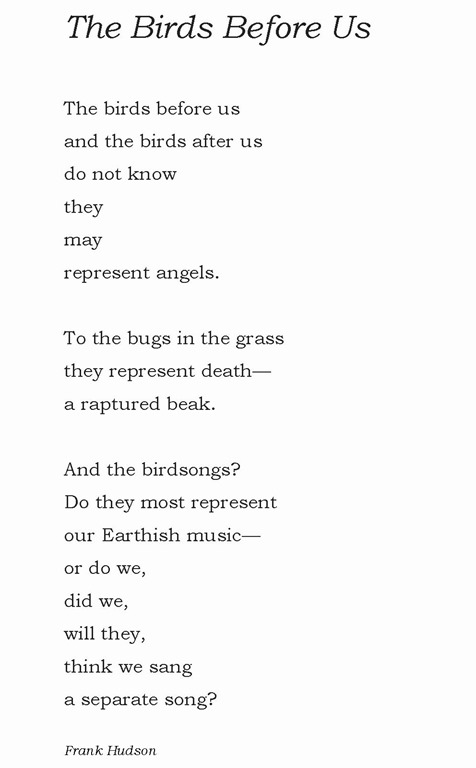
Today’s text is a poem I wrote about birdsong, and the larger book of nature in which we are only an entry, somewhere between horseflies and iguanas as alphabetized with our symbols. It’s occurred to me that I have taken time in this later year of my life to listen to the birdsongs, their piercing intervals; and that after I no longer roll down these streets looking for tea and scrambled bird eggs, that there will be birds in spring moving from note to note, and birds in fall, quiet and studious.
Here’s the poem if you’d like to read along as you listen to the performance.
The piece is called “The Birds Before Us,” and you can hear my performance of it with the gadget below. We’ll return soon with the usual Parlando Project thing: encounters with other people’s words.
Today’s text is a poem that works in the common garden using another poet’s central image. Christina Rossetti’s “An October Garden” is three lines in when she reveals that her garden isn’t growing nervous grazing watermelons—that what she observes there is the last rose of summer.
Irish poet Thomas Moore seems to be the writer who first struck that coinage, or at the least popularized it. His 1805 short poem called “The Last Rose of Summer” was soon set to music based on a traditional Irish harper’s tune, and the words and sentiments with the associated music has been sticking around ever since.* Moore’s poem is both dark and sentimental, a combination of ingredients that continues to impress audiences. Summarized to its core outlook, it’s a poem about surrendering (at least metaphorically) to loss.
Writing down to the bones & roses: “When the last rose of summer pricks your finger…”
What distinguishes Christina Rossetti’s use of the image from Thomas Moore’s? Rossetti’s is a bit shorter. It’s an unusual form sonnet, just 14 lines, vs. Moore’s 24. Rossetti’s sonnet form is neat: a pair of equal 7-line stanzas and an ABBAACC rhyme scheme. But furthermore, her take on the image is somewhat ambiguous. For one thing she notes there are other, more hardy flowers still around too, but her eye’s on that last rose, and however puny and forlorn it might be, she’s one for the roses and not them. Although no one would confuse her poem with a Modernist poem in the Imagist style, her presentation of the rose is more objective and there are fewer “feeling” words, and in their place: more observational words.
If one abandoned the structure she used, one could “translate” Rossetti’s poem into a free-verse Imagist poem fairly easily. But let me note one more thing about the structure: one could easily think that a need for rhymes has forced some word choices. The last rose “which cold winds balk” reads to me first and last as a forced rhyme. The literal sense is that the winds are still holding-back against this puny but still budding rose, but that’s not a strong statement (absence of the cold winds is less concrete than their presence). The other possibly forced rhyme is repeated twice:** “rosebud which uncloses.” This one is so awkward that I am still evaluating how it works. What a weird way to say what one could say simply “opens.”
There’s a dirty little secret about rhymes. More times than poets will admit, the need to make a rhyme will force a poet into a choice they otherwise wouldn’t make. There are times that rhyming need works like Surrealist tactics such as “exquisite corpse” or randomization techniques, it throws chaos and noise into one’s intent. When the result fails to set off sparks, it’s experienced as forced, a failure—but when it does work, the poem or phrase takes on a new freshness.
So which is “uncloses?” I’m still not sure. If one allows the oddity of the word, and asks what it could say that’s different than “open,” it’s saying that the last rose is making a choice in blooming, knowing that colder fall and then winter to come will make its feeble bloom even shorter. It suggests it’s choosing to not stay closed or to not close back up against the cold and bleak.
Musically I doubt my setting will do for Rossetti’s poem what music did for Thomas Moore’s, but it did give an excuse to break out the Mellotron sounds again. Musical instruments can accumulate associations, and for me nothing says sitting in an English garden like this wobbly keyboard instrument that tried to imitate orchestral instruments; and while failing in verisimilitude, succeeded in sounding like a memory of them.
My performance of Rossetti’s “An October Garden” is available with the player gadget below. If you don’t see the player, you can find all the audio performances here on Apple Podcasts, Spotify, or most other podcast sources. You can find them at such places by searching for “Parlando – Where Music and Words Meet.”
*In that Wikipedia page that I linked above for the text of “The Last Rose of Summer” I draw your attention to the lower sections where the extraordinarly wide range of use and allusion the tune and the text has had is listed. A personal favorite is Robert Hunter’s grief-filled variation “Black Muddy River.”
**There’s an old Jazz improvisor’s trick that when a player flubs a note or makes a wrong choice when improvising, that a way out is to repeat it, or even make it a motif.
Did Emily Dickinson mistake her tone, her presentation? This question occurred to me as I went off into the deeper, album cuts* of Dickinson’s work looking for autumn poems this fall. Her early poem, titled on posthumous publication “Autumn” is charming and very much in a mainstream short poem tradition of the day. If she was seeking publication or just checking in on an honorable hobby of an upper middle-class** young woman, it would do.
The next Dickinson Autumn poem I found and presented,“Besides the Autumn poets sing” is still charming, if self and otherwise referential in a sly way. If I was to “translate” it into the diction and particulars of New York in the 1950s it could be written by Frank O’Hara. I believe she intentionally means that poem’s opening word: “Besides,” and that is not a careless rendering of “beside”. That little “s” makes it a poem about what the poets of her time did “Besides” (meaning “in addition to,” or perhaps “surplus too”) Autumn, not merely poets rendering in verse the season while metaphorically writing en plein air. That makes the poem an expression of what is other than, or in opposition, to what a leading American poet of Dickinson’s day like William Cullen Bryant was writing.
If I was to read this poem in isolation, if it came to me “over the transom” would I make that assumption? I’ll be honest: I suspect most times I’d miss it. I’d hurriedly read the poem as another simple Fall season lyric. I’d miss that “s.”
Did Dickinson intend this slyness, if I’m right in my more careful reading? My understanding of her character is yes, she did. I could be wrong. If writers, if poets, can misunderstand how their tone will be read, certainly us readers, busy and full of our own prejudices, can also do our part to misread or read ourselves into their work.
But then I came onto this remarkable Dickinson poem, one that’s frankly strange on the surface: “The name of it is ‘Autumn’.” Even now, over 150 years after it was written, this makes no pretense to being a conventional poem.
The first thing I noticed was that as a poem of fall, it doesn’t really work—or work the way we expect a poem on that subject to work. Yes, fall leaf color is a common trope for landscapes that have this event.*** But this poem goes overboard if that is all it’s trying to do. Yes, many of the autumn leaves are red, and yes we can say they are blood red. But if that was what Dickinson was intending, and if repetition of that trope might add to its power, I think many readers would think it’s overdone.
And so my first thought was, that must be Dickinson’s intent—to over-do it—because I now trust Dickinson as an artist, and feel from reading her that she often is seeking some doubleness in her expression.
But before I continue with my sense of the poem, let me alert you to two other readings that have been put forward to explain what this unusual poem is on about. The first is that it’s a poem about a particularly deadly section of the American Civil War in the fall of 1862. Historically aware readers often wonder why Dickinson (unlike her contemporary poetic revolutionary Whitman) doesn’t deal with this deadly domestic war directly. Unlike Whitman she didn’t live in close proximity to the battles, but she was the daughter of a politician who had been caught up in the slide into this war, and an avid reader of the journalism of the day. The Civil War reading says this is her recasting of the slaughter of these battles.
If one accepts that idea the images make sense, a strong argument for it. But I’m unsure how Dickinson, even as an aware news-reader, could have received this explicitly gory battlefield scene. I’m unsure that the Republican newspapers she read would have featured detailed descriptions of the slaughter.**** The only way I can imagine Dickinson having an opportunity to pick up these specifically blood soaked slaughter/war images would be if the somewhat self-sufficient semi-rural Dickinson homestead slaughtered their own animals for food and Dickinson (who came to be responsible for the gardening food aspect of the homestead) observed that.
The other reading is that this is a menstruation poem. Likewise, the images can be fitted to that conception. And while we know nothing of Dickinson’s gynecological history (which as readers we need to know, along with the sperm and motility counts of all male authors) there is no barrier here regarding Emily Dickinson’s experience and knowledge, and so I think this one is more likely.
The third possibility is that Dickinson did intend this to be another autumn poem, just with stronger imagery; and if she may have misread how the poem’s tone would be encountered by others, that by this time in her life she didn’t care. She could intentionally have brought in those things other, modern, readers have seen in it, warfare and menstruation, and created one of those bidirectional images where the thing signified and the images used to illuminate it are of roughly equal importance. One clue to that is that she’s once more making use of quotation marks. “The name—of it—is ‘Autumn—’” the first line seems to say we need to examine that word. What could we find on examination? One thing I, the punster, finds is “Awe-tum.” The other thing she may be saying is: “Well, it’s got a common name we might find unremarkable, a mere label for a season, but it’s serious business to nature.” Then, all that blood—and in my reading, the intimate linkage to human fertility—is to make that case, to drown that conventionality.
In such a case, the imagery takes over from the subject. If in the process of composition, the poem became not about autumn but about menstruation, then autumn becomes an intense outward image for what would have been a private, if widely shared experience.
Given that frankly feminist examination of literature is no longer a rare thing, I wonder how unprecedented this was poetically as a subject? Anyone know of any poem preceding Dickinson’s that has a plausible focus on menstruation? A passing line in the old ballad “Willie O’Winsbury” doesn’t compare to this level of imagistic intensity.
Rather than some colorful fall landscape photo, here’s Anne Briggs whose singing helped bring the ballad “Willie O’Winsbury” to the fore.
Well, all that talk, and the comic incongruity of mansplaining my experience of Dickinson’s poem, but this poem is lovely again as word-music. Dickinson is famously sing-able, so I was charmed to put even my shaky voice on the line here. I keep thinking I’m building up to a big-time orchestral score or a mass of synthesizer lines, but today I’m musically down to just acoustic guitar once more. This past week, I found online an entire 90 minute coffeehouse set by Tom Rapp and Pearls Before Swine, and the melody today is similar to one used in Rapp’s “There Was A Man.” I even planned singing a couple of verses of that song in a sort of a round with Dickinson’s, but I couldn’t make that work.
The text of Dickinson’s poem is here. My performance of it is available in a player you should see below, or on most podcast platforms or Spotify as the Parlando Project.
*(in geezer voice) In my day there were musical collections sold on disks, and they had to have a bunch of songs, not just the hits. A kind of wireless streaming service called “radio” sometimes played cuts that weren’t the ones that you’d pick out for your playlist. It was a primitive existence, but we didn’t know any better back then.
**It’s not straightforward to place the mid-19th century Dickinson household in class hierarchy. Clearly they were a prominent family in their town, so in the context of Amherst, likely the 1% for the latter half or more of Dickinson’s life. But Amherst also wasn’t a wealth center, thus my approximation.
***It occurred to me as I looked at my series of autumn poems I’ve been presenting this month, that there are large portions of this globe that don’t have the “theater of the seasons” that Dickinson’s Massachusetts and my upper Midwest share. The whole leaf-turning fall colors event is a big deal and traveling to rural areas where the largest canvases can be seen is a thing here. One academic paper behind a paywall that I found an abstract for even suggests that fall-colors tourism in the mid-19th century to New England places like the Franconia Notch might have contributed to this Dickinson poem.
****The political career and situation of Dickinson’s father is too complex a subject to detail today. He was a unionist Whig, who supported the compromises with slavery-states meant to prevent the Civil War, while likely opposing the practice of slavery itself. When the Whig party died out it was largely absorbed into the newly founded Republican party, which included those who were more militantly opposed to slavery and such compromise.
Dickinson’s father stood with the compromisers who thought preserving the union primary over the more aggressive anti-slavery factions of the Republicans. It was the election of the first Republican President, Lincoln, who presented himself as unifying those two wings of his new Party which was the proximal cause of the outbreak of the American Civil War—in other words, the slaveholders in slave-holding states figured Lincoln wasn’t serious in acceptance of the ex-Whig and unionist wing of Republicans and that he would allow the more abolitionist wing to take power.
Once the war broke out, there was considerable agitation in the North to settle with the Southern slave states, either to reform the pre-war union or to accept the formation of the new slaveholder Confederate nation. A prime argument for this was the deadliness of the ongoing war. So, in general, Republican papers in the day would not have been in the business of publicizing the grizzly nature of the warfare instead of bloodless gallantry and sacrifice.
This is Parlando Project alternate reader Dave Moore’s birthday month, and so I thought it’d be a good time to interrupt the autumn poetry with his presentation of a short passage from detective novelist Ross MacDonald’s The Galton Case first published in 1959.
Dave did this live performance that I recorded a few years back, and when I asked him earlier this fall about it, he wasn’t sure exactly what went into its choice. It may have been that some of the formative influences on the Parlando Project date to the era depicted in this scene in the novel, the “Beatnik*” phase where a certain kind of post WWII bohemia reached general public attention.
I’d characterize most of that general attention then as somewhere between comic amusement and pearl-clutching concern. The “beatnik” as a comic character became a stock item, and it’s easy to see the derivation from earlier foolish artist characters like Don Marquis’ Fothergil Finch.** The world doesn’t understand their pure art, but in the comic context, the world is entirely right. And then the concern-faction folks were writing that standards were surely slipping as free verse, free jazz, free-style prose myths, and free love were celebrated in the demimonde.
Explosive ivory towers! The Beatnik id of the Fifties.
Fiction writers, even writers of detective fiction, have the choice of walking fine-borderlines on such things. Characters and voices can hit the comic notes, show the raggedness of the coloring outside the lines and the amputations when sharp lines cut, while allowing their readers the ability to vicariously experience those parts of town they would never visit. Attracted to the Beat but find it out of reach? Repelled by it? Find it phony? It’s possible to write a novel and hold the interest of readers who have one or more of those opinions of “Beatniks.”
This passage from Ross MacDonald is a good example. I’ve not read the book, I don’t know how it comes out, and what additional framing and information we might have if we did. Listening to the section Dave reads I wonder: does the narrator dislike the modern jazz playing behind the poet, or just dislike its incarnation that night? Is the poet reading to music a beatnik fool speaking useless nonsense, or a fool speaking the truth because they no longer care not to? What level of imposture is everyone portraying, and how can we know or find out?
We don’t know. We’ll turn pages so the detective can find out.
It occurs to me that detective fiction is allied on some essential level with literary criticism. Sherlock Holmes foretold the New Criticism; Edgar Allen Poe, one of the Fugitives before their time.
If last time Emily Dickinson was getting meta with autumn and poets who wrote about autumn, today we have Dave reading in front of the LYL Band this short, mysterious passage from The Galton Case which describes—someone reading before a band.
Happy birthday Dave! The player is below…
*Beatnik was created by newspaper columnist Herb Caen who combined the term “Beat” used by some writers in the scene with the Russian suffix used for the tiny artificial earth satellite Sputnik launched in 1957. Many members of the “beat generation” didn’t like the term, which after all was a diminutive. People breaking molds don’t generally like labels anyway.
The successor term “Hippie” was similarly made by adding a diminutive suffix to an existing term “hip” that was used within the subculture. Both Hippie and Beatnik had connotations of a vague aspiration to bohemianism, particularly by those who might be too young to really understand.
**”The Poet of Revolt” as he self-branded. Furthermore in Marquis’ Hermoine and Her Little Group of Serious Thinkers from 1916, we can find other characters like Voke Easeley the Modernist composer who “Doesn’t know a thing about music. He tried for years to learn and couldn’t. The only way he knows when you strike a chord on the piano is because he doesn’t like chords near as well as he does discords.”
Since we’ve re-established that Emily Dickinson can do simple, here’s a lovely poem of hers that introduces more than a touch of “meta” to her poetry.
This poem’s first line starts the meta thing right off. You could quickly read the opening word as “Beside” without the s, and then the poets are singing in the presence of Fall. I suspect Dickinson wished to include that element but subvert it. “Besides” means in this context “beyond that, in addition to.” So, there’s this thing: “Autumn” that poets sing about that is what? Well, it’s prosaic (i.e. prose and routine, not poetry and unique/charged). It’s small: “few,” and “little.”
Next stanza, the song now riffs with “few:” “A few…mornings,” “A few…eves.” Dickenson’s diction is still casual here, but she drops a couple of unusual adjectives with that repeated pair of fews. Unusual adjectives are often a weak crutch in poetry. Throw together some out-of-the-blue random adjective with a noun and you’re suddenly all surreal, poetically mysterious and creative—but more importantly, do these unexpected modifiers create a charged image?
“Incisive mornings,” is a bit of a play on words. Incisive here means not just perceptive, as in the coolness and lack of light predicting winter’s shorter days and lack of warmth: but taken in its other meanings, its winds are cutting and daylight is being incised, removed. “Ascetic eves” also speaks of removal, evenings no longer long with lingering light and it hints at spiritual matters this removal may reveal.
The second stanza ends with two references to poets, presumably examples of the ones mentioned as the poem opens: William Cullen Bryant, an older poet contemporary with Dickinson, and James Thomson, a Scottish poet of the 18th century. Neither are well-known today (though Bryant was a very important American cultural figure in his time). Dickinson mentions them and says that the stuff in their supposed Autumn poems are “gone.”*
In the context of these two stanzas, Dickinson is saying: the existing poets aren’t telling us much about autumn. I think that Dickinson’s sly inclusion of those two concise, precise, and original adjectives is cutting. She’s showing that in two words she can say more about autumn than they can in some long-winded poetry.
Sheaves get mentioned in passing in Dickinson’s poem, so I get to exercise my love for Dutch painting
The second half of the poem has Dickinson unleashing her style of poetry against these musty odes. The third stanza’s word-music is just wonderful. I won’t dance about its architecture today—you can just read or listen to it—I’ll only point out that the end-words “brook” and “touch” have a lovely rhymish echo, even though they aren’t even slant rhyme. This stanza has the superb line “Sealed are the spicy valves” which partakes of the musicality but is an elusive image too. As I read it, I thought of gardeners in our climate planting garlic cloves this time of year, but garlic was not yet a thing in Emily’s New England. After an hour or so of trying to decode the image, to determine what specific spice plant in Dickinson’s time and place is referred to,** I now think this a more generalized image of withered flowers. “Valves” is used only one other time in Dickinson’s poems, in the more famous “A Soul selects her own Society” poem where they appear as “the Valves of her attention.” “Spicy” I’ve judged now is just a biologic/erotic reference to flowers pollination role. We may read the valves anatomically in various ways, but eyelids*** may be intended, as in the closing two lines of the stanza.
The final stanza is Dickinsonian too: nature in Dickinson’s poems is often personified in comical and non-charismatic species, here squirrels. Comically, her thoughts on the matter of autumn and poetry will be of great interest to the squirrel, and in this image she’s pointing out her non-existent status as a literary figure compared to Bryant et al.
It could just be a handy, casual sentiment to finish the poem, but Dickinson may be earnest in her concluding phrase: her mind is the sun that can illuminate the lack of sunlight as Winter solstice approaches.
Mostly acoustic guitar for the music performance today, though if you listen in the background you’ll hear a little harmonium and tambura. You won’t hear it in the rhythm or the instruments timbre, but I put a hidden reference to one James Marshall Hendrix in the music. You can read the full text of Dickinson’s poem here as you listen with the player gadget below.
*Thomson wrote the lyrics to “Rule Britannia,” and Dickinson is likely referring to his long Miltonic blank verse poem called “The Seasons” in her 16 line one. Bryant’s poetry may be largely forgotten, but his former cultural salience is still honored with a lot of school, street, park, and place names in the U.S.
**As an adult, Emily ran an extensive garden in the largely self-sufficient Dickinson family homestead, and in her youth she studied botany and produced a remarkable herbarium book filled with precisely identified plants—so it’s not crazy to think that she could have had a specific plant whose lifecycle she understood. A full-fledged farm field operated right across the road under Emily’s window at the homestead. The “sheaves” in Thomson’s poem wouldn’t have been abstract to her either.
*** If one wants to get more biographical in reading the poem, Dickinson famously went for treatment to Boston for some tantalizingly unspecified “eye problems” a few years after this early poem was written.
I sometimes wonder if I overstress the mysterious, even mystical, element in Emily Dickinson. Perhaps I’m overcorrecting for the too-limiting image of the charming eccentric writer of little poems that was her package-label when I first learned of her in the middle of the last century. I’ve since wanted to put the small print somewhere on the Emily Dickinson carton: contents may be unsettling during reading. Sold by weightiness, not boastful volume.
But Dickinson was at times a writer of lighter verse, enclosing seemingly cast-off poems in letters to friends. Her classmate (and in Dickinson’s lifetime, more literarily successful) friend Helen Hunt Jackson would write and publish casual poems about the seasons or travel. When Dickinson wrote this way, was she bending her art to expectations for women of her time, or was she expressing a playful side of herself? Humor, as in satire and incongruity, is an essential part of Dickinson’s verse, even her darkest verse. When it’s employed without mysterious, ambiguous themes, that same sense of humor can produce a poem like today’s “Autumn” by Dickinson.
Even the part of me that loves to search for deeper meanings and undercurrents has trouble finding them in this poem. If forced to rely on that I could offer that her concluding remark that “Lest I should be old-fashioned, I’ll put a trinket on.” could be read as a comment on the loosening of plain-style 18th century Puritanism in Dickinson’s time. But let’s be serious: this is lighthearted, an example of the “happy Autumn” poem, and such things can make good songs.
Tiny clusters of turning leaves, like splatters on a green drop-cloth.
So I tried not to weigh this one down: major chords, acoustic guitar, bass, low Mellotron strings, and a touch of piano with the sustain pedal down. You can hear it with the player gadget below and read this short poem in its entirety by clicking this link.
I was at the Midstream poetry reading series last night, and by choices, I therefore had to miss out on the wisdom that would be passed on by the elder chieftain of my nation who was speaking in the same town that night.
It’s often thought that age heightens certain perceptions, certain outlooks. In age one has a feeling for repetitions, the way that ox-turning time keeps bending back on itself so that the place one is plowing is beside the past and the future is just one row next over. There’s also a lessening of thought of one’s own self, which after all is a diminishing asset, one’s storehouse filled only with memories that the rats nibble at all night long.
So I missed what our aged chieftain said. From these considerations of age I’m sure he could hardly find time to speak of himself, which matters less and little; and instead he likely spoke from his heart, wise from his own failures far exceeding those of the younger ones, of how we can forgive and remember, and how our nation can continue to be born, cared for, urged on.
Instead I heard fellow poets read. Oh, we fail—as all artists do. We talk of ourselves, even us older ones. And when we take a break from that we talk of others imperfectly. We speak too softly, too loudly. We forget to reach for the music, or we do stretch for it and then fail to hold onto it. We search for beauty and come up with the same things over and over again, and how can we make that interesting? We are gloomy, forget to laugh, and hold our work back for funerals.
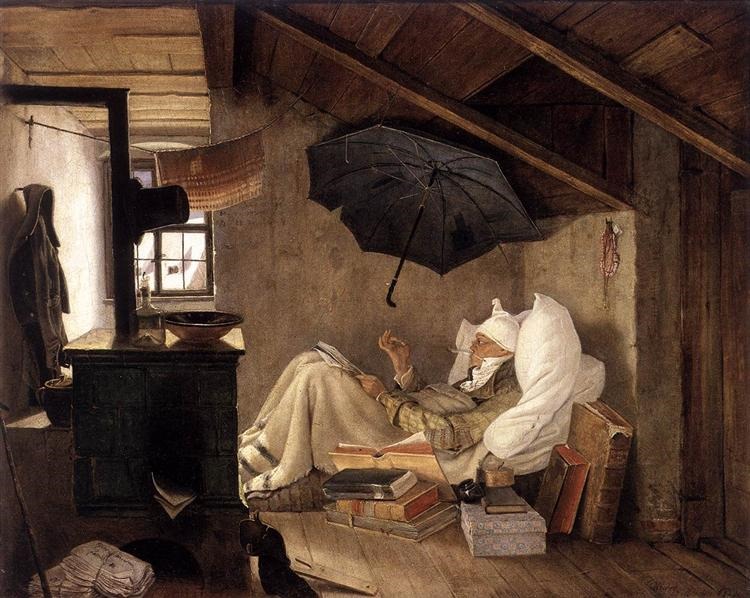
A graphic representation of the wisdom of poets such as myself
It was an older crowd last night, almost enough to make me feel younger for the couple of hours we were together. Today’s piece, Rainer Maria Rilke’s “Autumn Day,” as much as Shakespeare’s piece from last time, seems to speak of the experience of age, but Rilke is much more directive. One doesn’t often see a poem so full of “You” statements as the final stanza of this poem is. I’m not sure of the idiomatic nature of “you” in German, the language Rilke wrote this in. There’s some sense that the rhetorical you in the poem may be directed at oneself: so Rilke speaking to Rilke; but as I read this poem, I can’t escape the sense of Rilke speaking to me, and as I perform Rilke’s words in my translation, I expect that you, particularly if you are an older person, will hear it as speaking to you, so concisely do those last five lines seem to outline this stage in a lifetime.
If you’re curious to see a number of other translations and the original German, see this link.
But here’s why you come here and have read this far into this post: Rilke wrote this in his 20s. These are not the biographical autumnal musings of an older man, and I’m not sure it’s even a poem adopting that persona. I almost translated the title here as Harvest Time but chose to stay with “Autumn Day” because the copious other English-language translations used that for the title and using a different title would not allow searchers to find my fresh attempt to carry Rilke’s work into English.
Those who’ve followed my previous translations from other languages will know that I stress trying to express the imagery the author uses in a way that communicates to the modern English reader. Since that is my prime concern, I don’t make much of an effort to try to reproduce any of the word-music from the other language, but this time I did keep to a feeling of iambic pentameter for word-music’s sake. Much of my difference from other translations* was trying to sharpen the harvest imagery Rilke uses in the opening seven lines. The overall effect I aimed for was to clearly convey the weight and fullness of harvest bounty.
The final five lines converge more into a consensus with the other translations. One divergence: I read in one German speaker’s comment on their translation that “Alleen” (translated by many as alleys or avenues) was what they would call the tree-lined boulevards predominate in Rilke’s time. Not only did this strike home with me, who bicycles each day on tree-lined streets in my own town and time, but it seemed to be the linkage called for with the poems final image of following the restless wind-blown leaves on the pavements.
So back to this poem that may be read as a meditation on later life written by a 20-something. I think Rilke was trying to convey the harvest feeling, the fall into wintertime and that cyclical fallow season. Even as a young man he was able to convey this feeling an old man might appreciate. He didn’t need to be an old man to know this, he just had to read the book of nature which is older than all of us.
I often laugh as I think I’ve come across some wisdom from old age. “Aha! I’m just a slow learner” I exclaim.
To hear my performance of my fresh translation of Rilke’s “Autumn Day” use the player below.
Here’s one of the best-known of Shakespeare’s sonnets, which means it’s clearly one of “Poetry’s Greatest Hits.”
Since I’m not a real scholar or expert in such things, let’s take a look at it as if it was another of our presentations of lesser-known poems by little-known poets. You may want to follow along with the text, which can be found here. What might we see if we encounter it this way, without preconceptions?
The first thing one might notice is the antique language. In this case it’s not so much a case of “need to look that one up” words so much as it’s the olden-days tenses, pronouns and word forms: “mayst, ”thou,” “see’st,” “fadeth,” “doth,” “perceiv’st,” and “ere.” Given that the sonnet is a compressed form (this one uses 121 words) that might put one off. The syntax too, is not modern-day natural speech, but then when undertaking a sonnet even modern-day poets will sacrifice some of that for sound and compression of expression reasons.
If one is able to overlook those two things, or simply accept them as artifacts of the form and the time it was written, the next thing I notice is how much is stuffed into those 121 words. Tonight I’ll go to a meeting with three other poets, two of which are more accomplished than I am, with several published collections under their names. If I was to present to this group a poem with as many ideas and loosely linked tropes as Sonnet 73 (albeit with whatever level of skill I otherwise possess) they would likely be puzzled and displeased with it. Modern poetry is full of a great many styles, but many of them don’t try to push so much into so short a poem.
Let’s briefly look at those thoughts and the images by which we are to experience them. The first two lines open with a common autumn poem touchstone: the turning, falling, and fallen leaves. There are approximately 127 billion English language poems using autumn leaves by now, though there might have been only a few dozen in Shakespeare’s time. I think his image here is dual though, the left-leaves are compared to a balding head.
He’s not balding, he just has a large forehead. This disputed portrait has not been used to argue that Shakespeare was actually written by Larry Fine or translated from Klingon.
This image is further developed or morphed in the next two lines, including the image by which I always remember this poem: the now bare or near-bare branches bereft of the migratory and mate seeking/singing birds of earlier in the year liked to a ruined choir loft. Since choir lofts are elevated, and we’ve started with leaves equaling the now spare hair on a head, they are also the mind and voice which engenders such poetry and song.
Starting in the 20th Century some Shakespeare scholarship relates that ruined choirs image to the destruction and abandonment of Catholic abbeys and churches during his century. If so, Shakespeare has brought an undercurrent of the dangerous social change of his century into his short poem.*
Shakespeare doesn’t linger on that image, though it is so sharp it may have made his point. He next moves on to another image we now find common, the ending of a day related to the later parts of one’s life. His take is the variation (also used in some autumn poems) that there is extra beauty in the endingness, by implication it’s preciousness of limits, and from the luminous colors of sunset. He develops this a bit with an image that would have once seemed common, but has since fallen into disuse: that sleep is a model of death.
The final quatrain before the concluding couplet develops yet another image, one steeped in fire as one of the classical four elements. It’s antique physics, but observationally still rich for anyone that has ever dealt with burning wood: the speaker is the hot coals, hotter than the kindling fire of youth, or the early lapping flames. Since this is ostensibly a love poem, one can take this as another commonplace: fire equaling desire. My reading is that the love poem aspect is yet another layer of image, present, but not the only element, as it’s also about the artistic spirit that could create such a sonnet. The final line in the final quatrain is nearly the equal of the “bare ruined choirs” one. “Consumed by that which it was nourished by” is both a statement about the scientific nature of combustion; about desire, love, and it’s ending; and about the artistic impulse: that we must burn, fill and empty ourselves as if by weightless flame; that we will consume our time, our life-time.
The final couplet, as with many an English “Shakespearean” sonnet, jumps on to something else. In its guise as a love poem, it says that the lover must be extra passionate and devoted, because the poem’s speaker has limited time left and yet they still love them. What should we make of that? As a devotional interpersonal love-note, the thing the poem presents itself to be, it has emotional heft.** As a statement about the artistic drive, likewise. Every time one sets out to make something, we truly don’t know if it’s the last work we will do. As we age (I’m old, this is eminently personal with me) this becomes less and less a moot philosophical point. Treat the work as a lover, treat your lover as a work of art.
So, there’s a lot of territory in this poem. Even doing my best to present it with my performance there’s too much here to absorb in one listening, one reading, in one moment in one’s life. This is a reason why other kinds of poems may be better received. Many modern short poems seek to make one point, or tell a story with a plot rather than a complex instant that has no plot yet, or several plots happening at once. Those poems can work too, and work quickly.
Shakespeare seeks to lure us with his word-music, even now centuries later, even though he’s going to try to put a gallon of thought into a pint-sized poem, and even if he’s going to use a form of English we strain to hear as natural. “Bare ruined choirs where late the sweet birds sang” isn’t just an image, and an allusion to a piece of history that may be unfamiliar to us, it’s a lovely piece of sound. I could go on with other lines that have their compelling worth as sound: “When yellow leaves, or none, or few, do hang” or “Death’s second self, that seals up all in rest.” Can that word-music let us live with the 121 words long enough to get over the things which make us either hear this as “Shakespeare” the brand name or as an example of obsolescence?
I tried in my performance to illuminate the text and its sound as best I could. You can hear it with the player below. See no player? This alternate highlighted link will play it too.
*I’ve always loved the way Michael Wood presented the beginning of his series of TV programs on Shakespeare by saying he was born into what was a police state due to the whipsawing religious and geopolitical changes/wars/disputes England went through in the 16th century.
**By pointing out that this poem in my mind is expressing something about the experience of making art, I’m not prudishly seeking to eliminate the erotic reading. Many of the best images are bilateral. They aren’t just some thrown-off thing meant to decorate the poem with some cleverness or allusion. The thing used to represent the thing is real, maybe even more real than the thing it signifies. The thing signified enriches the image just as vice versa.
One piece of evidence that Shakespeare intends this as a complex set of images is that it was likely written when Shakespeare was in his 30s. Sure it reads “true” for this old man, but it’s not memoir as poetry. Memoir as poetry can work too, but I often feel that we’ve over-emphasized that mode.
It’s said about significant musicians that a careful listener can tell who’s playing just from their sound. The word-music of poets could be a similar tell, but in the case of poetry we have other kinds of data: subjects, characteristic outlooks, and the kind of imagery they choose to use—and those things often overwhelm the distinctions in the sound of a poet’s poem.
But even 130 years after his death, British poet Gerard Manley Hopkins sounds like no other. The piece I’m going to present today is one of his best known poems: “Pied Beauty,” and he intended it as a rhymed metrical poem, but Hopkins’ conception of meter and phrasing is so unlike other English poets that it might sound like a piece of free verse.
If Hopkins doesn’t sound like other poetry in English, he does have some similarities to Old English and ancient Welsh poetry, two languages he had some familiarity with. In place of the traditional musical phrases that his Victorian contemporaries might use, flowing lines in regularly stressed feet, Hopkins substitutes shorter, broken and paused phrases and a great deal of word sound echoing beyond just conventional end-rhyme.
Reading Hopkins in the pre-Modernist era at the end of WWI must have been like hearing Thelonious Monk play piano just after WWII. It doesn’t sound “right,” it breaks, or more correctly ignores, rules of how things are supposed to sound. Yes, the phrasing is instantly felt as rhythmic, but that’s no anchor, because the rhythm is part of what’s “wrong.” But also like Monk, to more than a few listeners, it can be arresting, even on first listen. You don’t have to understand the structure, or know how it works differently—that’s not a simple task by the way—to hear something that grabs your attention. You may dig it; but even though we humans are natural imitating machines, you may still not be able to do it.
And so, like Monk, Hopkins doesn’t have as many imitators as he has admirers of his achievement, even today.
His music still sounds more modern than most—both of ‘em.
An additional barrier to Hopkins is that his subject matter, though explicitly Christian religious, is also often harrowing. British poets have long explored unrelieved melancholy, but Hopkins doesn’t want to read Job, or understand Job theologically, he wants (or can’t escape) to be Job.*
Which makes “Pied Beauty” a good introduction to Hopkins word-music, because while it’s making a subtle theological point, this is not a particularly sad, tragic, or even solemn poem. Did Hopkins interject “Who knows how?” mostly to make his rhyme on the 8th line? I don’t know, but I can’t read that phrase and this poem without a little of the feeling of “Ain’t that funny? Unchanging, pure monotheist deity, and yet maker of a world of mixed and changing things.”
Musically, I’m not Thelonious Monk, nor was meant to be—am an attendant lord, one that will do. Still I musically sought to put a certain angle on my usual chords and cadences. Old-time Chicago jazz guy Eddie Condon said the modernist jazz composers flatted their fifths, while his crew just drank them. If so, I caucus with the modernists. Harmony has laws and customs, but the anarchists have melodies.** The full text of Hopkins’s poem is here. My musical presentation of it is available with the player gadget below.
*Just because he’s so distinctive in his sound and phrasing, we don’t need to overlook the imagery in Hopkins’ poem. Skies like cows? That’s proto-Surrealist, “old bossy in the skies with diamonds” stuff. I have to confess that my eyes once read “brinded cow” as a more conventional if workmanlike “bridled cow.” Brinded means patched patterns as on cows’ hides, it’s an archaic Middle English word, in keeping with Hopkins’ love for the sound of the poetry of the ancestors of modern English. See also firecoal colored tree nuts and painted fish.
**Well this is true at least for me. When I’m not working in drone or heavily home-chord centered structures, I will construct chords and chord progressions based on others’ ideas, or the mathematical commonplaces, testing the results for interest. But for melody, I usually don’t choose to follow rules or commonplaces, and when I find myself approaching those things, I may start to subvert them immediately. Yes, there are pleasures in knowing exactly what note comes next—must come next—but there’s too little music out there that mines disputing that expectation.
I awoke this morning to read that Ginger Baker died, a prime musical iconoclast if there ever was one. I’d read the earlier notes that he was gravely ill and I think I may have tried to imitate some of his playing (those tom rolls…) with the drum track on this.
We’ve had Edward Thomas and Henry Vaughn waxing medicinal about autumn and affliction, and now it’s time to head back across the Atlantic to see what metaphor American poet Paul Laurence Dunbar brings to the season.
By coming to prominence in the 19th century, decades before James Weldon Johnson’s 1922 Book of American Negro Poetry signaled the tip-off of what became known as the Harlem Renaissance, Dunbar proved to Afro-American poets of the 20th century that it was possible to get over to the culture at large.
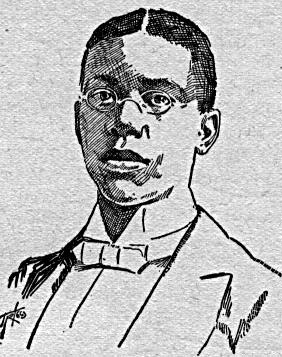
Paul Laurence Dunbar “Let the world dream otherwise…”
Like many cross-over artists, he did this by doing the established forms as well or better than the incumbents. One way he did this was by writing in regional black dialect, in poetry that is frankly hard for me to decode from my 21st century location. On one hand, regional dialect was all the rage in 19th century America across various regions and ethnic heritages, and there’s no reason that Afro-American dialect couldn’t be part of this—Oh, wait, there is a reason: white supremacy.*
Dunbar was born near the end of Reconstruction, right as the reaction to the possibility of full Afro-American humanity and citizenship was snapping much of his country back to a feudal system based on presumed, and if not presumed, enforced, inferiority. One can’t avoid the problematic nature of trying to portray a range of comic to simple-wisdom-dispensing Afro-American characters speaking a non-standard version of English in a context of a society that was fairly sure that was the extent of their intellect.**
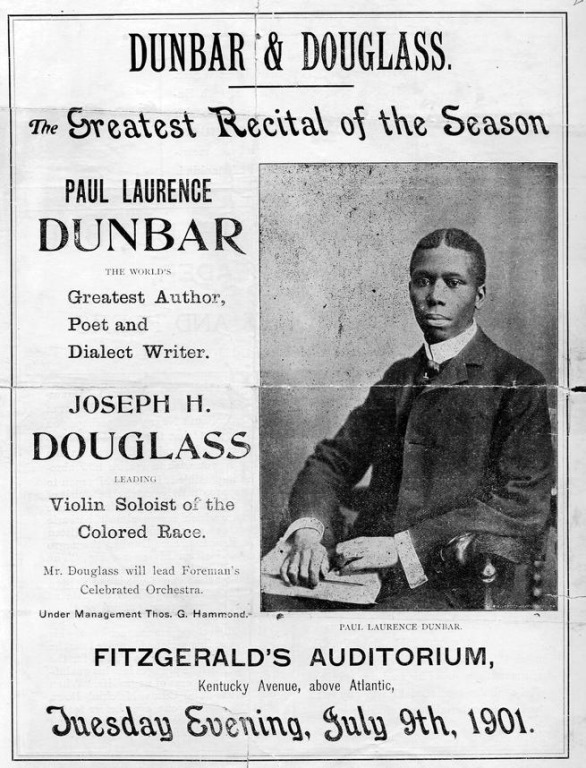
Fitzgerald’s Auditorium later became Atlantic City’s “Club Harlem” and hosted jazz and R&B acts.
But that was only part of what Dunbar wrote. He also wrote supple 19th century lyric poetry in standard English, as good or better than the “Fireside School” of East-Coast poets that were the standard for American poetry at the time. And it’s that side of Dunbar’s work that I present today with his poem “October.”
“October” is an extended metaphor nicely developed over 24 lines of rhymed and metrical verse. Dunbar alternates his rhyme scheme of ABAB to AABB to add some delightful variety. The autumn notes of harvest bounty and oncoming winter are struck and sounded cleanly.
It was only after enjoying it as a good poem in this style that I began to notice another context, an undertone. This had happened to me earlier this year when presenting a Dunbar love poem, “Kidnapped.” After performing that one, I moved on to ask: did the child of two formerly enslaved people write a poem about being captured like a butterfly and being taken far away from some home landscape? Yes, he did. Was he consciously encoding that undertone into a popular poetry form that could have been printed on a genteel valentine? I don’t know. It seemed a stretch as a conscious choice, if only because the undertone/metaphor wasn’t developed as fully as it might have been.
This time, with “October,” Dunbar does develop his metaphor, and I know of no document where he comments on his thoughts on this poem. Autumn’s harvest is presented as if it were an economic system, and dare I say it: as a feudal/sharecropper system. October is wealthy and in charge, and harvest makes her wealthier. She is presented as foolish with this collected wealth. The poet observer’s persona is not outraged by this however—indeed he portrays her as happy, carefree, joyous, beautiful. And the poem is also unambiguously beautiful. Is this personified red-headed October, collector of the treasure and bounty, deserving of unstated disgust or even envy? Is this an idealized Daisy Buchanan-like character?
Your eye (like mine) as you first encounter this poem may be on the signified season. We can’t be expected to see the fall of the year as a real person, with an actual role and privilege in a system, can we? Is it only unconscious sub-text?
Ambiguous as this is, this is part of the wealth of poetry. It can be enjoyed as word-music. Its metaphors can be admired for cleverness and their own silent music of thought. But it’s also the way for the moving minds and experience of others to be shared. It is the concise literature of the oversoul.
I performed my solemn version of Dunbar with acoustic guitar, piano and electric bass. If you’d like to check out the text of Dunbar’s poem, or follow along as I perform it, it can be found here. The player for my musical performance is below.
*I expect a percentage of this blog’s treasured audience just clicked off when I typed that phrase. If you, indignant, at least followed to this footnote, thank you, I appreciate it. I know that some of you come to poetry and music to escape the turmoil of politics and social problems.
**It’s hard to do, but some Afro-Americans managed to do it. I can trace the musical line of it anyway, from Charlie Patton to George Clinton to the hip-hop movement.