Litany for Dictatorships, a Pratfall

Tuesday was Election Day in the United States, and I had a lot of hopes and fears. As a matter of displacement for those fears, it was also the day I’d scheduled to get back together with Dave Moore to make and record spontaneous musical performances. Like the election, an event I was looking forward to, while retaining some worries. I’ve spent the entire summer rewiring and repatching the recording system in my studio space with the goal of improving captures of this kind of performance. But as the months passed, both Dave and I were getting older. We first started doing this kind of playing and recording over 45 years ago to cassette tapes, and now we have to deal with the frailties and energy levels of old age to continue this.

Monday I tested the new scheme out, as best I could by myself. Everything seemed to be working. Dave would arrive at our accustomed mid-day hour Tuesday. That morning I repeated a quick sound-check and left everything powered up and ready for his arrival.

Dave carefully traversed the rickety stairs and I greeted him. I explained that there was now a computer system at his position running Mainstage* that would allow him to load a variety of soundbank instruments for his main keyboard. I said I’d show him how it worked after we tried an opening song.

So here was yesterday: a country (and to some extent, a world) awaiting to find out what would happen with America’s current ruling cabal and this more localized concern about two older poets/musicians trying to create something with sound and words. I stepped over to my microphone position wearing a Telecaster electric guitar strapped across my body and began to play the first few notes. Dave was looking at a new keyboard setup, and as is our customary scheme, neither of us would have forethought of what were going to play. I quickly told him what key center we’d start in. We were beginning – we had to begin, even not knowing more than that. I had a serious poem of tyranny and the end of empire to present. Heavy stuff.
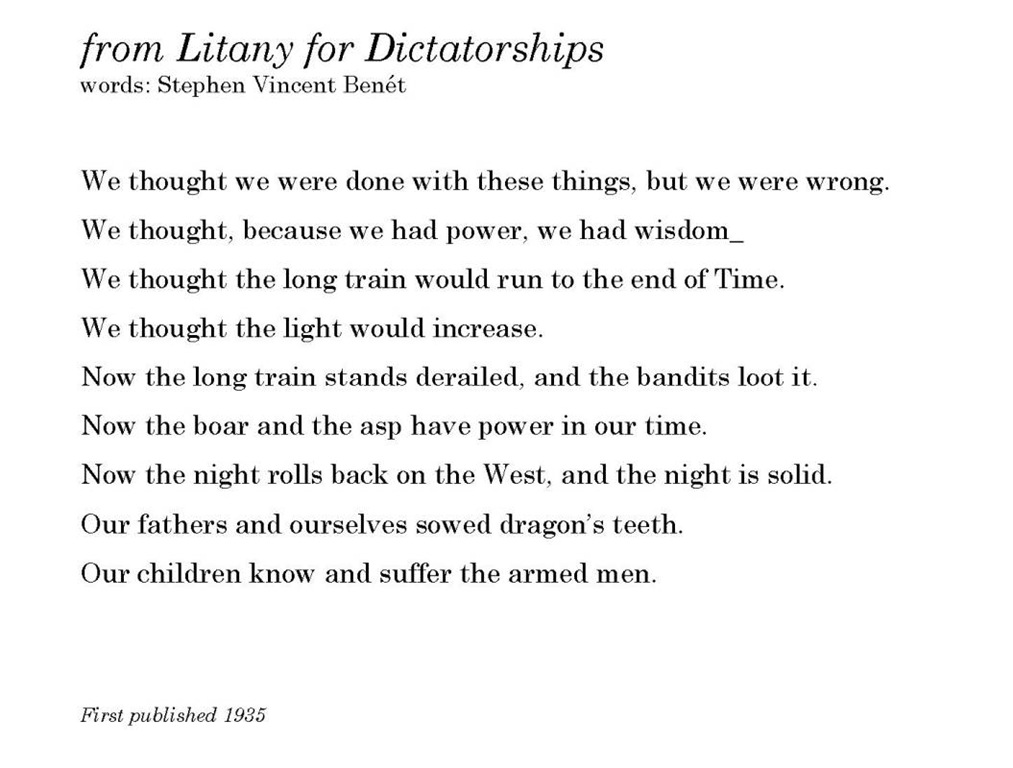
Litany for Dictatorships

You can read the entirety of Stephen Vincent Benét’s harrowing poem at this link.

.

I keep a stool near my mic, just as I do at Dave’s position in the studio space, so neither of us has to stand for the whole recording session. I stepped back to sit on it –

But I’d moved the stool a few feet away, probably to check or adjust something during my soundcheck. So, there was no stool where my butt was heading. My fat ass sat down on thin air, which I would then traverse much more rapidly than Dave took to the entryway stairs. An utter comic pratfall.

And like any good comic pratfall, no injury, other than the illustration of pride in serious intent. Dave asked if I was all right. I said yes, got up and kept playing. Telecasters are a 76-year-old design, but they aren’t fragile – the guitar, as I, was still intact and in-tune. Five minutes or so later, there was the performance you can hear below with the audio player gadget of a portion of Stephen Vincent Benét’s “Litany for Dictatorships.”

Are you thinking that any such audio player must have fallen off your computer screen? Well, some ways of reading this blog suppress showing the player, but this highlighted link will order a recount and pop up returns of a new browser tab with its own audio player.


.


*Mainstage is an app sold by Apple that allows computer hosted instruments and effects to be selected and controlled from a simplified user interface during live performance or recording. As these things go, Mainstage is getting a bit long in the tooth, and there are more sophisticated systems that more sophisticated modern stage computer musicians might choose to use these days, but it allowed Dave to use the menu I’d set up with only a couple of minutes of instruction.

America, A Prophecy

July 4th is celebrated in the U. S. as Independence Day, the day that our congress signed a declaration of independence from the British Empire. I know this project has an international audience. So, why celebrate a provincial event here?

Because the American Revolution was not simply a patriotic event. Ralph Waldo Emerson said that its initial battle was “the shot heard round the world.” What was so singular about it? It was not merely an anti-colonialist act—after all empires have had rebellious provinces forever, and empires always fall—but it was also an act that founded the modern democratic republic. Overthrowing a colonial government, as the American patriots did, is not in itself a remarkable event. I don’t mean to denigrate the sacrifices, the risks, they took. I don’t mean to overlook the evils inherent in armed struggle. I won’t today seek to re-litigate the proximate issues of the Revolutionary War, with its details of commercial interests (including, yes, commercial interests in human properties) and debate the best tactics for redress of grievances. No, those are all important, but they are not what makes the American Revolution worth our unique attention today.

signing the declaration

Silent thoughts in the room: What a fine statement of the Rights of Man we sign today! I hope they wrap this up before traffic on the turnpike gets crazy. None of my slaves have learned to read, right? Why am I the only one wearing a hat? I can’t get tickets to Hamilton? I am Hamilton!  All middle-age white guys, when does the prog-rock concert start?


Americans did not replace a king with a president for life. They didn’t exchange one dictator for another. They were not, in the end, interested in only replacing a bad man with what seemed to be a good man, and job-done. They instead instituted an imperfect, constantly challenged and constantly changing structure based on human rights and rule by reason and popular consent. The struggles, the risks of the Revolutionary generation were indeed great, but they pale in contrast to the struggles and risks born by the successor generations who sought to maintain and improve those structures. So, this is not a holiday honoring a person, a generation, or a concluding event, but instead, it is one marking a beginning.

Today’s piece was not written by an American, but by an Englishman who followed those revolutionary 18th Century events, but dealt with them on a spiritual plane: William Blake. The words come from his self-created 1793 book America, A Prophecy,  which he wrote, lettered, illustrated, and printed himself. It’s not an account of the actual battles, and its characters are largely his own imaginary beings, but he never lets his visionary eye fall away from what he sees as the core struggle in the events. It’s spiritual—not in sense of its fantastic stage—but in the sense of its divining the essence of the battle: human beings being held back from their potential and dignity by corrupt structures.

America_a_Prophecy_copy_a_plate_08

A plate from William Blake presenting part of today’s song


In our worldly plane, the men who signed that declaration were all men, all white men, mostly men of property, and yes, we should remember that some of those men of property’s properties were indeed other men, women, and children. Blake explicitly understood that. In his prophecy, the essence that they are declaring for, the angelic forces that cry for freedom and dignity are for all nations, for all genders. If the American structure had to struggle for generations to refuse slavery and give full citizenship to women, Blake says that, in essence, and in the philosophy of their republican structures and statements, they have already declared those evils as tyranny, even if they don’t perceive that yet.

It’s almost a reverse Faustian bargain, isn’t it? Instead of the devil tricking them to eternal slavery, freedom’s angels have them agreeing to dissolve their allegiance to a bad king—but the codicils they have signed declare for more than that! They’ve put their lives on the line to declare that humans have inalienable rights and that governments must work with the consent of the governed. How entirely can they understand what that entails? July 4th 1776 is a Thursday. Some are no doubt thinking of Friday; the men of foresight, to the possible course of the rest of the war; the wisest, perhaps, are thinking, of what, a generation ahead?

The sections I use from William Blake’s America, A Prophecy  are spoken by an angelic character he calls Orc, who personifies the overturning of the old tyrannies. With the limits of our short-piece format I’ve tried to give some flavor of what Blake understood was being overturned by the American Revolution. Musically, it’s a simple structure, though not the most common of chord progressions.  I tried to chant Blake’s words with as much passion as I could in this one-take performance by the LYL Band. If you are in the U. S., enjoy your cylindrical explosives and tubular sausages, but do not mix the two things up. Their shapes are similar, but keep your mind on their essences. The performance of an excerpt from William Blake’s America, A Prophecy  can be played with the gadget below.