The Little Car

Poetry as an immediate witness to momentous history is not a common thing. Poems of events tend to autobiography, deaths, love, births, personal injuries and triumphs. Today’s piece has both elements—memorable on both counts.

Guillaume Apollinaire is a major figure in Modernism with an influence across the arts as a critic and theorist. He popularized the term Cubism, invented the term Surrealism, and using his own name “Orphism” helped explain and formulate abstract expressionism. In the era surrounding WWI his influence and omnipresence was stronger from his base in Paris with French-speakers than Ezra Pound’s was for English-speakers from London. As a poet Apollinaire bridges the 19th century Symbolists to the Dada and Surrealism to come, and though he wrote in French, many of the English-language Modernists looked to French models for their verse.*  While his work is experimental with form and language, it’s also very open-hearted and joyous in a way I associate with later 20th century American Frank O’Hara.

“The little car”  tells of a day of Apollinaire’s that would change his life. On that biographic matter alone it would be of interest to literary historians. But it also tells us about the early days of the most influential event in Modernism, the outbreak of WWI. Apollinaire’s poem is comparable to W. H. Auden’s better-known beginning of WWII poem “September 1, 1939.”

So, let’s begin talking about the poetry as history today.

World War I started over a series of days earlier in the month of August 1914, kicked off by a ham-handed assassination in the Balkans at the end of June, followed by a slow enactment of various alliances and agreements plunging the whole world into warfare over the course of weeks (or in the case of the U.S., years).

Unlike the reputation of WWI as a brutal struggle of attrition between trenches, the opening August weeks were fast-moving. German troops cut through Belgium taking over that country in short order, putting them at the northern border of France as they met the French army. Large military movements and formations just slightly modernized from the Napoleonic era, that still included cavalry charges and fife and drum, met modern artillery and rapid firing weapons. Aerial bombings were introduced to warfare (though ground-based actions were more deadly to civilians). Soon amplified by propaganda, there are widespread accounts of bestial atrocities by the advancing army.**

Before the events of today’s poem, which self-dates itself to the end of August 1914 and into the following September day, during the Battle of the Frontiers, France’s army had suffered its largest single day of deaths and casualties in this or any war before or since, a staggering total of 27,000 killed in one day, with a figure of 300,000 casualties. The French army was reeling, withdrawing back toward Paris, which was the Germans’ objective in this first month of the war.

Apollinaire and his friend the artist André Rouveyre are in Deauville on the northern, English Channel coast of France. The poem doesn’t say, but I’m assuming they feel that the German advance is threatening their location, and so they do what threatened people unsure of the future often too, they head for home, Paris, not weighing that the French capital is the objective of that invading army.

The Little Car printed_Page_1The Little Car printed_Page_2

Here’s my new translation of Apollinaire’s “La petite auto” used for today’s performance


That they leave “a little before midnight” is not just an image of imminent dark change, it also may say something of a necessity not to wait, or perhaps a decision that traveling at night, as difficult as it might be with primitive headlights, may be safer under the cover of darkness.

The poem continues with a series of Symbolist images, assembled in whatever order, as a Cubist painting might be. These are not mere inventions. Although expressed symbolically, they are reportage. Indeed, some of the symbolic events which may seem mundane to us in our world, would be accounts of dreadful wonder in 1914: men fighting in the sky, submarine monsters of war—the masters/merchants of war with their opulent and extraordinary wares.

Another feature of this poem is that the text begins to wander on the page and eventually is laid out in a manner that Apollinaire called “Calligrammes” to form the shape of “The little car”  of the title.***  I’ve not included that concrete poetry text in my new translation for reasons of length and focus on the spoken potential of the piece.

The poem ends with Apollinaire and Rouveyre arriving in Paris on the afternoon of September 1st. I note the poem says they stopped for a bit in Fontainebleau, just south of Paris, which indicates that they took a round-about route that day since Fontainebleau is south-east of Paris though they were coming from the north-west of Paris.

The “mobilization posters” he speaks of that were being put up as they pulled into town tell of the irony of their route to escape the Germans. The German army is now threatening Paris itself, advancing to between 20-30 miles from the city, and legend has it that the French army was able to redeploy quickly by dragooning the entire taxi-fleet of Paris.****

What happened after the events recounted in this poem? Apollinaire fought in WWI for his adopted country France, and in 1916 was seriously wounded. Still weakened by the wounds, he’s felled by the infamous flu epidemic of 1918, two days before the end of the war that would reshape and extend Modernism, as Tristan Tzara would say in his moving elegy “He would have rather enjoyed the fact of victory.”

Many of Apollinaire’s WWI generation lived on as forces in my post-WWII lifetime, as still-living actors in the culture, but Apollinaire was not to be one of them. So influential as he was in the early-20th century’s cultural ferment, it could be said that his death during the war was the single most important cultural casualty, more important than the death of promising poets such as Edward Thomas or Wilfred Owen because Apollinaire, like another casualty, T. E. Hulme, was more than just a writer, he was a leader and promoter of ideas. You can make the case that his death is the same magnitude as some alternate-time-line where the world lost Picasso in 1918. Or you could make another judgement: he was so effective in the pre-1918 years, and the Modernist urge was so strong and then intensified by a world war that made the old artistic forms seem like a cavalry charge against machine guns, that his continued life was not crucial. That’s a cold debate. His friends sure missed him, and kept working.
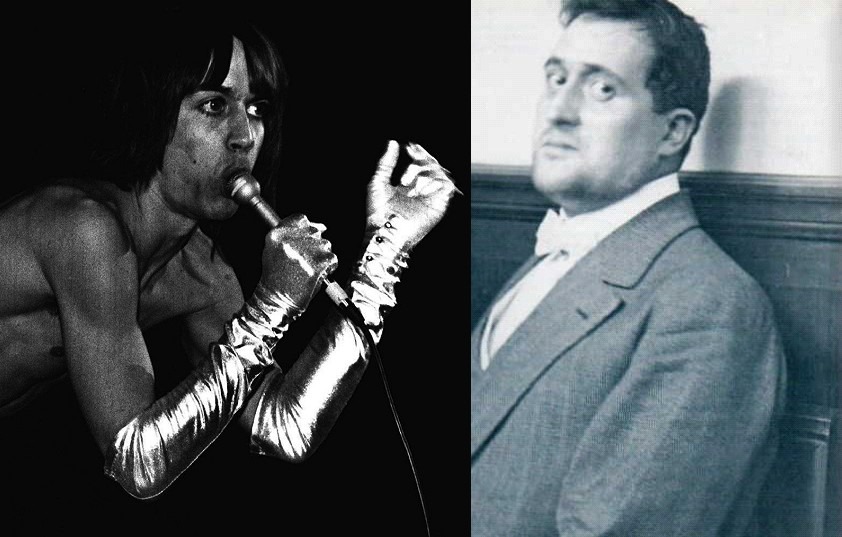
Pop and Apollinaire

Dionysus and Apollinaire.


Musically I’ve had this thought lately that I’ve avoided use of some of my most basic musical genres. And Iggy and the Stooges are the definition of that. They started as an art project, making free-form noise on stage, with Iggy Pop, a converted blues-band drummer as their front man. Somehow they decided that the most elemental and elementary expression, however untutored and unvarnished was the way to go. Iggy Pop’s lyrics were the “Blue Undershirts”  of 60s rock, the rejoinder to “you call that poetry.” A song such as “1969”  from their debut LP is a bored and hedonistic critique of a year deep in another war, cultural and shooting. Robert Lowell it’s not. It’s really not. No, it’s really really not.

For this performance I’ve enlisted my son, the “in his first year of it” bass player and singer, who from his interest in punk and indie-rock can explore that aesthetic with a fresh set of fingers. Conceptually, this song is inspired by the Stooges “1969”  because here we have (with “The little car”)  two songs about war across a nation,***** but in my tribute I simplified the Stooges’ typical 3 chord trick into a 2 chord chug. Of course, to my son the Vietnam era is exactly  as old as WWI was to Iggy and the Stooges. All wars should be so old.

Here’s the text of “La petite auto” in French with the calligrammes section.

The player for our performance is below. Click on play and turn it up.


*And the French in turn sometimes looked to American Walt Whitman, who never found full favor with the English language avant garde, making the French vers libre writers  poetic money-launderers!

**Posters about the evil Hun that I happened across in visits to the Iowa Historical Society museum in my childhood impressed me with the arbitrariness of racism: roughly as subhuman as any Jim Crow or evil-Asian propaganda. When you ascribe evil to an other, skin pigment is just a convention that you can work around.

***E. E. Cummings was heavily inspired not only by Apollinaire’s dropping of punctuation, but his freeness with placement of text on the page.

****The taxis that saved Paris legend may not hold up. But my favorite part of this linked story? The account that the taxi owners kept the meters running and presented a bill to the government after the battle. Paging Joseph Heller or Milo Minderbinder to the white courtesy phone.

*****Or not—at least by intent. On the rattling plastic luggage record players of the time, I always heard Iggy Pop’s opening lines in 1969 to be “It’s 1969 OK/War across the USA.” Some cover versions say I’m not the only one who heard “war” as part of the folk process. The published lyrics and close listening with headphones say Iggy was singing “All across the USA.” Well, excuse me while I kiss this guy. The Iliad  was carried by an oral tradition long before it was written down. Regression analysis says Homer wrote it about some sunny Mediterranean partying and dancing. The homoerotic and warfare parts were just misheard by the folks in the back row.
The Parlando Winter 2018-19 Top Ten part 1

It’s time to look at the most liked and listened to pieces here during our just ended winter. Overall, listenership was down in December and January, and I was a little discouraged by the drop off from the growth I was seeing throughout the rest of 2018. But then February was one of our most listened to months and March has started off strong too while readership of the blog posts here continues on a general upward trend.

As I’ve done for the past couple of years I’m going to count up our Top Ten audio pieces from 10 to 1 the rest of this week. I always enjoy tabulating these totals, as just like the Parlando Project in general it’s usually a mix of the “big names” as well as the lesser-known writers who I come upon looking for material we can use.

10. There Came a Lion into the Capitol. And we don’t have to wait long for a lesser-known. Walter J. Turner was a friend of Yeats who I hadn’t heard of until I read a book from 1920 seeking to summarize the British poetry scene, and saw Turner’s name. This one seems full of occult symbolism, something that links Turner to some of Yeats work as well. Since the lyrics mention the lion coming to the “blare of a great horn” I tried my best to play a trumpet line using a synthesizer “virtual instrument.”


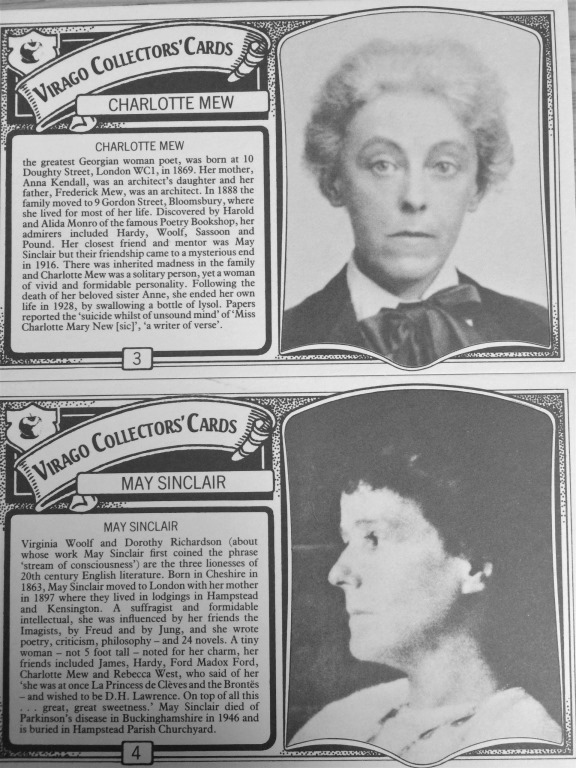
Mew and Sinclair Virago Collectors Cards 16

A Lioness Comes to the Capitol, or ‘Shipping the Poets. At least by the accounts I’ve read, Mew and Sinclair’s relationship was more troubling than these trading cards have room to recount. The “sudden end” involves May unexpectedly chasing Sinclair around a bed


9. The Trees are Down. The same 1920 book that mentioned Turner had considerable praise for Charlotte Mew, who’s become a personal “talent deserving of greater recognition” cause  for me this year. You can see some similarities to Emily Dickinson, Thomas Hardy or Christina Rossetti in Mew, but she’s got her own sensibility that immediately stood out as I started to read her work. She seems to have been an eccentric person in her life, but one of the joys of art is that different often attracts. This one’s a surprisingly modern meditation on a group of urban trees and spring. I liked what I was able to do with the bass and guitar parts following each other as Dave’s piano playing filled up the middle of this LYL Band performance.


8. Archaic Torso of Apollo. Even though he wrote in German, Rainer Maria Rilke is, on the other hand, well-known even to English speakers. There’s a spiritual/philosophical element to his writing that seems to attract many seekers, whatever language they read him in. Several translators have tackled transmogrifying this poem from German to English, but I try to do my own translations here.

In the process of doing this project I find I have to dig into the words I use and try to figure out what they’re asking for in terms of music and presentation, but doubly so when I attempt translations to English. I’m not sure how good I am at the translation task, but it’s a very intimate experience, trying to see, sense and think like another poet. I highly recommend doing your own translations to poets seeking to stretch their literary muscles.

Musically I spent even more time than usual on getting the drum part right, as the opening of my performance is all spoken word over percussion.


I’ll be back next with numbers 7-5 in our Top Ten Winter Countdown.

Gacela of the Dark Death

Here’s a piece using a fresh translation I made this month of a Spanish poem by Federico García Lorca. I’m sure there’s much to say about Lorca from those that know his work better than I do. That group of Lorca admirers includes many other artists whose work I respect, so it’s about time to present something by him here.

I’m told that a Gacela is a traditional Spanish form, but that Lorca’s poem follows the form only in spirit. Because Lorca was executed during the Spanish Civil War, not long after this poem was written, some view it as reflecting his experience of the war, but I get the impression that death elements were present in Lorca’s work even before the war. While encountering this poem in order to translate and perform it, I came to believe there’s a compound commentary on human mortality and more here.

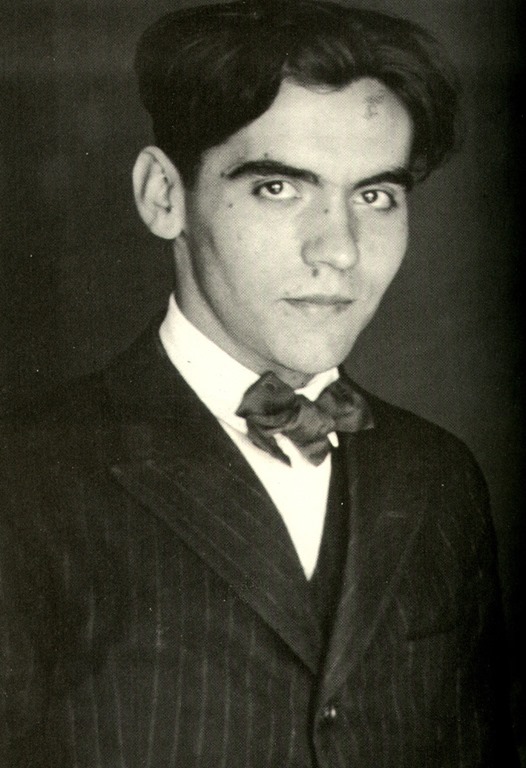
Federico_Garcia_Lorca

Federico García Lorca, a poet with open heart dreams


The poem opens and closes with a refrain that ends with a strong, bloody, and yet ambiguous last line carrying the image of a boy wanting to cut his heart. I chose not to overdetermine that image because I believe its ambiguity should remain. It could be an image of desire, or of self-harm, or emotional outreach—so let it be any or all of those things.

The middle portion of the poem, which I chant rather than sing, has a tone in my reading that has humorous elements, even if that seems to go counter to other readings of the text I found. When this section starts with what sounds like folk aphorisms about the dead, I take them as dark humor. In the next line “No quiero enterarme de los martirios que da la hierba” I decided for the only time in my translation to intentionally make the image stronger to American readers, by making the hierba, the grass, “leaves of grass” to connect to Whitman and his great image forged in the American Civil War. I can’t be sure, but I spent a long time on that stanza’s moon with a snake’s mouth image, “la luna con boca de serpiente” and what with the punch line about that mouth always working before dawn got me asking the question if this was a vampire image, which I decide to refer to sideways by determining that fangs were what serpent’s mouth means. Consistently in this stanza Lorca is giving us death images, but he’s also saying he doesn’t want to hear them.

I think the next stanza is meant to be humorous too, starting off with the wanting to sleep (perchance to dream?) for a moment to maybe as long as a  century—but “pero que todos sepan que no he muerto,” “let everybody know I’m not dead” as I translate it. Yes, like Hamlet he wants to compare sleep and death, but he’s playing with it. I’m at a loss if the “pequeño amigo del viento oeste,” “little friend of the west wind” is referencing something. It sounds almost like a children’s story or lullaby. I think this stanza’s concluding line is so wonderful that it transcends mood and attitude: “soy la sombra inmensa de mis lágrimas,” “I am the immense shadow of my tears.”

This stanza’s concluding line is so wonderful that it transcends mood and attitude: “soy la sombra inmensa de mis lágrimas,” “I am the immense shadow of my tears.”

The final chanted stanza before we return to the sung refrain also seems to me to be playing with death. Are we meant to take the insects here as accomplices of the grave’s earth? But this sounds like a boyish schoolyard dispute “He threw ants at me!” And what’s with the scorpion claw? As a northern North American I don’t deal with actual scorpions (hey, tropic readers, let me tell you about black flies…) but isn’t it the stinger that’s the weapon? I’m left wondering if there’s some idiom here that I just don’t know, even some kind of schoolboy pestering like unto a “noogie.”

And then the poem returns to a variation of the refrain, mysterious, beautiful, and I think serious. As to the intent of the poem, I felt I could perform the mystery and commit to the humor I found in the middle section without knowing the poem’s heart entirely. I think you can listen to it the same way. It is a darkly playful meditation on death? A comment on the outbreak and casualties of a civil war? Or is it a longing for childhood life and adventurous dreams? Or a love poem to a young man in Lorca’s life at the time the poem was written? Walt Whitman could sing all those things together, so why couldn’t Lorca?

I felt I could perform the mystery and commit to the humor I found in the middle section without knowing the poem’s heart entirely. I think you can listen to it the same way.

Musically, I sought to contrast the two refrain sections from the poem’s middle one. I was going to play my nylon string guitar for a Spanish flavor on this. Sadly, when I opened its case this week I found that its bridge had come completely off the top. Oh well, my battered Seagull Folk guitar had to stand in. My orchestration brings a bassoon part forward.

You can hear my performance of my English translation of Federico García Lorca’s “Gacela of the Dark Death”  with the player gadget below.

Archaic Torso of Apollo

New Year’s is a time to look at where one’s been and to look anew, to make resolutions and changes. So, let’s look anew at a 110-year-old work by Rainer Maria Rilke.

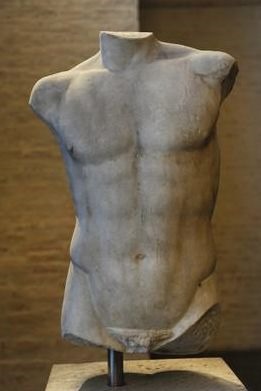
That’s appropriate, because Rilke’s “Archaic Torso of Apollo”  is about looking at something old, something that many others have looked at. And Rilke’s poem too has been read and listened to by many, both in it’s original German and in several translations into English. Each translation differs from the others as there are several problems of understanding and reconstruction into a new language that each translator had to solve. So I started by doing my own English translation, working with Rilke’s German words and trying to understand what he’s getting at.

What’s the over-riding observation about the statue that is Rilke’s subject? That it’s broken and incomplete. This is past obvious, but because Rilke spends some time in this brief poem talking about how drawn he is to it, I think it’s possible to misunderstand this point. He says wonder-filled things about it, and this leads many translators and readers to believe that he’s making a case that it’s artistically perfect in some talismanic way.

Torso of Apollo

Worst New Year’s party ever. Woke up without head, arms, legs…

My reading is that he’s making a contrasting case. This is a legless and headless statue. Rilke makes us see right off that the head is missing. Describing that missing head Rilke uses the German word “unerhörtes,” unheard—which we take in the sense of “unheard of.” Translators have translated it into “fabulous”, “legendary”, and so on. There are certainly good German words for those things, but Rilke chose otherwise. Does he want the double meaning that this statue of the Greek god of poetry and music is missing its ability to hear?

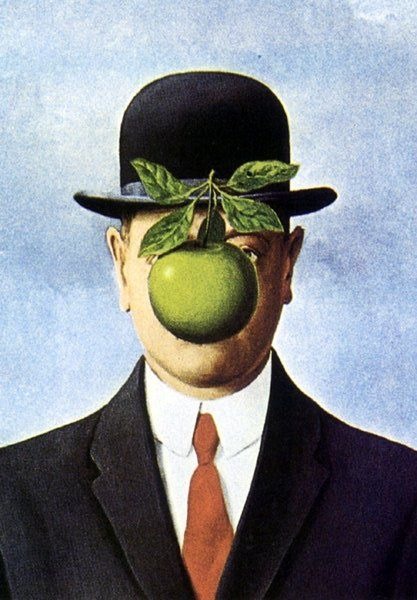
What do I make of the remarkable, surrealist-sounding image near the start of the poem that the missing head is surmised to have eyes ripened like apples? Everyone is struck by the audacity of it, but what does it mean? I don’t think Rilke means this in a René Magritte way, as even a small apple is too large for an eye socket. My wife had a suggestion: ripened apples eventually fall and rot, just as the head has been harvested or fallen from neglect.

Magritte Son of Man

Eyes ripened like apples, René Magritte’s way.

Another hard to translate line is the poems eighth, which dips down to the naked statue’s beltline and makes reference to genitals that should be there if we were to continue in the path of the gaze. I suspect the statue has been fractured above them. My translation breaks with most others on the following “beast’s pelt” reference. Some translate that fur as a wonderous quality of the entire remaining stone torso, which seems to make no sense imaginative or otherwise when referring to Greek statues of Apollo*. My translation reads the German as saying that the wild beast’s pelt is missing, that is to say that the statue ends above the pubic hair. So blind, deaf, headless, and also without his sex organs.**

What’s left after these amputations, this incompleteness? First, Rilke is drawn to this torso. He is a poet, and Apollo’s the god of poetry. He’s also spent a couple years working as a young assistant to the great French sculptor Rodin, so statuary is an interest. I think what he sees as still there is the soul, the heart, the essence, which he portrays as that mysterious flame-like glow in the marble and the remaining curves that smile at the damage.

Which brings us to the poem’s notable surprise ending, which I won’t spoil in my explanatory text if you don’t know it already. I think Rilke is drawn to this torso because he senses this soul, that which eternally remains, that which is without borders and broken places, can heal or transcend this: the lack of fulfilled desire, vision, mind, and music. Perhaps he is drawn to this broken statue so intensely because he feels he and his art are broken and incomplete too.

To hear my performance of a new translation of Rilke’s “Archaic Torso of Apollo,”  with its conclusion that many readers/listeners find unexpected, use the player gadget below. And to all the brave readers and flexible listeners here: an exploring and improving New Year!

*Rilke may not have known it, but something else was missing on that statue. We have become accustomed to viewing classical Greek statues as glowing white marble, aesthetically we may have even absorbed the idea that this monochromatic paleness is the timeless ideal. However, the Greeks painted their statues, even the nudes got skin tones and hair color. Oh, and they were Southeast Mediterranean people with interchange with Africa and the Middle East, those skin tones weren’t pasty white, as examination of pigment remnants on classical Greek statues reveal.

**Of course, I must be modest. My knowledge of German (like my knowledge of French and classical Chinese which I’ve also translated here) is lacking, which can lead to translation errors. The only skill I can bring to this is that I read, perform and write poetry.

And the most liked/listened to piece this fall was…

What makes for a “hit” in the small province of the Internet that is yours and mine?

We started off the countdown of the most liked and listened to audio pieces here this past fall by talking about the variety of poets and writers that we use for words. Yes, we present well-known poems and poets work, and yes, we like to go further and look at the poets that other poets were influenced by or admired. Sometimes we go yet farther down into the unclaimed storage locker of history, to the obscurities that you likely won’t encounter in school or standard literary surveys.

When looking for words I only ask to find some interest in them and that they are of a length and focus that can work with music, and that they are free for me to use (typically this means pre-1923 work that is in the public domain).

And you, the audience? If you’ve stuck with our efforts here, you’re broadly curious, or at least ready to wait for something to come along that strikes you. I’m so pleased to have you listening and reading, because, like me, you’re ready to have encounters with the unknown or new aspects of the known.

And look at what most captured your attention this fall. Four poems by well-known authors (Sandburg, Cummings, Blake, and Dickinson). Two by influencers/”poet’s poets” (Edward Thomas and Paul Blackburn). Two that are from classical Chinese poets (Du Fu and the unknown author from the Book of Odes).   And one observation I wrote myself (though I also arranged the short quotation from Blackburn and did my own translation of Du Fu).

This past fall’s most popular piece is yet another English translation from the Chinese Confucian Book of Odes.  Even though the words appear to be an inaccurate translation, they’ve gathered their own place in English-speaking culture in the same way that the King James version of the Bible, or FitzGerald’s Rubaiyat,  or Ezra Pound’s own take on classical Chinese poetry have, despite disputed translation accuracy.

Wild Plums scroll

A mid 12th century Chinese scroll illustrating another plum poem in the Book of Odes


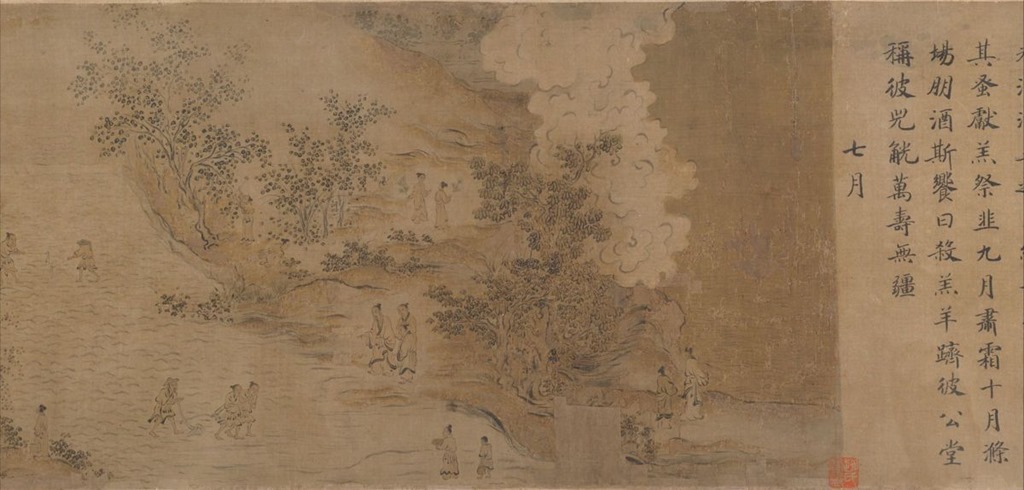
Someone first wrote, and likely sung, this poem nearly 3000 years ago in some southern province of China. Given that it’s another of the Odes  written in the voice of a woman, we may assume it was a woman. English translations I have read generally portray the speaker as a well-born eligible woman who is more or less saying “Hey suitors. I’m a catch. If you want to marry me, get your proposal in quickly.” A minority contrastingly represent the woman as being too picky, rejecting too many suitors, and in that view, she needs to stop fiddling around and choose. Either reading is interesting. At least on the face of it, it’s reflecting some (though likely upper-class) female empowerment in bronze-age China. But these are not the translations I used.

Here’s the text of the translation I used for my performance. It can be found all over the Internet, but more importantly and intimately, it was known by my wife who sent it to me.

ripe plums are falling

now there are only five

may a fine lover come for me

while there is still time


ripe plums are falling

now there are only three

may a fine lover come for me

while there is still time


ripe plums are falling

i gather them in a shallow basket

may a fine lover come for me

tell me his name

When I first posted my performance as “Wild Plums”  I didn’t know who did this translation, and despite several hours of reading and searching, I still don’t. Translators generally are attracted to and retain the poem’s litany of plums* decreasing in number, regardless of how they render the situation, but the outlook presented by this version is different. The woman has less agency, or at least in this matter of desire and longing over the course of the poem, she is willing to cede for the moment her power (other than hope). And that is one of the things lyric poetry allows: no one need expect that the moment of emotion or perception in a short lyric is a person’s whole thoughts and feelings on a matter, or themselves. We only ask that it shows us something vital that we wish to have shared between ourselves. As such, this version strikes a chord in our time and our culture.

I still don’t know who this translator is. I have a theory. If that writer didn’t write the translation herself, she popularized it, as I can find no references to this version of the ancient poem before Susan Sandler’s 1985 stage play and then screen play for the 1988 movie Crossing Delancey. Here’s how the poem was used in the movie:

I saw the movie when it came out, and I remember liking it. A different take on the RomCom formula.


The woman in this scene (played by Amy Irving) is the movie’s unmarried heroine, and the somewhat smarmy dreamboat across the table (Jeroen Krabbé) captures the heroine’s attention immediately with the personal resonance she feels with this version of the poem.

The person who posted the movie’s poetry scene on YouTube says the translation was by Arthur Waley, but I’ve already found other references to a completely different translation that begins “”Plop fall the plums; but there are still seven” by Waley. So, what’s my mystery translator theory? Could it be by Susan Sandler herself? If anyone knows, please give me info in the comments.

Well after all that, here’s my performance of this piece. If you haven’t heard it yet, the player is below.


*Poets and writers seem attracted to the plum when choosing their imagery. The wild plum is referenced elsewhere in the Book of Odes, and Horace, Laura Ingalls Wilder, James Joyce, Mary Oliver, and William Carlos Williams (meme-worthy, if non-wild, plums). I even decided to use wild plum blossoms in my own ode about my son.

Fall 2018 Parlando Project Top 10 Number 7-5

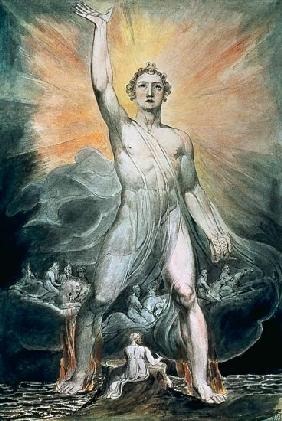
7. A Poison Tree words by William Blake.  When I posted this piece this fall, I remarked that Blake never seems that popular with the blog readers/listeners here. Dave and I have always sung Blake pieces since the early days of the LYL Band, and so we persist anyway.

Well, this piece finally allowed William Blake to break out. I can’t say exactly why, but I’m just glad it found an audience.

When I first encountered Blake as a young man, one of the things that I admired about him was his DIY/Indie spirit: apprenticing as an artist/engraver, doing his own coloring, writing his own texts, devising his own mythology, making his own prints. In the psychedelic Sixties there was this appeal because Blake was a visionary, the man who was reported out talking to angels in trees. Well those are the reports—but the work says he did a lot more than that, using his hands and applied energy. Reminds me of one of my mottos: Creative people aren’t people who have great ideas. Creative people are people who make things.  Of course, you’ll need some ideas, some vision that we need to see—but sometimes you’ll come upon those on your workbench scattered and shining amid worn tools.


The Angel by William Blake

In pickup basketball games, Blake always played skins. Also no pants.


6. Gone Gone Again words by Edward Thomas.  Thomas has been a blog favorite here ever since I followed the connection from Robert Frost to him, and discovered that I had unwittingly nearly reenacted his most famous poem “Adlestrop”  on a visit to England.

Thomas seems to have suffered from depression and other issues throughout his life. I don’t think that sadness inspires deep poetry, so much as battling it does, and Thomas’ poem is a compressed record of that battle as well as his beloved countryside of England during WWI.


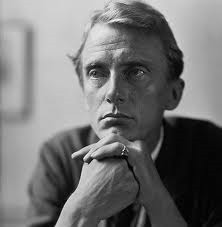
Edward Thomas thin and thoughful

The return of the thin white duke, throwing darts at Blenheim oranges


5. Jade Flower Palace words by Du Fu.  I’ve noticed that I was using a string section of some sort (or its Mellotron equivalent) for every piece so far. Finally, we break that pattern as a conventional, unadorned LYL Band rock-combo instrumentation is used in this live recording.

There’s something I feel in Du Fu’s poem that is very near to Edward Thomas’ that is just above in the countdown, so it’s a nice coincidence that they slot together in popularity this time.

During the Parlando Project I’ve taken to doing my own translations from non-English language sources, including this one. Particularly with classical Chinese poetry this is risky or audacious on my part. I’m not sure if I should be encouraged by the number of inaccurate translations that are out there, including some that are fairly well-known—for example: the Chinese translations of Ezra Pound, which I’ve loved even after learning of the translation errors present in them.

I sometimes view my task as translator like I view my job as a musician who wishes to cover someone else’s song without merely duplicating it. I don’t want to be unfaithful to what the writer intended, but I do want to express it, in my own country’s language, in my own time, to my own audience. To do so, I may pull things toward my own language and my own grasp of the author’s imagery to keep what comes out vital.

That may just be an excuse for my own weakness in foreign languages and other skills of translation. Still, though Ezra Pound’s “River Merchant’s Wife” or “South Folk in Cold Country”  are not what Li Bai wrote, they are powerful works. But then, Aretha Franklin’s “Respect”  isn’t Otis Redding’s “Respect”  played back faithfully either.


Jade carving

“There are many paths away from here. How long are any of them? None of them go on forever.”

Wild Plums

Is love enough in dealing with matters of translation? I want to talk a bit about some issues with this, and while it may start out sounding esoteric, stay with me, I’ll end up as immediate as anything.

I’ve presented Chinese poetry here before. Collected classical Chinese poetry goes back to around the 10th Century BC, materials gathered from an oral tradition around 700 BC and written down by Confucius or his school, and also a later golden age in the 8th Century AD for literary Chinese poetry. In Western terms, that’s from the time of the Bronze Age Trojan War to the time of Homer to the European Dark Ages.

If you enjoy thinking about large amounts of time, consider those dates again, that’s 1,800 years between the time of the oldest Confucian Odes  (or the Book of Songs  as it is often called), and the time of Du Fu and Li Bai, and then over 1,200 years until now, a total of 3,000 years—enough time to get through that bookshelf of books I’ve put off reading to do this project. Or if you’re a listener and want to relate this to the oral culture of the Modern or the Bronze ages, in that 3,000 years span you could listen to every one of the 20 million tracks on Spotify 26 times each and still have time to go for a night walk in the country while trying and failing to count the stars.

Let us contemplate the differences inherent in that much time. How different was the culture of Du Fu’s time or his anonymous predecessors who sang the Book of Songs  before it was a book? I can’t even begin to compress those differences into a short post.

We sometimes speak about unchanging “human nature” when talking about such a great divide of time and place—and yet, then we turn the page (or flip to a new browser tab) and read about how technology and social changes may have significantly altered how humanity works in a decade or two. How much differently did a poet or a listener/reader evaluate, create, and experience poems then, compared to now?

Both of those conclusions could be true (essential, retained, human nature elements and change that is not slowing in velocity), each moving from opposite edges of the human experience in proportions hard to measure objectively from inside it.

Into this gap steps the translator (and in our case here, also the performer) who seeks to render the written record of these poems from a place so far away in time that great geographical distances seem minor. The task of translating a hundred-year-old poem from French to English is difficult enough—but this?

Should there be any surprise that many of these translations will seem inaccurate and differ significantly between themselves in their approximations, or that areas that would be understood by the poet or their more contemporary readers remain mysterious?

Greater scholarship and cultural knowledge than mine may help in these approximate efforts at translation and performance, but even then, one should understand the difficulties and likelihood of success. And yet I do it. I want to try to grasp this, however imperfectly, not because I am Du Fu, or his nearest like extant, but because his story is different.

I promised I’d eventually get immediate. Here’s the first level of the now: think of the occurrences in our times where a choice to use, perform, or even experience cultural expressions of our contemporaries will draw condemnation on the grounds of cultural appropriation, non-identical background tone-deafness, or of just plain laughable or painful ignorance on the part of the artist (that last often two sides of the same flaw).

Some of these are very practical objections. In financial (as opposed to artistic realms) cultural appropriation impacts people’s livelihoods. Yet there’s no Du Fu or other 8th Century Chinese man to perform his work with a closer understanding today. And Du Fu himself, as a neo-Confucian, probably realized that his appropriation of Confucius’ literary appropriation of the oral tradition Book of Songs  material would be different and inexact in his own way.

Even if we’re necessarily failing, creating in our errors a cultural “telephone game,*” if we do this humbly and with respect for our forebearers, ancient or contemporary, I believe it’s honorable work.

Wild Plums

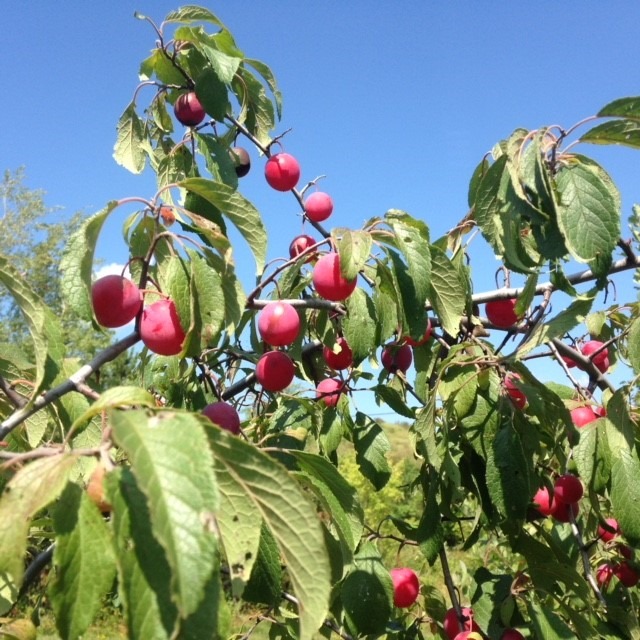
Wild plums my wife found along the Mesabi Trail, leading me to today’s piece


Here’s a second here and now: I mentioned I was re-reading some translations of the Confucian Odes  because my wife sent me a copy of one of those poems in translation, the one I’ve reworked into today’s piece which I call “Wild Plums.”  This was a gift of love I received in gratitude—even if the composer/performer-with-a-pedantic-streak part of me wanted to know who translated it, and if I could find a literal raw translation for another perspective on the work.** And here I found this, which indicates that it was not intended originally in Chinese in the way the translation presents it in English. My guess is that the translator loved the word music they found in it, that repetition of the line “the plums are falling ,” and this lured them away from the original meaning.

As best the literal translation I linked above can transfer an original meaning to me, the woman who speaks in it is either claiming that she has so many suitors that a successful one will need to up his game to make the cut (a Bronze Age “No Scrubs”) or it’s a portrayal of an eligible woman who is being too picky about a husband and has driven suitable mates off.

So, the poem that my wife sent me is probably not accurately translated, and yet it expresses something that was engendered in the translator by it, and by the caroms of life that bounced off my wife and to me. And that poem’s yearning, and the music of it in English has its own beauty, like the love that brought it to me.

And so that is what I adapted and performed. I’ve even added some additional refrains to further emphasize the musicality of the piece. To listen to the LYL Band’s musical version of this very old poem in it’s more romantic guise, use the player below.


*Also called “Chinese whispers,” unintentionally helping me make my point.

**That my wife is willing to tolerate this dreadful mix of traits is one of her charms, she even found and sent the less romantic literal translation as well.

(footnotes because I love My Year in 1918 using them)

Jade Flower Palace

National news and household events continually waylay my attention. Dejected gutters, palace intrigues throwing glances on complicated and duplicitous political alliances, and a middle-schooler with the sniffles—how can one weigh these things against this small but welcomed audience here for music combined with (mostly) poetry?

And so, I found myself short of material as I got ready to record with the LYL Band this week, a problem that the domestic, the national, and the poetic world combined to answer.

My wife had sent me a poem from the Confucian Odes  recently, a loving gesture gratefully received, and as beautiful as it was, I wondered about the poem and its English translation because of my work here. As the news sticks its tongue out at me with screen-edge notifications (mutterings about the Emperor and his possible private derangement issuing from the far-off capitol) I read again some of those Confucian Odes,  an ancient anthology designed to instruct not just scholars or poets, but politicians and bureaucrats.

What an odd idea. I suppose distributive requirements in American colleges still require some exposure to literature for those who will eventually serve in those roles, but this anthology was considered core material in Imperial China. And the Confucian Odes  are not grand works of moral or civic uplift, rather they are compressed, tiny reports of humble activities, decisions, and situations. They sometimes imply or depict correct behavior, but they don’t explicitly end with a moral. Their lesson may be, in the largest part, that the reader must study them and find the lesson in the everyday.

How different would our emperor or his retainers be if this was their schooling?

One collection I read mixed in later classical Chinese poems with some of the Odes.  It was here that once more I was pulled in by Du Fu, one of those aspiring bureaucrats who was steeped in those odes, but who lived centuries later at a time his country was in rebellion and upheaval. The Confucian ethos elevates faithful service, but who was to be served was shifting with the tide of rebellion. Reading Du Fu’s poems from the 8th Century as a small-part-citizen witnessing an empire disrupted in folly can have eerie resonances.

Late Thursday night, worried about material to record the next day, I began to translate Du Fu’s “Jade Flower Palace.”

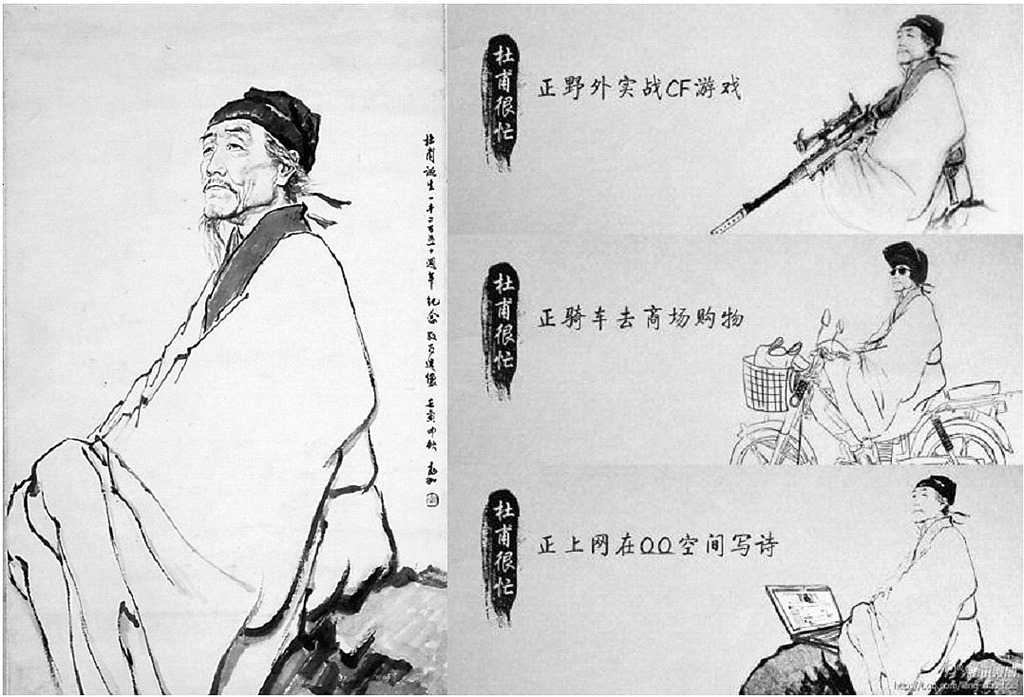
Du Fu and his Memes

If time is boustrophedon, wrapping back next to itself, then Du Fu may still be with us.


I could not find a clean literal translation of the original ideograms for the entire poem, only for about half the lines. I was able to find three previous English translations, which I could at least triangulate for the parts I didn’t have the raw stuff for.

Looking at what I had, I noticed that Du Fu was making constant juxtapositions, comparisons of contrast. Even the opening lines had water pushing and wind sighing and reflecting. That seems conventional, even a commonplace like “oh no, the wind and rain” in an English folk ballad, but it’s followed by a jump to rodents running through a roof, so close to a translation of the English idiom “bats in the belfry.” I decided to take Du Fu as intentional here. Events may seem to push you, or you may sigh and accept them, but “Rats are running in the rafters.” The ruin is real, and for that matter, your mind may reflect that too.

What follows is part “Ozymandias”  without Shelly’s political radicalism, and part ghost story. A ruined palace, once as lush as Mar-a-Lago, haunted by ghosts. I was puzzled by the “green ghost fires” referred to in this section, what with my limited knowledge of Chinese culture. Those three words are wonderous, but I still don’t know exactly what Du Fu is describing. Are there actual fires, lit as protection from ghosts (akin to the tradition of ghost lights in theaters)? Why green? Is it brightly colored moss or overgrowth in the ruins? Is Du Fu seeing luminous ghosts (instead of hearing them as he does later in the poem)? I can’t tell. Looking at some online material on Chinese ghosts, I see that this end of August/beginning of September period is sometimes celebrated as “ghost month” in China, and various things are done both to connect with or protect oneself from various spirits. Offerings, such as burning a pile of currency may be left out. I have no idea if that goes back to Du Fu’s time, but in our current world, the thought of a burning pile of greenbacks to keep one safe from long dead rich people sure seems like a vivid image. And water is running over the palace’s roadways. Just what is the sea level of Mar-a-Lago if global warming isn’t only a political question?

Green Ghost Fires

“Green ghost fires” The “ghost light” on the dark Fitzgerald Theater stage and money being burned as part of the Chinese Ghost Festival


As you listen to “Jade Flower Palace”  perhaps you’ll want to pay notice to Du Fu’s subtle use of juxtapositions. More so than the other translations I read, I sought to bring those forward in mine. Translators seem to differ on Du Fu’s final lines, and that was a part where I didn’t have a literal translation to draw from. As midnight approached, I left two alternatives for my decision of what the final line should be to follow “There are many paths away from here.” It could be “How long are any of them?” or “None of them go on forever.” In the morning I decided that I would keep both, another juxtaposition.

In the performance on Friday I used this as our band warm up, where we loosen up our old and demented fingers, a cold first take. I repeated the first two lines once more at the end both to emphasize that they should be heard as more than commonplaces, and as a reminder (to invert a proverb of mysterious origin) that history isn’t necessarily instructed by rhyme, but repeats.

To hear the LYL Band perform Du Fu’s “Jade Flower Palace,”  use the player below.

My Poor Bagpipes

In search of words to combine with music here, I sometimes find it necessary to translate from other languages. Poetry translation involves following strange paths.

Here’s the path I followed to present today’s piece, Jules Laforgue’s “My Poor Bagpipes.”  Throughout this month I’ve been presenting parts of T. S. Eliot’s “The Waste Land”  as part of my celebration of April as National Poetry Month. This causes me to look more at Eliot and where he derived his sense of modern poetry from. Eliot’s own testimony says that a late 19th Century French poet, Jules Laforgue was very important to his own poetics. That’s about all I knew about Laforgue: important to Eliot.

I search and find some Laforgue poems, though only a couple in English translation. Luckily, there’s a site, laforgue.org that has put a great deal of his work online in its original French. I pick out a handful that have interesting titles or first lines and see what rough machine translations will show me.

As I looked at the rough translations I was struck by déjà vu—only in English of course. “Hey, that sounds familiar! I’ve read something like this poem.” In French it was “Poètes a Venir,” and of course it was Walt Whitman’s “Poets to Come.”  It appears that Laforgue may have been among the first to translate America’s Whitman to French in 1886, while Whitman was still alive. And from his work translating Whitman, Laforgue began to write “vers libre”—free verse, himself, helping to pioneer that idea in French poetry.

Chat Noir Poster2

“The very illustrious company of the black cat with his famous shadow plays, his poets his composers.” Remembered by its posters long after it closed, the Chat Noir cabaret was a place where music and poetry mixed in 19th Century Paris. A very Parlando Project thing, no?


I will not be translating Laforgue’s translations of Whitman back to English here. I picked his “Air de Biniou”  to try, primarily because I was intrigued by the first line “No, No, my poor bagpipes.” I’m attracted to incongruity and black humor, and I kept double-checking to make sure that line’s “cornemuse” in French must mean “bagpipes.” The poem’s first verse seemed to refer to the bagpipes’ famously raw timbre and pitch issues: “everything is a mistake, everything turns out bad” claims Laforgue’s first stanza.

Inserting gratuitous bagpipe joke:

Why do bagpipers walk while they play?

To get away from the sound.

As I worked on it, I had trouble with several words, two or three of which I’m still unsure I’ve translated correctly. This may be a general issue for anyone translating Laforgue, as he liked to play with language and meanings, sometimes using unusual words. But I soon had a more serious issue, after dealing with “occit” in the second stanza. A poet’s images are not his literal manifesto, and irony was part of Laforgue’s stance. In this second stanza he says Nature is a wife the artist will kill. I get his point: the artist thinks they can better the mundaness of nature and create something new and above it. And it’s nature—an inanimate concept, not a person. Yet and all, it’s still a too-casual image of a too-serious and widespread problem, domestic violence, for me to be happy with it. Looks like this is a general issue with Laforgue too. He consistently used images of women, sex and relations with women as a repository for his issues with our biologic nature. In a word: misogyny.

Clearly he’s not alone in this. It could be one of the things Eliot picked up from him too. Like Eliot, he’s not stinting on masculine failures, but this can reveal an attitude that men  fail because of their souls  while women  fail because of their gender.  I tried to mitigate that stanza by dealing with another problematic word in it: “carambole.” It’s a word usually used for a particular fruit, but it’s also a bumper pool game, and something like that later meaning I think was what Laforgue intended. I was going to use something like rebound or carom in my translation, but at the time I performed it, I went with a more archaic meaning of the word where it may refer to cannons. At least that put the poet and Nature in a running battle. I may have made a wrong choice there, but that’s one of the things you run into in translation, needing to convey the author’s outlook which may not be your own.

We have little space left to wander more in the twisted paths you find when translating. I think it can be tremendously helpful for poetry composition, because it puts you, hand in hand with another poet, trying to find the right word with the right sound and connotations.

Bretons' with Bagpipes

“Je suis bagpiper!” says the man in the center. “Daddy, can we talk about the patriarchy and your intonation issues.” says the girl on the right.

But one last thing, those surreal bagpipes in this French poem. Laforgue’s family was from Breton France. Bretons are a Celtic culture, and yes, they have bagpipes. As to my music here, while I enjoy composing string parts and breaking out the classical guitar, sometimes I don’t want to be careful, I just want to grab electric guitars and bash something out. “Everything is a mistake” says Laforgue. Nonetheless. Use the player below to hear it.


March 2018 Parlando Top 10 Part 1

It’s time for that quarterly exercise where we look back for the most popular audio pieces here at the Parlando Project over the past season. I’m going to follow the format we used last time, and break the countdown into four episodes. I base the popularity on the number of likes following their posting here, and the streams the audio pieces received directly from the blog, or on iTunes, Spotify, or other podcast sources. Let’s start the count from the 10th most popular as we move up the list to number 1:

10. Rosemary

Even though these pieces were listened to in the Winter for most of our listeners*, Edna St. Vincent Millay’s words have a kind of spring-cleaning of the heart vibe, and so may be apropos for opening the windows and letting the curtains blow around—or at least they will in a few weeks when it warms up here in the northern part of the northern hemisphere. I awoke to 10 degrees Fahrenheit and snow and polished ice myself today.

I rather liked the music I wrote and performed for this one, just as I have liked going back to Millay to reassess the strengths she brought to poetry. Millay’s popular reading audience, once substantial, hasn’t completely disappeared, and there’s a welcome re-assessment of her poetry starting in academic circles.


9. Stopping by a Woods On a Snowy Evening

I’ve featured Robert Frost’s words quite a bit here, perhaps to atone for my dismissal of him when I was a teenager as the kind of worthy poetry in our schoolbooks that we needed to move beyond. Two things were key to my learning to love Frost: his uncanny ability to write lyrical verse that sounds natural, and my finally noticing the dry wit and stoicism that underlies most of his work.

Frost, alone of his American generation, has retained a level of popular appeal and critical approval. He’s double-edged in maintaining that. Some are captured by the surface of his poetry, hearing and maintaining in their memory the catchy moral-of-the-story “big choruses” of Frost. In this poem, it’s the “I have promises to keep, and miles to go before I sleep” at the ending. Others listen carefully to the verses, the parts other than the lines we most remember, the parts we can come back to and find that we’ve forgotten were there. When I came to work musically with this poem, I’d forgotten those. There’s no lovely woods to see in this dark night. He may be lost. He’s so dark and alone that he can hear snowflakes sweeping across snowbanks between the jingle of his rig’s harness bells.

Musically, I was obligated to add shaker bells percussion to stand for those harness bells, but then, more obscurely, I decided to add a South-Asian tambura drone for the sweep of snow.


amedeo-modigliani-pierre-reverdy

Modigliani’s portrait of Pierre Reverdy


8. Clear Winter

I was a terrible French student in my little Iowa high school and my little Iowa college. I seem to have no ability with languages, and less than no ability to handle those accents and the reforming of the mouth that makes speaking a foreign language possible. But I love poetry translation. I feel like a paleontologist removing the clods of sediment from a skeleton. Slowly, painstakingly, there it is, just as it was in its moment of sudden! But then my task shifts, and I must become the process of fossilization, to find the minerals of English that can fill in for the sinew and feathers of it’s original language.

I had a great time with the challenge of Pierre Reverdy’s “Clair Hiver.” I’m unsure of the accuracy of the “tea-kettle” section of my translation, but I fell in love with it, and could not abandon it, even if the light behind Pierre Reverdy’s eyes cannot reach the little anteroom behind mine.


*web stats I get for the streams tell me I have as many recent listeners in Australia as I have in Texas—and one listener in New Zealand. Bret, please tell Jemaine that there’s a lot of good stuff to read and listen to in the archives you’ll see listed by months on the right.