Here’s another new translation of a poem by pioneering French Surrealist Paul Éluard that I made in order to perform it with music. This one, “A La Minute,” which I’ve rendered as “At This Minute,” also lacks the extravagant imagery that one might expect in a poem associated with Surrealism. I hear its language as informal speech, though this could be a mistake – remember I’m far from a fluent French speaker, nor am I an expert on early 20th century France. The only solid objects referred to in the poem are the eye and a more vague “instrument.*” There’s also the pronoun “it” present, and from the poem’s title and inference that may refer to the abstract concept of time.
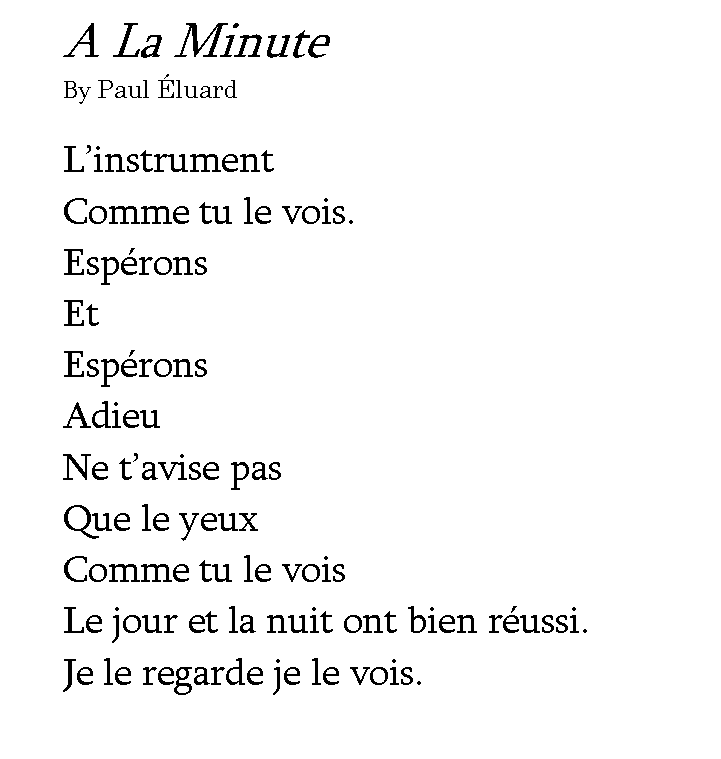
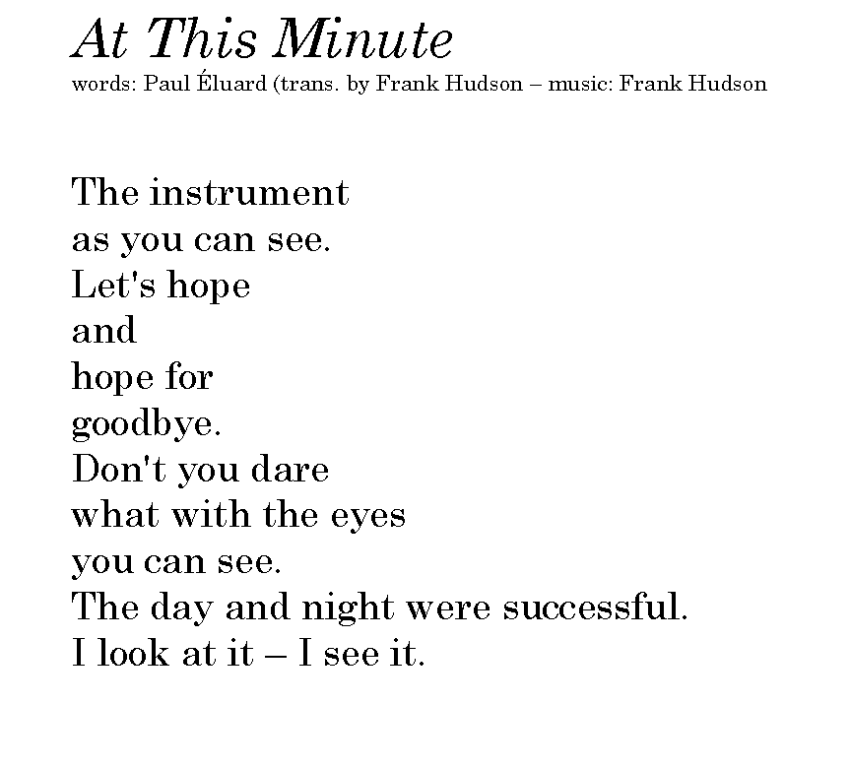
Éluard’s original French, and my translation to English. That translation may still be a WIP. This morning I was thinking I should revisit the penultimate line.
.
What the poem is talking about is elusive. Like the Éluard poem last time, the greater context and situation are left out of the poem, leaving a set of statements about it. At the time I performed the poem – as with “The Naked Truth” – I had decided that my performer’s subjectivity was going to use my dissatisfaction with my country’s current regime to animate the words. On deeper reflection afterward I’ve begun to think that both of these poems are complicated love poems. Perhaps if this series continues, I’ll write more about Éluard’s complicated love life, but even in the absence of that biographic information I remembered that Éluard is famous in his native France as a great love poet.
Those two frames can become congruent in poetic expression. If one loves one’s country and residents, one can have a complex relationship with its civic actions and outlook. Similarly, the intimate relationships between erotic partners cannot escape political and power questions. If early 20th century, or modern French readers, are expecting a poem about the affairs of love from this poet, they will likely hear it as such. As to the political reading? One thing I often see myself here in America: those women who carry experience with incompetence, reflexive lying, and lack of responsibility from intimate partners see immense resonance in my country’s current leadership. That is not a happy feeling, but it’s a clarifying one.
Éluard had a lifelong political side, and so consciously or unconsciously he may have intended this ambiguity. The poem seems to me to be addressed in hopes that a relationship will change, perhaps with the ending of it. What a speaker in the poem is declaiming then is that they are aware, can clearly see, what is wrong there. It may be a “who do you believe, me or your lying eyes?” situation.
Since I’m accustoming you to link two seemingly disparate worlds when hearing this poem, let me jump now to the music I made for performance. There’s a producer/musician and music theory teacher, Rick Beato, who has a very popular YouTube channel. One of his regular segments is to listen to the top 10 contemporary pop music streaming songs. This sort of thing is red meat for older listeners who eagerly click on those episodes wanting to hear Beato’s declarations of the lack of merit in modern pop music which will include objective reasons for that lack of achievement.** In one recent episode he noticed that many of the streaming hits didn’t “go anywhere” – meaning that they didn’t modulate to new keys, change tempo or time signature, or even change chords very much. Since there is a universe of sophisticated things that a composer or performer can do with all that, there’s value in pointing out the potential of using those musical tactics. But what he doesn’t stop to ask himself (or his audience) is: why might acts make that choice, and are then rewarded with large contemporary audiences for doing so?
Two putative answers that quickly come to mind: we are seeking something that seems stable and comforting – and conversely, we may be quite frustrated by the lack of positive change in our world and want to express that.
There’s a great, complicated, love song made famous by Aretha Franklin, written by Don Convay: “Chain of Fools.” Lyrically, that song may be a cousin to Éluard’s poem, and the song’s harmony is an interlocking one-chord riff, broken only for a few bars where all the instruments fall away and only voices and handclaps carry on in the same key. Whenever I hear someone make a statement that assumes that harmonic complexity is the key to effective music, I will call Aretha Franklin to testify.
Now I’m not Aretha Franklin – as far as I can determine, no one is – but my music for “At This Minute” is based on one chord (Em) with the tiniest movement in how it’s voiced. I built this composition starting with the rhythm, a pair of related and repeated broken chord piano arpeggios expressing that chord, underlaid with a simple bass part I played on my U-Bass.*** To drive home the statis, I plucked my kalimba (thumb piano) right up next to the microphone so that it sounded almost like musical hammer blows.
Rather than performing my translation from Éluard’s French straightforwardly, I decided to improvise repetitions of phrases in it. While it doesn’t sound like ecstatic Afro-American gospel a la Franklin, conceptionally, it’s akin. You can hear that performance with the audio player gadget below. No audio player? It hasn’t said goodbye, but I hope and hope you’ll see this alternative: a highlighted link that will open a new browser tab with its own audio player.
.
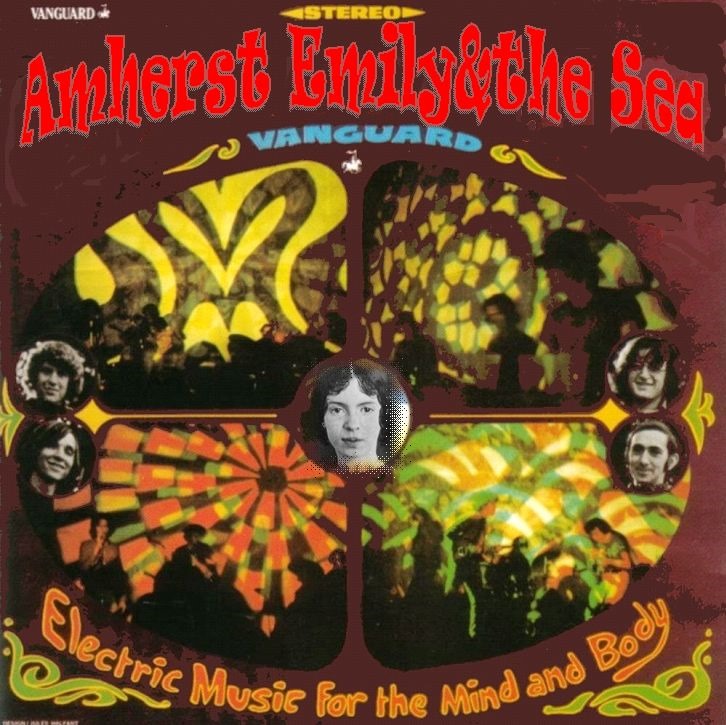
*What is that “instrument?” A clock or watch face perhaps? Or since the poem wants to riff on the eye and seeing – the spider face of Éluard’s poetry is as full of eyes as Emily Dickinson’s is of bees – the instrument could be the instrument of vision, the eye. If one was to create a Surrealist painting to illustrate this poem, both of those instruments should be melded together.
**To Beato’s credit: while he savvily promotes these run-downs (both senses of the word) as disparagement of modern pop music, he’s got a wide enough musical taste to offer praise for things he hears and likes in these top-tens. His grasp of music theory and enthusiasm for how it can be deployed is infectious, and that’s a good thing. As to how good or bad modern pop music is compared to the golden era that (just coincidently) happened when the oh, so, objective evaluator was a young person, I’ll call to the stand Mr. Theodore Sturgeon with his law that “90% of everything is crap.”
***The U-Bass is the size and construction of an ukelele, but with very thick nylon strings meant to be tuned to the same notes and register as a bass guitar (EADG). I love the upright bass, but I can’t afford, store, or play one well-enough – but I have three or four ways to make something like that instrument’s sound, such as today’s U-Bass.