A Summers Night

A couple of posts back we had a piece with words by Roy G. Dandridge who got called the “Paul Laurence Dunbar of Cincinnati.” Today’s episode’s words are by the Paul Laurence Dunbar of Paul Laurence Dunbar.

paul-laurence-dunbar

Paul Laurence Dunbar. Young, Gifted, and Black.

Dunbar grew up in Dayton Ohio, the Afro-American son of former slaves. In his town’s high school class of 1890, he was friends with another guy, a white guy, one who had varied enthusiasms. This other guy was a snappy dresser for his time, wearing newfangled wing-tip shoes, bowler hats, and a sporting a dashing waxed handlebar moustache. When the mandolin had a popularity boom, Dunbar’s classmate dude had to learn to play it, and he apparently drove his family around the bend as he practiced. Then later, the dude became interested in printing, and so designed and built his own printing press. He got so attached to printing and publishing that he dropped out of high school to start his own print shop with his brother. Then a couple of years later, the modern bicycle was invented, and his mechanical ability branched out to building, selling, and repairing bikes.

Dayton HS class of 1880 labeled

Dunbar with his high school class. Dunbar is in the upper left, our mystery dude in the shadows in the back.
And what’s with the guy on the left in the front row, shouldn’t he be in a band or something?

But let’s step back to that printing business. Paul Laurence Dunbar was already writing poetry as a high school student. After graduation, his family’s lack of funds and racial discrimination kept him from going to college, but he hungered to get into print. Our dandy, mandolin playing, designed-and-made-his-own-press print shop guy went into business with Dunbar and printed a newspaper that Dunbar edited and wrote for, even while Dunbar was still in high school–and then he used his connections in the business to get his classmate’s poems collected and published two years after Dunbar graduated from high school.

Dunbar’s books gathered attention. James Witcomb Riley, Frederick Douglass and William Dean Howells reviewed him favorably. By the end of the 19th century he had toured England, gotten a job with the Library of Congress, and written the lyrics for a Broadway musical and collaborated on an operetta, becoming the first widely known modern Afro-American poet before he was 30 years old. The 20th Century awaited him.

Then he contracted tuberculosis. His health declined, and though he tried to continue to build on his career, he died in 1906 at the age of 33.

He should have been one the older generation of the Harlem Renaissance of the 1920s. He could have taken his mastery of the lyrical 19th century style, and like Yeats in Ireland, transitioned seamlessly into the forms and topics of modernist poetry.  Alas, none of that was to be.
 

Dunbar’s “A Summer’s Night”  is a lovely, sensuous lyric. If one goes beyond the Victorian-drenched term “maiden” used almost as a refrain in the opening lines, and the slightly precious “perfumed bosom” of the southern breeze that closes the first half of the poem, the flitting last half that closes with carousing fireflies staggering home in the dark is just gorgeous It’s my hope that using our Parlando Project tactic of performing these words with music lets one more easily accept the sentiment of the more archaic words.
 
So, what happened to our mechanical aptitude dude, the guy who’s printing press began printing Paul Laurence Dunbar while they were High School classmates, helping launch the career of America’s first widely known modern black poet?

Wright Bike

This bike looks pretty sweet even today. Dig the mono-tube rear stay, the tri-plane front fork, and the flipped moustache bars.

Turns out bicycles were one of the seed technologies of the 20th century. Our dude knew how fabricate his own stuff, and make it strong and light. The dude was named Orville Wright and he and his brother Wilbur took the modest profits from their printing and bike businesses, and three years before Dunbar died, they designed, built and flew the first airplane. There was a lot of disbelief that a high-school dropout from a hick town could do any such thing. Pioneers like Paul Laurence Dunbar and Orville Wright had to do it,  otherwise no one would believe it.

To hear my performance of Paul Laurence Dunbar’s “A Summer’s Night”  with music, use the player below. And thanks again for liking, following, and sharing.

Adlestrop

Remember that “Reverse British Invasion” that happened 50 years before the Beatles landed in New York in 1964, when American modernist poets landed in London just before the outbreak of WWI?

One of those American poets was Robert Frost, and he soon struck up a friendship with an British writer Edward Thomas. Thomas was in his mid-30s by then, and he was writing this and that for whoever would pay, but he was not writing poetry. Frost and Thomas enjoyed walks about the Cotswolds together. Frost was encouraging Thomas to write poetry. On his part, on the walks Thomas would often puzzle at which country lane to take a crossroads, and Frost noted that.

Last summer I had the opportunity to take my own ramble about the Cotswolds with my wife. My itinerary was mixture of bicycling with some linkages between sections via train. During the biking part of the journey we often found ourselves lost. Just as with Thomas and Frost back in 1914, there seemed to be few straightforward crossroads and few road makers on the country lanes.  It was the hottest summer week in recent record in England that year, and at one train station stop the arrival of our train kept falling farther and farther back off-schedule as the trains were slowed and sometimes stopped by the fear that the heat would buckle the rails.

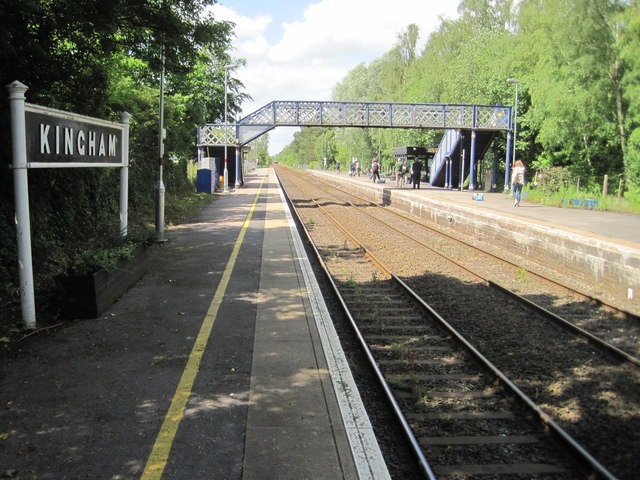
Well there was nothing we could do about it. We spent the next hours just sitting in the Kingham railway station in the heat we were somewhat accustomed to, watching the wind play with the trees and foliage, listening to the birds.

Kingham rail station

A few hours listening to the trees, breeze and birds at Kingham


This month in 1914, Edward Thomas had a train ride that stopped “unwontedly” in at the small Cotswold village of Adlestrop. Despite being a beginner at poetry, Thomas seemed to immediately grasp the modernist concepts, perhaps because he had no outmoded Georgian and Victorian habits to break.  His June experience lead him to write today’s piece, named after this village rail stop: “Adlestrop.”

adlestrop station sign

No rail stop in Adlestrop today, just this sign and bench remain. The present stop in Kingham is 3 miles away.


Thomas’ “Adelstrop”  has most of the markers of a modernist poem as Frost was writing them. It’s metrical, but not so strictly as to call to much attention to that. It’s rhymed, but again, the rhymes are not showy. There are no “hey look at me, I’m a clever simile or metaphor for something” tropes. In the place of that is the clean presentation of an exactly observed moment in time, peaceful, off the clock, yet clearly set in a time when the countryside’s nature and the train were in equilibrium. Thomas didn’t know it, but the moment in the poem gathered context after he wrote it, his village train-stop happened only a few weeks before WWI broke out, and England and Europe would be changed forever.

Robert Frost had returned to America, but he sent his friend a poem he had just written, one that was inspired by their Cotswold walks together, “The Road Not Taken.”   Frost’s poem famously ends with the lines:

Two roads diverged in a wood, and I—

I took the one less traveled by,

And that has made all the difference.

It’s been Frost’s fate that his irony and dry wit, as well as his uncompromising assessment of human nature, has often been missed by his readers. I first read “The Road Not Taken”  and thought, as do many to this day, that this was a simple homily— a boast that taking one’s own, perhaps less popular path, is the road to success and happiness. But read again, more closely, Frost was gently making fun of his friend’s indecision, Thomas’ puzzling at if there are meaningful differences between the two choices in their rambles.

Thomas, though himself a discerning poet, missed Frost’s intent as well. He thought it was reminder of the necessity of making correct decisions, and he warned his friend that readers would misunderstand it. At the same time, Thomas was mulling his decision regarding enlistment in the British army, which was grinding up men at a prodigious rate against the weapons of modernist war. He enlisted, and within a few weeks of deployment in France, he was killed by a bullet through the chest.

Sometimes when I compose music for one of these pieces, I find at the end that I have written something that reminds me of another piece of music, one I can’t quite place. Often when I solve this internal puzzle there is a mysterious connection revealed. The music I played and recorded for Edward Thomas’ “Adlestrop” reminds me a bit of the Edgar Broughton Band song “Evening Over Rooftops”—and the hidden connection for all that (different but shared) flanged and phased melody over an insistent strum,  is that like Thomas’ fine poem, they both are hymns to the eternal moment.

To hear my performance of “Adelstrop,”  use the player below. And another reminder that you can use the social media share buttons here to let other people know what the LYL Band and myself are doing here at the Parlando Project.


The Green Fairy

Here’s another piece with the voice of Dave Moore, and I guess you could say it deals in myths. In the notes for the last episode “Print the Myth” I said that myths arise out of the need to explain mystery, and that there are some dangers there. Your explanation, your perfectly good and gripping story, can be just wrong on the facts as we learn more; but also your favored myth may say more about your culture and yourself than you realize it does.

However sometimes we’ve simply forgotten what the questions and cultural associations were that gave birth to a myth, and they become these free-floating, free-associative ideas charged with a mysterious weirdness that defeats explanation. The myth returns to mystery.

Across the world there are demi-human nature-creature myths. I suppose they might have arisen out of explanations for the capriciousness of nature or the randomness of fate. At other times they serve as perfectly good characters to satirize human foibles in demi-human form. I think one of the strengths of “The Green Fairy” is that none of this is quite clear. Within Dave’s piece, we only know that the Green Fairy, like Godot, is coming (and not coming). I think that late summer mystery is its charm.

While producing this piece, I wanted to serve that mystery musically. I treated Dave’s keyboard part in a sort-of Lucy In the Sky With Diamonds manner and stayed on the drone with my stringed instrument parts.

To hear The Green Fairy, click on the gadget that should appear below to play the piece.

The School Year Begins

Tomorrow many US schools begin their school year, so here’s an audio piece about a child going through that first week back in school after what seemed to be an infinite summer.

The schools in Iowa, where I grew up, began a week earlier than the “day after Labor Day” start that is more common elsewhere in the US. I’m not sure why. Maybe farms needed kids more in the spring to summer transition weeks than in the summer to fall interval. Maybe it was an advance allowance for the inevitable “snow days” that would cancel school during the winter, days that if made up in the spring would move the end of the school year into June. Maybe it was, in some way, a gesture to say Iowans cared more about getting down to education than slacking neighbor states.

All I know is that as a kid I thought this terribly unfair. A whole week! My cousins in Minnesota got a whole week more of summer! That next week was always going to be the best week of summer, the one that you got to do whatever you hadn’t done, or done enough of, during the rest of the summer vacation.

Now my son goes to school, and the school yard the kids are walking across to get to the first day of school is like my schoolyard was. Maybe all schoolyards are like this. The grass is still a little beaten down from every independent path the kids have taken too and from, still worn from every recess outside last spring.

To hear the spoken word/music piece “The School Year Begins” as performed by the LYL Band, click on the gadget below this.