Lenox Avenue: Midnight, an extension

Here’s another early Langston Hughes poem from The Weary Blues,  his collection which I’ve chosen to focus on during this Black History Month. Given Hughes’ esteemed position as part of the Harlem Renaissance and the long career that followed, it may be hard to remember that this is a poem by a young man, less than 25 years old. Of course, as I reminded myself as I tried to write the best poetry I could as a young person: famous British poet John Keats died at 25 — so there’s no reason for our Afro-American poet to wait to write either.*

Though it was Langston Hughes’ first book, The Weary Blues  doesn’t make much of a point of his youth. While the perennial youthful topics of wine, love, and song make their appearances in this collection’s poems, there’s little if anything I can recall that makes explicit pleading that the author is of a new generation with new perceptions. The way Hughes did signal that was in the way he deals with the “song” part of that triumvirate: Jazz and Blues were still considered disreputable musics of little substance. The decade of the last Twenties may have been called “The Jazz Age,” but that then novel music was mostly the music to dance, drink, and swive to.

So, when Hughes claims right from the start that “The rhythm of life is a jazz rhythm” he’s making a fresh claim in 1926, that it’s not just some musical fad that’s passing through, a speeded-up frivolity. Even if white musicians and dancers were quick to latch onto the jaunty high-BPM rush of Jazz, Hughes is ready to claim that broken desires and pain were in there too.

Does he mean lovesick blues, or the Afro-American experience here when he makes that claim? Both I think. That’s a hella-reason why Afro-American forms pervade American music to this day: Americans as a whole have a long and strong dissatisfied streak. Plenty of musics sourced from around the world are good for dancing and signaling your erotic availability. Same for songs of utter sadness. But Afro-Americans figured out how to make sublime musics out of a combination of the oppressions and absurdities of life.

In his poem, Hughes twice makes the claim “The gods are laughing at us” — and despite the repetition of that line, he is ambiguous about what we should think of that. Are the gods the society that ignores, belittles, and oppresses? Or are the gods the wise eternals who know that we humans live short lives approaching half-knowledge, an absurdity that leaves laughing as wisdom?

I think at midnight — perhaps after some youthful partying that’s implied as preceding this poem — it’s a vibrating mixture of both. Overtones, undertones, Hughes says.

Move by Heidi Randen 800

Overtones, undertones….Jazz in Hughes’ 1926 was still thought of as a way to shake your groove thing.

.

I often mention that my experience of the poems I use for texts here often changes in the process of making them into Parlando Project pieces. With this one, as I began to understand and express Hughes’ words I wanted to reply to the laughing gods in the original poem. So, I extended the original words with my own couplet: “Let them hear the laugh I return. / Let them understand the laugh I return.” Is that laugh and desire to the wise gods or the careless and oppressing system? Both. I’m far from 25, and that’s what I think reading and performing the young Hughes’ poem today.

Music in this piece is about as close as I can get to Jazz, though more of the Jazz of my youth than that of Hughes’ time. Yes, that fad was still going concern 40 years after Langston Hughes wrote his poem. I spent most of my time creating the piano part, which unlike a real pianist I have to compose by playing and selecting parts for each hand, but modern “virtual instruments” let me do stuff that Conlon Nancarrow had to hand-punch into player piano rolls to realize. I wanted a saxophone part too, but as I’ve already mentioned this winter, I can’t really get the articulations a good Jazz sax player relies on. My sax part sounded like an early student playing the most dismal society dance band number, and so I made the compromise I normally avoid and put in a short Gil Evans-ish horn section sample to enclose my sax part effectively.

You can hear Langston Hughes’ “Lenox Avenue: Midnight”  and my extension to it with the player gadget below, if you see one — or this highlighted link which will open a new tab to play it.

.

*Lesser-known early 20th century Afro-American poet Anne Spencer made the same point eulogizing Paul Lawrence Dunbar with her short poem.

To Midnight Nan at Leroy’s

It’s Black History Month, and I’m planning on presenting a series focusing on Langston Hughes’ first poetry collection: The Weary Blues — but before we get to today’s new Hughes’ piece, let me briefly set down a few reasons for why Langston Hughes.

This project presents early Modernist poets most often. From the American predecessors of Modernism (Whitman, Dickinson) we often jump to those of the 1905-1926 era who sought in various ways to “make it new.” While I continue to read and have interest in post-1926 work, less of that can be reused freely for this project. This reduces the Afro-American sources free to use, as the beginnings of the Harlem Renaissance have moved into Public Domain slowly, year by year, since this project began in 2016. My earlier Hughes’ pieces, even if they were eventually included in The Weary Blues,  were published earlier and so had already moved into PD. It’s only on January 2022 that the whole book’s contents moved to public domain.

The Weary Blues cover 1024

Our February focus: Langston Hughes’ first book.

.

A second reason: look at the title of Hughes’ first book, it includes “Blues.”  As we celebrate Afro-American contributions and experience this month there’s an important parallel here. Americans, some of whom set up shop in England and France before WWI, are hugely important in establishing the Modernist break with the shopworn 19th century writing styles. At the same time, Afro-Americans were crucial in doing the same job for music. As I tried to briefly explain last Black History Month, a great deal of the American Black intelligentsia was caught flat-footed by this musical revolution happening around and by them.*

Let’s cut them some slack on that: cultural change is hard to understand while it’s happening, and the quick white adaptation of Afro-American musical ideas in The Jazz Age of the previous Twenties reflected back to the Black community some rough or even derogatory approximations of what was really going on.

Hughes was a young man when he wrote today’s poem. He’d crossed paths with Black intellectuals by then, but he wasn’t fully one of them. His father had cut a bargain for him to go to Columbia to become a professional. Langston skipped out, worked as a cook and at other restaurant jobs; and took to sea working on merchant ships. Hughes came quickly to an understanding of this new music, it’s complexities and its reflections.

Lastly, here’s one of the things I’ve come to understand about the beginning of Modernist poetry in English: there were substantial elements there that sought to strip back poetry, to simplify it to its essence, to make it immediate to an open heart and mind without pre-requisites. This mode was eventually superseded by a more academic and allusive poetry to the degree that some of the best of this early poetic Modernism was set aside or down-rated as simplistic and insufficient.

Over the years you’ve heard me sing the praises of Carl Sandburg, who seems to have been eventually excused away as cornball. But Sandburg was still vital to the young Langston Hughes in the 1920s, and Hughes took Sandburg’s Midwestern American Modernism and applied it to his own heritage and experience. The mainstream of Afro-American poetry retained more of the vitality and working-class connection that Sandburg expressed. Thank you, Afro-Americans.

Let’s move onto the poem I used as today’s text for the performance you’ll be able to hear below. “To Midnight Nan at Leroy’s”  is not one of Hughes’ best-known works, though it deserves more attention. Here’s a link to the text. You could skim through it on the page and see the Blues connection, even if it’s not a Blues stanza as printed — though it could be refitted as one — but more importantly, it’s got a Blues sensibility. My reading of the poem says there may be a little playing going on, a little con and double consciousness which the whole of the work will show up. This will let the hip listener say on hearing it “Yeah, you and I know what that’s like.” That’s Blues sensibility.

I think the poem is a dialog. Nan of the title is performing at a club, and she’s expressing some eroticism in her performance. I think the poem’s other voice is hitting on Nan. The opening stanza is that other voice, the un-named man, who’s starts out teasingly acknowledging that he’s getting what she’s putting down.

The second stanza could be either voice. I performed it neutral, even as if it might be a narrator, a third voice. Note the loaded word “jungle” in it, one of the “primitive” adjectives used to describe this new Afro-American art. Primitive isn’t totally a derogatory or diminutive to the Modernists, who remember wanted to remove the cruft of a worn-out culture and get back to an essence; but in the context of a white-supremacist-soaked society it could surely slide over to being that. Black artists with intact self-respect did use labels such as “Jungle” in the 1920s, so it’s not simply an external white appellation, but it sure sounds like they’re partially reflecting with the white culture when they do. Pause at the last line: I hear Hughes’ “And the moon was white” with intent.

The third stanza is the man cheering on the singer/performer Nan, and I think also he’s suggesting that if “lovin’” is her object, he’s ready.

Fourth? Yes, the two get together. I perform this as Nan’s voice. Note Nan’s use of the diminutive “boy” for the man in this part of our dialog. He may have been acting the player in his earlier stanzas, but I think this is an intentional reveal that the male character is less than a fully actualized man. The white moon image returns, and their moments of Black joy contrast against it. One could write a moving essay on this poems white moon image, but I’ve already gone long.**  You write it.

The poem concludes by refraining the entire first stanza. I perform in the man’s voice, now sour-grapes-ing the couples’ night. Who put one over on the other in this one-night? Maybe some of both, and maybe external social forces are part of the fate-mix too. Hughes chose to dedicate the poem to Nan, so I suspect his sympathies lie more with her. Another question: is Langston Hughes the unnamed male voice? Hughes’ sexuality is mysterious, and while that’s possible, my estimate is that he’s observing, not writing a poem as memoir here.

I performed “To Midnight Nan at Leroy’s”  with my own one-man-band providing the trio accompaniment, and I hope your speakers can handle the bass part. Some of you will see a graphical player gadget below, but other ways of reading this blog won’t show it, so here too is a highlighted hyperlink  to play it.

.

*Last years Black History Month book was 1925’s The New Negro , which included an essay worrying about the dilution of Black uplift and culture from the diversion of frivolous Jazz. Read my post on that essay here.

**As with Sandburg’s short poems, with Langston Hughes here it may help to imagine that you are translating this from Tang dynasty Chinese. The plain English words here could mislead us to think this a mere rote moon/June thing and that Hughes had nothing complex to say.

Sonny Rollins, The Bridge, 1959

I’ve got reasons for kicking off Black History Month a few days early: my February is going to be appointment-filled, something that’s likely to reduce new work for this project, and I want to participate in this observance of American history.

Why was I so determined to do this? Well, note this project’s subtitle: “Where Music and Words Meet.” I’m an American composer, and American music is disproportionally Afro-American music. Yeah, it’s a big country, and many musicians with heritages from every continent*  have contributed, but if you compose or play American music, a lot of the notes are Black. So let’s get to today’s piece through three short, linked, tales.

The First Story:

Who’s this Sonny Rollins, and what bridge is he selling us back in the Fifties of all decades? It’s easy writing about poetry as I do here most often, to get used to a constrained fame; but I suspect more of the general Internet audience will know Emily Dickinson, William Butler Yeats, or T. S. Eliot than know this man’s name and work. Mid 20th Century Americans, most often Black Americans, made a consolidated point of becoming masters of improvisation on the saxophone. Afterwards artistic accountants rank art and artists — and even if you think that’s wrong-headed, I’ll cite those who expend sincere effort in doing that and say that lists of great improvising saxophone players likely include Sonny Rollins.

But, just saying Rollins was good at it, a skilled musician, reduces him. For one thing, he had a dedication to the art of his craft, a need to expand the expression. So much so he famously spent a couple of years or so just dropping out of what was then still a viable commercial niche of jazz gigs and recording when he was considered to be one of the best and brightest on his instrument. To do what? To get better.

Insiders later learned some particulars of what he did. He went to a near deserted deck of a busy urban bridge and just played. And played. For months. For hours a day. In all kinds of weather. No, he wasn’t busking for spare change. Few noticed him. One of his records before this time was called Saxophone Colossus.  This wasn’t ironic as a title, or laughable, or a piece of hopeless self-promotion. Once likened to a metal giant who could stride rivers, Rollins on the bridge was small and alone and unnoticed, one man in a wind-gap of a city’s gusts. Practicing there he was no more than a flea on the back of a colossus.

After around two years of this, he figured he found some of his new/better. If you’re writing a screenplay you know how the final scene plays out. Our hero walks off the bridge and into a recording studio. A selection of ominous natterers remind us of the stakes in quick cuts: “Was he kicking drugs, or failing to kick? Is he washed up?” “You know folks like it sweet and tropical, he should try to play bossa nova.” The next voice says, “Funky jazz is the thing.” And another says, “How can you be even more free than ‘free jazz?”

And you know the next beat in your screenplay: he emerges with a record or a concert or both — and all of a sudden everyone realizes that he’s found it, something great, unique, ground-breaking, resplendent and recognized.

Wait, you don’t know who Sonny Rollins is — or maybe you do, but you know the person next to you on the Internet doesn’t. The record that Rollins did make was called The Bridge  in honor of the solitary workshopping he did over the East River. It was not a cultural event. Throw out your screenplay, the elevator doesn’t want your pitch. Even the experts then, the artistic accountants and grim critic-coroners were underwhelmed. Paging the Joseph Campbell who isn’t  an under-recognized Irish poet, this is The Hero’s Journey that ends with a shrug.**

The Second Story.

Back in my youth you paid for music ala carte. Every bit you could access at will was on a material disk you had to pay for. A person like myself with more time and adventure than money might scrounge. One thing I liked to do was to go into charity and second-hand shops and look for used records that attracted me. I can’t recall the exact cost of a new LP then, but I think it was around $3 to $4 or so. Records in these dingy shops might be a dime or 25 cents. Those within cardboard covers gave you extra material to judge if it was worth your widow’s mite — but at those places and time, the most forlorn records were just bare black disks scuffing against each other in a bin, and sometimes those got an additional price break. Whenever I recall those naked disks, I think of those who cleaned up after someone died or skipped rent and town, who just shoveled it all off to Goodwill or the Salvation Army in whatever, Warholian, cardboard boxes.

That’s where I found Sonny Rollins’ The Bridge.  I may have heard a bit about Rollins, how he was a particularly good improvisor because his improvisations had the logic of more considered compositions while retaining the flow of fresh idea after fresh idea.

Three things struck me about the record upon listening to it over and over and under its scratches and surface noise: that it mixed moods more than most jazz records. It wasn’t just a fast blowing session with a change of pace ballad or two, but that it was both angular and spare and hauntingly beautiful in both sorrow and joy.**  That the guitar player, Jim Hall, on the record didn’t sound like “jazz guitar” as I had heard it then.***  Instead, Hall added unusual harmonic colors that Rollins would then carve from. Eventually I realized something else unusual about the record as I compared it to more jazz records: there was no piano or other keyboard instrument. I eventually learned that this was something Rollins’ made a practice of. Yes, Hall was giving pieces some harmonic framework, and bass players in non free Jazz contexts are often asked to, and then, play “the changes” indicating the chords; but keyboard players, even if it’s not their session, often dominate the harmonic and rhythmic structure of a track. Here there was none of that.

Poetry in Gray. I know this is a long post, and I value your time, but here’s 30 minutes of the same group that recorded The Bridge playing live with a short interview with the 32 year old Rollins.

.

The Third Story

I read this week an article by John Fordham in the Guardian  that reminded me that Sonny Rollins went into the studio to start recording The Bridge on January 30th in 1962 — so, 60 years ago. Fordham remarked on the legend of Rollins’ time on the Williamsburg Bridge along with a new interview he did with Rollins.

Unlike almost every one of his mid-century saxophone contemporaries, Rollins is still alive. He’s 91 years old now, and I last saw him play when he was around 80. Rollins was performing in a trio on that night with just bass and drums, and for about an hour he tore it up covering so much sonic space with his monophonic but powerful instrument. I marveled then, and now that I’m approaching his age at that gig, my amazement increases. Rollins developed lung disease and can no longer play, but he seems to have retained his composer as improvisor ability to see the patterns and connections.

This month I’ve been trying to build up a little strength and chops on guitar again. Nothing like Rollins’ multiple hours each day on a bridge level of woodshedding, but enough so that I can play that instrument that requires some physicality to realize its sounds.

In the midst of this, in the middle of the night, I awoke with some thoughts I had been growing about Rollins and the task of being an American and Afro-American artist. I wrote a complete first draft of today’s text in that middle night awaking. Not quite a Kubla Khan  dream, but still complete and formed enough to count today’s text as an improvisation. Wednesday, I came up with the song’s harmonic structure equally quickly. Yesterday I recorded it. Given that I’ve no access to other musicians — and I hardly make count-one-musician unless I beg the composer (who’s me, so I listen) to make things I can play — I had to play a track at a time. Today’s recording is a trio: drums and two guitar parts. I first recorded the chordal guitar part on a big archtop guitar (DeArmond X-155) along with the vocal. I’m no Jim Hall, but like Rollins’ The Bridge  I let that instrument set the harmonic framework. I confess (though listeners have already convicted me) I’m not good at Jazz comping, a key guitarist’s skill in that genre. I pardoned myself and proceeded. I then did the drums, trying very hard to get them to play off the guitar’s rhythm feel. And then finally as my studio-space time was coming to a close, I got to “blow” with guitar for the lead part.****  I did four passes, and the third was the best, and there you are. No, it doesn’t sound like The Bridge  LP, but then the point of The Bridge  wasn’t to sound like what went before either. The player gadget to hear it is below. No gadget? This highlighted hyperlink will also play it.

.

*I must pedantically interrupt in footnote form to note that the continent of Antarctica has done little for American musical culture! It may be because our human species only visits there? One man, one guitarist at that, stands (sinks?) as the submariner of Antarctic-American guitar: Henry Kaiser. Here’s a 90 minute example.  Yes, that’s him playing guitar, and doing the under-ice diving too.

**Joy? “Without a Song. ” Sorrow? “God Bless the Child.”  Angular? The title cut’s cascade of heterodox melodic ideas. Or the stubborn “John S.”   I used to share a workspace with a 20-something guy who liked his progressive metal. He was perfectly tolerant of my King Crimson live tour ‘70s tapes. But the opening riff of “Jon S.”  would drive him right around the bend to a burlesqued old-person-like rant about “take off that noise.”

***Jazz guitar at that time was represented to me by John McLaughlin in his Mahavishnu Orchestra years and others exploring that bag. Those guitarists were loud and very in your melted-face with their expression. Even quieter, older generation jazz guitarists often played more notes in one song than Jim Hall played on the entire The Bridge  LP. Magazines would have “best of” polls back then for musicians, and I’d always vote for Jim Hall, who’d end up in the fine print of “those also receiving votes.” Then strangely enough as the 20th century started to end, Jim Hall became the model for a number of other guitarists who came up later, for example: Pat Metheny and Bill Frisell.

The Bridge itself has come to be recognized as more vital in retrospect. Oh, not necessarily to the raters who will need to get numbers down for Kind of Blue, A Love Supreme, The Shape of Jazz to Come  first, but to those who seek to learn new pleasures listening to music whose time has passed but whose timelessness remains. You may not like all of it if you just taste test it. Looking today, about eight times more Spotify listeners pleasantly listen to “God Bless the Child”  than dig “John S.”   By the way, the version on Spotify seems to be remastered, and to my memory Jim Hall’s parts are mixed up higher than they were in my vinyl memories.

****Should it have been saxophone? Yes, but I have a hard time wrangling any of my saxophone MIDI virtual instruments to get good expression, and Rollins is a master of saxophone expression. I stuck with my primary instrument for the lead instead. By the way, it’s the same jumbo DeArmond archtop that chopped the chords, but my little combo amp is turned up.

Oh, Maria

Here’s my performance of another poem from Irish-American poet Ethna McKiernan’s final collection Light Rolling Slowly Backwards.  In McKiernan’s later years of life she did social work with people who were homeless, and she dedicated Light Rolling Slowly Backwards  to “the hundreds of homeless clients I’ve worked with through the years — to their resilience, courage and care for each other.” Given that Ethna was somewhat frail even before her final illness, I marveled at her strength in taking that work on.

I recommend this collection, a fine summation of McKiernan’s poetry and its range. Here’s that link again to the Irish publisher of this book.

Why this one to start reading McKiernan? She herself created this “New & Selected Poems” book before she died late last year.

.

When I first encountered “Oh, Maria”  in draft form as a member of the Lake Street Writers’ Group I couldn’t help but flashback to my time working in Emergency Departments as a young man. As one side-point Ethna’s poem tries to convey the feeling of being next to someone experiencing a sudden, and unexpected death. I’d summarize those memories of mine as being full of intense experience, intent action, and if stabilization isn’t achieved, a solemn ceasing. Ethna’s account adds poignancy because it’s missing that middle part. I ached with her both as she feels guilt for not immediately recognizing the mortal nature of Maria’s incident — and then comes the line as she considers if she should have performed CPR: “If I remembered, God help me, how.”

I probably did my usual awkwardness in responding to that first hearing, perhaps mentioning how it reminded me of my experiences — something which was likely no help in her revision process. I think I did express that her missing the initial diagnosis of what was happening was not only forgivable, but par for the course. Could that have been worthwhile?

Indeed, my experience was that most people, even people who are otherwise medically trained, are likely to get this wrong in some way. Although my experience is now decades ago, I’ve seen CPR being performed on breathing people with a pulse — which is not a good thing. And effective CPR requires a degree of skill and frankly cold intent that is hard to practice outside of repeated actual events. Given that I last worked in an Emergency Department more than 30 years ago, and last went through the practice-with-dummies certification around a dozen years ago, I myself would likely not be the best person to be next to you if you were to experience a cardiac arrest.

If you ever take, or have taken CPR training, pay attention to that first step of assessment.   It’s important.*

So, besides the imperfectly empathic personal reaction I had, this poem’s core matter is Ethna’s continued sharing of the experience of those without homes, which exceeds even my old ER experience with our un or underhoused “regulars.” Notice the subtle point Ethna weaves into this poem: she expects that Maria is severely intoxicated when she collapses, and then she concludes her memories of this person dealing with complex problems imperfectly in the telling line “I laughed at your antics weekly.” What were the antics? Maria might have had a sense of humor, that could be part of it. It’s also possible, even probable, that Maria’s human attempts to deal with the difficult state of homelessness and its context were at times comically imperfect or ineffective.**   Ethna knows this from her intimacy with Maria, just as you know it with those you have in your lives. Intimacy isn’t just the experience of joyous connection, it’s the experience of our misapprehensions too.

Same with poetry. We write it imperfectly, read it imperfectly. That is part of our human experience of it.

To hear my performance of Ethna McKiernan’s “Oh, Maria”  you can use a player gadget if you see it below, or this highlighted hyperlink which will work if you don’t see the player.

.

*Several decades ago a book called The House of God  by Samuel Shem was written that was like unto a modern Machiavelli’s The Prince,  only about practical hospital medical training instead of statecraft. In Shem’s book there is a list of “laws,” one of which is “At a cardiac arrest, the first procedure is to take your own pulse.”

**Dealing with homelessness either as one who has reached that state or, as McKiernan did, as someone trying to mitigate it, is much more difficult than dealing with cardiac arrest. In my couple of decades in Emergency Rooms, I’ll admit that in the course of a shift or two dealing with intractable problems and complexly impossible situations, the “break” of dealing with a crash-cart severe trauma case or a cardiac arrest with their steps of immediate choose/act instants was, strange as it might seem, a relief.

The Men in the Basement

Late last year I promised you’d get to hear some pieces based on the poetry of Ethna McKiernan. I thought about which one to start off with, and decided I’d perform this one for you first. Why? Because it may make you smile.

Regular readers here recently will have caught up with my connection with Ethna: how I heard her read work in progress in a small group of other writers who cycled through each other’s homes each month to do that. You’ll also know that the rest of the group was usually men in its later years.

When we met in Ethna’s our meeting would always start in her little kitchen. We’d stand near her sink and stove and brew up some tea and talk a bit about what happened since we last met, until our remaining writer’s group members accumulated. On one side of that room was the clipping and photo-decorated refrigerator door, a generalized cultural artifact, and on the other side a small table and chair. Her house was a modest South Minneapolis bungalow probably built in the last Twenties, a couple of blocks off of East Lake Street. Comfortable and reasonably roomy with the usual shelves of books in its main-floor rooms and a couple of wandering cats as one might find in a poet’s house. I never saw more than the main floor, but there was a second story up a wooden staircase, and as we shall shortly hear, a basement below. That all said, it seems Ethna wrote and revised mostly in that small kitchen.

Kitchens are a physical metaphor, the site of drudgery and giving, sustenance and routine. If I may gender a floorplan: the most female part of most houses.

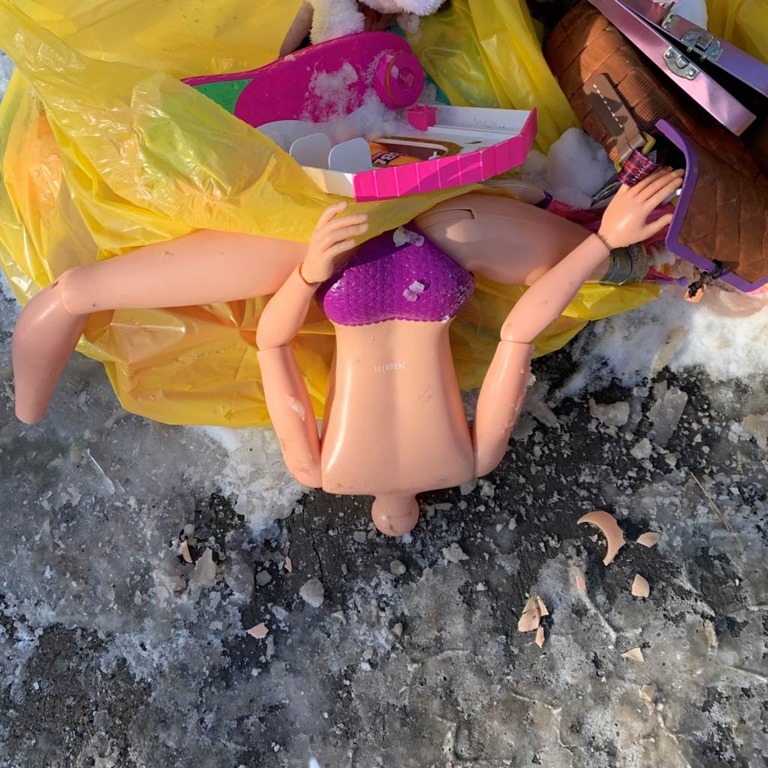
South Minneapolis is Tough on Barbies by Heidi Randen

Approximately how some of us feel on winter days. If only there was some help…

.

I remember hearing “The Men in the Basement”  at one of those meetings. Everyone enjoyed it, got it, right off the bat, which was far from a universal reaction to the work we shared. I heard her read it at least once at a public reading, and since it was included in her New and Selected  collection* published just before her death late last year, we can be sure that Ethna herself liked this poem and expected audiences to do so too.

Do women understand this poem more than men do? How the hell should I know, though I suppose some raise themselves to opinions on such matters. I myself found it easy enough for my anima to perform it, though maybe some listeners will find that strange. Again, how the hell should I know? Anyway, given that we all bruise, want, wonder, live together and alone — and sorry, buzzkill for this entertainingly arch poem, we all sicken and die — I don’t find it worthwhile to predict or expect right now.

Musically I made this one an assortment of sounds, and I even worried that I may have over-egged it with the variety, but I’ll limit my predictions to that you’ll enjoy meeting Ethna’s text today. There’s a player gadget below for many of you, but you can also use this highlighted hyperlink where the player isn’t shown to hear it.

.

*That book, Light Rolling Slowly Backwards: New and Selected Poems  is a great summary of McKiernan’s poetry. Here’s a link to the publisher’s listing.

2021 Parlando Project Hits (and Misses)

Once again a variety of things we call life is keeping new material from being posted as part of this project. So, why not do what a lot of bloggers do this time of year and give a short rundown of 2021 traffic for this blog and the associated audio pieces? That might be interesting. What do people come here for?

In general, this blog traffic continues to grow, as it has every year so far. Over the five plus years we’ve been active, there’s been an expected yearly pattern sweep: rising in the fall and carrying over until spring, then dropping off in the summer. This might indicate that some of the traffic here is related to schoolwork assignments or interests lit around that, or that even in our always connected age, that more are outside reading the “book of nature” in the summer than inside curling up with a poetry-related blog by the glow of a crackling screen light. We had 43,621 views last year, modest by political or lifestyle blogging standards, but rewarding in the context of poetry event attendance.

To my personal disappointment, listens to the audio pieces are close to flat in contrast to increased blog readership. The continuing Covid-19 epidemic has put a damper on my ability to collaborate or even to work as extensively on the audio pieces in other ways, and over the past two years I sometimes fear that the quality and variety of the audio pieces could suffer from that. That fear aside, as “The place where music and words meet,” says, these pieces were the real spark that led to all this.

Here are the ten most viewed posts here during 2021. This is the 754th post here, and all of these posts are older posts made over the years since we launched in 2016. I made them hyperlinks in case you’re curious, as a few of them are quite old, and could be from before you started following Parlando.

1. Poem 1 from Twenty Love Poems

2. The Lake Isle of Innisfree

3. The Stare’s Nest at My Window

4. Edward Thomas’ October

5. Rimbaud’s Eternity

6. Hitch Your Wagon to a Star

7. The Red Wheelbarrow

8. The Aim Was Song

9 .“Hope” is the thing with feathers

10. The Pool

The popularity of the Pablo Neruda translation from Spanish I did in 2020 shouldn’t surprise me. Love and its ornery cousin lust are attractive subjects after all, and this early collection of Neruda’s is a poetry best-seller in its original language. I myself prefer the final poem in the series to the opener, but they are both part of the story told in the series. Posts on Yeats make two high-placed appearances. I suspect the posts on “The Red Wheelbarrow”  and “The Pool”  get hits from those looking for homework help on what to say about these enigmatic short poems that appear in many anthologies. The puzzler for me is Edward Thomas’ “October,”  which is a lovely poem by a poet better known in the British Isles than in America, but I can’t guess how that post got so popular. My post on Emily Dickinson’s well-loved “Hope’  is the thing with feathers “ may be attractively controversial. Many read that poem as motivational poster simple: praise for plucky hope. I took the idea that the “Hope” quoted in the title may refer to a lesser known poem by Emily Dickinson influence Emily Bronte that makes hope something of a taunting flirt.

None of these top ten for page hits this year was written and posted in 2021. Even though total blog traffic increases smartly year to year, most days I find older posts are among the most read — or at least loaded into readers browsers in hope of finding out something — proving the notion that poetry is news that stays news. The most hits for a 2021-written post was Rimbaud’s Dawn (#21), followed by William Carlos Williams’ Thursday (#26), and my memorial post for Lawrence Ferlinghetti (#36).

What was the least viewed 2021 post, other than very recent ones from the year? My post on the unusually gritty Joyce Kilmer poem “The Subway.”   What’s that mean? Joyce Kilmer may be past his sell-by date in the 21st century? Or maybe it was reflected pandemic fear of crowded mass transit?

Audio pieces? These new audio pieces posted in 2021 had the most listens:

1. The Negro Speaks of Rivers

2. The Snow is Deep On the Ground

3. The World is a Beautiful Place

4. Georgia Douglas Johnson’s Escape

5. Reynardine

Sure, I’m the composer and sole performer on 4 out of those 5 pieces, but not a bad grouping of Parlando music performances, even if none of them have more complex arrangements (harder to get done this year). Listening to them again reduced my fears about the 2021 audio pieces not being as good as in the years past. I was surprised that “The Negro Speaks of Rivers”  had made it to the top by the end of the year, but it’s one of those “long tail” audio pieces that continues to attract listeners long after it was first posted. “Escape”  was another surprise, because both my vocal and fiddle performance was aiming at “not pretty.” I didn’t expect that one to be so popular.

Early T-Rex and Swinburne - Bongo Fury!

What more can I say in my defense? T-Rex before they had a hyphen and then Swinburne. Bongo Fury!

.

Least listened-to new piece last year (excluding those from end of the year that probably haven’t risen to their eventual level)? “Love and Sleep.”  Maybe I just couldn’t pull off a fusion of Algernon Charles Swinburne and early Tyrannosaurus Rex — even with a line like “Glittering eyelids of my soul’s desire…” dictating that attempt.

I really hope to have more new pieces here soon, but since it’s not one cause that is preventing things from progressing, I can’t be sure how quickly we’ll get to our 600th audio piece combining various words (mostly poetry) with original music (as varied as I can make it). Thanks to everyone who read and listened here last year. I appreciate your time and attention — and then even more so the likes, reblogs, mentions, Tweets and Facebook posts. I want to reward all of you with more encounters with new stuff. I really do. Wishing all of us a productive New Year….

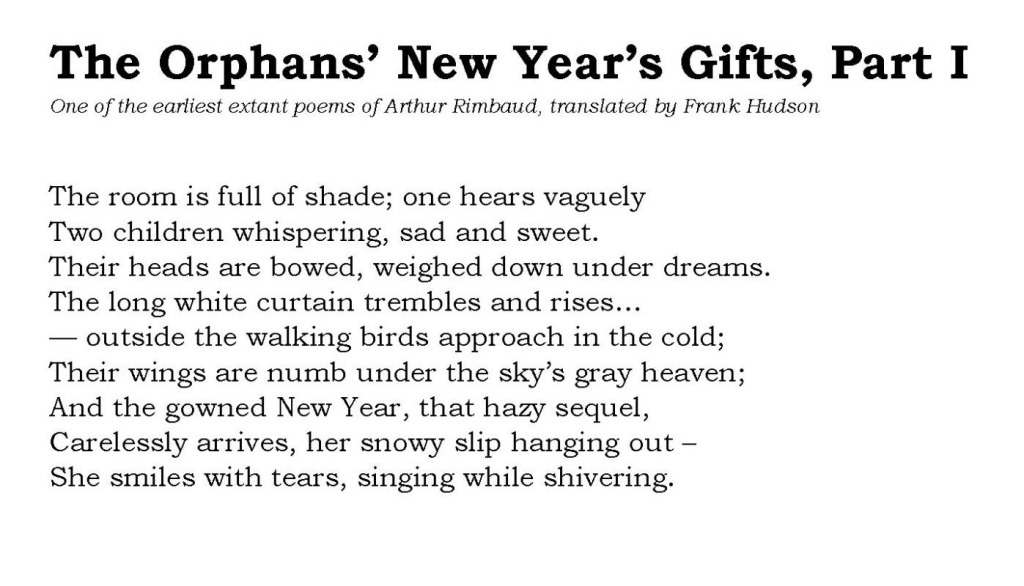
The Orphans’ New Year’s Gifts

Last time I said I looked through Arthur Rimbaud’s collected works in the middle of the nighttime looking for something to translate, combine with music, and perform. I guess I could have saved myself some time, because I eventually chose the first poem in the collection, The Orphans’ New Years’ Gifts,  placed first because it was the first poem he ever published. When it appeared in print on January 2nd, 1870 Rimbaud was all of 15 years old.

On first reading, it’s not representative of the poems Rimbaud would be writing in little more than a year or so. While the entire poem is a gothic story, it’s also quite sentimental and largely conventional. For reasons of time and preferring shorter works, I decided to only perform the first part, but spoiler alert: it’s soon revealed that the children are recently orphaned and they are dreaming of their family still being intact and how they will give their now dead mother they expect to find in their dreams a pair of “for mother” plaques from each of them as a New Year’s gift.

But for us, the performer and listeners today of this first section only, this is no matter, because it’s the last day of 2021 and tomorrow is a new year. We know nothing of 2022 save for dreams pleasant or frightening. The coming year is a more mysterious ghost to us than our past years.

It might seem odd to say, but I’m an orphan — that’s not unusual, at my age most everyone is. It’s a different matter to write this as a 15-year-old, as an adolescent, as Rimbaud was. Those are the years that children learn how to gradually break away from their parents in whatever manner they fall into. Rimbaud instead would do this early and abruptly, leaving his mother — and for Paris, and unrest, and rebellion of all sorts  in that “about a year” timeframe. Poetically and emotionally, this poem hardly seems to be a rehearsal for the Rimbaud of 1871 and after.

As I worked on translating this poem, I saw a little window into that other Rimbaud in this short first section. Those intimations were unlikely put there by conscious choice. Maybe they were slipped in by Rimbaud’s future ghost?

A few notes on how I translate. I generally don’t try to bring over the word-music (too tough, too damaging to other elements of the translated poem). I start attempting to be as faithful as I can, but then while in process I am often tempted to sharpen or expand on the images I’m trying to bring forward into contemporary English; because those images expand in my mind as I consider them, and because I want them to remain vivid. I’m of two minds about doing that, and I try to make clear here when I’ve really inserted something altogether invented. If you’d like to read the whole poem in it’s original French, here’s a link.

The Orphans New Years Gifts

My local forecast says –11 F (-24 C) for New Year’s dawn. I think of a blues song Leo Kottke used to sing with the line “So cold in China, the birds don’t even sing.” Maybe that’s why I choose the guzheng today?

.

Here are a few examples in this one, in ascending order of significance. I suspect the curtain Rimbaud has blowing in the winter drafts is a bed canopy, a largely unfamiliar antique item, and instead I’m leading you to see a window curtain. Leading you to the window lets me transition to an image I sharpened. Rimbaud doesn’t explicitly say the cold winter birds are walking, but I think he did intend to tell us they aren’t able to fly in this moment, and I thought I’d underline that. And the final image, the one of New Year arriving as a woman in a dress of snow, I wanted us to see a tipsy celebrant whose party gown is no longer arranged neatly. Did the 15-year-old Rimbaud intend that image? I don’t know, but his future ghost might well have chosen it!

Yesterday I revealed that I wanted to do this piece to honor ardent Rimbaud admirer Patti Smith. Obligation completed, though you may notice this is nothing like how Patti Smith or her band would characteristically perform this. The first instrument you hear is a Chinese guzheng,* a sophisticated zither family instrument, then eventually a variety of drums and percussive sounds arrive along with electric bass, and finally a low synth moan. But did I make clear in talking about Smith yesterday: one of the things she demonstrated was that untapped possibilities of presentation styles are the point, not just duplication of one’s heroes.

The player gadget to hear my new translation of Rimbaud’s New Year’s Day poem is below for some of you. Don’t see it? This highlighted hyperlink is an alternative way to hear it.

.

*With expensive and exotic instruments like this I usually use what are called “virtual instruments” that sample the notes and sounds of the entire range of the instrument; and as in today’s piece allow you to articulate some of the instrument’s particular attacks and variations, like the guzheng’s vibrato. I select and play the notes with a little plastic keyboard or my guitar with a MIDI interface.

Winter Solstice Consolations

I ran long the last time, let me be short today. Last week after Ethna McKiernan died, Dave Moore and I talked briefly, and I said that I was going to try to write something for Winter Solstice.

“Make it a happy one” Dave requested. I’ve written at length about the losses Dave and I have had with poetic colleagues in recent posts, so for those who want more details, I’ll refer you to the last couple of posts here instead.

How far did I get to that “happy?” Not all the way. The piece I wrote and you can hear my performance of today is more at bittersweet. I’ve talked to Dave about how I’m hearing Kevin FitzPatrick’s and Ethna’s voices, very distinctly at times when I’m quiet. And since I knew them largely as poets, I’m hearing them reading their poetry. I tell you honestly I don’t find this eerie at all. I find it comforting. I expect that those voices will fade with time, but right now to hear them keeps them with me.

I suspect grieving people have heard similar departed voices since we first began to speak, and that those voices would be more sure to come on a long dark winter night. But here’s my modern variation: due to the pandemic the last few meetings of the Lake Street Writer’s group happened over Zoom Internet videoconferencing. I became accustomed to seeing Ethna’s face after she began her cancer treatment on the same home screen I’m typing this on, and so now when I’m on a Zoom conference I sometimes expect to see her face again as one of the squares on my grid — and I will allow myself to visualize my expectation. You can read all 2916 lines of “In Memoriam,”  and you won’t find Alfred Tennyson having that exact image to deal with.

Winter Solstice Consolations

Here’s my own text I performed from. Due to short recording opportunities, I worked out the drums and percussion, and then rapidly laid down a bass, piano, and then an arpeggiated 12-string guitar part to further establish a harmonic flavor. I had time to quickly improvise three passes of a lead electric 12-string part, and this was the best of them.

.

Then the last time I saw Ethna McKiernan, it was her book launch reading at Celtic Junction on August 6th. I recall she wore a brightly colored headwrap on those last Zoom conferences, and for the public reading she was all in bright red. I melded those two visual memories with our seasonal gift-wrapped packages in the poem.

Ethna McKeirnan reading August 6th 2021 2

Ethna with bright red shinning over frailty, on stage for the book launch of “Light Rolling Slowly Backwards” this August.

.

So those are some of the consolations the poem’s title refers to. And too, one of the fine things in winter and on winter solstice is to be inside, in our lights, at home with our partners, family, house-pets, and welcome ghosts.

Here’s what I speak of in the final line: our lakes and ponds and the still parts of rivers have ice surfaces now. Whichever side of the ice you are on: under it and in the underwaters, or over precarious ice not thick enough to securely separate yourself from those cold underwaters — laugh with more than happiness, laugh with that knowledge that that ice is a fragile and temporary division.

A player gadget to hear my performance of “Winter Solstice Consolations”  will appear where possible below. If you don’t see it, you can use this highlighted hyperlink to play it.

Ethna’s Dream

Long time readers here will know that one of this Project’s ideas is “Other People’s Stories.” I’ve chosen to make that one of its principles for a couple of reasons. First, the Internet is full of folks telling their own stories, and this is fine (after all, to me those would all be “Other People’s Stories”). I wanted to do something different, to focus on how you and I experience a variety of words from a variety of writers with a variety of outlooks. The second is that I’m rather uncomfortable with promoting myself. That one’s complex.*  Like most writers or composers or artists I think my own work has value at some percentage over half the time. Which then, mathematically, allows that I doubt its value, or my handling of its value, or the costs of declaiming its value to the universe a bunch of the time too.

No one creates without the first thought. It would be impossible. And no one who cares about what they create, about their audiences, or about how much craft and care can be devoted to any art; without seeing the faults, the missed communication, the needs for just one more revision or tomorrow for any work.

Many of us create instinctively, because we have to — but sharing that work is a choice. I’m nearing 600 Parlando Project audio pieces presented here. I could have presented at least half or two-thirds of that easily with things Dave or I wrote, but I made a different choice. It’s less conflicted for me to publicly look at, to be honestly surprised and delighted at Emily Dickinson, William Butler Yeats, Carl Sandburg, Langston Hughes, Sara Teasdale, or Du Fu; and then to share that with you.

But there’s a problem with “Other People’s Stories.” I’m likely not understanding everything those authors intended.** And they’re their  stories, their  visions. I’ve talked recently here about how when I translate a poet who wrote in another language how I want to honor their work and transfer accurately their particular powers, and yet then become tempted to break off into something their work makes me see through my own eyes.

A long prolog to presenting today’s piece, one I wrote and titled “Ethna’s Dream.”  Ethna is Ethna McKiernan, a poet who I used to meet and talk about work with once a month or so, along with two to four others. Ethna cared and crafted her work over decades, and in her life did other useful work: running an Irish heritage book and art shop, working with the homeless. She’s currently in hospice, comforted by family, and the reports are that she’s now mostly in an out of what appears as sleep.

I couldn’t call Ethna a close friend. I always sensed a distance there. I think often of her none the less these days, and of every rudeness, awkwardness, or self-dealing on my part around her; and those or any number of things could have caused that. The very fact of writing a poem about her death, her dying, that mostest personal thing, seems problematic.

So, when you listen to my piece “Ethna’s Dream”  you now know all that. This is not a poem about those things I’ve discussed in prolog, or at least I hope so. Instead, my intent is that it’s a poem about what we should treasure of that sharing of the unconscious that we have with artists (including those whose main art is just living). What I present in “Ethna’s Dream”  is not a romantic, imaginary, sentimental metaphor in my own mind — though it may attract or repel you if you see it as such — it’s more at the essences of what we do, share, and take with art.

Ethna's Dream

There’s references to Bottom’s speech in Shakespeare’s A Midsummer Night’s Dream. Am I prettifying  myself up with pretentiousness, or comparing myself to the foolish play character? I wrote it, and yet I can’t tell.

.

There’s a player gadget to hear it below for many of you, but some ways of reading this blog won’t show it, so there’s this highlighted hyperlink to play it as well.

Thanks for reading and listening.

.

*One problem, leading to one fear, is that when offered the chance to promote myself I see myself as overdoing it, and coming off as a self-absorbed narcissist that runs on too long about the arts I work in, prattling about the obvious and the obscure in equally embarrassing ways. If you’re still reading at the footnote stage, you may have forgiven me for that.

**Beside just plain embarrassment of ignorance, we now more often talk about cultural appropriation in regards to this. The travesties of cultural appropriation are real, but my belief is that they should, must, be risked.

After Apple Picking

Around America people are getting ready to celebrate Thanksgiving Day, a sort of remembered harvest festival, now a family get-together mostly celebrated by eating as most Americans are separated from farm work by some distance and decades. However, back in 1914, American poet Robert Frost was close enough to that work to write a masterful and closely observed poem about harvest time that I’m going to present for today: “After Apple Picking.”  While I hope you’ll listen to my audio performance with my original music below, here’s a link to the poem in case you’d like to follow along with the text.

This poem is full of sensuous detail. Encountering it — even if you don’t do farm work — you should feel the completion and weariness of the poem’s speaker who is falling asleep at the end of his harvest season. The poem’s farmer has been working in an orchard, and that place is full of the scent of apples. In a fall orchard such as this, much of this scent may be from fallen apples which, even as they start to rot, give off a sweet musk. And it’s frost time, not just the poet’s name on the poem, but the livestock water-trough has a frozen sheet on top, so the picker has been racing against a loss of the crop. In a piece of rural surrealism, the farmer has, that morning, picked up a plate of this surface ice —which would be thin, wavy, and fragile — and looks through it as if they are magic spectacles at the morning frost on the grass. This lasts but a moment, the magic glass will disintegrate in his hands, but that’s of no matter, there’s work to complete.

While falling asleep his body is still weary, his feet are sore from standing on the round ladder rungs, but as dreams approach his mind once more magnifies and intensifies reality like the view through the wavy ice sheet, and he’s haunted by apples, by his job of picking and inspecting, his rush against the end of season frost.

As the poem moves to its conclusion the farmer seems to imply that his work to gather the crop before it’s lost is like unto the work of salvation. We might remember and notice that the poem started with a ladder pointing “toward heaven.” And those apples that touch the earth are held by it and not offered heavenly worth.

Frost ends his poem whimsically, not with an angel or a prayer, but with a small rodent, the woodchuck, which hibernates (“his long sleep”) in the winter. As the farmer falls off to sleep, he wonders how long a rest he has earned.

How big a slice of apple pie do you want? Stand back, I’ll cut you a piece.

.

When Frost wrote this poem about a third of Americans were farmers and farm workers. Now, most of us have other labors. Our harvests may not be food, we may not be tied to the cycle of seasons as exactly. My wife will be getting time off from working in a medical clinic, where she works to gather as many as she can, and Thursday she’ll be making a meal for us and her mother with dementia. I’m working past midnight to bring you a presentation of this poem. Our labors are many, they may make us weary, but perhaps, yet, we can be thankful for them.

My audio performance of Robert Frost’s harvest poem “After Apple Picking”  can be heard with the player gadget below, or with this highlighted hyperlink. My music today is percussion, piano, cello, two violins, horn, and harp.

.