A few updates, and why fewer new audio pieces so far this summer

Between revising my recording setup and spaces and some travel, I’ve been away from being able to create new audio pieces for much of the past month. I’ve missed that, and I hope you have too, though I have  been able to put together a few new things in the midst of this.

I was hoping to bridge this gap by presenting some things I have from older recording sessions featuring writing still in copyright, but so far I have received no response from those that seem to be the contact points for that—the usual when I seek to gain permissions. I assume this is just the inevitable result of a publishing industry focused on those business and revenue things they may need for survival. In an ideal world there’d be another me busy banging on the door of rights-holding publishers until they at least told me no or “Go away, we don’t want any.”

For you constant readers, in place of new audio pieces, I’ll leave you with just two brief follow-ups.

I’m reading a couple more Emily Dickinson books so that I won’t be so embarrassingly blank on certain questions. One is Aife Murray’s Maid as Muse,  it’s fascinating premise to look at the lives and possible influence of the Dickinson family’s Afro-American and Irish servants. The book also doesn’t overlook the basic fact that it was the presence of servants exchanging their focus and time that allowed Dickinson to produce poetry that valorized independent thought.

If by chance you read that last sentence and think, well there’s your white privilege and base economic exploitation that I’m too aware of or otherwise inoculated to by family heritage or economic class to engage in, think (as I do) that it’s some Asian factory that allows me a cheap computer* to write this and to create and/or record the Parlando Project audio pieces and someone in another place built the inexpensive electric guitar you hear.

The other Dickinson book is Lives Like Loaded Guns by Lyndall Gordon. Gordon seems to have a more polemical mood so far than Murray, though her wars are mostly laid in books. The book promises to help me understand the complicated way that Emily Dickinson’s almost entirely unpublished work managed to get published and find a considerable audience shortly after her death. Even early on in the book Gordon is presenting an understandable portrait of Mabel Loomis Todd, one of the producers of the first posthumous edition of Dickinson poems. Todd is often painted on cardboard: Emily Dickinson’s brother Austin’s mistress and nemesis of her brother’s wife, Emily’s intimate friend and often interpreted as lover Susan Gilbert Dickinson. A social climbing no-talent who glommed onto a real talent? Todd might be all that, but I’m already finding Gordon’s portrait of her illuminating.

As it seems it always is with Dickinson books I’m frustrated by a lack of chronological clarity. Murray’s book has a great deal on the life and influence of Maggie Maher, an Irish born servant who worked with Emily in the Dickinson house kitchen in the post American Civil War years just after Dickinson had already written the majority of her poems; and the admittedly juicy details of the Emily/Susan/Austin/Mable love rhombus are no doubt material to the way Dickinson’s poems emerged after her death, but the events of her brother’s “betrayal” of her friend/possible lover’s wife happened in the last years of Emily Dickinson’s life when she doesn’t appear to be writing or even collating her poetry.

Dr John Emily D

This is the place were you see pictures of these two together.


One last note: one of my personal favorite pieces over the past three years was “Blues Summit in Chicago 1974”  a short narrative of my reaction to watching a video a couple of years ago of a concert combining some pioneering “Great Migration” Afro-American blues musicians with some more likely white “Blues Revival” guys in front of an audience redolent of that titular year. In it I note that both the young guys and the old masters are all dead, and that some of the “young guys” died before their elders—well, except for one guy, Dr. John (stage name of Mac Rebennack) who was still living. “Can’t be the clean living” I remind listeners to that piece, as Mac had a long dance with heroin and other drugs. This year Dr. John in effect asked for a revision of that piece when life finally claimed him for death.

If you haven’t heard that piece, here it is as performed with the LYL Band a few years back, it’s available with the player below. And I’ve just got some good news on another piece that you’ll see here soon!


*I am moving to a new Macintosh computer for those “in-the-box” musical elements this summer as I want to use more of those tempting virtual instruments that allow me to work up to orchestral levels of scoring. My old computer was still working with occasional needs to account for its capacities, but it’s now nearly nine years old and eventually it won’t work. My hope is the new one will work as long as I do, but alas the “Apple Tax” is real and a few things about the new computer are frustrating despite its considerable cost. Still, I’m privileged to be able to afford it, and it’s so hard to find good help these days….

The Fly

The state I live in, Minnesota, has a reasonable list under “claims to fame.” Lots of lakes, a funny accent, Prince, F. Scott Fitzgerald, Sinclair Lewis* and Bob Dylan. And bugs.

It may be all that water, Some of the Twin Cities sits on what was once marshland, and even when it forgets that, the bugs have longer memories such that the oldest joke in the state is that the Minnesota State Bird is the mosquito. Farther upstate to our northern forests the most feared animal isn’t the bear or wolf, but the tiny biting gnats and other larger and blood-hungry black fly species. All and all, it’s likely there are no vampires in Minnesota. Too much competition.

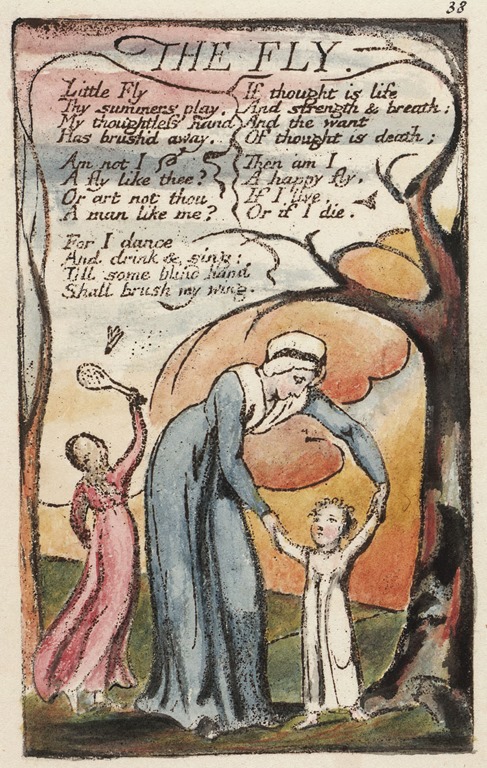
I’ll go to English romantic poet, political radical and mystic William Blake for today’s piece “The Fly”  from his collection Songs of Experience.  Blake’s short poems can be shockingly brief in a way that Emily Dickinson’s sometimes are too. For a simple looking poem with only small and common words, there are numerous commentaries explicating the mystic or philosophic meanings of “The Fly.”  It opens with an uncomplicated setup: a fly bugs Blake one summer day, he brushes it away, something a hundredfold mundane. In an impossible way, he says he did this thoughtlessly, as he’s got four more short stanzas packed with thought and meditation.

Songs_of_Innocence_and_of_Experience_THE_FLY

Here’s the text of the poem as Blake the artist presented it. Toddler Robert Frost in front right is telling the woman that Allen Ginsberg (pretty in pink) is playing badminton without a net again.


For a mere 30 words in two stanzas Blake speaks on the similarities between the insect and himself. In a typical explication of this poem, the first stanza’s shoe-fly act, self-labeled by the poet as thoughtless, is read by those as a swat, killing the fly. But Blake doesn’t describe that as I read it. Instead I read it as a mutual act of interruption. Blake has interrupted the fly who has interrupted him.

The fourth stanza in my reading sums up a value Blake sees in this interaction, a stanza which would be quite obscure if this was indeed a meditation on a sudden death of the fly. The fly’s interruption wasn’t thoughtless after all, it caused thought in Blake.

The “Dance and drink and sing” line is not, or at least not only, a paean to the joys of living. It’s a remark on the superficialities of life for a fly and human, in the Buddhist sense, maya. “Thought is life…and the want of thought is death” is Blake’s precept here. It was good that he and the fly engaged in a momentary summer dialectic. The final stanza is mysteriously balanced. If to think is to live, the unconsidered life is death. The human choice should be then to think, to interrupt thoughtlessness. In the final stanza, is Blake saying that the fly’s insect’s brain cannot choose, and that humans who don’t make their possible choice for thought may be happy flies, but they are not exercising their human potential?

I wonder if Blake was knowledgeable of Socrates and his claim that he must be a gadfly to society, the presenter of bothersome ideas, the interrupter of the thoughtless, or if this was an independent realization. Others certainly borrowed it. Gandhi liked Socrates’ fly thought. Martin Luther King used that gadfly line of Socrates in his “Letter from Birmingham Jail”  too, and it even inspired the periodical that alternate Parlando reader Dave Moore started up that he called The Gadfly  a half-century ago.

Minnesota also had a reputation for political progressivism. Maybe it was the bugs?

I won’t interrupt you long for today’s audio piece, my performance of Blake’s “The Fly.”  There’s a player gadget below.


*Literarily, a step down in fame, we also have Robert Pirsig, who wrote Zen and the Art of Motorcycle Maintenance  living over a shoe-store a couple of blocks away from where I’m typing this, and Robert Bly, he of the deep image and a revised-standard-version of masculinity. Some would even claim John Berryman, an interstate grump who was teaching here when he took a faith or faithless leap off the Mississippi bridge that  I once traveled over between my job at a hospital and my last few dollars of college education. I kept walking, and encourage you to do so too.

For Once, Then, Something, or Robert Frost kicks it EDM

You know, I really mean it when I say I aim to combine various words (mostly poetry) with various original music. I find I’m a self-iconoclast. If I sense a few too many audio pieces leaning one way, I want to lean another.

Brave listener/reader, bear with me. If you like or even love something I present here, you might well find the next one meh to boring to obnoxious.

Today’s piece uses a poem by Robert Frost. Long-time readers will know that I didn’t much care for Frost in my youth. He seemed so conventional, the man to reassure us of timeless verities in verse and sentiment, a left-over Victorian. Even Emily Dickinson who I first absorbed, as she was taught then as a writer of gentle ironies, at least had a bit of the scamp about her. And in my young days Frost had the job of bringing up the rear of the poetry textbooks, the last in the line.*  Everything newer was unexplored, unteachable as to danger or value.

Carta Marina Beyond this point are Monsters

Beyond this point are monsters. This map makes it look like one could cross the North Sea by hopping from back to back. My mid-century text-books stayed onshore.


How soon did I hear Frost’s “playing tennis without a net” line, often deployed then against the Beats, those descendants of Whitman and Li Bai who were roaming the streets unschooled and braying? In high school I’d guess. I didn’t know then that Frost hated nearly every living poet, that Frost’s distain was like the rain, it fell on all.

I suppose I could have at least related to Frost’s rural themes in my little farm town, but that passed me by then. I do recall that a high school English teacher who I admired, Terry Brennan,** told us that Frost had not been successful in his short try as a farmer, and I still remember that assessment of Frost’s poetic persona as something of a phony mask. Carl Sandburg, still thought of as the proletarian urbanite, was more a man of the soil, his household goat farm likely more successful and certainly longer-lived.

Of course, few young persons—and not I, then—realize that all masks are phony, but they give you something to show for what you’re saying. To criticize a poet for putting on masks and speaking lines is like criticizing LeBron James for spending too much time dribbling when he could just drop the ball through the hoop from the top of a stepladder. Did I just restate Frost with larger balls and a different net? And you in the back row: that’s basketballs, stop snickering.

Frost’s true nature is as a stoic, a man sure of human failure and the unacknowledged dark humor in denying that. Sure, that outlook can be too reductive. Kindness, love, the act of caring, may be only momentary balms in the great scheme of things, but momentarily we live.

So why do I now present Robert Frost fairly often here? Well, in his early years he was a superb lyric poet. And as I’ve gotten older, I’m more and more drawn to the lyric poem, the short expression that says those who tell you everything in their poem, who are sure their next line will tell you more yet, are testing both my patience and my sense of how much anyone knows. If we live momentarily, then the lyric poet is our documentarian.

Frost’s “For Once, Then, Something”  is a defense of that understanding, a lyric poem about the Book of Nature that is itself about the momentariness of the lyric. I choose this unconventional musical setting to emphasize that other part of Frost, that he’s the hard man, and that if he’s a poet who can be taunted for spending too much time staring down wells, he isn’t going to lie about what little he can see. ***

Today’s piece marks the 350th audio piece that the Parlando Project has presented here, so that makes it particularly apt, not only because we most often focus on the lyric aspect of words, but because this project is about encountering those words and asking what is new or particular in our apprehension.

Disliking or liking a piece’s words, music, or performance are just two sides of the same coin in the wishing well. My dislike of the poet I thought Frost was at first led me to love other poets more, and then, eventually, in another once, I was able to come back to Frost and see him again, differently.

Rural Well!

You’ve given us your attention, so not wishing for you to toss coins…


If you like some of what we do, here’s what I ask of you: spread the news about it. Particularly if you use social media (I have too little time after doing this, nor do I have enough of the nature for it). The audience has grown in the nearly three years this has been going on, but the amount of effort to do this asks that this growth continue.

Here’s today’s audio piece, my performance of Robert Frost’s “For Once, Then, Something”  taken as a driving EDM piece. You can dance if you want to, and the player is below. If you’d like to read the text of the poem, now or later, it’s here.


*Carl Sandburg, who I’ve always liked, was actually a few years younger than Frost, but the books still seemed to choose Frost to end with. There was a generation of poets after them, born in the early 20th century before the Beats and their contemporaries, who were also still not in the textbooks then.

**I wonder if he’s alive, an old man if so. I owe him a debt. Like an early musical influence, my short-time college friend Don Williams, his name is too common to be easily searched.

***I suspect an intended undercurrent here of the Celtic tradition of wells being the domain of spirits, something that survives in enervated form with traditions like the “wishing well.”

O My Darling Troubles Heaven

When we last left-off Kenneth Patchen he was beginning his career as a proletarian poet in the 1930s, writing a strikingly prophetic (in both senses of the word) poem about what the middle of the 20th century was holding in store. I’ll leave it to you to decide if that poem also speaks of our 21st century’s future.

Kenneth_Patchen_1952

I didn’t have time to discuss that Patchen’s 1952 Wikipedia picture looks like Thurston Howell from Gilligan’s Island.


Patchen never left his concerns with society’s dangers and constraints, it remained part of his poetry throughout his career until his death in 1972, but that’s not all or even much of what he became known for. Here are some of those things:

He was a significant influence on the post-WWII independent, largely non-academic Beat explosion. The bohemian aspects of his life and outlook, as well as the ways his writing expressed itself was a key living American model for the Beats.

And speaking of the Beats, he and his friend and fellow Kenneth, Kenneth Rexroth, were enthusiastic pioneers in the tradition of performing their poetry with musical accompaniment. Though many Beat Generation poems still live on the page, I’m not alone in hearing many of them, even when read in silence, as spoken voices, a jazz group cooling it behind. Patchen was more committed to this combination than most he influenced, touring his “Poetry-Jazz” in the late ‘50s.

Obviously, that style is part of what’s led to the Parlando Project, though I wish to expand on it. Patchen too seemed open to other musical genres with his writing: for example, a longer piece for radio performance with a musique concrete score by John Cage, “The City Wears a Slouch Hat.”

American bohemian arts flowed out from the Beat era, and Beat’s immediate predecessors like Patchen, in a series of connections and mutations. Diverted poet Jim Morrison used his psychedelic ballroom singer money to help Patchen publish one of his final books. And a figure as singular-seeming as Leonard Cohen has links in his expression that seem to connect closely with some of Patchen.*

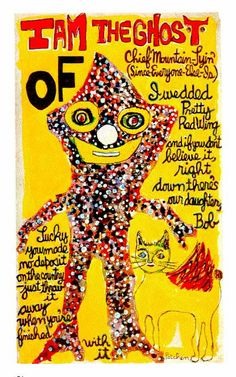
It wasn’t just music that Patchen combined his poetry with, but visual art—drawing and painting pages that were as much pictures as poems. While this has precedent in medieval illuminated manuscripts, the painter/poet/engraver William Blake, and some of Dada’s work, Patchen’s style of combining his own naïve art with epigrammatic text connects with some of the poster art of the Sixties.

I Am the Ghost art by Kenneth Patchen

Closer to Pedro Bell than William Blake? Art by Kenneth Patchen.


One of the reasons I so like presenting figures like Patchen or Blake is their “get in the van” indie spirit. Art does not need to ask permission, it perpetrates itself anyway, figuring out a way to use the resources it can scrounge together.

And lastly, another thing Patchen became known for, even if it wasn’t as widely imitated in the Beat era, was his love poetry. It would be restrictive to think of him as just a love poet, but it was a substantial part of his writing and audience. As the billboards changed from “The Beat Generation” to “The Love Generation,” Patchen was already there with his poetry. A case in point, today’s poem “O My Darling Troubles Heaven”  performed here by Dave Moore and the LYL Band.

So, enough talking without a band. Go ahead and click on the player below to hear Dave’s performance of Patchen’s poem.


*Like what? The love poetry combined with the prophetic social dread is a recognizable Patchen trope. The combinations of art and writing, such as in Cohen’s Book of Longing  can be similar. And while Cohen’s typical poetry plus music style isn’t often reminiscent of Patchen’s, the two obviously didn’t mind mixing those arts.

Back Yard

Just a couple of posts back I said that early Carl Sandburg poetry can be just as aligned with the ideals of the Imagist school as the Trans-Atlantic poets such as the then contemporary work of Ezra Pound, Amy Lowell, H.D., Richard Aldington, F. S. Flint, T. S. Eliot, William Carlos Williams, and T. E. Hulme was. Yet he’s rarely mentioned as such.*  Why might that be?

My guess is that there’s an issue with Sandburg’s more expansive mode, present in some of his work, Whitmanesque in character and scope. The Pound and Eliot school of Imagism wasn’t much on Whitman, charging him with lack of craftsmanship and concision. And then there’s the issue of cultural affinity, which while outside the text, is important. Of the above, only Lowell was from a wealthy background** (and Flint’s childhood seems positively Dickensian) but they all saw themselves as culturally elite. Most were familiar with classical languages, some had Ivy League educations (though none were Oxbridge, save for Hulme who was thrown out after a bit more than a year for rowdy behavior), most had spent time in Europe , even Williams, the most American-focused of these.

Sandburg? Born working class to two immigrants in the Midwest***. Drops out of school at age 13 to go to work. The jobs he had in the first 40 years of his life were modest in prestige, but varied in location and nature. Coal-heaver, farm laborer, Army private, milk-truck driver, political organizer, bricklayer, “The Front Page” era urban journalist. What T. S. Eliot knew about the whole of literature, Sandburg knew about the whole of working-class work and life.

One could make one mistaken generalization from Sandburg’s biography, that like Whitman self-advertised himself, he’d be “one of the roughs,” a man whose art would be artless and as unconcerned with the niceties of aesthetics as the correct fork for which dinner course. But just like the lazy assumption that there’d be no poets in foxholes, the idea there are no aesthetes who punch a clock is bogus. Sandburg’s early work is as concerned with Modernist beauty and style as working-class dignity—and he is very concerned with working-class dignity!

Is today’s Sandburg piece, “Back Yard”  an Imagist poem following the three Imagist rules? Let me paraphrase them:

Direct treatment of the thing: that is, the focus in the poem is on the image itself which will be described, instead of the image being a decoration and figure of speech within the body of a poem more concerned with its moral or message for which the image is only a “like” illustration. Conciseness: no extra words, and though not stated, it’s corollary is no less-apt words used only to make the rhyme. And freer rhythms: word-music, like sound-music, is not required to limit itself to only extraordinarily regular and repetitive rhythms.

Direct treatment? The outdoor, summer night scene is just that. One is hardly aware here that it’s an image, it seems like simple reportage. Is it merely the “hardly news” that on a summer night if one is outside, perhaps sitting on an open porch, you’ll hear and see other people outside too?

Concise? Pretty much. It’s not In A Station of the Metro,  or The Pool,  or The Red Wheelbarrow,  there is some re-iteration in it, even a single line refrain, but even by the standards of lyric poetry, this is a short poem. The elements of the scene are evoked, but there’s little extravagant or showy description. One element that many Imagist poems share (though never a formal rule AFAIK) is that colors are used to simply describe objects, though since this is a moonlit night scene the colors are more monochromatic.

A follow up question: how minor and mundane is “Back Yard”  really? I can’t claim it’s a poem of great originality—but that’s not the job of every poem, and this is more a poem of the continuity of change, a moment of shared perception, not a striking new vision.

I think its intent, in it’s just over 100 words, is for us to see a chain of life in a Chicago night early in the 20th century; and in its everyday exactness, state those things that might link to a night tonight where we live today. The silver moonlight in the scene seems almost a preservative, everything is frozen in that direct moment. In my night tonight it may not be an Italian boy with an accordion, but Mexican music from the back yard at the end of the block. The couple Sandburg says will marry next month, are now-dead grandparents of people as old as I am. An old man has fallen asleep in the late and waiting moment, his back-yard cherry tree’s fruits held in a moonlit unmoving until his eyes close. He will likely pass on sooner than the marrying couple, and his dreams and those long-ago cherries will be returned to the place that dreams, fruit, and poems go and come from.

The poem closes with a perennial thought delivered in the scene’s description. The clocks, the poet relates, say he too must go. The clocks say that to all of the characters in his poem, and by extension to us, his audience. Sandburg, the artist, the poet, has the job like the moon to fix this moment in silver. Was he thinking here of the silver of his brother-in-law Edward Steichen’s art photographs? What does he mean by the poem’s closing line? What are the “silver changes?” My best understanding is they are the endless succession of such fixed moments. There will be more and more silver changes, a great richness, even as we are entirely not there.

Edward Steichen Nocturne-Orangery Staircase

Fancier than my back yard: “Nocturne-Orangery Staircase” (1908). Sandburg occasionally collaborated with his brother-in-law and pioneer in fine art photography Edward Steichen.


For the performance of “Back Yard”  I decided to intersperse some other night moments, sung as commentary on Sandburg’s poem. You can hear it with the player gadget below. Want to read along? Here’s the text of the poem.


*Yes, Imagism is only a label, a piece of sticky paper put on some writers and writing. But because Imagism was so vital to the formation of English poetic Modernism, excluding Sandburg, “The Forgotten Imagist” from its usual ranks was part of how he was diminished in the late 20th century. The artistically-chosen stark simplicity of Imagism was admired, but similar directness in Sandburg was seen as populist simple-mindedness. For an example, here’s a long review of a late 20th century  biography, where the dagger is that Sandburg’s poetry was “dumbed-down Whitman” and the charge seems to be that he was a pretentious yokel who was also a phony who pretended to be a yokel.

**I’m of the impression that Eliot and Pound’s family had at least upper-middle-class wealth too, but my informal memory is that some estrangement or streak of independence led them to live outside their families’ wealth.

***Sandburg’s home-town area, the Quad Cities and its surroundings in Iowa and down-state Illinois, was a surprising well-spring of writers in his time.

The Parlando Spring 2019 Top Ten Part 3

Now we’re nearing the topper-most of the top in our tip-top count-down of the most liked and listened to pieces this spring. Wait—did I just turn into a mid-20th century radio host? Out! Out! Commercial spirit! Timeless poetry knows no acne creams, Yardley scents, Thom McAn Beatle boots or white Levis. Well, maybe some of the music knows them—but honestly, it interrogates those pop intentions and asks us to re-evaluate that intent in the context of greater artistic accidents consciously or unconsciously evolved from the Modernist revolts of the last century.

No, no. Not that either. I mostly just want to make things that haven’t existed before, mix the known and the unknown, like and contrast the unlike, let poetry talk to music, and let music not shut up but talk back. As I do this, I look at things you and I and many others have looked at before and see if they’ve changed. And then sometimes I look at those poets whose names and poetry were writ in water.

It just so happens that our next three pieces in our count-down are from such writers, poets unknown to me, many literature students, and likely to you.

4. They Say Life is Precious. One of the principles of the Parlando Project is “Other Peoples’ Stories.” I don’t dislike memoir, self-narrative, words intended to establish or confess one’s selfhood. I couldn’t, or I’d have much less poetry to choose from to present here. But I feel that’s well served elsewhere, not just in literature but in blogs, podcasts, and social media. So, if and when we want that, we can find it. In the words of a wise boss I once had, it’s “ubiquitous everywhere.*”

What I do instead here is to encounter some other person’s words, see how they sound in my mouth, and ask myself what I hear, feel, and think when they are enthroned there.

I could suppose it’s a failure of a kind that a performance of one of my own poems is in this Spring Top Ten then. And indeed, I usually fall to using my own words when I find I’m behind in getting things posted because the research into the other writers adds to the tasks of writing, playing, and recording the music. “Well” I say to myself “At least I know that writer already.”

An unsafe assumption. We don’t really know ourselves effortlessly.

My favorite part of the music I did for this was the combination of bowed contra-bass with an upper register fretless electric bass part. What does that sound like? Listen below.


3. Everyday Alchemy. One of the things I love about this project is when I go crate-digging after poets I’ve never read and that I expect you haven’t either. Coming across this poem by Genevieve Taggard was one of those moments.

This is such a poem of sorrowful balance, yet it’s 11 lines contain a piercing analysis of society and its arrangements of obligations that are increasingly out of balance the farther down the chain one goes.

I’ve often spoken about the Confucian Odes  here, designated by the Chinese sage and his school as required instructional material for government functionaries. The Odes  are not, as educational poetry aids today might be, mnemonics of components, checklists or causes; but like “Everyday Alchemy”  they are mostly accounts of daily life near the bottom on the pyramid, a pyramid where the giant blocks of limestone are not lifted by alien magic.

If I were Confucius again, I’d select this poem as required reading. Anthology editors now, or of the future: include this poem! And in the meantime, you can listen to my performance of it with the following gadget.


Taggard's Bookplate

EX ARBOR, now dead with its ghost-pale sheets under a bookplate


2. Poppies on the Wheat. I reviewed the latest attempt at making Emily Dickinson cinematic this spring. TL;DNR: a mixed bag. The film had a consultant who’s a Dickinson scholar, something I’m not, and it’s likely they’ve read more and know more detail about Dickinson that I do. I wanted to cheer them on (forza Dickinson!)  and there were moments in the film where I could. But there were also moments, some of the funnier moments viewed (as intended) as comic bits, that made me feel like they were leading the viewers to misunderstand some of the characters I’ve covered in “The Roots of Emily Dickinson.”

I imagine the film creator’s response: “It’s a movie! Dramatic license! Evenhandedness isn’t entertaining!” Yup. Still felt unfair. It’s only after the movie that I’ve read more about and from Thomas Wentworth Higginson, the literary-connected “Preceptor” sought out by Dickinson who is thought to have misunderstood and underappreciated her genius. He’s used in the movie as a comic personification of The Patriarchy and White Privilege. The author of the second most popular piece this Spring, Helen Hunt Jackson gets one scene in the movie, where she’s portrayed as a vapid sentimental sort who Higginson prefers to the artistic rebel Dickinson.

Yes, that’s one of the reasons we so admire Dickinson, who is never sentimental, even if the 19th century seems to want and need sentimentality so badly. But that charge, of sentimentality, was also a sledgehammer used against most women writers of the age. The same slack I’d expect the film-makers would ask for in presenting their matter in the way present-day movie audiences might absorb it, is what I’d ask them to apply to Helen Hunt Jackson negotiating with her audience in her time.

Jackson’s “Poppies on the Wheat”  is a Wordsworthian sonnet whose argument in itself is a debate between practical commerce and the sentiments of memory and semi-wild beauty. Musically, it reflects a mood on my part this spring to put more focus on acoustic guitar. You can hear the result with the player below.


Helen Hunt Jackson defiant

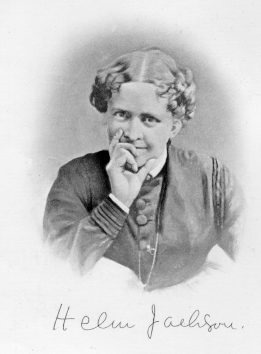
Hard to tell personality from a picture, but those eyes and the start of a smile make Jackson look like she’s  about to dispute something or share a delicious secret.


That’s all but the most liked and listened to piece this spring, and I can tell you it was a run-away winner. Words from a famous poet or unknown one? Well, it’s sort of both. I’ll be back soon with that announcement.


*He laughed right after he said it, thinking it a fit pronouncement from the Department of Tautology Department.

Higginson’s June

Here’s another post in our informal series “The Roots of Emily Dickinson.” Now a title like that may lead some to think I’m some sort of Dickinson scholar—which would be a fine thing to be, but I’m not. Frankly, when I started this project a few years back I assumed I’d present some Emily Dickinson poems. After all, not only do they famously fit well to music, but she was part of the poetry canon that I was raised on. Then something unexpected happened.

When I started to dig into Dickinson poems they grew mysterious, not just the elusive mystery of their intent or even their true subject, but the somewhat more external mystery of how they came to be written in the mid-19th century in a town in rural Massachusetts without any sure models for Dickinson’s new kind of poetry.

We know how many other writers assembled their machines and what fueled them. Shakespeare and Bob Dylan worked within successful entertainment enterprises, even if they were to reshape them. T. S. Eliot had a scholar’s interest in a wide range of art and spirituality across history, and after the trauma of WWI a significant part of the culture was waiting for someone to reassemble it however dolefully, even if it was in his Cubist collage. The Surrealists were crystal-clear about their influences and the impact of Freud and psychoanalysis. The G.I. Bill after WWII and the following post-war American prosperity introduced large numbers to colleges and college towns, including some who would likely not have attended before the war. This fueled not only the Beats, but the more academic-associated American poets of my youth. The 20th Century urban migration of Afro-Americans and the Talented Tenth tactics of the early 20th century U.S. Civil Rights movement encouraged the Harlem Renaissance and similar artists.

Emily Dickinson? It’s just not so clear to me. My best guess remains that she was a Transcendentalist of some sort in a household dominated by a father that wasn’t. Transcendentalism, staunchly individualist in it’s outlook has no mandatory dogma, but the sense that the intense, even visionary study of nature reveals the deepest spiritual truths seem to me to be its core. Received truths, any established customs and traditions, are to fall before this apprehension.

However individualist in philosophy, the Transcendentalists and the Boston publishing and cultural nexus were intimately connected socially in a way that Dickinson was not.

One incident, often judged as a quasi-accident* closed this circuit. In 1862 as the 31-year-old Dickinson had begun her extraordinary five years or so of white-hot poetic composition, she wrote Thomas Wentworth Higginson and enclosed a few of her poems. A string of correspondence ensues, and eventually the two met in person.

Dickinson’s letter is conventionally seen as a “cold call” prompted by Higginson writing a magazine article in The Atlantic “A Letter to a Young Contributor.”  That article is largely unremarkable if sensible, the subject one that is covered over and over wherever there are editors who accept written submissions. Submit clean, legible copy. Re-writing is as important as writing. Remember your audience and take pity on them. Hey, the editor is on your side—they, like the writer, want to produce good work.

And here we come to the next beat in the story as it’s usually told. Higginson is often portrayed as something of a doofus, the archetypal mansplainer who can’t understand Dickinson’s greatness. He suggests Dickinson write more conventionally and doesn’t think her work is suitable for publication. Presented with one of the founding geniuses of Modern poetry, he’s blind and hesitant.

Is that so? Well, there’s a lot we don’t know. First, we only have letters from Dickinson’s side of the correspondence. I’ve delayed this post so that I could at least read some of Higginson’s writing on other contemporaries of his and Dickinson, and one thing stands out from his later 19th century accounts of his life and times: he’s the soul of discretion (obscuring names for embarrassing incidents), generous even to his opponents, and extraordinarily hesitant in claiming credit for any of the things he may have been instrumental in. As an editor and literary critic, he seems to have a fairly good and objective eye, and he does not shy from pointing out shortcomings in writers he admires. I read his essay on Emerson written shortly after Emerson’s death, and his admiration for the man and his intellect does not keep him from agreeing with judgements about the faults of Emerson’s poetry. It therefore seems likely he could have suggested changes to Dickinson in his correspondence.

How artistically wrong would those suggestions have been? How harmful might they have been to the isolated Dickinson? Even if he was “wrong” could he have been tactically right about what mid-19th century audiences would tolerate? Here we don’t know the devilish details, but we know some things otherwise: Dickinson wrote most of her nearly two thousand revolutionary highly condensed poems as this correspondence was initiated. If Higginson squelched her or convinced her to temper her individuality, he must have been bad at it. If, on the other hand, what he said encouraged and kept her going, that would be consistent with what occurred.

Here’s something else we know objectively: in 1890 he was instrumental in getting Dickinson’s posthumous-published-career off the ground.**  He did not prevent and may have agreed with the conventionalizing of Dickinson’s punctuation, adding of titles to title-less poems, and so on—but historically those editions sold well right from the start and gained Dickinson a reading public. He added his prestige to the launch with the book’s introduction where he framed her (not yet knowing how well Dickinson would sell) as a sort of art brut phenomenon:

“In many cases these verses will seem to the reader like poetry torn up by the roots, with rain and dew and earth still clinging to them, giving a freshness and a fragrance not otherwise to be conveyed.”

This may be false, even if it’s an accurate advertisement for the impact reading Dickinson for the first time may have on a reader. Yes, Dickinson was likely a more conscious and careful artist than this impression leaves us with. But it worked! Remember, there was no Dickinson tradition to be misinterpreted when he did this. To a large degree, the reason we have an on-going debate about Dickinson that more than a handful of graduate students and eccentrics like me care about is because of his work in insuring that original edition.

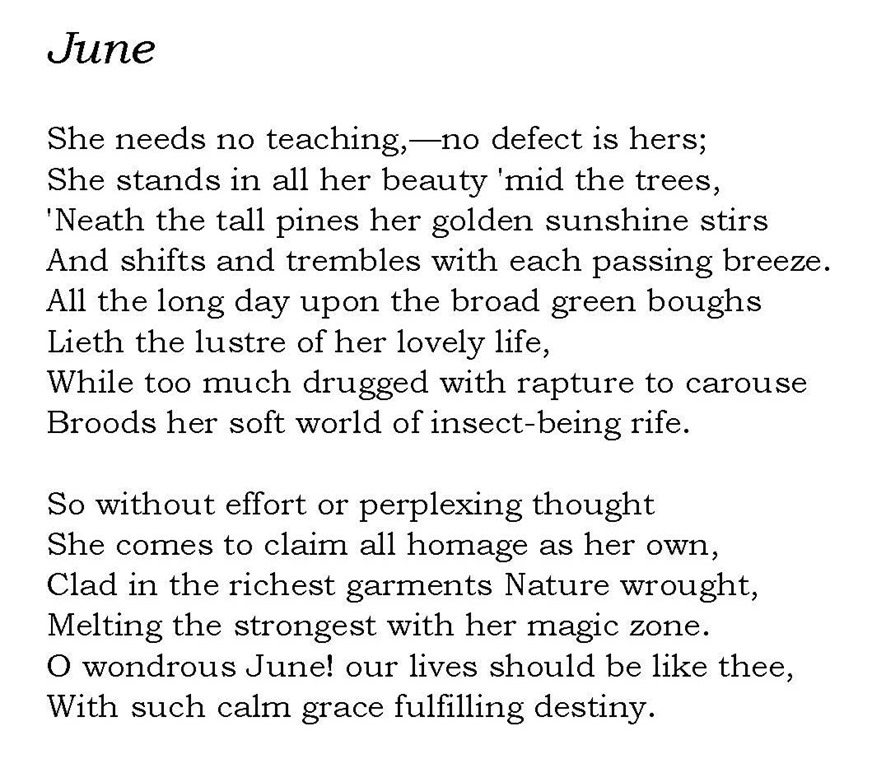
Now for a surprise. I did not know that Higginson had written poetry until I came upon this poem by accident while looking for June poems. I can find nothing about it, but in the absence of knowledge I’ll speculate it might be from Higginson’s college-age youth. Here it is:

June

I may be full of perplexing thought even if this June day isn’t


It’s a graceful sonnet. I’m not in love with the slightly over-egged consonance of the “Lieth the lustre of her lovely life” line, but I’d suspect other readers would point it out with appreciation. On the other hand, the vowels of the preceding line “All the long day upon the broad green boughs” are pleasing to me. And the poem’s fine opening line, referring to June’s summer overture, “She needs no teaching,—no defect is hers” is hard for me to not read, whenever it was written, as the proper way to approach Emily Dickinson’s genius. The ending of the octet “While too much drugged with rapture to carouse/Broods her soft world of insect-being rife” is a truly strange one, half awkward “poetic diction” perhaps necessary to make the rhyme, and half a striking William Burroughs a-century-too-early image of June on the narcotic nod as summer’s insect-being is partly suppressed for the moment.

The sestet is not as distinctive, and I wonder if “zone” was chosen for its rhyme rather than being the best word at the end of the 12th line, but overall more interesting than most 19th century American sonnets. In his “Young Contributor”  article Higginson sagely notes that duality of the critic who’ll offer criticism when they themselves are not accomplished in the arts they criticize. “People criticize higher than they attain” he says.

After all that, here’s Thomas Wentworth Higginson’s sonnet “June”  and my performance of it. The player gadget to hear it is below.


*The writer of the standard Dickinson biography Richard Sewell believed that regular Atlantic  reader Emily Dickinson was attracted to Higginson’s nature articles which he’d published in The Atlantic  prior to the “Young Contributor.”  Early Dickinson biographer Genevieve Taggard speculates that George Gould (which she identifies as Dickinson’s ex-fiancé) may have suggested Dickinson write Higginson.

**I’m still underinformed on all the details of how we got to the 1890 publication of the first large batch of Dickinson poems. Originally, Dickinson’s sister looked to Sister-in-Law and intimate friend Susan Gilbert Dickinson to shepherd the publication. Susan Dickinson said (after the successful Higginson-introduced 1890 edition) that she had a big idea for presenting Dickinson in a fuller way from the start, but the project didn’t seem to get off the ground in the mind of Dickinson’s sister who was legally the rights holder. In an example of the multivalent family dynamics of the Dickinson family, the mistress of Susan Gilbert Dickinson’s husband (Emily’s brother, Austin) Mabel Todd Loomis, was then brought in as well as Higginson to edit and arrange for the first publication of Emily Dickinson’s work. Where Higginson comes in within this series of connections and who selected who, I don’t know, but seeing the book to completion and getting it published and launched with notice and eventual surprising sales has to be presumed to be largely Higginson’s work. He was the man with the connections, track record and prestige after all.

Beach Burial

In the United States this is a long holiday weekend, ending with Memorial Day, a day set aside to remember those who died in wars. Other countries have similar days, but in the US it has largely become the embarkation point for the joys of summer. Yes, oh yes,  there are those who have specific and somber memories in Memorial Day, but despite our generally observed notion of honoring all who fought in our wars on our side, whatever the war, for whatever the reasons, this day, set aside for those who gave their lives, may include only brief offerings to them.

Intentional death, for whatever reason, is a complex subject. Perhaps it’s best if we don’t think about this unless we’re really ready to think about it. There are so many questions, some of which I have no answers for even after a long life, and even if I did have answers, what matters more (if you are younger than me) is your  answers—and what you do while waiting for answers.

Is it always “Sweet and proper to die for one’s country?” Note, we know that phrase from Latin, written as it was by Ovid. It’s used in several English-language poems, often still in Latin, as it is engraved over an entrance to the U. S. Arlington National Cemetery: “Dulce et decorum est pro patria mori.”  So, it’s not an American phrase,* not even written knowing what America was!

Oddly Memorial Day comes out of Decoration Day when the graves of the dead from both sides of the American Civil War were visited and decorated by those who lived through that war, honoring those who, as in all civil wars, were seeking to kill their own countrymen.** That’s a complicated act, is it not?

So, it’s perhaps understandable that for many of us our outdoor grilling, our sports and play of summertime, our readying for graduations and vacations are not deeply troubled by the Memorial in Memorial Day, as huge and final as those sacrifices are, for those sacrifices are both simply total—and complicated.

Today’s piece doesn’t use words by an American either, it’s by Australian Modernist poet and journalist Kenneth Slessor, and it comes from observations he made while serving as a war correspondent accompanying Australian ground troops during the battle of El Alamein during WWII.***  I believe it to be a masterful poem by a writer too-little known outside of Australia.

Kenneth Slessor war corespondent

Kenneth Slessor as the official Australian WWII war correspondent


I could go into it line by line and point out what Slessor does that makes this poem work, but I also believe “Beach Burial”  needs only your attention to make itself felt.

I’ll add only one thing, though I’ve long lost the notes to where I found it. Some other explications of “Beach Burial”  are puzzled or make out the nakedness of the bodies as only metaphorical. The account that I read said that the sea-torn bodies from the burned and sunk ships that were washing up were indeed naked or nearly so, and that this was part of the effect Slessor chose to make with his poem and account, that the men doing the hasty burials in the midst of battle could not tell friend from foe from non-combatant.

Still they probably understood, as Slessor did, that some of those they were burying were their mortal enemies. It they, or you, were to think about the moment in Slessor’s poem, it’s complicated. This is an example of the sort of act I speak of above, things you might do while you are waiting for answers.

As it happens, today’s audio piece is an older live LYL Band performance recording from before the Parlando Project got underway. I hear some imperfections in it that are different than the imperfections I still hear in more recent pieces, but perhaps a different sort of imperfection will seem fresh to you. The player gadget to hear the LYL Band performance of Kenneth Slessor’s “Beach Burial”  is below. The text of the poem, for those that want to read along is here.


*One American phrase, made famous in the movie Patton  as spoken by the titular general is “No bastard ever won a war by dying for his country. He won it by making the other poor dumb bastard die for his country.”

**I’m sorry, but I must add that one side was fighting of course for the chattel slavery of other of their countrymen. This doesn’t make the acts of these early Decoration Days less complicated, only more so.

***And I point out, one side in this battle was aligned with the cause of an odious tyranny that sought to extract via meticulous death and slave labor the lives of many, due to some crackpot racist nationalism. That doesn’t make this poem less effective, it makes it more so.

They Say Life is Precious

Creativity is escape and sticking-with-it, avoidance and attention. Routine can take you to your place reserved for freedom, you may believe you’re going to the same place, and then something else happens.

Every so often I present a set of words I wrote here rather than following my usual practice of using other people’s words and “other people’s stories.” I didn’t plan to do a piece of mine here, though I did plan to revise this poem from 2016 yesterday. Sticking-with-it.

But first, I thought I should take the opportunity to play a little acoustic guitar in a quiet house on a cold grey day. Avoidance.

This is one of the good things about my multisided creative life. If I put off or am outright avoiding one side, for example, writing or rewriting my own poetry, I may flee to my music side, to the shear tactile pleasure of playing an instrument. Or to the poetry written by others and this project. Escape.

So there I was at the guitar. I tuned it to “double drop D,” and because the guitar that was at hand has too narrow a neck width at the nut to suit my less flexible older fingers, I capoed up to the second fret which gave me a little more room. From there, by ear I started to work on some chord forms that sounded interesting together in this alternate tuning. This is one of the virtues of altered tunings on the guitar. I have some understanding of the guitar’s conventional tuning, but an altered tuning requires new exploration.

None of the chords I ended up playing would have been difficult to find or fret in standard tuning, but the altered tuning I was using has three strings tuned to the same note (though one’s an octave lower than the other two) and that not only makes it easy to get a drone going while playing other notes on top, but that trio of strings resonates sympathetically.*

I was quite receptive to the sound that was developing, and next to me as I played was the manuscript of the poem I planned to revise. Could the resonating chords be fit to it? Yes, it looked like they could. Attention.

Performing a written piece can be an aid to revision. As I worked on the music I was cycling through sections of the poem, and some lines began to volunteer themselves for deletion. The poem lost five lines, and it was the better for it. The ending wasn’t strong enough, so I added a couple of sensuous verbs which I think made it better. The line deletions happened almost without attention. I was years separated from when I thought they were a good idea to be included, and the repetition while thinking mostly about the music and its flow simply made them seem unimportant. The revision of the ending was a more literary endeavor, but by that point the music was coming together, and I came up with choices sharply focused on getting that ending “fixed” so I could record a finished version.

That piece I ended up working on, today’s piece “They Say Life is Precious,”  was intended as a page poem, but the process I went through with it on Thursday made me think it works better as a performance piece—but even on the page I think it works better now because of the time I spent performing it as I composed and recorded the music.

They Say Life is Precious
We pay for life by filling it’s container, time, with attention. You can put money in there, but it can’t read what’s on the currency.


The acoustic guitar part didn’t turn out to be difficult. I recorded it and my vocal. The chords of the piece are E5, E minor 7, and two voicings of Bsus4.**  To fill out the sound I added Mellotron violins and flute, a simple contra-bass part, and an upper-register fretless electric bass line.

Escape and sticking-with-it, avoidance and attention. By avoiding the revision and choosing to play guitar first, I accomplished the revision—and when I thought I was just going to play guitar, my composition routine refused to relinquish itself and drew my attention.

To hear my piece “They Say Life is Precious”  use the player gadget below.


*Many musical cultures have instruments that use drones or sympathetic vibrations. South Asian music is full of them, but so to are Celtic pipes, Norwegian hardanger and any number of African stringed instruments. Even something as common as the piano when played undampened pulls up resonances.

**If there are any guitarists who want to try to play this, it’s a good introduction to altered tunes as the fingerings are easy. First drop your high and low E strings one whole step to D. To match the recording, capo the guitar at the second fret. The following fret-hand fingering positions are used: Chord E5 = 3rd string at 4th fret, 2nd string at 5th fret. Chord Em7 = 4th string at 5th fret, 3rd string at 4th fret and 2nd string at 3rd fret. The higher sounding Bsus4 = 4th string at 11th fret, 3rd string at 11th fret. The lower sounding Bsus4 = 4th string at 4th fret, 3rd string at 4th fret. Technically this Bsus4 also has the C# that makes it a Bsus2 as well.

A Letter to Those Who are About to Die

Certainly not the most self-love inspiring/invest me with hope/promise to give me beauty title for a poem. Mid-century American poet Kenneth Patchen could supply those sorts of things, but in his first book, Before the Brave  published in 1936, he was looking around him, and the things he saw and felt were ominous.

In that collection and this poem, Patchen seems militant and politically committed in tone, though the poems seem too immediate to the times for me to fully decode his advocacy. “A Letter to Those Who are About to Die”  indicates something’s coming, but it doesn’t simply say what. Violent revolt or revolution? Another World War? State-run oppression? Radical social change? If we study history, we know that it turned out to be some all of that. By the time Patchen was writing “A Letter to Those Who are About to Die,”  the Italian invasion of Ethiopia, the Spanish Civil War and the Japanese invasion of China were at hand or a few months away. Hitler was firmly in power in Germany. America was in economic crisis—and if you were poor, black or another ethnic minority perhaps only a generation away from another country that might be equally troubled, your life was now doubly challenged.

Kenneth Patchen 1939

A photo of the young Kenneth Patchen in the 1930s


I know the later Patchen, the pacifist, the poet of love, the painter of illuminated outsider pages, but this was an angrier voice, more desperate than I expected. He was all of 24 and he’d just found the love of his life—but this wasn’t a newlywed world of hope. Could we look back from our perch informed by 20th century history and say he was wrong, that he was over-reacting? No. The ovens, the bombs, the death marches, the battle beaches, the truncheons, the gulags, the lynchings, the public gunshots.

Someone called Patchen’s mid-century cohorts The Greatest Generation. They fought for and against these things, perhaps in roughly equal numbers, and there are claims in all alignments that some of the above list of horrors were necessary to defeat some others also of the above. Objective history can tell us this all happened, even if it can’t speak with one voice on which horrors were justified. As far as I know, Patchen was against all of those horrors, which made him an outsider in his generation. Idealist? Naïve? An individual who opted out from being blamed for history?

I’ve been taken this spring by a song of Andrew Bird’s “Bloodless.”  Bird’s an artist that I’ve previously admired more than I’ve wanted to listen too, but this song has a laid-back Curtis Mayfield/Marvin Gaye groove and heart that I can’t deny, with lyrics about the poets exploding like bombs “And it feels like 1936 in Catalonia.” That feels, in my present, like today’s Patchen poem.


Andrew Bird’s “Bloodless” official video.


So, even with that title that refuses to be attractive, I’m willing to give Kenneth Patchen a read and a performance, and you may be willing to give it a listen.*

Musically, my band and voice aren’t going to be keeping Andrew Bird awake on those nights when it’s music and not the parallels of the Spanish Civil war that interrupts his sleep. However, Patchen is one of those pioneers in combining spoken/chanted poetry with jazz-influenced American music, including collaborations with John Cage and Charles Mingus and a series of LPs with other musicians issued in the ‘50s. I do not expect or wish to frighten the ghosts of Cage and Mingus, only to honor their, and Patchen’s, independent spirit. The player gadget to hear my performance is below. There is no easy place to read the text of this poem on the Internet, but this link may work for those that want to read along.


*By coincidence, the Poem-a-Day from poets.org today is by Fatimah Asghar titled I Don’t Know What Will Kill Us First: The Race War or What we’ve Done to the Earth,”  which title probably equals Kenneth Patchen’s in click-through rate, even though the poem itself might ask us to read the title after the poem rather than before. I sat in a bakery this week and overheard two older white guys, looked my age or a bit younger, discussing the ridiculousness of fears like unto Bird’s and Fatimah Asghar’s these days in America. I wonder what Kenneth Patchen would say if he were to stop by?