I promised a return of Dave Moore earlier this month, and here he is, presenting a story that frames itself three ways. In today’s piece Dave reads a short passage from Greil Marcus’ 1975 book Mystery Train: Images of America in Rock’n’Roll Music, which in turn includes this story 20th century musician Frank Floyd told about himself. Marcus uses the not-quite-a-footnote career of “Harmonica Frank” to outline a grand story of American music forming itself from disparate sources, and Dave’s selection focuses on something particularly disparate and desperate in Floyd’s story, the diversity of work musical and otherwise that Floyd knitted together into a life. That litany of Floyd’s gigs is the coat of arms on the flag of “The old weird America” that Marcus’ famously invoked.
Beside the trick of playing harmonica like it was some stogie, all the while singing, Floyd would play two at once using both his nostrils and his mouth. Getting attention in those old weird America gigs wasn’t easy.
I’m over half-way in watching Ken Burns’ Country Music 16-hour documentary series. I’ve got a few hours left to go, so please no spoilers, I don’t want to know how it comes out. It has drawn some criticism for being an overview with Burns’ characteristic trope of excerpting some figures to represent the greater points and leaving out or footnoting others. I suppose the later problem is inevitable but will also always be a fertile ground for argument, and the former, the survey course pacing that keeps moving forward with short excerpts of songs and talking heads (and yes, those won’t stay still pictures’), is something I’ve come to accept with anything that tries to tell a more than century-long story.* We currently live in a world where much of the once rare and physically bound-up resources of our history, our cultural histories told by example, are widely available, constrained only by time and our levels of interest. Overviews, just as pieces about obscure figures, can inspire one to use those resources to find out more.
Decades ago, when the Internet was still young and more text-based, I was enormously frustrated by Burns’ similarly-scoped Jazz. Some rare film clip or unheard recording would play for 10 or 15 seconds, and then a talking head would be cut to, telling us how important this one was, how we should pay attention to it, while the filmmaker was doing exactly the opposite.
Country Music does exactly the same thing, but in a great many cases the whole thing is available fairly easily now. And in the middle episodes, where the “Country and Western” era played out for 20 years or so, I hear the music of part of my father’s life, one of the gigs he knitted together to make a living. I hear the songs that would play on his transistor radio sitting on the metal dash of his bread van, racks now empty and rattling after tray after tray of loaves had been carried into small-town grocery stores via his drives over two-lane roads. Over that insistent chorus of bare-rack snare-taps, the steel guitars and keening vocals cut through readily where we never talked.
Burns’ doesn’t have to play the whole song for those. I know it and I don’t know it instantly.
Well, there I go, off onto something else, talking over consideration of Dave’s presentation of Harmonica Frank Floyd and the many gigs Floyd did while trying to do his “something different,” songs and earn his daily bread. I think you’ll find Dave does a nice job of presenting Floyd’s story. The player to hear him tell it is below.
*You can’t win department: the criticism that you didn’t include everybody is the opposite side of you didn’t go deep enough on any one thing. As long as you accept that there’s some value in these survey-course/overviews then you are committed to not delving the depths on a particular issue, style, or person. Of course some get left out, just as the canon of poetry leaves some out—but as we do here with some of our pieces over the years, as Marcus’ did by including the obscure figure of Harmonica Frank, as to some degree Burns did by including another harmonica player: DeFord Bailey in his survey, that should just inspire other, corrective and extending work.
It’s perhaps my favorite scene in D. A. Pennebaker’s Bob Dylan documentary Don’t Look Back. Pennebaker has setup this narrative as Dylan tours England in 1965, introduced with shots of British music newspapers touting the teen-aged Donovan as Dylan’s rival. My well-remembered scene is shot in Dylan’s Savoy hotel room, where boffins can pick out various UK music figures sitting about and talking. In the background, there’s Donovan himself, tuning an acoustic guitar as Dylan asks if there’s anyone in the British Isles that is a poet like unto Allen Ginsberg. Dominic Behan is offered. Dylan says nah. Donovan has tuned up and launches into his “I’ll Sing a Song for You.”
“That’s a good song” Dylan chimes in as Donovan sings, and though eyes behind Ray-Ban shades he still seems to be paying respectful attention. Someone says “He plays like Jack man,” not a slur, but referring to Ramblin’ Jack Elliot, the legendary folkie and predecessor to Dylan in the Woody-Guthrie-continuation field.
Dylan takes the guitar from Donovan and launches into “It’s All Over Now, Baby Blue.” The guitar has gathered a capo and Dylan has lost the shades. Donovan lights another filter cigarette and chews on his nails, figures how to be cool.
Now, “rating” Dylan songs is subjective and subject to mood, even for any one person. For this one person, “It’s All Over Now, Baby Blue” gets a lot of respect: a song about love using politics as a metaphor or a song about politics using love as a metaphor? The best metaphors are like that, the thing and the representation can flip places.
So besides the people-watching and the music in a movie about a songwriter that actually has little music in it,* the gist that’s often drawn from this scene is an unhelpful but crucial tip: if you’re ever in a song pull, don’t sing your song just before 1965-vintage Bob Dylan if you can help it.
OK, so I’ve already drifted back to 1965, let’s keep drifting backwards to 1922, and you’re a Modernist poet, not a singer-songwriter. You’re about to be published in The Dial, the sort-of-successor to the mid-19th century American Transcendentalist house organ, now publishing the cream of Modernism in art and literature. Let’s get specific, the “you” you’re playing as you travel back in time is Mina Loy, a woman who’s au fait with the avant garde and whose poetry remains strikingly original even today. Yes, the Modernist movement is going to have its problems with women as artists, but Loy seems fierce.
And the Mina Loy poem that goes into that issue of The Dial is a glorious ode to a visual Modernist: one of Constantin Brâncuși’s series of bird sculptures “The Golden Bird.” Loy’s poem has something the pre-WWI Modernists often had, a joy at the new way of looking and expression.**
The lesson of the Dylan’s Savoy Hotel room is true but unhelpful here. The November 1922 issue of the Dial leads off with a new publication of a poem called “The Waste Land” by T. S. Eliot. You might have heard of it.
Antiquities dealers ask for more than $1,000 for this back issue
Art of course isn’t a competition. “Rating” art is a silly pastime that gets sillier the thinner you try to slice it. The emotional/intellectual transfer happens between art and audience or it doesn’t. Still the unhelpful rule would hold that if you’re trying to make an impression as a Modernist poet, holding up your “read me” sign next to what gets rated a masterpiece isn’t the way to go.
Now, almost a hundred years later, readers and critics are starting to look again at Loy, whose entire career was overshadowed compared to others she worked beside. How successful was her art? There’s no fixed record, because that assay happens every time it’s read or listened to. I think this tribute to Brâncuși stands up, even though it no longer benefits from the early 20th century shock of the new.***
Musically, today’s performance marks my annual tribute on the anniversary of the unfortunate death of the American musician and composer Jimi Hendrix. Each year for September 18th I plug in a Stratocaster electric guitar and try to channel a little of Hendrix’s bird in flight. Hendrix was enormously interested in the electric guitar’s timbral possibilities, so I tried to make my guitar part reflective, chirping with bird song, and gong-like in turn. You might easily think: this is my Savoy hotel room moment. You could be right, but I persist. My performance of Loy’s piece praising Brâncuși’s sculpture is available with the player below. The text of her poem is here if you want to follow along.
If you ever find yourself, regardless of the unhelpful rule and your careful plans, as a Donovan next to someone as a Bob Dylan, one choice is: go ahead anyway. I’m glad Loy did.
*Yup, it’s true. The movie is forever showing Dylan about to go on stage and then it cuts to another backstage scene. This may have been necessary for music-rights issues, but the movie Pennebaker got was all the more unique because of this.
**RaulDukeBlog has sagely commented here about the gloomy-gus nature of so much of 20th century High Modernism. T. S. Eliot’s poem helped turn it that way, even if it was a personal expiation to break out of that. Two World Wars and surrounding atrocities certainly didn’t help cheer up the arts, and our present state is damp with sodden things that can only be dried with some fire that joy sparks. Another reason to go back earlier in Modernism, and to look at the kindling of artists like Loy and their pure enthusiasm for breaking out of entrenched tropes.
***A famous anecdote about Brâncuși’s work has it that at one point when the statue was being transported to the U.S. the customs officials refused to believe the abstract form was a sculpture at all, and it was instead classified as a metal ingot.
How much do we know about Emily Dickinson as personality, as a living person? I can’t say that we know much at all. Originally, she was marketed as cypher, an enigma, a hermit/shut-in, and this reflected a valid aspect of the later parts of her life. The self alone is not a no-place, but it’s a hard-to-know place. In my lifetime there’s gradually been an understanding that it’s not the whole picture however.
Her youth seems to have included an above average circle of experiences for a woman of her class, time, and place. And her most productive writing years, those of her early thirties, seem a middle ground, with some travel amid mysterious and undetailed accounts of illnesses.
Her poetry, still revolutionary, no longer needs the biographical mystery to market it, but that doesn’t stop us. Its domestic strangeness makes some of us look for a Baedeker to help figure out the sites and landscape.
I say this because it appears that yet another attempt to portray a living Emily Dickinson is upon us. In 2017 we had A Quiet Passion portraying an intellectually vital person dealing with a rigid society, and only this year we had Wild Nights with Emily which tried to illuminate Dickinson’s emotional life and the revolutionary artistic aspects of her work. Both of these films have to deal with issues that any biopic about an author will: watching people write is boring second-unit stuff, connecting written work designed for the page to a visual performance is not straightforward, and what writers record in books is not a one-to-one reflection of their own personality and character. I’m willing to cut filmmakers some slack because of these unavoidable issues.
None-the-less, Dickinson, one of the tentpole series that Apple TV+ has announced for its nascent Netflix/Amazon Prime/Hulu streaming video competitor this fall, is raising eyebrows and guffaws. Here’s the trailer.
Midway through Emily and Lavina rock-out in their underwear on ukulele and banjo.
Let me summarize some comments the trailer has drawn:
“That’s crazy pants”
“Instead of the classy story-telling Apple has promised for its new video service, this looks like a CW* series.”
“What were they thinking?”
“Portraying a famous recluse as a wild child? Really?”
Well I’m not going to predict anything (I’m bad at it). The hyper-fast cutting of the trailer should almost come with a strobe-light seizure warning and makes it even harder to determine how the series will work than a run-of-the-mill promotional clip, a form already infamous for misrepresentation. I’m not going to throw stones at the EDM soundtrack of the trailer though. Indeed, I’d hope Dickinson is as audacious as I’ve been here in mixing “wrong” music with older art.
A worry is that if it tries to modernize Dickinson without comic awareness and savvy, it could be unintentional comedy that goes nowhere. As with previous Dickinson movies, I suspect it will give in to the dramatic temptation to compress and confuse the time-line of Dickinson’s life. I know nothing of the show-runner’s previous work, but title-role-actor Hailee Steinfeld was great with vitalizing 19th century dialog in the Coen Brothers’ version of True Grit.
A list of recurring characters gives hope that the show will try to deal with some of the formative influences on Emily Dickinson: Susan Gilbert, the eventual sister-in-law and possible romantic partner, Benjamin Newton, generally recognized as a mentor to the young Dickinson who died at age 32, and George Gould, who Genevieve Taggard identified as once engaged to Emily and who might have continued to serve as a connection to outside literary and cultural forces per Taggard’s biography.
I’m even more heartened by the presence of actor Chinaza Uche in the regular cast, which indicates that Amherst’s African-American presence will be included. How complex will they allow that element to be?
Much of what we know about these people comes from Emily Dickinson’s letters, a form in which Dickinson performed, taking a series of personae. Within a variety of frames and masks understood and puzzling to the recipients, she herself remains unrevealed while revealing. The letters don’t tell us how Emily was like to be around, they tell us the ways that Emily wants to express herself on paper. Tantalizing and frustrating for biographers—when Dickinson writes of her life, the enigmatic poet side comes out.
Today’s piece is an example. Indeed, if one wants to contrast Walt Whitman to his fellow American mid-19th century poetic innovator Dickinson by saying that Whitman was able to write free verse while Dickinson was content to write irregular stanzas with looser than “proper” rhymes, passages like this from a letter from Dickinson to Thomas Wentworth Higginson in the spring of 1862 are vers libre without being published as such.
The first “tutor” she mentions in this letter is usually identified as the doomed Ben Newton, and the second may be Gould, who had to leave Amherst to seek a living, eventually traveling overseas. Other dramatis personae: Emily’s famous dog, Carlo, and her piano, the instrument she was known to have played in the home with some skill. But what is the terror since September? Illness? Artistic sturm und drang? It’s tempting to say that the letter-passage’s sundown and the hills reference another famous Dickinson poem, but what is the noise in the pool? Is it “public—like a frog?”
So, regardless of how entertaining, enlightening, or disastrous Dickinson turns out to be, there’s evidence for presenting a rather outrageous, self-dramatizing, and rapidly thinking person who relates her own poetry to her life. That is, if the Dickinson of the letters is like the young, living, social Dickinson.
No dance-oriented Dickinson today listeners, and I had to be literal and include some piano due to the reference in the text, though no singing pond-frogs or dogs. The player gadget to hear me perform part of this letter is below. The full text of the letter to Higginson is here.
*The CW is a minor American broadcast TV network that targets its programming at younger audiences. Just to go on the record: as long-time readers here might suspect, I’m not immune to meta-rich transformation of historical subjects with references to modern phenomena. I love Upstart Crow because it sitcom-frames Shakespeare’s life as if it was The Dick Van Dyke Show (which itself was a Sixties recasting of Carl Reiner working on Sid Caesar’s show in the Fifties) with lots of wink-wink anachronisms. Dickinson may not have yet reached the level of dead-white-male canonization that allows Shakespeare to be deconstructed for laughs though.
In Minnesota there’s this thing, The State Fair, that’s hard to explain. Up to a couple-hundred thousand folks show up each day to it, for various hard to describe reasons. There are events, exhibitions, livestock judging, sales booths, musical acts, lots of fried and sweetened food that can be eaten by hand. You could describe it as an overgrown county fair, and as with those, there’s a midway with clanking and spinning rides and games of chance.
Rural and farm folks come to it from around the state, but it’s held in the Twin Cities, a thoroughly urban place, and most of the attendees that fill much of the fairgrounds are from The Cities. Some like me would be once rural folks, or children of rural folks. A place like the Twin Cities is full of those, people remembering that place not present in location or time, À la recherche du temps perdu, “In search of lost time.”
I came to the Twin Cities in the 70s, not directly from the small-town Iowa of my youth, but from New York, where there are fewer intimate thoughts of farmlands. Shortly after arriving, a woman I was in love with told me there was this guy on the local classical music radio station, who was no longer playing Liszt and lieder, but rather other stuff—Beach Boys, folk music, whatever. And she said: he tells stories about this small town he’s made up.
I stopped her there. I admired her smarts, the things she knew, but I know how those stories go I said: We’re ignorant and out-of-touch, those rude mechanicals. As the urban-cool Bart says in Blazing Saddles when introducing the Waco Kid to the little town: “You’ve got to remember that these are just simple farmers. These are people of the land. The common clay of the new West. You know… morons.”
“No, he’s different. If you listen, you’ll see.”
He had a 6-9 morning show. We listened together. He’d spin humorous stories of invented events and institutions between records. Some of it was sort of like Jean Shepherd’s shtick, still playing in New York on WOR radio when I left, but as she had said his take on small town life was different. His stories then often had a delicate balance between young Twin Cities residents, some of them college students with literary aspirations such as myself, and their hometown folks. He was generationally close to the former, but he often had them play their pretentions toward great changes for humor against the set in their ways but caring older generation back at the hometown. From my seat then between those two worlds, this was a high-wire act, and he stayed out of falling into the netting or sawdust.
He was also forming up a weekend radio show, that graveyard of radio without the reliable drive-time slots. He’d perform them live anywhere locally there was room for the hundred or so attendees. He modeled it on the radio country music variety show, something that still existed in my youth, but except for the Grand Ole Opry had died out. But instead of country music acts, most of which would have little interest to a metropolitan public radio audience then, he stocked his traveling stage with young musicians that played the West Bank bars and coffee houses around the Twin Cities. Some of these players played trad jazz or blues, some were folkie singer-songwriters, some were from the more museo-wings like Leo Kottke or bluegrass revisionists, others from a variety of old-time-music revivals. In recent decades everyone knows what to call this mixed-bag: Americana. But in the 70s no one did. This weekend show, Prairie Home Companion, sort of helped make that category up.
A man I knew once charged with programming a radio network liked to say regarding the success that show eventually had: “Prairie Home Companion is a lousy idea for a show—except for a show with Garrison Keillor.” A lot of folks doubted that thought, and while some attempts to do “something like, only….” have had decent runs, no one else ever made it work to the degree Keillor did.
There seems to have been a reason that the younger, moved to the cities generation in his stories often had writerly ambitions, because Keillor continuously worked a side career as an author of short stories, poems, novels, columns and opinion pieces. The thing that connected that side and the radio show was “The News from Lake Wobegon,” a varying length monologue that came near the end of each show.
This wasn’t standup, it was storytelling. Unlike the comic and parodistic skit elements that became an increasing part of the show over its run, it wasn’t read direct from a script radio-drama-style, but told, and written entirely by the host. This was the small town and its history he’d made up in its most concentrated and alive form. It had that live performance immediacy. Occasionally there’d be short dead air pauses, some intended. There’d be things repeated, some as intended refrains. Moods and directions would be mixed, sometimes turning within the course of a sentence as it does in ordinary recounting. Is he thinking, and that thought interrupting his story?
Sometimes it was a rousing tale, a good-hearted shaggy dog story on some foible. Other times along with the humor was sentiment, mood pieces buffered inside rueful rural characters. Occasionally, framed through some youthful ambition, there’d be poetic asides and lines such as the passage I bring to your attention today.
Even with the framing, it was a very pure thing, and like most things of that sort, some loved it and others found it somewhere between meh and tiresome. Keillor had a slow, even-voiced recitative, a sighing oboe that could reassuredly uncoil some from a basket while leaving others sleeping inside.
Say it with me, long-time readers: “All Artists Fail.” I last posted 5 minutes of wailing electric guitar arpeggios over my fresh translation of a hundred-year-old French avant garde poem. I’m not going to throw shade based on either some idea of universal criteria for art or a proper recipe for entertainment.
I remember hearing a version that included the passage I perform today. Did I hear it live on the radio on a Saturday night decades ago? Did I hear it later, on a distributed recording? I can’t say for sure, but as this ending summer was beginning, I was on the northern shores of Lake Superior. The cabin I was in, when some spitting rain opened the pores and raised white hairs on the smooth surface of the lake, had a couple of books. One was a book length collection of pieces from the radio show re-cast as linked short-stories and published after Keillor’s first retirement from live performance in the 1980s.* Reading them was a good afternoon, but only this single small passage was drenched in déjà vu.
Still raining, still dreaming. Keillor reframed monologues from the show he’d ended into a book for my rainy afternoon years later.
The ‘80s jacket author photo surprised me. Neither the bearded ‘70s guy with the light suit nor the older man I remembered.
The State Fair in Minnesota means the end of summer, a lost time that can be returned to and can’t be returned to. Here are a few sentences that a man once wrote and spoke on the radio. I’ll speak them today. Gave them a title of convenience and the music I composed on my naïve piano and then performed with a small orchestra setting using three woodwinds, a flute, and a few strings. My thought is that Keillor’s words could sound different to you when not performed by him, illuminated differently in the Parlando Project manner. The player is below.
Poetry as an immediate witness to momentous history is not a common thing. Poems of events tend to autobiography, deaths, love, births, personal injuries and triumphs. Today’s piece has both elements—memorable on both counts.
Guillaume Apollinaire is a major figure in Modernism with an influence across the arts as a critic and theorist. He popularized the term Cubism, invented the term Surrealism, and using his own name “Orphism” helped explain and formulate abstract expressionism. In the era surrounding WWI his influence and omnipresence was stronger from his base in Paris with French-speakers than Ezra Pound’s was for English-speakers from London. As a poet Apollinaire bridges the 19th century Symbolists to the Dada and Surrealism to come, and though he wrote in French, many of the English-language Modernists looked to French models for their verse.* While his work is experimental with form and language, it’s also very open-hearted and joyous in a way I associate with later 20th century American Frank O’Hara.
“The little car” tells of a day of Apollinaire’s that would change his life. On that biographic matter alone it would be of interest to literary historians. But it also tells us about the early days of the most influential event in Modernism, the outbreak of WWI. Apollinaire’s poem is comparable to W. H. Auden’s better-known beginning of WWII poem “September 1, 1939.”
So, let’s begin talking about the poetry as history today.
World War I started over a series of days earlier in the month of August 1914, kicked off by a ham-handed assassination in the Balkans at the end of June, followed by a slow enactment of various alliances and agreements plunging the whole world into warfare over the course of weeks (or in the case of the U.S., years).
Unlike the reputation of WWI as a brutal struggle of attrition between trenches, the opening August weeks were fast-moving. German troops cut through Belgium taking over that country in short order, putting them at the northern border of France as they met the French army. Large military movements and formations just slightly modernized from the Napoleonic era, that still included cavalry charges and fife and drum, met modern artillery and rapid firing weapons. Aerial bombings were introduced to warfare (though ground-based actions were more deadly to civilians). Soon amplified by propaganda, there are widespread accounts of bestial atrocities by the advancing army.**
Before the events of today’s poem, which self-dates itself to the end of August 1914 and into the following September day, during the Battle of the Frontiers, France’s army had suffered its largest single day of deaths and casualties in this or any war before or since, a staggering total of 27,000 killed in one day, with a figure of 300,000 casualties. The French army was reeling, withdrawing back toward Paris, which was the Germans’ objective in this first month of the war.
Apollinaire and his friend the artist André Rouveyre are in Deauville on the northern, English Channel coast of France. The poem doesn’t say, but I’m assuming they feel that the German advance is threatening their location, and so they do what threatened people unsure of the future often too, they head for home, Paris, not weighing that the French capital is the objective of that invading army.
Here’s my new translation of Apollinaire’s “La petite auto” used for today’s performance
That they leave “a little before midnight” is not just an image of imminent dark change, it also may say something of a necessity not to wait, or perhaps a decision that traveling at night, as difficult as it might be with primitive headlights, may be safer under the cover of darkness.
The poem continues with a series of Symbolist images, assembled in whatever order, as a Cubist painting might be. These are not mere inventions. Although expressed symbolically, they are reportage. Indeed, some of the symbolic events which may seem mundane to us in our world, would be accounts of dreadful wonder in 1914: men fighting in the sky, submarine monsters of war—the masters/merchants of war with their opulent and extraordinary wares.
Another feature of this poem is that the text begins to wander on the page and eventually is laid out in a manner that Apollinaire called “Calligrammes” to form the shape of “The little car” of the title.*** I’ve not included that concrete poetry text in my new translation for reasons of length and focus on the spoken potential of the piece.
The poem ends with Apollinaire and Rouveyre arriving in Paris on the afternoon of September 1st. I note the poem says they stopped for a bit in Fontainebleau, just south of Paris, which indicates that they took a round-about route that day since Fontainebleau is south-east of Paris though they were coming from the north-west of Paris.
The “mobilization posters” he speaks of that were being put up as they pulled into town tell of the irony of their route to escape the Germans. The German army is now threatening Paris itself, advancing to between 20-30 miles from the city, and legend has it that the French army was able to redeploy quickly by dragooning the entire taxi-fleet of Paris.****
What happened after the events recounted in this poem? Apollinaire fought in WWI for his adopted country France, and in 1916 was seriously wounded. Still weakened by the wounds, he’s felled by the infamous flu epidemic of 1918, two days before the end of the war that would reshape and extend Modernism, as Tristan Tzara would say in his moving elegy “He would have rather enjoyed the fact of victory.”
Many of Apollinaire’s WWI generation lived on as forces in my post-WWII lifetime, as still-living actors in the culture, but Apollinaire was not to be one of them. So influential as he was in the early-20th century’s cultural ferment, it could be said that his death during the war was the single most important cultural casualty, more important than the death of promising poets such as Edward Thomas or Wilfred Owen because Apollinaire, like another casualty, T. E. Hulme, was more than just a writer, he was a leader and promoter of ideas. You can make the case that his death is the same magnitude as some alternate-time-line where the world lost Picasso in 1918. Or you could make another judgement: he was so effective in the pre-1918 years, and the Modernist urge was so strong and then intensified by a world war that made the old artistic forms seem like a cavalry charge against machine guns, that his continued life was not crucial. That’s a cold debate. His friends sure missed him, and kept working.
Dionysus and Apollinaire.
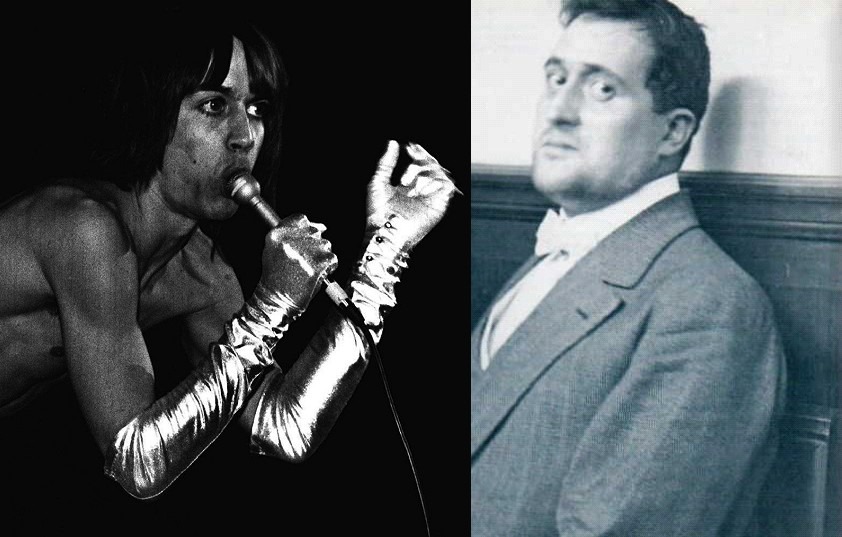
Musically I’ve had this thought lately that I’ve avoided use of some of my most basic musical genres. And Iggy and the Stooges are the definition of that. They started as an art project, making free-form noise on stage, with Iggy Pop, a converted blues-band drummer as their front man. Somehow they decided that the most elemental and elementary expression, however untutored and unvarnished was the way to go. Iggy Pop’s lyrics were the “Blue Undershirts” of 60s rock, the rejoinder to “you call that poetry.” A song such as “1969” from their debut LP is a bored and hedonistic critique of a year deep in another war, cultural and shooting. Robert Lowell it’s not. It’s really not. No, it’s really really not.
For this performance I’ve enlisted my son, the “in his first year of it” bass player and singer, who from his interest in punk and indie-rock can explore that aesthetic with a fresh set of fingers. Conceptually, this song is inspired by the Stooges “1969” because here we have (with “The little car”) two songs about war across a nation,***** but in my tribute I simplified the Stooges’ typical 3 chord trick into a 2 chord chug. Of course, to my son the Vietnam era is exactly as old as WWI was to Iggy and the Stooges. All wars should be so old.
The player for our performance is below. Click on play and turn it up.
*And the French in turn sometimes looked to American Walt Whitman, who never found full favor with the English language avant garde, making the French vers libre writers poetic money-launderers!
***E. E. Cummings was heavily inspired not only by Apollinaire’s dropping of punctuation, but his freeness with placement of text on the page.
****The taxis that saved Paris legend may not hold up. But my favorite part of this linked story? The account that the taxi owners kept the meters running and presented a bill to the government after the battle. Paging Joseph Heller or Milo Minderbinder to the white courtesy phone.
*****Or not—at least by intent. On the rattling plastic luggage record players of the time, I always heard Iggy Pop’s opening lines in 1969 to be “It’s 1969 OK/War across the USA.” Some cover versions say I’m not the only one who heard “war” as part of the folk process. The published lyrics and close listening with headphones say Iggy was singing “All across the USA.” Well, excuse me while I kiss this guy. The Iliad was carried by an oral tradition long before it was written down. Regression analysis says Homer wrote it about some sunny Mediterranean partying and dancing. The homoerotic and warfare parts were just misheard by the folks in the back row.
These posts on Edgar Lee Masters’ Spoon River Anthology have run to the long side, so today I’ll be brief. I promised I’d tell you how the book of linked short epitaphs about a Midwestern town resolved the tale of Minerva Jones’ sexual assault.
Music has utility, it’s entertainment, a movement in sound to dance with and loosen one cares. Poetry is pretension, it asks one to rise above everyday speech and outlook, and offends you when you don’t.
Sexual assault is often largely about power, not unbridled lust or desire, and this seems to be case here. Minerva’s rape is to teach her a lesson. No amount of understatement and fracturing of the story in Spoon River can hide that this is one of the ugliest episodes in this book that contains full measures of hate, distrust, crooked deeds, hypocrisy, and crushed hopes.
Masters, the lawyer/poet, wishes to prosecute this town’s crimes even further. Doctor Meyers tells us that he was a good man, maybe a touch proud of his good deeds and steadfast life as a father and husband, but that’s such a minor sin, and set out to set up his tragic fall. When Minerva comes to him after her rape the general reading of his poem/epitaph is that it’s for an abortion. It’s just slightly possible that the episode Doctor Meyers speaks of in his epitaph is her showing up at night right after the rape, injured from the assault. It’s even thinkable that she’s miscarrying a pregnancy when she arrives at his door.
Masters isn’t interested in making this clear. Doctor Meyers simply says Minerva Jones died that night she came to him “in her trouble.” In an odd fracturing of the story, in Minerva’s earlier-in-the-series epitaph we have a vivid two-line account of her going into shock from blood loss. Doctor Meyers’ account picks up intensity as he recounts what happens next. The town assumes his act was evil and criminal—the strongest evidence that what occurred that night was considered to be an abortion bolstered by the idea that “help her out” was a euphemism that would be understood as such by reader of the time.* It’s slightly possible that he was presumed to be the rapist and then murderer of Minerva, or the father of the unborn child.**
I assume his “indicted me” is legally literal, but there’s no account of a trial, much less a verdict or sentence—and Masters the lawyer has lots of trial and law stories in Spoon River. Perhaps the “pneumonia finished me” event happened soon after the indictment and before any trial.***
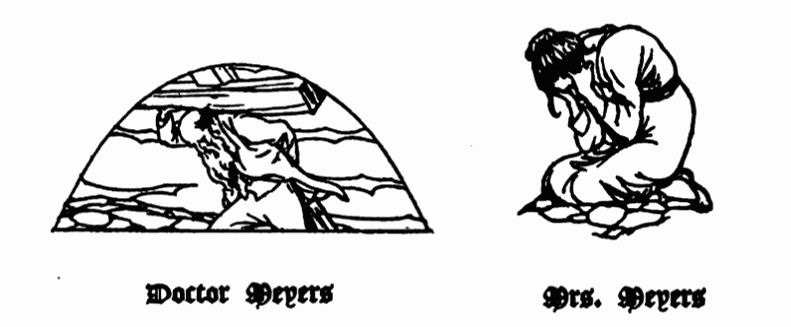
I don’t know if Masters had control over the line drawings/gravestone engravings used to illustrate Spoon River in the 1919 edition, but if he did, these may tell us how he viewed these two characters, or how the characters view themselves
Doctor Meyers says his wife died of a broken heart. Her epitaph follows his, and the divided heart seems to me to be between some existing love or duty to her husband and her strong sense of propriety and morality that largely blames the “fallen woman” for tempting her husband into something she assesses is against “law human and divine.” Her testimony more or less cinches the abortion assumption, at least in the mind of Mrs. Meyers. If the accused crime was that Doctor Meyers was the rapist and murderer of Minerva Jones, she wouldn’t also use the possible abortion euphemism “he…tried to help her” in her epitaph. She ends her epitaph preaching that the rules of morality are absolute, an unfailing guide to avoidance of shame. In the context of the story, her view is that Minerva Jones, even if she had a pitiable soul,**** got what she deserved and her husband was justly accused. I won’t blame readers for thinking this a chilling statement of callousness, because it is. But Mrs. Meyers is the victim as well as part of the cause and maintenance of the town’s cruelty. It is at least slightly pitiable to hear her clutch at the protections of adherence to a strict and legalistic morality and probity that didn’t protect her from the town’s patriarchal prejudice nor Minerva Jones from her tragedy of a pretense to poetry and useless beauty.
Mrs. Meyers epitaph directly follows “Doctor Meyers,” which is proceeded by Minerva Jones’ father’s (not presented here) which follows Minerva’s. “Butch” Weldy, the rapist/attacker’s follows “Mrs. Meyers,” with Masters the lawyer giving us a black-humored joke that you can think of as the final resolution.***** Masters wanted us to clearly follow this story in this order. Other stories and linkages in Spoon River are more separated. In general, reading the epitaphs has a certain likeness to an open-world video game, and in any order the mosaic of events remain the pieces of a Cubist jigsaw puzzle loose in the box.
I performed “Doctor Meyers” and “Mrs. Meyers” together for today. A mild finger malady was making it hard for me to play guitar this past weekend, so it’s mostly piano today, though I could work out a way to play electric bass for this short piece. The player is below.
*Much of the action in Spoon River occurs in the later half of the 19th century, a period during which abortions were made illegal in much of the United States. Illinois law was early in this change, so it’s clear he could have been indicted on this in the legal sense that would have been clear to lawyer Masters.
**In another of the epitaphs tangled linkages, we learn that another townsperson Willie Metcalf is said by some to be Doctor Meyers illegitimate son. We aren’t told if that is cause or effect of the disgrace of Dr. Meyers. I can imagine an elaborate Serial-style podcast relitigating the entire Jones/Meyers/Weldy case.
***During the course of writing Spoon River, Masters himself, likely weakened by stress and an unhappy life, was stricken with pneumonia and may have been close to death, so this choice for Doctor Meyers coupe de grace may have not been random. “Webster Ford,” the pseudonym that Spoon River was first published under in serial form in Reedy’s Mirror, gets an epitaph in Spoon River Anthology: a longer, more hermetic and supernatural one than most of the book’s.
****Masters’ syntax in Mrs. Meyers epitaph is confusing, perhaps designedly so. Even with the semicolon separator, “The newspapers lied about him…” is linked in sentence with “That he was not at fault in Minerva’s fall….” The newspapers disgracing him were claiming the opposite, and the sentence seems to reflect Mrs. Meyers’ own ambivalence. Likewise, the sentence starting “Poor soul so sunk in sin he could not see” is ambivalent. I think she’s largely referring to Minerva, “poor” in her possessions of morality and wealth, though some read it as referring to her husband.
Were you surprised or puzzled when I introduced this series on the Spoon River Anthology by comparing it to the later bleak Modernist landmark “The Waste Land?” I would have been. Not only is it often (usually?) left out of recent timelines of significant events in Modernist poetry’s emergence, the single epitaphs I recalled from it, the book’s “greatest hits,” were more similar to the ones I’ve presented so far here than to the bulk of Spoon River. My first two Spoon River posts: “Cooney Potter” and “Fiddler Jones” are ostensibly wistful, and while Cooney’s notice of the driving of his family and himself to increase his wealth and holdings has darker undertones, he’s telling this in the context of regret and guilt. He might even be exaggerating his faults.
Other unrepresentative Spoon River “greatest hits” include the glowing and mildly tragic elegy for the putative love of the young Abe Lincoln’s life “Anne Rutledge,” and “Lucinda Matlock*” the stoic toting up of a full life by a pioneering settler who tells us she outlived (in a dual sense of the word) her troubles. The book’s opening introductory poem, “The Hill” in its death-comes-to-us all catalog of outcomes remains elegiac. We might expect bittersweet with a strong flavor of nostalgia in the whole book. That’s how I’d cataloged Spoon River informally in my mind.
File under horror, not reminiscence
Reading the Spoon River Anthology this month has changed my understanding of it. Overall, the view of life and values in it is far more bitter than sweet. Many epitaphs are accounts of cruelty or unmitigated evil. Most relationships can be summed up (and are) as a grudge of one sort or another. It’s a harrowing read in its entirety if you are paying attention all the way through. With only a hint of the supernatural in it, it’s a horror story, the mitigating moments and elements only relief before another crime or creep comes around the corner.
Today’s piece is perhaps the most chilling one in the entire book, as cold as a lynching poem—** and with gender replacing race, that’s approximately what it is. As I said when introducing last April’s sections of “The Waste Land” this is not material for everyone. It’s not poetry that soothes, reassures, or delights its attentive reader. Masters is going to tell the story in first person, a somewhat unusual choice, and the narrator is going to fiercely understate in but 12 lines. Here’s a link to the text of “Minerva Jones” to follow along with.
As I said when introducing last April’s sections of “The Waste Land” this is not material for everyone. It’s not poetry that soothes, reassures, or delights its attentive reader.
We learn that Minerva Jones*** thinks of herself as the village poetess, and that some part of the village loves to taunt her, perhaps for her pretension, perhaps for lack of conventional femininity, perhaps just because she stands out as not conforming. Her father in his separate epitaph says he’s taunted for being Welsh and poor, so add that to her “crimes.”
And then she’s attacked by a village ne’re-do-well “Butch” Weldy, motivated by and/or knowing he’ll be excused by the village because of the above supposed transgressions of Minerva’s. We are given absolutely no details of the attack, another authorial choice. Many, and I, read this attack as rape. I think Masters intends that assumption. The choice to include no details of the attack itself could be discussed at length. It could be revealing of the speaker’s shame or decorum. It could be mental shock transcending even death. It could even be a level of what could be published at that time. Does that choice add or detract from the power of the poem? I suspect that varies from reader to reader. Think here of one of the core practices of Imagism:**** that one leaves out the core ineffable thing so that it may still be invoked by what is included.
Minerva tells us her attacker “left me to my fate with Doctor Meyers.” Here the story-telling gets more fractured and confusing, as this telling alone indicates that she sought medical treatment after the attack ends. However, in the context of other Spoon River poems that touch on this incident, the most likely reading is that a pregnancy resulted from this rape and her visit to Dr. Meyers was weeks later and for the purpose of seeking an illegal abortion.
At this point I’m more willing to say that Masters has made a narrative error, or at least disassociated one of the most powerful images in the entire book from its vivid context. Only by reading the other epitaphs dealing with this episode would it be clear to the reader that when Minerva Jones says in her sparse account: “And I sank into death, growing numb from the feet up/Like one stepping deeper and deeper into a stream of ice” that Masters has her acutely describing the feelings of a body undergoing hemorrhagic shock as she bleeds out in Dr. Meyers office. If one can distance oneself from the empathetic horror we may feel of the incident Masters is describing, these two lines are also Imagist: immediate, not mere decoration:
Anything that follows such a cruel situation and powerful lines must trail away. The next two lines have the power of pathos, posed as a question, not a command, and then the final two lines break with Imagist rules by stating emotions directly. After all the elision of the poem, many will forgive Masters for the value of these lines’ contrast with the cold account.
What happens next? Does Masters resolve this story? As they used to say in the days before binge referred to media consumption: stay tuned.
I too made a curious choice in performing “Minerva Jones.” I could have gone with a big orchestral sound, something I’ve been exploring this summer. Then I’ve been thinking I’m missing the element here of loud “rawk” with guitars and band. And synthesizer/electronic sounds are almost a stereotypical way to express horror. Even solo acoustic guitar would be a conventional choice—many traditional ballads are as cold and bleak in their description of violence.
Totally out of the blue, and perhaps not correctly, I chose to instead use something out of my not-quite-jazz side. Dampened drums in a solid backbeat, always a good signifier of fate, a fretless bass line in a rolling walk, a chord progression sketched on piano that subtly violates expected cadences and harmonies, and then the guitar top line emphasizes the G-flat that adds stress to the harmonic structure. Like Masters, I fiercely understated. Did it work? The player is below.
*Rutledge is one of a handful of real people with real names included in the Anthology, but a great many others are thinly disguised real people from Masters hometowns or Chicago (some of whom weren’t dead, and recognized themselves), Matlock for example is his paternal grandmother at whose farm Masters spent time at in his childhood.
**Several times here I’ve considered poems about American lynchings for presentation. I’ve so far pulled back, and the why of that is complex. Dealing with the emotions brought forward in the Minerva Jones story walloped me, and I had to step away unable to continue work on this for a while.
***Is she related to Fiddler Jones I asked last time? Possibly, but I can’t recall that being established in the book, while Minerva’s connection to other epitaphs is made explicit. If she is, then there’s possibly a comment on how poetry is treated by the town (and presented by Masters) and music. Music is a recognized good, poetry something between an oddity or a fault. Two professions are probably overrepresented in the small town of Spoon River, mirroring Masters’ own life: poets (there are at least three) and lawyers and judges (I lost track, but there are many).
****While writing the Spoon River poems, Masters once called his work “Imagiste” indicating that he thought the term fitting. Pound’s “A Few Don’ts by an Imagiste” along with F. S. Flint’s short report on “Imagisme” was published in Chicago-based Poetry in the spring of 1913 as Masters was thinking about how to shape his Illinois material; and though this has been less remembered later on, Chicago colleague Carl Sandburg was committed to using Imagist principles.
I almost feel like I need to place a warning label on today’s piece: Rated RE Strong Romantic Emotional Content. Thanatopsic material. May not be suitable for those who have not sufficiently worked through issues with self-harm or the experience of self-dissolution.
Modernism had a strong tendency toward a critique and reaction to romanticism and its characteristic expression of emotional content. A man viewed as the founder of its English-language poetic wing, T. E. Hulme, wished to set it on a course of completely overturning Romanticism. But those bylaws didn’t always filter down to every chapter and member of the Modernist International. Readers here know I love some of the early Imagist works which are parsimonious with overt emotional words, even while seeking to charge their images with a fresh immediacy. These poems aren’t necessarily devoid of emotion if the reader has it to supply themselves—but then some Modernists, such as E. E. Cummings, were perfectly fine with frank emotional outpourings.
Sara Teasdale, in addition to being largely forgotten for the better part of the last 100 years, was never officially a Modernist, so there’s no movement membership to endanger and no expectations for her to fulfill anymore. She wrote intensely lyrical and musical verse in plainspoken and non-archaic language. That’s a surface shiny enough, devoid of hermetic imagery, and with sweet word-music that makes it too easy to miss what she’s saying.
Sara Teasdale is sick’n’tired of you mentioning how pretty her poems are
I knew this already, having presented Teasdale regularly here. Still, I had to go through a journey to inhabit and grasp this poem for this project. I collected it earlier this summer, seeking to stockpile a few seasonal poems ahead of time to have some on-the-shelf ideas for possible use.
Here’s the full text of the poem. If you skim through it, it looks like a fairly common poem subject: summer night. It might seem to hit the expected points too: hey, summer, it’s nice at night (maybe even better than the heat of afternoon). Plants, trees green and full, explicit birds. A Moon one can linger with long enough that you feel that if you stay the night you could watch it change its phase.
Teasdale can write a poem that seems like that. That’s a problem. It’s too easy to miss what she’s communicating if you leave it at “That’s pretty.” You could use her writing as a case-study in why some of the Modernist tactics that frustrate (or delay) understanding might not be counterproductive. Teasdale gets misunderstood quickly as one passes over the words, while someone like Mina Loy, Tristan Tzara, or Gertrude Stein causes those who won’t care to read carefully and empathetically to not stop in at all.
As I began to read, really read, “August Moonrise,” to figure out how I might perform the words, the last section seemed dark—and not in the pretty moonlight way. Here are some of the words that hit the notes in her word-music after the poem’s midpoint: bitterness, sorrow, death, wavering, blind, fearful, fire, cold, vanish.
Seeing that, I reexamined the opening half for portents. The swallows are rushing, willfully, together and departing from each other. And is their willful act truly willful? Maybe not, it’s like the movement of dark tree leaves. If that was a spare Imagist poem, or a work of classical Chinese poetry, we’d be confronted with that image, asked on no uncertain terms to deal with it. Here you may think it’s so much minor scene-painting.
The scene-painting gets even more painterly next. Sunset, moonrise. The final palette: “a deeper blue than a flower could hold.” Is that merely a beautiful picture or a statement of more blue than can be sustained?
Teasdale’s singer in the poem is drawn in (note, she goes “down,” descends to it, even though the preceding birds, trees, sunset, moonrise are all things normally above the horizon) because it’s her, or because it will become her. The poem reaches—if only briefly—a quasi-orgasmic happiness. One line here: “I forgot the ways of men” is so rich in ambiguity. I could read it three or four ways easily.
This happiness, this intoxicated leaving of all but the senses (however brief) is portrayed as a consolation. Consolation for what?
And then we enter that section that is so full of darkness, loss, imperfection. Is this section spiritually sublime or just harrowing? I think you can play it either way, though I suspect it works best if the other choice is kept as an undertone. Compare this to Laurie Anderson’s childhood account of Buddhist Midwest night skies and the non-necessity of self, the archaic trials of the Lyke Wake Dirge, or to a searing inventory of imperfection, almost a suicide note.*
Teasdale’s concluding couplet is so searing I think it must be performed understated. The crucial word in it, “theft,” says she doesn’t feel in control of this loss of control. Isn’t that frightening? Spending several hours with this text this week, fitting it to music, performing it, thinking about it was a journey, from “Oh, a summer night poem” to a consideration of the sameness and the difference of exceeding the self and end of the self.
So, am I out on a limb here, thinking this a major poem by a too overlooked poet? Has the seeming conventionality of its setting (subverted as it may be), the gender of its author, the musicality of its expression, the unabashed romanticism of its sensibility obscured our view? If this was Rilke translated from the German would we read it differently? If this was Yeats with swans instead of swallows would it matter? If a Cubist ran it through a copier a few times and then cut up all the lines and reassembled it, would we stop long enough to think about it? The issue of Teasdale’s membership or non-membership in Modernism might have seemed germane in the mid-20th century, but to a significant degree it’s immaterial now.
Well, I’ve done it again. Talked about the words so long that there’s no time to dance about the architecture of the music. Thinking about what I said above, I could have cut up and obscured Teasdale’s words rather than a straight recitation I recorded, but the choice I made has its strengths too. I did try to undersell the sensuousness of the lyric in hope it would cause the listener to consider it differently, but the opposite choice works too, for I’ve discovered this gorgeous and emotionally effecting choir setting of “August Moonrise” by Blake Henson that had me in tears this morning. See my comments last post about how my limitations as a singer and no access to alternative skilled singers focuses my composition into other modes.
I intentionally avoid apologizing for my work. I think that’s a good practice. If you think you should do better, do better or do different, instead of talking about it. My approach to “August Moonlight” with a skip-footed motorik beat and an ominous and fateful tone in the reading and music certainly contrasts with Henson. I could even imagine that hearing Henson’s work after considering Teasdale’s darker undercurrents intensifies it, as it did for me today. You can hear my version with the player below. Don’t see a player gadget? Then use this highlighted hyperlink to play it.
*There was a point in the production of this piece that I seriously considered abandoning my presentation of “August Moonlight” because of this. Once I could see that element was present in the work (as it is in Teasdale’s life), I felt it shouldn’t be denied if I was to perform it. Many artists deal with feelings of self-harm and because “All artists fail” in the sense of imperfection and producing things farther, rather than “Something nearer your desire.” I hesitate to present work that might feed into that, particularly with a beautiful and romantic sheen to it all. In the end I decided that Teasdale is illuminating that, and if I presented it so that you can consider its danger, it could have value. Henson’s setting makes a choice to emphasize the perception of beauty, the singular hour of atonement, which also would have answered this concern.
Here’s a poem by Carl Sandburg, whose poems can be returned to for their light illuminating justice and injustice, but also because he will give you endurance and compensating love.
Injustice is large, it is ancient. Love is short as life, but nearer to us, and like the palm of a nearby hand it can blot out an immense but distant mountain. If enough hands are raised together, the most foreboding mountain can not only be obscured, it can be leveled.
How many in favor of more music and poetry?
Today marks the third year since the official launch of this project. My goal when I started was to create 100 to 120 audio pieces using various words, mostly other people’s words, and mostly poetry, combined with original music, music I planned to be as varied as I could make it. Today’s piece is the 360th of these.
That number amazes me, even though/because I have been there creating each of those music/words combinations. It means that nearly every day in the past three years I have been—or I have been avoiding—searching for and selecting words, composing music, playing and recording that music and then presenting some thoughts on that encounter with you.
I started as a guitar player, and in this time I’ve become nearly a functional bass player and found ways to allow my naïve keyboard skills to direct music making from that direction too. My abilities to integrate bowed strings and orchestral instruments into these pieces has grown, something that I’ve been indulging in a bit this month.
During this time my son has grown from a grade-schooler to the doors of high school. I think he still finds this activity a little odd, and as far as I know he never reads these posts, only hears the audio pieces in their halting steps of creation. He might recognize it later. Many of the posts here were written with him as the audience in mind.
My wife has been patient and forgiving of the time I spend on this, for which I am grateful. These few words are not thanks enough.
Dave Moore (you’ll hear from him again here soon) has of course been an important inspiration and help in the overall project.
And you, readers and listeners and fellow bloggers, are a large part of why this project has continued. This project has no revenue, no grants, no sponsoring institution. The reason it has continued past the first 120 pieces has been your response and assistance in spreading the word about it. You weren’t the reason I started this, but you’re the largest reason I continue with this project. Your likes, links and sharing help keep it going.
Renée Robbins. A memory too strong to forget and too heavy to carry. “Whisper, Oh beginners in the hills. Tumble, Oh cubs…”
So why did I start this project officially in August? I was thinking of my late wife, Renée Robbins, a caring person who helped and befriended many. I lack the personal skills to do what she did in that regard, but I can, in my idiosyncratic way assist the writers I present here. If poetry is a living art, it lives not just in the mind and memory, but in the moment and the ear. Thanks for your moments and your ears.
Earlier this year I presented part of the title poem from Sandburg’s Smoke and Steel collection, the first poem in that book of his. Today’s piece is the concluding one in the same book. As I mentioned above I’ve been working on larger orchestral arrangements with woodwinds, horns, and string sections lately, and that’s what I’m using here. I’m kind of moving through different orchestral colors in this short piece to match the range of Sandburg’s catalog in his poem.
The player gadget to hear Carl Sandburg’s “For You” is below. If you want to read the text of the poem, it’s available here.
Did you find yourself agreeing more with H.D. or William Carlos Williams in Thursday’s audio piece taken from Williams’ Kora in Hell? If I was to survey listeners, I’d be surprised if Williams wouldn’t win far more applause. Being that it’s his book, and he controls what H.D. presents before he responds, it wasn’t really a neutral-site debate.
That sort of exchange could remind you of our modern political ads, where candidate A is quoted or shown in some excerpt that appears outlandish, and then candidate B is cut to saying that they think that’s just as outlandish as you think it is, and I’d never take that position, so vote for me. Except, it’s in reverse. It’s Williams, candidate B, who’s taking the more extreme position. Still I think Williams will largely win the audience.
It’s also easy to see this as a male/female dynamic. H.D. makes a suggestion, plausibly insightful, asking only for self-reflection on W.C.W’s part. Williams responds to her, in much more forceful rhetoric, defending his freedom, saying in effect when you say “sacred” I hear “heretic.” I think a great many observers of gender roles would see this as a stereotypical exchange. I agree*, but I could imagine this same exchange with the genders switched—less common, but possible. And it certainly occurs in a same gender situation too.
Something else that came to mind as I read this was a division that was made in an influential essay at mid-century, something that was still current when I was in school. This month I re-read that essay after Kora in Hell and the telling exchange I took from its prologue. It’s by critic Philip Rahv, published in 1939, and its title “Paleface and Redskin”** sets out the framework of its thesis, something that professors still thought relevant when I was being taught. The title is a distinctive dichotomy Rahv had observed in American literature. This paragraph from Rahv’s essay summarized the two types:
…the redskin glories in his Americanism, to the paleface it is a source of endless ambiguities. Sociologically they can be distinguished as patrician vs. plebeian, and in their aesthetic ideals one is drawn to allegory and to the distillations of symbolism, whereas the other inclines to a gross, riotous naturalism. The paleface is a ‘highbrow,’ though his mentality…is often of the kind that excludes and repels general ideas; he is at the same time both something more and something less than an intellectual in the European sense. And the redskin deserves the epithet ‘lowbrow’ not because he is badly educated—which he might or might not be—but because his reactions are primarily emotional, spontaneous, and lacking in personal culture. The paleface continually hankers after religious norms and tends toward a refined estrangement from reality. The redskin, on the other hand, accepts his environment, at times to the degree of fusion with it, even when rebelling against one or another of its manifestations. At his highest level the paleface moves in an exquisite moral atmosphere; at his lowest he is genteel, snobbish, and pedantic. In giving expression to the vitality and to the aspirations of the people, the redskin is at his best; but at his worst he is a vulgar anti-intellectual, combining aggression with conformity and reverting to the crudest forms of frontier psychology.”
Rahv ostensibly doesn’t favor either side. His observation, made by a man who could claim to be an immigrant, outside observer, was that American Lit was binary and divided with authors on one side or the other and no synthesis, and that this was a bad thing. ***
Pale faces and redskins, or 3 artists and some spuds.
It’s easy to see that divide in the H.D. and William Carlos Williams exchange. H.D. in the moment captured in her letter to W.C.W. is paleface, and Williams is redskin. Rahv expends most of his examples on novelists, and Modernist novelists like Hemmingway and Faulkner and Sherwood Anderson he feels all fail to a significant degree due to redman tendencies. But Modernist poets weren’t really in either camp as Rahv defines them. Ezra Pound could be claimed as either, and even in the two early pre-Modernist poems I’ve just presented here he tries on each personae: in “Grace Before Song” a pious poet in service of art who will be personally forgotten and in “In Thus in Nineveh” as an unheralded poet who will be remembered because the people value the lively if imperfect vitality of his verse.
Feel free to consider Rahv’s classification system as silly, outdated, or even distasteful. I myself consider it an amusing parlor game kind of thing, more subjective than Rahv thinks it is, and as subject to superficial oversimplifications as taking a “Which Disney Princess are you” quiz. ****
I wasn’t going to include any audio with today’s post, but after spending a day avoiding completing this post so that I could play with orchestra scoring, I figured I could read a couple more sentences also from Rahv’s 1939 essay backed by a short example of what I was coming up with. The player’s below.
*Even though Williams and English language Modernism in general coincided with the rise of women’s independence and citizenship, and even if women were participants in this cultural revolution, that doesn’t mean that Modernist men were invariably feminist—far from it. There are things to admire about W.C.W. for sure, but even in my limited reading of his work I keep getting this weird vibe from him where women are concerned.
**Yup, Rahv went there with the casual use of the racial slur. As literary culture goes in this era, totally non-remarkable and non-controversial. The first college I attended, where I heard of Rahv’s essay, had named its sports teams The Redmen, a just more polite term. I had a tiny part in asking this name be changed. In Rahv’s defense I’ll say that he was a Jewish heritage immigrant from the Pale of Settlement. If life experience is knowledge, he likely “understood” ethnic slurs as deeply as any of us.
The kind of dichotomy Rahv lays out has analogues in modern discussions on just how street a rapper is, or debates on if performance poetry can be “real poetry.”
***From the luxurious wisdom of history, I found it fun reading the essay to see who of his contemporaries he thought was fatally damaged by this inability to join the strengths of both groups. He seems to give obvious paleface T. S. Eliot a passing grade, though noting that he had to leave America. Rahv says “Faulkner’s horror stories have long ago ceased to have any recognizable value.” History disputes Rahv there. Hemmingway is just a retread Natty Bumppo he says, an arguable case still today (even though I’ll take the other side on that one). Emily Dickinson gets an atta girl notice as a more or less successful paleface. No, additional reflection since 1939 has discovered that Dickinson is a redskin with paleface trappings.




 Frank Hudson