Musically we ricochet again (as this project often does) from last-time’s acoustic South Asian ensemble to today’s rough’n’ready one-take rock band. For the words though, maybe not so great a jump, even though Ralph Waldo Emerson and Robert Frost are approximately a century apart.
Emerson is the prime American cultural instigator. Like many pioneers it’s easy to see where his maps may have been a bit off, his cultural borrowings misunderstood or missing sufficient attribution, but the route he set the American culture on, however paved, fueled, and electrified, is still one many travel on today. His conceptual school, Transcendentalism, whether acknowledged or not, can be found easily in 21st century America. It is impossible to think and write about ecology, perhaps even to use the word at all, without echoing Emerson. It’s difficult to examine mysticism or Asian religious traditions in America without going places that Emerson went before the Civil War, and if we do either of those things along with some practical sense that we’re using them to rebuild and reform our individualist understanding of the world, we’re doing as Emerson urged. It is both diminishing and praising of Emerson to say that he’s the first self-proclaimed “self-help” American authority.
If Emerson isn’t a great poet, America’s greatest poets often owe much to him. Whitman sought to use his concepts. Emily Dickinson clearly absorbed some of his then new thought. And so too Robert Frost, who is always examining nature and mankind and drawing hard lessons from the pairing of them. When Beat poet Michael McClure’s speaks as a bird or otter, and declaims public maxims,such eccentricities are Emersonian as much as they are from Emerson’s own small-town neighbor Thoreau.
So, today’s piece, which Emerson called simply “Fable,” may not be a great poem if we have criteria to judge such things, but it has begotten great poems. The sage as small animal theme would please Dickinson. The flattening of greatness across multitudes of small things would be Whitmanesque. The cracker-barrel retort of the squirrel who knows, for all external mightiness and achievement, that his daily talent to be able to crack a nut is exquisitely necessary would fit Frost. The charge of change in attention, that the mountain is also just a squirrel-track, would serve Wallace Stevens well.
Returning to end, why the rock band today? The current Covid-19 situation has removed coincident live music—that joy of sounds and breaths in the same room—not only in public performance but in the kind of informal get-togethers that musicians of all skill levels and genres have enjoyed forever. I now miss even the difficulties and limitations of such things, finding it sad that I have no way of knowing when I’ll experience them again. “Fable” today is an approximation of a live band. I started with the drum pattern, added bass, the rhythm guitar, the piano track, a second “lead” guitar part, and declaimed Emerson’s words, doing each in one pass. There’s no composition process as a separate step, no great consideration on instrumentation. Even if it must be done sequentially: end, back to start, and track again, I wanted to approximate what playing live with others feels like.
In Emerson’s “Fable” the mountain calls the squirrel a prig: a self-righteous, self-superior, self-satisfied prude or killjoy. That’s an odd accusation: a majestic mountain charging a little bottom-of-the-food-chain critter with unjustified audacity. Gee, Mountain, project much? The squirrel is “self” indisputably—it cannot be otherwise—but that doesn’t mean it must also be any of the other things on the right-hand side of “prig’s” synonyms. Covid-19 is a mountain, large and natural, undeniable. My little squirrel track, my little path to crack the nut today, is not majestic nor considered in geologic time. What care I for the age and resolve of the mountain. The eagle, the owl, the car-tire have already said there’s no time to waste.
The player gadget to hear my performance of Emerson’s “Fable” is below. If you’d like the text of the poem, here’s a link—and at that page there’s a link to someone else performing “Fable” with music, music with it’s drone and percussion that sounds a little like last time’s “Nothing Gold Can Stay.”
Perhaps today’s audio piece and what I came to write about it has an interesting path. In words it’s a medium-length journey—so I beg your patience—but the places it goes are vast. Eventually, we’ll answer a question you may not have asking: who’s buried in William Blake’s tomb?
It started with an illustration drawn by Sergio García Sánchez which I saw on Kenne Turner’s blog this month. Turner’s blog has a great deal of manipulated and beautiful nature photography, mixed in with things he notices in his desert region location and occasional poetry, so it was unusual to see a drawing at first, but his post correctly located the words in the drawing and let me recognize the white haired old man whose beard is a star’s journeywork in this cartoon. The man in the drawing, the words, was Walt Whitman.*
Perhaps because Whitman’s words were embedded inside a drawing, they seemed Blakean to me as I read of that grain of sand, a hinge in the hand across the starry dynamo machinery of night. The main effect was to grab my attention and bring thoughts of doing it for this project.
And so I composed a small orchestra piece of music to accompany my reading of this piece, taken from the 31st part of Whitman’s “Song of Myself,” using the 1855 edition. I’d normally give you a link to the text, but the two links above to Turner’s blog or to Sánchez’s picture are the best way to see the 1855 text I used which includes a line that was dropped in later editions, the line with the farmer’s girl and her iron tea-kettle that reminds us back to earth and daily life. For many compositions I’d be done.
I know McClure best from a record album he made with ex-Doors keyboardist Ray Manzarek and flautist Larry Kassen called The Piano Poems in 2012. This was nowhere near my introduction to the Beat-associated “jazz behind poetry reading” style, but it’s a very good one. Listening to that helped build my own convictions for this project back then.
One of the poems performed on this set is McClure’s “Action Philosophy.” Though he didn’t on Piano Poems as released, McClure would often introduce it by saying that his poem begins with words written by Henry David Thoreau. That led me to think about combining McClure’s incorporation of Thoreau with Whitman’s Blakean lines about the universe’s manifestation in everyday nature. After all, McClure extends Blake’s and Whitman’s vision, seeking to become the animals he sees, to inhabit them fully. That’s the animal meat of his poem, but it’s in a reality sandwich on this deli menu—those separated first and last lines present a vital dichotomy. Here’s the text of McClure’s “Action Philosophy.”
Fifteen jugglers, five believers, six angels in the same performance! Tell your mama not to worry, ‘cause they’re just my friends. Yes, learn to play the triangle and visionary poetic figures will flock to you.
That first line: “That government is best which governs least” is taken from Thoreau’s “On Civil Disobedience,” an essay that soon became important to certain liberation movements. Thoreau himself was speaking about the Mexican-American War and slavery in his essay, oppressive evils that he felt he had to take action against. Gandhi and Martin Luther King made explicit reference to this work of Thoreau in their movements against colonialism and American racial subjugation. Lines from it had vital currency during the anti-Vietnam War movements of The Sixties.
But that’s not what I associated this line with from my life in the later 20th century, or where you may most likely hear it today. Now if you see this line quoted, (perhaps misattributed to Thomas Jefferson, not Thoreau) it may be used to buttress some form of conservatism, particularly conservatism that has a claim to libertarianism. Libertarianism is a complex subject, too long to explore here today, but on the other hand, elements at the foundation of the Beat literary movement were anarchists, an alignment that would have fitted Thoreau.
Now we take another side-step. Back in the 1990s I worked with Gary, a white database programmer from South Carolina. He aligned strongly (as do some technology people today) with libertarianism and the political right that was ascendant in parts of America at that time. He was a great fan of Thoreau’s line, though I think he’d attribute it to his fellow Southerner Jefferson, rather than the Yankee Thoreau. From talking with him I felt that his philosophical libertarianism might have protected him somewhat from the racism, acknowledged or unacknowledged, that can be found in a lot of American conservatism. When he would talk about his political opinions, I’d say “Well, that’s not me, but you know a lot of the folks I read are anarchists, and they sort of have the same feelings about the dangers of governments.”
Gary replied with a question that might take a long time to answer. “What’s the difference between libertarianism and anarchism?”
What an interesting question, and how long could that answer go on? I improvised my first thoughts, observational ones that day Gary asked it decades ago. “Well, some of it is just cultural associations. They dress differently, they listen to different music. And some of that is reflected from where they are moving from: Libertarians come largely from right-wing backgrounds and anarchists from left-wing ones, though each of them may be disenchanted with something from the Right or the Left respectively.”
McClure’s “Action Philosophy” takes what might be a book-length examination and instead put a distinction into his poem’s first and last lines. The world of the Randian side of libertarianism is perfectly fine with hierarchies and a thought that the unfortunate are the unworthy, or if not that, the unavoidable. Most anarchists—and from McClure’s final line spoken here today, McClure himself—were not. So the first and last lines today are a meaningful combination.
That was my process, a path of liberties and syndication, from within which the piece emerged as the Whitman Blakean section enclosed in McClure’s poem which seemed so Whitmanesque. My performance and recording was done, and yet I went to bed last night with a question in my mind. “What did Whitman know of William Blake? Those lines seemed so Blakean to me.”
How did they come to similar forms of poetic expression? The translated Hebrew poetry of The Bible influenced both strongly. And the same political philosophies informed both men, Blake knew Thomas Paine, Whitman was reading Thoreau and Emerson. And maybe the muses, the angels, the wake-waves of ghosts from the last movements of the dead moving in our air pressed similar things into each poets’ ear. Right after Ginsberg read “Howl” at the Gallery Six reading for the first time (and by some accounts it was the first public reading of any kind Ginsberg or McClure had ever given of any of their work), Lawrence Ferlinghetti contacted Ginsberg from out of the Gallery audience and said “I welcome you on the beginning of a great career.” Ferlinghetti no doubt knew he was echoing what Emerson had written to Whitman in response to that 1855 edition of Leaves of Grass.
To hear a performance mixing in Thoreau, McClure, and Whitman with my music for a small orchestra, use the player below. Thanks for reading. Thanks for listening. Thanks for sharing these ghosts with me.
*Should I have used the more multitudinous verb “where” here?
**McClure didn’t even have to be there. In the summer of 1970, I was working frying hamburgers in Port Chester New York. Down the road was the Capitol Theater, one of those converted to rock concert venues of the age. At a bar in town Janis Joplin was drinking with Bob Neuwirth, and Joplin started riffing on a line from a McClure poem “Come on God, and buy me a Mercedes Benz.” Neuwirth scribbled the night’s journeywork on a paper napkin. Later that day she performed the resulting song at the Capitol Theater. Me? I just kept frying those burgers.
***True to their anarchist-hearts, the reading seems to have been blessed with several “organizers” but happened anyway. Kenneth Rexroth MC’d, Phillip Lamantia, Gary Snyder, Phillip Whalen, Michael McClure, and Allen Ginsberg read. Lawrence Ferlinghetti, Neal Cassady, Ann Charters, and Jack Kerouac where in the audience. Since it was at this reading the Ginsberg premiered his long poem “Howl,” that seems to have become the summary of the event, but the edges of the blast broke more windows. The 22-year-old McClure read a poem about the death of whales, showing that his “Mammal Patriotism” was already forming.
The Parlando Project is mostly about presenting other people’s words. I like that. It adds variety and it lets me write about what encounters with those words bring forth. We’ve done that over 400 times since this thing kicked off publicly in 2016
So, we’re always ready to celebrate National Poetry Month. Any month is poetry month here! But every once in awhile I slip in one of my own poems. Sometimes it’s just because I have something I want to say to this adventuresome audience, but it’s often because I’ve read something someone else wrote and I think of something I wrote (or should write, and then write) that relates to it.
A blog I read regularly by Paul Deaton has ranged over various subjects in the past couple of years, but lately he’s been writing some about the past, including lives that range back into his parents and grandparents generations. I’m not going to go back that far, I’m only going to go back to when I was a young man. Given my age, this is “Boomer” territory that’s been already over-farmed—but bear with me. This isn’t really a poem about the past, it’s about someone in my generation who has a past, but presently. For those Gen X and Millennials who find this insufferable, I remind you that I’ve been priming my High Schooler who isn’t a Millennial to blame Gen X and Millennials for ruining things for the current and subsequent generation. I urge other geezers, crones and wise-ass elders to do the same. As our aged, but still very stable emperor demonstrates, the best thing to do to deflect blame is be proactive in shoveling it elsewhere. I don’t know why that should work, but it does!
Anyway, I’ve presented quite a few poems this year by younger-than-mid-life poets whose poems speak as if they are aged.
Besides National Poetry Month, April is supposed to bring us Record Store Day. It would have been last Saturday, an annual celebration of those venerable little stores that once again were selling dark flat petroleum circles that sing when you poke them with a needle. Our current crisis has canceled that.
Now back in my day…Oh man, having a past and dragging it around does make one insufferable doesn’t it…this sort of thing was serious business for me. I had little spending money, but I would hope to have it in order to buy one of those foot-square pieces of art with the circles inside. Something cool. Something that represented my generation.
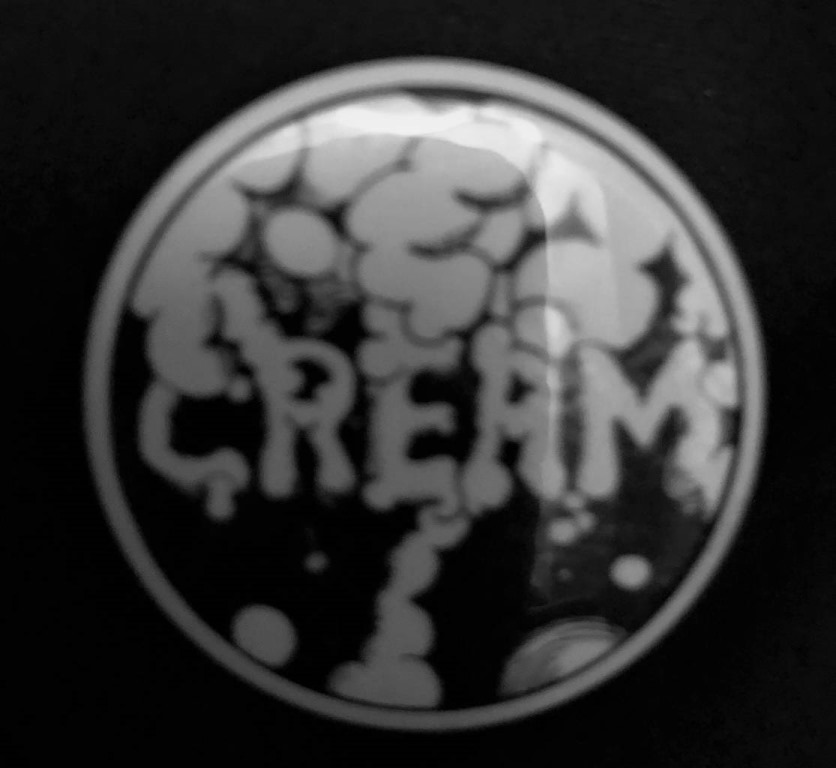
I can remember a particular spring afternoon. Somehow my girlfriend and I had caged a ride in a keyboard player’s new AMC Javelin to travel to Iowa’s capital city where there was a “head shop” (which is where the best new records were sold, along with, well, “smoking accessories.”) On the way we listened to an 8 Track tape of the Moody Blues To our Children’s Children’s Children. When we got there, I could merely marvel, as I had barely enough for one record album, and couldn’t decide which one to get or if I might need the money for something else. So, the only thing I bought was a pinned badge: a smaller, paler circle, containing a bit of the cover art to the Cream’s Wheels of Fire record.
A circle from “The Sixties.”
Recalling this day 50 years ago or so, says paradoxically to me what music and recordings meant to me then. A record was a precious clue to take me through days or weeks. Foolishness? It’s always been partly that.
But of course something else was on my mind, and the mind of some of my generation on that non-official, just another record store day. War. Justice. The cutting edge of the then gap between generations and elders that had been through WWI, WWII and the Korean War, and were often sure we were ducking our war turn. Our best thoughts of ourselves were that there were more important battles, and of course some of us didn’t succeed in avoiding the war they wanted us to fight. And some of us went off looking for Eden, a place you can sort of find, and then lose track of again.
What else does that memory mean? What does it mean presently? That’s what today’s short piece is about. The player gadget is below to hear it.
This may have been one of the first poems I fell in love with: the richness of the language, some sense of strangeness, the exoticness of the depicted setting–all enough for a young teenager. I did not mind the often outdated language then—less then than I do now—as I expected poems then to be written in an old and alien adult literary language.
If you’d asked that teenager what it meant, I would have probably stumbled out something to defend my appreciation of it—but what I did know was that “Ode on a Grecian Urn” is just flat-out lovely word music.
One could go on about that, but no technical analysis will increase or decrease a listener’s appreciation for that element. Music has a structure, theorems and practices, but it remains subjective and it is not engineering. My performance of it today may not do it justice either, let your own ear or voice be the judge.
Beyond that, what about my experience of the poem today? This week, the always Interesting Literature blog discussed the poem’s meaning, bringing it back to my mind, and causing me to read it anew. My immediate reaction, reading it in our current times, was that this is a poignant poem infused with an intense “almostness” and an express “never.”
You don’t need biography to feel this element in the poem, but Keats wrote this in the spring of a year in which he had cared for his brother Tom as he died of tuberculosis that previous winter. In around a year, the medically trained John Keats would notice symptoms that he well knew were from his own infection. Another year from there he would be dead from the feared infectious respiratory disease of his time. So I read it differently today in our time of the pandemic Covid-19.
But “Ode to a Grecian Urn” isn’t poetry as memoir, a common genre in our time. Instead, despite its failure as an example of pared-back language avoiding words describing emotions, the concept of the poem is not unlike that of Imagists nearly a century later.* Keats looks at a thing, a decorated classical Greek vase,** and records that moment.
I’ve figured out why it’s hard to create this week—the muses are sheltering in place. And it ain’t mine.
I’ll resist the urge to go through this poem line by line, but as the poem’s speaker approaches the titular urn he wants to interrogate it. One could draw a cartoon where the vase is in a police station room and the poet-detective is trying to tease out the details of the caper, while we the audience look on. The vase ain’t talking. The detective says that you were seen with that couple at that musical party, would you like to tell us why she was running? OK, so who were the musicians at the gig? You don’t know! Whatd’ya mean?
But let’s return to that almostness, that never. The lover and the beloved are palpably close, yet they cannot touch. The musicians are playing, but it’s somewhere out of ear-reach. Are they all six-feet, a social distance apart? What’s avoided by this freeze, this lock-down? The sorrow with a “burning forehead, and a parching tongue.” Keats seems to intend this as an illness metaphor.***
The poem tells us this vase includes another scene, a cow being led to a ritual slaughter. A vegan, Hindu, or animal-rights advocate may cringe, but the scene is one of an entire town wishing for this consummation, and we may conclude the scene is “You will die so that we may live or prosper”—which after all is the belief of all such rituals. I’m not supposing that Keats was Joaquin Phoenix, however we may view this sort of thing; and most readers have historically taken the poem’s characterization of this as pious at face value. But Keats could have imagined his urn with another religious scene, and chose this one.
If he doesn’t want an element of dread in the sacrifice scene, why does he choose to add the detail that the pious morn has left a town with eerie deserted streets?
At the poem’s end, Keats places the famous couplet “Beauty is truth, truth beauty,—that is all/Ye know on earth, and all ye need to know.” As well-known as these lines are, they’re the source of some controversy. Some think them profound, some glib. They are meaningless babble or a concise summary of Keats’ aesthetic.
The urn, this mesmerizing object, has artistic impact, and that means it’s beautiful in an aesthetic sense. It doesn’t mean it’s clear in its message. It doesn’t mean it’s a simple comfort. Yes, Keats says near the end, the urn is “A friend to man.” But friends are friends partly because they will tell us things that mere sycophants or acquaintances won’t, and friends will be there when things are not all wonderful and happy. It’s true too in this sense: that it is not telling itself with ulterior motives or self-interest.
The experience of the two scenes that precede this summing up are not happy ones. Even the consolations of artistic immortality are slight: we know nothing about the end of the lover’s pursuit, the musician’s tune, the name of the village or if it prospered, or if the sacrificial cow had a soul that was reborn.
As I performed it I decided to downplay what that past teenager would have read as a ringing conclusion. After all, whatever Keats’ sweet unheard intent might have been, his object that we can see and puzzle over tells us that the urn is saying this to him, not some “deity or mortal, or both.” A piece of art says what it says in ways its creator cannot control, as the poem predicts it: “In midst of other woe than ours.”
So, I read it today as that weak voice that says, from when this poem was written, from this time when I performed it, in a time of contagious illness, in a time when caretakers were at risk, to a time when our streets are silent, at a time when some pious ready sacrifices instead of remedies, a time when music is silences and lovers parted—that there is somehow something beautiful to be discerned that is still as true as our living moments.
Speaking of musical engineering, I decided to keep the music silent or very minimal for the first part of this one, even though this project is all about combining music with words—the text’s “unheard music” was just to powerful to contradict. I also chose to keep everything in a major key/major chords, because that too is how I read the text: the urn’s subjects think they are in joy, though we see them, like re-viewing films and video of past happy social crowds today, in a different frame. To read the full text of Keats’ “Ode on a Grecian Urn” go here. The player gadget to hear my performance of it awaits you clicking on the player gadget below. Stay well. Take care.
*The idea of poetry expressing the experience of another piece of art, particularly visual art, ekphrastic poetry, long predates Modernism and Imagism. By using this approach to the everyday encounter with the world, the Imagists extended this technique.
**There is wide agreement that there is no singular vase/subject to discover that Keats actually encountered in a moment. Britain had recently absconded with “The Elgin Marbles” from Athens, a series of marble sculptures that Keats viewed in London, and he had seen period vases, even making his own drawing of one.
***In Illness as Metaphor, Susan Sontag spent a good deal of time on the historical ascribing of tuberculosis to a dissipated or too passionate life-style in pre-germ-theory times. Currently, lovers may be close but separated precisely by our knowledge of microbes.
I’ve been planning on presenting this eerie ghost story by English poet Frances Cornford for awhile now, but I wanted to take care with the musical setting while working on our recently completed countdown of the most popular pieces here from this past winter.
Heidi Randen was interested in doing this as a guest reader, and it’s her voice you’ll get to hear today. She’s also the guest blogger for this piece, so before I say our customary few words about the music let me turn it over to Heidi.
From Our Breasts, Frances Cornford’s The Old Nurse
By Heidi Randen, guest writer for Parlando (and Frank’s wife)
Like the subject of this poem, I am an old nurse. When my husband shared these sad, sweet, ghostly, gothic verses, they resonated with my experience of nursing in the biological and professional sense. I breastfed our kid and have worked as a Registered Nurse in hospital and clinical settings with very old and very young people.
Frances Cornford wrote this poem in the 1920s when professional nursing was still a new concept. Florence Nightingale pioneering nursing in the field during the Crimean War would have been about as far back in the collective memory as the Korean War is to us now. Nightingale started the world’s first professional nursing school in London in 1860. This occupation would have been as relatively novel as computer programming or palliative care are today. In an English village in the 1920s, an old nurse would most likely mean an old wet nurse or an old nursemaid.
Wet nursing is a humble and humbling profession:
Against my breast I felt a small and blunt-nosed head.
To breastfeed is to be reduced to a mammal, a one-person dairy operation. To share your milk with an infant in need who is not your own is an extravagant act of human kindness, yet it carries great stigma. In my family’s American immigration story, relatives on my mother’s side repeat the line: Our family was so poor that your great-great grandmother had to work as a wet nurse in the Netherlands.
Breastfeeding is like still being a little pregnant. Your body is not wholly your own, still providing shelter and sustenance for another. This is also the case in professional nursing. When I worked in the hospital, I would often forego sleep, meals and bathroom breaks if it was a particularly busy shift. This self-sacrifice is why nursing is still considered a calling and is listed as the most trusted profession in the United States and the United Kingdom.
The circle of life: the woman who breastfed me and who suffers from Alzheimer’s, being helped long by the person I breastfed, my kid who talks about going into nursing when they grow up.
In my experience talking with fellow nurses, neonatology, pediatrics, oncology and hospice are considered extra special callings. It takes greater emotional mettle to get close to babies and children in pain, to help people with serious or life-limiting illness and their families. Put any of those specialties together: neonatal hospice or pediatric oncology and you are exponentially special, perhaps super-human.
But nurses are very human. We see things that are unbearably sad. And there is nothing sadder than a dead baby. It seems like the worst violation of the order of things. But it is not. To me, the worst thing in the world is when people are left alone in sadness and fear. Like the woman in the poem, the nurses of the world—in all senses of the word—hear crying over the sound of storms, seek out those in distress and provide comfort. The satisfaction of this experience is expressed tangibly by the poet:
And a sob-quivering body slowly growing calm
And toes like round cold buds that warmed inside my palm.
Like the subject of this poem, I too see dead people and they don’t frighten me. The longer you watch human beings move through all their stages, you see that the end of life has much in common with the beginning of life. This became most apparent to me in the space of one day when I visited a friend in the hospital with a newborn and a friend dying in hospice. The mystery of where that baby came from was the same as the mystery of where my friend was going. To nurse is to help for a little while on another’s journey, then—like the old nurse at the end of the poem—to be alone again with this mystery after they leave.
The page from Cornford’s “Autumn Midnight” collection where the poem was published in 1923. Woodcut by Gwen Raverat
Heidi didn’t mention this when she wrote this earlier this year, but of course now we are asking nurses and others to put their bodies on the line with our current Covid-19 crisis.
Here’s those few words on the music. My original starting idea was to use singing bowls as part of the arrangement, but I have only one available, and while I could manipulate the single pitch after recording, I wanted them to play intervals and triads and decided to go another route. I used some gongs and bell for the piece’s intro, but much of what sounds like the singing bowls is an electric guitar being sustained to feedback levels and then being fed through a modulated reverb. I also made use of one of my favorites, the Mellotron cello sound, because that instrument’s uncanny aural valley always sounds spookier than the real thing to me.
The player gadget to hear Heidi’s performance of Frances Cornford’s “The Old Nurse” is below. If Cornford intrigues you, I’ve presented two of her poems with original music earlier this month.
Continuing on with lyric poetry, that short form of compressed immediacy, here’s a poem that seems to be better known in Britain that it is here: Frances Cornford’s “To a Fat Lady Seen from the Train” first published in 1910.
I think it illustrates one of the things about good lyric poetry of the Imagist* type: it may be right or it may be wrong, but it’s always true. Almost immediately this poem was recognized as “wrong” by many (most?) readers. It could, and was, easily seen as unfeeling, or an expression of cruelty to the extent it has implied feeling. How the hell does the poet on the train know anything about that fat white lady in gloves? Early responses seemed to dislike the compression they read as glibness; more current readers see haughty fat-shaming.
Good lyric poetry of the Imagist type: it may be right or it may be wrong, but it’s always true.
I haven’t found anywhere where Cornford wrote about her intent with this poem. Given that she lived a long life and this poem became her best-known one, she must have said or written something, but lacking that I’m left to react to the text itself.
The objectionable is the poem’s third line. If the poem did not include it, I doubt any significant number of readers would dislike the poem. Let’s look again at that line: “O fat white woman whom nobody loves.”
If that was a social media post today, one can see the storm breaking rapidly. It sounds like it’s “kicking down” doesn’t it? Our graceless current President could easily tweet this line at someone who disapproved or challenged him, and regardless of one’s political stance, his demeaning meaning would be clear. But even in this short poem that stands alone with no testimony from its author, context may change how we read it.
What’s changed since 1910? “Fat” stands in a strange place in our culture currently. There are elements that regard it as somewhere between a sinful sign and a regrettable disease, but also strong elements that wish to make fat-shaming disreputable. Our general agreement, best as I can read it, is to allow “fat,” like curse words, as something we allow or forgive when we feel the subject it’s applied to has wronged us sufficiently, but not something we should throw around willy-nilly, particularly at strangers. But how damning and diminishing was “fat” in 1910?
Much less I think. First off, let’s look at the U.S. President in that year. A crude reading of the culture for sure, but William Howard Taft was, well, fat, and yet today few politicians are.** Female beauty standards too were curvier (though this was soon to change). Fat was, to the level of unexceptional cliché, associated then with wealth, and therefore wealth’s courtier, power. This once unquestioned association with wealth and power is partly responsible for how the fat person was treated comically, even later in the century. The lean, skinny person was the scrappy underdog, the fat person the one who ran things. Stan Laurel was put upon by the more officious Hardy. The Marxist critique of Margaret Dumont was to tear down the well-fed power structure of white women in gloves.
Moving on in Cornford’s problematic line: “white” is if anything more striking in its frank appearance in this short poem. Here I’m even more unsure of Cornford’s context and intent. “White” as a term for those not considered a person of color existed in 1910 certainly, and that’s how most of us will read Cornford’s line today. But a consciousness, without the context of other non-white people in the frame, of a white person calling out someone as “white” strikes me as so unusual in 1910*** that I wonder if we’re misreading her intent. Does she mean that she’s dressed in white? If she means, to us as we may experience the poem now, “a member of the favored and privileged racial caste,” we should take that into consideration regarding the effect of the poem more than most readers seem to. If she means “dressed in white,” which I think is more likely in the poem’s context, then she’s extending the “gloves” image as observing someone she imagines is not in touch with the earth. It’s probably taking too large a deterministic leap to think that she’s meaning to reference suffragettes with a singular woman in white. It’s a slightly lesser leap to consider dressed in white as a wedding gown undertone.****
And yes, let’s not miss the third word in this compound epithet: “woman.” Given that the author is a woman, and we presume the train-riding speaker of the poem looking out the window is a woman, we may have something like a peer to peer relationship between the observed subject and the observer.
In the few Frances Cornford poems I’ve read so far, there’s considerable female empathy exhibited. Why are we sure that the woman in the train is disgusted with or condemning the other woman? Does she feel superior or knowing in some way in the lyric moment (regardless if she’s right or wrong) that the white woman is missing something (love, an experience of nature)? Yes, I can see that. Is it a haughty superiority? I think that leans too much on the dismissive way we read “fat” and even “white.” As I read this poem over, I visualize looking out a train window, and the sense that comes to me is that one sees the woman outside through one’s own reflection in the glass we are looking through. I think, in the lyric moment, Cornford is imagining (and letting us know that it’s only that, imagining) a difference and a risk for herself, and for that other woman.
Dialectic: Frances Cornford at work. Frances Cornford without gloves.
There’s another mystery in the poem that I can’t decode completely: the gloves that refrain along with the absent loves. One reader jocularly suggested that the woman is hurrying on her way to a cricket match, and she’s wearing gloves because she’s a wicket keeper. Some, I think seriously, see gardening gloves. Others, formal-wear gloves. This is part of what I like about this poem: it’s plain-spoken, allusive, and elusive. That’s a hard combination to pull off. Along with its excellent musicality, that may be why it’s so well remembered in Britain—even by folks who are sure they dislike it.
Like Marlowe’s shepherd, this is a poem that calls out for an “answer record,” and humorist G. K. Chesterton’s retort “The Fat Lady Answers” is the most famous of several. I stand more with Cornford’s lyric than Chesterton’s busted triolet, but his point is worth remembering as we consider “other people’s stories.” And so I performed the two together today. At the time I recorded this performance I decided to read the female poet’s poem in a male voice and suggest a woman’s voice in the male Chesterton’s response. I was still buying into Chesterton’s objection more than I am now after living with the poem a bit longer.
Anyway, Cornford’s triolet is so damn catchy that I wanted to keep it to the hook today—mostly drums and bass for the music—but I added a little of my naïve electric piano working off an odd inverted-voicing CMaj13 chord. One of my shortest audio pieces gets this long post. Go figure.
*AFAIK, no one considers Cornford an Imagist, and this poem was written and published before other pioneering Imagist train poems like Pound’s “In a Station of the Metro” or Sandburg’s “Limited.” But in its straightforward immediate language, specific color imagery, compression, and avoidance of sentimental emotional language, it follows the intent of those later free-verse Imagist poems.
**King Edward the VII doesn’t look svelte either, nor Queen Victoria in her later years. Of course, “Who made you king of the Britons?” and all that, but this still speaks to how excess weight was viewed in 1910 as representative of wealth and power.
***I don’t know much about Cornford’s political and social beliefs. She had one son who was a dedicated Marxist of the Karl branch, but what she thought herself about racial questions, I don’t know.
****If it was explicitly a wedding gown, it’d be a different poem, but you can re-read or relisten to the poem and imagine that at your own option. Another possibility would be that the woman is white because she’s a ghost. Again, overdetermining the poem. I’d still like to know what Cornford’s intent was, but even if it was a bit of light verse that got away from her, one of the joys of lyric poetry is that undercurrents can be waiting for the next time you read, hear, speak, or perform it.
Here’s a follow-up note on another alternative reading of this poem. In the time since I wrote this post I sometimes wonder if the woman in white we ostensibly see through the train window is actually the poet, Cornford, looking at her own reflection in the glass which would then seem to be sweeping through the countryside. In photos I’ve seen, Cornford appears quite thin, and even given cultural differences in body image that I talk about above, I wonder (with no evidence) if Cornford may have suffered from anorexia.
I neglected to plan ahead enough for today’s U. S. Presidents’ Day holiday. It’s an odd holiday anyway, of no great interest to the large number of readers/listeners this project has overseas. And for Americans, the title and avowed purpose of the holiday may be especially fraught in our present day.
Back when I was young, it was two holidays, celebrating two specific Presidents: George Washington’s Birthday and Abraham Lincoln’s Birthday. The first President, a leader of the American Revolution, had a cardinal virtue: he could have become the dictator of the newly independent country. That after all, is the result of many revolutions. He was one of the richest and most powerful men in the new country, full-fledged in the 1% for certain. Yes, part of his wealth consisted of enslaved men and women he owned, but these facts strangely testify to this one important fact in his character: he could have been that dictator. He could have run our country as a personal plantation. He would not.
Abraham Lincoln is another case entirely. I’m not au fait with the demographics of the early 19th century United States, but Lincoln’s family was undistinguished in wealth and fame then, and the circumstances of a rural frontier farming family in his time and place would rank his conditions with those of the world’s poorer regions today.
American poet Carl Sandburg was born less than 70 years after Lincoln, the son of a wealth-less immigrant in a rural America that was different from Lincoln’s, but much closer to Lincoln’s country life than we are today. When, in the last previous decade to be called “The Twenties,” Sandburg chose to write a biography of Abraham Lincoln, he could see those differences, smaller though they were to his eyes. And his eyes were an Imagist poet’s eyes.
This led to an unusual book,* one that was once central to Sandburg’s contemporary renown, but now is generally less well-regarded. Sandburg chose to tell the Lincoln story, as he might portray a scene in one of his poems, with a great deal of humble detail that at any moment could slip into a wider context unexpectedly. His palpable reverence for those humble details is unmistakable.
When Lincoln wrote and spoke the great American civic poem called “The Gettysburg Address” he famously began by noting our “fathers brought forth upon this continent.” Sandburg though, in telling Lincoln’s story was not exclusively beholden to the patriarchy. And so, however late for Presidents’ Day, here’s a piece more directly about the holiday’s forerunner: Lincoln’s Birthday, as portrayed in Sandburg’s book.
I could see Sandburg, being a poet, choosing poetic methods of refrain as he tells the story of Abe’s birth, and then but a few pages later the death of Lincoln’s mother Nancy Hanks Lincoln. Each event is set in humble rural isolation, with a central image of a bed of poles and animal hides, cleated to the wall in the corner of a hand-built, dirt-floor hut. This is where Nancy Hanks first presented us Lincoln’s birth day, and also where she died nine years later.
When Dell books got the paperback rights to Sandburg’s condensed version of his Lincoln book, they also made a 1956 comic book from it. The unknown artist didn’t follow Sandburg’s text accurately for the interior scenes however. The cabin drawing is based on a later reconstruction and the interior panel could be a 20th century home familiar to the 1950s reader.
Can we believe that’s an American story, much less the story of the birth of a President? It seems like a tale from somewhere else, particularly today. Oh, so much, particularly today. Like a grim fairy tale passed down from some old country. That the Lincolns’ nearest neighbors have the name “Sparrow” only adds to this effect. I decided that Sandburg’s Lincoln tale needed an invocation, a striking way to set us in readiness. My choice for that was to begin with a quote from Patti Smith’s “Birdland,” another place where music met words to tell the tale of a child who had lost a parent. In the little section I chose here Smith—like Sandburg will at times in his tale—steps outward from the particular in her poem to the promise of an ecstatic future.
The player to hear this performance should appear below. Because I was so late in getting this piece together, the main section retains a “scratch” rhythm section track I used while constructing the piece that I’d normally replace, but I doubt it detracts much from Sandburg’s story.
*The first book, published in two volumes, Abraham Lincoln: the Prairie Years was followed up several years later with Abraham Lincoln: the War Years published in four volumes. These books were in their time a success, and helped form the American cultural understanding of Lincoln in the 20th century. After another interval of years Sandburg created his own one volume condensation of these books, greatly shortening the original text. With my short deadline, it was from that later edition, the one I could get quick access to, that today’s text it extracted.
This week I met with a small group of poets that have been sharing their work with each other for a few decades. At the end of the night one of us said that, despite the date, that love poems had been rare.
I said that I do try to look for love poems to present here as part of this project, but when I do I’m often waylaid by something gloomier—“But then, love poems can be as complicated as any other, and there’s always Lorca where the poem is ‘I love and desire you even while we’re between one foot and our whole body and soul in the grave.”
Did I mention the group is all old poets? Young poets can choose to be poète maudit types, and to mine the tropes of love, separation from all, and death—but past a certain age, us old poets have an organic attachment to that role that we’d have to actively deny to escape.
So, for Valentine’s Day, here’s a free-verse sonnet of mine that speaks about a kind of love that old partners may have. I think some readers could miss that aspect in “These Phones in our Hands (are so Magical),” working as the poem does to contrast the little glowing palm-shrines that are now common to most of us with other kinds of connection.
Long time readers here know that we’ll be back soon with performances of poems I didn’t write.
The magical incident it describes, of a phone that can display a picture of a couple seven years in the future is not entirely fantasy. As the poem jokes, there are processes that can age a photo to show how a person might look at an older age. For someone older, the assurance that one might see proof that one will be around for seven more years is magical in a more above and below-ground earthy sense. Young lovers can wonder if their partner will stay partnered with them. Old lovers know that they will part.
The final couplet may be tricky. The empty hands are not just empty of their magical smart phones.
I almost presented this with just the drums, but in the past week or two I’ve spent composing time blowing on the guitar because my fingers have been up to it, and maybe I can recover a little of the few chops I once had. Yet, in the back of my mind I’ve reminded myself that it’s been awhile since I composed an orchestra piece for this project, and that led to the strings today. The player to hear it should be below. If you’re reading this in the WordPress reader on an iPad or iPhone the player gadget may be missing. Why? I don’t know, as the player shows up fine in Safari—but you can subscribe to the audio pieces by themselves in the Apple Podcast app or many other podcast places as “Parlando – Where Music and Words Meet.”
I’ve largely put off considering the American Modernist poet Marianne Moore. Why? Largely a combination of difficulties in understanding her verse with an inability to appreciate her word-music. When I look at a Marianne Moore poem I’m usually struck by a combination of plain-spokenness with a knotted syntax that obscures the direction of her meaning.
Ordinarily I’m perfectly willing to put up with hard-to-understand-on-the-first-reading poetry—indeed I can like poetry that I can never quite grasp as long as its language makes me gasp. But a Moore poem on the page, and in its first or even second reading often seems more like a set of notes for a poem or one of my own jumbled first drafts rather than an elusive song I’m driven to follow by the impetus of its structure.
But of course all of that is an impression based on limited exposure to her work. Late last year I put down a short list of works that would come into public domain in 2020, and one of those works from the last decade to be called “The Twenties” was Marianne Moore’s first book-length collection Observations.
This month I read Observations. I was puzzled by many of the poems—that I expected—but what surprised me was how consistently the poems take a stance of protest, opposition and stubborn grievance. Don’t ask me to explicate each poem in Observations, I’ll fail that test, and even if my understanding of the alliances of various Modernist has been refreshed and expanded by doing this Project, I can’t say completely who or whose poetic theories are being skewered, but Moore’s first collection can be read as a collection of dis tracks.
Marianne Moore has a few things to say about obstacles and those that put them up
Observations contains Moore’s most famous poem “Poetry,” the one that begins “I too dislike it.” But as it sets out it’s ideas of proper poetry, it’s relatively gentle in chiding those that fail. Other poems in the collection are not so gentle.
Take the one I’m performing today: “The Labors of Hercules.” The title helps us with a reference before we get to Moore’s discursive style. In Greek mythology these were a series of 12 tasks, each one next-to-impossible on its own, all of which the hero Hercules must complete as penance. Moore doesn’t seem to follow the scheme of these classical tasks.* Instead she sets out the tasks that have been made next to impossible for her (or her like) to create their own variation of American Modernist art—and there’s a bunch of them.
Is the mule at the start of the poem then her own poetic muse, not conventionally beautiful and lyrical? The rest of the obstacles/tasks seem more outer than inward. There’s a narrow-minded pianist too tied to the score** to improvise or compose in a new manner. A string of invective brings us some “Self-wrought Midasses of brains” with “Fourteen-carat ignorance” that she’ll disappoint. She sarcastically threatens to rebel and dress up as the specifically male and bearded representation of time and posterity.*** She disputes the theory (propounded by T. S. Eliot and some lions of New Criticism) that detachment from one’s particular personality is required for creative power. She runs into the “High priests of caste” and lashes them with some further, unmistakable invective. Next she says she’ll have to teach saints to atheists to succeed in her penance.
There’s a line I’m not sure of that follows: “Sick of the pig-sty, wild geese and wild men.” Moore might be saying she’s sick of reflexive poetic worship of a timeless nature, as she shared a Modernist interest in observing the man-made and mechanical as worthy of poetry. Myself, I like a poem that freshly opens the book of nature as much as the next person, but there are days when one more poem about majestic wild-geese or another Robert-Bly-has-helped-me-come-to-terms-with-my-masculinity**** wild man poem makes me gag.
The poem closes on a short litany negating a series of common prejudices and ethnic stereotypes. I will not tarry long here to note that several other Modernists of 100 years ago were not shy about displaying each of these bigotries. In the context of this poem, Moore is saying “and besides all of the other things I’ll need to overcome, I’m not going to score easy points with bigots.”
Andy Gill in action with the Gang of Four.
It’s my hope that my performance of “The Labors of Hercules” helps as much as what I’ve written above to illuminate Moore’s poem. Musically I was thinking of Andy Gill, a guitarist who I admired greatly and who died this month. I didn’t mimic his distinctive sound or the can’t-not-dance groove of the group he founded, The Gang of Four—but a little of his attitude was informing me. The full text of Marianne Moore’s “The Labors of Hercules” is linked here. The player to hear my performance should appear below, and all the Parlando Project audio pieces are also available on Spotify or Apple Podcasts. Just look there for (or on other podcast sources) for The Parlando Project.
**”Tadpole notes” made me think of immature notes that haven’t grown into those real toads for one’s imaginary garden, but it appears that Moore’s quoted image is more likely a reference to the shapes of notes in conventional notation with their bodies and tails.
***Moore’s politics are not something I know a lot about. Socialism of the William Morris sort is said to be an early influence, but she was an ardent woman’s suffragist 100 years ago when she still couldn’t vote as a matter of law. At the time that the female “song-bird” poets (Teasdale, Millay, Wylie, and others) were starting to be denigrated by high-church Modernists, Moore was one woman who was going to fight back with her own distinctive Modernism.
Here’s another in our series presenting poems that address what a struggle for social change feels like. A couple of differences this time, but then this project likes differences.
First difference: the words I adapted for today’s piece weren’t intended as a poem. How’d I come upon them? I saw this post over on the Afro Punk blog which had a linked short video with long-time radical activist and thinker Angela Davis. Davis’ younger interviewer starts off with a philosophic observation about the nature of time and changes, and ends by asking Davis to “get us to a different place.”*
Davis’ reply did that: it included an insightful statement that may be useful across generations. Listening to it in her exact and measured speaking cadence I began to see a structure already implied in it that could be expressed poetically. My contribution to the text was simply to cut out and arrange some of her words in order to further compress and focus on an element that I heard and resonated with and that I’d like to emphasize. Though that’s audacious on my part, my intent was to respect and re-amplify this part of her message. Did I succeed or fail by changing the context of some of her words in this way? Listeners will judge.
You may not agree with every one of Davis’ ideas, but my point is that through poetry we can better understand the experience and soul that fires those ideas
Here a second difference. When I presented Yeats’ poem about his country’s civil war, I said most living Americans will likely have no knowledge of which sides and positions were involved in that struggle that Yeats wrote about in 1923, much less a position on them or their consequences. I certainly didn’t. Time and distance can do that. What might a civil war feel like so soon after Ireland had gotten its independence? We can still feel that element in Yeats’ poem regardless.
Similarly, the complex theological structure of William Blake’s 18th century “prophetic books” require footnotes for many of us, but his stance for human freedom and possibility despite our fallen nature may still come through.
Davis though is still a person of controversy. That’s a radical’s job after all, and she’s been at that for more than 50 years. Furthermore, actual questions of life and death of people—people that other still-living people know or knew—are connected to those positions and tactics over the decades. Arguments of necessity and priority are complex. As it is, no passage of time has made racism, sexism and homophobia mooted points, and no country I know is a safe refuge from these things. These are too important questions for me to be glib about them.
But what about what Davis said during this Black History Month about us who want social change? There is some wisdom to take in. You can listen to my performance of a few statements from this February 2020 talk by Angela Davis with the player gadget below, and you can see Davis herself make her points herself. Musically I believe I was thinking of Gil Scott-Heron when I tried to do my best playing a couple of electric pianos. Gil Scott-Heron is another one of those influences that helped form this project.
*For Black History Month, Afro Punk has taken a theme “How long ‘til Black future month?”