Letting Go the Wolves: I praise Ethna’s wolves

I’ve promised one more piece using texts taken from Irish-American poet Ethna McKiernan, and here it is. There are a couple of reasons why I left this one to the end of this series memorializing her work. The first reason: the poem’s persona seems to speak of her approaching death. The second reason: I don’t know if McKiernan actually liked or rated it as highly as I do. Let me make this plain at the start: I think this is a great poem, and I’ll go into why in just a bit.

I believe I encountered “Wolves”  at the same writer’s group where I heard other work Ethna was working on in draft form.*  These things make my performance today particularly fraught with issues. I only take this step of releasing this performance today because of my admiration for the poem, and my feeling that some out there in the rare and appreciated audience for this Project will welcome it. “Wolves”  has what poetry often hopes for: it is beautiful and yet harrowing, and its experience is vivid while not guarded inside defined borders.

I hear the snow crust crack
into spider-fine antenna lines
with every thudded footbeat. It is so still
that their light scratch of nails on ice
rasps the air like flakes of metal filings.

Let’s grab this text as it grabbed me, even on first hearing, with the opening statement: “I hear the snow crust crack / into spider-fine antenna lines…” The meter has a lope of accents that appeals, the internal rhyme of “fine” and “lines” separated by the chime of the assonant “antenna.” The three strong accents together in “snow crust crack” which allow “crust” to not get the full stress it would normally get appeals and announces. “…with every thudded footbeat. It is so still / that their light scratch of nails on ice / rasps the air like flakes of metal filings.” follows — and if you’re not captured yet by this poem’s story, I can’t think of what language can do to do that.

This opening almost registers as synesthesia, as the sense invoking words rush in. “Snow-crust crack” is visual and auditory together — and for a winter clime resident, you feel that texture in your own feet too. Besides the word-music the visual of “spider-fine antenna lines” has the sense of the spreading broadcast of the wolves’ approach. The ordinary snow-surface footfall of a “thudded footbeat” made by the furry pads of the wolf would be only present in an unnatural silence — and then the quiet but more plausibly audible sound of talons on ice. The shivers of it, nails on blackboard-like, invokes the winter.

ice pond

Listen carefully for those claws on the ice.

.

I could go on, but I think any listener who is pulled in by this opening will sense equally strong lines and images as McKiernan’s poem proceeds. The creative writers in my audience may benefit from analyzing for themselves why they work their attraction on us. There’s an overall effect of intimacy with nature in the midst of this poem: not a passive, uncomplicated, and easily beautiful nature, but one close enough to be (prematurely) incorporated with the poem’s speaker.

The cave mentioned in the poem means that this is almost certainly a persona poem. The voice we hear telling this story is not the literal biography of a modern Irish-American woman who normally lived in cities, yet the astonishingly vivid images lets us doubt this just enough to not judge that outright. Even the most personal and revealing poetry can benefit from real and fantastical lies.

I’ll not explicate the ending outright, for I want you to experience it in the course of the poem’s story. I’ll only say that it could possibly be why McKiernan did not select this poem for wider distribution while she lived. “Twist endings” can cloy or leave a reader/listener feeling tricked, but my judgement says this one only enriches what’s sensed as the description of the poem’s scene has unfolded. Like many a good ending of a great short poem, it may make us want to read/listen to it again immediately.

Before I direct you to my performance of Ethna McKIernan’s masterful “Wolves,”  I’ll leave you with one thought the context of this poem leaves with me beyond the poem’s own effects: what might your art do that you don’t necessarily realize that it can do? For it’s a mystery to me why this wasn’t in a final selected poems. The poem seems to me to be fearless and exact, but the self-editor may have been frightened or dissatisfied.**

A player gadget to play this performance appears below in some ways this blog is read. Others will need to use this highlighted hyperlink to hear it.

.

*Just before I published this post I thought to do a final string-search for the opening lines of this poem — and found that it had indeed been published in The Poetry Ireland Review  of January 1984! This published version uses exactly the text used for this performance, and you can find that text via this online link. That publication date is much earlier than I would have expected it to be. Did I somehow run across it — not as a draft as I recalled inside the Lake Street Writer’s Group — but in a publication that might have been shared with the group?

On publication it was titled “Letting Go the Wolves.”   I had recorded the performance you can hear above  a decade ago thinking the title was only “Wolves.”

Did McKiernan feel it was too immature a work when making final judgements for her final “New &Selected” collection Light Rolling Slowly Backwards  compiled a few months before her death? I don’t judge it so.

**Another, if unlikely, possibility: Ethna may not have secured rights to secondary publication, though the grant of such is traditional within small-press poetry. As much as the wolves in the poem, I may be clambering on top of thin ice in presenting this poem, even though I only want to point out its value. If I haven’t made it clear recently: The Parlando Project is not even a non-profit organization — it’s a no-profit organization.

Stones

I’m going to write here a bit, but if you’re in a hurry, I urge you to do two things. The first is to simply listen to today’s audio piece. I think that will reward you. You’ll find a way to play that near the bottom of this post along with my second suggestion.

To a large extent this project adapts other people’s poetry in the process of combining it with music I write and record. Occasionally when I mention this, or when the more general topic of a difference between poetry and song lyrics comes up, there will be objections or distinctions brought forward: those two things (poetry found on the page and words designed to be combined with music) aren’t the same, they’re different.

I’ve written about this here in the past. My conclusions in summary: the thing we call poetry includes a great deal of unlike expressions,*  and many are comfortable with that. Why chop off “song lyrics” as an appendix of non-poetry or not-quite-good-enough poetry? Well, if we do that are we forgetting that poetry across multiple cultures began as an oral presentation almost certainly combined with music? Why would that precedent not mean that literary poetry, however prized and skilled, has failed to sing or express its music explicitly?

So, if I move past those differences between poetry meant for the page and poetry meant for performance with music, and seek to test literary poetry in that context, what do I find? Well, a number of things that seem like problems with musical performance of Modernist page poetry are often less difficult than they seem. Poem doesn’t rhyme? That doesn’t help one memorize for unaided performance, but it’s not really a big deal. Uneven meter or line lengths? Modern musical expression has long slipped the bonds of straight beats or fixed length of melodic lines. One can even up shorter lines with musical elements too.

What is challenging? There are auditory challenges. Texts designed for performance often take into account pronunciation obstacles and allow space for breath. At least for myself there is a general difference in attention between words heard and words read in terms of attention. If a word or image requires one to pause for consideration on the silent page, there is an automatic “pause button” in our consciousness, and this is not so in the ear. The richest literary poetry may overwhelm us when listened to, though performance itself may also illuminate things we would never hear on the page, even after multiple readings.

In the context of today’s piece, let me speak of another issue. Work for performance, such a song lyrics, thrives on repetition, or refrains. Rhyme itself is one of those matters of repetition, even if it’s not required. Refrain draws our attention as it combines with the rest of the performed text, allows us to more fully absorb one part of what is expressed, and combines naturally with musical motifs that also repeat.

When I look through a poetry collection looking for Parlando candidates, the poems that use repetition will often be the ones that seem most suitable for performance — but that said, many pieces I’ve performed here have no refrain, no repeating chorus. Particularly with shorter texts this can still work, but piece after piece of poetry performed without repeating elements seems too much of avoiding that useful thing.

More than 50 years ago, a pioneering rock critic Richard Goldstein, published a book, The Poetry of Rock,  examining the possibility that rock lyrics of that era could be considered as poetry. Despite the title, the book did not wholesale advocate for the conclusion that they were simply poetry. Instead Goldstein noted, as I’ll admit, that these two ways of encountering words lend themselves to different experiences.** One tactic Goldstein decided on when dealing with song refrains in his printed examples to be experienced as literary poetry was to not completely transcribe the refrains in his versions of the lyrics. Instead he might just put them once at the end of the set of words. Making them the final statement on the page gave them emphasis, as repetition in a chorus would, without overwhelming the expression of the verses.

Working the other way, as I will do today, one can reverse this tactic. One can simply repeat a stanza, perhaps the first one, as a chorus, or at the end. Or one can take a line and make it a refrain, as I did with Sheng-Yu’s “Lament”  this fall.

Celtic Ouroboros

The Poetry of Rock? A Celtic representation of the ouroboros. This is a mystical symbol beloved by Jung and alchemists that is often used in graveyards. What does it mean? Thoughts differ, so may I offer one: Death can go kiss its own ass.

.

Did you skip to here? That’s fine.

OK, let’s get to the good stuff: this poem “Stones”  appears in the new poems section of Ethna McKiernan’s Light Rolling Slowly Backwards.  It’s a fine poem on the page, and I highly encourage you to experience more of McKiernan’s work there by buying her book or seeking it out via a library. Here’s the publisher’s link.  That’s the other “ask” I have for you today. But “Stones”  is also a poem of lyric experiences, it calls out to be performed with the context of its implied emotions shared in your ear.

And this I did. Besides presuming unilaterally to do that, I made one other adaptation in the piece for performance’s sake: I took a line in the final stanza and made it a refrain. Because that line is repeated now six extra times, I’m bringing it forward for you to make sure you notice it and its possible meanings.***  I could throw in some more paragraphs about what I considered those possible meanings to be as I performed this beautiful poem, but I’ll not do that today. May your ear link to your heart, and listen with the player gadget below —if your way of viewing this blog shows that — or this highlighted hyperlink otherwise.

.

*”Paradise Lost,” “Tyger,” “We grow accustomed to the dark,”  and “The Red Wheelbarrow”  are all worthy poems we might agree. Are they less different from each other than some random literary poem is from some song lyric?

**I may be repeating myself to say this here in a footnote — but that’s part of why I do the Parlando Project: because I expect you’ll experience the texts differently when you hear them performed with music.

***Did Ethna intend that line, now a refrain, to reflect itself in those meanings? I can’t say, but perhaps not. I, who performed it, intend for those extra meanings to come forward. I completely subverted William Butler Yeats intended meaning in one of his poems this fall. Judge me as you will.

Velvet Shoes

I’ve got a gorgeous song for you today, despite a difficult week for new work. I’ll try to get to it shortly, with only a little throat-clearing first.

It was 18 degrees F below zero* this morning. Oh, there was probably some wind chill too, but let’s not put too fine a point on temps like that — Minnesota January winter certainly doesn’t.

Our winter, to speak broadly, isn’t just cold. There’s also ice, snow, and winter cancellations and rescheduling. If that sounds grim, well, somedays it is — but then there’s a little something else about this sort of winter when you run across others out in it. Early this morning I saw another bicyclist with full face mask and goggles sawing their bike over the packed snow pavement. Before that, a woman walking her dog, each of them concentrating on getting such business done. In other duties, some school kids were walking to school. Every one of those fellow citizens are dealing with this shared winter too, and despite not being able to see much of their faces, you can likely feel something of a common cause.

But winter can also be experienced without even such scattered crowds. I used to commute around midnight on a bicycle, and the urban streets on rough winter nights would be the same as some new nowhere, like unto a SciFi paperback cover of the astronaut gazing through alien ruins. My wife sometimes runs just before dawn to a park that has no others but her and the existential animals.

Today’s piece is a winter poem by American poet Elinor Wylie, who wrote absolutely lovely short lyrical poems around 100 years ago. Hers is a slightly different winter. First, she’s walking with someone else. She doesn’t mention the temperature, but I doubt it quite as bitter-brittle as my morning. Hers is explicitly windless, but there is snow, the kind of loose powder that tends to fall when it’s colder than the soggy wet flakes.

Here’s a link to the text of Wylie’s Velvet Shoes,  in case you’d like to follow along.

Wylie’s reputation dropped fairly rapidly after her premature death in 1928. One knock against her pretty poems was that they were that and nothing else but attractive pictures drawn in word music. Well of course music itself doesn’t task itself with more than to be attractive, and visual art doesn’t need to support a philosophical argument or insight explicitly.

Elinor Wylie at the door

Sure it’s a pretty line: “I shall go shod in silk,” but damn it, open the door, it’s seriously winter out here!

.

I rather like this poem’s picture, because it’s something of a white-space void with just scant details coming out of the snow, like a Whistler painting. But it’s not even visual clues for the most part — the details are textures, feel images: veils, silk, wool and fleece, feathers and down, and then the velvet of the title. There is testimony that there is no noise, much less talk. Indeed, her partner in the walk is near-totally obscured, and this choice —conscious or unconscious — seems striking to me. Is she alienated from them, or so close that there’s no novelty in mentioning? The sensuality of the imagery may give undercurrents of erotic love, but the obscuring of the partner makes that reading stranger.

I seem to be specializing recently in taking leaps at alternate readings that even I don’t think likely, though not impossible either, like my wild-ass guess that Truth’s body moldering in the grave next to Emily Dickinson’s Died for Beauty could plausibly be John Brown. Don’t bet your grade on that one, students! But I thought of the woman walking her dog this cold and snow-covered morning. No reason to talk there, nor was the dog taking time out for a barking address. Wasn’t that dog wearing a wool sweater? Less romantic a poem, but not impossible.

Though it’s freshly done, I’m fond of the music I came up with for Wylie’s poem. Maybe you’ll like the little song they make together when I performed it this morning. The player gadget is below for some of you, and if you don’t have that, you have this highlighted hyperlink that will also play it.

.

*That’s minus 28 C. Minus.

2021 Parlando Project Hits (and Misses)

Once again a variety of things we call life is keeping new material from being posted as part of this project. So, why not do what a lot of bloggers do this time of year and give a short rundown of 2021 traffic for this blog and the associated audio pieces? That might be interesting. What do people come here for?

In general, this blog traffic continues to grow, as it has every year so far. Over the five plus years we’ve been active, there’s been an expected yearly pattern sweep: rising in the fall and carrying over until spring, then dropping off in the summer. This might indicate that some of the traffic here is related to schoolwork assignments or interests lit around that, or that even in our always connected age, that more are outside reading the “book of nature” in the summer than inside curling up with a poetry-related blog by the glow of a crackling screen light. We had 43,621 views last year, modest by political or lifestyle blogging standards, but rewarding in the context of poetry event attendance.

To my personal disappointment, listens to the audio pieces are close to flat in contrast to increased blog readership. The continuing Covid-19 epidemic has put a damper on my ability to collaborate or even to work as extensively on the audio pieces in other ways, and over the past two years I sometimes fear that the quality and variety of the audio pieces could suffer from that. That fear aside, as “The place where music and words meet,” says, these pieces were the real spark that led to all this.

Here are the ten most viewed posts here during 2021. This is the 754th post here, and all of these posts are older posts made over the years since we launched in 2016. I made them hyperlinks in case you’re curious, as a few of them are quite old, and could be from before you started following Parlando.

1. Poem 1 from Twenty Love Poems

2. The Lake Isle of Innisfree

3. The Stare’s Nest at My Window

4. Edward Thomas’ October

5. Rimbaud’s Eternity

6. Hitch Your Wagon to a Star

7. The Red Wheelbarrow

8. The Aim Was Song

9 .“Hope” is the thing with feathers

10. The Pool

The popularity of the Pablo Neruda translation from Spanish I did in 2020 shouldn’t surprise me. Love and its ornery cousin lust are attractive subjects after all, and this early collection of Neruda’s is a poetry best-seller in its original language. I myself prefer the final poem in the series to the opener, but they are both part of the story told in the series. Posts on Yeats make two high-placed appearances. I suspect the posts on “The Red Wheelbarrow”  and “The Pool”  get hits from those looking for homework help on what to say about these enigmatic short poems that appear in many anthologies. The puzzler for me is Edward Thomas’ “October,”  which is a lovely poem by a poet better known in the British Isles than in America, but I can’t guess how that post got so popular. My post on Emily Dickinson’s well-loved “Hope’  is the thing with feathers “ may be attractively controversial. Many read that poem as motivational poster simple: praise for plucky hope. I took the idea that the “Hope” quoted in the title may refer to a lesser known poem by Emily Dickinson influence Emily Bronte that makes hope something of a taunting flirt.

None of these top ten for page hits this year was written and posted in 2021. Even though total blog traffic increases smartly year to year, most days I find older posts are among the most read — or at least loaded into readers browsers in hope of finding out something — proving the notion that poetry is news that stays news. The most hits for a 2021-written post was Rimbaud’s Dawn (#21), followed by William Carlos Williams’ Thursday (#26), and my memorial post for Lawrence Ferlinghetti (#36).

What was the least viewed 2021 post, other than very recent ones from the year? My post on the unusually gritty Joyce Kilmer poem “The Subway.”   What’s that mean? Joyce Kilmer may be past his sell-by date in the 21st century? Or maybe it was reflected pandemic fear of crowded mass transit?

Audio pieces? These new audio pieces posted in 2021 had the most listens:

1. The Negro Speaks of Rivers

2. The Snow is Deep On the Ground

3. The World is a Beautiful Place

4. Georgia Douglas Johnson’s Escape

5. Reynardine

Sure, I’m the composer and sole performer on 4 out of those 5 pieces, but not a bad grouping of Parlando music performances, even if none of them have more complex arrangements (harder to get done this year). Listening to them again reduced my fears about the 2021 audio pieces not being as good as in the years past. I was surprised that “The Negro Speaks of Rivers”  had made it to the top by the end of the year, but it’s one of those “long tail” audio pieces that continues to attract listeners long after it was first posted. “Escape”  was another surprise, because both my vocal and fiddle performance was aiming at “not pretty.” I didn’t expect that one to be so popular.

Early T-Rex and Swinburne - Bongo Fury!

What more can I say in my defense? T-Rex before they had a hyphen and then Swinburne. Bongo Fury!

.

Least listened-to new piece last year (excluding those from end of the year that probably haven’t risen to their eventual level)? “Love and Sleep.”  Maybe I just couldn’t pull off a fusion of Algernon Charles Swinburne and early Tyrannosaurus Rex — even with a line like “Glittering eyelids of my soul’s desire…” dictating that attempt.

I really hope to have more new pieces here soon, but since it’s not one cause that is preventing things from progressing, I can’t be sure how quickly we’ll get to our 600th audio piece combining various words (mostly poetry) with original music (as varied as I can make it). Thanks to everyone who read and listened here last year. I appreciate your time and attention — and then even more so the likes, reblogs, mentions, Tweets and Facebook posts. I want to reward all of you with more encounters with new stuff. I really do. Wishing all of us a productive New Year….

Christmas in the Workhouse

One thing about the Christmas and winter holiday celebrations is that they can occasion the sharing of strands of different traditions. For the teenager in the house, hardly old enough to have traditions, it’s been watching Hogfather,*  and at least for this year, as many of the Matrix movies** as can be found to stream. For the wife, it’s been revisiting a memorable-to-her Seventies’ Christmas TV movie The Gathering.***

The Gathering stars Ed Asner, not yet transformed from the comic Lou Grant of the Mary Tyler Moore Show  to the more dramatic Lou Grant of the spinoff series.  One of the pleasures of this cheaply and quickly made TV movie are the scenes where Asner gets to show off some of his range the viewing public probably didn’t know he had, aided by the rest of a cast headed by Maureen Stapleton.

The script’s story by James Poe could be viewed as a blander suburban-set predecessor to The Royal Tenenbaums,  with Asner as the thoughtless and self-centered older father trying to reunite his varied family and his connection to them.

One lovely scene stood out for me, one odd enough that it could have made it into a Wes Anderson version. Male family members surround the partially redeemed patriarch Asner amid Christmas decorations in the old family home to enact what is presented as a family Christmas ritual. Adapting a broad Cockneyish accent, Asner recites a poem he ascribes to Rudyard Kipling while another family member, who well knows the piece, “bleeps” offending words with a little Zuzu Bailey Christmas ornament bell.

Readers here will know this’ll ring the Parlando bell too. I had to know more about this poem! First off, there’s no evidence that it’s by Kipling, though its audience would likely have been familiar with Kipling’s poetic style. Rather it’s an Edwardian parody of unknown authorship of an earlier Victorian sentimental poem by George R. Sims.  Sims’ poem is a critique of the limits and constraints of the workhouse solution**** of poverty and vulnerable citizens without support, couched in a Dickensian weeper of a personal story by a poor man who the system has failed. The original aims to engender angry tears.

The parody on the other hand is a much more compact work, though too a critique of the same workhouse system and limits of charity. This work by an unknown author is meant to make one’s anger laugh at such human coarseness. It can be enjoyed, immaturely, as simple travesty, a variation of the “Jingle Bells, Batman smells…” substitution of sentimental holiday cheer with the lyrical equivalent of fart noises or singing dogs. But Batman is a fairytale character who wears his underwear on the outside of his tights, and riding a sleigh to grandma’s house is unexperienced nostalgia; while residents of a workhouse, or the unhoused modern equivalents, are actual fellow human beings who we emphasize with and aid imperfectly.

If you’re of the mood to shout “balls” at unexamined Christmas cheer or the faults of Capitalism, or if you’ve ever been condescended to by a “better,” then you’re the audience for this piece. Perhaps you’re not of that mood? Well then, here are two Christian Christmas hymns the Parlando Project has done: Christina Rossetti’s sad-sounding yet beautiful and joyous “In the Bleak Midwinter”  and my adaptation of Henry Wadsworth’s Longfellow’s “The Three Kings”  which is full of precise majesty even with undernotes of parental anxiety.

Christmas in the Workhouse chords

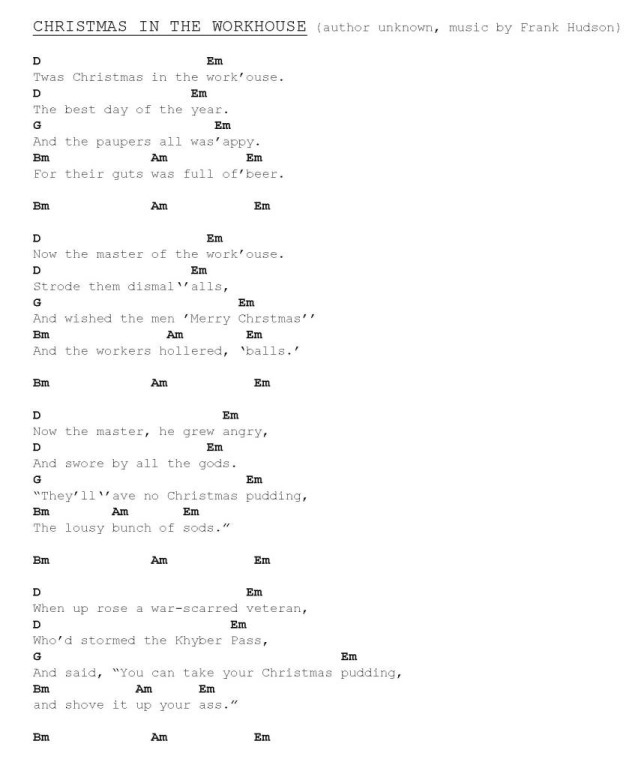
Here’s a chord sheet in case you want to form your own workhouse chorus to sing this one

.

In the 1977 movie, the missing but rhyming rude words of this ditty were assumed to be understood even if missing. In modern TV standards they’d all be allowed. Rude British slang probably even adds unintended charm to American audiences. “Beer” of course isn’t a curse other than to abstainers, though too much may be a burden to be coarsely unburdened of. “Balls” or bollocks are testicles, and patriarchally still somehow measurably more polite than the “c word” (also used more freely in British than American slang.) “Sods” is more obscure, but is short for Sodomite, which gets its suppositorian retort from the don’t ask, but will tell, crusty veteran.

Assault your tender ears with my performance of “Christmas in the Workhouse”  using the player below. No player to be seen? This highlighted hyperlink will serve.  I was aiming for a bit of the early Billy Bragg sound for this one, but I ended up somewhere else nearby. Wife and teenager were dragged away from their Matrix series home-viewing festival to play members of the workhouse chorus, so the least you can do is listen. Happy Holidays to all you intoxicated, genital flaunting, gender-queer, ass-owners who despite it all manage to listen to a variety of musical presentations combined with a variety of words — only some of which are solemn — here.

.

*A wonderful British TV movie presentation of an episode from Terry Pratchett’s Discworld. Unreservedly recommended.

**I saw the first one and liked it well enough to not have a great desire to see the continuations.

***Footnotes, it’s like even more gifts to unwrap after that package of socks — and wait…it’s… another…pair of…socks.  Watching The Gathering  made me grateful for the much higher standards expected of modern “event television” productions. The Gathering  won an outstanding dramatic event Emmy for 1977, so it was considered good of kind for that era.

****Workhouses were a British invention to solve the problem of the chronically unemployed, unhoused, indebted, and sometimes frail or mentally abnormal citizens. The idea was that if you couldn’t scrape together enough to survive otherwise your option was to be sent via government edict to a facility where you’d be given enough to arguably survive under a discipline and order that might include being treated as inmate labor.

This sounds exactly Dickensian and out of the mouth of Scrooge before conversion, but this solution was also widely adopted in America. Even in my childhood I can remember driving with my dad past a local Iowa “county farm,” which was founded on the same principle. In practice these institutions varied from hell-on-earth abusive places through ascending circles of shame and shaming up to sites that, at least when under the best administrations, may have been not altogether worse to what came before and after. The degradation was often “designed-in,” as the workhouse was supposed to make even the worst of wage-labor situations look better than the alternative.

In some ways then, today’s piece continues my honoring of the life of Ethna McKiernan, who worked with the unhoused professionally up until the onset of her final illness.

Irish poets, we complete our Fall 2021 countdown, and Ethna McKiernan

I fear this is going to be one of those bad elegies, one where the writer goes on too much about themselves and not about the person who has died. I’ve already mentioned that I find myself unacceptable and self-absorbed when I talk about myself, and saying that again only digs the self-dug hole I’m going to speak from today deeper.

In the mid-1970s when I moved to Minnesota from New York I connected back up with Dave Moore who I knew from a year in my aborted attempt at college. Through Dave I fell in with a literary group that varied in size and was herd-of-cats led by Kevin FitzPatrick. The group had just started  a little magazine they called the Lake Street Review,  Lake Street being a long commercial and industrial street that ran east/west through the center of Minneapolis: bars, gendered barber and beauty shops, warehouses, grocery stores, used car lots, a high-towered Sears linked to a rail-freight line and distribution center behind it, neighborhood movie theaters and former such theaters now grinding porn, the recording studio where “Surfin’ Bird”  was recorded, a small attempt at a non-suburban shopping mall built on the tract where tractors and tanks were once factory-built, a “hardly a foot we can’t fit” shoe store whose upstairs apartments housed Robert Pirsig when he wrote Zen and the Art of Motorcycle Maintenance.  Literary magazines generally preferred foreign words, or landscape landmarks like rivers, lakes, or mountains for their names. Yes, there were lakes at the west end of Lake Street, a self-improvement plan for nature dredged out from what had been swampy wetlands as part of a series of landscaped urban parks that circled Minneapolis — but let me be clear to those who aren’t from around here: calling an artistic enterprise The Lake Street Review was something of a provocation. This was a group of working-class writers with a non-academic outlook toward poetry.

The groups earliest meetings were held at a bar, and Dave noted to me that a large portion of the informal membership was made up of bartenders. Let me also set one other demographic fact: this was a group of men moving from their 20s to their 30s. Eventually the membership thinned out, and the remainder continued meeting in rotation in the members homes and apartments.

As the clan leader, Kevin was generally gentle and accepting. A high-school graduate, working in an urban ER, the again’er in me was attracted to the outsider stance, but Kevin also wanted the magazine’s public work to be acceptable to the parents and grandparents of us young men. The 1970s had still extended the “generation gap” of the 60s, so the “Seven Dirty Words You Can’t Say on Television” you also couldn’t say on the pages of the Lake Street Review.  Feminism was mysterious, like women generally were to these young men, but those women were talking about it  which made the mystery unsettling. Anything gender-queer was probably beyond the pale.

I liked those folks, but some of this rankled me. Kevin’s desire to speak across the generation gap as a poet was more noble than I appreciated at the time, but I wanted to go much more radically into discussions of sexuality and sexual roles than Kevin did, and what work I shared with the group privately I thought was underappreciated and misunderstood. I skipped off to two other groups sometime in the 80s, only to return to the Lake Street Writers Group after more than a decade away.

By this time the group had become smaller and more fixed in membership and was no longer concerned with the discontinued magazine. Four or five others, interesting writers and persons in their own right, were regulars, and then not; until by the last few years it became a quartet that would meet every month to share and discuss work in progress.

So when that group ended, it was Kevin FitzPatrick, Dave Moore, Ethna McKiernan, and myself. I’m not sure exactly when Ethna became one of the group as it was likely during my sojourn away from it. At one point she was one of two women generally attending, but as we contracted into the quartet, she was the only woman. As we aged it’s possible that this was less of a filter or division, even if it didn’t disappear. Another thing that happened as we condensed: the group had become predominantly Irish-American. Ethna’s father had been a force in the Irish cultural renaissance, something I was almost entirely ignorant of,*  and Ethna’s speaking voice retained a distinct Irish pronunciation undertone. Kevin and Ethna took it upon themselves to establish an annual Twin Cities St. Patrick’s Day poetry reading, a reminder that non-descript leprechauns, green plastic hats, sham-shamrocks, and ever-filled and spilled red cups and flushed faces were not the sum total of Irishness.

Will I ever get to Ethna in this post? To my shame, I will speak more in silhouette, about myself. In many ways I felt the junior member of this group. Kevin and Ethna has several collections published. Ethna got arts grants, had an MFA. Kevin and Dave had degrees from fine private colleges, I was a High School graduate. I gave up trying to publish shortly after my temporary leaving of the group, and it would have been understandable if it irked Kevin and Ethna sometimes that here was this opinionated yet apparently non-professionally serious person taking up their time. I retained a close friendship and collaboration with Dave outside of the group throughout the decades, and grew to understand and appreciate Kevin’s artistic goals, but no such closening happened with Ethna. I knew much less about the details of her life, and what bits I picked up second hand, sometimes from the poetry itself and not from her own conversation, indicated a life with more than it’s share of staggering life events. I also got a not-unexpected sense that men had been part of some of those staggerings, something that she didn’t express much directly in our group of three men and herself. Here’s a statement: I know more about the life-details of Emily Dickinson than I know about the life of a poet, my own contemporary, who I shared a few hours with every month.**

Kevin’s mature poetry never seemed to aim at beauty as such. It is a beautiful thing to find beauty were it isn’t. Ethna indeed aimed for beauty, sometimes comforting and sometimes fierce, and as the saying goes, if you don’t know where you’re going, you’ll never get there. Ethna got there some of the time, which is all we artists can do. Looking through her recently published Light Rolling Slowly Backwards, New and Selected Poems  it is easy to find that she was the most skilled poet in our little group, which sounds like fish-in-small-pond praise — but if you (who don’t know us) were to read her, I think you might find similar achievement to whatever other poets you read. When I read Kevin and Ethna’s last books during my yurt retreat early this fall I observed that while I had heard almost every one of Kevin’s published pieces in Still Living in Town in early draft form, I hadn’t heard many of Ethna’s. I know she attended more than one group sharing works in progress, but the amount of work new to me was surprising. I do plan to share one of her striking poems with you soon, but let’s wrap this long introduction up and get to the final part of my countdown of the most listened to and liked Parlando pieces from this past fall.

Two grey guys and a colorful woman

Three Irish poets: Yeats, McKiernan, and Campbell.

.

2. The Folly of Being Comforted by William Butler Yeats.  Ethna never simply said something like “Read Yeats!” but before I encountered her I didn’t think much about him one way or the other. Now over the five plus years of this project you’ll have heard the fruits of that influence from her in my many well-liked presentations of Yeats. As I said when I presented it, Yeats was making a very specific point in his poem relating to his own life. I chose in my performance to stubbornly ignore what Yeats intended his poem to be about, and to instead sing it remotely to her on her hospice bed with my own intent. If I snub Ethna in this eulogy, I’ll ignore Yeats too. No respect.

It’s a challenge for me to work out my approximations of Jazz when I’m playing all the parts one pass at a time while being far from a master of any instrument. When it succeeds, as some thought here, I try to combine my simplicities (unimpressive I’m sure to a skilled musician) into something that still pleases when heard together. The highlighted title above will link to my original post on this where I discuss Yeats’ intended meaning, but you can hear my performance dedicated to Ethna with a graphical player (if you see that) or this highlighted hyperlink.

.

1. Reynardine by Joseph Campbell.  Before the depths of their illnesses, I asked Kevin and Ethna if they’d heard of this early 20th century Irish poet, and they both drew a blank, which I’ve now found is generally true about this overlooked and worthy of more study poet. If Ireland is thought known for exuberant and willing to risk excessiveness expression, Campbell is never more masterful than when he’s compressing things to a handful of words.

Reynardine is a supernatural story in three short verses. From what I’ve been able to determine (see the original post on this) the supernatural element may have been introduced by Campbell, who took an existing long-winded run-of-the-outlaw ballad, and boiled it down with a shapeshifter element. After he’d done that, the resulting folk revival song, one sung by many of the best revival singers of the British Isles, always includes at least hints of that element. My presentation uses Campbell’s original lyrics, which I think are superior to those usually sung.

As far as it’s popularity here this fall, this is an odd one. The blog post presenting it wasn’t read much at all, and the likes for my explanation there of how Campbell transformed the Reynardine story were low in number. But the listens to the song (as with all the audio pieces here, available via Apple Podcasts or most other podcast directories) were easily higher than any other recent piece. To hear it now you can use the player gadget if your blog reader shows it, or this highlighted hyperlink.

.

*I once joked, confessing my cultural ignorance there, that my idea of an Irish writer was Frank O’Hara. Joke or not, someone somewhere must have addressed what connections O’Hara’s poetry had with Irishness, but I haven’t found it.

** It was only a year or two ago, after my interest in Dickinson intensified that I found out that Ethna too had a deep appreciation for that genius. Of course, I have my portion of blame for this, just as with this inappropriate eulogy, but suspect she believed that I wouldn’t understand or have any sense of her experience or sensibility. I’d estimate she was wrong, but saying that only adds to my inappropriateness here today.

Fall 2021 Parlando Project Top Ten, numbers 4-3

Today we continue to move up the countdown to the most popular and liked piece from this autumn. I mentioned earlier in the countdown and elsewhere that during this year two poets that Dave Moore and I had grouped ourselves with over the years fell seriously ill, and this autumn they both died. Dave himself has been through a health swerve since 2020, but given that he’s alive and could tell his own story, I’ll leave that to him. I’ll just summarize that these three people were a large part of my direct and living connection to poetry, and my circumferential part of the ripples from two of them dying has been to sharply feel that human poetic-creation connection become past-tense.

Two of the pieces left in this countdown are remainder connections to those two poets.

4. Timepiece by Kevin FitzPatrick.  This is one of my favorite pieces that I heard Kevin read even before it reached its final draft for publication. I believe Dave liked it too, and shortly after we heard it, the LYL Band performed it and that’s the recording you can hear below.

Kevin, like our other departed poet, Ethna McKiernan, was a consistent reviser of his work. Poets in groups like ours sometimes present work soon after it reaches a completed draft, but Kevin’s early drafts nearly always seemed close to “ready to publish.” Despite his reliance until far into this century on a typewriter and carbon paper, his drafts’ punctuation and spelling was always correct and the suggested and taken revision ideas often revolved around clarifying narrative elements that would be in the forefront of his poems.*  Kevin also paid attention to meter, and when we’d see later revisions that would be another area he’d have changed.**  As a group we could sometimes be brutal with each other’s work, but it was rare that Kevin would present a stick-out sore-thumb.

“Time Piece”  (the title may have been a single word in the draft I performed it from) had one issue that I recall: there was discussion of the “incorrigibles” that the poem concluded hadn’t stolen the dead father’s wristwatch. At least one of us didn’t like it, perhaps thinking it an archaic, obscure or somehow too formal a word. Kevin nodded and said little as was his usual response to suggested revisions. I think I may have argued for incorrigibles, and since it was there in the draft we performed from long before the poem’s publication in Kevin’s 2017 collection Still Living In Town,  that was still the word in my performance.

Well, damn it, Kevin’s dead, and it’s his poem, and he was good at writing poetry, but “incorrigibles” is the right word, and his revision for publication: “those slick boys” doesn’t have enough flavor. That Dick Tracy word-aroma is just what’s called for! “Greatest Generation” father, and a wristwatch after all! He also made one other revision on the published version: from “That he wasn’t scheduled for a boxing match at six” to “That he wasn’t scheduled to box at six.” I suspect Kevin’s ear thought the later better meter-wise. However as boxing has become a more obscure sport the shorter “box” may miss some readers.***   “Did he work in an Amazon warehouse?” some moderns may think.

“Timepiece”  or “Time Piece”  is a poem well worth reading or listening to. The LYL performance of the earlier draft is what the graphical player below will play, and if you don’t see the player, slug this highlighted hyperlink.

.

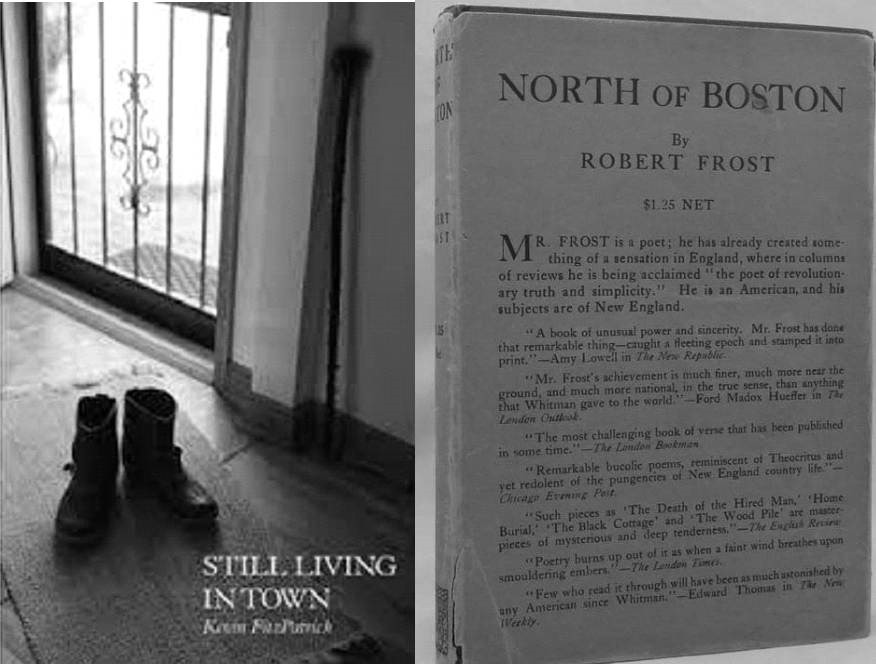
Still Living In Town and North of Boston

FitzPatrick’s publisher, Midwest Villages & Voices, doesn’t distribute online, but this link contains an ISBN and other info that may help you obtain a copy from your local book store or library. Then this other guy, Frost, has books available  too.

.

3. After Apple Picking by Robert Frost.  Unlike our other Frost poem in this autumn’s Top Ten, the metaphysical “Bond and Free,”  you can feel this one. Particularly as Kevin began to spend his weekends working at his life-partner’s rural farm, I could see kinship between FitzPatrick and Frost. Both were drier than a Minnesota winter’s static humidity, both liked to observe human outlooks critically, and both of them could give you some of the tang of work tied to nature. I’m not sure if lifetime farmers are likely to write a poem like this, but someone coming to that work from something else, as Frost and FitzPatrick did, has the outsiders’ advantage of fresh observation.

When I presented this poem last month I thought about dedicating it straight out to Paul Deaton, who’s blog I’ve read for the past few years, in part to catch up on his accounts of small-format food farming, sometimes mentioning apple trees and orchards. But I wasn’t certain how well it fits anything Paul experiences. The apple trees of my youth were tall enough that ladders would be required, but the orchards I saw biking around Bayfield this fall have quite short trees, the kind where an adult would stand flat-footed to pick the fruit.

But maybe I should have gone ahead. Even though this poem has specifics, even to what aches after work, it’s about finishing a task. When another blogger I read: professor, editor, and author Lesley Wheeler wrote of getting to the final stage of a book-length manuscript, I thought of how I felt after finishing a manuscript decades ago. That same “Well, I probably missed a few, but I’m done  with apple picking now.”

Player gadget below for some, this highlighted hyperlink for the rest of you to hear my performance of Robert Frost’s “After Apple Picking.”

.

This post has gone long, though with things I wanted to say. Our next post will break from our usual Top Ten countdown, as it will deal with both the most popular piece, and the runner up, and I’ll talk more about poet Ethna McKiernan.

.

*More than once I’d say to Kevin “If I had had the idea to write something from this same material that you used, I’d have written a short story.”  I remember once Ethna took me sharply to task for saying that, admonishing me that Kevin was writing a narrative poem. She misunderstood me, for I knew and admired that. Mixing into a short poem, with its almost unavoidable lyric immediacy and compression, with narrative elements sometimes even including a Joycean epiphany, is not easy. Once or twice, so taken with the story in one of Kevin’s poems I attempted to craft a short story from the same material, to demonstrate my point — and yet I could never complete one of those attempts. Kevin’s poetry may look unshowy, but it’s not easy to duplicate.

**Several years ago, Kevin and Minneapolis folk/blues revival pioneer Dave Ray of Koerner Ray and Glover engaged in a little side-bar about meter in Blues lyrics, with Kevin scanning their iambics. Kevin played a little blues harp, and Ray and Kevin’s dad were both in the insurance business.

***Kevin also boxed, and not in a warehouse way. He once wrote a poem which had as significant line “The boxer slugs!” Dave Moore’s punishing wit, after dealing with a lengthy group discussion about if that line would be misunderstood, was spurred to write an entire song about a garden beset by invasive…wait for it…”boxer slugs.”

Fall 2021 Parlando Project Top Ten, numbers 7-5

Let’s continue our Top Ten countdown of those pieces that you liked and listened to the most this autumn. Regular readers here may not be surprised that death features in some way in each of today’s three poems, as illnesses, infirmities — and yes, folks I’ve known a long time dying — have been part of the year for me.

Everyone that dies or is limited by infirmities is a lesson, one you listen to more richly and intently as you get older. It’s a lesson that makes me press immediately against what limits age has put on me, gives me a sense to use what I have presently before it’s gone. Oh, I am sad that I’ll not hear Kevin or Ethna’s voices again, except in memory or recordings — thin mirrors those. Dave reminds me that it reminds him when I post older LYL Band recordings where he was able to pound and roll the keys. Our family continues to deal with my wife’s mother descending, as politely as she can carry it, into dementia. But those that go before us are meant to teach us. Don’t skip the lessons.

Why Now, Vocalissimus  by Frank Hudson. When I posted this audio piece, shortly after I wrote it, I said right out I wasn’t sure what I meant by it. That state may be unnerving for a writer. After all, aren’t you supposed to know? If you don’t know, how can you present anything vividly to the reader or listener?

Well, there’s a theoretical structure, a mythological structure, that seeks to explain that. It says that we are conduits for muses, external things. We don’t have to be outstandingly worthy, exceptionally preceptive, or precisely eloquent, since we are in this scheme conduits of something outside us. Frankly, this can lead to a lot of bad poetry: inchoate self-expression bearing the costume of inspiration. But then everything leads to bad poetry — all artists fail as I remind readers here often. But what of us readers, us listeners? We fail too, grasping partially what much art conveys.

My understanding of what I wrote back in September has grown as I live with this set of words. Part of our job as living, breathing artists is to carry forward the work of those who’ve left off working. We are not just creators, but also carriers. So, if you write poetry, bring words down onto the page or speak your own words, know that I’m charging you to also preserve and enliven those others who have no voices left to carry the spark. And that’s what I try to do here with the Parlando Project.

My performance of “Why Now, Vocalissimus”  is available below with a graphical player. Don’t see it? Then his highlighted hyperlink.

.

Heidi Randen’s picture of a milkweed husk spoke to me this autumn.

.

6. The Shadow on the Stone by Thomas Hardy.  A complicated ghost story, a complicated haunting. As I wrote when posting this, English poet Thomas Hardy had a dysfunctional marriage — and yet, like many folks forced by fact into the separation of death and mourning, he still felt the returning presence of the intimate dead.

I rather liked the music I composed and played for this one. It has a weird loping groove that I find attractive. To hear the performance, some will see the player, and the others can use this highlighted hyperlink.

.

5. God Made Mud by Kurt Vonnegut.  I decided to present several short excerpts from Vonnegut novels that work as poetry this fall on the occasion of the 99th anniversary of his birth. The LYL Band had recorded them well over a decade ago, on the week Vonnegut died. Why didn’t I wait for the nice, round 100-year birthday? See the start of this post for why.

In Vonnegut’s novel Cat’s Cradle  the text I used here is the last rights of an imagined religion. Like the theoretical/mythological structure of muses directing us to write poetry, Vonnegut proposes a useful if compressed Genesis story that asks us to recognize that the nagging mystery of death is no harder to explain than the overlooked mystery of living at all.

Yes, player gadget below for some, and this highlighted hyperlink for others to hear it too.

.

Halfway through this fall’s Top Ten. The rest will be posted here soon.

Fall 2021 Parlando Project Top Ten, numbers 10-8

It’s that time again when I present our quarterly countdown of the pieces most liked and listened to here at the Parlando Project during the past season. We’ll proceed from the 10th most popular and move up to number 1 in the next few posts. The bold-faced heading for each piece are links back to the original post that introduced the pieces here, in case you didn’t see them earlier this autumn.

10. Cobwebs, Steel, and Moonshine by Carl Sandburg.  Longtime readers here will know of my admiration for American poet Carl Sandburg, and so it may be no surprise that this is actually the second time I used parts of a single Carl Sandburg poem for a Parlando Project audio piece. The Sandburg poem is “Smoke and Steel,”  a poetic celebration of labor and laborers from a collection of the same name published in 1920. I used that whole poem’s title for the piece I created out of the beginning of it for May Day in 2019, but for this past American Labor Day I used the conclusion of “Smoke and Steel”  and gave the result this title. I dedicated it to another American poet, Kevin FitzPatrick, who was suffering from a serious and unexpected illness that killed him later this fall. This is the first of three poems in this fall’s Top Ten dedicated to poets Dave and I knew and exchanged work with who were suffering mortal illnesses.

I’m thankful that long-time reader of the blog rmichaelroman submitted a good guess as to what the steel might be in Sandburg’s short ode to workers and work: rebar.

Player gadget below for some of you, or this highlighted hyperlink will also play it.

.

9. Bond and Free by Robert Frost.  It’s been a while since I mentioned it, but Robert Frost bugged me when I was young. He was still alive, and omnipresent in anthologies one might find in school, which caused me to treat him like other 20th century poets and critics treated Longfellow: as a square preaching platitudes who stood in the way of younger and fresher voices who’d question all that with a more unruly poetry. I was misreading Frost of course, but through that error I did find others I thought in opposition to him that I found rewarding back then. Eventually I came around to love the word-music in his shorter lyric poems, and from that attraction found a starker and more divided meaning was there.

“Bond and Free”  is Frost in his more metaphysical and frankly philosophic mode, which isn’t my favorite Frost, setting out here a cosmic stage where Love and Free Thought conflict. He sounds more like Shelley or Keats in “Bond and Free”  than the more modern diction he was able to make sing in other poems, but sing the words do.

Player gadget below for some of you, or this highlighted hyperlink will also play it.

.

Frost-Moore-Sandburg

Three young poets at work. One played in the LYL Band.

.

8. They’re All Dead Now by Dave Moore. One of the most popular of my Halloween series this year, even though it’s a longer ballad form story that put my singing strength to the test. Longtime listeners here will know Dave as the most common alternate voice here at the Parlando Project as well as the keyboard player you’ve heard in the LYL Band.

He’s also a fine writer of poetry and songs. For reasons too complicated to deal with now, I fairly often sing Dave’s songs here rather than having him sing them himself. There’s a factor when someone sings another writers’ song. While they may bring a different kind of talent and musical craft, they may also somewhat misunderstand the song — or misunderstand (maybe more at “re-understand”) it in a valuable mutational way. Though I’m not a great singer, I do try to bring something to Dave’s songs when I present them here.

Every song stands to gain much more than one more life when sung by someone else. From time to time I’ve encouraged others to sing some of the Parlando Project songs. Anyone have their own cover of one of our Parlando Project pieces you’d like me to hear?

Yup, player gadget below for some of you, or this highlighted hyperlink will also play it.

.

I died for Beauty — but was scarce

I’m nearly over the bout of upper-respiratory crud that has laid me low this month, so I felt it time to see if I could test the dulcet tones of my voice again with a new audio piece. Today’s is one by Emily Dickinson: “I died for Beauty — but was scarce.”

This poem is characteristically short, and “I died for Beauty”  has long been one of Dickinson’s “better known” poems. Let’s do what I often like to do with one of Poetry’s Greatest Hits here and see what we may have missed, and why I might archly put that “better known” in quotes. Here’s a link to a blog post that starts with the full text of the poem in case you’d like to refer to that as I discuss it.

Let me get this out first: to certain sensibilities this is a poem that’s easy to find infused with a kind of corny gothic pretension. It’s got all the counters, common already in Dickinson’s mid-19th century, only more so now: graves, decomposing tragic corpses, sad death, and the world’s disinterest in earnest souls. And on top of this: it’s got capital letter Truth and Beauty. Even a school child who’s read and adored some Keats* will see Dickinson as dropping a shout-out to the doomed garageman’s son.

What can we infer about what Dickinson intended here? I’m no Dickinson scholar, but what I’ve gleaned from reading some of her letters as well as her poems is that while she had those gothic urges, she fiercely wielded a skeptical eye and a satirist’s pen. My guess is that she believed in capital letter Truth and Beauty, and Poetry for that matter, but she also knew the comic limits of humans dealing with them. I could be wrong, or projecting, but that’s the Dickinson I “read.”

The poem’s opening line, with its concluding start of a broken phrase “I died for Beauty — but was scarce” lets one suspect that the tomb is not exactly overflowing with heavenly beauty. So, our dead-in-the-tomb “died for beauty” narrator here finds death (like life) is asking for our narrator to become “adjusted.”

But wait there’s another voice! One equally devoted to capital letters! One who died for Truth! In case one thinks those capital letters are shouty, his voice is soft, somewhat defeated, and is asking about failure. Note that the died for Truth voice is male —we’ll have more to say regarding gendering in the poem soon.

I died for Beauty ms

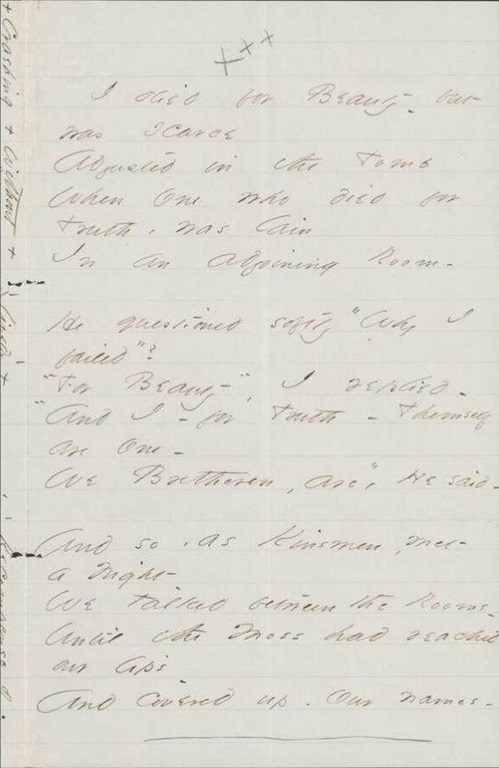
Here’s how Dickinson wrote down this poem of hers in one of her sewn-up fascicles.

.

Dickinson either makes an odd choice or is just awkward in the Truth guy’s opening question.**  She writes it as he’s asking “Why I failed?” in quotes. In ordinary writing this would indicate that the voice is asking: “Why did I, the Truth Guy, fail.”***  However in the context of the poem the Beauty voice, our narrator, answers back as if they  were asked why they died. It’s hard to convey in a single-voice performance, but if Dickinson intended this awkwardness, it’d be a demonstration of Beauty being consumed by their own state and so thinking the question was to them.

The conclusion of the 2nd stanza, Truth Guy’s reply to our Beauty narrator is stilted, even by mid-19th century formal speech standards. I don’t know if this is intended or simply a failure in Dickinson’s prosody. If intended, Truth Guy’s speech is demonstrably meaningful (truthful) while not  being beautiful. I think of my thought about Dickinson growing up in a household consumed with lawyering and contracts and being genetically related to lawyers.

I’m indebted to Oliver Tearle in pointing out something else in Truth’s little speech: he calls our narrator “Brethren” which is continued in the summary of the next and final stanza as “Kinsmen.” Now if we are to assume that our narrator is Emily Dickinson, a woman, then she’s just changed gender or has been miss-gendered by Truth Guy. Now of course even though the poem begins with “I” we can’t be sure that Dickinson — even if consumed by the beauty of poetry and multiple times in her poems apt to cast herself as writing of herself after death — intends that I who died for Beauty to be herself.

This may be leading to the final two lines, where truthfully and beautifully the omnivorous (even consuming mineral!) moss consumes their bodies and eventually their grave’s marker stones, leaving nothing gendered, nothing specific, only their essences returning to our shared essence: the truth and beauty available to us all if we seek it, to borrow and use it, to find comfort with, and to comfort by.

I’ll pause here to note that poet Ethna McKiernan died this past Sunday. I worked on this Sunday and Monday before I heard the news.

A Player gadget is below for many of you to hear my performance of Emily Dickinson’s “I died for Beauty — but was scarce.”  And if you don’t see that, this highlighted hyperlink will also play it.

.

*No shame in that. I was one. The long-running Prowling Bee blog project points out that the Truth and Beauty paring is also present in known Dickinson influence Elizabeth Barrett Browning’s epic poem “A Vision of Poets.”   It’s also worth considering that Keats’ Truth and Beauty urn is not simply a joyful object for contemplation, or even a clear model for the supremacy of art like Rilke’s white-scrubbed statue.

I’ll offer my own tentative and inconclusive possible inspiration: It’s thought this poem was composed in 1862, and while we don’t know the particulars of Dickinson’s intent, there’d be this possible even more contemporary influence: the folk hymn adaption “John Brown’s body (lies a moldering in his grave/but his soul is marching on)” which was transmuted into a more grand literary composition with the chorus of “His truth is marching on.” As “The Battle Hymn of the Republic”  Julia Ward Howe’s poem was published in the February 1862 number of the Atlantic Monthly where Dickinson surely would have seen it. Literally, the antecedent to “His” in Howe’s poem is the godhead, but folk-music-process wise, the antecedent is John Brown.

Posthumous editor and sought-out living “preceptor” (in her words) of Dickinson, Thomas Wentworth Higginson, was a backer of John Brown’s raid.

**Original Dickinson editors Mabel Loomis Todd and Thomas Wentworth Higginson removed the quotes Dickinson put around Truth Guy’s question, making it clearly a question to our died for Beauty narrator in their version. So “He questioned softly ‘Why I failed’?” in Dickinson’s hand then became “He questioned softly why I failed?” on first printing.

***”Failed” here is meant also to have a double meaning as in dying, but the fail in failed is too prominent. As this voice was first introduced, “One who died for Truth” is more noble sounding, as in martyrdom, than failed in truth.