Besides being the first day of National Poetry Month, it’s April Fools day, so maybe it’s a good day to present a poem that caused many readers to wonder if it’s a joke: William Carlos Williams “The Red Wheelbarrow.”
I’m not against a poem causing wonderment, are you? It’s fine to look at it and respond “You can’t be serious — is that really a poem?” but I urge you to follow that question with other ones, such as “What use is it?” “Is this just an artsy provocation?” or “What should poetry be then?”
I think Williams’ poem is a late but effective representation of the movement that launched Modernist poetry in English: Imagism. Fairly quickly, a great deal of English language Modernism soon moved on to more complex poetry, a poetry that was often hard to grasp due to intense but hermetic personal material or elaborate references to other works of art, but “The Red Wheelbarrow” is none of that. Instead it expresses, like a sub-two-minute punk song from the mid-1970s, a rejection and clarification of overly elaborate poetry.
and this place has chickens. Also a short 12 tone-row composition.
.
I think Williams genuinely thinks the rain-water makes the wheelbarrow beautiful, and he doesn’t even think he needs to say that word “beauty” or make some elaborate metaphor to seal the deal. To say that, and just that,* is a provocation against poetry that asks more, and to readers that expect the poet to give them more. But it’s not just the momentary rain-water glaze that makes it poetic: it’s useful, something to depend on. Now that’s a goal for poetry (or any art) to meet at least some of the time, don’t you think? Self-impressive poetry, trickster poetry, poetry that gathers and unites widespread allusions — all have their place as well, but sometimes it’s good to see what there is seen naked in the rain. When the cave dwellers put their hand or the hand of their child up against the wall of the cave and blew red ochre dust around it, that’s art — not of the artists showing us skills, but the art of our shared and transient experiences made fixed.
Musically here I decided to use another contemporary early Modernist tactic: the tone-row. If one knocks “The Red Wheelbarrow” for not having poetry’s elaborate or fanciful imagery, or some tight connection with the artist’s personal biography, perhaps this performance will show something traditional it retains: a lovely, largely iambic, word music. Yes, it’s music in miniature, but still that poetic element was there for me to express.
To hear my audio performance of William Carlos Williams’ “The Red Wheelbarrow” set to my own music, you can use this highlighted link, or (if visible) a player gadget below. And as I’ve been doing with our National Poetry Month re-releases, there’s a simple, low-budget, lyric video at this link.
You might think we’d need do nothing but what we usually do — after all, we’re always celebrating poetry here. We have over 600 pieces you can find in our archives, performances that combine words (mostly poetry) with original music we compose and record ourselves. But here was my problem as April arrived: time to compose new pieces is inconsistently available.
So, I’m going to lean on that collection of pieces we’ve done and make this also a celebration of what the Parlando Project has done over this past 6 years. My plan is to regularly repost pieces from the first half of our history this April. For many of you who joined this Project already in progress these may well be pieces you haven’t heard, but an additional goal is to introduce new listeners to these audio performances.
Why do that? Readership of this blog, originally intended as brief “show notes” for the audio pieces, has grown tremendously over the past year, but the audience for the musical presentations has increased only by a small amount over the same time. I’m hoping to capture more ears for those performances and the poets whose work we interpret, sometimes in surprising ways.
To gather more ears I’m going to be making new low-budget YouTube videos for these classic pieces, mostly just “lyric videos” that display the poet’s words we are presenting. Most new people find us via search engines, and my wild guess is that putting things in front of YouTube searchers may bring more listeners and readers.
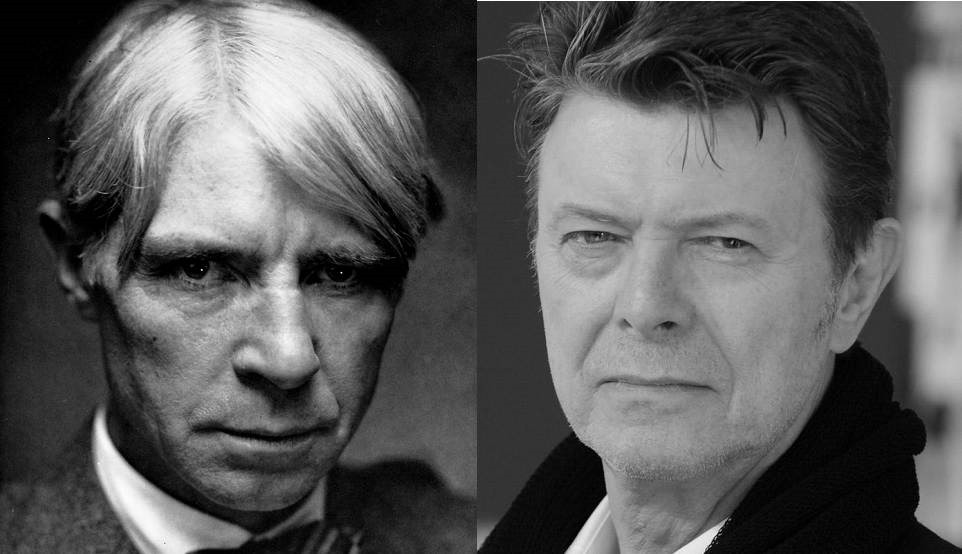
To begin this series? Why not use the first piece from this project’s official public launch in 2016: Carl Sandburg’s “Stars Songs Faces.” Speaking of strange, The LYL Band performed this on January 11th 2016, the day after David Bowie died. Carl Sandburg didn’t have the opportunity to prepare a eulogy for Bowie, since that American poet died in 1967, but back in 1920 he wrote this short evocative poem that we used for the words in this performance. Spookily, Sandburg’s poem presented this way makes it seem like he did write a eulogy for Bowie. And to eerily evoke that short time when both Sandburg and Bowie were extant, the music makes use of one of The Sixties most distinctive sounds: the wobbly Mellotron that could sound like a string section whose batteries were running down.
“What will I be believing, and who will connect me with love?” The young Swedish-American and the star with songs and faces.
Given the everything I’d rate between losses, troubles, and mere distractions I’ve gone through since late last autumn, I’m not in a mood this week to do the traditional Parlando Top Ten list for the past season. These are the same issues in repertory that have reduced the number of new pieces I was able to present here during that time. You, the audience for this Project, have stayed with this: readership to this blog is growing, overall listenership to the audio pieces is slightly up. Thank you. Thank you. Thank you. There’s more than three of you — I mean to thank all of you three times.
I know some of you do like these quarterly Top Tens, and I enjoy them myself — if only just to see what pieces from the variety presented here got the most response. That said, let’s rush through the numbers 10 up to 6 for the record:
You can see in those five pieces two from my memorial observance for the Irish-American poet McKiernan who I had the privilege to know and examine poetry with, and one from my February Black History Month celebration of Langston Hughes’ first poetry collection The Weary Blues. There in the middle, there’s one by long-time Parlando Project favorite Emily Dickinson. And my own piece in that group talks about the loss of Ethna and also my March memorial subject who Dave Moore and I also knew and worked with: Kevin FitzPatrick. If you missed any of these, each of that above list is a link to my original blog posting and the audio performance of it, just as the following ones bolded titles are.
We join the countdown to the most listened to and liked piece then at number 5.
Spring, a rebuttal.
.
5. Velvet Shoes by Elinor Wylie. A lovely, graceful winter poem by a too-often-overlooked poet from “The Last Twenties” in our previous century. I like the music and performance I created for this one just as much as I did when I created it back around the beginning of 2022.
One would think I’d be through with snow experiences this far into spring, but my morning bike ride today was in big wet flakes and a cold enough north wind. Wylie’s velvet snow is more the dry January sort, but then appreciating snow for its beauty qualities may be best done in past-tense. If so, you may enjoy listening to this one in what I hope is a pleasant spring.
.
4. Lenox Avenue: Midnight by Langston Hughes. “The rhythm of life is a Jazz rhythm” says the first line of Hughes’ poem. I did my best to honor that injunction from one of the first Afro-American poets to unabashedly celebrate that musical form. Although I’m a vary unskilled keyboard player I was able to compose a satisfying two-handed part using MIDI as a scoring tool. I wanted a saxophone solo too, which you can hear a bit of in this performance, but I just couldn’t score or execute enough articulation to “make it.” The piece’s final horn section flourish is one of my rare surrenders to using a sampled musical phrase.
Of course, motif sampling is now an oft honored tactic in the ongoing Afro-American musical tradition, so perhaps I shouldn’t view it as a failure on my part. On the audacity front: I decided to extend Hughes’ lyric which ended with “And the Gods are laughing at us” with a newly written affirmation from after the poem’s time of 1926, one that says that the young art of Jazz and of young writer Langston Hughes’ has answered those gods.
.
3. Sonny Rollins, The Bridge 1959. Staying with Jazz for this one, though with my own words straight through. There are beliefs — some sincere, some insincere — that Afro-American history is but a sorrowful tale, a grievance and a pandering response. If you can heartily do so, I ask you to improvise your own expletive response to the call of that fearful theory, one with as much eloquence and melodic force as you can deliver. Now our response may not be Sonny Rollins level improvisation. That’s not a reason not to — after all, Sonny Rollins wasn’t sure his improvisations were Sonny Rollins’ level improvisations. That’s the story in this piece.
I seem to lack the concentration, or the assured concentration of blocks of time, to do arrangements as full as the one I created for Frost’s poem right now. But you can still enjoy this one.
.
1. Stones by Ethna McKiernan. One answer to lack of compositional time is to write solo instrument pieces, which for me usually means acoustic guitar. Of the several pieces I did to introduce more of you to McKiernan’s range of poetry, this was the one that by far got the most listens this winter — in fact, more listens than any piece has received for more than a year during its first season after posting.
Before I leave you to listen to it, I want to say that beyond soothing my grief at Ethna’s death, that performing those pieces which used her words this winter made her seem closer than our too casual life connection sometimes had us. Wherever we voyage, the same waves lap the same sounds on the walls of our boats.
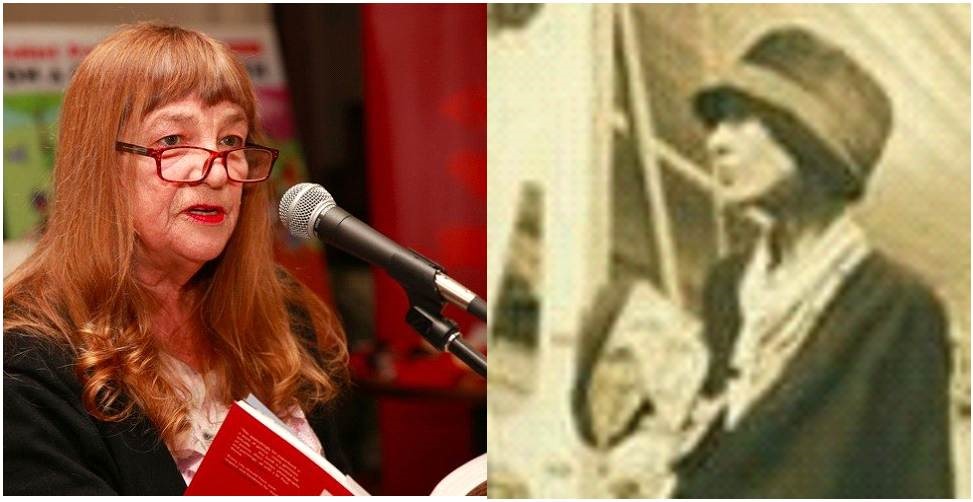
I’m posting a bit late in the day, but it’s International Women’s Day, and so today’s audio piece uses as a text a poem by a very international woman, Lola Ridge. Ridge’s poetry is perhaps best known for a fierce commitment to social justice and the situation of the poor in early 20th century America; but she was born in Ireland, left with her parents for New Zealand as a child, emigrated from there to Australia to attend college, and then to America, eventually New York City, where she mixed with most of the political and artistic radicals of the early Modernist era, including on the arts side: Marianne Moore, Edna St. Vincent Millay, Hart Crane, and William Carlos Williams and the rest of the circle around the NYC Modernist magazine The Others. Over at the Midwestern anchor of Modernist American poetry, it’s editor/founder Harriet Monroe was said to have called Ridge a genius, and she won awards and some favorable reviews in the years between the two World Wars.
Late in the 1930’s she apparently fell from the scene politically and artistically, and when she died in 1941 she was as poor as the people she wrote about, and then seemingly the subject of a rapid and rather complete forgetting for the rest of the 20th century.
Luckily our 21st century has become interested in reassessing the women who were on the scene a century ago along with the male Modernists, and there’s now a revival in considering her work.
Unlike some of Ridge’s poetry, today’s piece is not formally Modernist. It’s not only a sonnet, it attempts to present a passionate if conventional poetic argument regarding the abstract ideal of artistic beauty. Taken by itself it’s more Percy Bysshe Shelley than William Carlos Williams, but if we look just a little beyond its surface we can be reminded that Shelley was a thoroughgoing political and social radical as well as a Romantic era poet. Here’s a link to the text of Ridge’s “Sonnet to Beauty,” from a blog that does a great job of presenting sonnets and similar shorter poems, FourteenLines.blog.
Ridge’s poem starts by worshiping beauty almost as an awed acolyte unable to face the godhead. But in the midst of the poem, something strange starts to manifest itself: a buzzard (an ugly, carrion-eating bird) appears gussied up by “The wizardry of light” to appear “All but lovely as the swan.” I read this as Ridge saying that artists and society can fail, can deceive, can fake beauty.
A musical metaphor follows this that says despite the diversity of artistic endeavor — including false beauties or injustice like unto our buzzard — that beyond the dissonance and the harmonic stress of this dialectic, that the chords can resolve. The poem ends avowing that true beauty can still chime through ugliness, falsehood, and strife.
Beyond sonnets, I will now make a turn in this post before giving you a chance to hear my performance of Ridge’s poem. Let me quickly summarize the event I attended this past Sunday remembering Irish-American poet Ethna McKiernan. There may be more than coincidence that Lola Ridge started this off.
Ethna McKiernan reading, with lipstick, and Lola Ridge, I’m not sure.
.
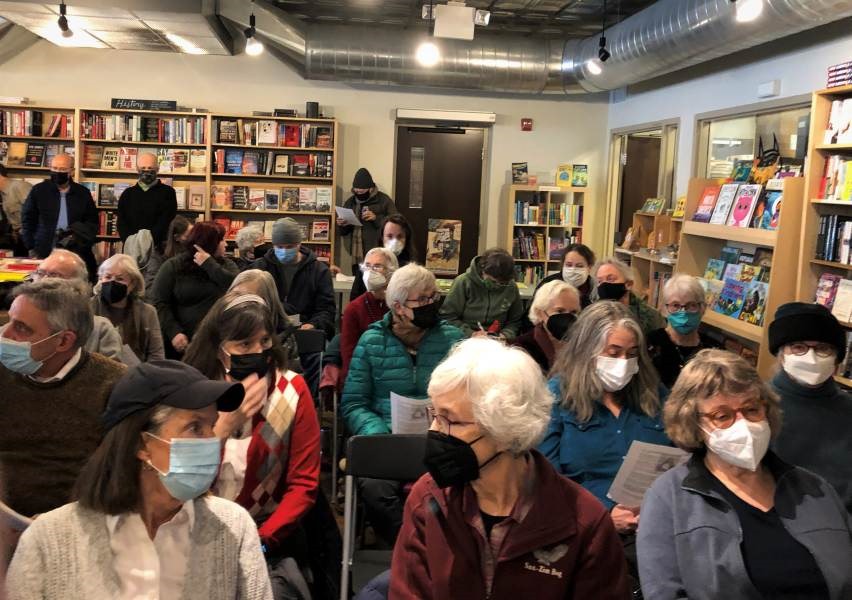
Minnesota weather and continued Covid-19 concerns might have conspired to reduce attendance, as the side streets were still full of sloppy snow from Saturday’s snowfall.* I arrived early and helped the bookstore staff setup chairs. They seemed to be expecting maybe a couple of dozen, which may be par for a Twin Cities local-writer poetry reading, but both the event organizer and myself the bystander suspected we’d need to maximize the amount of chairs the space could hold. I think we were able to get nearly 40 folding chairs into the designated space, but as the crowd started to assemble, extra chairs needed to be rounded up and put in the various aisles between the bookstore shelves to handle those that kept coming in, and we had a few standees who fit in where they could.
More than typical bookstore poetry readings, I suspect most of the crowd knew Ethna for a long time. And that may have given a boost to the eight poets who read poems of Ethna’s, a smattering of their own, and gave short thoughts about her as a writer and a person. So less a usual public reading where some poets might be nervously trying to consider how they would come off presenting their work to an audience which might not know it, and more like an experienced and informal poetry group of long-time colleagues.
Several of the readers were members of other periodically-meeting writer’s groups that included Ethna, like unto the Lake Street Writer’s group that Dave Moore, Kevin FitzPatrick, Ethna, and I were decades-long members of. I’m sure that if Kevin had lived, he would have been a valued part of this event, as Ethna often credited Kevin as an influence on her writing — but he died a few weeks ahead of Ethna. I tried to make myself useful by playing stagehand and raising and lowering the mic stand for the variety of readers.
Many of the readers spoke of Ethna’s work with homeless outreach, and read some of her poems that dealt with that work, something that echoes today’s poet Ridge. Though the audience was entirely masked, a few noted that Ethna was a stickler for always putting on lipstick when out in public. For all anyone knew, what with our Covid era masks, we all were wearing lipstick! Who could see — but I believe all of us were remembering Ethna.
Covid-era ambiguity: “Lipstick? We were supposed to wear lipstick?” A portion of the crowd at the “Remembering Ethna” event last Sunday.
.
So, as I speak of a woman who promoted culture, wrote beautiful poetry, and was committed to helping the economically desperate, I will now leave you with a piece using the words of another woman who a century before us did the same. You can hear Lola Ridge’s “Sonnet to Beauty” with a graphical player below if you see that, or if you don’t, with this highlighted link.
.
*My friend and participant here in the Parlando Project Dave Moore was unable to attend due to concerns with the street conditions. I’ve attended two other book-launch poetry readings given by Ethna herself, and this Sunday’s was the smallest crowd of the three. Consider though that most of those who knew Ethna are “senior citizens,” and some are frail as well.
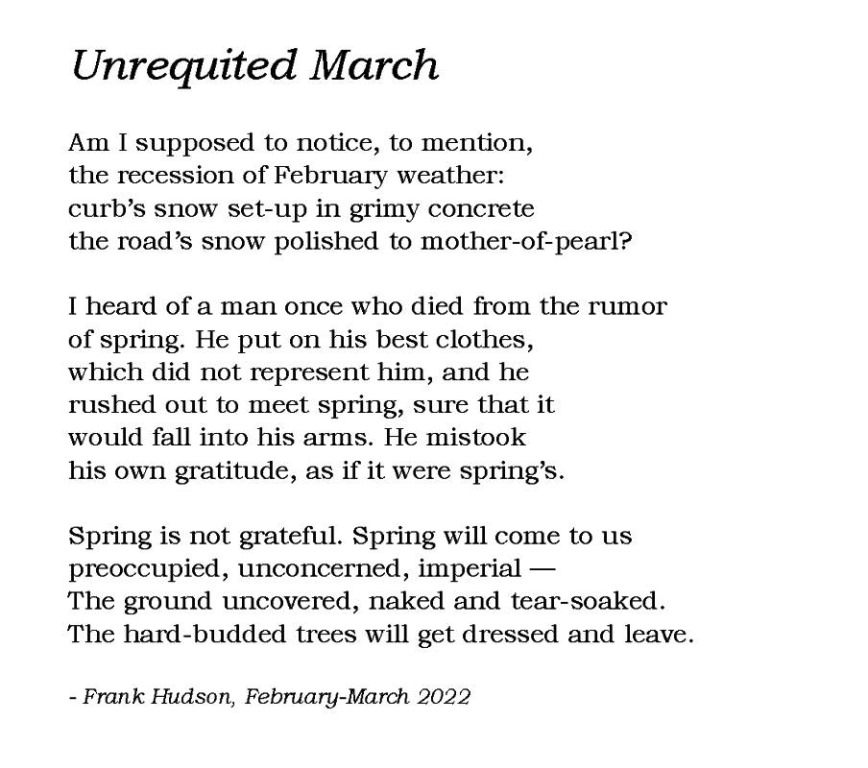
Here’s a sonnet of my own about the oncoming spring. I live in Minnesota, and here that season’s arrival is something of a lottery ticket. Oh, it’s likely that by sometime in February a Minnesotan is tired of winter, and we know that somewhere around May Day we’ll not have snow or cold to deal with for a few months, but when today’s high got to 40 F, we know no more than that. When I moved here, I was told that on days like today we might see folks wearing T-shirts outside — and yes that’s so. We are so in a hurry for spring that what would be a 5-degree Celsius winter day in more temperate regions seems time to ditch the jacket. Yet we are still likely to have more cold, and even more likely to get substantial snowfall, particularly in March.
So it is, from late February to late April is a two-month season of “what d’ya got” in our state. That’s what my poem performed today deals with.
Things are still snow-covered around here, but it’s not fluffy, Christmas-card snow— more at rugged crusts. I still ride a bicycle nearly every day year-round, and so winter means that I pay special attention to the surface conditions of the side-streets that I most often ride. You know the old factoid that Inuit peoples have a multitude of words for snow in their vocabulary? A day or two after a snow what’s often found is compressed and polished snow with some patches of white glaze where tires’ friction has buffed a gloss.* A few days later there will be areas where that surface further abrades and patches of dull-brown porridge-like snow aggregates are scattered on the roadway. I call the later “brown-sugar,” and the earlier hard white surface looks to me like the smooth inside of a shell.
Spring-time bike rides in Minnesota aren’t necessarily what you think.
.
Low-pressure studded bike tires work pretty well on the hard shiny stuff, and large knobby treads are the thing for the loose brown sugar. My deep-winter bike’s tires are a pair of Venn diagram hoops circling both.
That’s a poet’s bike ride for you: metaphors per hour.
The meter’s a bit loose, yet not loose enough to cry “Kings X — Free Verse!” either.
.
Does any of this help “translate” my poem for those without my climate? That’s my hope anyway. Though the title of my poem is “Unrequited March,” my wish for you, curious or stalwart reader/listener, is that spring will love you back this year. The player gadget to hear about the uncertainty of that is below for many readers, and for those whose way of reading this blog won’t show that graphical player, this highlighted hyperlink will open a new tab to play the performance just as well.
.
*The large, knobby, low-pressure tires are also capable of riding on fresh snow before cars get to it. Un-rutted light and granular cold-weather snow is kind of fun to ride in. The wetter and clumpy snow that will likely come in any heavy storms for the rest of the season is much less joyful. That stuff is like riding in deep mud. The tires’ knobs will get traction — it’s not the tires, it’s an old out-of-shape guy like myself who’ll get tired quick riding through that.
The sense I get from today’s example is that by using the generic if exalted name of “Poem” as the title, when what follows is so spare and simply stated, is meant to draw attention to the provocation that this is worth consideration as a complete lyric.
It may be me and my current situation, but when I read “Poem” I immediately thought it was a memorial poem, a five-line-with-one-refrained-line statement of the essence of loss intended to put itself up against something like the book-length “In Memoriam A.H.H.” by Alfred Tennyson. I still find nothing in the text that forbids that reading.
But death isn’t the only loss in life. Some, particularly those looking for obscured clues to Langston Hughes’ erotic orientation see this a coded statement of a romantic or erotic breakup with a “He.” Like Shakespeare’s sonnet sequence and Tennyson’s long poem, the poem has a dedication to a set of initials: “F. S.” in “Poem’s” case. Some articles one can find in a web search identify this dedicatee as Ferdinand Smith, who was in the merchant marine — as was young Hughes before he published The Weary Blues. Hughes did know Smith, but I haven’t seen a full explanation of how this putative identification was made. Oddly, if this poem of complete separation was written about Smith, Hughes and Smith kept in touch until Smith’s death in 1961. In Real Life there was no utter break between the two — but that’s biographical information, nothing in the text forbids the abandoned love reading either.
Frederick Smith, who’s been identified by some as the mysterious F.S.
.
And then too the poet Hughes of The Weary Blues and elsewhere is very broad in his use of the pronoun I. Not only does Hughes not identify F. S. and what exactly was the nature of the love relationship, Hughes is fully capable of using “I” as a collective or representational singular. Think of Hughes most famous early poem “The Negro Speaks of Rivers”— its litany of I’s is not a Quantum Leap confession that this certain 20th century poet worked on the Pyramids or rafted the Mississippi with Abe Lincoln.
But “Poem” does feel like a personal expression, even if Hughes may frustrate us if we prefer poems as memoir filled with explicit self-expression. Yet maybe this is of little importance to the essence the poem wants to express. Grief from loss of a lover who leaves and lives, or loss of a friend who has died — does the heart assay any difference?
Musically today I demonstrated fidelity of a different kind, playing a cheap 40-year-old 12-string guitar that I bought shortly after coming to Minnesota, and a bass that once belonged to Dean Seal, who played in the LYL Band in the early 80s. I have newer better* instruments, but it seemed like a good way to reset and get back to making some new Parlando Project musical pieces after February presented other matters that needed to be done.
You can hear my performance of Langston Hughes’ “Poem” with the player gadget below — or if you don’t see that, with this highlighted link.
.
*My newer guitars are better in that they don’t have parts that won’t exactly work anymore or intonation issues I need to work around, but besides old-times-sake I think there’s some character remaining in these funky instruments sound.
As I mentioned as January ended, this February has been challenging for me to keep up with this Project and it’s associated tasks. I still hope to have new pieces soon. In place of a new encounter and performance with a poem or other text, let me do one of those posts where I pretend this is a normal blog
I know nothing other than what I read in the news about the situation in Ukraine — and that news with Ukraine now is, in short, mostly about what is feared to be an imminent invasion. I’m sure this Internet is full of folks with takes and information and policy positions if you feel the need for that, but instead I’m going to tell you a little story from my youth.
Back in the 1970s I was working the overnight shift in an urban hospital’s Emergency Department. Overnight, those 11 PM to 7 AM shifts, are probably not good for one’s health or social life, but I rather liked them. Staffing is much lower, and there was in my day almost no administrative or support presence. No crowd of attending MDs looking for proper deference to their priorities, no administrators to set or enforce policy in between meetings. Therefore, hierarchies were radically flattened at night, and I got to see and participate in a lot of different medical things.
My ED then was staffed with myself, a registered nurse (RN), a clerk who typed in information to print up a chart and the handy labels that would be pasted on lab requests/samples, and a family practice resident* Just down the hall from our suite of four treatment rooms was a door with a buzzer where anyone from the ambulance patients we’d expect after incoming radio calls, to those who’d called their doctor and clinic and were told to drive to the hospital for further evaluation that couldn’t wait until morning would appear. And then too, the walk in.**
I worked nearly 20 years in hospitals, most often in Emergency Rooms. This stock photo looks about the right vintage.
.
On the night I remember, the buzzer rang and there was an older man at the door. He had apparently walked up alone, and I usually was the one who went to the door to see what was the matter. And that was the issue from the start: he was speaking some foreign language, and he seemed to have only a scattered understanding of English and almost no English words to reply with. He looked to be in his seventies, had no obvious injuries, no severe distress. He moved slowly, but was walking.
Our door had a big lit-up Emergency Room sign, we could only assume he’d come in for treatment, but for what? You might assume that any 1970s urban hospital would have multiple language interpreters on hand, but that was not the case in ours then. And frankly, we wouldn’t even know what interpreter to call because we couldn’t figure out what language the man was speaking. Some words sounded a bit like German to me, so we called up a nurse working that night who spoke some German to come down. The RN and I hooked our mystery man up to the cardiac monitor, and the resident MD did a quick exam to see if we could figure out why this man had come to us. I think I may have even done an EKG on him, with no obvious issues found.
We looked for an ID in his clothes once we’d put him in a hospital gown and on a stretcher. There was none.
The nurse who spoke some German arrived. She got to her first preliminary question, which might have been “What is your name?” “Or why are you here?” and the mystery man exploded. At least some of the reply was in German. And our volunteer nurse interpreter said his angry words were that Germans had killed his family. How much German did he know? Made no difference, he wasn’t going to answer questions when asked in German.
I next got a bright idea. One of that class of residents was a young doctor who had a great facility in European languages, speaking at least a half-a-dozen of them. He wasn’t on call, and it was 4 AM, but I thought we should call him in. Given the infamous hours that residents worked in those days (maybe still do) that was asking a substantial favor, but he agreed to come in early. I was busy with something when our multilingual resident MD arrived. At one point he thought maybe Russian, and tried that. Later, I heard that once again the mystery patient became angry. Our resident didn’t know the man’s native language, but he got back something that was similar to our German speaking nurse — Russian was not a welcome language to our mystery patient.
Our multilingual resident was a smart guy though. One of the old-guard attending doctors on the hospital’s staff was Ukrainian American and had written a book dealing with Ukrainian culture in Ukrainian, a copy of which was on the shelf in the hospital’s medical library. Our resident showed that book to our mystery patient he later told us, and there was a quick realization that that was his language. After the regular day got underway, the older Ukrainian American doctor found that the man was one of his patients who was somewhat confused and had wandered to the hospital thinking that his doctor might just be there in the middle of the night.
So, as I said at the start, I know nothing about Ukraine — but I do think of that man who appeared in the night at the door of my Emergency Department and demonstrated how little I knew of him and what his country had been through.
Long guns, a poetic example.
.
What to bring forward for a musical piece today? How about this one about war and violence that combines a line or two of language expression from Afro-American singer Howlin’ Wolf with second generation Swedish immigrant Carl Sandburg’s poem about countries that pack those long guns. Player gadget below for some of you to play it, or you can use this highlighted link otherwise.
.
*Family Practice was the improved modern evolution of the old school “General Practitioner,” and the program that our hospital had treated that generalism like any other specialist residency to give the doctors who went through it a great deal of practical experience in things they would encounter. Almost every one of the residents I worked with there and then were fine people, who would come in some degree of unsure in the Emergency Room and leave after three years as the kind of doctor that I would want for myself or my family. Doctors and regular medical educators ran that program, but experienced nurses were so important in that too. Each June brought in new residents who really needed the steady hand of nurses at night to guide them in practical medical logistics and solutions.
**There was an indoor hockey rink across the street that had a fairly full set of bookings that ran until midnight. Yes, we needed to keep a lot of suture kits in stock.
I’ll promise you a love song at the end of this, but let’s look briefly at some other stuff that surrounds that song.
As I look in the Langston Hughes poetry collection I’m featuring this Black History Month for a Valentine’s Day piece, there is less to pick from than one might imagine. Even though his The Weary Blues is a first book by a young man, and it includes some of the Afro-American poet’s best-known poems — poems of love or passionate desire are conspicuous in their absence.
Even for 1926, the year The Weary Blues was published, this is somewhat unusual. You might think roughly a century ago the down and dirty lunge of love might be automatically missing, and to some degrees of physical explicitness you’d be correct, but poems on the emotional variety of love and desire were if anything the very fashion for the last decade called The Twenties. Popular and esteemed poets of that era Edna St. Vincent Millay, Sara Teasdale, and others were quite ready to talk frankly about desire. Nor were Afro-Americans silent on this subject. Jean Toomer wrote what I think is flat-out one of the best surrealist love poems of all time. Claude McKay wrote beautiful and passionate love sonnets, and the Blues singers performing and recording then were quite willing to serve in the lust and fond department of art.*
We’ve already said that Hughes was a pioneer in valuing those very Blues and Jazz singers. Early this month we performed Hughes’ “To Midnight Nan at Leroy’s,” a Blues poem presenting just such a singer and a condensed late-night view of a hook up. Was the man in this poem Hughes himself? Possible, but I think the preponderance of the evidence says not. I think he’s an observer of the tryst, and even given the value he puts on short poems in his collection, he somewhat stints on the details.
No, Langston Hughes, for all his night-life settings and ash-can-school observations in The Weary Blues is almost prudish about sex and love. If he feels desire himself, he’s loath to talk about it — while all around him poets and singers were talking and talking about that.
I’m not a scholar, just a person who actively seeks out poetry encounters and then gathers some information that helps me grasp what the poem may be on about. Hughes was guarded about his sexuality. I gather this was true for his entire life. Some believe he was gay or bi, but then other poets of his time were and that didn’t stop them from writing about desire even if their readers didn’t necessarily understand the gender object of their affections.** I read at least one piece that concluded Hughes was asexual. Frankly no one seems to know, and if you’re looking to date Langston Hughes, he’s dead, so it may not matter.
Today’s piece uses Hughes’ “Song to the Dark Virgin.” It does show passion, and if not as Surrealist as Toomer’s great poem, it dips into almost a Robert Herrick style 17th century set of conceits*** Hughes’ use of the archaic pronoun “Thou” and a few other less current words in common speech show him code-switching to something a bit like the Bible’s “Song of Songs” in the King James translation.
And speaking of “Song of Songs,” it’s not even clear if this love poem is to some anonymous person or if in some sense it’s to Black people in general, just as “Song of Songs” melds what seem like individual lovers into Judaism. If you read this poem as Black is Beautiful breaking out 40 years before it’s more publicized instances, you could make a good case.**** The Weary Blues includes poems set in the various ports Hughes landed at around the world during his stint as a merchant sailor before assembling the book, and his father was living in Mexico. From this I wondered if the ”Dark Virgin” is a reference to the Black Madonna paintings and figures he might have encountered overseas. A possible clue to this not just being a young person’s love poem is that it’s titled “to the Dark Virgin” not “to a.”
A Greek Orthodox icon, one of the examples of the Black Madonna found in Eurasia and Latin America.
.
But Valentines Day is here, so let’s perform this as a romantic love song. In Robert Herrick style, just calling out a love object as a virgin isn’t unusual. In such a reading or performance this is how the poem may be described: the poem opens with the idea of being a scattered and shattered love offering to the beloved in Part I. Part II gets a little more intimate: the speaker wants to be the layer of clothes next to the beloved skin. Kinky, but Herrick and for that matter “If I Was Your Girlfriend” Prince would approve. Part III gets closer to consummation of desire as in the trope of consummation as consumed by fire. Yes, it’s a little bit of archaic dress up, but who knows, maybe a love whisper of “I want to annihilate your body” is still a working bedroom line?
The above are guitar chords as I fingered them, but the recording uses a capo on the 3rd fret, so it’s heard in the key of Bb today. Interesting progression, there’s no V chord in it!
.
If you follow the progress of the imagery Part I starts out with shining light, then the more obscured light inside folds of clothing, and finally in Part III it’s out in blazes of leaping flame.
I ardently performed this one today with guitar, chorused fretless bass, and a warped low string section. I let those bowed strings play what an electric bass would play so that the actual electric bass could do other things. Many of you can hear it with a graphical player below, but those whose way of reading this won’t show the player can use this highlighted link to play it.
**Today’s poem never uses a gendered pronoun or name.
***No, not meaning he’s vain — it’s a poetic term for a metaphor that’s not afraid to be elaborately weird or fanciful.
****Back to “Song of Songs,” get to the 5th verse and you get “I am black, but comely” in the KJV. Or as “Ecclesiastics” had it: “Nothing new under the sun.”
This month I’ve been doing a series of pieces based on poems from Langston Hughes’ first book-length collection The Weary Blues of 1926 — but maybe it’s time to mention that I have already presented two early pieces that were included in that book.
Here’s Hughes “Dream Variation” which also offered its title to a section of the 1926 book. “Dream Variation” is an example of Hughes offering a quickly understandable surface message with a plausible deeper intent beneath that surface. The surface reading will connect easily with anyone stuck in a February northern location winter: “To fling my arms wide / In some place of the sun” is something most of us in Minnesota would be ready for, but are only dreaming of right now. Many here like to talk about our enjoyment of the outdoors even in our cold climate, and yes there was some sun when I rode out at 16 degrees F this morning on my bike. I was happy to get the exercise and to watch the crows big as black chickens and the binary oblivious to flurious* squirrels — but I’m tired by now of pulling on leggings and making sure my hands have enough covering to keep my fingers from the cold stiff numbness.
The Weary Blues has another section that takes its title from one of Hughes’ best known poems “The Negro Speaks of Rivers.” I was talking about this poem this morning to a fellow I sometimes meet in a café I ride to. I was saying this is a remarkable poem written by a 17 year old, one who literally crossed and looked at America’s Mississippi River on his way to New York City in furtherance of a compromise with his father on college education.** Maybe this won’t seem remarkable to you, if you’re here already reading this far down about a poet who died in the last century, who wrote it generations back.
Hughes might have written about the exact details of his current life. He could have written about how he felt, what with the bargain he’d been forced to strike with his father. He was 17, and forming his own autonomous self is the task of any young person. His father probably didn’t know what the rest of the 20th century would be like for Langston, much less what we’d think of things now in the 21st. What would young Mr. Hughes have known? More, or less?
I was recently reading some jokes observing what are considered the perennial follies of youth. One of the zingers was “It’s best to hire young graduates while they still know everything.” Queue the laugh track.
I don’t know if 17-year-old Langston Hughes thought he knew everything. I didn’t think so at that age myself. But as we consider why we might want to read or listen to poetry by long-dead poets, we might want to consider what Hughes’ poem asks us to consider: that we are the accumulations and results of our ancestors and neighbor’s ancestors. That doesn’t mean we are them, we are the sum on one side of the equals sign from a lot of figures to the left of it; and so the possible extensions, solutions, fulfillment and remediations of them.
That’s what’s remarkable about the young Mr. Hughes’ poem, its approachable impersonality and insistence on the distances yet salience of the past. It’s not “A Negro…” even, but “The Negro….” In it, the current of the past is longer than any history of oppression, injustice, or any stories of conquest. Endurance yes, but beauty too. So, despite age-related-stereotypes, at 17 Mr. Hughes may not, and doesn’t have to, know everything — but it helps to know some things that came before you. Rivers flow. Rivers move. Langston Hughes wrote this moving to New York City — the place where he eventually lived most of his life, but not before changing what he did on the banks of another river.
That’s why we have Black History Month,*** and why I’m talking here to what I suspect is substantially a white audience about Hughes and that observance. Some of you may be nodding off by now, whatever color — “We know all this.” you may be muttering. Facts are not the soul, but poetry and music can speak of that.
I’ve always rather liked my electric guitar performance on my setting of “The Negro Speaks of Rivers” that you can hear with the player gadget where seen below, or with this highlighted link.
.
*Yes, there wasn’t a word “flurious” until now. You are present at the creation!
**My original post on this poem has a longer summary of Langston Hughes’ family situation at the time he wrote this poem. In short, his father was adamant that instead of literature that Langston study engineering. Langston agreed, but then after trying to go along with his father’s wishes, he dropped out, shipped out to sea on merchant ships, and on return to the U. S. worked various lower-end jobs. I think of John Keats’ decision a hundred years before Langston Hughes’. Engineering and medical field students: I’m not suggesting poetry instead. Really, I’m not. Perhaps rather an and instead of or is best.
This will be a short post. The last day here has not been a good day for thinking of this project and my planned series from Langston Hughes’ first book The Weary Blues. I’d intended to do a version of that book’s title poem, I’d even begun to collect some ideas in my head: different sections, different instrumentation for those sections — a fancier, fuller arrangement than I’ve had time to do this year.
Wednesday morning a young man got killed in a police raid in my town, never a good thing, but something that frankly has a lot of possible contexts. Since then we still don’t know everything, maybe not even enough yet — and yet here I am tempted to write something about that: that it’s a horrible act, stinking of systematic issues that existed long before that 7 A.M. no-knock raid, things that go beyond the specifics of the Black man killed; and a (likely white) cop shooter whose job it was to go, for us, inside a stranger’s door, apparently looking for a murderer and ending in a new killing.
If you’re not in our local area, you probably haven’t even heard of this. Apparently, this is an aberration that isn’t shocking or novel enough now. This is not a public policy or political information project, others will serve you if you feel in need of that.
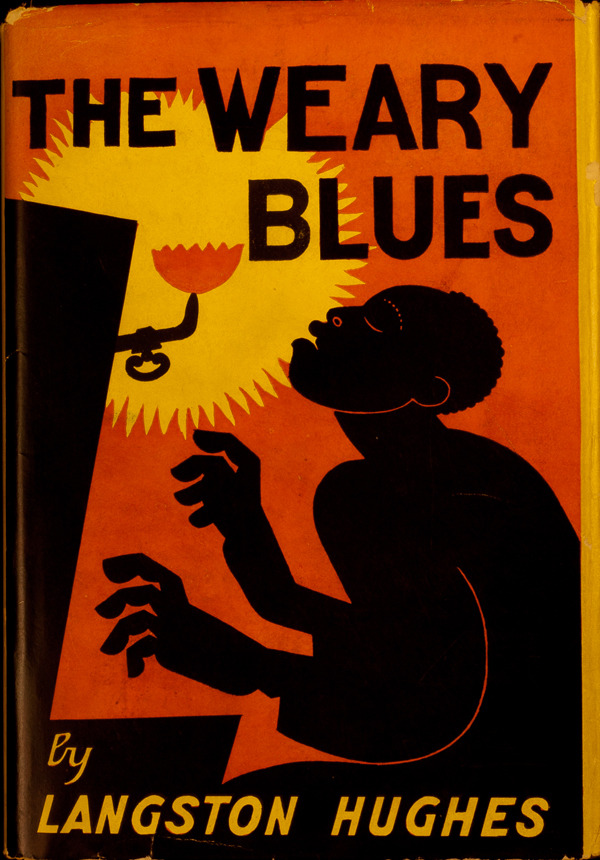
Cover of the original 1926 edition of The Weary Blues
.
Still, I’m deeply ambivalent today about my chosen project. When Langston Hughes wrote “The Weary Blues” in the last Twenties, almost a hundred years ago, racism, ignorance, prejudice, injustice, class-caste system — all were old enough to be blues one could be weary of. So now so, more weary so — and we’re alive to feel’em. Perhaps I’ll write more this weekend, but I was feeling our current hurt today, and less any release of joy or the blessings of overcoming.
Instead of fully realized version of Hughes’ “The Weary Blues,” what I’ll offer today is more like a quick demo: a beat, a guitar playing simple chords. When I finished laying it down, and with no more than a couple of minutes until I had to get off mic in my studio space, I started to riff on a variation adapted from another song, and I left a couple of lines of that in the fade out. That secondary song takes off from “I’d Rather Go Blind,” a song about love gone bad, where the heartbroken singer declares they wish they were blind so they wouldn’t see their unfaithful lover. In my variation, we ourselves must ask, heartbroken at things we don’t want to see: do we want to go blind? Is that what we want, would prefer? To just not see the hurt?
Player gadget below for some to hear my sketchy demo of Langston Hughes’ “The Weary Blues”, or this highlighted link for those who can’t see that.





 Frank Hudson