I have a fair number of “started” to “nearly-finished” musical pieces, but I for various reasons I’ve not been ready to release one for a week or so. This of course is a weird expectation on my part – it’s not normal to present original music that rapidly. Today is a day with a quiet studio space available where I could work on more, and yet here I am at a computer keyboard typing this.
I spent the weekend oddly enough watching two documentaries made over 60 years apart on people doing visual art. Both gave me resonances compelling me to write about them. The first I watched was a 40-minute piece directed by Ken Russell, first shown on the BBC in 1962, Pop Goes the Easel.
I was led to this film by reading a short excerpt from American history professor Sean Wilentz’s new Bob Dylan biography covering the bard’s early performing years. This is essentially the period covered in the recent Dylan Hollywood biopic, but the level of detail and narrative appears to be at the more granular level a book provides. In the excerpt, Wilentz recounts Dylan’s first trip to the UK in 1962, ostensibly to take a featured acting role in an original TV drama. Turned out Dylan was a washout as a conventional actor, so the teleplay was rejiggered to make him a folk singer who sang some songs, a role that he must have been entirely convincing in, though no video survives. While there, Dylan did what visiting American folk singers habitually did in those days, he absorbed Martin Carthy’s arrangements of a couple of British Isles folk tunes and fashioned them into his own songs.* For habitation, he had to put up with staying in the London flat of a beautiful young woman, an artist named Pauline Boty. Wilentz figures that Dylan got a song out of that too, a somewhat awkward song about a somewhat awkward affair, lashed to a floating-between-lyrics folk tune that I know as “Lily of the West.” **
Wilentz mentions the artist Boty had been in a documentary about young artists, and I found Russell’s Pop Goes the Easel online here to watch. After the tweed-suited and stiff to the point of parody series host intro,*** the film starts with the only artist in the movie I knew anything about before this month, Peter Blake. Blake is found, slightly chunky, closely approaching 30, bearded, dressed in work clothes, sawing on a door (I cannot help but make the Blakean pun that he’s cleansing the doors of perception, to be what they are: infinite). We are then led to a pair of younger, good-looking men of the narrow tie and nicotine milieu, who like Blake are making Pop Art out of the commercial detritus of contemporary culture: comics, SciFi prognostications, movie and pre-Beatles pop stars. Like Blake, we see them making their art and earnestly talking their gallery catalog place cards about it. Intercut are scenes of them cavorting in a clearly French Nouvelle Vague way about London and at a circus midway. Among these three young men, a beautiful woman also appears as part of the group, and the documentary’s final segment lets us know she’s the fourth artist. This is Boty.
All these 20-somethings are a bit self-consciously playing roles, but Boty is better at it, easily more charismatic. One quickly sees how she achieved the sobriquet “The Wimbledon Bardot” – but here’s the punch-line, the kicker: her artwork is also easily the equal of the three men. Not to slight those men, all of whom are clearly serious as the French would say about their art, and all of whom would be still making art into their eighties and into our current century. Boty though died Keats-like at 28 – her illness, cancer, a few years after this film was made. Maybe less than two-dozen of her art works survive. The film doesn’t show this of course, no more than Russell’s film knows it’s being made within a year of when Bob Dylan revolutionized song-lyrics or the Beatles made self-contained quartet bands of young artists a model to follow. But we as modern watchers are able to appreciate the unheard music on that black & white TV Grecian Urn as we hear the films found sound-track of pop music hits from the “decade” of the early 1960s that happened before The Sixties™.
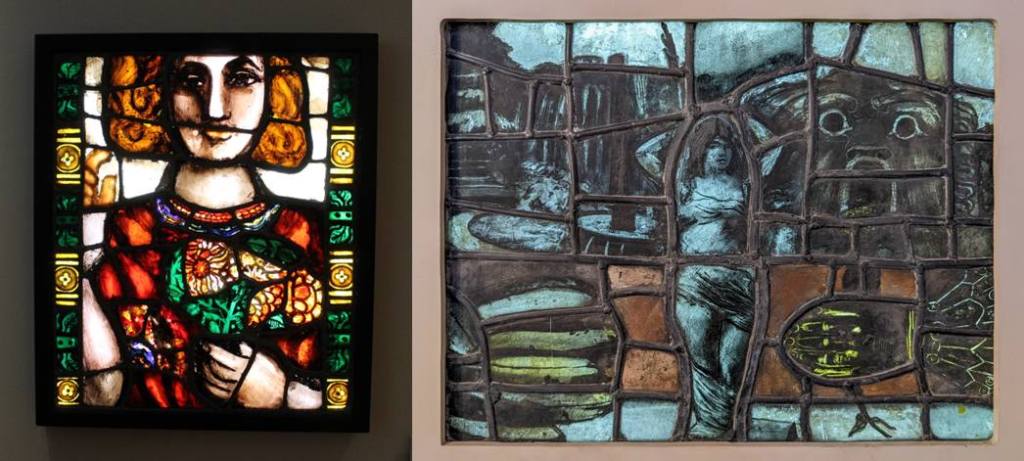
Only around a couple dozen of Pauline Boty’s art works are known to have survived. Some of her early work used stained glass, and here are two examples.
.
And then the next day of the weekend, I watched Who Is Martin Mull, a long-story-about-how-it-got made documentary about the singer/comedian/actor/visual artist Mull. In place of Ken Russell we have a work helmed by Bob Saget, a club comic and actor who admired Mull’s work. Apparently filmed over a period of years with extensive interviews and scenes of a 70-something Mull in his home studio working on his visual art, as well as testimony from friends and family about Mull’s character and achievements. Then in 2020 Saget unexpectedly died from a lonely hotel room closed-head-trauma injury after a fall on tour. Then in 2024, subject Mull died at age 80. From subsequent efforts of others, the film about a dead “cult figure” class actor made by younger sort-of-famous comic was completed this year. That’s remarkable, but it would generally promise to be either a work of either the “you didn’t know all the dirt about” or the “gee, he’s dead, let’s all say nice things about ‘em” sort.
It’s not. It’s tender and relaxed about telling its story, and the story is a man who at the age in life of our British quartet of pop artists, and just four or so years later than them, graduated from a prestigious American art school. Just like the Pop/Easel artists, this American’s work seemed to be based on reexamining how we view the world through our commercially infused culture and art. His family, or at least his father, put no value on visual art and artists, and perhaps the US puts less value on art that the UK did or does, but Mull never envisioned the lottery work of trying to establish an artist’s career. As it turns out, he was also musically talented, and the suddenly post-Beatles and Dylan world offered work for musical performers. This is where I knew Mull’s work. In 1970 he had a fluke C&W hit when a gender-playful answer record/parody song of his, “A Girl Called Johnny Cash,” was recorded by a Nashville singer, and he began to tour himself as “Martin Mull and his Fabulous Furniture.” It was a weird act, but one that you might see reflected in others’ performing acts: Steve Martin, Biff Rose and Leon Redbone, or in other comics who would bring an instrument on stage like the Smothers Brothers, Neil Innes and Eric Idle, or folk musicians who told comic stories like Billy Connolly or even Leo Kottke.
But Mull the performer was his own thing. His act was performed in persona, a smarmy chap who deconstructed the nature of performance and audience expectations. The bit I remember most was his presentation of young white folks getting into the Blues by playing bottleneck slide on a ukulele using a nipple-equipped baby-bottle. The difficulty of the trick? He had to make that inefficient pairing work musically. How well could he make it work? He might be performing it while opening for an act like The Allman Brothers at some early 70s hippie musical ballroom or theater show. Live recordings indicate the joke went over, and the minstrel show critique inside the bit must have been absorbed by some.
After working that act for a decade or so, he transitioned to becoming a comic actor in TV and movies. It paid the bills. He found a happy marriage. Had a kid. Got old. But remember, that’s not the story. His story is an aged-American version of the young UK Pop/Easel artists in a way. The story is: he is, always was, a visual artist. He paints. He always paints. This might sound – the danger is it sounds – like a “weekend painter,” the hobbyist who paints to relax. But he insists – and the testimony of others in the film buttresses this – his constant internal conviction was: he’s an artist and the other stuff was just a “day job.” The amount of work, the decade after decade length of its effort, the variety and quality of that work, says this is not some vain-glorious affectation.****
.
The part that moved me the most? The scenes of Mull gratefully working on his art in his 70s in his studio space. This is inescapable: I think: that’s me – but the possible diagnosis of vain-glory is a differential yet to have all the test results returned for my case. It appears that, at least in general, Mull knew he was good. He did the work to make his work seem skilled to others. I can’t say the same for my own work, which I think has value, and also imperfections.
As my day progressed, I had to know the song Dylan is supposed to have written to visual artist Pauline Boty in 1962, and the surest way for me to know the song is to perform it. “Liverpool Gal” kept deep cover, even after decades of Dylan instigating the modern Bootleg/Special Edition album. For most of its life it was known by a single obscure performance of it done by a little-known act Lennon & Hyam live for a BBC radio broadcast in 1992. How Lennon & Hyam heard the song is mysterious. It wasn’t until a year ago that a rough performance by its author emerged, taped at a party in Minneapolis by local musician and writer Tony Glover back in 1963. Dylan stumbles on his own lyrics in that recording, and the song differs slightly from the Lennon & Hyam version. I quickly cobbled together a third version and a quick and dirty arrangement for acoustic guitar and my voice of subjective quality. Quickly – my studio-space time was now limited – I did four takes all the way through, the last one was the best I think. I call my interpretation “London Gal” as it dispenses with the appendix of Liverpool origins to a London-set story. Even cutting the final (dispensable) verse in my version, it’s a long song, over 7 minutes, ambling along in its plot like many a traditional folk song. Here it is via an audio player gadget. No gadget seen? Lennon and Hyam didn’t steal it to protect their monopoly position, and Tony Glover has joined the blues-harp choir invisible, but I also offer this highlighted link to hear it via a new tab which will supply its own audio player.
.
*For Dylan, “Masters of War” and “Bob Dylan’s Dream” tunes were copped from “Nottamun Town” and “Lord Franklin” via Carthy. Paul Simon swiped a guitar arrangement for “Scarborough Fair” from Carthy on an early Sixties UK trip of his own. The Folk Process is promiscuous.
**Wilentz makes an interesting point: this early Dylan “love or something like it” song is a predecessor to the kind of complex songs about romantic relationships and power-relations that would become a Dylan specialty. This kind of writing seems so embedded in Dylan’s songwriting that it would probably come out anyway, but a moot court case could be made that Boty engendered it.
***Oh, let’s give Huw Wheldon his props: he was decorated D-Day landing veteran, and as a producer he not only helped introduce Ken Russell, he boosted David Attenborough, and later Sir Kenneth Clark’s mighty Civilization series. His host job was largely to act as a flack-catcher to divert fellow Greatest Generation types from strafing the BBC for giving attention those frivolous young people.
****I gather the fine art world doesn’t truck much with the person who isn’t publicly artist first, not hyphenate – allowed to be an artist who becomes a celebrity, but the reverse is suspect of affectation. And there’s nothing in the film that says Mull did the grants application and hob-nobbing prerequisites for most modern American arts careers. He was AARP age before he had his first small gallery show.


