I worry some that I’m shorting my appreciated audience its rations of expected poetry, what with the recent series of poorly received short Dadaist French translations – but if there’s one thing guaranteed when working in this self-managed Project it’s that I can go where chance and mood takes me. For those wondering if I’ve left more conventional poetry behind, I ask for a short dose of patience – I have variety in my soul, and I’ll be back to that soon.
But not today. Today this thing where Music and Words Meet will be about words meeting music.
Almost every year this century I’ve taken to noting the anniversary of the death of the American musician Jimi Hendrix. Initially it simply meant that on the morning of September 18th I’d plug in an electric guitar, turn the amp up loud, and play.* When the Parlando Project started in 2016 I began to publish some of those recordings memorializing Hendrix each September.
I’ve been thinking recently about an aspect of that decade called The Sixties.™ There was over its ten-year allotment (which carried over into the decade where a lot of what we think of as The Sixties™ happened, the merely The Seventies) an increasing appeal and practice of freedom in music. I believe this started first in Jazz.** Bebop liked to see how free one could be within ever more finely woven harmonic frameworks, which tempts one to point this out as a metaphor for the Afro-American experience. How expressive can you be though constrained? But as The Sixties™ approached, a new thing was coming into Jazz. No one worked too hard on what to call it: it was called “Free Jazz.”
A number of things happened within this expanding freedom, often all at once – in practice, decidedly all at once – harmonic structures were relaxed, no more making the rapid chord changes; improvisation became not just the rule of the featured solos, but the rule of entire compositions, and more than one musician could be soloing at once, even musicians in the “rhythm section;” allowed instrumental expression and articulations were expanded every which way into sounds that would have been considered defects in technique or propriety; and song length became limited only by the endurance of fiery young musicians.
Such endurance and allowance didn’t extend to audiences. Many of the practitioners of Free Jazz never knew substantial audiences that extended beyond fellow musicians of the same movement – but two who had achieved audiences took different paths through this freedom. One was Miles Davis, but I must leave him out for lack of time.
The other was John Coltrane, and this month it’s the centenary of Coltrane’s birth. As I worked on my annual Hendrix memorial I thought of this other great artist, one whose life can be properly studied like the lives of saints without inappropriateness. Coltrane did not start out as a young phenom. He was a perfectly average saxophonist in an age where there were many, many others, and like others in his era, heroin addiction tampered his resources early in his career. Somehow his dedication to his craft survived this, and even among his most ardent contemporaries, his study and practice regimen was legendary. By the late Fifties he could write and perform structures like “Giant Steps,” a set of abrupt, up-tempo, leaping chord changes that he would arpeggiate over – a task to challenge any post-BeBop Jazz player to the upmost.
Coltrane also made music with a popular footprint. He was featured on the most popular Jazz LP of all time, the Miles Davis Quintet’s Kind of Blue, and with his own quartet his revolutionary, yet popular, reconception of the Broadway tune “My Favorite Things” sold well and became a juke-box staple.
Coltrane’s “My Favorite Things” was Free Jazz adjacent, so that performance’s popularity with audiences was another achievement. Coltrane was the featured soloist on it and the chord changes were now sparce (as were the charts on the Kind of Blue LP), but the quartet’s rhythm section stayed in a catchy Jazz waltz groove on that record. Performing live around this time, Coltrane would feature fellow genius improviser Eric Dolphy, They might solo simultaneously and unleash extended articulations – outright Free Jazz in all its general audience baffling ways. As The Sixties™ continued, Coltrane increased the freedom in his work, live and on record. More soloists, extended rhythm sections sometime doubling bass and drums who were also freed to solo or extend themselves from strict time-keeping. This didn’t help Coltrane maintain his audience, but soon enough he was dying of liver disease, expiring during the “Summer of Love” in 1967. One of his last popular LPs was also among the last with the simpler Quartet, 1965’s “A Love Supreme.” “A Love Supreme” is one of the most overtly spiritual albums in history, and Coltrane seemed unconcerned that his devotion to extending musical freedom should bow to commercial expectations.
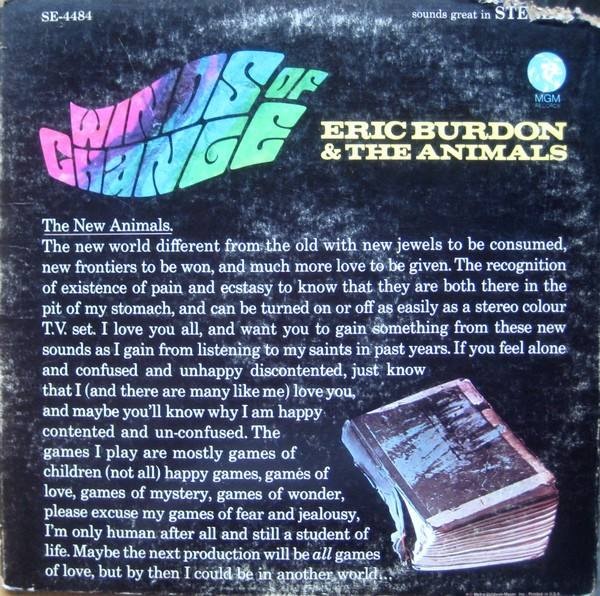
OK, what’s this LP cover doing in a post about Free Jazz, John Coltrane, and Jimi Hendrix?
.
Now if Free Jazz wasn’t topping record charts or filling large venues, that didn’t mean it wasn’t impacting popular music, by way of musicians appreciating musicians. In general, rock musicians weren’t Jazz musicians in theoretical knowledge or technical skills, but this call for musical freedom became quite broad in The Sixties™. I’m going to short change that history today, but rock musicians were listening to Jazz, and wanted to try to take part in this kind of Free Jazz expression.***
Which brings us to two rock musicians: Jimi Hendrix and Eric Burdon. Not a natural pairing it might seem, but a close one none-the-less. Eric Burdon was the lead singer of the Animals, a northern England R&B band with soul-Jazz tinges, that by 1966 had reformulated themselves as Eric Burdon and The New Animals – the new DBA designed to escape the clutches of a shady and money-skimming manager named Mike Jeffery. This new group was going to play “progressive rock,” the name I would have called the sort of Rock groups who wanted longer pieces with more expressionist soloing.****
Through a convoluted but happy set of accidents, that year the going-nowhere American Hendrix was taken to England by the now obsolete Old Animals bass player, Chas Chandler. If Chandler was tired of being screwed over by managers, he decided what he would do is become one – a supportive, musician centered one – and with Hendrix he could see the potential to make a ragamuffin couch-surfing Afro-American R&B player who loved Bob Dylan lyrics and SciFi into a going commercial concern.
Which he did. Alas, he needed front money to establish even a stripped-back power trio to launch Hendrix, the newly formed Jimi Hendrix Experience, and Chandler had to enlist his old devil Jeffery to get that cash. Over the next 3-4 years of a Jimi Hendrix career we now remember, Chandler’s role diminished and Jeffery’s role expanded – but in the winter of ’66-’67 Chandler’s old lead singer Burdon and his new band was hip to the idea of this new force Hendrix, and they concocted a tribute to Jimi and musical freedom to close the first side of their first LP, a short yet expansive jam they titled “Yes, I Am Experienced.” I wondered: how soon after Hendrix had released his first LP with the song “Are You Experienced?” did Burdon and the Animals do their tribute? A quick search result says Burdon released his “answer record” before that Hendrix LP that contained it – but I heard them in the correct order.
Back then I liked the Animals. I liked Eric Burdon and the New Animals as much, but there are elements about them that might be, well, embarrassing. Burdon was one of those ecstatic converts familiar to religious movements, all-in on what they understood about this upcoming Summer of Love, psychedelia in drugs and art, free love – and yes, this Free Jazz inspired expansion of musical arrangements and expression. So much so, that he embarrassed some acolytes of these things even in The Sixties™!
And so it was that Burdon’s lyrics on “Yes, I Am Experienced” have a mixture of enraptured naivete and cringe. Back in The Sixties™, I can remember my eventual LYL and Parlando musical partner Dave Moore finding Burdon’s performance there a tad pretentious,***** while liking the new band on the record, particularly guitarist/violinist/sitarist Vic Briggs.
So, for the 2026 version of my Jimi Hendrix memorial, I’m releasing this recording which adapts a few words from Burdon about Hendrix, but it’s mostly about taking the electric guitar and getting on with playing long solos using that instrument’s expressive colors, despite not being a John Coltrane.
I laid down the bass part with my Jack Casaday bass, using the melodic line there to inform the harmonic scheme for a vibraphone track. Then I picked up a somewhat problematic Telecaster that’s in my studio space, one that has a very noisy P90 neck pickup. Undaunted by buzzing from the single coil pickups plugged into a considerably overdriven amplifier, I played a one-pass freely expressive solo extending for nearly 9 minutes. It’s not really in Jimi Hendrix’s style, or Vic Briggs’ either. Perhaps it’s my style? Well, playing for 9 minutes you have to be somebody. I misremembered some of what Burdon went on about in his recording praising Hendrix, but I yelped out an adaptation of part of his lyrics, while the music has nothing to do with what the New Animals recorded in the winter of ’66-67.
What you can hear with the audio player below is less than 4 minutes of that, a foreshortened “single version” that fades out less than half-way in. If I have the time, I may indulge the full-length “album version” release a bit later. No player? This highlighted link will open a new browser tab with its own player.
The initial point of these annual exercises was to use Hendrix as an example to memorialize musical creators – to do this, however imperfectly with my musical limitations, because I’m alive and can do what I can do when they no longer can do such in a present moment – to notice, to underline, to pay attention to that, to feel it in my body. This is like what I try to do for the dead poets here other days: to bring them inside myself, a living being.
In point of fact, Eric Burdon is still alive. The evening before Jimi Hendrix died in a London flat after taking too-strong European formulary sleeping pills, he showed up at a gig in London with Burdon and his then new in 1970 group, one called War. Yes, the War who would put out sublime chill Latin-funk songs later in the merely Seventies. Eric, unlikely that you’re in the hardy audience here that indulges poetry and varied music, but this is the second or third time I’ve tipped my hat to you in this Project. I think you influenced me, though of course not as a convincing singer, but (oddly enough) as being naïve enough to do this anyway.
.
*This became easy for me to do after the death of my wife – no one to disturb. It’s become harder to do in the past couple of years – more folks who can be disturbed.
**As I wrote this, I thought: did avant garde orchestral-instrument art music do this first? As Andrew Hickey’s Law has it, “There’s No First of Anything,” but my casual thought on this was that a great deal of the “classical music avant garde” (yes, this sort of oxymoron was used) was focused on abstracted and system music in the mid-century. Yes, rules were broken and discarded, but often new rules or procedures for chance were brought in. Those designed abstractions might challenge audiences as much as Free Jazz did, but Free Jazz did it from what seemed to listeners as too much indulgence in unfettered human expression.
***Examples of direct influence: the Byrds’ “Eight Miles High” is a loose adaptation of Coltrane and Eric Dolphy’s live recording “India.” Highly underrated drummer John Densmore of The Doors often speaks of how the John Coltrane Quartet drummer Elvin Jones’ example showed him how to ground freer soloists without constraining them. Other rock drummers of this era, including Mitch Mitchell of the Jimi Hendrix Experience, used Jones as a model.
****Let’s be careful around music nerds: not to be confused with Prog Rock, a name generally given to bands as The Seventies dawned who were more influenced by European orchestral instrument composers than the American Jazz influenced bands of The Sixties™. Of course, these two things intermixed, but we must maintain distinctions!
*****The song’s fade out, as Burdon essays the “Good Morning Little School Girl”/”Sweet Little 16” trope of rock stars having sex with presumably underage girls is particularly objectionable. As a horny young man when the LP came out, I’m not sure I can claim retrospective acknowledgement of the power imbalances there so much as remembering the unintentionally comic idea of Burdon, a great singer without ever being able to sustain the erotic charisma of others of his era as an irresistible love god. Yes, there’s real harm in real life in such conceptions, but the aura of Bottom with the asses head in Midsummer’s Night’s Dream was unavoidable.

