I’ve got a gorgeous song for you today, despite a difficult week for new work. I’ll try to get to it shortly, with only a little throat-clearing first.
It was 18 degrees F below zero* this morning. Oh, there was probably some wind chill too, but let’s not put too fine a point on temps like that — Minnesota January winter certainly doesn’t.
Our winter, to speak broadly, isn’t just cold. There’s also ice, snow, and winter cancellations and rescheduling. If that sounds grim, well, somedays it is — but then there’s a little something else about this sort of winter when you run across others out in it. Early this morning I saw another bicyclist with full face mask and goggles sawing their bike over the packed snow pavement. Before that, a woman walking her dog, each of them concentrating on getting such business done. In other duties, some school kids were walking to school. Every one of those fellow citizens are dealing with this shared winter too, and despite not being able to see much of their faces, you can likely feel something of a common cause.
But winter can also be experienced without even such scattered crowds. I used to commute around midnight on a bicycle, and the urban streets on rough winter nights would be the same as some new nowhere, like unto a SciFi paperback cover of the astronaut gazing through alien ruins. My wife sometimes runs just before dawn to a park that has no others but her and the existential animals.
Today’s piece is a winter poem by American poet Elinor Wylie, who wrote absolutely lovely short lyrical poems around 100 years ago. Hers is a slightly different winter. First, she’s walking with someone else. She doesn’t mention the temperature, but I doubt it quite as bitter-brittle as my morning. Hers is explicitly windless, but there is snow, the kind of loose powder that tends to fall when it’s colder than the soggy wet flakes.
Wylie’s reputation dropped fairly rapidly after her premature death in 1928. One knock against her pretty poems was that they were that and nothing else but attractive pictures drawn in word music. Well of course music itself doesn’t task itself with more than to be attractive, and visual art doesn’t need to support a philosophical argument or insight explicitly.
Sure it’s a pretty line: “I shall go shod in silk,” but damn it, open the door, it’s seriously winter out here!
.
I rather like this poem’s picture, because it’s something of a white-space void with just scant details coming out of the snow, like a Whistler painting. But it’s not even visual clues for the most part — the details are textures, feel images: veils, silk, wool and fleece, feathers and down, and then the velvet of the title. There is testimony that there is no noise, much less talk. Indeed, her partner in the walk is near-totally obscured, and this choice —conscious or unconscious — seems striking to me. Is she alienated from them, or so close that there’s no novelty in mentioning? The sensuality of the imagery may give undercurrents of erotic love, but the obscuring of the partner makes that reading stranger.
I seem to be specializing recently in taking leaps at alternate readings that even I don’t think likely, though not impossible either, like my wild-ass guess that Truth’s body moldering in the grave next to Emily Dickinson’s Died for Beauty could plausibly be John Brown. Don’t bet your grade on that one, students! But I thought of the woman walking her dog this cold and snow-covered morning. No reason to talk there, nor was the dog taking time out for a barking address. Wasn’t that dog wearing a wool sweater? Less romantic a poem, but not impossible.
Though it’s freshly done, I’m fond of the music I came up with for Wylie’s poem. Maybe you’ll like the little song they make together when I performed it this morning. The player gadget is below for some of you, and if you don’t have that, you have this highlighted hyperlink that will also play it.
Once again a variety of things we call life is keeping new material from being posted as part of this project. So, why not do what a lot of bloggers do this time of year and give a short rundown of 2021 traffic for this blog and the associated audio pieces? That might be interesting. What do people come here for?
In general, this blog traffic continues to grow, as it has every year so far. Over the five plus years we’ve been active, there’s been an expected yearly pattern sweep: rising in the fall and carrying over until spring, then dropping off in the summer. This might indicate that some of the traffic here is related to schoolwork assignments or interests lit around that, or that even in our always connected age, that more are outside reading the “book of nature” in the summer than inside curling up with a poetry-related blog by the glow of a crackling screen light. We had 43,621 views last year, modest by political or lifestyle blogging standards, but rewarding in the context of poetry event attendance.
To my personal disappointment, listens to the audio pieces are close to flat in contrast to increased blog readership. The continuing Covid-19 epidemic has put a damper on my ability to collaborate or even to work as extensively on the audio pieces in other ways, and over the past two years I sometimes fear that the quality and variety of the audio pieces could suffer from that. That fear aside, as “The place where music and words meet,” says, these pieces were the real spark that led to all this.
Here are the ten most viewed posts here during 2021. This is the 754th post here, and all of these posts are older posts made over the years since we launched in 2016. I made them hyperlinks in case you’re curious, as a few of them are quite old, and could be from before you started following Parlando.
The popularity of the Pablo Neruda translation from Spanish I did in 2020 shouldn’t surprise me. Love and its ornery cousin lust are attractive subjects after all, and this early collection of Neruda’s is a poetry best-seller in its original language. I myself prefer the final poem in the series to the opener, but they are both part of the story told in the series. Posts on Yeats make two high-placed appearances. I suspect the posts on “The Red Wheelbarrow” and “The Pool” get hits from those looking for homework help on what to say about these enigmatic short poems that appear in many anthologies. The puzzler for me is Edward Thomas’ “October,” which is a lovely poem by a poet better known in the British Isles than in America, but I can’t guess how that post got so popular. My post on Emily Dickinson’s well-loved “Hope’ is the thing with feathers “ may be attractively controversial. Many read that poem as motivational poster simple: praise for plucky hope. I took the idea that the “Hope” quoted in the title may refer to a lesser known poem by Emily Dickinson influence Emily Bronte that makes hope something of a taunting flirt.
None of these top ten for page hits this year was written and posted in 2021. Even though total blog traffic increases smartly year to year, most days I find older posts are among the most read — or at least loaded into readers browsers in hope of finding out something — proving the notion that poetry is news that stays news. The most hits for a 2021-written post was Rimbaud’s Dawn (#21), followed by William Carlos Williams’ Thursday (#26), and my memorial post for Lawrence Ferlinghetti (#36).
What was the least viewed 2021 post, other than very recent ones from the year? My post on the unusually gritty Joyce Kilmer poem “The Subway.” What’s that mean? Joyce Kilmer may be past his sell-by date in the 21st century? Or maybe it was reflected pandemic fear of crowded mass transit?
Audio pieces? These new audio pieces posted in 2021 had the most listens:
Sure, I’m the composer and sole performer on 4 out of those 5 pieces, but not a bad grouping of Parlando music performances, even if none of them have more complex arrangements (harder to get done this year). Listening to them again reduced my fears about the 2021 audio pieces not being as good as in the years past. I was surprised that “The Negro Speaks of Rivers” had made it to the top by the end of the year, but it’s one of those “long tail” audio pieces that continues to attract listeners long after it was first posted. “Escape” was another surprise, because both my vocal and fiddle performance was aiming at “not pretty.” I didn’t expect that one to be so popular.
What more can I say in my defense? T-Rex before they had a hyphen and then Swinburne. Bongo Fury!
.
Least listened-to new piece last year (excluding those from end of the year that probably haven’t risen to their eventual level)? “Love and Sleep.” Maybe I just couldn’t pull off a fusion of Algernon Charles Swinburne and early Tyrannosaurus Rex — even with a line like “Glittering eyelids of my soul’s desire…” dictating that attempt.
I really hope to have more new pieces here soon, but since it’s not one cause that is preventing things from progressing, I can’t be sure how quickly we’ll get to our 600th audio piece combining various words (mostly poetry) with original music (as varied as I can make it). Thanks to everyone who read and listened here last year. I appreciate your time and attention — and then even more so the likes, reblogs, mentions, Tweets and Facebook posts. I want to reward all of you with more encounters with new stuff. I really do. Wishing all of us a productive New Year….
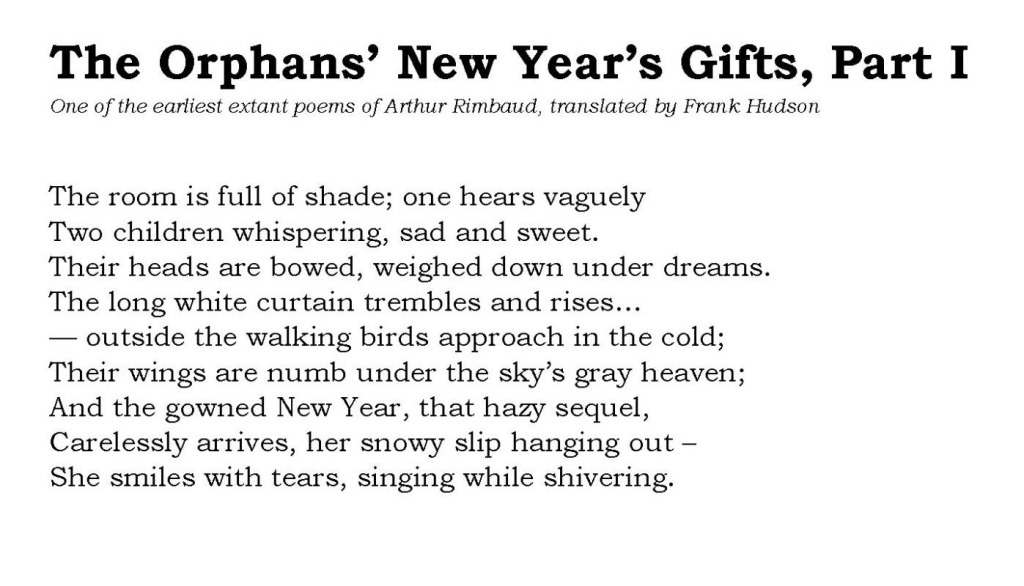
Last time I said I looked through Arthur Rimbaud’s collected works in the middle of the nighttime looking for something to translate, combine with music, and perform. I guess I could have saved myself some time, because I eventually chose the first poem in the collection, The Orphans’ New Years’ Gifts, placed first because it was the first poem he ever published. When it appeared in print on January 2nd, 1870 Rimbaud was all of 15 years old.
On first reading, it’s not representative of the poems Rimbaud would be writing in little more than a year or so. While the entire poem is a gothic story, it’s also quite sentimental and largely conventional. For reasons of time and preferring shorter works, I decided to only perform the first part, but spoiler alert: it’s soon revealed that the children are recently orphaned and they are dreaming of their family still being intact and how they will give their now dead mother they expect to find in their dreams a pair of “for mother” plaques from each of them as a New Year’s gift.
But for us, the performer and listeners today of this first section only, this is no matter, because it’s the last day of 2021 and tomorrow is a new year. We know nothing of 2022 save for dreams pleasant or frightening. The coming year is a more mysterious ghost to us than our past years.
It might seem odd to say, but I’m an orphan — that’s not unusual, at my age most everyone is. It’s a different matter to write this as a 15-year-old, as an adolescent, as Rimbaud was. Those are the years that children learn how to gradually break away from their parents in whatever manner they fall into. Rimbaud instead would do this early and abruptly, leaving his mother — and for Paris, and unrest, and rebellion of all sorts in that “about a year” timeframe. Poetically and emotionally, this poem hardly seems to be a rehearsal for the Rimbaud of 1871 and after.
As I worked on translating this poem, I saw a little window into that other Rimbaud in this short first section. Those intimations were unlikely put there by conscious choice. Maybe they were slipped in by Rimbaud’s future ghost?
A few notes on how I translate. I generally don’t try to bring over the word-music (too tough, too damaging to other elements of the translated poem). I start attempting to be as faithful as I can, but then while in process I am often tempted to sharpen or expand on the images I’m trying to bring forward into contemporary English; because those images expand in my mind as I consider them, and because I want them to remain vivid. I’m of two minds about doing that, and I try to make clear here when I’ve really inserted something altogether invented. If you’d like to read the whole poem in it’s original French, here’s a link.
My local forecast says –11 F (-24 C) for New Year’s dawn. I think of a blues song Leo Kottke used to sing with the line “So cold in China, the birds don’t even sing.” Maybe that’s why I choose the guzheng today?
.
Here are a few examples in this one, in ascending order of significance. I suspect the curtain Rimbaud has blowing in the winter drafts is a bed canopy, a largely unfamiliar antique item, and instead I’m leading you to see a window curtain. Leading you to the window lets me transition to an image I sharpened. Rimbaud doesn’t explicitly say the cold winter birds are walking, but I think he did intend to tell us they aren’t able to fly in this moment, and I thought I’d underline that. And the final image, the one of New Year arriving as a woman in a dress of snow, I wanted us to see a tipsy celebrant whose party gown is no longer arranged neatly. Did the 15-year-old Rimbaud intend that image? I don’t know, but his future ghost might well have chosen it!
Yesterday I revealed that I wanted to do this piece to honor ardent Rimbaud admirer Patti Smith. Obligation completed, though you may notice this is nothing like how Patti Smith or her band would characteristically perform this. The first instrument you hear is a Chinese guzheng,* a sophisticated zither family instrument, then eventually a variety of drums and percussive sounds arrive along with electric bass, and finally a low synth moan. But did I make clear in talking about Smith yesterday: one of the things she demonstrated was that untapped possibilities of presentation styles are the point, not just duplication of one’s heroes.
*With expensive and exotic instruments like this I usually use what are called “virtual instruments” that sample the notes and sounds of the entire range of the instrument; and as in today’s piece allow you to articulate some of the instrument’s particular attacks and variations, like the guzheng’s vibrato. I select and play the notes with a little plastic keyboard or my guitar with a MIDI interface.
Happy Birthday poet, performer and rock band leader Patti Smith! We’ll get to her, girls basketball, Arthur Rimbaud, and studying French in Iowa before we’re through today’s post.
There’s a lot of things that go into this Parlando Project existing. One thread of that origin begins: I came to admire poetry as a teenager and a couple of years later I started to write it. I did those things sensuously, without deep understanding of connotation or denotation. I loved poetry and I wrote poetry as music: organized sounds that attracted and pleased me.
Let’s follow that thread, barely woven. I took French in high school in my little Iowa town. The teacher was an interesting man, full of iconoclastic thoughts and some experience in France itself that I don’t recall the particulars of. He seemed rather bold in my little farm town mostly settled by Swedish immigrants some 80 years before, and I suspected then he felt immune to criticism because he was a fairly successful girls basketball coach.* French was the only foreign language offered in my small high school, but I was both aware of Iowa’s history as a French colony** and with bilingual French and English labels and signs from fishing trips deep into Ontario Canada. I was not even a middling student in the class. I did fine with vocabulary, reasonably well with the language rules and syntax, but I was bad at conversational French, both being slow to pick up the knack for spontaneous expression using the words and grammar, and abysmal in pronunciation. I was entirely incapable of making the mouth sounds required. I suspect this is neurological, I have a general problem with mimesis in music or speaking. People are often shocked at how bad I am at that kind of thing.
I did even more poorly in my freshman French class in my attempt at college. This was so even though by then I had an additional motivation: I had learned that French poetry was an important influence on Modernist English poetry. And then, after the Bob Dylan revolution in popular songwriting, French poetry was often cited as an influence on Dylan, and so then by one remove from Dylan, a reflected influence on others who sought to write unusual lyrics using expanded forms of expression.
Let’s skip forward to the fall of 1975. I’m living in a trailer in the middle of Newburgh New York, a small descending city beset with racism and mid-70s industrial ennui, working in the busy E.R. that served as the last resort of the uninsured sick and wounded of the area. I eagerly snag the first LP by a poet who has formed a rock band, and who has been performing 68.2 miles away down the Hudson river in Manhattan. A bootstrap magazine down there would put a label for her band and the bands that were performing around the same time and place: “Punk.***” Like most genre labels, that’s too reductionist, but there you are.
The album “Horses” by the Patti Smith Group presented something important to me, then, and from the uncoiled, frayed thread that unravels from there to now. It’s highly audacious and retains a considerable level of originality even today. I’ll allow that audacious may be the friendly way to say pretentious — the difference may be how much the results work for a listener. I can somewhat understand those that down-rate or even dislike the record, for even though some reject it for ignorant or stupid prejudices, others have valid reasons from their experience and ways of looking and doing. This is the nature of art, and it is almost required of art that breaks new ground. One must go on one’s nerve to be different — and nerve is another way to say that you fully risk pretending to validity and worth.
Horses is halfway a rock song record, and the other half is something else. Yes, Smith sings on the record, but often words are chanted, spoken, prayed, reduced to sound collages halfway between puns and scat singing. If one was to compare it to the singer-songwriter records of it’s day or to a hip hop record closer to now, it’s closer to the later but still its own thing. In the context of then and now, Horses is less likely than records of either the 1975 or 2021 poles to represent itself as a first-person narration of the singer. For much of the record’s running time Smith speaks as fuzzily defined protagonists that however lacking in biographic detail don’t seem to be herself. Rappers may like to put on exaggerated and boasting personas, and lately gender fluidity has found its way into hip hop, but Smith is male or of indeterminate gender for almost the entirety of her first record. Sexualized violence and unilateral lust occurs in a state between fantasy and reality. Visionary states of consciousness are entered into extravagantly, yet this never seems much like a psychedelic record of a few years before. Is it more gothic than many of those? Perhaps — but too Horses seems more consequential, and less a novel pipe dream.
Around this time, following my own thread, I began reading in translation and slowly translating to English a handful of French poems. I still “understood” little of that poetry, and didn’t even like all of it. I gravitated to the Surrealists mostly, but I had paperback volumes of Arthur Rimbaud’s Illuminations and A Season in Hell, and I knew that the Surrealists thought him a Surrealist before their time. Yet to this day, I’ve not really come to grips with Rimbaud. Translation is one way to deeply understand, and that’s a route I’ve taken in the past couple of years with him.
From left to right: the most well-known photo of Rimbaud while he was still writing poetry, Patti Smith’s iconic Horses cover photo taken by Robert Mapplethorpe and a photo from the time of the Paris Commune in 1871 that has been identified as likely of Rimbaud.
.
Even superficially one can see the linkage between Smith and Rimbaud in the most hermetic piece on Smith’s record, “Land.” A protagonist character that may persist throughout this more than nine-and-a-half-minute piece, Johnny, seems to be a melding of one of William Burroughs’s Wild Boys**** and Chuck Berry’s persona of Afro-American guitar-playing crossover success, Johnny B. Goode. In place of Berry’s refrain of “Go go, go Johnny, go go” Smith substitutes “Go Rimbaud, go Rimbaud.” But Smith’s Rimbaud influence seems to be even deeper, merging somewhat too with her partnership with the young Robert Mapplethorpe. If decades of exposure to Rimbaud hasn’t greatly increased my understanding and/or appreciation for Rimbaud, I’ve oddly been able to appreciate Patti Smith from the first words I read of hers on the page, and from the first words on Horses.***** It was famously said about the first Velvet Underground record that few bought it, but everyone who did started a band. Horses sold a bit better, despite its originality and outsider stance. A lot of Horses’ listeners started bands too, and more than a few of us found it more than a demonstration of how to express unusual things within the context of an irregular rock band — we remember it helped us survive and find meaning in that survival. Does that sound sappy to say? Sound like late-adolescent hero worship? Examining myself I don’t think it’s as much of that as it sounds like. Maybe I’m wrong? I’m beyond caring this late in my life what that was, or why — I’m more at grateful I survived and can do this Project now.
Those who know Rimbaud’s biography or work from its appearances here or elsewhere will know how unique and audacious he was too. The most famous single fact about him is that he stopped writing poetry as a teenager, so his entire collected works are the works of a minor. Some of it conforms formally and shows a careful versifier, and some of it out-Whitmans Whitman in free expression of physicality and sexuality.
I awoke at 3 AM this morning, deciding I had to do something today for Patti Smith’s 75th birthday. My sleepless mind half-dreamed and solved that it needed to be something by Rimbaud. Despite reduced higher brain functions, I downloaded a collected works and began searching. Life situations will not allow me to complete any piece started as late as today by end of the day. So, this is Part One, all I can complete. Below there’s an audio piece containing my translation of one of Rimbaud’s best short, rhymed lyrics performed with a little Patti Smith Group feel to the music. The piece is Rimbaud’s “Eternity,” and it’s been one of the most popular ones the Parlando Project has presented. If you’d like to read my translation of the lyric or my original thoughts on the process of creating it, you can find that here. To hear it, you can use the player below, or this highlighted hyperlink will also play it.
.
*Girls basketball was a big thing in Iowa outside of its largest cities who were uninterested in girls sports at that time. In those days it was played with special rules using 3 on 3 teams separated in each half of the court. This meant that girls that didn’t have shooting talent could play only defense and rebound, and girls whose talent was shooting could be very effective and dominate without having to be quite the all-around athletes that modern women basketball players are asked to be. This allowed good coaching and gritty players from small towns to beat many larger schools in the single-class annual state championship tournament which was broadcast live and covered extensively in the newspapers.
**Like snooty Parisians, even rural un-degreed Iowans of my time would know to discretely sneer “out-lander!” at anyone who pronounced our state capitol with un-French final “s” sounds. Beside that historical French connection, my aunt and associated pair of cousins had been posted with her husband in France with the Army, and those cousins were bilingual as they learned speech. She herself spoke French with a decided American southern accent, a little like American Creole. I loved that aunt so much, this might have also been a factor.
***I keep reminding my contemporary teenager that “punk” at its American inception didn’t mean a single style. It was more at the “irregulars” —those whose lives had not necessarily been as musicians — being pressed into service as the more exclusively musical Sixties predecessors died, became depleted from drugs (cocaine in particular gave too many a “best consumed by” date), or just became regimented in a new record industry that understood how to constrain musical artists into commercial money-makers. Speaking in the context of Rimbaud, I could note that “punk” originated as slang for a less successful/powerful criminals and by extension into less-powerful young men in homosexual relations.
****I’ve read and enjoyed a lot of those labeled “Beats,” but for some reason I’ve never really wanted to read Burroughs. I have no idea if that’s my loss. All I know about him is what others have said, but Smith has spoken of Burroughs’ influence, so I don’t need to draw the connection myself. “Land” itself was the hardest song on Horses for me to appreciate and enjoy. I’d been through some incidents of sexualized violence in my teen years and Smith’s use of that motif, while not exactly “triggering” in the modern parlance, wasn’t easy to appreciate.
*****I do own a copy of the indie single that preceded the LP, but I bought it after the LP came out. I first ran across Patti Smith on the page as a writer, before Horses. One early example I recall was a prose-poemish piece of hers called “Dylan’s Dog.” And I knew from notices that she and Lenny Kaye (another person I knew as a “rock critic” before I heard a note of his music) had been mixing electric guitar with poetry. By 1974-75 in Newburgh I was far enough away and far enough poor that I was disconnected from New York City, and so I missed out on the NYC CBGB’s scene.
One thing about the Christmas and winter holiday celebrations is that they can occasion the sharing of strands of different traditions. For the teenager in the house, hardly old enough to have traditions, it’s been watching Hogfather,* and at least for this year, as many of the Matrix movies** as can be found to stream. For the wife, it’s been revisiting a memorable-to-her Seventies’ Christmas TV movie The Gathering.***
The Gathering stars Ed Asner, not yet transformed from the comic Lou Grant of the Mary Tyler Moore Show to the more dramatic Lou Grant of the spinoff series. One of the pleasures of this cheaply and quickly made TV movie are the scenes where Asner gets to show off some of his range the viewing public probably didn’t know he had, aided by the rest of a cast headed by Maureen Stapleton.
The script’s story by James Poe could be viewed as a blander suburban-set predecessor to The Royal Tenenbaums, with Asner as the thoughtless and self-centered older father trying to reunite his varied family and his connection to them.
One lovely scene stood out for me, one odd enough that it could have made it into a Wes Anderson version. Male family members surround the partially redeemed patriarch Asner amid Christmas decorations in the old family home to enact what is presented as a family Christmas ritual. Adapting a broad Cockneyish accent, Asner recites a poem he ascribes to Rudyard Kipling while another family member, who well knows the piece, “bleeps” offending words with a little Zuzu Bailey Christmas ornament bell.
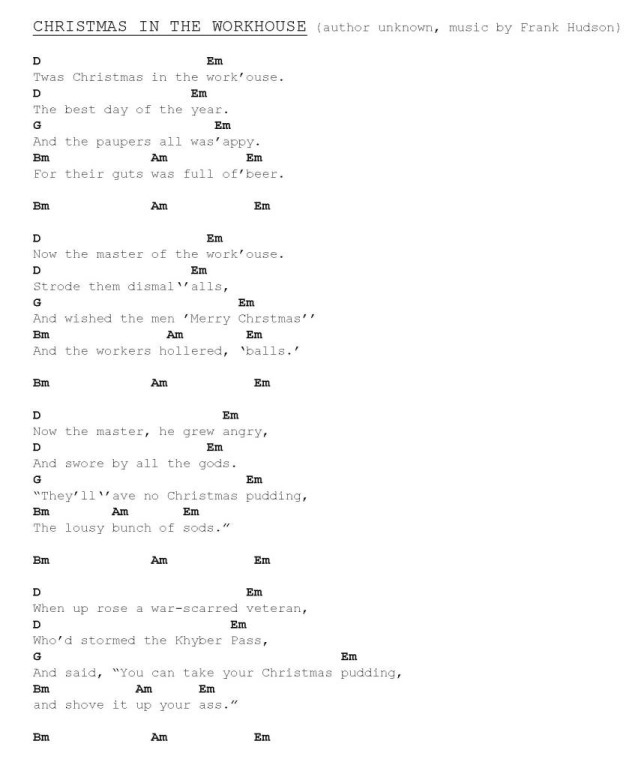
Readers here will know this’ll ring the Parlando bell too. I had to know more about this poem! First off, there’s no evidence that it’s by Kipling, though its audience would likely have been familiar with Kipling’s poetic style. Rather it’s an Edwardian parody of unknown authorship of an earlier Victorian sentimental poem by George R. Sims. Sims’ poem is a critique of the limits and constraints of the workhouse solution**** of poverty and vulnerable citizens without support, couched in a Dickensian weeper of a personal story by a poor man who the system has failed. The original aims to engender angry tears.
The parody on the other hand is a much more compact work, though too a critique of the same workhouse system and limits of charity. This work by an unknown author is meant to make one’s anger laugh at such human coarseness. It can be enjoyed, immaturely, as simple travesty, a variation of the “Jingle Bells, Batman smells…” substitution of sentimental holiday cheer with the lyrical equivalent of fart noises or singing dogs. But Batman is a fairytale character who wears his underwear on the outside of his tights, and riding a sleigh to grandma’s house is unexperienced nostalgia; while residents of a workhouse, or the unhoused modern equivalents, are actual fellow human beings who we emphasize with and aid imperfectly.
Here’s a chord sheet in case you want to form your own workhouse chorus to sing this one
.
In the 1977 movie, the missing but rhyming rude words of this ditty were assumed to be understood even if missing. In modern TV standards they’d all be allowed. Rude British slang probably even adds unintended charm to American audiences. “Beer” of course isn’t a curse other than to abstainers, though too much may be a burden to be coarsely unburdened of. “Balls” or bollocks are testicles, and patriarchally still somehow measurably more polite than the “c word” (also used more freely in British than American slang.) “Sods” is more obscure, but is short for Sodomite, which gets its suppositorian retort from the don’t ask, but will tell, crusty veteran.
Assault your tender ears with my performance of “Christmas in the Workhouse” using the player below. No player to be seen? This highlighted hyperlink will serve. I was aiming for a bit of the early Billy Bragg sound for this one, but I ended up somewhere else nearby. Wife and teenager were dragged away from their Matrix series home-viewing festival to play members of the workhouse chorus, so the least you can do is listen. Happy Holidays to all you intoxicated, genital flaunting, gender-queer, ass-owners who despite it all manage to listen to a variety of musical presentations combined with a variety of words — only some of which are solemn — here.
.
*A wonderful British TV movie presentation of an episode from Terry Pratchett’s Discworld. Unreservedly recommended.
**I saw the first one and liked it well enough to not have a great desire to see the continuations.
***Footnotes, it’s like even more gifts to unwrap after that package of socks — and wait…it’s… another…pair of…socks. Watching The Gathering made me grateful for the much higher standards expected of modern “event television” productions. The Gathering won an outstanding dramatic event Emmy for 1977, so it was considered good of kind for that era.
****Workhouses were a British invention to solve the problem of the chronically unemployed, unhoused, indebted, and sometimes frail or mentally abnormal citizens. The idea was that if you couldn’t scrape together enough to survive otherwise your option was to be sent via government edict to a facility where you’d be given enough to arguably survive under a discipline and order that might include being treated as inmate labor.
This sounds exactly Dickensian and out of the mouth of Scrooge before conversion, but this solution was also widely adopted in America. Even in my childhood I can remember driving with my dad past a local Iowa “county farm,” which was founded on the same principle. In practice these institutions varied from hell-on-earth abusive places through ascending circles of shame and shaming up to sites that, at least when under the best administrations, may have been not altogether worse to what came before and after. The degradation was often “designed-in,” as the workhouse was supposed to make even the worst of wage-labor situations look better than the alternative.
In some ways then, today’s piece continues my honoring of the life of Ethna McKiernan, who worked with the unhoused professionally up until the onset of her final illness.
I ran long the last time, let me be short today. Last week after Ethna McKiernan died, Dave Moore and I talked briefly, and I said that I was going to try to write something for Winter Solstice.
“Make it a happy one” Dave requested. I’ve written at length about the losses Dave and I have had with poetic colleagues in recent posts, so for those who want more details, I’ll refer you to the last couple of posts here instead.
How far did I get to that “happy?” Not all the way. The piece I wrote and you can hear my performance of today is more at bittersweet. I’ve talked to Dave about how I’m hearing Kevin FitzPatrick’s and Ethna’s voices, very distinctly at times when I’m quiet. And since I knew them largely as poets, I’m hearing them reading their poetry. I tell you honestly I don’t find this eerie at all. I find it comforting. I expect that those voices will fade with time, but right now to hear them keeps them with me.
I suspect grieving people have heard similar departed voices since we first began to speak, and that those voices would be more sure to come on a long dark winter night. But here’s my modern variation: due to the pandemic the last few meetings of the Lake Street Writer’s group happened over Zoom Internet videoconferencing. I became accustomed to seeing Ethna’s face after she began her cancer treatment on the same home screen I’m typing this on, and so now when I’m on a Zoom conference I sometimes expect to see her face again as one of the squares on my grid — and I will allow myself to visualize my expectation. You can read all 2916 lines of “In Memoriam,” and you won’t find Alfred Tennyson having that exact image to deal with.
Here’s my own text I performed from. Due to short recording opportunities, I worked out the drums and percussion, and then rapidly laid down a bass, piano, and then an arpeggiated 12-string guitar part to further establish a harmonic flavor. I had time to quickly improvise three passes of a lead electric 12-string part, and this was the best of them.
.
Then the last time I saw Ethna McKiernan, it was her book launch reading at Celtic Junction on August 6th. I recall she wore a brightly colored headwrap on those last Zoom conferences, and for the public reading she was all in bright red. I melded those two visual memories with our seasonal gift-wrapped packages in the poem.
So those are some of the consolations the poem’s title refers to. And too, one of the fine things in winter and on winter solstice is to be inside, in our lights, at home with our partners, family, house-pets, and welcome ghosts.
Here’s what I speak of in the final line: our lakes and ponds and the still parts of rivers have ice surfaces now. Whichever side of the ice you are on: under it and in the underwaters, or over precarious ice not thick enough to securely separate yourself from those cold underwaters — laugh with more than happiness, laugh with that knowledge that that ice is a fragile and temporary division.
I fear this is going to be one of those bad elegies, one where the writer goes on too much about themselves and not about the person who has died. I’ve already mentioned that I find myself unacceptable and self-absorbed when I talk about myself, and saying that again only digs the self-dug hole I’m going to speak from today deeper.
In the mid-1970s when I moved to Minnesota from New York I connected back up with Dave Moore who I knew from a year in my aborted attempt at college. Through Dave I fell in with a literary group that varied in size and was herd-of-cats led by Kevin FitzPatrick. The group had just started a little magazine they called the Lake Street Review, Lake Street being a long commercial and industrial street that ran east/west through the center of Minneapolis: bars, gendered barber and beauty shops, warehouses, grocery stores, used car lots, a high-towered Sears linked to a rail-freight line and distribution center behind it, neighborhood movie theaters and former such theaters now grinding porn, the recording studio where “Surfin’ Bird” was recorded, a small attempt at a non-suburban shopping mall built on the tract where tractors and tanks were once factory-built, a “hardly a foot we can’t fit” shoe store whose upstairs apartments housed Robert Pirsig when he wrote Zen and the Art of Motorcycle Maintenance. Literary magazines generally preferred foreign words, or landscape landmarks like rivers, lakes, or mountains for their names. Yes, there were lakes at the west end of Lake Street, a self-improvement plan for nature dredged out from what had been swampy wetlands as part of a series of landscaped urban parks that circled Minneapolis — but let me be clear to those who aren’t from around here: calling an artistic enterprise The Lake Street Review was something of a provocation. This was a group of working-class writers with a non-academic outlook toward poetry.
The groups earliest meetings were held at a bar, and Dave noted to me that a large portion of the informal membership was made up of bartenders. Let me also set one other demographic fact: this was a group of men moving from their 20s to their 30s. Eventually the membership thinned out, and the remainder continued meeting in rotation in the members homes and apartments.
As the clan leader, Kevin was generally gentle and accepting. A high-school graduate, working in an urban ER, the again’er in me was attracted to the outsider stance, but Kevin also wanted the magazine’s public work to be acceptable to the parents and grandparents of us young men. The 1970s had still extended the “generation gap” of the 60s, so the “Seven Dirty Words You Can’t Say on Television” you also couldn’t say on the pages of the Lake Street Review. Feminism was mysterious, like women generally were to these young men, but those women were talking about it which made the mystery unsettling. Anything gender-queer was probably beyond the pale.
I liked those folks, but some of this rankled me. Kevin’s desire to speak across the generation gap as a poet was more noble than I appreciated at the time, but I wanted to go much more radically into discussions of sexuality and sexual roles than Kevin did, and what work I shared with the group privately I thought was underappreciated and misunderstood. I skipped off to two other groups sometime in the 80s, only to return to the Lake Street Writers Group after more than a decade away.
By this time the group had become smaller and more fixed in membership and was no longer concerned with the discontinued magazine. Four or five others, interesting writers and persons in their own right, were regulars, and then not; until by the last few years it became a quartet that would meet every month to share and discuss work in progress.
So when that group ended, it was Kevin FitzPatrick, Dave Moore, Ethna McKiernan, and myself. I’m not sure exactly when Ethna became one of the group as it was likely during my sojourn away from it. At one point she was one of two women generally attending, but as we contracted into the quartet, she was the only woman. As we aged it’s possible that this was less of a filter or division, even if it didn’t disappear. Another thing that happened as we condensed: the group had become predominantly Irish-American. Ethna’s father had been a force in the Irish cultural renaissance, something I was almost entirely ignorant of,* and Ethna’s speaking voice retained a distinct Irish pronunciation undertone. Kevin and Ethna took it upon themselves to establish an annual Twin Cities St. Patrick’s Day poetry reading, a reminder that non-descript leprechauns, green plastic hats, sham-shamrocks, and ever-filled and spilled red cups and flushed faces were not the sum total of Irishness.
Will I ever get to Ethna in this post? To my shame, I will speak more in silhouette, about myself. In many ways I felt the junior member of this group. Kevin and Ethna has several collections published. Ethna got arts grants, had an MFA. Kevin and Dave had degrees from fine private colleges, I was a High School graduate. I gave up trying to publish shortly after my temporary leaving of the group, and it would have been understandable if it irked Kevin and Ethna sometimes that here was this opinionated yet apparently non-professionally serious person taking up their time. I retained a close friendship and collaboration with Dave outside of the group throughout the decades, and grew to understand and appreciate Kevin’s artistic goals, but no such closening happened with Ethna. I knew much less about the details of her life, and what bits I picked up second hand, sometimes from the poetry itself and not from her own conversation, indicated a life with more than it’s share of staggering life events. I also got a not-unexpected sense that men had been part of some of those staggerings, something that she didn’t express much directly in our group of three men and herself. Here’s a statement: I know more about the life-details of Emily Dickinson than I know about the life of a poet, my own contemporary, who I shared a few hours with every month.**
Kevin’s mature poetry never seemed to aim at beauty as such. It is a beautiful thing to find beauty were it isn’t. Ethna indeed aimed for beauty, sometimes comforting and sometimes fierce, and as the saying goes, if you don’t know where you’re going, you’ll never get there. Ethna got there some of the time, which is all we artists can do. Looking through her recently published Light Rolling Slowly Backwards, New and Selected Poems it is easy to find that she was the most skilled poet in our little group, which sounds like fish-in-small-pond praise — but if you (who don’t know us) were to read her, I think you might find similar achievement to whatever other poets you read. When I read Kevin and Ethna’s last books during my yurt retreat early this fall I observed that while I had heard almost every one of Kevin’s published pieces in Still Living in Town in early draft form, I hadn’t heard many of Ethna’s. I know she attended more than one group sharing works in progress, but the amount of work new to me was surprising. I do plan to share one of her striking poems with you soon, but let’s wrap this long introduction up and get to the final part of my countdown of the most listened to and liked Parlando pieces from this past fall.
Three Irish poets: Yeats, McKiernan, and Campbell.
.
2. The Folly of Being Comforted by William Butler Yeats. Ethna never simply said something like “Read Yeats!” but before I encountered her I didn’t think much about him one way or the other. Now over the five plus years of this project you’ll have heard the fruits of that influence from her in my many well-liked presentations of Yeats. As I said when I presented it, Yeats was making a very specific point in his poem relating to his own life. I chose in my performance to stubbornly ignore what Yeats intended his poem to be about, and to instead sing it remotely to her on her hospice bed with my own intent. If I snub Ethna in this eulogy, I’ll ignore Yeats too. No respect.
It’s a challenge for me to work out my approximations of Jazz when I’m playing all the parts one pass at a time while being far from a master of any instrument. When it succeeds, as some thought here, I try to combine my simplicities (unimpressive I’m sure to a skilled musician) into something that still pleases when heard together. The highlighted title above will link to my original post on this where I discuss Yeats’ intended meaning, but you can hear my performance dedicated to Ethna with a graphical player (if you see that) or this highlighted hyperlink.
.
1. Reynardine by Joseph Campbell. Before the depths of their illnesses, I asked Kevin and Ethna if they’d heard of this early 20th century Irish poet, and they both drew a blank, which I’ve now found is generally true about this overlooked and worthy of more study poet. If Ireland is thought known for exuberant and willing to risk excessiveness expression, Campbell is never more masterful than when he’s compressing things to a handful of words.
Reynardine is a supernatural story in three short verses. From what I’ve been able to determine (see the original post on this) the supernatural element may have been introduced by Campbell, who took an existing long-winded run-of-the-outlaw ballad, and boiled it down with a shapeshifter element. After he’d done that, the resulting folk revival song, one sung by many of the best revival singers of the British Isles, always includes at least hints of that element. My presentation uses Campbell’s original lyrics, which I think are superior to those usually sung.
As far as it’s popularity here this fall, this is an odd one. The blog post presenting it wasn’t read much at all, and the likes for my explanation there of how Campbell transformed the Reynardine story were low in number. But the listens to the song (as with all the audio pieces here, available via Apple Podcasts or most other podcast directories) were easily higher than any other recent piece. To hear it now you can use the player gadget if your blog reader shows it, or this highlighted hyperlink.
.
*I once joked, confessing my cultural ignorance there, that my idea of an Irish writer was Frank O’Hara. Joke or not, someone somewhere must have addressed what connections O’Hara’s poetry had with Irishness, but I haven’t found it.
** It was only a year or two ago, after my interest in Dickinson intensified that I found out that Ethna too had a deep appreciation for that genius. Of course, I have my portion of blame for this, just as with this inappropriate eulogy, but suspect she believed that I wouldn’t understand or have any sense of her experience or sensibility. I’d estimate she was wrong, but saying that only adds to my inappropriateness here today.
Today we continue to move up the countdown to the most popular and liked piece from this autumn. I mentioned earlier in the countdown and elsewhere that during this year two poets that Dave Moore and I had grouped ourselves with over the years fell seriously ill, and this autumn they both died. Dave himself has been through a health swerve since 2020, but given that he’s alive and could tell his own story, I’ll leave that to him. I’ll just summarize that these three people were a large part of my direct and living connection to poetry, and my circumferential part of the ripples from two of them dying has been to sharply feel that human poetic-creation connection become past-tense.
Two of the pieces left in this countdown are remainder connections to those two poets.
4. Timepiece by Kevin FitzPatrick. This is one of my favorite pieces that I heard Kevin read even before it reached its final draft for publication. I believe Dave liked it too, and shortly after we heard it, the LYL Band performed it and that’s the recording you can hear below.
Kevin, like our other departed poet, Ethna McKiernan, was a consistent reviser of his work. Poets in groups like ours sometimes present work soon after it reaches a completed draft, but Kevin’s early drafts nearly always seemed close to “ready to publish.” Despite his reliance until far into this century on a typewriter and carbon paper, his drafts’ punctuation and spelling was always correct and the suggested and taken revision ideas often revolved around clarifying narrative elements that would be in the forefront of his poems.* Kevin also paid attention to meter, and when we’d see later revisions that would be another area he’d have changed.** As a group we could sometimes be brutal with each other’s work, but it was rare that Kevin would present a stick-out sore-thumb.
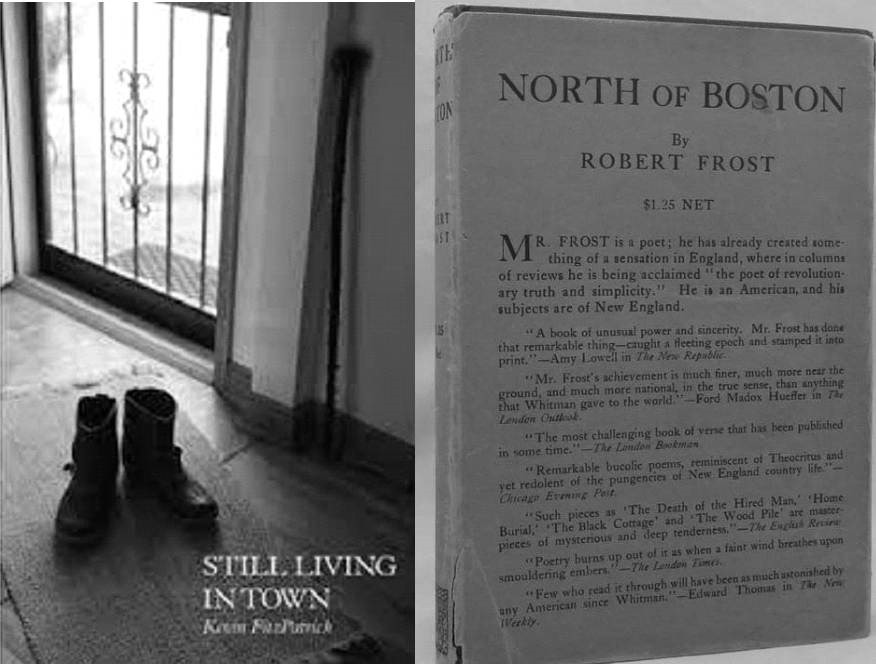
“Time Piece” (the title may have been a single word in the draft I performed it from) had one issue that I recall: there was discussion of the “incorrigibles” that the poem concluded hadn’t stolen the dead father’s wristwatch. At least one of us didn’t like it, perhaps thinking it an archaic, obscure or somehow too formal a word. Kevin nodded and said little as was his usual response to suggested revisions. I think I may have argued for incorrigibles, and since it was there in the draft we performed from long before the poem’s publication in Kevin’s 2017 collection Still Living In Town, that was still the word in my performance.
Well, damn it, Kevin’s dead, and it’s his poem, and he was good at writing poetry, but “incorrigibles” is the right word, and his revision for publication: “those slick boys” doesn’t have enough flavor. That Dick Tracy word-aroma is just what’s called for! “Greatest Generation” father, and a wristwatch after all! He also made one other revision on the published version: from “That he wasn’t scheduled for a boxing match at six” to “That he wasn’t scheduled to box at six.” I suspect Kevin’s ear thought the later better meter-wise. However as boxing has become a more obscure sport the shorter “box” may miss some readers.*** “Did he work in an Amazon warehouse?” some moderns may think.
“Timepiece” or “Time Piece” is a poem well worth reading or listening to. The LYL performance of the earlier draft is what the graphical player below will play, and if you don’t see the player, slug this highlighted hyperlink.
.
FitzPatrick’s publisher, Midwest Villages & Voices, doesn’t distribute online, but this link contains an ISBN and other info that may help you obtain a copy from your local book store or library. Then this other guy, Frost, has books available too.
.
3. After Apple Picking by Robert Frost. Unlike our other Frost poem in this autumn’s Top Ten, the metaphysical “Bond and Free,” you can feel this one. Particularly as Kevin began to spend his weekends working at his life-partner’s rural farm, I could see kinship between FitzPatrick and Frost. Both were drier than a Minnesota winter’s static humidity, both liked to observe human outlooks critically, and both of them could give you some of the tang of work tied to nature. I’m not sure if lifetime farmers are likely to write a poem like this, but someone coming to that work from something else, as Frost and FitzPatrick did, has the outsiders’ advantage of fresh observation.
When I presented this poem last month I thought about dedicating it straight out to Paul Deaton, who’s blog I’ve read for the past few years, in part to catch up on his accounts of small-format food farming, sometimes mentioning apple trees and orchards. But I wasn’t certain how well it fits anything Paul experiences. The apple trees of my youth were tall enough that ladders would be required, but the orchards I saw biking around Bayfield this fall have quite short trees, the kind where an adult would stand flat-footed to pick the fruit.
But maybe I should have gone ahead. Even though this poem has specifics, even to what aches after work, it’s about finishing a task. When another blogger I read: professor, editor, and author Lesley Wheeler wrote of getting to the final stage of a book-length manuscript, I thought of how I felt after finishing a manuscript decades ago. That same “Well, I probably missed a few, but I’m done with apple picking now.”
This post has gone long, though with things I wanted to say. Our next post will break from our usual Top Ten countdown, as it will deal with both the most popular piece, and the runner up, and I’ll talk more about poet Ethna McKiernan.
.
*More than once I’d say to Kevin “If I had had the idea to write something from this same material that you used, I’d have written a short story.” I remember once Ethna took me sharply to task for saying that, admonishing me that Kevin was writing a narrative poem. She misunderstood me, for I knew and admired that. Mixing into a short poem, with its almost unavoidable lyric immediacy and compression, with narrative elements sometimes even including a Joycean epiphany, is not easy. Once or twice, so taken with the story in one of Kevin’s poems I attempted to craft a short story from the same material, to demonstrate my point — and yet I could never complete one of those attempts. Kevin’s poetry may look unshowy, but it’s not easy to duplicate.
**Several years ago, Kevin and Minneapolis folk/blues revival pioneer Dave Ray of Koerner Ray and Glover engaged in a little side-bar about meter in Blues lyrics, with Kevin scanning their iambics. Kevin played a little blues harp, and Ray and Kevin’s dad were both in the insurance business.
***Kevin also boxed, and not in a warehouse way. He once wrote a poem which had as significant line “The boxer slugs!” Dave Moore’s punishing wit, after dealing with a lengthy group discussion about if that line would be misunderstood, was spurred to write an entire song about a garden beset by invasive…wait for it…”boxer slugs.”
Let’s continue our Top Ten countdown of those pieces that you liked and listened to the most this autumn. Regular readers here may not be surprised that death features in some way in each of today’s three poems, as illnesses, infirmities — and yes, folks I’ve known a long time dying — have been part of the year for me.
Everyone that dies or is limited by infirmities is a lesson, one you listen to more richly and intently as you get older. It’s a lesson that makes me press immediately against what limits age has put on me, gives me a sense to use what I have presently before it’s gone. Oh, I am sad that I’ll not hear Kevin or Ethna’s voices again, except in memory or recordings — thin mirrors those. Dave reminds me that it reminds him when I post older LYL Band recordings where he was able to pound and roll the keys. Our family continues to deal with my wife’s mother descending, as politely as she can carry it, into dementia. But those that go before us are meant to teach us. Don’t skip the lessons.
Why Now, Vocalissimus by Frank Hudson. When I posted this audio piece, shortly after I wrote it, I said right out I wasn’t sure what I meant by it. That state may be unnerving for a writer. After all, aren’t you supposed to know? If you don’t know, how can you present anything vividly to the reader or listener?
Well, there’s a theoretical structure, a mythological structure, that seeks to explain that. It says that we are conduits for muses, external things. We don’t have to be outstandingly worthy, exceptionally preceptive, or precisely eloquent, since we are in this scheme conduits of something outside us. Frankly, this can lead to a lot of bad poetry: inchoate self-expression bearing the costume of inspiration. But then everything leads to bad poetry — all artists fail as I remind readers here often. But what of us readers, us listeners? We fail too, grasping partially what much art conveys.
My understanding of what I wrote back in September has grown as I live with this set of words. Part of our job as living, breathing artists is to carry forward the work of those who’ve left off working. We are not just creators, but also carriers. So, if you write poetry, bring words down onto the page or speak your own words, know that I’m charging you to also preserve and enliven those others who have no voices left to carry the spark. And that’s what I try to do here with the Parlando Project.
My performance of “Why Now, Vocalissimus” is available below with a graphical player. Don’t see it? Then his highlighted hyperlink.
.
Heidi Randen’s picture of a milkweed husk spoke to me this autumn.
.
6. The Shadow on the Stone by Thomas Hardy. A complicated ghost story, a complicated haunting. As I wrote when posting this, English poet Thomas Hardy had a dysfunctional marriage — and yet, like many folks forced by fact into the separation of death and mourning, he still felt the returning presence of the intimate dead.
I rather liked the music I composed and played for this one. It has a weird loping groove that I find attractive. To hear the performance, some will see the player, and the others can use this highlighted hyperlink.
.
5. God Made Mud by Kurt Vonnegut. I decided to present several short excerpts from Vonnegut novels that work as poetry this fall on the occasion of the 99th anniversary of his birth. The LYL Band had recorded them well over a decade ago, on the week Vonnegut died. Why didn’t I wait for the nice, round 100-year birthday? See the start of this post for why.
In Vonnegut’s novel Cat’s Cradle the text I used here is the last rights of an imagined religion. Like the theoretical/mythological structure of muses directing us to write poetry, Vonnegut proposes a useful if compressed Genesis story that asks us to recognize that the nagging mystery of death is no harder to explain than the overlooked mystery of living at all.
It’s that time again when I present our quarterly countdown of the pieces most liked and listened to here at the Parlando Project during the past season. We’ll proceed from the 10th most popular and move up to number 1 in the next few posts. The bold-faced heading for each piece are links back to the original post that introduced the pieces here, in case you didn’t see them earlier this autumn.
10. Cobwebs, Steel, and Moonshine by Carl Sandburg. Longtime readers here will know of my admiration for American poet Carl Sandburg, and so it may be no surprise that this is actually the second time I used parts of a single Carl Sandburg poem for a Parlando Project audio piece. The Sandburg poem is “Smoke and Steel,” a poetic celebration of labor and laborers from a collection of the same name published in 1920. I used that whole poem’s title for the piece I created out of the beginning of it for May Day in 2019, but for this past American Labor Day I used the conclusion of “Smoke and Steel” and gave the result this title. I dedicated it to another American poet, Kevin FitzPatrick, who was suffering from a serious and unexpected illness that killed him later this fall. This is the first of three poems in this fall’s Top Ten dedicated to poets Dave and I knew and exchanged work with who were suffering mortal illnesses.
I’m thankful that long-time reader of the blog rmichaelroman submitted a good guess as to what the steel might be in Sandburg’s short ode to workers and work: rebar.
9. Bond and Free by Robert Frost. It’s been a while since I mentioned it, but Robert Frost bugged me when I was young. He was still alive, and omnipresent in anthologies one might find in school, which caused me to treat him like other 20th century poets and critics treated Longfellow: as a square preaching platitudes who stood in the way of younger and fresher voices who’d question all that with a more unruly poetry. I was misreading Frost of course, but through that error I did find others I thought in opposition to him that I found rewarding back then. Eventually I came around to love the word-music in his shorter lyric poems, and from that attraction found a starker and more divided meaning was there.
“Bond and Free” is Frost in his more metaphysical and frankly philosophic mode, which isn’t my favorite Frost, setting out here a cosmic stage where Love and Free Thought conflict. He sounds more like Shelley or Keats in “Bond and Free” than the more modern diction he was able to make sing in other poems, but sing the words do.
Three young poets at work. One played in the LYL Band.
.
8. They’re All Dead Now by Dave Moore. One of the most popular of my Halloween series this year, even though it’s a longer ballad form story that put my singing strength to the test. Longtime listeners here will know Dave as the most common alternate voice here at the Parlando Project as well as the keyboard player you’ve heard in the LYL Band.
He’s also a fine writer of poetry and songs. For reasons too complicated to deal with now, I fairly often sing Dave’s songs here rather than having him sing them himself. There’s a factor when someone sings another writers’ song. While they may bring a different kind of talent and musical craft, they may also somewhat misunderstand the song — or misunderstand (maybe more at “re-understand”) it in a valuable mutational way. Though I’m not a great singer, I do try to bring something to Dave’s songs when I present them here.
Every song stands to gain much more than one more life when sung by someone else. From time to time I’ve encouraged others to sing some of the Parlando Project songs. Anyone have their own cover of one of our Parlando Project pieces you’d like me to hear?







 Frank Hudson