The Poet’s Afterthought

Does any poet know if their work is any good? Some perhaps have that conviction, but at least during substantial moments I think the majority of poets have doubts. This drives some poets to ever tinker with and improve their writing, and causes others to abandon the idea of poetic writing as a useless pretention. Some even numb themselves to the question — yet anything that numbs doubts can overshoot and numb creativity too.

Do bus drivers and child-care workers have these doubts about their work? Do politicians or generals? Is a poet’s lack of confidence in their work generally less than other artists? Let me only take the last question. I do think more poets have more doubt, because their audience is usually small, and that audiences’ response is so muted. Actors, musicians, or other performers can expect immediate audience response, it’s in the nature of their work that it exists only in front of others. Poets, even successful ones, read publicly much less often than they write. The attempts at bringing performance to poetry, with slam and other spoken word variations are seen by many literary poets as corrupting the complex and more contemplative aspects of their art. Novelists, screenwriters, the authors of non-fiction and memoir, can lucidly dream of paydays that would be fantastical for poets, and it’s not unusual for poets to step aside from their poetry to those other writing fields seeking something they can touch and deposit on account from their work. Visual artists are as abstracted from their audiences while doing their work as poets, but we have no auctions of living artists poetry that bring bidders to the alexandrine numbers.

So, in such solitude, such silence, or even within the quiet, diffuse reverence of award-winning poets, there is most often doubt. What would it be like if poetry was on most everyone’s mind, if living poets were giants in our culture?

Since I started this project I’ve sometimes thought of Longfellow, an American poet who reached that level of achievement. The American culture of Longfellow’s era wasn’t more educated or entitled to access to high culture that we are today. Yet, I grew up in a town, and live in a city now, which from that time created streets and spots, and named them for him like we would for Presidents or Generals. My father and his father would know, would memorize his work. We do not need to travel back to Classical Greece or the Confucian Odes to imagine that level of poetry in our culture.

And yet. Longfellow has disappeared, and as far as those that do care about poetry this is regarded as neither mistake nor injustice. This isn’t due to scandal. AFAIK, Longfellow lived a praiseworthy life. He must have said or written some things we could condemn, but on the big issue of his age, slavery, he was on the side of the angels. He was a nationalist, but an internationalist too. He may have appropriated First Nations names and legends with insufficient grounding, but he did it to ennoble not dehumanize them. No, the main reason we have dumped Longfellow off the bookshelves of our culture is that he doesn’t excite or move us in the least. His poetry seems like old civic statuary covered in pigeon dung, not worth noticing, and not worth any effort to replace.

American poetry is a different country now, and Longfellow is exiled from it.

Inside poetry, in its provinces, and within old classics where we might still retain interest, there’s current discussion about Emily Wilson and her fresh translation of Homer’s Iliad.  Wilson has been clear in discussing her practice of translation. She assumes or assays that there must be something there in the archaic Greek. Her task, she writes, isn’t to make a work that sounds like the original text, or to bring us its most exacting word-for-word translation, but to make a new poem that works like the original must have worked for it to have had the impact it had — a version which we can by extension expect to be something like the authors best intentions. We believe this is what Homer deserves, regardless of if our tactics vary from or agree with Wilson’s.

We do this for Dante. We do this for Du Fu. We even do this to some degree with Shakespeare’s plays. We don’t do it with Longfellow. Why not?

We may think there’s nothing much there. We may think that Longfellow’s English is close enough to our modern English that to do so would be presumptuous or dishonest to the work. This last objection is a funny combination with the first. If there’s nothing worthwhile there, who cares what we do with it?

For a recent live in the studio LYL Band recording I decided to “translate” — or more exactly, extract and arrange for greater direct effect to the modern ear, a portion of a lesser-known Longfellow poem, one he titled “Epimetheus, or the Poet’s Afterthought.”  Epimetheus, for those not up on your Greek mythology is Prometheus’s contrasting brother. If Prometheus is a hero, however tragic his fate, Epimetheus is the “Oops! I did that?” guy, a total fool. Prometheus is the I’ll give humans fire and suffer the eagle eating my liver forever hero. Epimetheus is the ”What’s in that cool box, Pandora. Let me have a look” disaster.

In my version I left Epimetheus out of it. Pandora too. Longfellow’s poem is a Friday-the-13th thirteen stanzas long and would require more melody and virtuosity than I can muster to capture a modern listener’s attention. I cut it to three stanzas, modified a couple of pieces of archaic word-order, killed one perfect rhyme for a near one. I did this because I think there’s a core in the piece that might speak to me or you without delay or overly baroque elaboration — and that’s the intent I found in Longfellow’s subtitle. If you write, particularly if you write poetry, you likely know the feeling: that joy and initial appreciation of the inspiration that carries you into the first draft, only to be followed by the problems of realizing the best poem that escapes us. And the completed poem? It travels out to a place where there are only wanderers like us.

Poets Afterthought

Here’s my much shorter adaptation of Longfellow. The full poem as originally published is linked here.

.

You can find that performance of my revised version of Longfellow with the audio player many will see below. Don’t see any audio player?  This highlighted link will open a new browser tab that will have such a player.

.

Quiet Sanctuary

I have trouble at poetry readings.  Oh, I enjoy them, but they tend to spark off ideas and associations* in my mind. When I come back from those jumps in my consciousness the poet reading in front of me may have gone off to the next poem — and I feel like I have been delinquent in my duty as an audience.

A couple of months ago at the poetry reading series I try to attend regularly,** a poet was introducing a poem, and somewhere in between that poem’s introductory material and the poem itself this connection, this metaphor, occurred strongly to me. I don’t now recall what it was the poet reading said. Was it something about an acoustic guitar? Possibly. Something about a church? Maybe. That I can’t remember says something about the utter rapidity and completeness of my leaving that room and into the germ of this poem.

Quiet Sanctuary

Here’s the poem presented as a chord-sheet with the guitar chords I used to accompany it.

.

I saw immediately the churches of my parents’ and grandparents’ generation, small Midwestern US churches. Usually wooden and white with a steeple’s neck outside, and inside largely one room, the sanctuary within the single story, filled with dark brown wooden pew benches. A basement below, small children’s bible class spaces and a kitchen that smelled of brewing coffee, the sanctum of wives, mothers, and grandmothers of the congregation after weddings, funerals, baptisms.

South Marion church

The particular church most in my memory is decades gone, but this nearby one will serve as an example.

.

When one thinks of churches, I suppose some think of grand spaces, cathedrals or those more modern large urban churches built to approach that scale and presumption. Weighty stone buildings, as unresonate as tombstones, intricate carvings and décor. Grand halls, chambers, perhaps a pipe organ, for they are the pipe organs of buildings, elaborate and encyclopedic, overwhelming anything human that would manipulate it.

The modesty of those small-town Midwest churches, the woodiness of them, has its own glory. And so it seemed natural to connect them to a instrument that is somewhat of a point of origin to me musically, the acoustic guitar.

I don’t know how well this little poem will communicate that to those who do not share my experiences with those buildings. I accept that a poem can’t be everything. There’s one detail in my poem that might not make sense or image to some readers: the attendance list. In my recall, it was common for these churches to have a board that toted up the attendance for the last service. I’m not sure that sign’s entire purpose. To remind those in the sanctuary that they were part of a continuance? Could be. The small continuances are what these churches contained.

You can hear my musical performance of “Quiet Sanctuary”  with the audio player gadget you might see below. No player to be seen? I offer this highlighted link as fall-back then. The link will open a new tab with its own audio player.

.

*It occurs to me that I rarely have ideas as such so much as I have associations, things that seem to recall other things or suggest other things yet to be connected. It’s possible to write poetry without the poems containing metaphor, that kind of association, but most poets don’t. That trait may be why I’m drawn to poetry.

**That reading series, held the second Thursday of the month in St. Paul Minnesota, is the Midstream Reading Series. I know some of my readers are from the Twin Cities area. I find this event worthwhile, and you might too. Though I’m often inarticulate in person, I would try to say hello if you were to greet me there. Next reading is this coming Thursday, October 12th.

Touch lightly Nature’s sweet Guitar

This week while attending the online reading of all 1789 Emily Dickinson poems as part of the yearly Tell It Slant Festival, I have been noticing how many Dickinson poems use music as a metaphor. I know she played the piano herself, but I know little about what her personal musical aesthetic was, or if there were other musical instruments played in her home. Piano could be then, as it still was in my mid-century lifetime, a home entertainment device — provided that the family could afford the space and the cost.

For whatever reason though, Dickinson chose to use guitar in this poem, and seeing my “home” instrument in it attracted me.

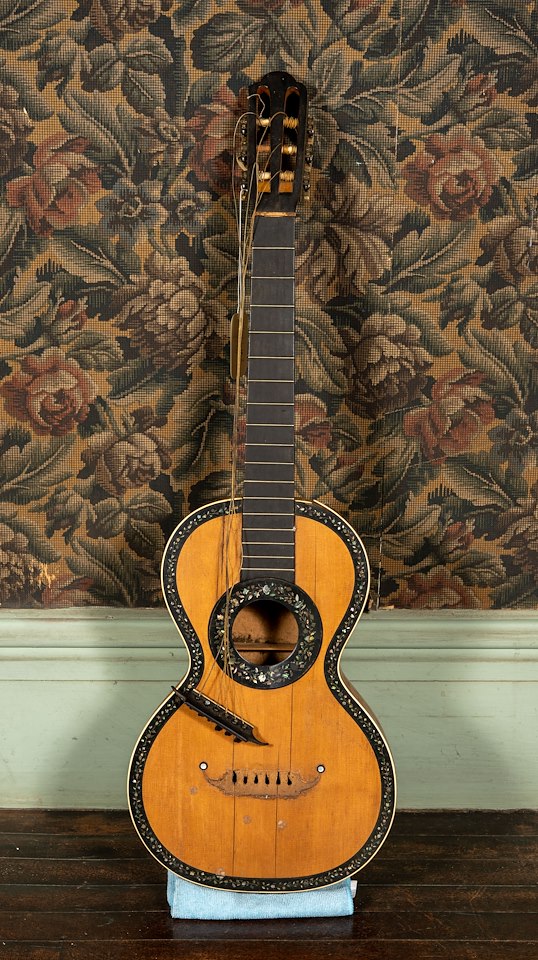
In Emily’s 19th century, guitar also played such a home entertainment role. I have a somewhat worn-out, very small bodied six-string that I sometimes play, and in today’s guitar marketplace such guitars are often called “parlor guitars.” The historic usage that name honors was that with less cost in space than a keyboard instrument, a home player could entertain themselves or their housemates with a guitar. These small guitars easily suited smaller-bodied women* and many of the players in the home were women.

A parlor guitar from the Emily Dickinson Museum’s collection**

.

When it came to realize my music for this poem, I didn’t play my parlor guitar — I played an electric model — but as I continued to go over the words in the process of creating the audio piece I’m not sure that Dickinson had an actual guitar in mind either.

Touch lightly Nature’s sweet Guitar
Unless thou know’st the Tune
Or every Bird will point at thee
Because a Bard too soon —

The opening line, used in place of a title as we do with Dickinson’s untitled poems, has somewhat conventional words for playing a guitar: “touch” “lightly” and “sweet.” Indeed, a parlor guitar like mine responds sweetly to a lighter touch and isn’t designed for driving picking such as used in some later American guitar styles. But Dickinson is a master at choosing the unusual word, the one you or I might never come up with. Her opening line calls it “Nature’s…guitar.”

Given that she moves over to bird’s opinions by the poem’s third line, I think this guitar may be figurative. Its wood and strings might be tree branches, and the Bard too soon, a too early storm. Still, the final line might be speaking of prerequisites for musicianship or songcraft, seeming to warn that a player should be cautious until they know their “song well before I start singing” as another songwriter once stipulated.***

I left a middle section open for an additional top line when Dave and I recorded the basic tracks last week. Afterward I wasn’t sure what should go there, but I decided to score one of my simple orchestral instrument parts for this featuring a violin. You can hear the result with the audio player below. No player seen? Touch lightly this highlighted link and it will open a new tab with its own audio player.

.

*They weren’t made especially small, the petite size was normal for guitars in that time. The current standard size acoustic guitar in our era, often called a “dreadnaught” (because it was seen on arrival between the World Wars as big and formidable as a battleship) is much larger in dimensions: deeper, longer, and wider, and often with a longer-scaled neck.

Men played these small guitars too. In an earlier post I showed a picture of what purports to be Mark Twain’s own guitar, which is also that then standard parlor size, though Twain said he played it for the roughs in his California sojourn.

**The Museum has only recently been able to digitally document the artifacts in its collection. Perhaps due to the difficulties in provenance because the houses of Emily Dickinson and her brother and important friend and sister-in-law Susan Gilbert Dickinson did not pass immediately into museum curation, there is no online information as to who may have owned it, or even if it was played in Emily’s presence. I’m somewhat knowledgeable, though not a professional appraiser, and think this guitar could be a 19th century instrument. The collection’s picture of the back of the guitar shows a blacksmith-quality repair at the headstock joint. A common guitar injury, then as now, is for the neck to fracture at that place. My somewhat-informed-amateur’s opinion is that the headstock may be later than the rest of the guitar and was grafted onto it.

***A stipulation I disregarded, as the first song I learned to play was the Dylan song containing that line, “A Hard Rain’s A-Gonna Fall.”   I did not touch it lightly.

The Terror of the Blank Page

I think today’s audio piece is something many writers will relate to, but since it’s one I wrote I’ll be brief later down the page in writing about my encounter with it. The top part of this post will be a process post about music and working “live in the studio” with Dave Moore again after a long break. Feel free to skip to the bottom if this process stuff isn’t your thing.

For many years I’ve taken time every September 18th to remember guitarist and composer Jimi Hendrix. This September 18th I planned to get together with Dave Moore to do what we’ve done off-and-on for more than 40 years: attempt to make music together as The LYL Band.*   For almost all that time we’ve done this in a peculiar way.

I have a space with various guitars, basses, drum pattern software, and a couple of keyboards. Dave comes there after I’ve setup the recording equipment. I start playing something harmonically simple (often a one-chord groove) and Dave walks up to a keyboard. I start with some words (usually something from another writer) as we play off the top of our heads while the recording software rolls.

After that, Dave hands me a sheet of paper with something he wrote or wants to play. Sometimes there are chords handwritten on the sheet, sometimes not. I ask for a key center. He starts off and I try to follow and figure out a part on the spot. We finish playing to that set of words. I hand Dave a chord sheet with chords written out, something I’ve composed or want to play. I start out and Dave tries to come up with a part on keyboards.

We almost never do second takes. We rarely present the songs to each other by playing the sections through to demonstrate before recording. This alternation of I, then Dave, leading a piece continues for a couple of hours with a short break in the middle to rest our hands and voices.

A great many musicians cannot do this, wouldn’t do this, are perhaps afraid to do this. It is not an exact way to accomplish the art of music. Many skilled folk, Blues, and Jazz musicians can do this if they choose to.**  Dave and I are not at that skill level. What comes out can be inarticulate, chaotic, of no use whatsoever. We give it permission to utterly fail.

Are we just lazy or eccentric. Well, maybe the latter, but the aim is to catch moments when something happens spontaneously that has a quality of that type of creation. You know the expression “Building an airplane while it is flying?” That’s the feeling when something coheres as we feel our way into the piece. I believe the best of the pieces that come out of this process may transfer some of that feeling to a listener later on.

When I work on the Parlando Project pieces I work as a composer, usually playing or directing most of the parts myself. It’s a thoughtful process, painstaking to a degree though I try to create more pieces rather than a few most perfect and maximally impressive pieces. There’s lots of do-overs, retakes, instruments attempted and rejected. What Dave and I do when we play together uses a very different part of the brain. I love the change, each type of music-making refreshes the other.

Epimetheus Unbound Cover picture

Part of collating the useable material from a session is creating a cover image. I had no idea who Epimetheus was until I encountered this Greek titan in a Longfellow poem that you may hear more about later this fall.

.

Today’s new audio piece

Back to today’s new audio piece. It’s the first thing Dave stepped up to the keyboards to play with me this past Monday. “The Terror of the Blank Page”  is a poem I wrote more than a decade ago during what the US liked to call “The War on Terror.” I think the germ of the idea may have come from finding out that Saddam Hussein had fashioned himself as a novelist and had several books published attributed to him as an author. The finished piece isn’t really about that, it’s about how we punish ourselves if we are writers for fearing and avoiding starting new work. What if it’s not the best idea? What if it’s bad, embarrassing, revealing of our faults as artists? In the end, I think my poem and this performance makes fun of that fear as it names some imagined incarnations.

The process I talked about above, the one that Dave and I use to make music quickly is a way to get out the door before the fear arrives to arrest us. To hear our live in the studio performance of “The Terror of the Blank Page”  you can use the audio player gadget below. No gadget? This highlighted link is there for those whose way of viewing this doesn’t show the gadget — it will open a new tab with its own audio player.

.

*Various other musicians have played with Dave and I from time to time in The LYL Band. Given our peripatetic musical path, it takes a special kind of musician to enjoy playing with us. One could easily say that a model for The LYL Band is The Fugs, an intently impolite band created around a core of two poets and assorted others. Don’t go listening to The Fugs recordings around your parents, your children, your school board censors, or anyone who can’t help but mention when your singing or guitar is out of tune.

**Two accomplished musicians who have used something like this approach are Miles Davis and Bob Dylan. Dylan’s classic mid-60’s ensemble recording sessions would start off pieces live in the studio which (just maybe) a music director of a sort had prepared the musicians somewhat for. He’d try a few takes, and if it didn’t work, he just went on to something else or some other combination of musicians. A record like Highway 61 Revisited  is corralling the best attempts to make chaos cohere. Miles Davis hired exceptional musicians with extraordinary ears and knowledge of the Jazz repertoire. Even though Davis was comfortable with charts and pieces with set forms and sections, he had periods when he worked with a roomful of musicians given little direction. He made a series of records from In a Silent Way  on that were mostly assembled after these live sessions by editing and collaging the best parts of this spontaneous playing.

That approach by Davis is similar to what I do with some pieces that Dave and I originate together in spontaneous live playing. I’ll add parts and remove or edit parts to create a resulting hybrid recording that contains live and composed playing.

Like trains of cars on tracks of plush

Later this month I’m hoping to attend remote online sessions of the Tell It Slant Poetry Festival run by the Emily Dickinson Museum in Amherst, perhaps as many as I did last year. Something they do that I enjoyed was listening to all the sessions where a range of readers read all of Dickinson’s 1789 poems.

Now was I sitting in rapt, solitary devotion for every hour of that multi-day marathon? No, though I was paying some attention throughout. I restrung some guitars, reduced the clutter in my office and studio space, put away laundry, and tended to the dishes. If I gardened or cooked, I could pretend I was work-a-day Emily herself.

What makes the marathon meaningful, even if one does it only in part? The multiple voices for one thing. A group of several people read the poems in rotation each session, so there was no careful preparation from foreknowledge of which poems exactly each reader would read. A prepared reading might be powerful — having trained actors or voice artists read the whole corpus would bring something to it. This is not that, yet worthwhile.

I’ve heard a lot of folks read poetry over the years. Several of the readers struck me as better than most, even given that they might be reading the poems that came up in rotation for their turn essentially cold.*  Of course, every so often one of the readers in their turn would get one of ED’s greatest hits, and all of us: the reader, the other readers, and the attendant listeners would perk up. If one pays attention to this, that happenstance, it “dazzles gradually.”

But then too the ordinary readers, the times when someone stumbled on a word, the lesser-known poems, the small ones that might be no more than a quatrain or two — they two are part of the fullness of Emily Dickinson. She may have been a genius, but she produced these hundreds of poems among a more-or-less ordinary life, infusing them with worthwhile attention. With this many poems it’s unlikely anyone (certainly not I) can really hold all of Emily Dickinson’s work in memory. And so it is, in such a complete reading, that some poems will spark with my attention as if they were just written and never before read or heard. With the smaller poems especially, it may be not much more than a glimpse we share in real-time with Dickinson’s ability to see and think differently. Yet, those small visions add up over the hours, grander from their numbers of unique takes.

Which are the poems she drafted while baking, head full of the hymnal meter, hands dusted with flour? Which while in the garden? Which while caring for her sick mother?

Virtual attendance is planned for many of the Tell It Slant sessions that run from September 25th through October 1st. You can sign up for them at no cost at this link. No one’s taking attendance — see or not see any of the sessions as they fit into your life or level of interest. Given the uncertainties in my life, I’m not sure how many I will be able to fit in.

One game I played during the readings — where I eventually jumped into the chat window with exclamations — was whenever the poem cycle came upon a bee. Dickinson closely observes many plants and animals, but she seems to have had a particular affinity for the bee. Is it a symbol of the Puritan work ethic? A chunkier, easier to observe bug? A symbol of fertility? A flying rose with sweetness and a sting? A coworker the knowledgeable horticulturalist knows is essential to pollination?

like trains of cars on tracks of plush illustration

Billy Strayhorn and Duke Ellington aside, sometimes the muse takes the bee train,

.

Here’s one of her short bee poems, particularly extravagant in its imagination. And here’s a link to what I believe to be the authoritative text.**  That opening image alone should astound. Bees as a railroad train, with the plush flowers as directive as train-tracks —yet soft, not iron.***  “A jar” in the second line is ambiguous. A jar as in a container for the pollen it collects? Possibly, but I’m suspecting more at ajar’s meaning as apart or out of harmony. Bees as locomotives and their train of cars makes them outsized from reality’s proportions. They may move the petals on close examination, their industry is harder and heavier than the plants.

In the second stanza, the metaphor shifts. Now the bee is a knight, the flower a fortress or castle they assault. The bee-knight seems a strangely chivalrous marauder, if inconstant and ready to move off to the next bloom.

As an Imagist poem, this then can be apprehended as simply a picture, an observation of a charged moment of attention. How strange to see the tiny bee as a train or even a knight — but yes, it must travel in appointed commerce on its compelled track, and yes, like a wandering knight-errant it must move on.

But this bee could be a muse too, couldn’t it? It knows its schedule, even if we don’t. It arrives, shakes us like a passing train, assails our walls, then bids a courtly adieu and passes on to another artist, writer, musician.

You can hear my musical performance of this short Emily Dickinson poem “Like trains of cars on tracks of plush”  below with the audio player gadget you should see there. No player? This highlighted link is another way to hear it, as it will open a new tab with its own audio player.

.

*I once worked for a radio network. Watching the on-air folks, I was reminded that the ability to cold read text is a skill. It sounds easy to do — when it’s done right.

**There’s a twice as long version out there which I think is derived from the 19th century Mabel Loomis Todd and Thomas W. Higginson posthumous collections. These were straightened up for easier public assimilation and were given, by the editors, their ideas of meaningful titles. Did they append two fragments thinking them connected? My apologies for not researching this issue further.

***As striking as Dickinson’s image is here, railroads were as essential to 19th century American commerce as bees are. Towns grew and shrunk based on their routes. Another plausible reason for the train image: one of Dickinson’s father’s commercial achievements for Amherst was assuring that it’d get a railroad line.

Another Child (“To Any Reader”)

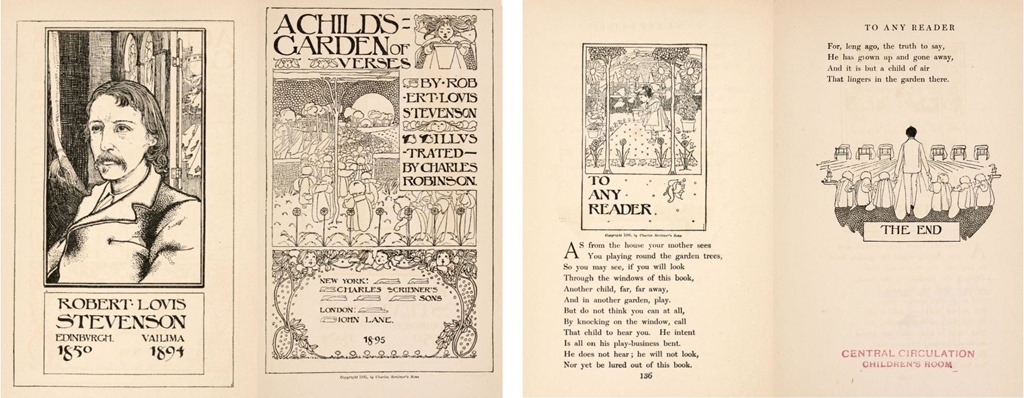
When I used a Robert Louis Stevenson poem last July I wasn’t expecting to follow it up with another. When introducing his “Bed in Summer”  then I mentioned that writing poetry for children, as Stevenson was doing in his A Childs Garden of Verses,  seemed to reduce some of the fustian of a lot of Victorian verse.

So, when I happened upon this other example from that collection I was even more struck by the sensibility of this one. Though I had no reason to believe Stevenson was intending visionary poetry, today’s piece could almost fit inside of Blake’s Songs of Innocence  — though it was written a half-a-century after Blake’s death.

another child layout

Here’s one illustrated edition of the book and the original text with Stevenson’s title “To Any Reader”

.

What was the author’s intent? I first read it as Stevenson making a pitch that even if the poems in his book might someday seem quaint and old-fashioned, they could still relate to like-experiences of some future another child. Was this canny foresight on Stevenson’s part? Stevenson was only 35 when he published this book, so his own childhood memories should not have been all that outdated as he wrote the material. On the other hand, his childhood nurse (to whom the book is dedicated) raised him on John Bunyan, stories from the Bible, and tales of 17th century Scottish Covenanters. That may have made him aware from a young age that tales from past times could be transmitted to young minds.

I do recall encountering A Child’s Garden of Verses  as a young child in the mid-20th century, though I can’t say for sure where. Did someone read it to me in my pre-literate days? Was it a book from my parents’ library, perhaps a keepsake from their childhoods? Did I run into it while exhausting my tiny Iowa town’s small library children’s section?

I would not have minded if it was old-fashioned, for I was from a young age fascinated with the past. It could have seemed juvenile unless I came upon it very early in my reading years, but most editions were illustrated, and illustrations excited the ekphrastic in this young reader. Yet my recall on this is not that specific, I just remember that I had seen it. I have more recall of reading Stevenson’s Treasure Island  and enjoying that.

Oddly, when I finally looked this week, this is not the lead-off, introductory poem in the book. Instead, it’s the final poem — not the place to make the case to continue reading “To Any Reader”  who just happened onto the book. Instead, in this place, it’s a ghostly envoi, a reminder to the child (or to the adult reading to them) that they, their childhoods, will obsolete themselves.

As I did with Claude McKay a couple of pieces ago, I decided to adapt Stevenson’s words slightly for singing. Some changes were to make it less awkward to separate things into a series of sung verses. A couple of changes just fit better to my non-agile tongue. Most significantly, I devised a repeating coda to drive home a final summary to the listener. One subtle thing I did was a covert attempt to speak to my own child’s specific journey to young adulthood.

Another Child song with chords 1080

Here’s my version. Since I want to emphasize that other child of air, I also retitled the poem.

.

An uncomplicated folk-song style setting seemed appropriate. The chords today are simple for the guitarist, though the alt-tuning I used changes the sound of this simple chord progression slightly. You can hear my performance with the graphical audio player below. If you can’t see any player, I also provide this highlighted link which will open a new tab window with its own audio player.

From “The Windy City"

This Monday, Labor Day in the U. S., is a legal holiday which arose from the idea of a day to celebrate workers. Some see this holiday as being in conflict with May 1st, International Workers Day, but I myself have no beef with having two days to celebrate work and those that do it.

Poets and poetry are not, as a rule, oversaturated with attention to labor. Creative work such as writing is, in itself, labor — but the wages are so scant for poetry that it’s hard to see it as allied with such. Currently television and movie writers are on strike, but poets have little in the way of wages and rights to negotiate. If the weekend and the 8-hour workday were obtained through labor struggle, it’s hard to imagine poets picketing for a full honorarium for the 12-line sonnet, or chapbooks for sale on every bookstore shelf that stocks James Patterson books.

What I find less forgivable is that poets don’t write about labor as much as I think is due. Poetry’s Greatest Hits will tell us about mystery, death, love, war, dreams, desire, loneliness, family, friendships, every facet of our non-commercial relationship with nature, all the panoply of pain and joy. What poetry won’t speak of much is the third or so of our lives spent making or getting a paycheck.*  And I don’t think the situation for the subject of labor is getting better. Farm work, even if romanticized into shepherd tropes or the like, supplies many of the poems in the canon that speak of work. As the percentage of Americans engaged in, or even living among others engaged in that line of work decreases, we see fewer of those poems.

Around Labor Day or May Day, I often find myself dipping into the work of Carl Sandburg. Despite his less than illustrious education, not of the Ivy League but more a Row-Crop League college with hobo semesters, and attendance in The Front Page era of journalism, rather than sessions abroad and drawing room soirees. Sandburg was by intent a thoroughgoing Modernist artist, making it new as much as any of the early 20th century Americans, but his Modernist solutions and prosody get little respect currently. Maybe they’re right, though I find Sandburg can be effective for my purposes. Judge those things as you might, he does pay attention to labor and laborers as colleagues. He can portray all kinds of struggle in doing so, but also endurance, achievement, and harbored joy.

Before I get on to the piece I found in Sandburg to celebrate Labor Day, let me suggest a rough analog of the Bechtel Test.  Let me call it the Sandburg Test. To be clear, it’s not my suggestion that every poem has to be about work, about the things we do for our daily bread. But, if we are viewing an anthology or substantial poetry collection from a poet, to pass the Sandburg Test it has to have poems that deal with work in some substantial way. How does the speaker or characters in the poem relate to work? What are they doing that work for? What is it in presenting them that portrays something about life? What are the mysteries, sensations, and systems of that work?

What Sandburg poem did I choose? I picked a selection from the 6th part of a longer, multipart poem, “The Windy City.”   This one is sort of an extended revisiting of Sandburg’s Greatest Hit “Chicago,”  sometimes remembered as a boosterish paean to the great Midwestern American city, which it’s not — “Chicago”  is a poem about a city and a workforce in struggle. “The Windy City”  on the other hand is more mystic, and the section I chose is essentially a labor hymn. Physicists tell us that the things we see about us, solid things apparently, are in fact full of moving atoms and vibrating particles, their close motion making solidity. Sandburg’s windy city is such. The labor we celebrate on Monday, and do most every other Monday, is the gusty current that makes our world.

Carl Sandburg looks out on midcentury Chicago

Looks solid enough, but it’s made of something as transitory as work. Carl Sandburg looks out on mid-century Chicago.

.

My music for today’s piece is in my punk orchestral mode: simple musical structures making use of orchestra instruments and a few interlopers. You can hear it along with Sandburg’s words with a player gadget below. No gadget? Here’s a highlighted link, that’ll open even on Labor Day to present you with an alternative audio player. Want to read more of from the poem from which I selected today’s passage? Here’s a link to that.

Thank you for reading and listening. Thank you for the work you do when you’re not doing that. Yes, you may be paid for that, well or not, but our lives and communities are made out of that work. How can that not be mystical?

.

*My diagnosis of this avoidance is that poets may still feel an expectation that they should either be full-time poets earning a living from their poems, or if not that, rich enough to not need a “day job.” Their day jobs then are not poetic, and so don’t appear in their poems. Poets with academic jobs are a considerable middle case however. I suspect administrative policies and faculty politics still don’t seem poetic. Perhaps office-based work in bureaucracies is harder to press into non-humorous verse than the village smithy or a steel-drivin’ man?

Come August, September

The usual remit of this Project is to take words — somebody else’s words, words that were intended as literary poetry — and to combine them with original music in some way. Every so often, I’ll use my own poetry, but the journey there is similar, not like most songwriting where the songwriter will as likely as not begin with a tune, or a set of words that seem to emerge with a tune.

But I have written that way. No one can spend as much time with music as I do without having the music muse show up dancing with the lyric muse sometimes. Today’s piece is an older composition, one that I considered posting for the Parlando Project since its beginning years ago. You haven’t seen it before today because of that difference, because it always was a song.

I recall distinctly how this song began. I was reading an interview with Brandon Flowers, the lead singer of the modern rock band The Killers. In it he wanted to make plain that for all the traveling showmanship and flash of that part of his life, he was a guy who grew up in a small town where one could see a farm tractor driving down a main street as an unremarkable occurrence.

Bang!

As I read that I thought of the small mid-century Iowa town I grew up in. A tractor on main street? Yes, that had never registered as unusual until this other person made a point to remember that. A version of this song came quickly from that moment of coincident remembrance. Taken back to my mid-century small town in my mind, I could see this teenage schoolkid who had a springtime crush on a fellow classmate, but who couldn’t get up the nerve or words to speak to her of his feelings. And then it would be summer vacation. In my town, my school, in my time, most of the kids lived in the surrounding countryside and disappeared from the town outside of the school-year.

And eventually, as I saw this kid in my mind, this time of year, late August, would arrive. He’d have another chance to speak to her. Would he have the courage? He knows half-way at least that he might not. Does he? We never find out.

Good Tractor 5

Another AI generated image. I couldn’t get the AI genie to generate one of the tall, narrow farm tractors I remembered from my youth, so I had to settle for this.

.

A version of the words came out fairly quickly as I inhabited that kid’s mind and the tune was nearly there simultaneously. The somewhat odd phrase that became the refrain and title was there from the beginning. I don’t know why that phrase came to me. Researching, I see there was a 1961 Rock Hudson movie with the title Come September.   Not a small-town setting, more the Italian Riviera. Our little town did have a movie theater then, or that film might have played on our black & white TV as a “movie of the week.”  Bobby Darin was also in the film and wrote music for it, including a title-tune “Come September.”*  That title laying fallow in my unconscious is plausible — but whatever, I like my variation, as the overlap from late August to September seems a distinct “month” on my calendar, and perhaps yours.

Maybe I should have performed this with a full rock-band setting in honor of The Killers, but my mood and logistics brought this voice and acoustic guitar version out instead. You can hear it with the graphic audio player below if you see that. No player? This highlighted link will open a new tab with its own audio player.

.

*I checked this morning, it was an instrumental.

Langston Hughes “Summer Night”

All too often there is someone dying that interrupts the summer. In my neighborhood, a musician* named August — even doubling the metaphors, named August Golden — was shot and killed last week. His friends speak highly of his kindness and good heart, and we don’t know exactly why he was killed when someone shot up a house concert in a backyard, wounding several and killing him. The story is the shooter came up, said nothing, fired a bunch of shots, and escaped running down an alley. There’s speculation that the attack might have something to do with the young gay and trans audience at the concert, and so — beyond the don’t-knows — that community has fears that this could be.

I’m thinking of August Golden on the anniversary of the poet Lorca’s killing in the midst of the Spanish Civil War. Revisiting Lorca’s story today to see if there was anything new — for example there have been multiple efforts this century to locate where the celebrated poet’s body was buried — I see that there’s also no agreement on who killed him in 1936 or why. It could have been Lorca’s politics, or because Lorca was gay, or even some personal dispute.

Today’s text is not by Lorca, but by his American contemporary Langston Hughes, a poem he called “Summer Night.”   You can follow along as I discuss my impressions with this link to the poem. Hughes doesn’t say what summer month this night was in, but it feels very much like August to me. In America, and its northern parts, August has endings all over it. Long daylight hours recede. The freedom of summer for the young approaches the beginning of school weeks. Autumn and cooler weather beckons, and I’ve started wearing a jacket on some early morning bike rides.

Langston Hughes in front of graphic

Young Langston Hughes, writer and poet, and one of the early proponents of “Jazz Poetry”

.

Hughes’ poem seems like that August of calendared endings, because he starts out with a litany of “lasts” in his poem. As in another Hughes poem I’ve presented here,“Railroad Avenue,”  what he sees is as much what he hears, and it’s full of music of his turn of the century youth: “last” pianos, a “last” wind-up Victrola record player playing Jazz, and the cries of others — or their absence — with a “last” crying baby ceasing to silence. This section ends with the whispers of a heartbeat.

Hughes’ poem continues with its speaker (for simplicity, let’s assume it’s Hughes) now refraining on the word “empty.” What’s this night empty of?**  Music and the companionship of voices. Hughes could have spent the entire poem describing tossing alone at night, but he doesn’t. He spends almost as much time on those things that depart in the poem. Maybe mechanical pianos don’t play in your neighborhood. Maybe it’s break-beats leaking from cars or punk rock not Victrolas, or the house on my corner that plays Mexican music on the weekend as folks gather under an awning on the front yard. This is what we miss when dying interrupts August. This noise that keeps us up, keeps us living.

For my noise tonight, I wanted to summon remote, leaking, night music. I decided to take a cue from the poem and use piano, but as I worked on the piece with my limited keyboard skills I chose to depend on sound design more than other musical ideas. The piano parts are simple triads, but mixed in the grand piano sound is a subtle melding of electric piano. And for the bass part, which was the musical line I followed when speaking Hughes’ words, I decided to mic my Epiphone Jack Casady hollow-body bass as if it was an acoustic instrument and to mix that with the electric pickup output the bass was designed to use. You can hear the result with the audio player below. No player?  This highlighted link will open a new tab with its own audio player.

.

*The stories told about August Golden make him out as an embodiment of DIY punk, the whole idea that you learn to make what you want to have happen by making it happen. I recently wrote of the same spirit as a large part of what animates this project.

**Expanding on that final section where Hughes also talks of desire and “Needing someone, something.” Hughes sexuality is something of a mystery. There are some who believe he was gay, and others who thought he was largely asexual. This poem was included in his first poetry collection published while Hughes was in his twenties, and we do know that in his Victrola-era youth he yearned to be a writer, while this was strongly discouraged by his father.

700

I released the 700th Parlando Project audio piece earlier this month. I consider this an extraordinary achievement. I’m unaware that anyone has ever done anything like this* at this scale.

Sometime around 2015 I had an idea: that while poetry and music had long been combined, the ways you could do that hadn’t been fully exploited. I thought of the strains of Modernist poetry that were presumed to be obscure and non-musical, and believed that they had musical elements that would allow those poems to seep into one’s consciousness under the decoration and repetition of music. And I thought too of dusty words safe in their paper alabaster chambers — obsolete poetry, or lesser-known poets — could some of them be asked to come out and sing and dance?

If one would combine these words with music, how could the music illuminate or vivify them? I knew there were answers that’d already been given, so I wanted to try some of the other answers and maybe even find new ones. I knew the traditions of Art Song a bit, admired much of that; but I sometimes felt that Art Song settings and performance styles, while beautiful, didn’t always communicate all a poem’s possible environments and emotions. I knew the old-fashioned mid-century traditions of Jazz and Beatnik poetry pretty well, and despite Rap owing something to those things ancestrally, Rap’s insistent flow of words sometimes seemed more demonstrative than denotative to my ear. Indeed those two traditions, Art Song and Rap, poles apart in cultural associations, often suffered from a similar flaw: they needed to demonstrate talent and skill in the singer or rapper to execute tricky stuff, vocal feats. I’m not against that per se, I just thought there could be more than that.

Musically I was more aligned with two movements, also closer than superficialities might lead one to suspect: “folk music” and what was called variously punk rock, alternative, and indie music. These two musical movements could allow virtuosity, but they didn’t require it. They knew that simple could be as effective as complex, that one could be both simple and distinctive, that expensive equipment and recording perfection wasn’t essential.

I originally thought that the Parlando Project could best be done by other people. I even pitched it as an adlib series of collaborations between various musicians, bands and ensembles with words that might not be overly familiar to them. Sensible radio network people listened and wisely chose not to try this. They were wise because such an effort has opportunity costs, and the results could fail embarrassingly. My idea was not a good bet and would take resources from safer bets.

So, I decided to try another route, one most consistent with my alignments: Do It Yourself. Like hootenannies, sing out, kick out the jams, get in the van, DIY is a way to bypass the might-have-been, the we’re-not-ready, we-haven’t-been-given-permission obstacles. My singing voice didn’t suit Art Song, my less than agile speaking voice didn’t suit Rap.**

Who’d write the music? Mostly, I would. Who’d perform the music? I planned to pitch-in on what I could play as things started out, but later it was often myself playing all the instruments. Who’d select the words and present them? I would. Who’d record the music? Me. Who’d promote this and call proper attention to it? Alas, mostly me.

The result? It got done, however imperfectly. Things that hadn’t even been imagined had realizations that now exist, that others could hear. What was beyond my imagination? How many writers work I’d have meaningful encounters with. Those writers are almost always long dead, yet the work of composing, performing, and recording these combinations with music means I have hours of collaboration with them. The poem I start out with is often not the understood poem I’d write about at the end — and frankly, my understanding sometimes changes after I finish presenting the audio piece to you. We understand poems, if we understand them, with our whole lives.

I’ve learned new things musically out of necessity. I’ve become a somewhat better vocalist. As a recordist, I’ve figured out some things that work well enough. Would the pieces be better if someone more talented in each of these fields did these things? In most cases, yes. But that didn’t seem the choice. The choice seemed to be: nothing, silence, possibilities that remained “how about/what if…” thoughts and nothing else.

Then there’s that last part of the DIY bargain, promoting this Project and bringing it to attention, something that was done badly. I’m a lousy self-promoter. Many artists are. When I get up the courage to do it — which I consistently fail to do — I often do it badly with insufficient skill at figuring out the hook that draws interest. It’s also quite possible that the general idea here: a variety of words (not always “poetry’s greatest hits”) combined with a variety of musical styles has a very narrow appeal. That musical eclecticism, a choice that suits me, I suspect reduces appeal. The listener who might like my simple folk music style examples will not care for the electronic pieces will not like the let’s give it a go live small rock combo stuff, will not care for the “Punk Orchestral” pieces, will not care for the weird drone and minimalist stuff, and so on. I fear it may only take one or two examples someone doesn’t like to end their engagement with the Project. Yet, I can’t help myself, all different kinds of music are always in contrasting discussions in my head.

In summary, as I look over the more than seven years I’ve been doing this, I’m left with pride at what I’ve done. The self-questioning and pitying part of my emotions whispers to me “No one else is astonished. Are you the fool for thinking it astonishing, or are they the fool for not?” The sensible me judges those self-whispers. Replies that a few hundred read or listen on the best days to things that would not exist otherwise. I’ve received kind words from some of you, and if I haven’t replied enough to those messages it’s because I’m so grateful for them I can’t think of adequate words to respond. Some readers and listeners have gone even further and re-blogged or re-posted some of the things from the Parlando Project on your own blogs or on social media, something that’s been important in growing the audience for this.

But still the question sits in my mind on my doubting days: literary poetry and approximately realized indie music are both smallish groups. The combination of the two may not be additive as in my initial hopes, but subtractive. It’s possible I’ve done the most substantial job ever toward a goal inherently of not-much-interest. Or that I’m not good enough at it. Sobeit, it’s what my soul wants to do, and if such doubts try to stay me from doing this, I’ll listen to them and try to continue.

Earlier this month, as this post sat in drafts as I wondered how embarrassing, needy, or self-aggrandizing it was, I saw this quote in a column by someone who I never really knew, though she was technically a co-worker.*** In a final column in a local arts and entertainment paper, The Dispatch,  that was itself folding its tents, long-time local radio host Mary Lucia wrote:

“Ultimately the world owes you nothing, but it’s OK to secretly believe it does.”

How can I tell if that’s true or not? I can’t even tell how I could tell. It’s one of those things that might take more than one lifetime to know. I remember that quote and  I remember the trio of things I wrote above examining myself: “embarrassing, needy, self-aggrandizing.” I may not have enough time in my aging lifetime to find out what is most true in the balance — and any younger person reading this, even you may not have enough time for whatever you bill out to the world. Doubt has value, doubt may keep you from doing something foolish, but as of now, doubt doesn’t tell me what else to do. If I’m a fool, I must do what fools do, or nothing.

The 700th Parlando Project Piece bw

I can’t draw for beans, but I’ve had fun generating illustrations this year using Adobe’s new AI technology that claims it doesn’t use uncompensated work of artists.

.

* New here? What’s this?   Words, usually literary poetry from a range of eras, combined with a variety of original music, with posts here discussing my impressions of the poets and poetry as I encountered them in the making of those pieces.

**More than 50 years ago, in my naïve solitude, I imagined a type of music that would use a chorus of rhythmically spoken words to represent music. I even composed a couple of short pieces that I imagined could be performed that way, and eventually a script for a short play that expanded on these ideas. A year or so later, I heard The Last Poets recording and heard something partway like what I had imagined. I looked with admiration at the beginning of Rap, but I honestly have to say that I haven’t kept up with it. Besides my lack of speedy vocal chops, and generational distance from the modern masters of this form, the word-music I hear in my head sounds more like Carl Sandburg and Langston Hughes. I’m just as generationally removed from that latter pair as from today’s rappers, only in another direction. I guess I’m just weird that way.

***She would come to work about the time I was leaving my shift at a radio network, so I knew her more the way ordinary listeners did, as an on-air host.