The Prodigal Son: Another mode of Fenton Johnson’s poetry

Over this February I’ve presented a variety of early poems by the lesser-known Black Chicago poet Fenton Johnson. Johnson self-published two book-length collections of his verse in the years before WWI, and he’s an interesting Afro-American poetic bridge between the turn of the century Paul Laurence Dunbar and the poets like Langston Hughes who emerged in the 1920s.

I try to remind myself that one of my goals in these posts is to make things accessible with fewer pre-requisites than a lot of other writing about poetry. Effective poetry can have a degree of timelessness, but I’ve come to believe Johnson was pioneering poetic expressions that we might forget haven’t always been available — so let me briefly explain today some more context that makes Johnson’s work especially interesting.

Dunbar and Johnson’s poems that use conventional late-19th century English language verse are a demonstration that Afro-American poets could utilize established prosody and forms while reflecting their own experiences; but then, as awkward as some of it seems to me,*  Dunbar and Johnson’s dialect poems helped further something Mark Twain and other dialect writers were bringing to literature: a sense that the common vernacular had it’s own poetic diction that could have value. By the time we’ve moved onto Johnson’s dialect mode in a poem like “Mistah Witch” we’re getting something that is Afro-American in both sound and sense. My estimation of how valuable “Mistah Witch”  was as an expression increased many-fold in my journey to performance of it this month. More than anything in dialect that I can recall from reading Dunbar, Johnson’s “Mistah Witch”  reflected the Blues poetry that I treasure in Langston Hughes and song lyricists that will follow. Was there a direct flow-line of this innovation? Did Hughes know of Johnson’s work?**

Today’s piece is another example of Fenton Johnson’s prescience. Within his first two collections Johnson included poems reflecting Afro-American preaching modes to tell pointed versions of Biblical stories. He often called them “spirituals,” and in Visions of the Dusk  where “The Prodigal Son”  is printed, he introduces that section saying this:

These songs we offer, not as genuine Negro spirituals, but as imitations. We attempt to preserve the rhythm and the spirit of the slaves, and to give literary form and interpretation to their poetic endeavour. Here and there we have caught a phrase the unlettered minstrels used; here and there we have borrowed of that exquisite Oriental imagery the Africans brought with them.”

Note the careful and crafted way Johnson frames this section, thinking perhaps of the broad “crossover” audience he desired. To extrapolate: You might enjoy this even if you think of Black people as less smart, he pardons. It might seem strange, but strange might be exotic like other “foreign” things that interest you from farther lands, he offers.

Afro-American spirituals as a song-form emerged in the late 19th century as a popular concert music. White audiences found them moving — and to the best of my understanding, they often came to those feelings in a non-condescending way. For the Black intelligentsia, as late as the between-the-World-Wars “Jazz Age,” spirituals were used as an example of successful and laudatory Black musical expression, while Blues and Jazz might be held at arm’s length as too reflective of baser contexts.

Johnson’s spirituals don’t sound to me like the anonymously-authored choral concert music that has come down to us as spirituals. We have sheet music from before Afro-American artists were generally recorded in the 1920s, but those printed scores don’t show something substantially like the word-music I see portrayed in Johnson’s spirituals. What I do  hear in Johnson’s Literary Spirituals — something recoverable once later recordings entered our historic record — is Afro-American preaching modes.***  This style of preaching is musical, and it will (like Johnson) make quick jump-cuts to other ways of seeing an element of the story being portrayed.

The Prodigal Son

Though it appears in the table of contents as “The Prodigal Song,” here’s Johnson’s poem as it appeared in his 1915 collection Visions of the Dusk

.

As it turns out, this is a strong and versatile poetic form. It continues to be a significant part of the Afro-American strain in American literature. Although we “hear” it through Johnson’s silent printed pages, and also through his particular mind and ear, these poems are valuable in preserving some of this tradition.

Johnson, largely based out of Chicago, was well-placed to observe this. Not only because of Chicago’s diverse Black community including many “Great Migration” internal-immigrants from across the American south, but because Chicago seems to have been a key center in the development of the more overtly musical strain from this tradition, Afro-American Gospel music.****

My performance of Johnson’s “The Prodigal Son”  is not exactly Black Gospel — I’m not sure it’s anything genre-wise really — but it’s more my independent attempt to perform the wide-ranging text of the poem with the musical resources I could bring to bear on it this month. “The Prodigal Son”  is easier to see as a Modernist poem than the more formal, redolent of the 19th century verse I started with this February. It uses a free sense of phrasing in its meter. It uses near-rhyme subtly but has no fixed rhyme scheme. And look at how the poem’s narrative cuts cinematically: starting with a specifically northern speaker in a blustery Chicago winter, to a jump to the Biblical parable of the wastrel son who is seen returning home and the father calling for a welcoming feast, followed by what?*****  Not a homecoming to a BCE Middle-Eastern farm settlement, but heaven, cast with Biblical notables — yet, the feast of welcoming does  occur.

As the poem moves on, a litany of the particular sufferings of American chattel slavery are movingly condensed, in this section echoing the abolition/Underground Railroad folk song “No More Auction Block.”  This welcome heaven/home will have no drivers’ whips, no bread and water diets, no more auction block separating families.

Johnson has one more final jump cut, one in time and place: we end at the River Jordan as the River Lethe (the river addressed in “Waters of Forgetfulness”  earlier this month), and at the end we find that our poem’s singer hasn’t yet arrived to what the middle of the poem has described.  This, the concluding metaphor for America: if we’re a nation of immigrants — including kidnapped ones, and ones driven here beyond their wills — we may find ourselves still awaiting arrival to the fulfilled landing of that promise.

My performance, as I said above, doesn’t really use Gospel music elements. Not only would that be a challenge to my singing constraints, I haven’t found the time to build a more grand musical ensemble that this poem could be said to deserve. I hope the sparse voice and acoustic guitar presentation you can hear below does it some justice. You can hear it with the audio player you should see below. No player? This highlighted link is a backup.

.

*I’m not alone in finding this part of their work troublesome. I can’t say how white audiences of their time might have viewed it, but the air of minstrel show stereotypes must have been hard to escape. When performing blues tunes in vernacular I’ve made the choice to not put on vocal black-face — in part because I’d be bad at it — but also because it can’t (for me) escape that burnt-cork shading, even though I’ll retain informal/colloquial syntax.

**Likely Hughes would have known at least Johnson’s later post WWI work as they published in the same journals and were included in early Afro-American poetry anthologies together. But independent observation of less-documented Black musical expression contemporary to them both (though this was not yet widely recorded for posterity) would have been easy for the two of them. There’s no reason I’m aware of to think that Hughes used Johnson as a model, but it’s fair speculation that reading Fenton Johnson, even incidentally, could have validated or confirmed to Langston Hughes that he was onto something worthwhile.

***In the between-wars era, besides “live” sermons in church or over the radio, we have commercial recordings issued by the same “race records” companies that would have pressed Blues songs — recorded sermons which likely reflect what Johnson could have heard prior to WWI from a slightly earlier generation of Afro-American preachers.

****Did Fenton Johnson influence Thomas Dorsey and contemporaries who helped formulate Black Gospel music in Chicago in the 1920s? I have no evidence, not even a likely. I’m reduced to those expressions from bad cryptozoology and UFO documentaries: “What if…” and “Could it be possible….” Weak stuff. Common inspirations is the real likely here — but with Johnson’s poetry we do have interesting examples of how this was emerging.

*****This is one of my favorite parables, because its narrative point is that the other sons are totally non-plussed by the father wanting to welcome the ne’er-do-well who’s been off carousing with outsiders, finding non-productive failure, and generally sinning. Other sons: “We had to stick around with you pops, doing all this righteous stuff day after law-following-day. Where’s our bar-b-que old man?” The point Jesus and Johnson then make from this: you celebrate the ending of suffering, and that goodness is its own reward.
Fenton Johnson’s “Dunbar”

Though poetry might aim for timelessness, time as we know it aims to hide itself in the past. For that reason, when I talk about Fenton Johnson this month, I want you to be able to step inside his time a bit. Depending on your expectations for poetry, or poetry by Black Americans, some of the elements of his poetry might seem out-of-place, but Johnson didn’t have the ability to see us — an audience of today — instead he was addressing the expectations of his time.

From reading Johnson’s first collection of poetry, 1913’s A Little Dreaming  it’s clear that one of Johnson’s chief models was Paul Laurence Dunbar. Dunbar was born in 1872, Johnson in 1888. Depending on how you think of the amorphous boundaries of generations, the two are bookends of one generation or a generation apart, but two facts are important to understand in this relationship.

The leading fact? Dunbar was proudly counted as the first Afro-American poet to reach some level of general recognition. How well recognized was Dunbar in Johnson’s time? I can’t say for sure. Some established white critics reviewed his work. Public reading tours were advertised, indicating that there may have been expectations of greater than the folding-chairs in bookstore-aisles readings common for poets today. Part of Dunbar’s potential audience would be something new: an emerging Black American cohort born post-slavery who could read. Their parents might have been enslaved (as Dunbar’s were), and now they had this new broad skill, and they were allowed to indulge in it.* What was it they would read? Newspapers & magazines for sure. The popular press was growing during this time — and it was somewhat analogous to the Internet today, including the breadth of materials and parochial opinions, not all of them on the up and up. Novels and prose books? They were around, some inexpensive editions aimed at the less-wealthy casual reader’s budget. Poetry? Likely closely related to the availability of novels. Does that surprise any of you? In the Dunbar/Johnson pre-WWI era poetry was more a co-equal branch of literature than today. In our early part of our 21st century, open the books section of one of the big city American newspapers, and it’ll be rare to see any notice of new poetry collections. A literary author interviewed on TV is an increasingly uncommon event, but such guests will almost always be novelists. If you were to walk into a bookstore this year, how likely would you see poetry collections prominently displayed to tempt the general shopper?

I have no time machine to visit a circa-1900 bookstore, but my reading of the Dunbar/Johnson era indicates that to readers and the commercial side of publishing then, poetry was not consigned to a specialist interest of a small coterie of folks. Poets like Longfellow and Tennyson were as famous to the ordinary reader, if not more so, than many of the American novelists you might be asked to read in an American Lit survey course today. And there were contemporary, living, popular North American poets who were read by a general public then too: John Witcomb Riley, Ella Wheeler Wilcox, Bliss Carmen, Robert W. Service, and Edgar Guest emerge in this era. All these poets had a general audience, even if these once popular poets might not be covered in an academic survey course today.

So, Dunbar’s intended audience was broad, general. Some of his writing followed the same formal structure and practices used by the most esteemed poets of the 19th century, but not all of it. To a Black audience he may have intended to capture the newly literate while also offering a more serious solace and uplift for these men and women only recently granted rights on paper. To potential white readers of his time a parallel intent: poems at the casual entertaining level to put them at ease, but then poems in elevated literary modes expressing the beautiful thoughts in a Black man’s head or the pressing problems he and his race are encountering.

A young poet today might aim for a published collection, likely with an academic or specialist small publisher. Might aim for poetry awards watched mostly by other poets. Might aim for a teaching position. In the Dunbar/Johnson era it may have seemed possible for a poet to aim for a deeper/wider presence than today in both the literary and popular sense.

How far did Dunbar get in accomplishing that? My understanding, subject to correction from better scholarship, was that he became “Black famous.” His efforts would have been known and recognized by more-educated and culturally ambitious Black Americans, even if he would have been unlikely to be known to my (white) grandparents. To Black literary writers, whatever size that group was? He seems to have been huge.

Which brings us to the second important Dunbar fact. Dunbar died young: 33 years old, in 1906. Johnson would have been 18 and was about to go to college. If you were Afro-American, a poet, and interested in furthering the prestige of your culture in the first part of the 20th century, Dunbar was the man to consider. That Dunbar had fallen, still not meeting his highest expectations, could be seen as a standard bearer staggered short of the wall, but another young poet could pick up the flag and carry it further.

Dunbar by Fenton Johnson

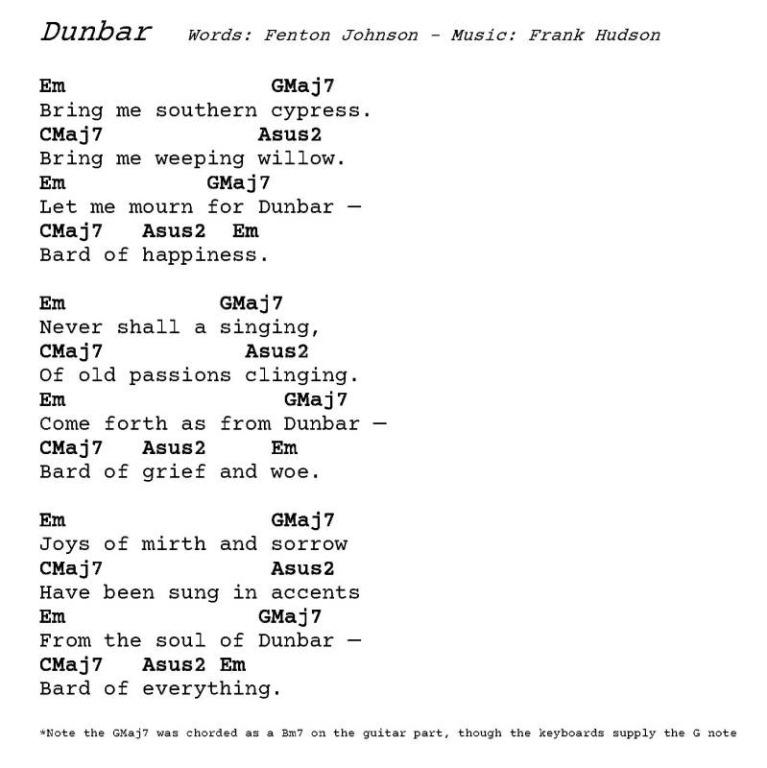
Once again, here’s a chord sheet for those who’d like to sing this themselves.

.

Long time readers here may recall that another of Johnson’s Afro-American poetic contemporaries, Anne Spencer, wrote a short poem linking the died-young Dunbar with early 19th century British Romantic poets like Keats and Shelley.  Today’s piece from Fenton Johnson is a poem with similar goals. Johnson’s “Dunbar”  is just 12 lines itself, but it makes a concise case for Dunbar’s broad worth. In a refrain at the end of each stanza he calls Dunbar “bard” to indicate that he as a poet is representing his culture, and Johnson is particularly interested in bringing forward that Dunbar can do the serious and be a “Bard of grief and woe” but that also he is the “Bard of happiness.” In this claim for Dunbar’s worth in comedy and tragedy he may be exceeding Spencer’s claims for Dunbar — as this best for comedy and tragedy claim echoes one made for Shakespeare.

What does Johnson mean when he writes that Dunbar’s poems were “sung in accents?” Dunbar’s rhymed metrical verse would use standard English (including a willingness to use elevated “poetic diction”). Johnson would begin doing the same. Dunbar also wrote in dialect: poems where the language is meant to portray less-educated speakers, is written in colloquial grammar, and is printed in phonetic approximations of heavy accents. Dialect was a literary vogue in the late 19th century in both prose and poetry. Of the popular poets mentioned above, John Whitcomb Riley, specialized in dialect poems reflecting common-man white speech of the rural Midwest. Dunbar wrote a poem in praise of Riley, Riley wrote a letter complimentary to Dunbar. Modern readers may have an inescapable problem with this sounding like minstrelsy.** And there is correspondence from Dunbar where he wrote that he was increasingly troubled by what he saw as the greater acceptance of the dialect poems. Fenton Johnson may not have known of that, and Johnson would also write in dialect in the mode of Dunbar.

I said at the start of this Black History Month that Fenton Johnson was a bridge between Dunbar and the Harlem Renaissance poets such as Langston Hughes. At the beginning of his writing Johnson is clearly on the Dunbar side of that bridge, so this poem in praise of Dunbar — now song with the addition of my music — is a good place to start. You can hear it with the audio player below, and if that player isn’t there, with this backup highlighted link which will open a new page with its own audio player.

.

*Dunbar’s mother Matilda was born enslaved and illiterate. She worked as a domestic servant after emancipation and took night classes to learn to read. There are stories that she had her children teach her ABCs, perhaps with the dual utility of drilling them while helping teach herself! Paul began writing poetry as a schoolchild, and she encouraged him and organized the family to allow Paul to complete high school. Paul Laurence Dunbar died so young that he was survived by his mother who lived until 1934.

**Bothers me too, and not just because it seems belittling even when it is only so by association with racist beliefs. I have little to no facility for reading or reproducing phonetic speech for some reason.

The Sparrow

Paul Laurence Dunbar is most often introduced as the first successful Afro-American poet, and I guess I’ve just followed form by starting this post that way. That statement is more-or-less true. I’d suppose a case could be made for the primacy of Phillis Wheatley who published a book of poems with some notice in the 18th century even before American Independence. And then too, there’s the question of success levels. Dunbar was able to publish more than a dozen books, got praised by some white literary critics and established poets. Figures in Afro-American culture put him forward as a leading Black poetic voice: Frederic Douglass, James Weldon Johnson, pioneering Black orchestral composers William Grant Still and Samuel Coleridge-Taylor.

As noted in Anne Spencer’s elegant short eulogy poem linking him with other died-young poets, Dunbar was only 33 when he died. Carl Sandburg was just 6 years younger than Dunbar, Robert Frost was but two years younger — both of those poets survived into the 1960s. Dunbar died in 1906 after being debilitated by illness and a series of personal crises. By the time the Harlem Renaissance came around to start making Afro-American artists chic, Dunbar was more than a decade dead. How much more growth and new circumstances could have accrued for Dunbar!

That we still remember him, that a couple of his poems, “We Wear the Mask”  and “Sympathy (I know why the caged bird sings),”  survive to be widely read and considered, should be counted as a success.*  “The Sparrow”  is not as well-known, but I’d note that it both comments on the Afro-American experience and a more generalized human experience.**

“The Sparrow”  is a poem about being sent joy, being sent song, being offered the peace of fellowship, being offered something — and being too callous, or too ignorant, or too busied with the things that aren’t joy and song. In the course of this poem, it may be simply drudgery that is keeping the poem’s singer from noting the bird. Even non-unpleasant rote life can obscure those offered gifts. And oh yes, oh yes,  it can be fear and prejudice that shuts them out too.

The Sparrow

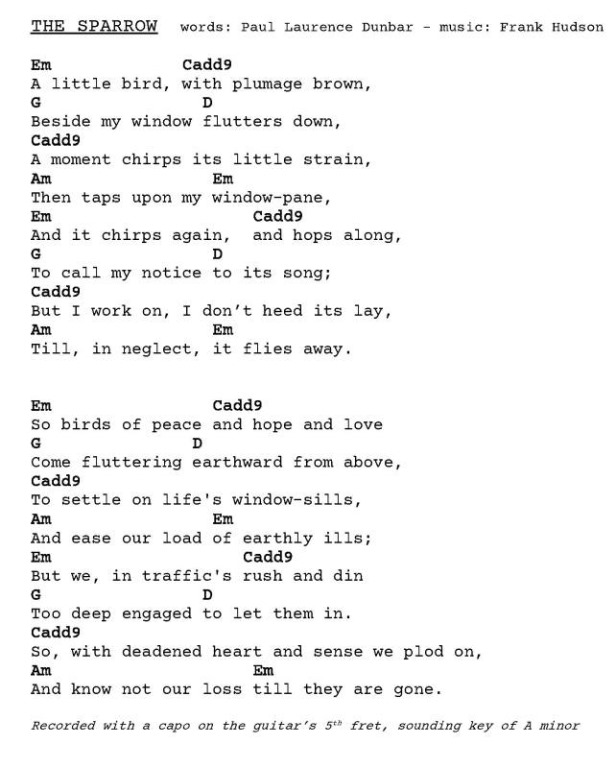
Guitar chord sheet for those that want that want to perform my song setting of Dunbar’s poem.

.

Beyond his remembered poems, I think often of Dunbar’s own life as a sheaf of strong metaphors. His mother was born enslaved. Sensing somehow that her son had a talent as a child, she herself learned to read to help him along, so that eventually that son wrote of that caged bird and of today’s offering sparrow. After publishing his first poetry collection, Dunbar sold it while working at his job as an elevator operator in his hometown of Dayton Ohio. He would offer it to his passengers migrating a few floors up or down inside his elevator cage.***  He grew up in Dayton with a couple of bicycle mechanics, Orville and Wilbur Wright. Orville was his school classmate and helped Dunbar find a publisher for that poetry collection. After eventually attaining some notice for his poetry and public readings of it, Dunbar got a job in the Library of Congress. Around that time his mortal illness was diagnosed as tuberculosis. I read today that he thought the dust of the books in the library made him — the man who could once charm musicians with the way his poetry sung off the page — choke and cough. He descended into his illness and depression for the foreshortened rest of his life. Three years before he succumbed, those bike mechanics made and flew the first airplane, and some of mankind slipped the surly bonds.

Someone had to be the first men to compose flight — but flying or caged, we need to sing, need to hear the singer, even after they’ve flown away. As Dunbar’s “The Sparrow”  has it in its ending line we often “Know not our loss till they are gone.”

I composed the music for Dunbar’s poem earlier this week, and dedicated much of today to completing the arrangement you can hear below with the audio player you may see below. No player?  This highlighted link will open a new page with its own player so that you can hear it. You may notice that I changed a few words in Dunbar’s poem while singing it. Some of the longer sentences didn’t give the song (or at least this singer) enough space for breath — and where rhyme didn’t demand it, I unconsciously changed a couple bits of the 19th century poetic diction as I strove to bring out the poems meaning as I sung it. That’s generally considered a fault in classical song settings, but I come from a looser folk songwriting tradition where that sort of thing is allowed. Here’s a link to the poem as Dunbar published it with all his words and syntax intact.

.

*To be known for a single poem, to have that carried by others, even in part, in reader’s memory, is an achievement I’d say. I can remember having a discussion with Kevin FitzPatrick some years back when he put forward that Dylan Thomas should be weighed by only being known for one poem — or maybe just that one poem’s refrain. That’s an arguable assessment, but even accepting that, that’s more than many poets, including prize winning-poets, achieve years after their death.

**In dealing with Autism Spectrum Disorder I often think of Dunbar’s poem of Black code-switching to seek acceptance or protection from mainstream white culture, and apply it to the ASD tactic of “masking” to seem more neurotypical. Dunbar’s caged bird never has to say it’s a metaphor for Afro-American experience to Black folks, but caged hopes are not an exclusive experience. I’ll split hairs on thin ice to mix those metaphors re: cultural appropriation vs. cross-over impact.

***Further risking flippancy on my part, it could be argued that the Wright Brothers invented the airplane, but the enterprising Paul Laurence Dunbar invented the elevator pitch.

Anne Spencer’s “Dunbar” for National Poetry Month

In 1922, amazing Afro-American polymath James Weldon Johnson* published an audacious anthology titled The Book of American Negro Poetry.   Not only did it claim that there was a tradition worth an anthology at that early date; in his preface Johnson made the observation that Afro-American music was disproportionately important in American musical culture, and furthermore that he saw no reason that Afro-American’s literary impact shouldn’t also arise to that level.

A century later Johnson the prophet could be charged with underestimating Black American’s musical impact, but we are entering an era when his predictions about Afro-American poets are no longer considered exceptional cases, and not even a “why not” situation — but instead an “of course” predilection.

One has to give Johnson credit for declaring this back then, with what poets had managed to be published or otherwise eked out a career at a time when the ex-enslaved were still living. A few of the poets he put in his anthology would soon be known as the vanguard of the “Harlem Renaissance” and yet others would remain little-known afterward. Only one, Paul Laurence Dunbar, really had made writing a career at that point, and a large part of that career’s viability was on the back of a 19th century fashion for dialect writing, with rough printed approximation of regional and ethnic speech being put forward as evidence of America’s diversity or oddness. Reading Dunbar’s dialect poems today is rough going, a lot of context and translation cultural and phonetic is required.** But Dunbar also wrote fluent poetry in the rhymed metrical styles of the day, and those are the poems he’s remembered for now.

And what about those “deep cuts” in Johnson’s anthology, those poets and poems that aren’t required in a modern summary anthology of American poetry? One of those is Anne Spencer.  It’s an imperfect analogy, but you could roughly think of Spencer as a sepia Emily Dickinson. The two poets even shared a passion for gardening. Except there wasn’t a preserved and handed-down pack of good copies of poems in Spencer’s case. Imagine what we’d know of Emily Dickinson if the tiny number of poems that were published in Dickinson’s lifetime were all we had?

It’s plausible the proximate reason that Spencer’s poem praising Dunbar was included in Johnson’s anthology was that Spencer’s home was a waystation and salon frequented by Black artists and civil rights activists in the Jim Crow era, which would have included Johnson. But let’s just be grateful, it’s a lovely short lyric making in a handful of words, the case that Dunbar, and by extension Afro-American poets yet to come, can stand with and extend the tradition of British poets then considered “canon.” And by linking Dunbar with the struggling working-class poets Chatterton and Keats, and the exiled radical Shelley, Spencer may have been making a subtle point about where poetry could, or should, come from. And like Johnson, she predicted with her poem’s linkage that by our present time we’d remember Dunbar as a supple lyrical poet unlinked from the fashion of dialect poetry.

The lyric video includes a poster for a Dunbar performance and some photos of Spencer. Spencer wrote poetry throughout her life, but didn’t focus on publishing.

.

Three ways to hear my setting and performance of Spencer’s “Dunbar”  today. You can use a players that will be shown below in some ways this blog is read, or this highlighted link if you don’t see the player. And, as we’re doing this April, there’s the lyric video above.

.

*Polymath? Well, let’s see: key early civil rights leader, helped found NAACP, poetry, novels, wrote the lyrics to “Lift Every Voice and Sing”  (aka “the Negro National Anthem”), diplomat, teacher.

**Dunbar made a go of it touring and reading his poetry, the sort of thing that was the YouTuber or podcaster route for extra-literary revenue and publicity then. His dialect poems were often touted on the billings, and so may have been the crowd draw. I don’t know how integrated his audiences were, or indeed how the dialect stuff was presented. I’m unaware that any recordings of Dunbar exist, and I don’t know that we even have secondary recordings such as exist of folks who knew Twain, imitating him on early records from direct memory of performances.

I’m not a scholar, but I play one on the Internet

Let me write a post about something that I experienced recently, just like a real blog would do.

Early this month I attended a virtual symposium Sonnets from the American  organized by Dora Malech and Laura T. Smith.*  I’ve heard “Zoom Fatigue” is a thing now, but I found it energizing. I’m still integrating things from this experience, but here are a few preliminary things this three-day program brought forward.

There’s still a lot to be discovered out there for me.  Even when I saw the listing of sessions, I came upon the subject of Fredrick Tuckerman’s poetry, a name that I’d never heard, and someone who was certainly not part of the American Lit canon in my mid-century day. I can see why he’s a fascinating subject, and the simplest thing I can say about his biography is one could quick-take him as “a male Emily Dickinson.” Similar locations, times, and period of social isolation. I’ve read a few of his sonnets, and so far they aren’t grabbing me, but then that may be me. I’ve been quite distracted as this difficult year has progressed.

Americans don’t mind messing with the sonnet form.  I started writing sonnets around age 20 or so. It was the first poetry form I cottoned to, and the only one that I’ve ever practiced much. There’s something about the length of 14 lines, long enough for a contrasting pair of lyric statements, but not so long as to ask the reader to maintain the mind-meld intensity lyric poetry asks for past endurance. The venerated Petrarchan and English/Shakespearean forms have mechanisms that have been established to work, and I wrote close to the form to start. I recall writing a crown of English sonnets as a 20 year old in a barracks on a fair grounds, but mostly since then I’ve wanted to see how many variations I can create inside the 14 line form, while at the same time worrying that I was cheating by not being faithful enough to it.

In session after session I learned from scholars that Americans not only brought a different sensibility to the matter of their sonnets, but that they didn’t mind morphing the form too. And why not, after all the Elizabethans didn’t just clone the Italian form.

I’m pretty sure I’m not up to snuff as a scholar, but I like running into scholarship.  Compared to any scholar (and many avid readers) I’m under-read. I’ve perhaps read more poetry than a few, but I’ve read many fewer novels than almost any serious literature person, and I’ve got lots of holes in contemporary poetry that this project doesn’t help me in remediating. And at my age, there’s also the “I read it fifty-years ago” factor. The younger scholars at the event had a reasonable retention of what they had read, perhaps more than I have read in my longer time. Is there a minimum amount of poetry one has to have read to have a significant interaction with it? I’m unsure. But what the scholars presenting at the event brought to this is new outlooks, new connections. In my modest, under-read way, this is what I try to do here.

To non-scholars who read this, if you think (perhaps put off by scholarly terminology or personal educational experiences) that scholars have dissected poetry only from corpses, the Sonnets from the American  event let me see the real enthusiasms that are out there.

Just this month I’ve noticed that the Royal Holloway, University of London seems to have linked to some thing or things I’ve written here. The referrers link lets me know that folks are coming here via that institution, but the referring links are behind a staff/student login, so I don’t know what. I’m not sure if that’s a blessing. I might be embarrassed by what I wrote!

There are more light-skinned people writing about Afro-American poetry.  I’m a hybrid music and poetry guy, this shouldn’t have surprised me. While this is a complex and delicate subject which cannot help but interact with wider social forces and existential injustices that this post cannot even begin to cover, in my 20th century Afro-Americans tended to write (where they had the opportunity) about current or recent generations of Afro-American music, and white writers, performers, and impresarios did a lot of the noticed work in reviving interest and applying attention to older Afro-American musical artists and forms. This is changing in the 21st century.**

Again, there can’t help but be an overlay of the American racial caste system here, but my observation, blinkered as it may be, is that this factor still exists in music scholarship and non-institutional enthusiasm.

Now this project is enjoined by practicalities and by copyright law to concentrate on pre-1925 texts, which means that my interests in Afro-American poetry must make do with a shorter list of authors, but the Sonnets from the American event had plenty to interest me there. I could fill my dance card with presenters who’d have something to say about Paul Laurence Dunbar, Claude McKay, and Jean Toomer. One of my favorite pieces I’ve presented here, Toomer’s remarkable Modernist love poem “Her Lips are Copper Wire,”  a 12-liner that works like a sonnet, got mentioned in several sessions I attended. Another personal favorite of mine, Fenton Johnson, got a shout out in question time at another.

I don’t want to give a misleading impression here. There were people of color presenting at this event and presenting important insights, but in the current isolation of my project I could think I was the only white guy whose interests in “Other Peoples Stories” included Black Americans as well as Elizabethans, Tang Dynasty Chinese, South Asians, various early Modernists, some French-speaking guys, and sundry 19th century library stack dwellers.

Negro sharecropper and two wagehands shucking corn for the landlord, a white woman. On road to Cedar Grove, west of highway No. 14, Orange County, North Carolina, Sept 1939

Different tunes, same words:  “Happy Harvest” or “Maggies Farm

Since I’ve written this instead of working on new audio pieces, I’ll leave you with a piece I did last autumn, Paul Laurence Dunbar’s poem “October.”  Dunbar, the first successful Afro-American poet, emerging late in the 19th century, wrote in several styles: dialect poetry that I find hard to read and impossible to present, competent variations of late 19th century literary poetry and subjects, and a handful of poems speaking about the experience of an American Black man in an era when the promise of freedom was decaying steadily into a new era’s variation of denial of humanity. It’s those last poems, small as the number may be in his work, that he is most remembered for now. But what about this one? On the face of it, this is a harvest poem, a “happy autumn” number taking joy in the last bounty of fall.

It works entirely on that level. I’m not enough of a scholar to tell you if Dunbar ever expressed any other intent in writing it.

Now, listen to or read the poem again. Published in 1913, when large numbers of Afro-Americans were trapped in a feudal agricultural share-cropping system, where harvest’s bounty went to the white landowner and their family. I can’t unread the subtext here.  My performance of Dunbar’s “October”  can be heard with the player gadget you should find below.

.

*I found out about this symposium via writer/editor/professor Lesley Wheeler. A big thanks to her for that! Wheeler’s own presentation at the event was on sonnets with radically short lines, a variation that I hadn’t thought of or tried.

**And wait a few years, and any fresh Afro-American musical innovation will get adopted by white musicians. I’m an American musician—most of the notes are Black. This blog started out largely focusing on the early 20th century Modernist poetry revolution, part of a multi-art-form change. Fenton Johnson’s poetry and Toomer’s Cain  are public domain examples of Afro-American Modernist poetic work from this era that I’ve run into so far, though maybe there are others yet for me to find. But, but, but, if one asks the question: “Where are the pre-1925 Afro-American Modernists?” all you have to do is look to poetry’s sister art music and the blind will see.

Spring 2020 Parlando Top Ten, numbers 4-2

Continuing on with our countdown of the most popular pieces here this past spring, I find a few things that break the usual patterns. So let’s get on with it and see what we find that were the most liked and listened to since March 1st. The bold-face titles are links to the original post presenting the poem, so you can easily visit those to read more about it and what I said back then.

4. To a Fat Lady Seen from a Train by Frances Cornford. This short poem in the tricky triolet form is as catchy as a nursery rhyme and is fairly well known in Cornford’s native Great Britain. Besides that earworm quality, the poem is weird in it’s shocking and concise frankness of observation, even more so when one considers it was published in 1910, pre-“Prufrock”  and “Hugh Selwyn Mauberley.”  It seems to have raised a little ruckus in its time too, as A. E. Housman and G. K. Chesterton both wrote parodies of it, and so by way of equal time I performed Chesterton’s parody as well in my presentation of Cornford’s poem.

Cornford is another of those worthy-of-greater-attention poets that I’ve enjoyed finding in this project. This spring I presented a poem of my own about the bourgeois and un-artistic lineages of some of our greatest poets. Cornford would be a countervailing case. She descended from William Wordsworth, the great reformer of English poetic language and Charles Darwin, the revolutionary evolutionary theorist. I may be something of a Leveler myself, but I won’t hold it against her.

Pattern breaking? This is a second poem by the same poet to appear in this Spring Top Ten, and it’s quite different from the charming Walter de la Mare-like narrative of “The Old Nurse.”


3. We Wear the Mask by Paul Laurence Dunbar. Pattern breaking? This isn’t a piece that was presented this spring, but back in February. Most of our pieces get a third or more of their listens in the first week, and in this one’s example, those listens were counted last winter—but listens continued this spring at a high enough level that here it is at number 3.

Dunbar is America’s first successful Afro-American poet, and this poem is often read as an eloquent statement of the burdens of bearing up under racial oppression. And that it is, and so it retains a still unavoidable relevance. If you follow the bolded link, the original post includes the guitar chords for my conversion of Dunbar’s poem into a broadside to sing.

Here’s the wisest thing I know about protest songs. Does singing a protest song change the world? Not necessarily. But for the moment you sing the song, perhaps together with others, it likely changes you, for as long as the song continues. Therefore, it’s good that we continue to remember Dunbar’s poem in voice and song.

Not to trivialize the immensity of the struggle against the evil of racial oppression, but as I write this in June 2020, I’m struck by the marchers and mourners here and elsewhere during our Covid-19 pandemic wearing their masks, a gesture to help protect others from the spreading of that virus. “We Wear the Mask”  indeed.


“We wear the mask” photo from Minnesota protests on the killing of George Floyd. photo by Derek Montgomery for MPR News.


2. The Stare’s Nest at My Window by William Butler Yeats. Odd how this poem snuck up on me. I noted a Yeats book it was in had moved into the public domain, and I read the entire poetic series it was part of with an initial shrug. The esoteric mysticism of Yeats is not what attracts me to him, and these poems seemed overdependent on that aspect.

So, what about Yeats attracts me? Well, the beauty of his language certainly, but also his quests to see poetry as something again suitable for performance and to revivify the cultural heritage of his nation which had been much damaged by colonialism.

Somehow I wanted to know the context of the poems, and to find that this poem was written in the midst of a civil war made it more pointed, more charged. Then, later this spring I sat in my room, flames and smoke within my own tower’s view. “A man is killed” and “We had fed the heart on fantasies” are phrases in a poem. Nice words, they scan well, just phrases in a poem?


I’ll be completing the countdown soon with the most listened to and liked piece from last spring. Hit follow or check back to find out what piece that’ll be.

Winter 2020 Parlando Top Ten, numbers 7-5

Back now to our recounting of the pieces that you, our readers and listeners, most liked and listened to this past winter. Let’s jump back in as we count them down.

7. “We Wear the Mask”  by Paul Laurence Dunbar.  This one is remarkable in that it was released on February 24th, very late in the winter season, yet it still racked up a lot of listens to go with the number of likes here on the blog, outstripping the other well-known Dunbar poem I performed and released three days earlier: “Sympathy (I Know Why the Caged Bird Sings.)”

These two poems are the best known works of this early 20th century Afro-American poet directly addressing racial issues, and given the seriousness of racism and the quality of “We Wear the Mask”  as word-music, it’s well earned its current position as a much anthologized poem.

Why did it edge out “Sympathy?”  Who can really say? I liked both performances I did of the Dunbar poems myself. “Sympathy”  has the more complex arrangement, but simplicity that works has its appeal. Or was it something random—did Dunbar’s title put it in search queues connected to world-wide Covid-19 concerns?


6. “Do the Dead Know What Time It Is”  by Kenneth Patchen.  I was completely enraptured by this poem of Patchen’s because of its complicated paralleled half-conversations. In the previous Top Ten post this week I remarked about how Marianne Moore’s poetic expression seemed to echo the actual syntactic twists of transcribed common speech, even at the cost of being harder to follow on the silent page. In Patchen’s poem, we have the more common “naturalistic dialog” where syntax is complete, where sentence structure is plausible, not the fractured and disagreeing actuality of literal transcribed speech. But Patchen has two speakers totally focused on non-answering halves of a conversation: the old guy at the bar who wants to tell the poem’s persona of a second-hand encounter with the God-head, and the poem’s persona, a quasi-homeless swain in conversation with an unheard and somewhat mysterious woman* at the same bar.

The chemical reaction of these two side-by-side half-conversations builds until one phrase appears to link the two—two loves linked somewhere between desperation and desire.

Patchen All at Once is What Enternity Is

And all our count-downs are happening over and over. Patchen as painter.


5. “The Little Ghost”  by Edna St. Vincent Millay.  So, a comforting God-head appears off-stage in Patchen’s poem. Hugo Ball’s ghost in our last Top Ten post seemed of the malevolent poltergeist type. Now here Millay’s is a much more benign spirit who seems to signify being there after being there.

Regarding the music for this one: like a number of my generation, I encountered Ravi Shankar LP records and performances in the Sixties. For a moment some borrowed sense of South Asian music permeated the culture of popular music groups and their audience. Why did that happen? Has anyone asked, much less answered, that question? Yes, I assume the drug and social stress induced search for mysticism was a factor. Maybe George Harrison and his access to the culture through The Beatles alone was enough. But I can speak for myself: some musical qualities easily discerned in this music grabbed me then as they still do now. The musical structures related to steps in various orders away from and returning to a home drone pitch. The opulence of microtones beyond the conventional 12 notes. The singing rhythms.

In the Seventies, that decade that everyone forgets, I spent nights working in a busy Emergency Room, often with an Indian-born surgeon, who as the evening would wear us on, would suture while hum-singing tunes of his homeland. Every so often, even these decades later, I sometimes find myself singing unremembered vaguely South-Asian melodies when working late on some task.

Evidence of some ghost? I doubt it myself. Not reincarnation—resonance.


We’re more than halfway down the countdown. The next three coming up here soon.


*Is she a down-and-outer like the poem’s persona just looking for some kind of human connection? A prostitute seeking money? An analog to the God-head, or is the poem’s persona that? By not clearly defining this, the poem gains mysterious power I think.

We Wear the Mask

Today I present the other widely anthologized Paul Laurence Dunbar poem: “We Wear the Mask.”  I was going to put a “now” qualifier in front of “widely” above, but that made for an awkward sentence. I think it’s worth burning at least another sentence to note that.

In looking for some more Dunbar information, I found this story told by Professor Joanne Braxton. Braxton recounts that as recently as the 1980s when she was looking to teach Dunbar poems at her university, that Dunbar’s work was out of print and difficult to find. That’s not unusual. As Donald Hall fatalistically stated in one of his late essays: the majority of poets who receive prizes and ample publication in their time will be unread 20 years after their death. Braxton, who knew Dunbar’s poems from family and Afro-American tradition, eventually saw to publishing of the first collection of all of Dunbar’s verse.

I’m sure I have readers here for whom the 1980s is “a long time ago.” It’s all relative I suppose, but this change in availability speaks to the dynamism of “The Canon,” and which poets we’re exposed to in school or the culture at large. Braxton teaches by her example that we, each of us, shape The Canon,* particularly with poetry, which is in suspended animation on the page and lives only when we read aloud, chant, and sing it. It’s up to all of us to find those poets who split our skulls, open our caged chest bones, and let us animate the slumbering dreams.

Young Negro Poet Dunbar poster

No date is known for this poster, but Dunbar looks quite young here


Braxton** and others have written eloquently on the meaning of this Dunbar poem and about Dunbar’s pioneering code-switching project to write in dialect as well as mainstream 19th century poetic forms, so once more I’ll defer to others today in those matters.

On the poem itself, let me praise its word-music. There were occasional words that were hard for me to sing or set to music, but that’s likely my fault as a composer and certainly my fault as a singer. “We Wear the Mask” is almost too pretty for its subject, but then there’s a tradition (I associate it with Celtic folk musics) of setting the saddest stories to the most beautiful tunes. Last time, for Dunbar’s “Sympathy,”  I followed that idea for my music and the fiddle melody. Now, for my explicit music today, I decided to go in a more martial cadence and ambience. Art song (that traditional method of setting poetry to music) usually avoids that mood; but one of my influences, the English language 20th century Folk Music Revival is perfectly fine with that.

We Wear the Mask

Here’s the guitar chords. The piano and bass mostly just play the roots of the chords in today’s performance. That’s a nice thing about music: sometimes simple works just fine.


In the Broadside tradition, I’ve included my guitar chords with Dunbar’s lyrics for this one. I played it with a capo on the second fret, so the chords sound a full step higher than the chord forms indicated above. My performance can be heard with the player gadget that should appear below.


*This leads to complaints that change in The Canon is “watering down,” or subject to special pleading which somehow is self-evidently inferior to one or another objective aesthetic criterion. If there are indeed multiple criteria (objectively, that must be agreed to be so) how else must we decide among ourselves what has worth, but by a dynamic of discussion, debate, disagreement? And will such actions by human minds and hearts ever lead to a static situation? How can it, if for no other reason that we continue to create poetry, music and art. Hall says, correctly on the face of it, that most will be forgotten. But like those that charge, armed or not, against the redoubts, we must move forward even if only a few will reach and cross the wall.

**One fascinating bit in the link has Braxton sharing an account from Dunbar’s widow about a possible specific inspiration for Dunbar’s famous “Sympathy (I Know Why the Caged Bird Sings)”  poem.

Sympathy (I Know Why the Caged Bird Sings)

The last two times I presented poems by Paul Laurence Dunbar here I went out on a limb on subtexts that might be present in those poems. “October”  is on the surface a harvest “Happy Autumn” poem, but there’s an element in it of the personified rich harvest’s carefree possession of wealth. Just a handy poetic metaphor? Perhaps. And then there was his valentine of a poem “Kidnapped”  which could plausibly be connected to the Cupid and Psyche myth, but specifically deals with the narrator being captured and taken from its home. Just another recasting of a widely utilized myth? Could be.

But you see Paul Laurence Dunbar is the first successful Afro-American poet. A man whose parents had both been slaves, whose ancestors would have been very non-metaphorically kidnapped, and a man whose race in his 19th century were the harvesters who retained none of the wealth that accrued to the owners.

Today’s piece by Dunbar carries its subtext clearly—it’s hardly subtext at all! One cannot read or hear it and not see it as a statement about freedom denied. Partly because it can be applied so directly to Afro-American history, it’s become one of Dunbar’s best-known poems.

Dunbar Live!

Dunbar with violinist. Seems like an idea….


I don’t need to add to Dunbar’s words today. But since my ego claims I should say something, I’ll note this: Dunbar chose to write his poem as a universalized statement. There’s no lack of Afro-American experiences of freedom limited, other-defined, and outright denied—but the poem he wrote speaks universally of that issue.*  The specifics of racism and economic deprivation would be self-evident to his Afro-American readers anyway.

Was writing about denied freedom in metaphor a commercial choice, in accordance to the poetic style of his time, or an example of a largeness of his soul? Well, now his poem exists, and it speaks to freedom denied to anyone who encounters it.

Levys Ad and Malcom X

I started thinking of wry captions for this. Nope, the picture doesn’t need’em.


Another setting from me using violin, cello, and acoustic guitar today. I went out last night after working much of the day on this audio piece and saw songwriters playing acoustic guitar at a local venue. I enjoyed the concert, but also in the background I was thinking: alas, I can’t really play guitar or write songs like they do. I watched them changing chords rapidly compared to what I could do earlier in the day. That’s so useful I thought, recalling that I had had trouble rendering my leisurely cadence earlier.

I’m not sure why I thought that. I’ve been doing both of those “I can’t” things for over 40 years, despite limitations on my part that change over time. When I returned to the piece today my guitar part didn’t sound as wanting as I remembered, and the uncommon “i, III, VI, v, i” hopscotch chord progression of my composition seemed worthwhile to the morning’s ear. My violin line (played on guitar via MIDI) seemed better than I remembered too. I still wish I was a better singer, but I can express my own way with melody on an instrument even if my singing limits me. The piece seemed valid to me again.

What lesson to draw from that? Comparing your art to others can be fraught. Sometimes when you need to improve, observing others can show you the way. Sometimes when you’re different, it’s still good, and not a falling away.

To hear Dunbar’s “Sympathy”  as I performed it, use the player below. The full text of the poem is here if you’d like to follow along.


*A good argument could be made that there is a specific to the Afro-American experience in Dunbar’s metaphor though: the caged bird’s song. American music, that stuff that we (and a great deal of the rest of the world) have come to hear as the strongest part of our American culture is disproportionally Afro-American music.

Fall 2019 Parlando Top Ten, numbers 10-8

It’s time to look back on the past season and to look once more at the most listened to and liked pieces over that time. We do this in the classic count-down method, moving from the 10th most popular to the most popular piece.

This time I’m going to link to the original post each time so that you can read the longer discussion of my encounter with the text, but if you’d just like to hear the recordings of the performance of the poems, the player gadget following each listing will do that.

10. October by Paul Laurence Dunbar.  When something makes these count-down lists it’s often hard to know if it’s the inherent interest in the author, the things I wrote in the post introducing the poem, or the qualities of the musical piece and its performance that account for that. In this case I think it could be a bit of all three. I wrote in my post about what I thought was an undertone in this seemingly happy autumn poem. Was that a misreading? I’m not sure, but it informed my solemn musical performance which may work even if you don’t share my sense of this supple poem.


9. Saint (Cecilia) by Stéphane Mallarmé.  I do generally get a good response to my translations from languages other than English, which encourages me to continue them here. This one was a real bear to wrestle with, and my post on it went into detail with the kind of problems I encountered in that process.

I highly recommend translation as an exercise for poets. Not only do you need to achieve a Vulcan “mind meld” with another artist when translating them, but the mental muscles activated to find the best English word in sense and sound are great ones to develop for one’s own writing.


Rilke Mallarme and Dunbar

Three poets awaiting the invention of the MacBook and the modern coffee shop with WiFi: Rilke, Mallarmé., and Dunbar.


8. Autumn Day by Rainer Maria Rilke.  Another translation that received good response this fall. Here I ascribe a substantial portion of that response to those looking for and appreciating Rilke poems, and finding some here. Of course, there may be many reasons for that desire to seek out Rilke, but I’m under the casual impression that he’s treasured for what seem to be life lessons to his readers. I noted in my post on this poem that it’s been a particularly popular target for translators, but you still may want to look at mine, or hear the way I performed it.

This poem of his is also an example of a theme: gardens and small agriculture, that I returned to again and again this fall. Perhaps it’s my own position in life’s passage that caused that, but there are a good number of autumn poems that are both about the experience of “cultivating one’s garden” and the valence of the ending of a growing season. Such is Rilke’s.