Parlando Project Status Report

This summer I completed the goals I set out for the Parlando Project, which I originally envisioned as a one-year project to combine performances of various words with various music which I could present to the public here on this blog, or as podcast that could be automatically downloaded if desired. My original goals was to try to present 100 to 120 pieces during that year, and I hoped, despite (dare I hope, because of?)  the variety that I would achieve a few thousand downloads for the entire series of pieces.

What a year it has been! The 100 pieces goal looked ambitious to me, and indeed the amount of time to write most of the music, produce and record the performances, and the research into their presentation—most of which remains unseen to the readers and listeners—was considerable. As of this week, there have been 128 Parlando Project pieces since our official launch. Hundreds of hours have gone into this year, and as with all such intense pursuits, the artist’s family gets to wonder why someone would spend that much time staring at the thing the artist is making instead of the very real people who surround them. That’s a very good question that no artist really has an answer for, save for most artists’ recognition that they seem to have no choice in the matter once they feel what the thing they are making could be. So I thank them. And Dave Moore, who’s not only written several of the most popular pieces here, he has been key to this. He’s allowed me to use his voice so you don’t have to always hear mine, as well as playing most of the keyboard parts on the Parlando Project music pieces. The Parlando Project wouldn’t be what it has been without Dave.

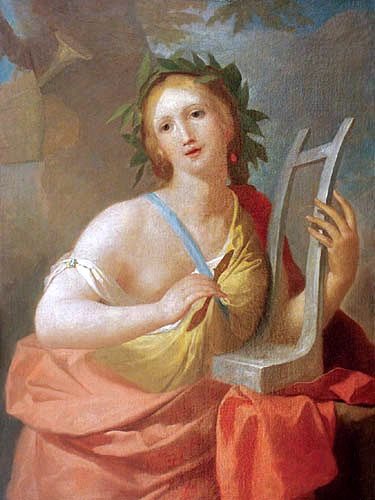
Calliope_by_Marcello_Bacciarelli

I suppose I should thank the muses too, but she thinks it’s a lyre,
even though it has no strings. Is it just part of an old chair?


Audience growth has been beyond my expectations over the year. Streaming web stats, at least as I get them and understand them, are less definitive than I would have hoped, but by this summer thousands of streams or downloads a month had become the norm. Blog readership here is more in line with my initial expectations, and lower than the podcast stream numbers, but the blog readership is still it’s growing steadily from what I can tell.  This only concerns me in that the show notes with the podcast are a poor substitute for the richer presentation of the material about the piece in this blog, and through iTunes the show notes are about to get much briefer and simpler. Maybe this is a sign I should stop talking and simply Kick Out the Jams?  If so, I’m going to be a bit dense and put even more emphasis on the blog in the next few months.

But I can’t leave this discussion on audience without thanking each of you who read this, and to thank several times over those of you who’ve linked to Parlando Project pieces on social media or other blogs, or who have taken the time to click the “like” star on a post here. I’m fine on focusing in close on creating what I hope are interesting pieces, but I’m not good at promoting them. You are the ones who’ve done much of that. I’m not always sure who’s done this linking, I only see the result when a piece starts getting more attention. If you’ve one of the readers/listeners who’s done so, and don’t mind saying so, please let me know in the comments.

Going forward I’m intending to keep the audio pieces coming. If I have the time, I even hope to spend a little more time looking for permissions to include works still under copyright. It’s distressing to me that there are authors whose work I’d love to present here, some of whom are long dead and whose work still speaks to us, but I feel constrained by law from doing so, and feeling lost as to the methods to get around this issue.

It’s this connection with authors who can no longer speak for themselves that has been a surprising, but most moving part this project. Reading and translating Du Fu, coming across writers I knew only as names like HD or T. E. Hulme. Finding out more about Yeats or Carl Sandburg, their poetry and politics. Finding out that Bob Dylan was the second or third songwriter to win the Nobel Prize for literature, and that the first Nobel songwriter,  Rabindranath Tagore, was such a mammoth figure standing outside my view until I looked. Or that Christina Rossetti spoke to me more clearly as a poet than the other Pre-Raphaelites. Without this project I’d never have learned that I had this unscheduled train layover in the English village of Kingham one hot summer day just down the track from where Edward Thomas was still listening to all the birds in Oxfordshire and Gloucestershire. That the teenage love poem of George Washington still could have a listenership. That the simpler Emily Dickinson speaks, the more sharp the ambiguity, all needle and no embroidery. Hearing and relaying the words of Viola Davis about art being the “Only profession that celebrates what it is to live a life.”

Calliope with long blog post by Charles Meynier

I know I’m supposed to be inspiring and all,
but isn’t this blog post getting a little long?


So I’m going to continue here with the Parlando Project to “Tell Other People’s Stories,” but here, with this blog, I’m also going to spend some time talking about art, particularly about the intersection of music and words. These blog posts are going to be longer, perhaps more theoretical, but don’t fear too much theory. I’m still going to be elbow deep in making more Parlando project musical pieces, and work rounds off the sharp edges of theory.

The Nymph’s Reply to the Shepherd

There’s a long tradition of “the answer record” in pop music, where another artist responds to a hit record with an opposing viewpoint. Christopher Marlowe’s 1593 “The Passionate Shepherd to His Love”  (our last post) received a similar diss from Sir Walter Raleigh with his “The Nymph’s Reply to the Shepherd,”  which is today’s. Who will folk-rock the mic harder? Feel free to re-listen to Marlowe’s inning before considering Raleigh’s reply, Marlowe’s player is just below:

As I mentioned last time, these poems with their shepherds and lovers, called Pastorals, were proudly artificial, and set in a completely stylized and relaxed world of affection and sufficiency. You may find any desire to dwell in this unreal world strange and old-fashioned, but perhaps we imagine now another kind of locus amoenus/“pleasant place” to dream of going to, to escape the world.

Christian_Wilhelm_Ernst_Dietrich_-_A_pastoral_landscape_with_Diana_and_her_Nymphs,_1754

“Then he was all about rural handicrafts all of sudden. Was he even interested in me?”
“Well, it’s not like taking care of sheep is that hard. A child with a tambourine can do it!”

 
Raleigh’s “The Lie”  has already demonstrated here that Raleigh had no patience with romanticism. So, he’s primed to take on “The Passionate Shepherd,”  but he also notices another weakness in Marlowe’s argument: the Shepherd promises pleasures, presumably mutual pleasures to his lover, but he isn’t stopping there. He’s going to demonstrate his commitment by throwing an entire Etsy shop at her: beds of roses, caps, vests and belts made from woven wildflowers, wool dresses and wool lined slippers. And bling! Gold buckles, coral and amber buttons.

So, Raleigh composing the nymph’s reply has three arguments to make. All those hand-made crafts on offer? Doesn’t move me Shep. Outdoor animal husbandry? Not as romantic as you make it out to be in May, and those wool slippers better be warm if I’m going to be traipsing after some sheep come January. Lastly Shep, you’re all hot and bothered about me now, but just how lasting is all that? I appreciate the offer, but let’s just say I’m keeping the wool lined slippers and you can go try your line on some other nymph?

Wool Lined Slipper

I’m not even sure what a kirtle is, but I understand cold feet at night

Musically, this is another piece inspired by a 1960s folk-rock sound. I was thinking specifically about the musical style of Fred Neil’s Capitol records as I arranged this. I used a minor key chord progression somewhat related to the major key one I used for “The Passionate Shepherd,” and once again I sung this one. Raleigh, if downbeat, is just as lyrical as Marlowe in his answer. Marlowe has pretty lines like “By shallow rivers to whose falls/Melodious birds sing madrigals,” but Raleigh has “The flowers do fade, and wanton fields/To wayward winter reckoning yields.” So, use the player just below to hear Sir Walter Raleigh’s response in song.

I Did Not Go and See the Perseids

Here’s a something of a bonus episode based on a sonnet I wrote a few years back. I’m tired tonight, and not feeling particularly useful, and I recalled that this is the time of year when one of the better regular meteor showers happens.

perseids meteor shower

Meteors are supposed to herald change, but the sky cannot change us


I recorded this piece tonight, to try to assuage that useless feeling. I started with the bass part, as the sound of the bass always seems to comfort me. I fit the drums to that bass part, did the vocal, and added a couple of guitar parts. It’s a short piece, and it was soon done.

Meteors are fabled to be meaningful from those times before our modern highly illuminated age erased them from the view of our cities, such as the city where I am stuck tonight. In the poem, I had played with the idea that making the trip to the countryside to see the Perseid meteor shower could indeed change someone’s life.

I did some extreme enjambment, breaking words in half, in a few lines in the poem to try to show how the sharp streaking line of a meteor trail might change us in an instant, because of course we are not changed in an instant, ever, though love and good fortune make us think at times that we have changed.

If change was instant, it would not be hard as it is, nor as easy to avoid.

I wish you all a good night tonight, with or without visible stars or knowable fates.  And I thank you again for reading and listening over this chattering yet silent Internet.

To hear the performance of “I Did Not Go and See the Perseids,”  use the player gadget below.


What is Poetry and What Is It Good For?

People blog about these allied topics elsewhere, and there seems to be a bloomlet of books answering the same questions. I’ve lived a fairly good number of years, writing, reading, and listening to what I consider poetry, and I can’t say that I’ve thought of this for a long time.

There are inductive and deductive artists: ones who think of, or latch onto, a useful theory, and produce art from it; and those that, if they think of theory at all, derive it from what they have already created. I’m in that later, and I think larger, group.

The concentrated amount of work I’m doing with the Parlando Project means I am working a lot with poetry, and making constant choices. To give me focus in this process I did take on a few principles for Parlando, but  having handled this much poetry in the past year means that I can’t help but observe my choices and what those choices say about what I believe about poetry.

Poetry is musical speech.

Simply, poetry is musical speech. And good poetry not only sings with its words, it sings twice, as its thoughts flow like the logic of music. Do that and I think it’s poetry. Fail to do that (or rather, if I fail to hear that) and it may be a perfectly good something else, but it’s not poetry.

Hold it, some of you may be saying to your screen, what about free verse? What about those decidedly non-rhythmic pieces that are published as poetry, and are widely considered as such? Let’s take Ezra Pound’s famous short imagist poem “In a Station of the Metro” as an example of that:
 
“The apparition of these faces in the crowd;
Petals on a wet, black bough.”

No meter, no rhyme, is that musical speech? To me, yes, it is. I hear this music, as I hear the music in other poems, as a musician, but you could hear it too, even if you are only a listener of music. Music does not need to be a drill team march or four-square polka or sound the bass drum of some dance music that expects regular, repeating beats. The top melodic lines of much music vary in rhythm constantly, and musical speech should have the same freedom, as Pound himself declared in his famous short list of Imagist rules.

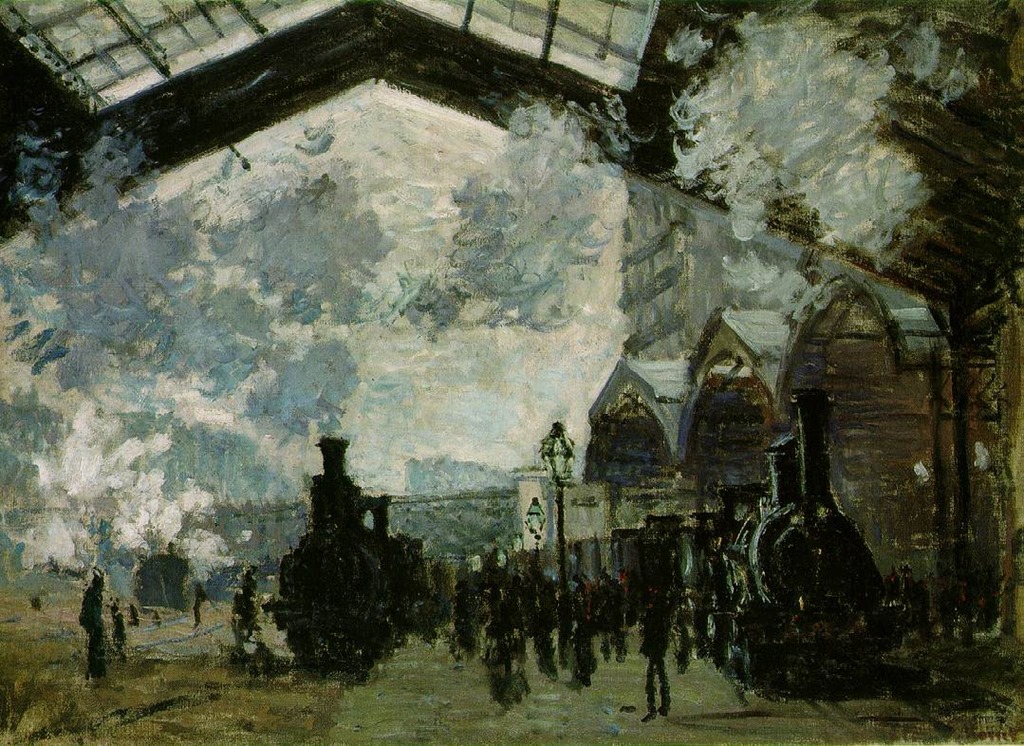
Monet St Lazare Station

They say the best things in life are free, but you can give them to the birds and bees!
I want Monet! Monet!  That’s what I want!

I could read other poems, ones that do follow conventional accentuated syllabic meters, and not hear much music in it. If I turn on a metronome or a simple drum machine pattern, I may hear rhythm, but I don’t necessarily hear music.

Yes, this sense of musical speech is subjective, particularly for a poem sitting mute on the page.

And what about the second music that good poetry will also sing, the musical logic of thought? I’m not even sure that “thought” is the right word, as it’s more at apprehension or experience, but as a listener or reader those subjective transferred experiences are felt as thoughts are and engender my own thoughts in response. When Emily Dickinson looks at a bird in her path, or Meng Haoran awakens after a stormy night, or when Ezra Pound comes to the subway stop and sees this throng of urban humanity as a transitory and eternal natural grouping I get to share my understanding of their understanding, if I have the patience and openness to seek to do so.

Music is not how to get from one note to the other as quickly and predictably as possible, rather it is how to pleasantly surprise, or even confound, you in those journeys between related notes.

Any of those experiences could alternatively be a chapter in a memoir, or a scientific observer’s log entry, or a character’s chapter in a novel. Some experience or apprehension of experience is transferred in those ways too—that’s what all art does—but in poetry, the transfer happens in the context of musical expression. This can work, like a meditation chant, a hypnotist’s spell, or any experience where the normal stops and starts of thought are interfered with. And the flow of the order of the data has an internal meaningful structure in good poetry, as a melody or a chord progression has in music, which is not necessarily the flow that works the most efficiently. Music is not how to get from one note to the other as quickly and predictably as possible, rather it is how to pleasantly surprise, or even confound, you in those journeys between related notes.

Consider an image, a set of relationships set out in a poem to be related at once to each other, as chord is in music.

Consider an image, a set of relationships set out in a poem to be related at once to each other, as chord is in music. And the relationship between one image and the next is like a cadence or sequence of chords in a musical composition.

When one thinks of poetry, as I now do, as a musical thing, and not a literary thing, then the presentation of it as we do in the Parlando Project, should make sense to you. Not that it must make sense first, it can simply be experienced.

All this implies some of what is the worth in poetry; and to be honest, some also of what is problematic in poetry, but I’ll leave a further discussion of those things to another post.
I Was Not Yet Awake

Here’s a piece with a short story written and read by Dave Moore.

Just as I have my bicycle ride poems, Dave has his morning dog walk poems and stories, and this one is one of my favorites. Dave tells me that he thinks he may have messed up the ending in this performance of “I Was Not Yet Awake ,”  but I think it works just fine.

I’ll let the story unfold as you listen to it without a lot of commentary from me this time. “I Was Not Yet Awake”  is a story about neighborhoods, neighbors, and trust, distrust and need.

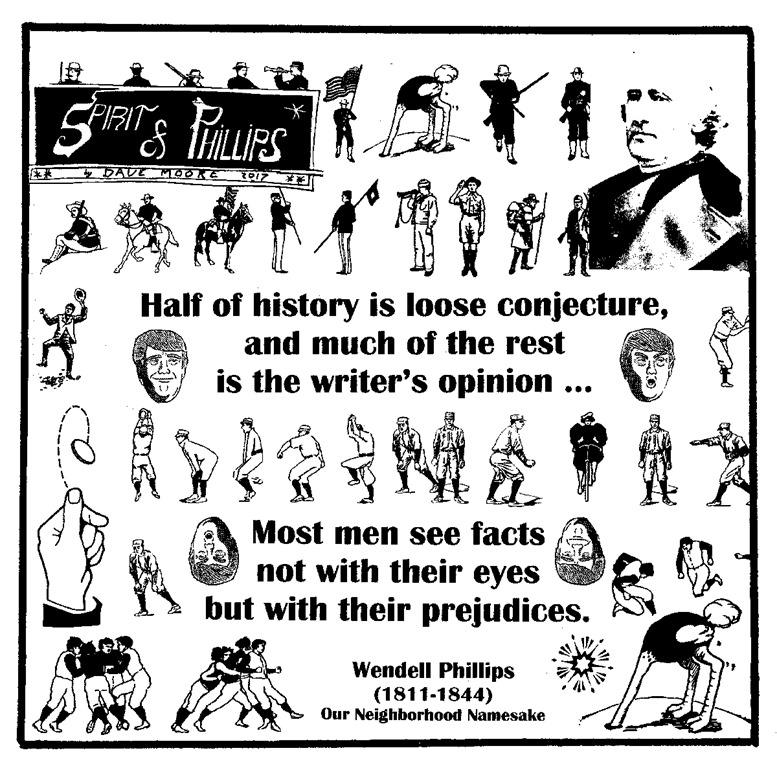
Spirit of Phillips Half of History

Dave Moore is also a cartoonist. His “Spirit of Phillips” reinvigorates the work of radical Abolitionist Wendell Phillips.

Dave is the alternative reader with the Parlando Project, and he also plays most of the keyboard parts you hear here on other pieces featuring the LYL Band. This story is much different from the last piece, where I tried to mash up Capt. Beefheart and Gertrude Stein, and it will also be different from the next episode. That variety in music and words is part of what we do. So go ahead and listen using the player you will find below.

Our audience growth in the past year has been largely as result of readers and listeners like you who have spread these audio pieces by sharing on social media or through their own blogs. Thanks to everyone who’s helped!


One Year of the Parlando Project

A couple of days back the Parlando Project passed its first birthday. It’s eating solid foods now, and is making efforts to walk. I thought it might be a good time for some posts to catch up a few things.

First off, some of you may be new to the Parlando Project and its presence here on this blog. What is the Parlando Project? We combine music (various kinds) with words (various kinds, but mostly poetry). I’m the Frank Hudson in this blog’s domain, and I’m the “editor” of this Project, but Dave Moore (whose voice you’ll be hearing again soon) is the alternative reader and vocalist here, and the project wouldn’t be the same without him.

I ask you to note the “various” used twice above. I’m one of those rare people, who when asked what their favorite type of music is, cannot answer. Yes, I have moods when I don’t want to hear one kind of musical expression, or when I strongly desire to hear or make another kind, but overall, I can’t say there is one type of music I want to be gone from forever, or another that I will never listen to or try to make.
 
So please do not take any single example of our music as representative of what you’ll hear next. I like noisy and chaotic music and sweet consonant sounds, I like solo acoustic guitar, I like modern day composers who refuse to die, I like artificial sounds created electronically, I like the natural sounds of strings vibrating in air, I like things simple and I like things complex.

The same somewhat applies to the words we use. I have a certain framework that we use at the Parlando Project. We favor shorter pieces for example. We both like a darkly comic touch. We generally don’t use our own words, even though Dave and I have written our own words since our youth, and we’ll use some of them here.

Rather than add another “I” speaking to the mesh of the Internet, I want to jointly experience with you some understanding of what others have written and spoken.

Why is that? The Internet is full of self-expression. I don’t want to put that down, but I feel the various mediums the Internet carries to your phone, tablet or computer are awash in it. Even our literature has become primarily memoir in one guise or another. Well, I consume some of that, you probably do to, but I’m currently not in the mood to create more of it. Rather than add another “I” speaking to the mesh of the Internet, I want to jointly experience with you some understanding of what others have written and spoken. That’s what I seek to do by performing the Parlando Project pieces, and writing about them here.

A poet who Dave and I have known for decades, Kevin FitzPatrick, was once reviewed as writing “poems that have other people in them.” Kevin’s other people are real characters, they have their own lives and wholeness, they are not hand puppets speaking only the words he mouths for them. They, like Kevin, are sometimes funny and sometimes subject to their own misconceptions and foibles.

Rush Hour cover

This is one of Kevin’s four published collections of poetry
You can find a copy here, here or here.

Stop and think for a moment now of how few poets do what Kevin does. Perhaps, if you write poetry, you too, fall into that larger grouping, writing from your innermost feelings, allowing other voices to speak only as you would have them. At the Parlando Project I use the idea, the rule, “Other People’s Voices” to remind me of this principle. I join with you, the listener and reader here, in trying to understand those other voices, by merging our performance of their words with the music we create as an audience to them.

Strange Meeting

Here is one more war poem from WWI, this one by another soldier poet, Wilfred Owen.

Beside living with the trauma of his war service, Owen was another poet caught in the revolution as English poetry moved from old modes to newer modernist verse. Like his friend Siegfried Sassoon, he was a decorated soldier who came to broadly distrust the case for war. Unlike Sassoon, Owen did not take the risky public stand against the war while it was being fought; but also unlike Sassoon, his fate was to die at the front of the war. Owen’s war poetry was largely published after his death, with Sassoon’s assistance and promotion.

wilfred-owen

Wilfred Owen: poet, soldier, witness to warfare

If WWI was billed as the war to end all wars, the anti-war poetry Owen and Sassoon wrote also spoke to universal themes. At least to what I’ve read, their poetry is not an argument against specific issues of their war, rather it’s an angry argument against war itself, and the associated patriotic justifications for sacrifice. Owen and Sassoon both wanted to rub their readers faces in the bloodied mud of the trenches.
 
It’s sometimes said that artists, if only they would happen to suffer the real struggles of non-artistic life, would see that art is only a trivial sideshow, inessential entertainment and decoration. Men like Owen are an example of how this is not necessarily so.

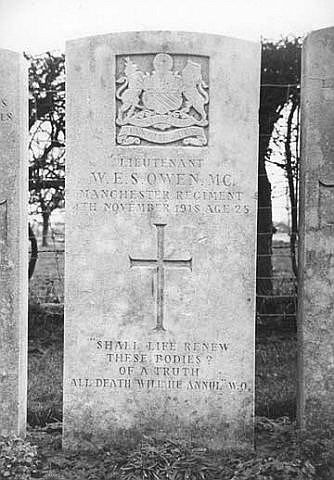
WilfredOwensGrave

Wilfred Owen’s gravestone

Today’s episode, “Strange Meeting,”  shows Owen’s anger, but because he’s a poet not yet fully in the 20th Century style, he expresses it sounding like a 19th Century poet, more like a Keats or early Yeats. As I came to grips with this piece, I felt the thought and subject matter was sometimes obscured by its march of rhymes and occasional poetic diction—and though a poem’s music is subjective, “Strange Meeting”  doesn’t consistently sing to me like Yeats does, but then Yeats is a very high standard to meet, and Yeats never lived the brutal fighting the war poets like Owen went through.

Speaking of music, I’m finding myself repeating ideas (or finding a style?) with the settings lately. “Strange Meeting”  starts with sustained piano chords, unsteady strings, and a plaintive wind instrument (in this case, an English horn). But I felt that carrying that all the way through would work against the grit and bitterness of the story here, just as Owen’s poetic diction does, so for much of the middle section I break it down to just drums and bass.

I hope I’m not overwhelming regular listeners with the war poetry from WWI this month. Perhaps I can find a change of pace soon, and some new variations in my musical arrangements too.

To hear my performance of Wilfred Owen’s WWI ghost story “Strange Meeting,”  use the player below.

I Have Fallen in Love with American Names

Anyone remember those sentry questions that would be used in to determine if some straggler in the soldier’s darkness was an American or foreign foe? “Who plays first base for the New York Yankees?” they’d ask.

Native Iowans have a similar method to catch those from out of state. They might start right off with asking about the state capital. “Dezz Moynens.” Wrong! Not an Iowan. “Day Moyne.” Native. Poweshiek, that fine county with a Brooklyn no one knows. “Poe’s He Eck.” Nope. “Powa Sheek.” How about that nice small town founded by lost Swedes in Boone County, Madrid. “Ma Drid?” Outsider, it’s “Mad Rid!”

While overseas in France in the early 1920’s Stephen Vincent Benet wrote his own catalog of place names that I have adapted for today’s piece “I Have Fallen in Love with American Names.”  In it, Benet contrasts American place names with European ones, perhaps to staunch a little homesickness on his part, but also as part of his claim to something he and Carl Sandburg helped to define in the first half of the 20th Century, something that’s now used to label a musical genre: “Americana.”
 
To briefly define Americana, it’s the featuring of things that are distinctive to our country, most often things that are in the past tense, things that we are asked to pay attention to as our heritage. If these things seem a little odd, old-fashioned or provincial to us, that’s the tang the artist wants us to taste.

I came upon Benet’s poem after reading a Phillip Roth memoir in the New Yorker last month, where Roth takes off from Benet’s poem to discuss how a literary sense of a greater America he did not yet know expanded his horizons westward from his childhood neighborhood in Newark New Jersey. Roth remembered how, in the 1940s, even though one of the most cosmopolitan cities in the world was a river and a marsh away from his town, New York City was a world away, perhaps as far away as America seemed to Benet in Paris.
 
Roth doesn’t mention it, but as I read Roth’s piece, I thought of Benet’s story “By the Rivers of Babylon,”  were a future neo-indigenous youth ventures across that same river into the ruins of New York on a vision quest.

The original title

This was “By the Waters of Babylon’s” original title

In the nearly 100 years since it was written, Benet’s “I Have Fallen in Love with American Names”  has not fallen to ruins, but it has gained some tarnish or patina. I’ve cut a stanza because the notables referenced are now obscure, and I modified another line in it, not out gentility, but because it frankly stuck in my craw. By chance, one of the obscure and colorfully named towns in Benet’s catalog, French Lick, now is slightly better known as the hometown of basketball great Larry Bird—but that’s the not the greatest resonance the poem has picked up over the years.

As the poem builds to its ending, Benet uses something like the thought used by Rupert Brooke in his famous war poem “The Soldier”,  the idea where even if Brooke was to die and his body was buried overseas, that his Englishness would remain. Benet sets up a series of places he might be interred in England or Europe, and ends with a line that later became the title of a landmark book about the cruel and unjust treatment of indigenous Americans. Did Benet choose to end his poem with the evocative place name of Wounded Knee because of the massacre that occurred there a bit more than 30 years before he wrote his poem, or because of legends that Crazy Horse was secretly buried there, or was it only something that caught his eye on the page of an atlas? I don’t know enough about Benet to say. His litany of American places does include “a Salem tree” which sounds to me like a reference to the Massachusetts witch trials and executions. If we are to remind ourselves of the greatness in our heritage, we are likewise obligated to remind ourselves of the sins there too.

I Married A Witch Poster

Fall in love with a Salem tree? I have a tenuous connection to the story made into this film.

In my performance, I made the choice that, author’s intention or not, modern audiences will hear it as intentional, so I should perform it that way.  The American name of my home state, Iowa, comes somehow from it’s indigenous people, but over 400 years passing, we no longer know what it’s meaning is. How strange to say that I come from a place of no meaning, knowing the pass-word to tell the magic ghosts of native sentries, but knowing not what I’m saying.

To hear “I Have Fallen in Love with American Names” use the player below.

a new mix of On the Troop Ship to Gallipoli

I don’t plan on making a habit of this, but the next morning after I posted the audio piece where I perform an “Imagist” revision of Rupert Brooke’s late fragment written shortly before his death while serving in WWI,  I wanted to change a few things about the mix.

WWI troop ship

Soldiers on a  World War I troop ship in transit

What’d I change? I delayed the entry of my piano part to a few bars later. I remixed the concluding electric guitar part entirely, it’s now a bit more forward in the mix. And finally I added an E-Bow electric guitar top line over the final section. Why did I make those changes? Just trying to give the piece a bit more sense of “build” as the troop ship steamed along carrying Brooke and his fellow soldiers to the disaster that would be the Gallipoli campaign. The newly added E-Bow part is probably the biggest change. The E-Bow is a clever gadget that magnetically drives a single instrument string as if it was excited by a bow. As the name suggests, it’s sometimes used to give the effect of violin or viola sound coming from a guitar—which Jimmy Page and Eddie Phillips aside, is not designed to be bowed, however I think the part I played sounds less like a orchestral violin and more like an overblown free-reed instrument.

In composing the music for the Parlando Project pieces, I like using different sounds like a writer might use different images or connotative words in text. If you listen, low in the background of the mix I have a Mellotron flute part. Of course this late 20th Century instrument would not have been known to Brooke and his fellow troops, but for those late 20th Century people a low Mellotron flute part brings to mind (ear?) The Beatles “Strawberry Field Forever” or “Lucy in the Sky with Diamonds” or other English rock band recordings of the 1960s, so I was trying to bring in some sense, however anachronistically, of the soldiers thinking of home, and then at end I add that much louder, strident and free-reed sound from the E-bow guitar part.  Similarly my fizzy guitar phosphorescent plankton bow-wave and electric bass thrumming ships engines. Hope it all works for you.

The new mix replaces the old one as of early this morning. To make it easy to hear the new mix, I’ve embedded the player to hear “On the Troop Ship to Gallipoli” below. The explanation of how I revised Brooke’s words, as if he’d been edited by Ezra Pound or had lived long enough to embrace the ideas of modernist poetry, is covered in the previous post here.


South Folk in Cold Country

Here’s one more piece from Ezra Pound’s 1915 breakthrough collection “Cathay,”  a war story he called “South Folk in Cold Country.”

At the time Pound was working from Ernest Fenollosa’s, and Fenollosa’s Japanese teachers,’ notes to translate classic Chinese poetry, World War I had broken out, and England, where Pound was living, had mobilized to fight this war. Like William Butler Yeats (with whom Pound was staying for part of this time) Pound did not want to take a side in the war. Not only skeptical of the war’s patriotic rationales, Pound also wanted to continue to focus on his modernist artistic revolution.

Earlier in the Parlando Project, we’ve seen how Yeats responded at the beginning of the war. His On Being Asked For a War Poem”  cloaked his disdain for statesmen’s’ rhetoric while seeming to take a aesthete’s stance of artistic superiority and inferiority.

Pounds Directions to Yeats House

Robert Frost needed to get to W. B. Yeats house,
so a helpful  Ezra Pound drew him this map.


Pound felt similarly. He may not have been sure, at first, of the what he would eventually call lies by the politicians by the end of the war, but his poetic BS meter was immediately sure that the patriotic verse being produced to ennoble the war was false ethically and artistically. But Pound also recognized that any poetry he would write in such a charged environment would be inescapably seen in the context of the war.

Still, he was wary of writing about war as a civilian who had never fought in battle. At one point, he reported he had tried to enlist, but was turned down due to his (then neutral) American citizenship. At another point, he wrote a review critical of Rupert Brooke’s war poetry, only to have Brooke, who was serving in the British armed forces, die while in service, leading Pound to qualify that he was only criticizing the poetry, not the citizenship.

So as Pound created and promoted Imagism, his vision of new modernist poetry by recreating classical Chinese poetry in English, he came upon a solution. He would use the Chinese poets, both as the model for his new kind of verse and as a way to comment on the war.

Today’s audio piece is an example of how Pound went about those two things, once again translating and transforming the work of 9th Century Chinese poet Li Bai.

“South Folk in Cold Country”  is an account by Li Bai of a military campaign in the north of China that had occurred almost a thousand years before he wrote. Pound, taking this for his modernism, has the soldiers who speak of their war experience say nothing of what they are feeling. There is not a word of them saying they are tired, confused, frustrated, or suffering, but their world is described by them as the image of all these things. While Li Bai/Pound’s “River Merchant’s Wife”  reads musically off the page, despite being “free verse” in English, “South Folk in a Cold Country”  has a more abrupt and doubtful music. Pound was trusting Li Bai and his own artistic sensibilities so that he might get some of the war experience right.

When I first read “South Folk in Cold Country”  this year I thought: this sounds like a bag of fortune cookies mixed in with Ernest Hemingway. Either or both of those comparisons may sound dismissive to you, but I suspect the best fortune cookie aphorisms have some relationship, however strained, to the concision of classic Chinese poetry, and Hemingway, however familiar he may seem to us now, was using Pound’s ideas as part of what was to be Hemingway’s revolution in prose. Thanks to Hemingway, and in turn, to Pound who directly influenced and taught him, we now are not surprised by representations of war, violence, and death that assume concise description and charged observation can be truer than superfluous remarks by the author.

Hemingway in uniform

Hemingway, who did serve in WWI, sought out Ezra Pound to shape his writing about it

I did wonder about the General Rishogu mentioned at the end the piece. His Chinese name (remember, Pound was working from notes of Japanese scholars, not Chinese ones) was Li Guang, and his story is here. I like this as an ending. I’m not sure if Li Bai’s soldiers who speak in this piece are using Rishogu/Guang as an example of the hard fate of soldiers; or if they are saying, after what we’ve been through, making all those rapid marches to make Rishogu/Guang’s name, who among them will care about the general’s death. On the odds, I’ll take the later.

Musically I used some relentless vibes over electric piano and bass to stand for the rapid marches that the “swift moving” general kept ordering, and then some neighing winds from a synthesizer patch. To hear me perform “South Folk in Cold Country”  with that music, use the player gadget below.