In the last hour of 2019 I was sitting on the couch with my son as we exchanged video clips we thought each other should see. I mentioned that Neil Innes had just died, that he was part of the Monty Python circle, and that before Python he had founded a musical group that helped inspire the Pythons called the Bonzo Dog Do-Dah Band.
“I think I’ve heard of the Bonzo Dog Do-Dah Band.”
“Search for ‘Canyons of Your Mind’” I suggested. Sure enough, the magic of Internet searching brought up a video. “This is the most Sixties song ever” I promised.
Here’s the clip we watched.
Farcical fascicles found “In the wardrobe of my soul, in the section labeled shirts.”
.
I wasn’t sure if I needed to provide context for it. As the performance shows they’re sending up every bit of performative anguish over absent love as well as the worship of musicians offering it. And the lyrics? They should have mortally wounded a certain kind of Sixties metaphor that was supposed to transcend our mundane world. In the middle of it Neil Innes plays a guitar solo that was likewise a pig cupid’s dart to the heart of every guitar hero moment. Anyone got the tab for that?
Son was not impressed. He had just shown me a Franz Ferdinand video chock-full of early 20th century Dada and Constructivist art moves: Max Ernst, Kurt Schwitters, Alexander Rodchenko visual riffs. In contrast, the Bonzo’s Dada lacked the same danceable drive and sleek black stage dress of the smart and sharp 21st century Glaswegian rock band.
Oh well. I hadn’t seen the Franz Ferdinand videos he showed me and I was glad I saw them. They made me think how we are still working out the Modernist revolution as we enter another decade that will be called “The Twenties.”
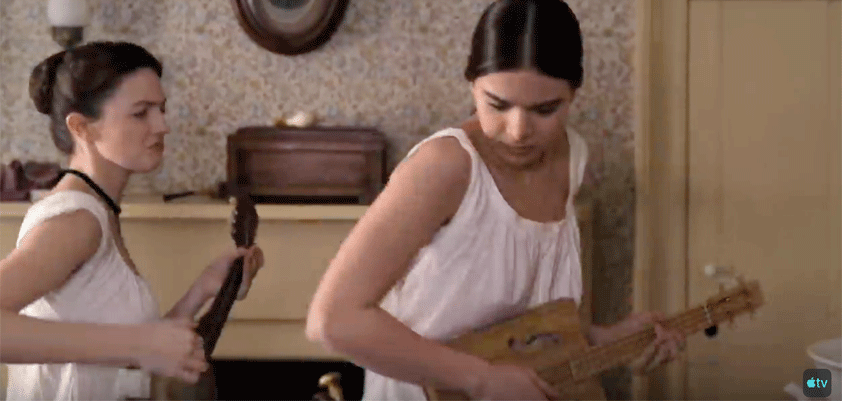
Early in the last week, I watched an episode of Apple TV+ Dickinson with my wife. In it Emily was crushing on Benjamin Newton over their mutual admiration for Ralph Waldo Emerson’s poem “Dirge,” “The one where he’s on a plain with all those ghosts” as TV’s Emily has it.
That made we want to go back and check out Emerson’s “Dirge.” What might Dickinson have seen in it?
It is 19th century Goth, right full of death and lonely love for the dead. Emerson had suffered at least as much as his early 19th century peers in terms of early deaths in his circle, and his poem is quite similar to a poem Abraham Lincoln wrote around the same time that we’ve featured here. One of Emerson’s charms as an essayist was that his mind might take him anywhere while writing one, and the reader is afterward taken along for the ride. This one-thing-after-another move can also work in poetry, but when Emerson the poet does it, it generally doesn’t work for me. “Dirge” suffers for that.
Here’s the text of “Dirge” as Emerson published it. The TV show’s Dickinson latched right onto that arresting image, a rural plain full of ghosts, but Emerson buries the lede, putting another stanza before it. That stanza isn’t entirely bad, indeed its abandoned field with scanty corn could have conceivably informed Dickinson’s “Summer’s empty room” in her later poem we featured this December. I tried performing the poem in its entirety, but it was running nearly 8 minutes (longer than I like to use here) and so I then decided to cut to length by removing those stanzas that were Emersonian digressions. I’m not sure that’s the right way to go, though I think the listener might prefer my more single-threaded version. In some of the excised stanzas, Emerson made the poem’s setting distinctly his Concord hometown; and the mourned, missing folks: his siblings who died young. Specificity also works in poetry, but I’m not sure it strengthens this poem.
One more thing before I offer you a chance to hear my resulting performance. An 1850s Emily Dickinson would have been reading this kind of gothic romanticism in its moment. The element, performative or not, of contemporary personal emotion in poems was part of the change of 19th century Romanticism. Her models: Emerson, Emily Bronte, Elizabeth Barrett Browning, and others used that mode. Even Whitman made common use of it. Here’s something I find striking: Dickinson generally didn’t. Her poems make little use of sentimentality. She will use emotional words in her poems rather than images meant to invoke feelings in the 20th century Imagist manner, but those emotional terms often seem examined, observed, set to the side.
I asked my son if what put him off the Bonzos was that they were desecrating his musical religion. *
“No, you could have just picked a better one.”
Acoustic guitar and a mix of synthesizer sounds for today’s musical performance of Emerson’s “Dirge.” The player gadget to hear it is below. Don’t see it? Then this highlighted hyperlink will also play it.
.
*Pedantically one could draw a fairly direct line from the Bonzos to early Roxy Music to “Anarchy in the UK.” But no more footnotes today! If I’m going to excise Emerson’s digressions, why should I give myself license?
I’ve not engaged much in re-blogging, but two pieces I’ve read this week really struck me: one for an idea and examples of how it might be executed, and the other for a sharply-written essay on a novel from the same early 20th century era that much of the poetry we use comes from.
The idea? A professor and poet Lesley Wheeler, who teaches a course in American poetry from 1900-1950, gave this assignment in lieu of the conventional essay: “create 8 pages of a little magazine from the period, including a cover, masthead, mission statement, table of contents, and a few ‘solicited’ submissions (mostly real poems from the period, but they were allowed to make up one or two plausible imaginary modernists, too, and write poems in those personas). They also had to write reflective essays explaining their literary and design choices and providing a bibliography of models and other sources they consulted.”
That’s a powerful idea. She shows examples of some of the responses to the assignment, and I’d love to see more of what the respondents chose to do. No one lives in history, even those old dead people were immediate. Here’s a link to her post.
The essay came from an unexpected source. I follow a blog Yip Abides that features unusually framed urban-midwestern street photography, a genre that follows the photographic aesthetic of my late wife. He also likes to feature videos that have impressed him, often animation. Visual art and musically oriented blogs are a large portion of my follow list as my own portion of reading on literature is taken up almost entirely with things that directly apply to material for this project.
But this week, there was a post there about The Virginian, a novel I’ve never read, but one of that helped formulate a genre, “The Western,” that dominated popular entertainment in the mid-20th century much like a certain kind of SF/Fantasy dominated the last part of it and the beginning of our current century.
The blogger, Bob Roman, writing about The Virginian ranges perceptively over the areas I’d want a writer to cover. What’s the connection between the cowboy “necktie party” and KKK style lynchings and murders?* How much does the American frontier underlie some particulars in contemporary libertarianism? And there’s more. Well worth reading, and here’s a link to it.
And before I leave to write another post on a new audio piece, a few miscellaneous follow-ups on things discussed earlier in the year.
I’ve now seen the first episode, and so far it seems to be what I’d hoped it was: a tongue in cheek re-contextualizing of Emily Dickinson’s life which both comments on her actual mid-19th century issues and our own times. Last year’s theatrical film Wild Nights with Emily tried to do something like this and had its moments, but I thought the overall execution flawed. Wild Nights with Emily and Dickinson are both comedies, but it was as comedy that Wild Nights failed, its portrayals of Thomas Wentworth Higginson, Helen Hunt Jackson, and Mable Loomis Todd were all too broad. True, they are peripheral characters in Wild Nights, but that too was a choice. As best as I can tell from one episode Dickinson doesn’t make those choices and is the better for it as a comedy. The characters of Dickinson’s world are more rounded portrayals.
The first episode was full of little footnote-quality accurate factoids about the Dickinson family—the creators apparently wanted to show they had done their research. Two choices Dickinson appears to make could work or fail as the series continues: It may have trouble showing why Dickinson matters and it makes the choice to play Emily Dickinson as younger than she was.
At least in the first episode, Dickinson is represented as being recognized by some in her peer group as “a genius” and a few lines of one of her best known poems are repeated almost as often as the hook in a current pop song, but we so far get no sense of why her poems are crucial. This may change over more episodes of course, but it’s always hard to show what a writer does visually. If you do a biopic about a great performer you show an actor portraying them performing, if the simulation is good you’ve made your case. Watching someone write, or how that writing works inside the minds of readers, is not so easy to act.
The first episode seems to be set in 1852, when Dickinson was the age that actor Hailee Steinfeld who plays her is in real life, 22 years old. But this is before Dickinson wrote most of her poems. Chronology seems to be a difficult issue for filmmakers trying to portray Dickinson’s life, but if the show works, I’m willing to grant them license for being loose with that. More problematic is that they appear to be portraying Dickinson as a teenager rather than as a 20-something, much less the 30-something that apparently wrote much of the poetry. I’m aware that different times had different norms for childhood and youth, but were 22-year-olds acting more like 16-year-olds in 1852? I couldn’t help but think the history they were unintentionally demonstrating was the TV and Hollywood practice of having high-school age characters played by 20-something actors.
I’ve had to live through an era when Dickinson was thought of as an arid eccentric, frustrated spinster, and even as a corrective I’m not sure I want her now to be portrayed as only the hormone-saturated brain of our adolescences either. We’ll see how they deal with that as the show goes on.
The knowing comic anachronisms and indie soundtrack? Bring’em on! The Parlando Project obviously isn’t opposed to purposely doing that kind of thing.
In closing then another thing relating to a recent presentation of a Dickinson poem here. What might be behind that striking image of windblown snow starting to fill a field as “summer’s empty room” in Dickinson’s Snow poem? Well, it was one of those poems she enclosed in letters (one of Dickinson’s contemporary uses for her writing). This one went to Susan Gilbert, the woman some modern scholars posit was her lover, and who was certainly one of the intelligent intimates that helped sustain Emily. I think that was an image of longing in the otherwise “winter wonderland” mise en scène of Dickinson’s poem.
An audio piece? As we approach winter solstice, here’s one of my favorite Dickinson presentations from this project, “We Grow Accustomed to the Dark.” The player gadget is below.
*White-on-white lynchings and extra-judicial killings were a common trope in Western movies and TV shows of mid-century, while terrorism directed at Afro-Americans was almost never the subject of popular entertainment. Consciously or subconsciously, this could have been American culture trying to address that which it was loath to address.
We’re now nearing the top of our look back at the most liked and listened to audio pieces this past fall. Yesterday we used words from a trio of women writers, and today starts off the same way. If you missed the original posts on my encounter with these texts and creating the music for them, I’m including a link to them in each of their notices in this Top Ten series, and those linked posts also will show or link to the full texts. The player gadget to hear the audio performances with original music is after each listing below.
4. Autumn by Emily Dickinson. We start off again with Emily Dickinson. I can’t help it, every time I go looking for some additional texts I run into a short Dickinson poem that fascinates, and that’s just the sort of thing I like to use here.
Oddly, this one isn’t the weird, sly, or mystical Dickinson. It’s just a light piece of occasional verse. In my original post I noted that Dickinson’s classmate and friend Helen Hunt Jackson could have written and published this sort of poem, and it’s the sort of verse that would have fit well in the newspapers and periodicals of the time.
Of course, her times weren’t placidly occasional as this poem seems to be—they were less so than even ours are. She grew up in a time that the U.S. political system was falling apart, unable to solve the social and economic addiction to chattel slavery based along racial lines. Her own father was a local principal in one political faction trying to grapple with this.* The years of her greatest poetic output paralleled the bloody 4-year civil war that followed.
I can’t say for sure why Bob Dylan issued his Nashville Skyline album in 1969—another war-torn time. In that LP Dylan dared to write the simplest, even corny, statements; and the singer who had snarled and howled his words at the height of his fame sung them in a tenor croon. Is there some truth—or at least momentary respite—in those sentiments? Opinions differ. Dickinson’s “happy autumn” poem reads like that to me. My suspicions are that it was a part of her capacious mind (no one can be fierce all the time), that she wanted to show (in this early poem) that she could do those expected kinds of verse, and that maybe it was a resting place for her (as it could be for us) from the changeable world that refuses to change.
Brancusi’s Golden Bird by Mina Loy. It was a blockbuster trade. The United States sent Ezra Pound and T. S. Eliot, both powerhouse Modernists with a reverence for old school classicism to the European side in return for a scrappy English up-and-comer Mina Loy and a future draft pick which turned into W. H. Auden.
And as I noted in my original post, this poem of Loy’s was published in the same issue of The Dial that included a modest little contribution from Eliot: “The Waste Land.” You might have heard of that one.
It’s only lately that some have come to re-assess Loy. And talk about fierce, committed, and assertive writing by a woman—Loy could bring it.“Brancusi’s Golden Bird” is a high-energy hymn to Modernist art.
Separated at birth? Mina Loy and Patti Smith. Alas, Loy was more than a generation ahead of the electric guitar, a fault we’ve now remedied.
In the 21st century, Patti Smith, one of my heroes for demonstrating the uses of heroes, and a model for the value of guitars with poetry, has issued some below the radar explorations of various Modernist artists. Let her heart and mind go where it wants to go, but I do sometimes wonder if she’ll get around to Mina Loy, whose soul might resonate with hers.
Do Not Frighten the Garden by Frank Hudson. Yes, the Parlando Project continues to be about “Other People’s Stories.” That means it’s about how I react to others’ writing. There’s no lack of selfish pleasure in that. The thrill I get when I compose the right music for a text, or when I complete a translation of something from another language, or just perform a piece with some degree of satisfaction is more than enough.
And really, honoring other people’s work is important! If our poetry scene is only voices, however vivid and individual, speaking only their own words, then it risks being the silent forest for the trees.
In my defense, I offer that “Do Not Frighten the Garden,” is inspired by a phrase in one of poet Robert Okaji’s poems as I discussed in my original post on this. In all probability I wouldn’t have written my poem if I hadn’t read his poem. Writers in general are instructed to “Write what you know,” but like “Look before you leap” and “He who hesitates is lost,” opposites can be true. Particularly with the immediate lyric poem, there is another possible instruction: “Write what you didn’t even start to know until just now.”
And here’s my holiday wish to you, adventuresome reader and listener: that something we present here inspires you to see something differently or possible. Tomorrow we’ll be back with the reveal of the most popular piece this fall.
Continuing our review of the Top Ten most liked and listened to pieces this past season here at the Parlando Project, here are the next three.
My son likes to needle me by asking what old dead white men I’m presenting today on the blog. What could be my defense? I could respond that many of the poets whose texts I end up using were young when they wrote their poems—but he’s a teenager, and frankly the idea that Rilke wrote his poem “Autumn Day” that seems to be about the restlessness at the onset of old age when Rilke was still in his 20s wouldn’t impress him. Someone in their 20s may not be ancient to him, but they aren’t exactly young in the way he is either.
And dead? That state is somewhat masked by literature. The writer, especially the poet, is always whispering in your ear. Perhaps we can tell by clues of language if they are ghosts or more present confidants, but they both whisper just the same. Will they lie pretty or tell the truth? Ghosts and the living do both. Are the living wiser, do they know all that the ghosts know and more besides? Only if they have listened to the ghosts.
Are they white today? Yes, plenty pale. I talked to my son this month about the arbitrariness of “Western Culture.” I asked him “Just how white was Socrates? Just how white was Homer?” This week the news announced some finds from a Mycenean grave dating from Homeric times, and the featured picture was a pendant engraved with an African goddess. Well, we don’t have Homer in the Top 10 today, though we do know—however misunderstood and thus transformed—that ancient Greek and Chinese poetry influenced our founding English language Modernists.
An African goddess pendant found in an ancient grave in Greece.
And none of today’s trio are men today, which shouldn’t surprise long-time readers here.
7. Besides the autumn poets sing by Emily Dickinson. It’s remarkable how much Emily Dickinson, a woman born nearing 200 years ago can seem modern, maybe even more modern today than she seemed to her first readers at the turn of the 20th century. Back then she seemed the quaint and curious poetess, a little rough around the edges technique-wise, but bringing some charming homespun metaphors with just a bit of a gothic edge. Now we may read her as if she had time-traveled to read late 20th century European aestheticians and philosophers instead of Emerson.
I believe we’re more correct now. This old man has listened to the ghosts and they are often dunderheads regarding Dickinson. And besides, as I wrote in my original post about this piece, I think this poem is having some wicked fun with the old white male poets of her time.
As to the missing people of color, let me supply the answer to a clue in that original post. Though disguised by the acoustic music arrangement, I based the changes in my music for this around a cadence from Jimi Hendrix’s “Purple Haze.”
6. Song by Louise Bogan. Unlike Dickinson, I had nothing to reassess about Bogan when I first encountered her poetry while working on this project. Bogan’s song is as straightforward in its complexities and contradictions as Dickinson is sly. The stark emotional directness of Bogan’s poem challenged me as a singer. I decided to modify the text by using the classic Afro-American Blues line stanza form, repeating a line to add an opportunity for emphasis and shading.
I partially apologized for my voice needing to be the singer to get this song out as part of the Parlando Project in my original post. I try to not apologize for my musical limitations (doing so helps no one) but this is one of those pieces that I’ve composed for this project that I hope someone who is a better singer will take up.
5. November by Amy Lowell. Speaking of the blues, this piece by the born rich and died much too young promoter of concise Imagist poetry Amy Lowell uses bottleneck* slide guitar, a playing method associated with blues musicians.
Which brings me to another side point: American music is American music substantially because it has had Afro-American music to anneal its soul. Strange that: the colonizers’ sin driven by not having enough healthy indigenous people to exploit brought forth upon this continent a new music which is its leading artistic glory. I can’t write a poem much less a sentence to properly express that.
As I wrote in my original post on this piece, I’m still coming to grips with Amy Lowell. I suspect those bohemians who disrespected her were right and wrong, but I have no idea of the proportions. This poem of hers is quite good I think.
*I’d read about blues slide guitar, but I can still recall the first time I saw it played (in “The Sixties”) when a teenaged kid from the Twin Cities area named Don Williams removed from his authentic folk-scare Levi’s denim jacket pocket an actual severed bottle’s neck, tuned his guitar I think to open D, and played a John Fahey-ish rendition of “Poor Boy (a long way from home).” Reconstructing that moment, Don (like Amy Lowell) probably had access to material and cultural resources that I a poorer kid from a tiny town didn’t have—what a strange way for the blues to work!—but I remain grateful to this day for the introduction.
For several months, as summer 1913 turns to ’14 through autumn and winter, a 35-year-old woman is creating the manuscript for her first book-length collection of poetry. Creating a book-length manuscript is always a challenging task, and regardless of whatever realistic expectations the author might have for its reception, hope is normally the fuel for this. First collections are like that, as a poet figures out how to introduce themselves to strangers.
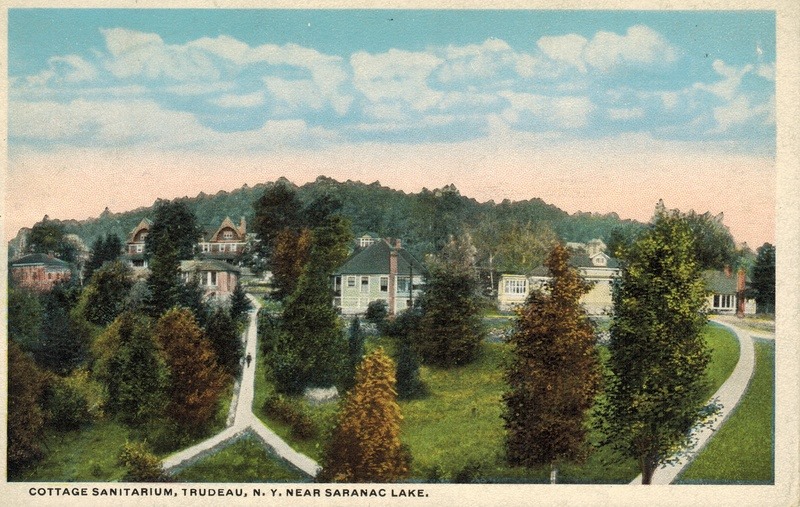
But this woman, Adelaide Crapsey, is also producing her final collection of poetry, and she likely knows that. She’s not working in her study or at some granted writer’s retreat, but at a sanitarium* where she’s suffering through the last stages of tuberculosis which has spread to her brain. If 1914 is The Year that Imagism Broke, it’s also the year that she will die.
The book that she is working on will be published in 1915, and it will be the place where she’ll introduce her own poetic form, the cinquain. The cinquain is a short five-line verse form, primarily iambic, that uses an increasing series of syllables: two in the first line, four in the second, six in the third, eight in the fourth, and then back to two in the final line. Some have noted that the increase creates an expectation of growth or expanding sense, only to have the ending come up short and terse. I’m not the first to see this as a symbol of Crapsey’s life and art itself.
Still it’s remarkable that Crapsey chose such a small, tight form into which to pour her thoughts on illness and approaching death. Some might choose a short but loose form to conserve energy; others might turn rangey trying to get all their last expressions in. Crapsey seems to find in the form’s limits the borders within to hold her place.
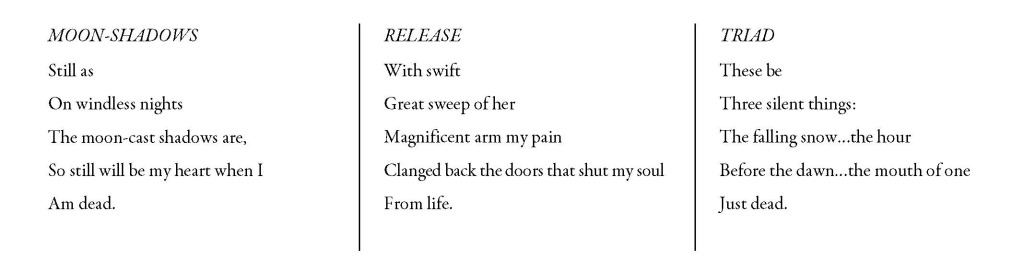
Here are the three cinquains I used today. Illness and the eventual passage of dying is something we all share. Crapsey used tiny poems to bear vivid witness.
In the early 20th century world of Modernist American poetry, her tragic story lent a degree of publicity to the posthumously published book, but it was a small fire which soon burnt out. As I mentioned last time, extremely short poems and the direct lyric impulse is not where Modernism headed after the 1920s—but in the long run, we can still access these poems the only way that poetry can be reached: by directly taking them inside us. These cinquains don’t ask for a large place.
For my performance of three more of Crapsey’s cinquains of 1913-1914 I composed music for strings which sounds acoustic even though there is some spare, bell-like Rhodes electric piano and a cello line that is treated with a strong resonant echo that I think adds some poignance. I don’t know where this melody and counterpoint came from, but as I tried and played some string lines on my MIDI guitar it came to me quickly, as if out of the air. You can hear it with the player below.
Let’s imagine that it’s 1914, and on both sides of the Atlantic curious short poems with precisely chosen and concrete imagery are appearing here and there. This is Imagism, the premier movement of Modernism in English. Long-time readers here will know* that these small and unpresupposing poems came from several sources: the away-with-19th-century-Romanticism ideas of T. E. Hulme, the promotional verve of Ezra Pound who also set out classical East Asian poetry as an ideal, things apprehended from French poetry by the slum-born F. S. Flint, and the fresh eyes and forms of Americans Emily Dickinson and Walt Whitman.
This new poetry was quite unlike the Tennysons and Longfellows that preceded it, but also it is by and large not Modernist poetry as we’ve come to know it later in that century or in our current one. It seems altogether simpler, pared down. It partakes of poetry’s timeless lyric impulse: the thought that a poem need not be long to be complex if it keeps itself true to the goal that the poem isn’t about ideas but the instantaneous experience of ideas. Nor is it a marathon course of those feelings and experiences, rendered on kaleidoscopic canvases.
To some this new kind of poetry is cheating. Where are the grand themes? If the poem doesn’t develop itself like an essay or history where is the effort or the worth of the effort? The poems often don’t seem to use heightened poetic language, and they may at first seem to have no metaphors—rather, the poem is the metaphor. That these poems often eschewed rhyme or conventional meter added to the “anybody can do this” sense many had.
As I imply above, this is not the Modernism that eventually emerged triumphant. Yes, a “Red Wheelbarrow” and “A Station of the Metro” will be constantly anthologized, but Williams and Pound will become known for their longer more esoteric poems. Even if some WWI poets could use these compressed poetic methods to express horror while the fighting was going on, the post-war world wanted it all expanded on, and the thought that expansive sur-rationality was the appropriate response to world-wide mechanized violence came to the forefront. Art needed to be as big or bigger than the things it was opposed to.
“Reading” pictures is risky, but this photo of Crapsey just seems to say determination.
All this ferment brings us to Adelaide Crapsey, a woman who has been forgotten in all the fuss. First, look at that name. It sounds like a character in a satiric novel. It’s so pre-20th century that you can’t imagine Modernist verse having it attached to it (perhaps Hilda Doolittle was savvy in immediately accepting Pound’s rebranding of her as H. D.). Also, if there was such a thing as Middle School in her youth, can you imagine the trauma of carrying her family name?
In The Year Imagism Broke, 1914, Crapsey was not only writing Modernist verse in the initial Imagist sense, she had made a study of English prosody and had created her own form to put her concise poems into: the cinquain. Just as many of the short Imagist poems owed some of their tactics to classical East Asian poems, the cinquain sought to create an English language equivalent to the understanding of forms like the haiku.
Just as with Amy Lowell from earlier this month, I think it may be worthwhile to not let these two poems of Crapsey’s that I use today wash over you quickly, as if they are essays or narrative personal memoir in verse. Each word was chosen carefully, precisely, to evoke a moment you might choose to share inside of her experience.
Ten lines and two of Crapsey’s cinquains that seem to tell the story of this year’s late fall
Am I setting this method of shaping poetry out as the best or only way to approach verse? No, though I’ve come to believe that we may have lost something when we abandoned it for the new more impressive edifices of post 1920s Modernism.
Musically I was thinking of one of my musical heroes and models, Steve Tibbetts, but alas my deadlines, and my musical and production skills this week produced only a rough approximation of what Tibbetts can do. I really tried to rip him off here: a down-tuned acoustic 12-string with paired unison (not-octave) strings. Lots of time-based effects (like reverb, phasing, echo, and delay). Hand percussion leading off to heavier stick drumming. Feedback-loud electric guitar arriving from off-screen into the landscape.
Yesterday, my disappointment in what I had down was fairly complete. My electric guitar solo could be better, and it’s been too long since I’ve played at that volume. The 12-string wasn’t naked and exposed enough. Where’s the space I keep telling myself to leave in? I had no idea of how to duplicate Tibbetts’ characteristic delay and echo effects. My percussion tracks had nothing like the splendid variety that Tibbetts’ long-time collaborator Marc Anderson routinely achieves.
But my son reminds me that Kurt Cobain thought he was just ham-handedly ripping off the Pixies and still came up with something that was worthwhile, and the Steve Tibbetts’ thing is not something commonly heard—so 20% of Steve Tibbetts level might still be worth listening to for what it is, not what it wanted to be. So, here it is, available with the player below surrounding those two 1914 cinquains by Adelaide Crapsey describing our current November season.
*This is a reminder that since “poetry is the news that stays news” that the Parlando Project has nearly 400 examples of what we do that may be just as interesting to you as the current post. Using the search function or just diving in at random to the archives is worth considering.
Modernist American poetry has two parents, Emily Dickinson and Walt Whitman, but it’s been awhile since we’ve presented any Whitman here. Dickinson is a subversive Modernist, ironically skewing the expected tropes. Whitman on the other hand is the provocateur, the poet who is proud to say right out front everything he wishes to change.
As Whitman prepared his 1860 edition of his evolving Leaves of Grass, he was about to cross a Rubicon of a sort. He had decided that erotic material needed to be added to his great collection. Since he wished to be all-inclusive and unabashed, starting with himself, that material would vary, but it would include expressions of male homosexual longing and relationships.
Walt Whitman as caricatured in 1860 in Harper’s Weekly
Once again, my knowledge of the historical context here is not extensive, but some brief reading this weekend indicates that to the mid-19th century American audience, the homosexual elements of what Whitman was to publish was little or no more disturbing than the erotic element generally. For a man who was already wishing to revolutionize English poetry with his free-verse and universalist message including what would surely be considered shockingly fleshy writing about desire, longing, and connection was certain to complicate his goals for a wide audience. His leading ally within American High Culture, the Transcendentalist Ralph Waldo Emerson, counselled him to not include, or to greatly tone down that material.
Whitman didn’t take that council. The 1860 edition of Leaves of Grass included a section, Calamus, that was full of love and desire between men. Emerson was right, that would complicate Whitman’s task of revolutionizing American poetry.
When Transcendentalist Thomas Wentworth Higginson* asked Emily Dickinson if she had read Whitman shortly thereafter, Dickinson replied: “You speak of Mr. Whitman. I never read his book but was told that he was disgraceful.” If one is of a speculative mind, one can imagine Emily Dickinson getting a plain brown wrapper delivery of Leaves of Grass that she would never acknowledge.
This Monday is Veteran’s Day/Remembrance Day, and as he prepared the Calamus poems Whitman was not a veteran or a survivor with war memories, as the American Civil War that would add another tremendous shaping force on his poetry was still more than a year off. Still he would write this moving comparison that I present today.
Today’s poem as it appeared in the 1860 edition of “Leaves of Grass.”
“When I Peruse the Conquer’d Fame” is a comparison of two things: fame and envy. Perhaps the fame part will strike you first, along with the implications of worth and value. The fame in the title most often comes to prominent men: victorious generals, Presidents who bask in their election and men who put their names on large buildings. The U.S. Presidents that Whitman would have had in mind then were bumbling ineffectual men, totally incapable of coming to grips with the immense and deadly crisis they were careening toward, but famous none the less.** What generals would he have in mind? Napoleon or his adversaries perhaps, men who could shuffle the borders and crowned heads back and forth in tides.
And for comparison, Whitman sets out “the brotherhood of lovers.” Does he mean men who love men? As this is part of the homoerotic Calamus poems section I think we need to accept that is significantly so. He goes on to praise the lovers who are steadfast in their love as aging and fate and even the numbing of time is arrayed against them.
This task of enduring love is not something unique to same-sex lovers, and I suspect that Whitman, the universalist, recognizes that too. But in his particular, he’s saying that unfaltering love which would not then be socially acknowledged is all the more extraordinary, though unknown compared to the war-heroes and political potentates.
Did Whitman, and I suppose myself in my choice to present this poem at this time, just dis veterans? That objection would assume that the two groups are mutually exclusive, at odds. That isn’t so. And if Whitman was here to answer he’d point out he spoke of Generals, Presidents, and rich men, not the soldiers he later comforted and whose wounds he dressed in the upcoming war.
And of course, in the U. S. today it’s Veterans Day, set aside for those who after their service may well have continued as or became those ardent lovers whatever their sexual orientation. We honor them for their service in the one regard, Whitman asks that we consider the second as well.
What of the other comparison, the one you may not have noticed, the one concerning envy? Whitman has chosen not to weigh his comparison between the two sets of roles only by their levels of objective fame, but specifically in the example of his own state of envy. He says he doesn’t envy those powerful and rich men—but of the “long and long” lovers, there he says he is bitterly envious.
Let me suppose Whitman was sincerely speaking here (he has almost no other mode in his poetry than sincerity). But there is an element in Leaves of Grass where the poet speaking—“Walt Whitman” as the character in his great collection of poems—is meant to be an example, as his verse is an example, of an imperfect thing striving to find a different, better path to something new and not fully known. Whitman, like the best of Modernist art, like various America, like many veterans, ardent as a lover is running faithfully and with a heart open toward an affectionate and unknown future.
Once more I marshal the ranks of my marcato orchestral instruments for “When I Peruse the Conquer’d Fame” into another “punk orchestral” piece. Harmonically, I’m working a three-chord trick here, just as if the composer/conductor’s podium was stocked with Ramones. Other than the use of a rock’n’roll drum set, the other unusual textures are mixed subtly into the low-end where there’s a contrabassoon line and Fender electric piano bass (ala Ray Manzarek). You can hear it with the player below.
*It’s possible that a canny Dickinson might have been telling Higginson what Higginson would want to hear, since Higginson, though au fait with political and social radicalism, was also of the opinion that Whitman was disgusting.
**Coincidentally, the U. S. President when the Calamus poems including edition of Leaves of Grass was published was James Buchanan, who may have been gay himself. Though Donald Trump has already selected Andrew Jackson as his favorite President, Buchanan may also prove to be indispensable to his legacy in that Buchanan has long been the consensus choice among historians as the worst-ever President of the United States.
It’s perhaps my favorite scene in D. A. Pennebaker’s Bob Dylan documentary Don’t Look Back. Pennebaker has setup this narrative as Dylan tours England in 1965, introduced with shots of British music newspapers touting the teen-aged Donovan as Dylan’s rival. My well-remembered scene is shot in Dylan’s Savoy hotel room, where boffins can pick out various UK music figures sitting about and talking. In the background, there’s Donovan himself, tuning an acoustic guitar as Dylan asks if there’s anyone in the British Isles that is a poet like unto Allen Ginsberg. Dominic Behan is offered. Dylan says nah. Donovan has tuned up and launches into his “I’ll Sing a Song for You.”
“That’s a good song” Dylan chimes in as Donovan sings, and though eyes behind Ray-Ban shades he still seems to be paying respectful attention. Someone says “He plays like Jack man,” not a slur, but referring to Ramblin’ Jack Elliot, the legendary folkie and predecessor to Dylan in the Woody-Guthrie-continuation field.
Dylan takes the guitar from Donovan and launches into “It’s All Over Now, Baby Blue.” The guitar has gathered a capo and Dylan has lost the shades. Donovan lights another filter cigarette and chews on his nails, figures how to be cool.
Now, “rating” Dylan songs is subjective and subject to mood, even for any one person. For this one person, “It’s All Over Now, Baby Blue” gets a lot of respect: a song about love using politics as a metaphor or a song about politics using love as a metaphor? The best metaphors are like that, the thing and the representation can flip places.
So besides the people-watching and the music in a movie about a songwriter that actually has little music in it,* the gist that’s often drawn from this scene is an unhelpful but crucial tip: if you’re ever in a song pull, don’t sing your song just before 1965-vintage Bob Dylan if you can help it.
OK, so I’ve already drifted back to 1965, let’s keep drifting backwards to 1922, and you’re a Modernist poet, not a singer-songwriter. You’re about to be published in The Dial, the sort-of-successor to the mid-19th century American Transcendentalist house organ, now publishing the cream of Modernism in art and literature. Let’s get specific, the “you” you’re playing as you travel back in time is Mina Loy, a woman who’s au fait with the avant garde and whose poetry remains strikingly original even today. Yes, the Modernist movement is going to have its problems with women as artists, but Loy seems fierce.
And the Mina Loy poem that goes into that issue of The Dial is a glorious ode to a visual Modernist: one of Constantin Brâncuși’s series of bird sculptures “The Golden Bird.” Loy’s poem has something the pre-WWI Modernists often had, a joy at the new way of looking and expression.**
The lesson of the Dylan’s Savoy Hotel room is true but unhelpful here. The November 1922 issue of the Dial leads off with a new publication of a poem called “The Waste Land” by T. S. Eliot. You might have heard of it.
Antiquities dealers ask for more than $1,000 for this back issue
Art of course isn’t a competition. “Rating” art is a silly pastime that gets sillier the thinner you try to slice it. The emotional/intellectual transfer happens between art and audience or it doesn’t. Still the unhelpful rule would hold that if you’re trying to make an impression as a Modernist poet, holding up your “read me” sign next to what gets rated a masterpiece isn’t the way to go.
Now, almost a hundred years later, readers and critics are starting to look again at Loy, whose entire career was overshadowed compared to others she worked beside. How successful was her art? There’s no fixed record, because that assay happens every time it’s read or listened to. I think this tribute to Brâncuși stands up, even though it no longer benefits from the early 20th century shock of the new.***
Musically, today’s performance marks my annual tribute on the anniversary of the unfortunate death of the American musician and composer Jimi Hendrix. Each year for September 18th I plug in a Stratocaster electric guitar and try to channel a little of Hendrix’s bird in flight. Hendrix was enormously interested in the electric guitar’s timbral possibilities, so I tried to make my guitar part reflective, chirping with bird song, and gong-like in turn. You might easily think: this is my Savoy hotel room moment. You could be right, but I persist. My performance of Loy’s piece praising Brâncuși’s sculpture is available with the player below. The text of her poem is here if you want to follow along.
If you ever find yourself, regardless of the unhelpful rule and your careful plans, as a Donovan next to someone as a Bob Dylan, one choice is: go ahead anyway. I’m glad Loy did.
*Yup, it’s true. The movie is forever showing Dylan about to go on stage and then it cuts to another backstage scene. This may have been necessary for music-rights issues, but the movie Pennebaker got was all the more unique because of this.
**RaulDukeBlog has sagely commented here about the gloomy-gus nature of so much of 20th century High Modernism. T. S. Eliot’s poem helped turn it that way, even if it was a personal expiation to break out of that. Two World Wars and surrounding atrocities certainly didn’t help cheer up the arts, and our present state is damp with sodden things that can only be dried with some fire that joy sparks. Another reason to go back earlier in Modernism, and to look at the kindling of artists like Loy and their pure enthusiasm for breaking out of entrenched tropes.
***A famous anecdote about Brâncuși’s work has it that at one point when the statue was being transported to the U.S. the customs officials refused to believe the abstract form was a sculpture at all, and it was instead classified as a metal ingot.
So how did the Spoon River Anthology get created and published in 1914, such an early date in the emergence of Modernist verse? Let me see if I can summarize what I know so far. In the early part of the 20th century Edgar Lee Masters was a busy lawyer practicing in Chicago. The most oft-remarked part of that career was that for a time Masters was partnered with the famed Clarence Darrow known for his progressive views and participation in numerous famous cases of the era.
I’ve quickly scoured a great deal of information this month on Masters, learning more each day, but it’s clear that for some time before 1914 Masters wanted dearly to become a writer of some kind, with a “trunk” of prose, plays and poetry, and a fair amount of rejection letters. It’s possible that, in his time, he might have been categorized by writers and cultural figures as a type that still exists, which for lack of a better name I’ll call a “wanna-be.”
Like all stereotypes, the wanna-be is unfair to some tagged with it, while seeming to be a useful short-hand among those who apply it. Authors from book tours only need to start a story with another about the businessman who buttonholes the author to say that they too have a novel, often partly written or even “just an idea, but…” and the fellow author will nod and immediately fill in the stereotypical details. Modern authors maybe divided into commercial, academic and bohemian enclaves, but all three can bemoan someone from outside those realms who thinks they are a writer, while giving signs that their real-life choices, risks, experience, and focus lie elsewhere.
Masters was certainly not the kind of wanna-be who claimed he had a novel in him, or “I once wrote poetry when I was young.” Despite what he described as a busy legal practice, he was writing—good bad or indifferent, he was taking his swings.
Here’s another stereotype label that could be applied to Masters in his time: “womanizer*” which is someone who engages in endless, usually short-term, love affairs: a cycle of attraction, infatuation, discovery of imperfection or the newness wears off, and then repeat. For a time prior to writing Spoon River, Masters was in a two-year extra-marital relationship with a Chicago woman Tennessee Mitchell.** Mitchell was a musician who taught piano, broke a glass ceiling for women as piano-tuners (lady brains can’t handle the complex tempering of all those notes you know), and who ran a salon where patrons, artists, and radicals mingled.
One question I had when I wondered how Masters could write a thoroughly Modernist work of poetry so early in the movement was did he cross paths with Chicago’s Poetry magazine and Carl Sandburg, then living and working in Chicago. In the case of the later, he certainly did. He struck up an acquaintance with his fellow Midwestern Modernist,*** and they took walks together and presumably talked about poetry as Masters was writing Spoon River. Masters referred to Sandburg in letters from this time as the “Swede Bard,” which even just between friends sounds dismissive and nativist, but this does point out something that shouldn’t be forgotten about Sandburg: he was the child of an immigrant. Masters didn’t have to “prove” his American legitimacy when he cast a critical eye on parts of its culture. Sandburg, though different in his politics from Masters, could be just as critical, but he was casting his critique from a different standing.
And Poetry magazine, a critical American organ in the dissemination of Modernism? Masters seems to have been stymied there. At one point he was having another of his affairs with a woman described in places as an editor at Poetry,*** but I so far haven’t seen that he was published in Poetry prior to Spoon River.
Instead the Spoon River Anthology owes its major inspiration and initial publication to a man down the Mississippi from south-western Illinois, William Reedy, the editor of Reedy’s Mirror in St. Louis, who like Harriet Monroe’s Poetry was ready and willing to publish American poets who were unabashedly American and willing to forge American verse in new modes, as Whitman and Dickinson had shown was possible in the previous century.
Inspiration? Well, for someone promoting American verse, Reedy’s prime move was to send Masters a copy of a recent translation by a British scholar from classical Greek late in 1912: Epigrams from the Greek Anthology.
A gift that helped start American Modernist poetry. Ironic, or Ionic?
.
Masters had an idea that stories from his southwest Illinois youth were good material, but he didn’t know how to present them. Even in 1913 he was thinking of shaping them into a play.**** As 1914 began, Masters, still being goaded by Reedy to drop his often florid and European-modeled verse and do something American, started writing the Spoon River epitaphs, accepting the incongruity of a classical Greek style of summing up a life being used for American Midwestern townfolk as having a certain satiric flavor. Masters sent a batch of them to Reedy, and as Masters himself recounted this, they were submitted in something of a mood of: you want American, well I’ll give you American and I’ll bet you won’t think it’s poetic.
Reedy published them, praised them. Throughout 1914 this process continued: Masters writing feverishly on the weekends while continuing a busy legal practice and sending off batches to Reedy and his Mirror of new Spoon River epitaphs to be published. Does Masters feel validated? Has he found his voice? There may be some ambivalence on his part at first. He has them published using a pen name Webster Ford. Some of that may be to protect his law career (lawyers who tell secrets about lives aren’t exactly sought out by clientele.) Part of it may be because he’s unsure. It’s even possible that “Webster Ford” may have been a way to escape his lawyer-who-thinks-he’s-a-poet issues with Chicago literary figures.
Ezra Pound, off in England, but considering himself the world-wide talent scout for all things Modernist, fires off a letter to Harriet Monroe. Pound is no stranger to urgency in speech, but he’s in full florid ALL CAPS shouting mode:
“GET SOME OF WEBSTER FORD’S STUFF FOR ‘POETRY’…Please observe above instruction as soon as possible.”
By the end of 1914, Masters drops the Webster Ford mask and puts his own name on the poems, and he’s looking to have Spoon River Anthology published in book-length form. He’s on his way, even if he’ll soon enough loose it.
For today’s Spoon River piece, here’s a companion to “Cooney Potter,” “Fiddler Jones,” showing the dialectical contrasts Masters likes to weave into his collection. With its invocation of music it was an immediate favorite with me. Besides the contrasts in values and outcomes that Masters uses, there are families’ and relationship stories throughout the book, but it’s unclear to me if Fiddler Jones is related to other Jones-surnamed characters in Spoon River.***** Jones is a common name, used as synonym for “anyone” idiomatically. But it’s also Welsh in origin, and there is a Jones family of specifically Welsh ancestry in Spoon River.
Reading “Fiddler Jones” I thought the character might be Afro-American. There’s one stated Afro-American character in Spoon River, and I wasn’t sure of the exact ethnic makeup of the region of Masters youth, but like finding out about the Afro-American community in Emily Dickinson’s region, assuming all-white is false default. As so often when I come to something like this, the Internet is my friend. It’s actually easy to search census demographic records for the two towns of Masters’ youth, and they were around 1% African American by those records. Of course, Masters’ book isn’t a documentary or demographic treatise, but that means there are 30-35 Afro-Americans living in Spoon River’s models in the later 19th century.
Strings link things: African styles mixed with Celtic styles in America.
.
From my musicological interests, the idea that that fiddler could have Celtic or Afro-American roots is apt, but in doing my music for today’s performance of “Fiddler Jones” I didn’t really follow traditional fiddle styles. I don’t play violin, and the solo violin line featured in today’s piece was played on guitar with a MIDI pickup using a lot of string vibrato and little of the short, rhythmic chops that might drive a field of dancers. Wondering what’s the dance tune they step off too mentioned in the poem? This blog has a good guess. The lyrics to that tune also end, as does Spoon River’s in the grave; and as Fiddler Jones does, with no regrets.
In composing the small orchestra accompaniment, I made sure to feature the bassoon and piccolos that bedevil Fiddler Jones in his mind as he tries to plow. I found myself rather enchanted as Fiddler Jones was, and as a result today’s piece is a bit longer than most here, but I hope you’ll find the spell as moving as I did. Player’s below.
.
*Particularly, but not exclusively, among arts and bohemians, even in Masters time there would also be women who were not called “mananizers” for some reason, and bisexuality and same-sex relationships too. The power relationships in such relationships would be too complex to discuss in a footnote: some exploitative, some less so, some respectful, some carnal, some duplicitous, some honest, and so on. So far, in my rapid overview of Masters he doesn’t seem particularly exploitative, and Spoon River shows he’s listening to women.
**Click this link and read about Tennessee Mitchell! After the end of her affair with Masters she eventually married another wanna-be-but-actually-could writer, an advertising man and entrepreneur Sherwood Anderson who went on to write Spoon River’s prose-in-law: Winesburg Ohio in 1919.
***At this point, do we need to broach the question of if Edgar Lee Masters was trying to sleep his way to the top of Modernist poetry?
****More irony, the brief poetic monologs in Spoon River so revealing of key details of entire lives in flat descriptive dialog became a staple of audition readings for actors since they so readily allow an actor to show keen presentation of character in a few lines.
*****We’ll meet one of those other Jones in Spoon River soon. You may think, small town, must be related, but in the 19th century Midwest residents are largely internal migrants from the previously settled regions of the U.S. and so, even later, it’s not certain. In my 20th century hometown, smaller than Spoon River, 20% of my class had the last name Johnson and were not related. As you might imagine, I thought the running joke in Blazing Saddles that every white townsperson is named “Johnson” was particularly funny.
I almost feel like I need to place a warning label on today’s piece: Rated RE Strong Romantic Emotional Content. Thanatopsic material. May not be suitable for those who have not sufficiently worked through issues with self-harm or the experience of self-dissolution.
Modernism had a strong tendency toward a critique and reaction to romanticism and its characteristic expression of emotional content. A man viewed as the founder of its English-language poetic wing, T. E. Hulme, wished to set it on a course of completely overturning Romanticism. But those bylaws didn’t always filter down to every chapter and member of the Modernist International. Readers here know I love some of the early Imagist works which are parsimonious with overt emotional words, even while seeking to charge their images with a fresh immediacy. These poems aren’t necessarily devoid of emotion if the reader has it to supply themselves—but then some Modernists, such as E. E. Cummings, were perfectly fine with frank emotional outpourings.
Sara Teasdale, in addition to being largely forgotten for the better part of the last 100 years, was never officially a Modernist, so there’s no movement membership to endanger and no expectations for her to fulfill anymore. She wrote intensely lyrical and musical verse in plainspoken and non-archaic language. That’s a surface shiny enough, devoid of hermetic imagery, and with sweet word-music that makes it too easy to miss what she’s saying.
Sara Teasdale is sick’n’tired of you mentioning how pretty her poems are
I knew this already, having presented Teasdale regularly here. Still, I had to go through a journey to inhabit and grasp this poem for this project. I collected it earlier this summer, seeking to stockpile a few seasonal poems ahead of time to have some on-the-shelf ideas for possible use.
Here’s the full text of the poem. If you skim through it, it looks like a fairly common poem subject: summer night. It might seem to hit the expected points too: hey, summer, it’s nice at night (maybe even better than the heat of afternoon). Plants, trees green and full, explicit birds. A Moon one can linger with long enough that you feel that if you stay the night you could watch it change its phase.
Teasdale can write a poem that seems like that. That’s a problem. It’s too easy to miss what she’s communicating if you leave it at “That’s pretty.” You could use her writing as a case-study in why some of the Modernist tactics that frustrate (or delay) understanding might not be counterproductive. Teasdale gets misunderstood quickly as one passes over the words, while someone like Mina Loy, Tristan Tzara, or Gertrude Stein causes those who won’t care to read carefully and empathetically to not stop in at all.
As I began to read, really read, “August Moonrise,” to figure out how I might perform the words, the last section seemed dark—and not in the pretty moonlight way. Here are some of the words that hit the notes in her word-music after the poem’s midpoint: bitterness, sorrow, death, wavering, blind, fearful, fire, cold, vanish.
Seeing that, I reexamined the opening half for portents. The swallows are rushing, willfully, together and departing from each other. And is their willful act truly willful? Maybe not, it’s like the movement of dark tree leaves. If that was a spare Imagist poem, or a work of classical Chinese poetry, we’d be confronted with that image, asked on no uncertain terms to deal with it. Here you may think it’s so much minor scene-painting.
The scene-painting gets even more painterly next. Sunset, moonrise. The final palette: “a deeper blue than a flower could hold.” Is that merely a beautiful picture or a statement of more blue than can be sustained?
Teasdale’s singer in the poem is drawn in (note, she goes “down,” descends to it, even though the preceding birds, trees, sunset, moonrise are all things normally above the horizon) because it’s her, or because it will become her. The poem reaches—if only briefly—a quasi-orgasmic happiness. One line here: “I forgot the ways of men” is so rich in ambiguity. I could read it three or four ways easily.
This happiness, this intoxicated leaving of all but the senses (however brief) is portrayed as a consolation. Consolation for what?
And then we enter that section that is so full of darkness, loss, imperfection. Is this section spiritually sublime or just harrowing? I think you can play it either way, though I suspect it works best if the other choice is kept as an undertone. Compare this to Laurie Anderson’s childhood account of Buddhist Midwest night skies and the non-necessity of self, the archaic trials of the Lyke Wake Dirge, or to a searing inventory of imperfection, almost a suicide note.*
Teasdale’s concluding couplet is so searing I think it must be performed understated. The crucial word in it, “theft,” says she doesn’t feel in control of this loss of control. Isn’t that frightening? Spending several hours with this text this week, fitting it to music, performing it, thinking about it was a journey, from “Oh, a summer night poem” to a consideration of the sameness and the difference of exceeding the self and end of the self.
So, am I out on a limb here, thinking this a major poem by a too overlooked poet? Has the seeming conventionality of its setting (subverted as it may be), the gender of its author, the musicality of its expression, the unabashed romanticism of its sensibility obscured our view? If this was Rilke translated from the German would we read it differently? If this was Yeats with swans instead of swallows would it matter? If a Cubist ran it through a copier a few times and then cut up all the lines and reassembled it, would we stop long enough to think about it? The issue of Teasdale’s membership or non-membership in Modernism might have seemed germane in the mid-20th century, but to a significant degree it’s immaterial now.
Well, I’ve done it again. Talked about the words so long that there’s no time to dance about the architecture of the music. Thinking about what I said above, I could have cut up and obscured Teasdale’s words rather than a straight recitation I recorded, but the choice I made has its strengths too. I did try to undersell the sensuousness of the lyric in hope it would cause the listener to consider it differently, but the opposite choice works too, for I’ve discovered this gorgeous and emotionally effecting choir setting of “August Moonrise” by Blake Henson that had me in tears this morning. See my comments last post about how my limitations as a singer and no access to alternative skilled singers focuses my composition into other modes.
I intentionally avoid apologizing for my work. I think that’s a good practice. If you think you should do better, do better or do different, instead of talking about it. My approach to “August Moonlight” with a skip-footed motorik beat and an ominous and fateful tone in the reading and music certainly contrasts with Henson. I could even imagine that hearing Henson’s work after considering Teasdale’s darker undercurrents intensifies it, as it did for me today. You can hear my version with the player below. Don’t see a player gadget? Then use this highlighted hyperlink to play it.
*There was a point in the production of this piece that I seriously considered abandoning my presentation of “August Moonlight” because of this. Once I could see that element was present in the work (as it is in Teasdale’s life), I felt it shouldn’t be denied if I was to perform it. Many artists deal with feelings of self-harm and because “All artists fail” in the sense of imperfection and producing things farther, rather than “Something nearer your desire.” I hesitate to present work that might feed into that, particularly with a beautiful and romantic sheen to it all. In the end I decided that Teasdale is illuminating that, and if I presented it so that you can consider its danger, it could have value. Henson’s setting makes a choice to emphasize the perception of beauty, the singular hour of atonement, which also would have answered this concern.




 Frank Hudson