I find it a wonderful “Parlando – Where Music and Words Meet” coincidence that one of Christina Rossetti’s sonnets and one of David Crosby’s songs share a title, “Triad.”
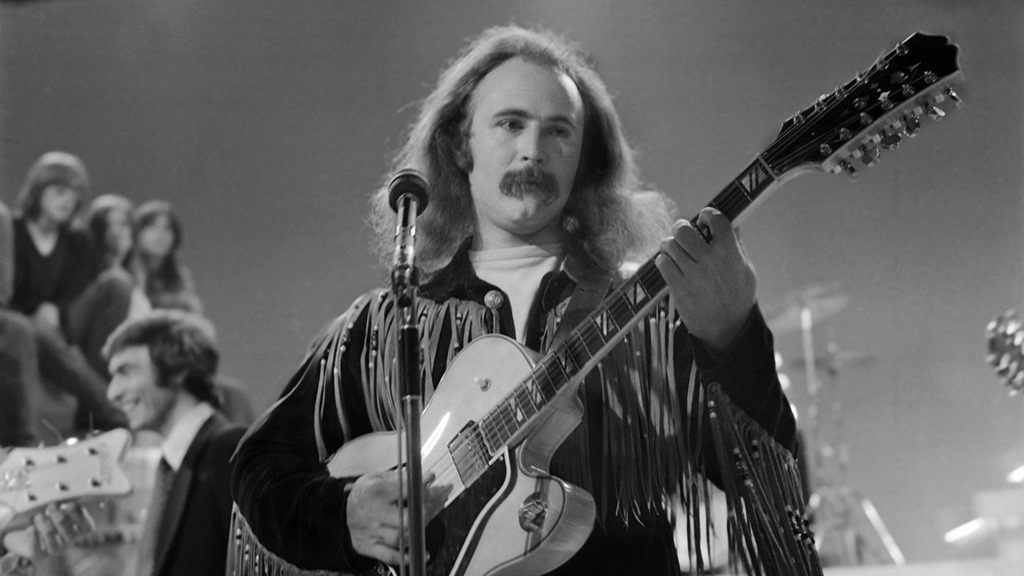
David Crosby is a musician and songwriter who first came to prominence in The Byrds and then as part of another triad, Crosby Stills and Nash. When I first came upon his songwriting many years ago, I was attracted to his distinctive abstract melodic and harmonic sense. Almost no one before, and few since, wrote music for songs that sound like his did then, with the exception of some Joni Mitchell tunes. Lyrically Crosby styled himself as unconventional as well. His “Triad” is a blissful ode to free love—well at least free love as long as David Crosby is the one explaining how things will be.
David Crosby’s song starts by asking “You want to know how it will be?” and then he mansplains it
Christina Rossetti was a pioneering British 19th century female poet. Her biographical triad was that she had two brothers William Mitchell Rossetti and Dante Gabriel Rossetti, also writers, who went on to form the Pre-Raphaelite Brotherhood. Hmmm, “Brotherhood”—I wonder if girls get to join? Not officially, though she was used a model in some of their paintings.
Her brother Dante used Cristina Rossetti as the model for the Virgin Mary, far right.
Christina Rossetti’s “Triad” is a not-so-happy look at romantic love, and the writer is none-so-sure how it should be either. Rossetti draws her portrait of three women who once sang together. One the stereotypical harlot, one the blue spinster, one the smooth compliant wife. Each of them finds the dead end of the limited paths available for passionate women. Conventionality decrees the hot harlot is shamed and the cold virgin dies for love, but Rossetti steps outside conventionality to tell us that the “temperate” spouse grew gross in her compromise until left with the devastating line droning “in sweetness like a fattened bee.” How much has changed since Rossetti’s Victorian England in this regard? Some things, not all things. New Rules are still rules, look at who makes them.
Musically here with our “Triad”, the LYL Band somewhat refer to the psychedelic vibe of Crosby’s musical style to accompany Rossetti’s sad and lovely words. To hear it, use the player that appears below.
Minnesota goes wild in spring when it finally gets warm, and so today, which promises to touch 70 degrees, will surely display this. Like the day described in today’s episode, I’ll probably go for a bike ride with my young son, and we’ll ride on The Greenway, a several-mile-long reclaimed railroad cut that runs, as time does, east and west through the middle of Minneapolis.
Raising a child as a musician, writer, and sometime bohemian brings extra questions. Do you want your child to follow the most conventional and unquestioning path? Certainly not. You encourage them to question things, even allowing that this will encourage them to question you. You look at your own life backwards as you look at theirs coming forward, and wish them adventures, but only so much. You know there will be hardships and wrong choices, but you hope only enough to be instructive. As an artist you may worship art, but you’re not sure you’re comfortable with them adopting all the tenants of that religion.
Today’s piece “Biking on the Greenway with My Son and Bob Stinson” speaks of this from the seat of a bicycle.
Bob Stinson was the animating force in The Replacements, an ‘80s alt-rock band that never tried to split the difference between insouciance and not giving a @#*&. As a guitarist he was an anarchist, and the band accidentally worked like the NY Dolls, the Kinks, or the Rolling Stones, with a great front man who had the lyrical wit and the staggering lead guitarist who embodied the music’s soul.
The Replacements sit and wait for The Greenway bike path to come through. Bob Stinson, middle left.
The guy on the left is an artist. The guy on the right played in Guns and Roses. The guy on the middle right, writes songs.
The Replacements’ front man, Paul Westerberg, was quickly indicted as a fine rock’n’roll songwriter, which damaged the band because songwriting implies loitering with intent to commit James Taylor. The band rebelled by making sure that a regimented presentation of a set of songs was not the aim. On any given night, this could be inspiring or a shambles: Dada or do-do. Being blotto on stage to the point you couldn’t hide it was almost a requirement, and for no member of the Replacements more than for Bob Stinson.
Eventually the dichotomy demanded an ostomy, and Bob Stinson was asked to leave the band he founded. Things did not go well for Bob without his artistic outlet, and chemical dependency played out its run until he died, his body worn out at 35.
Self-destruction aside, you can see that as path of purity. Chasing after success and an ego-driven desire to rise above others can harm too. The addict and the monk believe they have two different gods, but the penitents have the same scourge. Negation and creativity; deny this, so that that can emerge, is part of the religion of art.
Music, Minneapolis, and life are different now 30 years later, and that’s the place my child and I now live in. Somewhere 30 years on from today will be the place they will live in, no longer young, if they survive rebellion and conformity, if they find the balance between the worship of the self and self-destruction.
This is National Poetry Month, so in the spirit of the Replacements, this is a post more about music, and the music in “Biking on the Greenway with My Son and Bob Stinson” is not all that polished, tossed off by the LYL Band in one take. Still, you might enjoy clicking on the player below and listening to it. If you don’t see a player, this highlighted link will open a new tab with its own audio player.
John Renbourn, the English guitarist, and the subject of our last episode, once introduced a song in concert by saying he was now going to play an English song, “It’s a nice little melody—alas, there are just not that many good English ones.” As we said last episode, John’s repertoire was vast, so he had many musical traditions to draw from and could pick and choose. I mention this only in passing today, because when it comes to music, musicians accept no borders.
In the US today we have an odd holiday, St. Patrick’s Day, where we broadly and vaguely celebrate—well, not missionary saints. Instead many engage in an approximate celebration of Irishness, where amongst the dyed green rivers and dyed green beers, the “Kiss me I’m Irish” T-shirts, and the saucy leprechauns on everything, there is some occasional notice given to Celtic culture.
Indiana Jones : “Snakes. Why’d it have to be snakes?”
Alas, I have nothing prepared to be dyed green. I expect we’ll revisit Irish writers’ words soon enough though.
Instead I have a piece by the LYL Band’s keyboard player and alternate reader Dave Moore titled “He Hit Me First.” I think his words speak well enough for themselves, so I’m not going to add much here to them. When I asked him if the words were written about a particular incident, he told me that it was inspired by working on a book
Lester Moore: preacher, Dave’s father
collecting some of his father’s sermons. Looking over a pre-publication proof of that book, and the sermons Dave decided to include there, I don’t see where Dave used any exact words from his father, Lester Moore, in He Hit Me First; but I do see how Lester Moore’s inclination and approach informed it. Here’s a few words from a sermon Lester Moore delivered in 1981:
Christianity conquered an empire that was more cruel than Hitler’s Auschwitz. And it was done by Christians who were willing to live the love that God gave them in the model of Jesus.
I sometimes wonder why it is that we still fail to see this. Christians who offer love in today’s world are called ‘soft-headed.’ But what happens when we bluster and threaten in today’s world? Are we nearer peace today because we speak in militant tones?
Psychologists tell us that we get a REACTION equal to the ACTION in the emotional world just as we do in the physical world. When we shake our fist at someone, we get a fist right back. So, who is soft-headed?
Love does not turn its back on evil. It does not pretend that evil does not exist. Love stands firm and insistent. It is disciplined and ready to sacrifice. It cares about what happens to people, whether it has to do with freedom or hunger or health or hope.”
This is a complex subject, and I’ve only given Lester Moore a few words for his position. Knowing the action/reaction pair he speaks of, I anticipate one response, something I could summarize as “That’s all very nice, but in the real world, you may want those fists, that military, those soldiers to protect your music, poetry, and preachers.”
I will note only that Lester Moore earned a Purple Heart, Bronze Star and Silver Star serving in WWII, before he took up the ministry and eventually gave this sermon.
To hear Dave Moore’s He Hit Me First, use the player gadget below.
I’ve been on the serious side for the last few episodes, but this time it’s going to just be a late night, late winter jam called “Bar Tryst, Late Winter.” I wrote the words to this one—at least I think I did.
Do you know the story of how the song “Me and My Uncle” came to be? It’s a great cowboy song, recorded and sung by many people, including The Grateful Dead. Sometime in 1964 or so a songwriter named John Phillips who had toured to no great acclaim during the American Hootenanny pop-folk era in the early Sixties got a royalty check for writing this song. Seems Judy Collins has recorded it on a live album, and his first thought was to set the record straight. He got in touch with Judy Collins and told her that the writing credit must have been a mistake, that he didn’t know anything about any such song.
Collins then proceeded to tell the surprised Phillips that both of them had both been at an after-concert party in 1963 where a heady mix of intoxicants were present. During this night she had heard him compose this song on the spot. Luckily someone had run a tape recorder during the party, and from that tape she had learned the song.
Such a good song-finder, she could find songs the songwriter didn’t know about!
Well, Judy Collins was not involved in my story, but it’s more or less the same. Sometime early this century I was looking through some old notebooks from the 1970s where I had written some things, and there on a page in my handwriting was this piece. Not only had I had no recollection of writing it, I had no recollection of any night quite like it describes. It’s possible I imagined the scene, using elements of things I had experienced, It’s even possible that I didn’t write it, but why would I transcribe something of that length in the midst of other things I was writing?
Shortly after rediscovering it, I recorded this live take with the LYL Band and a drum machine. The guitarist I was playing with at that time was Andy Schultz who pulled out a lot of improvement in my playing as we wove lines between the two of us. Like the composition of the words used here, I can’t always tell when I listen to recordings from this time which of us played which guitar line back then.
To hear the LYL Band perform “Bar Tryst, Late Winter,” use the player gadget below.
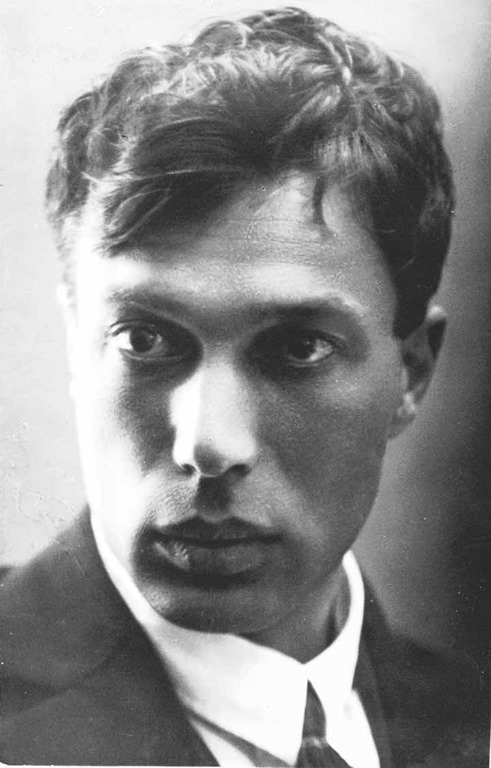
A couple of posts back I mentioned that we’d meet Yeats “rook-delighting heaven” again as we visit some more expressions of the month of February. Well, here’s one, Boris Pasternak’s “February.”
Coincidently, it appears that Pasternak wrote his “February” within a few months one way or another of Yeats’ “A Cold Heaven.” And both poets put ravens in these poems, though Yeats’ crows show up early, and Pasternak’s drop in near the end. Though Yeats wrote his “A Cold Heaven” in more temperate Ireland, it resonated with a Northern Midwesterner like me with its burning ice and unwarming sun. Pasternak, presumably familiar with a colder climate more like my own, sets the thermostat on his February to an early spring melt; but this is a muddy, sodden spring. His black spring holds cold rains, mud, and slush—more like a real early spring than a happy-butterflies-and-wildflowers May spring.
Bluesman?
I’m not fluent in Russian, but the challenge of translating this lyrical poem from Russian to English has attracted many. As I recall, when I tried to put together the text for this performance, I used several of those as gloss, tempered with Internet translator apps fed the Russian. I know nothing of Russian diction, so I aimed for an informal American diction, and unlike some translators, I didn’t try to keep the original poem’s rhyme scheme in English—after all, I knew I’d be supplying music for this.
I believe the music I choose here, bluesy rock’n’roll, while American, is fitting. I hear Pasternak here singing the Russian Blues: blues like unto our great American music of endurance, and rock’n’roll that cares only to seek the state he speaks of in the last two lines:
The more haphazard, the more true, the poetry that sobs its heart out.
So I’ll be putting this post up, and then I’ll go out in our haphazard too-early spring February myself. I too will head out past the noise of city church bells, past the cars, biking to the edge of my city where I’m going to buy George Saunders sad new novel.
Today’s episode is dedicated Renee Robbins, who once was lost on the edge of Moscow herself, the last passenger remaining at the end of a bus route. She found her way back long enough for us to know her.
To hear the LYL Band perform Boris Pasternak’s “February” use the player that appears below.
I decided on my own that Yeats’ piece in the last post was about February, but I have some other pieces that say, right out, in their own words, that they are about our current month. Here is one, “2ebruary.”
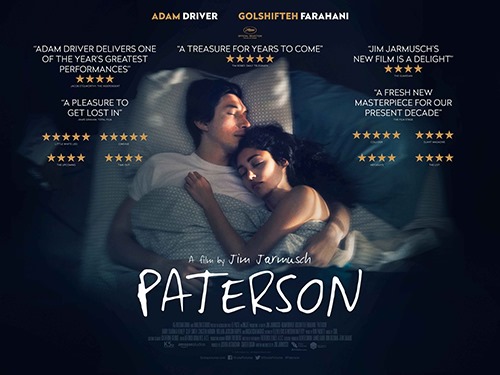
Earlier this month I saw Jim Jarmusch’s film, “Paterson.” This movie succeeds, in its modest and appropriate way, to do something impossible: to film poetry, or more exactly, the composition of literary work. It does this two ways: by having a writer, its central character, portrayed as a regimented, routinized person, grounded in a particularized working-class city and job; and then by having him compose “aloud in his head” his work against this background.
this movie has no light-sabers
This is a wonderful choice. The city, the routine clock of the days, the job, become the metrical, musical background for the flowerment of the writer’s consciousness that becomes the poems.
Though the movie is set in the New Jersey city of it’s title, the filmmaker refers often to the “New York School” of poetry, using the poems of Ron Padgett to stand-in for the work of the film’s main character.
The New York School uses a lot mid-20th Century Modern ideas, combining them into various combinations, depending on the individual writer associated with the movement. Some of it can be obscure and abstract, taking off from the same ideas that launched abstract expressionism in painting around the same time. But some also find a tenderness and wonder in the abstract patterns of urban existence, a Pop Art with a depth beneath its surface able to hold a beating heart. At a point in the film, the main character opens his noon lunchbox to eat, and to write down the intermediate state of his morning’s writing aloud in his head, and there like a Thermos, nestled above an orange and a sandwich, is Frank O’Hara’s “Lunch Poems.” It has to be there.
Don’t loose your Lunch Poems
O’Hara wrote in a great many styles, but this slim chapbook features several poems that someone once called his “I do this, I do that” poems. where O’Hara walks about, seemingly composing aloud in his head amidst daily tasks. These are my favorites, because, like “Paterson,” these poems seem to be about their own grounded creation in a city of routines, reflected inside the moist, encased, flowing mind of their writer.
Today’s piece “2ebruary” takes off from that Frank O’Hara mode, as I often like to do, though I’m an old man, writing in another century, in the Midwest, not New York City, and my old joints creak best on a bicycle.
a scene from today’s piece, breakfast not included
“2ebruary” is a short bicycle journey thinking of history, and past the events that are turning into history that we can still change. I take a pause, as every American should, to note that American culture is made from those who came here carrying something from elsewhere. And Midwestern culture? For many, those packing trunks are hardly great-grandparent’s-age-old, at the eldest.
At one point in the journey, I note those that had no trunks when they came to America, they had only their chattel bodies and souls—and even of those two things, the former had been appropriated by others for handy profit. What could they unpack? Well for one thing: the largest and grandest part of our American music. Our history is short compared to many nations, but it contains mighty things like this. We who are joining that history, already in progress, can turn it one way or another. Which way do you choose to turn?
To hear the LYL Band perform “2ebruary” use the gadget below.
We’ve already met Irish poet William Butler Yeats with a brief poem earlier this month. Now his words return with a piece suitable for the aftermath of Valentine’s Day, for “A Cold Heaven” is the tale of a rejected valentine. It’s also fitting, because Valentine’s Day comes in the midst of late-winter. February, as Margaret Atwood put it, is a “month of despair, with a skewered heart in the centre.”
Here in the northern Midwest it was a “seasonable” 19 degrees F. this morning, and hardy ice has outlived any soft covering snow. There is a promise of a thaw this weekend, but that will only recall mud and the detritus of what the snow once remembered inside it.
Critics from more temperate climes praise Yeats for his oxymoron here of “ice burned,” but up north we know that’s just what happens to skin in the cold, with no need for poetic intercession. And my back yard, my cities’ parks, and our central greenway have been home to that “rook-delighting heaven” he speaks of as well. Strange isn’t it, that the bird of death is so smart, so intentional, so sure, and yet inscrutable.
In “A Cold Heaven,” Yeats’ winter and his death-omen birds lead to a missed and misunderstood, “crossed” love; and he takes the blame: if not for the season, for the failed love. Like so many, and without the succor of chocolate or flowers, he is left in the rejected lovers worshipful, davening stance, “rocking to and fro.”
But he is a poet still! “A Cold Heaven” breaks itself in two with an image that is also a pun: “Riddled with light.” Yes, we Northerners know that winter light. Brighter than summer, and paradoxically the sign of a piercingly cold day. He knows his love’s in vain, and yet no amount of blame that he can assign himself—even if he exhausts “all sense and reason” to catalog that blame—can account for the failure of his love. What can solve this “riddle?”
Yeats begins again, with a majestic “Ah!” only to take us on a short ghost story, the spirit of his love in purgatory, in bardo, naked as a corpse or as a lover, wandering and asking why clear skies, clear answers, seem like punishment.
So to all those whose valentines were not accepted yesterday: peace. Such riddling has no end to its depths. I know this: that hole is too deep to be plumbed, just know that it’s deep. The correct prayer for such things is unknown.
Look, maybe she’s just not that into you…
As a performance, “A Cold Heaven” had some challenges because Yeats makes use of enjambment, where lines break in the middle of sentences; and where the meaning too, often forks, seeming to mean one thing before the line break and another afterward. Since I like to let the lines “breathe,” so that the music can interject, and so that the words’ impact can sit a little bit before the next line, I resorted to repeating a few words. There are also a couple of other audio tricks in the piece. The string parts, particularly at the beginning have a “backwards tape” articulation where the sound swells from louder to silence, in the reverse of the normal decay of strings, which I hope signifies the drop into the past in Yeats’ text.
To hear “A Cold Heaven” use the player gadget you should see just below this.
The motto of the Parlando Project is “The Place Where Music and Words Meet,” but in practice it has been the place where music and poetry meet. However, just as I want variety in the music used (within the limits of the musician’s talents) I don’t plan to always use poetry for the texts here. Today’s post is an example. I’m going to use a short public speech, but as I have done with poetry in other episodes, I’m going to treat the words as if they are specifically meaningful, and I’m going to treat those words as if they want to sing.
We are also continuing the investigation of artists and politics, something I’ve touched on several times already this winter.
A few days ago, a cast of actors received an award, and the actor acting as spokesmen for the cast delivered the acceptance speech. Though not entirely a political speech, it was received as one, and it was almost certainly intended to make a political point.
The actor, David Harbour, was speaking for the cast of a series available on Netflix called “Stranger Things.” That show is a sort of bumblebee. Like the famously un-aerodynamic bee, it shouldn’t fly, but it does.“Stranger Things” is a show that uses tropes of 1980s movies and books to tell a story set in that same decade. It should be a winking meta exercise where you spend more time noting the references than to the story itself, or a dreary “I’ve seen this one before” drama that plays as an unoriginal re-hash of ready-made plot points and incidents. Perhaps for some viewers it is one of those things, but for many viewers it’s an ingenious contradiction of all the ways it could fail, doesn’t, and instead flies.
I read on the Internet this is supposed to work!
As an actor, Harbour was part of that levitation. In his acceptance speech, he makes a choice as doomed to fail as the concept of “Stranger Things.” In his awards-banquet tuxedo, standing in front of an audience of actors, he gives his acceptance speech more-or-less in the person of his character, a gruff, down-on-his-heels Midwestern town sheriff.
What’s the percentages on this working? First off, actors are not their characters, often not even close. Humphrey Bogart wasn’t a grizzled tough guy, he was the son of a cardiac surgeon who grew up upper-middle class. John Wayne was a football player and son of a dirt farmer, not a cowboy or a military man. Actors themselves would know this more than anyone else. Secondly, whatever audience size “Stranger Things” has, that audience isn’t everyone. Will folks who haven’t watched “Stranger Things” get your message if it references tropes from your series?
Well, like the series, like the bumblebee, Harbour’s speech worked in the room none-the-less. You can view that short speech and the reaction here.
In turning this speech into today’s post, “Artists Hunting Monsters,” I changed a few things. First off, the video I first saw after the event did not include his prelude to the words I ended up using. In the part I didn’t have while composing, Harbour talks eloquently about his view of an artist’s role today. In editing the words I did have, sifting them down, and dressing them with music, I choose to universalize his rhetoric to the degree I could, so that even those who haven’t seen “Stranger Things” would have access the message; and in so doing, I changed things to address the role of artists in general, not only the actors that were his present audience.
I’m once more going to violate a principle I thought I would hold to here, and “explain” the text. Harbour, and my selection and recasting of his text, says that an artists’ job, an artist’s calling, is to offer succor to the disenfranchised: to show with our artifice, truth; with our play fighting, successful struggle; with our imagined detectives, the underlying monster. It’s a call to arms for artists to pick up blunted stage-swords and to deploy magnifying metaphors against oppressive decisions, systems and persons.
How did I speak with the music? Well, I won’t be so bold as to dance about that architecture. The main melodic line is a guitar played with an Ebow, a device that drives an individual guitar string into a cycle of feedback where it sustains with increasing volume until the device is moved away from the string. As the name implies it, it can mimic the sound of a bowed instrument, but that increasing volume feedback loop takes some finesse to manage. The secondary electric guitar line that emerges about halfway into the piece is a guitar feeding back with an amplifier, an even more chaotic effect. I was playing that part live in the main tracking session with bass, drums, and keyboards and was trying to get to the feedback “spot” with the guitar, but mics and other stuff were in the way, and it wasn’t until the track was nearly over that I finally got it to howl properly. And so, I was “hunting monsters” during the main tracking session for recording this piece.
This guitar D string is about to find out how bumblebees fly
Before we leave the music part, did you know that the way the bumblebee flies is the way those guitar strings vibrate?
There are still questions left to examine on the role of the arts, and more Parlando Project expressions of music meeting up with words to be posted here in the upcoming months. If you would like to be notified about these new pieces when they are posted, you can click the little orange “RSS – Posts” icon down on the right side of this post. To hear the LYL Band perform “Artists Hunting Monsters”, use the player you should see just below.
Here in the upper Midwest we are now in the middle of winter, and so are in a various ambivalence about it. Part of us doesn’t like the burden of winter, part of us wants to taunt it, and show that we can still have the upper hand over it, and some of us, those who don’t want to stop reading the book of nature, can find a cold, white chapter to puzzle over and admire.
I’ve already spoken here about how Minneapolis was settled as something of a colonial outpost of New England. The author of the words for this episode, Emily Dickinson was a lifelong New Englander, steeped in Transcendentalist thought, so we know she’s read that Winter chapter.
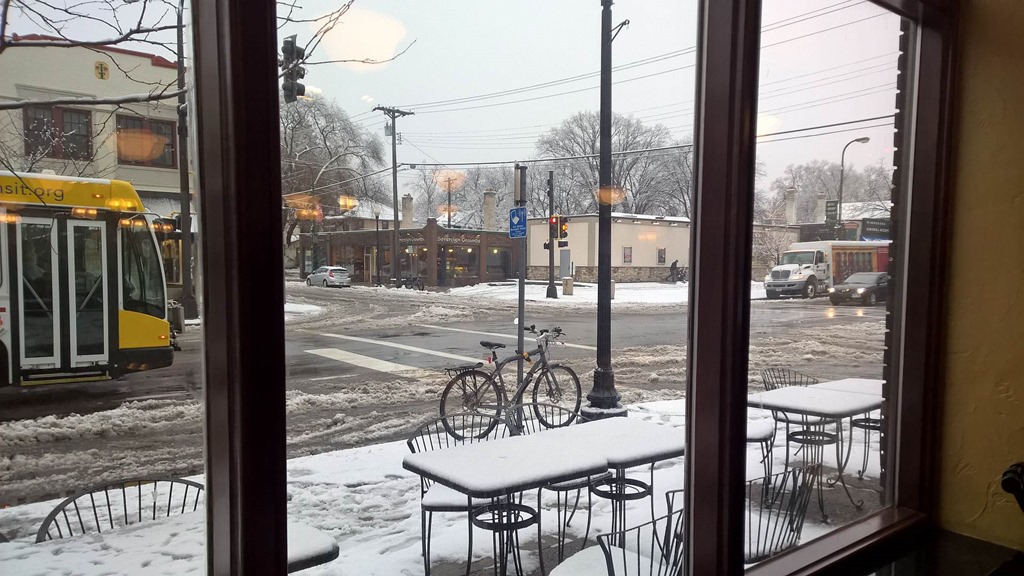
Just before dawn this morning, I jumped on my winter bicycle and took a ride to my favorite breakfast café. It was seasonable, 20 degrees Fahrenheit and snowing, the streetlight globes surrounded with particulate halos of pelting snow. My tires were crunching the snow, the big knobs of their tread like typewriter keys imprinting the blank pavement’s page. It really was quite beautiful, if obscure of meaning. Summer rain saturates us, inebriates us. Snow surrounds us, but we are never more than a transient part of it, unable to understand its dance.
Winter is good – his Hoar Delights! Also, there is tea and a frittata involved.
Emily Dickinson’s words are featured here a lot because she’s a great lyric poet and her words fit with music almost without effort. I learned decades ago that Dickinson favored “hymn meter,” that 8,6,8,6 syllable verse that makes much of Dickinson singable to the melodies of “Amazing Grace” or the “Gilligan’s Island” theme song. For “Winter is Good” I decided to throw out that pattern, turning some lines into refrains and marrying it to a melody similar to the Christmas carol “Joy To the World” instead.
Dickinson’s second verse is a doozy. Just 17 words in her text, but it twists so wildly. “Generic as a Quarry”—there’s winter’s white page I suppose. “And hearty – as a Rose-“ not sure where we go there. Dickinson was an avid gardener, and she no doubt missed her summer plants, but my best guess is just rosy cheeks. And finally, the concluding two lines “Invited with asperity/But welcome when he goes.” A jokey finish that seems like it’s singing the old joke about the pleasure of hitting oneself on the head with a hammer because it feels so good when you stop.
Our various ambivalence aside, that’s what the Winter chapter in the book of nature says to us Northerners, our words arise and are recovered over by the white page; our music only the spaces between silence, soon to be drifted in.
To hear the LYL Band play this hymn to winter with words by Emily Dickinson, click on the gadget below.
You can be in my dream, if I can be in yours. Bob Dylan said that.
You may have noticed that blog post frequency has fallen off a bit this month. Well besides the usual struggle of an upper Midwest winter, both alternative Parlando Project reader Dave Moore and I have had some extra tasks this month. I’ve been helping transition my mother-in-law to new living arrangements, and Dave has been working on editing a book of his father’s sermons.
Today’s post is a piece that Dave wrote a few years back about his parents, and his father’s experience after Dave’s mother had died. Like many good stories, it seeks to find meaningful connections in the flow of coincidental events.
And speaking of coincidence or archetypes or something, I wrote another piece myself a few years back. Though I did not mention it explicitly, my piece was also engendered by thinking of my father now living alone after my mother had died. Both pieces used the image of a bird trapped in a house.
I’ll not attach any more meaning than that to this. Today’s piece is Dave Moore’s story, read by Dave. Click on the gadget below to hear his story. Tomorrow I’ll post mine.