Remember, I said there was a bias in the top ten most listened to stats for the Parlando Project toward older pieces from the first three years of this Project. That’s due to a long tail effect: a quick bunch of listens when first published, followed by an accumulation in smaller daily numbers over the following years. Poetry – and the art I seek to meld with it, recorded music – is “The News that Stays News.” After completing the top ten run-down on this 10th Anniversary month of its public launch, I wondered today about the converse, about what was the least listened-to piece.
I scrolled down the hundreds of lines in the table of the reporting stats to see. Surely, it’d be some piece from this summer, and I’d have to explain that I must ignore the lowest listened-to piece because it wouldn’t have had a decent chance to find an audience yet – but it turns out I need no such adjustment.
The least listened to piece was from the very first month of the Parlando Project, published September 5th, 2016. Just 19 officially audited listens in ten years! 19.
Why would that be so? Well, it was one of those live LYL Band performances – something that makes up a substantial portion of the Parlando pieces over the years. None of them made it to the highest popularity levels. Musically, those are almost entirely first-thought-best-thought first-takes with no preparatory work at arranging the music. And this one’s got the limited technology of its time: the drums are just a canned loop. Keyboardist Dave Moore’s playing on a somewhat cheesy Casio rendition of an organ. I checked my recording dates: it was recorded a couple of weeks before release. I mixed it down and was considering it a only few days after that. I’ve got a number of Parlando pieces here (still available to stream, I’ve “unpublished” nothing) that seemed better in some fresh moment than a retrospective consideration says they are.
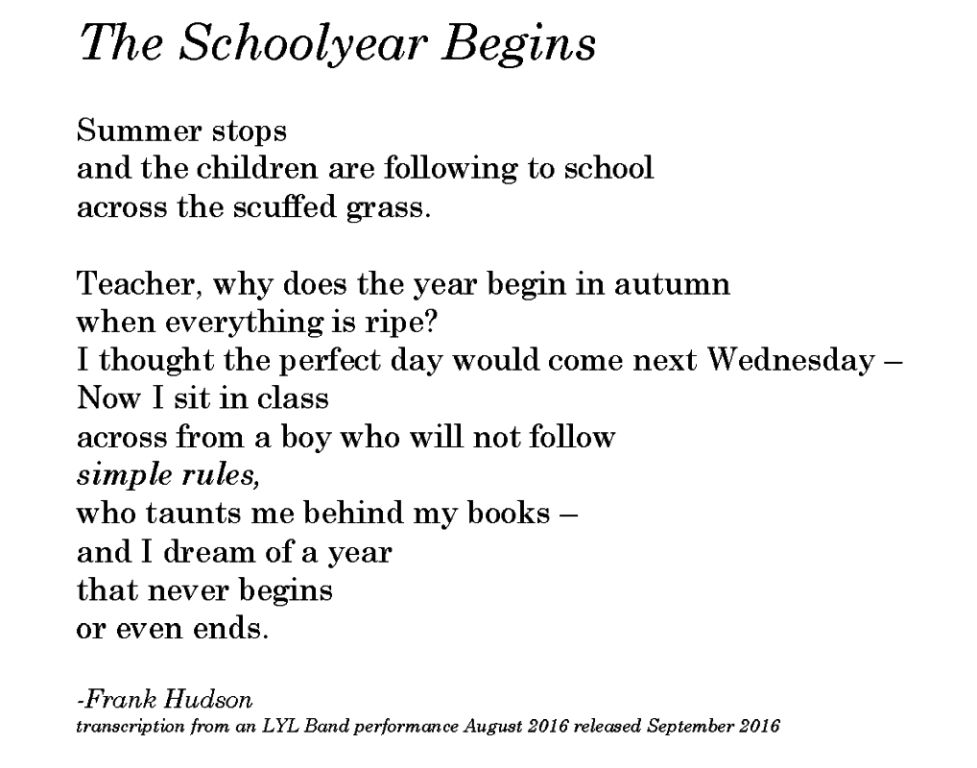
But listening to this piece, “The School Year Begins” again, I don’t find it all that bad. My embarrassment-meter is calibrated to my personal enjoyment scale, and I don’t mind unpolished musical performances. In this day and age of highly processed “real” recordings and uncanny valley AI simulations of that, I’m hardly less receptive now to this performance than I would have been then.
So, I figured I’d share it today in the Parlando Project’s anniversary month. I went looking for the document file of the words so that I could include them in this post. I got a surprise – it doesn’t exist. I’ve never been careless about such files, there’s almost no chance that any such was lost due to some computer accident or event. I searched my wrinkled wet grey-matter memory next, and this result came back: that would mean that I likely improvised the words while improvising the music. As a younger person I would do this sometimes. A few Beat poets did this sort of thing, though I don’t know how much preparatory material they brought to spontaneous live performance. Some of my other personal influences sound in performance like they might be improvising their text: Ken Nordine and his fellow Midwesterner Laurie Anderson. I don’t have detailed knowledge of how they worked – but my guess is that those two want to give the effect that they are improvising while working largely or entirely from script. Patti Smith in her younger years would improvise poetry in performance regularly, though referencing some basic premises and lines while Lenny Kaye improvised in musical “fields.” Two songwriters dear to my heart: Leo Kottke and Robyn Hitchcock will regularly go into fractured-facet spoken monologs on stage between songs, and these sound improvised to some level.* But in this case, I know how I would have done it. I would have had an image or situation in mind, and some trust that the words I’d choose to depict it would come out. I might have had a starting line, but the rest would be pure improvisation. This morning I had to transcribe the words I performed back in 2016 to present them to you today as if it was a page-poem.
Old as I am, whenever I pass a schoolyard at any school I look at the very-much-the-same worn grass and I’m into a Whitmanian reverie.
.
Does my improvisation work? Who can say – well, an audience, even a small one, like 19, determines that I guess. Could it have been better as a poem worked on in succeeding drafts? “Better” varies. Some poems are better in different ways. Those of us who enjoy improvised music often do so with a heightened empathy for the improvising musician, and in doing so our appreciation of their performance is bolstered by knowledge of the risk of their working without a net. That feeling simultaneously meshes with our own risk-taking, of time and attention. Improvised words are not exactly the same, but something of this might apply.
I certainly appreciate your risk of time and attention here. You can hear the LYL Band’s 2016 performance of “The School Year Begins” with the audio player below. No player? It hasn’t plummeted to the sawdust, it’s likely suppressed by the way you read this blog. I supply this highlighted link that will open a new browser tab with its own audio player for you.
.
*The only artistic place performed word-improv is widely practiced is in comedy. From the same Fifties as the beat poets who tried to Word-Jazz improvised poetry, an entire school of think on your feet that are resting on banana peels emerged. It’s now highly common for modern standup comics and comedy writers to have formed their craft-skills doing improv.

