I could, maybe should, write about a number of things this weekend. The end of May brings Memorial Day, one of the United States’ two holidays celebrating those who served in the armed forces, the spring version being more focused on those who died in wartime duty. It also brings to mind the anniversary of the drawn-out, agonizing death of George Floyd a few blocks from where I’m writing this. I think of that little group of South Minneapolis people, ordinary citizens of my neighborhood, who witnessed it, who pleaded with the police officers to cease their officiousness. I think of the new policemen in that squad, earnestly following the lead of their trainer who’d arrived, the man with his knee on Floyd’s neck. Duty.
Duty is a small word, but one that we have two holidays to honor. We generally respect it, and in small and large ways we carry duties through our days. My wife does in her workdays what I did for a couple of decades, taking on the duty of helping the sick. In between workdays she takes on the obligations to her mother suffering from increasing Alzheimer’s in a care home.
I’ve written about all those things here. I could write at length about them here tonight. In doing so I could say I am following my obligations to humanity, to those who suffer, to those who’ve lost. We use poetry often to decorate those tasks, more often perhaps than we use the more capricious song to do so. Thus I could write, and you might view it as your duty to read that.
Instead, I’ve been filled this month with the realization that this is my teenager’s last summer as a teenager. They’ve concluded an indifferent year of post-secondary education, and now have taken their first job. As to next Fall plans: they are thinking of stopping with school, saving money from the job, and moving out. Studying seems like a duty — their work-a-day job does too, but maybe it’s a more novel duty, or at least one that has a biweekly award of a paycheck.
Music is a key to memory, particularly emotional memory to me. During these feelings this May, I came upon a performance of a song by Jonathan Richman. Richman has an utterly strange career. He’s one of those you might see called a cult artist, which means those who “get” him sometimes puzzle those who don’t, but also it means that many who read this won’t know his work at all. As a teenager Richman became something of a Velvet Underground* superfan, and his early work shows direct influence of Lou Reed’s songwriting. In the early 70s he and his band The Modern Lovers recorded more than a dozen tunes that prefigured a lot of what was to come in Punk and Indie rock a few years later, but the recordings were not issued when they were made. Then in 1976, when the first stirrings of Punk were drawing attention, they came out along with newer recordings.
Here’s complexity to that odd: the old, early 70s songs and recordings were unvarnished, and they followed Reed’s model of being emotionally honest, but their timbres and approach would be in tune with some of the vanguard of what was called Punk at that time. The newer songs were even more childlike, though no longer being written by a teenager or recent teenage time-emigrant, and the sonics were quieter, even more stripped back. As his career continued, Richman generally proceeded down that path, writing ever more childlike songs focused on everyday wonderment. If his early singing called on some of Lou Reed’s snarl and assertion, the later work took on elements of 50s Do-Wop teenage innocent sweetness.** Richman in a sense started out before his time, had a recording career launch when his early work seemed of the moment, and then continued until the present day as a singer-songwriter presenting the impression of coming from a place that was younger and younger.
The song I heard while thinking of my teenager at the borderline, “That Summer Feeling,” was sung by a 40 something Richman a couple of decades into that career. On Richman’s record the Do-Wop influence is apparent, backing harmonies and call and response from additional voices. Compared to the version you can hear below, there are more verses, more detail of youthful specifics. Blind to the career history I’ve summed up above, you might easily think someone about 19 or 20 recorded it, fresh with passing through that borderland.
Here’s the intuitive choice I made when I decided to quickly work up a cover of “That Summer Feeling:” to record it more in the style of the early 70s The Modern Lovers recordings than the “mature” Jonathan Richman. If I had more time, I would have overdubbed a garage rock guitar solo at the end or maybe some combo rock’n’roll organ as those records sometimes had. Following my taste, I preferred the songs less specific but most summer-set verses.*** This musical change and the way I sang the lyrics also brings out more of the undercurrent in this song, a complexity that a casual listen to a more smoothly produced recording might let one overlook. The singer isn’t just doing a let’s remember our youth story here. He warns in slightly mutating refrains that that youth will haunt you, and then he pleads with the (presumably teenage) listener to not wait until they’re older to, what — it’s not entirely clear — somehow integrate that duty-free time’s outlook fully into oneself or it won’t just haunt you, it’ll taunt you, and finally it will hurt you “the rest of your life.”
Would any kid ever listen to that message? Doubtful. My fatherhood duty knows limits, even counterproductive effects, of advice. Still, I wanted to sing it anyway.
After the jumps of this Memorial Day post, I won’t make the proforma Memorial Day holiday wishes. Some will be decorating graves. Some will be thinking of how life was disregarded. Some are caring for the sick and infirm. Some will be having cookouts or taking a little vacation trip away from work. Black joy, worker’s rest, flopping down in the grass without any duty, playing or listening to music. We honor duty. Let us also honor some respite from it.
Here’s my performance of Richman’s song.
.
*As many writers do, I must reiterate the Eno quote about how only a few thousand bought the first Velvet Underground record — but that everyone who did went out and started a band. Historians have determined that the record actually had decent sales, but Richman is one of the early examples of direct VU influence. The early Modern Lovers band included folks who would go on to being in The Talking Heads and The Cars.
**The small vocal ensemble 1950 style of urban teenage music that got called Do-Wop was often written by teenagers or near teenagers — and like the Punk, Rap or Indie music that followed later, it was inexpensive and approachable to create for the kids who made it. Arch cultural critics and satirists-in-song Lou Reed and Frank Zappa both appreciated it, thought it honest in its innocence. Punk founders Patti Smith and Lenny Kaye met because Smith loved an appreciation of Do-Wop that Kaye had published. I on the other hand have vocal limitations that keep me from indulging in the style.
***I am struck by the specific the song takes in one verse where it goes from singing swimming ponds and cool lawns to a traffic stop. I don’t think Richman meant to make that an existential moment, even if our modern gun-soaked life might make it seem so now.
A three-part post today — let’s see how short I can keep it, though we’re going to go far. Read on and we’ll leap from an important artistic movement whose poetry is forgotten, to the case of the odd filtering out of a woman artist from that movement, to some notes about translation and musical composition — and in the end to a remarkable trick, an April Fools’ joke of a sort I played on myself unconsciously.
Canons
It’s weird sometimes trying to figure out whose work gets remembered. It’s too much to ask for there to be some fair-minded, objective, and well-informed process of experts weighing the canon as our caissons go rolling along. Instead, quality and salience is supposed to just emerge. Emerge from what? Taken, via circular reasoning, from that memory. This sort of works, though how we know how well it’s working is hard to explain, as it may not consider those we aren’t as a culture considering. Canons have always changed — it’s ahistorical to say they haven’t, and when did we agree that history stops?
Dada poets are under-considered — or if they are, it’s as a conceptual statement more than a considered poetry. Visual arts will always include a Dada piece when discussing Modernism, literary arts are much less certain to. Dada’s evolution into Surrealism makes it almost easier to leave out Dada poetry. Dada poetry can be seen as the rough demonstration, the provocation that initiates a disruption.
My idea of presenting a Dada piece today comes out of an idea as question I had: “What can I do for April Fools’ Day?” Dada can be seen as an April Fools’ Joke. How so? Let me invent a manifesto of Dada that no Dadaist is likely to earnestly write as it violates the concept of Dada:
Much of what we’ve been given as meaningful can be seen in the human predicament as useless, maybe even harmful. Yet, we’re constantly being fooled with the trappings of power and precedent. Arbitrary examples of meaning, truth, and rules, dressed in the right costumes, framed in the expected way, keep us susceptible. So let us show how the trick is played and laugh at its absurdity.
Art Movement — and also the structure of an April Fools’ Joke.
Therefore, Dada presented poetry — a literary form we believe must be meaningful because it’s beautiful — that was random, perverse, taking the forms and frames of meaning while eschewing that meaning. Surrealism later posited meaning — or perhaps more exactly, the experience of art including poetry — as being above and beyond logical, conventional rationalizations, but the way was cleared by Dada’s withering can(n)on-fire that made merciless sport of the idea of hierarchical poetic meaning.
Still, we’re more comfortable with the idea of looking at the urinal/fountain or bicycle handlebars above a bike seat and seeing a worthwhile experience than we are looking at a series of chaotic words uttered incongruously as poetry. The first is a gentle poke in the ribs, it can easily elicit a pleasurable “See that?” The second worries us more, how should we take this? And the connection of denotative meaning (even an elusive one) that we rely on to carry us through an assemblage of words, is it indispensable? Is reader/listener boredom a legitimate artistic response, or one we’ll long endure?
The questions in some Dada poetry are valuable. The answers, not always so.
Emmy Hennings, forgotten because she was a Dadaist and because she wasn’t a Dadaist
Earlier this week I set myself a task to look at some Dada poetry to see what I could present here. I came upon a handful of poems by a name I believed I’d never seen: Emmy Hennings. I’ve retrospectively rechecked a couple of books I’ve read on Dada/Surrealism and I found my memory faulty. Hennings’ name was mentioned, but the context of those mentions didn’t make her seem anything like a key player. She was the partner and wife of Hugo Ball, a big macher in Dada, and consigned as a peripheral helper/muse/hanger-on. She did perform (from the very first Cabaret Voltaire performance!) but she was often characterized as a “music hall performer,” the kind of conventional entertainment that wasn’t what Dada was about. The supposition was put forward by the avant-garde that she was an interloper tempting Ball and the Cabaret away from real Dada into some kind of bourgeois, conventional performance career.
On further examination, there’s a case that she’s been underestimated.
Just kids. 1913, three years before the Cabaret Voltaire, but Emmy looks to me here like this could have been taken in 1975.
.
Looking over her poetry in a handful of human translations and quickie machine translations from her native German, I was immediately drawn in. It showed that essential Dada tactic as stated many years later by American Dada composer Frank Zappa: “Anything Anytime Anyplace For No Reason At All.” It also contained German Expressionist poverty-stricken darkness — and yes too, an element of erotic romanticism, though in the context that element was being set in place against the rest, implying criticism of it. Downrating her including music hall and folk song in her Cabaret Voltaire performances would seem to leave-out the case for Hennings consciously creating a Dada collage. If you put disparate things together as part of Zappa’s AAAFNRAA, those elements will talk to each other when viewed as one thing.
Here’s a secret factor most artists remain loath to admit: the random, or even the most carefully constructed miss-matches, can generate meaningful perception in the human mind. Yet Hennings didn’t write unalloyed gibberish, though outlandish collisions were allowed. She sometimes writes in a manner I recognize from later Surrealism — although from a woman’s mind and experience, a vantage point the Surrealists were loath to admit into their boy’s clubhouse.
Reading more about Hennings, I could see a rich collage of biographic and aesthetic components to her art.* I tried to sum that up to my wife by describing my emerging conception of Hennings as “A WWI sort-of Nick Cave: dark outlook, opiate addiction but hard working, catholic mysticism encrusted, mixed with elements of power-observing romantic eroticism.”
I already had a rough performance mix of the musical composition used for today’s piece before any of these Dada and April Fools’ ideas. I composed it using four new “virtual instruments”** that were newly available to me: a viola da gamba, a hardanger fiddle, a singing voice, and something that called itself a dulcimer.
I love bowed strings, and the somewhat rare and archaic viola da gamba is one that has long interested me, an interest that was sustained by once having a co-worker who played the instrument. The VI is a bit harsher sounding than hers (she used period correct gut strings and a softer bowing attack) but I used it to play the low-end lines in today’s piece.
The hardanger fiddle is a Norwegian folk-variation that uses sympathetic drone strings to add persistent, powerful overtones to the those actually fingered on the fretboard. A musical hero of mine, guitarist Steve Tibbetts once recorded an entire album featuring the instrument. My honest summary: I love drone, I love Tibbetts, my wife would testify I must love Norwegian-Americans, but I found it hard to take the sound of the hardanger for the length of an album — my reaction is similar to how some people experience bagpipe music. I also like sour tunings and harmony, but still that was my reaction. Dada being my goal, I went against sweetness however, and there’s a brief hardanger section in the middle of the piece.
By far the predominant sound in today’s music is from the VI that calls itself a dulcimer. I play the American mountain dulcimer a little bit. It’s a gentle diatonic scale instrument associated with American British Isles immigrants who settled in rural Appalachia, usually played by women as a quiet solo accompaniment for singing. This VI’s sound is nothing like anything I’ve played on mountain dulcimer. A demonstrator for the company that sells the VI says it sounds more like a lute. I’d expand that to say any of the oud variations or maybe even a mandolin family instrument. I treated its sound with a lot of reverb, so it’s more Coleridge’s opium dream Abyssinian maid dulcimer than some rustic American in a lone cabin.
The last thing I added to what was an otherwise vocal-less piece at this point: a high, keening VI voice. The human singing voice is something that VIs don’t yet allow easy access to. Perhaps eventually the ability for an easily available VI to sing all the components in human sung language will emerge, but for now what they do quickest is singing vowel-rich syllables. This VI went beyond the usual Oohs and Aahs with what sounded like nonsense words in no certain language. I hadn’t made the connection yet, but nonsense words are another part of Dada.***
So, on completion of the realized composition I surprised myself — I had what I then saw as a Dada piece without starting out with any such intent. That led me to seek out Dada poetry, and then to find and translate Emmy Hennings’ poetry to meld with my music.
“Singing at Dusk” is one of the few Hennings poems that has English translations I could find, but I made my own fresh translation. I followed a priority that guides my translations: determine what the images are in the original language and construct a contemporary English language way to convey those images. Since that is my primary goal, I will take liberties with the original’s sentence structure and wording. At times (and this happens here in this translation) I’ll even change the matter of the image in search of vividness. This latter choice is a historical fault, and I feel conflicted about it, but as I continue to translate, I catch other more renowned translators, resorting to it. Because I wanted a compelling sound to match up with the rather insistent music it was to mesh with, I also (uncharacteristically for my translations) decided to impose a rhyme scheme along with some other sound elements for this translation, which further caused me to depart from Hennings’ original. That kind of mutation to serve a form or rhyme scheme is another thing I catch other translators doing. Due to these choices, the result is partway between an earnest attempt a poetic translation and an “after a poem by” variation.
This version is a looser translation aimed for the needs of today’s performance
.
If it’s Dada, how much of this matters? It could, maybe should, be nonsense syllables, a random whatever. However, I didn’t find Hennings’ poem in the original German to be nonsense. Dedicated to her husband, Hugo Ball, it strikes me in German — and perhaps even more so in my looser translation — as a critical look at romance and marriage/partnership from a woman’s standpoint. Another element I bring out in my translation is the immigrant/exile experience. The originating Dadaists were from various countries, holed up in Switzerland, with a World War raging around them. They were writing work in German and French and a smattering of other languages, when those languages were being spoken in opposing trenches. National rootlessness was endemic in Dadaism, both as a choice and a fate.
Here’s the promised final observation: those keening nonsense words I generated from a VI played on my little plastic keyboard resolve at the end to something that I suddenly realized sounded very much like a woman singing “Jawohl.” What! They were just vocalese syllables, abstract sounds when I chose them — and they remained so for the dozens of times I’d listened to those passages, played even before I chose a German language poet to translate. Was that a trick of the ear? Here it was, the night-time, I was going to bed after a long day working on this piece. I was listening to this singing at dusk, and inside my earbuds I hear this voice loudly singing the German word for the certain and absolute “Yes.”
Will you have my experience with this musical piece? I can’t say, but you can hear it with the audio player below. No player? This highlighted link will open a new tab with its own audio player.
.
*Like some other Dadaists, she was a hyphenate: she wrote poetry, prose, sang, danced, made and performed with puppets, painted.
**A virtual instrument (VI) is a playable instrument made up of multiple samples (most often taken from a microphone in a recording studio placed on the “real thing”) of the various notes, ranges, and articulations of an actual instrument. One plays the VI by using a controller (a keyboard or perhaps a guitar with a MIDI pickup) that controls the notes played, or by scoring the music and selecting how that score should be played. This is a much more atomized use of sampling than the other kind of sampling that uses recorded snippets (often several bars long) of already recorded music afterward triggered to create musical beds and motifs in modern hip hop/rap music. The latter is another use of collage: thank Dada again.
Obviously, the tactile experience and idiosyncratic techniques of the real instrument cannot be brought over, but the results are increasingly convincing, at least to casual listeners. For composers without grant patronage or large exploitable friend networks, it’s a godsend. Even when the exact sound of a musician and acoustic instrument in the room isn’t produced, a musical something can be.
***The most famous Dada poem in any form known to modern English speakers is the Talking Heads song “I Zimbra.” When he presented it during his American Utopia theater piece, composer David Byrne explained that he adapted the vaguely foreign-sounding lyrics from a Dada nonsense-word poem by Hugo Ball, the partner of today’s poet Hennings.
OK, it’s time for my Frank Zappa story. I’ve told this story a few times, but it’s appropriate that I tell it here as part of this series where I discuss the ways the Parlando Project’s meshing of poetry and music became an idea, and an idea I could implement. This post will be exactly as short as I can make it in order to move the story from Francis Poulenc to Frank Zappa.
Last time in this series you met Dave Moore and Jim Scanlon. During the year the three of us were all at this small college south of Des Moines in Iowa, we worked on an “underground newspaper” called The Gadfly that Dave and his partner ran. The content consisted of a mix of things, often with a strong satirical streak, commenting on politics, culture, and music. The capsule overview younger people of later generations get of The Sixties* is that every white young American was a hippie, everyone had long hair, and we all lived in bohemian haze coincidentally stoned and angry at political situations and injustices. The reality, as I saw it in Iowa then, was that 1968 was not that different from 1961. One common complaint reflected in The Gadfly was that the problem wasn’t just The Establishment, it was also our own cohort (at least the ones we were living among) who seemed mired in apathy. We thought new ideas and some ridicule of the old order might change that. Were we, and others like us elsewhere, slowly changing things? Observations differ.
Then came the spring of 1970, when for a brief moment the political activism spirit seemed to change in the matter of a couple of days.
My friends Dave Moore and Jim Scanlon had left for another college in the fall of 1969, Beloit in Wisconsin, where they hoped they would get a better education and find a more responsive group of students. I remained at the small college in Iowa where I had become the editor of the official school newspaper at a premature age. Over the school year, that responsibility slowly spiraled out of my control. I had no idea how to lead a group of people (still don’t). My working theory was to let them exercise their talents and see what happens.
Here’s what often happens under that scheme: many people will valorize what they think is their talent, then not actually exercise it. What will some conclude from that? That they must be restricted yet, somehow — that the actuality that they can’t deliver must be due to outside forces. For those, any extra degree of freedom doesn’t free them, it exposes them.
If you’re considering that carefully, you may wonder, is that what I was suffering from as well? I’d been given this opportunity/responsibility after all. Was I ducking it? Was I not taking advantage of it? I will say this: I wasn’t blaming outside forces, I was blaming myself. The romantic me wanted to see others blossom. The romantic me thought that blossoming was a natural process. Like an inconstant gardener, I was looking at a lot of failed plantings.
Then the spring of 1970 arrived, and with it the shootings at Kent State University, shortly followed by further deaths at Jackson State in the context of the now official expansion** of the Vietnam war into neighboring countries. This led to an extraordinary expansion of activism on college campuses around the country. I was frankly surprised at the speed and the rapid spread of the college student response, even after the shootings. There had been for at least a couple of years an eminent fear among the young men regarding the draft risk, which while it had helped fuel the anti-Vietnam War efforts, it hadn’t engendered this level of response. Tens of thousands of Americans, our generational contemporaries, had died in the combat, and that’s just considering “our side.” Activists being shot or killed wasn’t new either. Activists knew all this. I knew this. What had I discounted was that the Kent State shootings were at a very ordinary midwestern university, that dead included non-activists who just happened to be between classes, and that the dead included women.*** Across the country hundreds of colleges were shut down by a fast-rising wave of student activism, including my little Iowa college.
As quickly as the tide of activism rose up, the wave subsided. Our college-based headquarters and its plans for increasing political pressure to end the war depopulated as students returned to home or summer jobs. Eventually it was a few people in an apartment on the town square, lieutenants without any troops.**** I left for New York in an adventure I don’t have time to recount today.
Returning that fall, I was living in a sort-of-commune in the college town, without any funds to attend college, trying to figure out what I should do. Not only didn’t I know that, I didn’t have any idea how I would know that. That’s when I heard that Frank Zappa was going to play at Beloit, at the college my friends had left for over a year before.
I probably heard this news by reading it in a letter. Yes, younger readers today, there was no other way. There was no Internet. There wasn’t even timely press coverage of national tour dates, everything being done through local promoters and short-lived rock concert halls. Phone calls beyond your city were “long distance,” charged by the minute and too costly to use for entertainment gossip. I found out in 1970 the same way as someone would have exchanged this information in 1870.
My interest in Zappa had grown over the two years since I’d first heard Zappa’s Mothers of Invention on recordings. I didn’t realize it fully, but wider music listening and observing Don Williams’ ability to construct music on the fly was mixed with another rare thing my small college supplied me. This little college 20 miles south of Des Moines, with enrollment of barely a thousand students, had a burgeoning opera program. Opera of course is — what does it say up at the top of this blog? — a place where music and words meet. The opera curriculum would grow over the years, but at this time the program was still emerging. The theater used for performances (also the site of some of my classes) was a small old building, with seating for a few hundred. I’ll summarize one part of my experience in this: to see opera sung in a grand opera hall, with elaborate sets and pricey tickets, with a complete orchestra, is a very, well, operatic way to view the realization of that art. All art is artifice, sure, but the human connection to me in those situations is stilted. Not so, opera sitting a few yards away from another person singing it, perhaps even a person your own young age who you might see in your classes or on campus. That’s another experience, far rarer.
You have not likely seen that impact reflected on my adult life, or on the Parlando Project that you know here. For one thing, my voice is not operatic, it’s barely a singing voice. Yet I can write this today, that I remember seeing for one exact example, a performance of Poulenc’s Dialogues of the Carmelites, and being carried away about what performed music, voice, and words could do in that small space. It may have helped that this opera makes an extensive use of recitative.
Listening to Rock music in my daily life then in The Sixties, it occurred to me, who in Rock could bring something to opera? Besides the differences in the use of the voice, or the nature of projecting character as opposed to ones seemingly authentic personal voice, there was the problem of extending the instrumental colors. My thought-answers then? Jim Morrison, who had performed a bit of Brecht/Weill on the first Doors album, and Frank Zappa, who claimed the ability to be “a composer,” and was even allowed to demonstrate that he could compose for larger ensembles including orchestral instruments.*****
That I could consider that was consistent with Zappa’s brand then. In those early, heady days of Rock Criticism, it was a given that Zappa was a genius. He wasn’t the sort of musical act that many people listened to with addictive, ear-worm pleasure, sure, but still a genius. Well, there were those smutty lyrics, and an assumed swimming pool of contributory drugs, but still a genius. It was The Sixties, we assumed impossible things could happen, but we still felt genius was rare and worthy of note.
So, a chance to see this genius in a live concert, this artist whose recordings had opened up other considerations for me, couldn’t be missed. I drove there, 300 miles, with other share-the-gas people in a Fiat 1100D.
Cost of the concert? $3. An amount similar to my portion of the share-the-gas cost too.
.
The concert? Not life-changing. The acoustics in the fieldhouse hall were atrocious, and our seats were in the galleries far from the stage. The music was good, but with the sound bouncing around and the typical poor vocal PA of the time, the result was a mixed pleasure.
We got back in the little car to head back to Iowa. Finding our way through the unfamiliar streets we saw another car occupied with hair as long as ours inside. That car contained some young women. For some reason they wanted to share with the fellow freaky-looking folks that they knew the hotel where Frank Zappa was staying and that they’d been invited to visit him.
Of course we believed them. Of course we followed them. What did we assume was to happen there? Some sex, drugs, and rock’n’roll orgy? I’d just turned 20. I didn’t know what I was going to do with my life, or how I’d figure that out. So, why would I worry about might happen for the rest of some single night in October?
When we arrived, the bunch of us from the two cars, maybe 8 or 9 people, spread out around the non-descript motel room. A couple members of the band were checking in with Zappa. There was a short discussion at the doorway between Zappa and George Duke about what Duke had played at the concert, which got approval from Zappa. The band that night, though billed as the Mothers, was new, containing vocalists who had once been part of the pop band The Turtles, now billed as “Flo and Eddie.” One of the young women from the other car bounced on one of the beds. Most of us seemed like me, passive, waiting for something to happen. Zappa turned his attention to us, asked us what we’d thought about the concert. There was some short discussion. I think I may have mentioned that a lot of the material seemed new. Best as I can remember, that was accurate. Zappa replied that they were doing some of the old stuff too. Memories fail, but I believe “Concentration Moon” was replied as one of the veteran numbers. The male part of the room had some hard-core Zappa fans, who started to geekout on questions about the band’s history. I recall one asking about Doug Moon who had played with early versions of Captain Beefheart’s Magic Band. Were they trying to impress the genius with their knowledge, even in the midwest, of the places Zappa had come from? Zappa replied Doug was some guy who’d worked at a gas station. Zappa was patient about the questions, however trivial. At one point he took out a movie camera and filmed us in the room. I remember he moved in close to my face as I was missing one bow on my eyeglasses after that part had broken, and I had no funds to fix or replace the frames yet.
Here’s a few things Zappa conveyed to us in the roughly hour that I, and maybe others in the room, didn’t know before meeting him.
When asked about his doo-wop music parodies, including the Cruising with Rueben and the Jets LP, he corrected us that he liked that music. He spoke about Fifties R&B records he was inspired by. Since the lyrics in those songs were satiric, I’d assumed the music was also something he held in contempt. Far from it, he lit up talking about this. In The Sixties there was a widespread critical assumption that good music was “progressive,” meaning that we were to drive our plows over the bones of the dead, so this was news to us.
He nonchalantly corrected any impression that he was inspired by drugs. How he did this without sounding like a “Listen kids…” PSA I can’t exactly recall.
He seemed genuinely interested in us, and what we thought about the music — though at times, such as when he wielded the camera, the idea that we were natives and Zappa was an anthropologist occurred.
For me, the important thing happened near the end of our time in the room with this “…But, a genius” guy. I asked him how much of the show was improvised and how much was composed. He went over to the side of the room and picked up an oversized portfolio. Opening it, he showed it to me. Multiple staves of music, a rather full score as I recall. Dialogue written out, seemingly informal and back and forth, as if the band members were speaking off the cuff. In retrospect, I believe I was looking at scores for 200 Motels which would be filmed a few months later with a full orchestra. As he showed me this, he talked briefly about the effort he put into it, which the score showed. I was immediately impressed with the formality of the effort to achieve what seemed like chance informality. There must have been some serious seat-time in getting that done. The intent of it!
Imagine instead if I had somehow visited the hotel room of Jim Morrison in 1970. Perhaps my romantic notions of the creation of art would have gathered more poète maudit forces. Did something in my subconscious connect what Frank Zappa conveyed that night with William Blake, who when not out talking with the visions of angels, was innovating printmaking techniques and making books with his own skills?
After that significant side-trip, we left the room and returned to Iowa. If you’d asked me that day, I still didn’t know what I wanted to do with my life — not a whit more — but what I did have was a piece of information, and an outlook. From that night I could remember that doing was a large part of doing something with your life.
This is already a double-length post, so enough for today. To tip my hat to Mr. Zappa, here’s the LYL Band roughly approximating one of his later tunes in a we’ll-give-it-a-go live performance.
We flattened Zappa’s music and arrangement here, but as the video points out, if Zappa were performing this song today he’d be sure to include more screens than just TV.
.
*This oversimplification is more accurate about youth in The Seventies than the Sixties, even the final three years of The Sixties. In terms of clothes and hair, look at a range of contemporary photographs and film from the actual Sixties. Beards and long hair will be sparse on the young men, not movie wardrobe department common. Yes, use of marijuana and other drugs increased during the last half of The Sixties from a very in-group secrecy thing to a sizable minority, but in doing so it lost a bit of its bohemian rhapsodic connotations and became just another illegal high like drinking alcohol before the age of 21 had previously been. Real “counter-culture” bohemianism in an artistic sense had grown from the beatnik Fifties — maybe even doubled or tripled — but was still something a single digit percentage of people engaged in with any seriousness.
**In reality, this regional expansion of the conflict had been going on by proxy and by secrecy for a long time — but in the run up to the Kent State shootings it had become stated policy, driving hard-to-escape fears that there were now going to be additional para-Vietnam Wars.
***This is a complex point, one I need to leave off too briefly. Women of course were involved in anti-war activity before Kent State, but it occurs to me that this small factor may have been more important than recognized in adding to the explosion of activism in the spring of 1970. In case you’re wondering: yes, the anti-Vietnam war organizations, like the counter-culture, weren’t significantly less patriarchal than the rest of Sixties society — and though it may rankle some, I’ll add this as well: the victims at Kent State were also white.
****Any reading this who participated in Occupy Wall Street or the Black Lives Matter activism of this century may have a moment of recognition here. The emotional high of sensing that something is finally being said loud enough, that mass pressure is finally being brought by an unprecedented number of people is shared from this time. The emotions following, when such movements crest and seem to dissipate, need to be considered too. Here’s one piece of wisdom from someone else from this time worth listening to.
*****Will some Classic Rock oldster reading this think “Well, Rock Opera, what about the Who’s Tommy?” Tommy had yet to be released.
The Velvet Underground is important to me for two reasons. First, I have a high degree of respect for musical outsiders, those who choose to vary from the expectations for sound. That doesn’t mean I enjoy listening repeatedly to every outsider and experimental musician. I ignore and sample listlessly more of it than most mainstream listeners ever do. And some of it, and the Velvet Underground is one of those “some,” does something for me that other more generally likeable music doesn’t.
The second reason? Despite or because of their musical oddities, they attracted social outsiders. Haynes film reminds us that Cher* was once famously quoted as saying the VU would “replace nothing except suicide.” That was clearly understood as a slam on their dark outlook. It’s also commendably true in another way — that for some people this band of strangeness comforted some who felt unacceptably strange.
It’s OK, really, if you don’t like the Velvet Underground’s music. But I hold that you should still be grateful they existed. So how about Haynes film revisiting their formation and career? Grateful there too, though I want to second-guess Haynes more than most reviewers of this documentary. Before I do that, let me say that I respect the effort to put this together. Just looking at the long, long scroll of rights holders that needed to be placated and credited tells you that this was no easy thing to bring off.
Throughout the film I was thinking “they aren’t putting enough context here for those not already knowledgeable about this scene to understand who and what is happening.” However, reviewers have been almost universally kind, and this section of mid-20th-century NYC history can’t be all that widely known in detail to reviewers in 2021. This indicates that enough must come through for some. Perhaps I underestimate the value of samples of things to satisfy or attract interest, and overestimate the missing details that I personally find interesting or telling.
Am I being fair? The film does supply enough detail to see how the Mekas school of art film and the Fluxus associated music scene became the soil in which the band took root. And while it might not be surprising given that this is a film made by a filmmaker, I had not seen any other account that made an effort to tie those film and music threads together. So, props to that effort, but watching the documentary I wondered how many fresh eyes would be able to understand the variety of things the Jonas Mekas DIY film circle was experimenting with. Early in the film I watched a Stan Brakhage clip appearing on the left split screen, an experiment in drawing with light by scratching directly on the film stock. Annoying pedant that I am, I pointed at the screen and enthusiastically shouted out that that was Brakhage’s work. I stifled myself quickly, but the film didn’t credit it on screen at the time. I could surmise that not identifying it was part of the effect that Haynes wished to convey, that a sense of “what can you do that is novel and different” was ubiquitous then and there.
One hole I noted was any contextualization of how other bands and musicians beyond La Monte Young and John Cage influenced the VU sound and the courage of its exploration. R&B influences appear visually in the film, and early on some doo wop stunningly segues** into what I think was a La Monte Young piece, and I thought this side of VU’s influences would be demonstrated, but that brilliant moment was not repeated or expanded on. As a composer, half-baked musician, and writer I would have gone there, but I’m not Haynes, and he’s the filmmaker who made the film.
In general, other possible musical connections were lightly inferred. Perhaps this area is rock fan trivia? There was a passing mention of how Bob Dylan had opened up songwriting. In one film clip Allen Ginsburg is announcing an event which will include VU, other parts of the Warhol scene, and the Fugs, and Ginsburg nods to Fugs’ principal Ed Sanders in the room. The VU and the Fugs*** seem to have formed close to the same time, 1964, and despite The Fugs not having a John Cale figure, both were groups of Greenwich Village poets forming a band whose material will be unafraid to shock general society. I’ve never found any mention of either band knowing of each other, yet in the small world of NYC in the mid 60 they had to. We do know the Mothers of Invention and VU knew of each other — and in summary seemed to hate each other, perhaps because these two groups clearly competed in format to the degree that any so unique conceptions could compete. Given that the Mothers were West Coast until a summer-long stint in the Village in 1967, it’s less likely they knew of each other at their formation in 64-65 however. Here’s a link to a short run-down of those frictions.
Moving to my poetry side, there was also no mention made of the beatnik jazz-accompanied poetry which must have also fed into this band’s conception, even though Lou Reed’s college teacher Delmore Schwartz’s dark but unaccompanied poetry is covered
The included footage of the ‘66-‘67 Exploding Plastic Inevitable shows looks fascinating. In the interviews regarding the oft-told tales of the VU’s 1966 west coast tour EPI performer Mary Woronov mentions that west coast light shows were not in the same class. Yet another report from eye-witnesses says that the EPI shows were haphazard with inexperienced hangers-on and even audience members running the lights. This might have been a night-by-night difference over the run of the EPI. Or it could just be home team cheerleading by the VU/Warhol entourage. The transience of the multimedia lightshow/music events of this era makes this so hard to evaluate, and that era of improvisational multimedia collage surrounding live music has largely left our culture. In its place we have giant video screens so that we can assay the length of the lead singer’s nose hairs at concerts. It’s likely no one cares anymore who was first or better in this field, alas.****
One fleeting remark made when discussing how the West Coast Scene and the Velvets contrasted was an observation that there was an overlap in fans of VU and the Grateful Dead. I’m reminded of what I wrote here in 2016 about how it was too easy to paint all the West Coast bands as dilettante flower power Pollyannas and the VU as dark, hardened, and street-tough:
“Each band is fronted by a guitarist who has a problem with heroin. The bass player (and sometimes the keyboard player) is really an avant-garde classical composer. They both start out playing to dancers swimming in colored lights at events heavily associated with and promoted by a non-musician guru. Both bands had trouble selling records, at least at first, but those who did buy the records started forming bands beloved by cliques of college students. Both bands are known for an un-compromising poet maudit stance. Of course, one band hangs out with gangsters leading to a well-publicized incident of an audience member getting killed at a show. One wanted to call an album “Skull F**k.” One band put a drug kingpin in charge of its sound system. The other band hung out a lot with artists in lofts and had girl-germs for letting a woman be their drummer.”
Reviewers made much of the film breaking the talking heads format for music documentaries. Now having seen it, this point was oversold in reviews and publicity. Haynes had an authenticity policy of only using “eyewitnesses” who actually saw the band and its circle for his contemporary interviews. This only reduces the candidates, and those used, are used rather conventionally but effectively. I do hope that some of the interview material only excerpted in the movie is made available as a scholarly resource.
The subject of Lou Reed’s mercurial personality gets some play — an inescapable choice. Haynes shows us the VU was a combination of ingredients, but the idea that Reed’s is the largest contribution is hard to argue with. It was good to see Cale given his due here. Percussionist Tucker and guitarist Morrison’s contributions are mentioned but these mentions are comparatively brief. For example, the sole example of Tucker’s contribution to the band’s sound concerns one short (if endearing) featured vocal. If percussion is important to you, this hour-long video is an extraordinarily good dissection and demonstration of Moe Tucker’s musical contribution to the VU sound. On the other hand, I think Morrison’s musical contributions get less than a minute in the film. Was Sterling Morrison just that unimportant to the band? Has anyone who saw the band or witnessed the recordings ever outlined his contributions to the VU unconventional two-guitar attack? Is there just no one to speak for him on musical matters, and so Haynes had nothing to leave out?
Nico was always peripheral to the band, though interesting in her own right. In her case, I think Haynes does justice to the connection.
Back to Reed. The film hints at a more out and homosexual Sixties Reed than some other accounts I’ve read. The Rashomon aspect of who’s talking shouldn’t be surprising. Nods to transgressive gayness and gayness’ connection with the demi-monde (which was common linkage then, in gay and homophobic worlds both) was part of the band’s appeal without a doubt. Haynes presents this visually in a matter of fact way. This became culturally important, as important as the music — and in an odd way helped us into a world where gayness is no longer inevitably connected with a thoroughgoing outsiderdom.
The film once briefly nods to elements of misogyny in the scene. Some documentaries would never have made even that brief mention. My wife noticed this too and added that both the women and the musicians appeared to be treated as merely decorative by the Warhol Factory. In this matter, the scene too often, too easily followed mainstream culture and even the ironic elements of camp are subject to the mask becoming the face. In its defense, we could enter the question if it was less patriarchal, or no worse, than the general Sixties popular music scene.
The loud, aggro VU is fine, but then there’s this side. Here, you can hear the entirety of “Candy Says” referenced below. Doug Yule’s disarming vocal and Reed’s songwriting are superb here.
.
All the film’s en passant moves may still capture. Something informative and entertaining did accumulate over the course of the film’s two hours, but the emotional impact was less than I expected. We are not compelled to care about the human beings on the screen even as we consider them for their exceptional choices. Haynes respects and expects the audience to bring that element themselves. A personal emotional exception within the body of the film: 15 seconds of “Candy Says” plays to help introduce us to John Cale’s controversial successor in the group, Doug Yule, who sang this Lou Reed song on record. Musically, there’s nothing avant garde about the song, but it’s emotionally gripping to me, more so now. The documentary’s final sequences help summarize things a little. If an audience sticks it out, and brings their own empathy and intelligence to it, my summary is that the film could encourage some people today who wish to do something off-the-beaten path artistically; and Haynes’ film has rewards for those who are established fans of VU, whatever size that grouping is today.***** Should I be concerned about the size of the audience? After all, there are still Velvet Underground performances that can all but clear a room in minutes. The principal members of the Velvet Underground consciously chose that path, deciding to choose an audience who would stay for contrasts and experiments, an audience that in turn found a community of understanding when some of those and their experiments weren’t welcomed.
After 2,000 words in this review I’m hesitant to ask any more of your attention today, but here’s a short piece, “Up-Hill” I did several years ago where I combined Christina Rossetti’s Christian allegory with some VU inspired music. Player below for some, highlighted hyperlink for those that won’t see the player.
.
*It’s such a slick quote that I wondered if it was actually written by a publicist to be attributed to her. This was once a common tactic, for ghost-written quotes to be given to nightlife and gossip columnists as the clever things that celebrities were to have said in order to keep the pot of notoriety boiling for their charges.
**This was also something integral to Frank Zappa’s music. Late 60s listeners thought Zappa was just taking the piss out of an outdated pop music format when he’d do R&B vocal harmony, but he would tell anyone who asked that he loved that music and saw it as a valid sound and compositional color. The additional truth that satire was involved was incidental. There was satire involved when Zappa referenced Stravinsky, Berg, and Webern too.
***The definitive third-party consideration of The Fugs remains unwritten and unfilmed. It’s often occurred to me that The Fugs formation was as much or more than the Velvets, or The Stooges, or the Ramones, or the Sex Pistols the genesis moment of Indie Rock, and for punk outrage they easily outranked that list of founders even if the quality of their musical achievement was more inconsistent.
*****I suspect that within later generations now, there may be another grouping unfamiliar with the Velvet Underground, for whom the old joke can be repurposed “You mean, Lou Reed was in a band?”
William Carlos Williams Kora in Hell is an unusual book. Its subtitle: Improvisations promised me more than it delivered. Improvised or semi-improvised poetry, that true Jazz poetry where the author composes on the spot from themes or from spontaneous inspiration is something I admired and—to a degree—practiced in my youth. The improvisations of Williams’ book are usually classed as prose poems, but I don’t find much music in them nor a sense of surprise or discovery. They do reflect the influence of Dada and Cubism, and if I could hold my attention on them longer, they might still bring some pleasure and illumination to me—but so far I haven’t been able to do that. But nearly half the book as published is prologue and that was more rewarding to read.
One can get a real sense in the prologue to Kora in Hell of where Williams found himself a century ago when it was written. There’s a lot of self-assertion, a lot of names dropped, a lot of debates on poetry and art where Williams as the author of the piece gets to be not just a debate participant, but the moderator, editor, and director of the debate. Poets Ezra Pound, Mina Loy, Wallace Stevens, Marianne Moore, T. S. Eliot, H. D. and Alfred Kreymborg make their appearance. In visual arts Duchamp, Man Ray, and Charles Demuth are referenced. Earlier this year I also noted that a forgotten Modernist poet and editor Orrick Johns has one of his poems quoted in the prologue without attribution.*
The point Williams seems to be making over and over again in the prologue is that he is just as important, connected, valid and artistically insightful as any of these. One can easily view this assertion in a multi-valent way. Williams could easily have felt isolated and left out, now resident in New Jersey and earning his living with a bourgeois job** as a physician. And however genteelly it’s couched, most artists must engage in self-promotion—it’s unlikely that any ego-less man or woman ever set out to write a poem or paint a picture. And the point he’s making, that he, Williams, has something worth considering has since been validated by the canon-setters.
In the case of two poets, Pound and H.D., Williams has a personal history, having known them in his college years. And it’s an exchange of letters with H.D. excerpted by Williams in the prologue to Kora in Hell that I used for today’s audio piece. In her letter H.D. is offering gentle advice regarding something Williams has written. She’s noticed some stuff that seems derivative and that she feels doesn’t represent Williams’ individual inspiration. She sets that observation in the context of a writer’s calling and the sacredness (in her view) of the artistic enterprise.
Two initial American Modernist poets: H.D. and W.C.W.
Williams, the home team here, gets to respond in the bottom of the inning and he shrugs briefly before thundering. He doesn’t really address the substance of H. D.’s feedback so much as he jumps on the “sacred” sentiment it’s couched in. Sacred in Williams’ mind is associated with singular artistic criteria, the kind of thing that Eliot and the New Critics of High Modernism are starting to create in a revised standard version—and he’s again’ it. When Williams says “There is nothing sacred about literature, it is damned from one end to the other” it sounds as a ringing iconoclastic statement, but what does he mean? Is he saying “There’s so much crap around that folks think is great art, so who should care what little mistakes us Modernist innovators make.” Or is it something else? Is he perhaps saying something akin to a maxim I repeat here often, that “All artists fail.” Is Williams claiming that to attempt some impossible sacredness, forgetting that the artist will fail, will harm the work from that intention?
There is nothing sacred about literature, it is damned from one end to the other.
He then closes, in a sentence as musical as anything in the prose poems that follow, with a Dada litany. A half a century later, another Dada-influenced artist who influenced me, Frank Zappa, would phrase the same principles when he said his artistic rule was AAAFNRA, “Anything, anytime, anywhere for no reason at all.”
I’ll have more to say on this in a follow-up post, but this is long enough for one sitting and it’ll give me a little space to talk about the music in today’s piece. I got to use two new components in composing this. The opening section features a fine pipe organ virtual instrument from Garritan. In a vary real sense, the pipe organ was the first, wholly mechanical, embodiment of the synthesizer, and I personally can’t play or compose for it without thinking of Michael Barone and his long-running radio show “Pipe Dreams” featuring that instrument. The orchestra sounds are from Sonuscore’s The Orchestra which is a novel approach to orchestral virtual instruments. My initial encounter with using The Orchestra mirrors most other reviewers: it makes adding orchestra colors simpler than most while giving indications that it can be used deeply if one gets under the hood of the default ensembles.
This may be a good time to explain how I use virtual instruments here, and particularly orchestral instruments. I’m thinking that many of our casual listeners when they hear Dave or myself chanting or singing away with everything from a string trio to larger ensembles that I’m just dropping in some loops or samples from a recording. There’s a good deal of that done on the Internet with poetry and I won’t knock it.*** After all, I subscribe to the maxim of Duke Ellington’s that Peter Schickele sustained “If it sounds good, it is good.” However, because I consider myself, despite my limitations, a quasi-musician and an intentional composer, I choose not to do that. Those string and orchestra parts are played, on little plastic keyboards or with a guitar MIDI interface. Sophisticated musicians probably already know that because even while using orchestral instruments my harmonic framework is either based on rock’n’roll/blues and their common “three-chord trick” or on older drone/modal folk music traditions.
So the opening H.D. section of today’s piece is a three-chord trick, something that any garage band or punk musician would understand. And the William Carlos Williams part that follows is simpler yet harmonically, based on just C to D major chords, though the color notes of the electric guitar solo extend that slightly. When someone asks what kind of music I write I’m at a loss for useful words. I’ve said extended folk music and I’ve said punk orchestral.
To hear me present the epistolary dialog between H. D. and W.C.W, use the player below.
*As I said when presenting John’s “Blue Undershirts,” it’s possible that Williams, who praised the lines he quoted and used a similar though extended expression in his anthology staple “The Red Wheelbarrow,” might have thought that Kreymborg wrote them, since he quotes them while praising Kreymborg.
**I have no idea of Williams’ intent in that “day job” choice—or even how good or bad he was as a physician—but given the latency and indirectness of writers and artists impact on their fellow human beings, such work may be a useful adjunct to the writing life. I myself spent nearly 20 years of my working life in the lower levels of nursing. As I told my wife recently in a moment of clarity, I figured that if I couldn’t help myself at least I could be some help to others. Young artists: consider this.
***I must also mention modern hip-hop production which has developed a class of composers who are very adept in using samples, bits of recordings, and timbral eclecticism in a way that if someone had described it in the mid-20th century it would have seemed the very essence of an elite and esoteric avant garde, and thanks to a blessed (as in The Beatitudes) audience, and a good dose of the ever-popular folk music elements: intoxicants, sex and violence, they’ve made widely-heard popular music with it. This strikes me, along with Bob Dylan completing the Modernist revolution in poetry, as the most significant and surprising artistic events of my cultural lifetime.
Here’s a piece that I wrote* which is appropriate for July 4th, American Independence Day, since it talks about freedom and independence—but also because of its compositional back-story.
A few years back I got to travel to New York City with my wife and young son. An advantage of this trip is that I could see New York as a tourist. We stayed in Brooklyn, on the same block as a now unused building that was a waystation on the Underground Railroad, and we’d walk by it every day going to and from the subway station, that different underground railway. We visited the Tenement Museum (highly recommended) and my accompanying book for this trip was Rebels: Into Anarchy and Out Again,“Sweet Marie” Ganz’s** memoir of her life as a tenement-dwelling radical a hundred years before. We visited Ellis Island and my wife and son got to sit on one of the benches that immigrants sat on in the great hall awaiting decisions. We did what resident New Yorkers rarely do, we visited the Statue of Liberty, the giant statue that on Independence Day becomes the representational symbol for the American spirit.
Every American knows that statue as an image. For our large and diverse country, it’s the equivalent of ancient Athens’ civic sculpture of Athena. Still, here are two things that are lesser-known.
“Not like the brazen giant of Greek fame..” The reconstruction of the Parthenon’s Athena sculpture is in Nashville Tennessee. Athena has a carving of Steve Earle in her right hand as stone-Earle proclaims Townes Van Zandt the greatest songwriter ever.
The pedestal of the monument rests on the repurposed ruins of an early 19th century fort which once guarded New York harbor. Visitors to Liberty Island can see a section of the fort’s lower structures left uncovered and accessible down a stairway: bricked-in doorways of a room that was once used as a military prison cell according to the placard. The author of the placard was likely not a poet, but the Statue of Liberty rests on top of the doors of a prison.
One part of the statue, otherwise so well known, is nearly impossible to see for visitors, but was intended as part of the work’s imagery by its creator: beneath the torch of “imprisoned lightning,” the halo of spiked rays, the serene face, the tablet bearing the date July 4th 1776, and the copper-clad folds of its robe, the sandaled feet of this Lady Liberty stand on top of a broken shackle and chains.*** That would become the title image of “Chains At Her Feet.”
“Flashing for the refugees on the unarmed road of flight” some of the broken chains at her feet
It was sometime after that visit that I watched a young woman move out of a rooming house on my block. I could not discern all her story, but the small number of belongings, and the unable-to-tell relationship with a man who was assisting her with the move, but who left after helping with a couple of larger pieces of furniture, supplied the second set of images.
Why did I combine those two sets of images? Because it seemed emotionally right, though it may not be. A Dada principle, one beloved by composer/musician Frank Zappa, was “Anything, anytime, anyplace for no reason at all.” My understanding of Zappa’s artistic tactic is that combining things that don’t seem to go together, even things that seem outrageously incongruous, can create new and strong impressions. Chance, randomness, coincidence can be entryways to this.
I agree with that, though I’d caution you that my experience has been that most results of chance, incongruity and randomness will suffer from incomprehensibility and boredom, near and far misses. In practice, selection must occur, whether it happens before or after. Who selects? The artist and their audience. Zappa certainly chose, he was just happier choosing widely, and in some cases choosing things many people (and even I) will not like.
So, this combination in today’s piece “Chains At Her Feet,” the Statue of Liberty and a young woman, leaving or going somewhere, sketched in clear lines, yet missing parts of the story, may not impress on readers/listeners what I intuited and felt in combining them. Would it be better if I filled in the missing parts, even with invented details? Some readers of it have thought so. The title/refrain “Chains at her feet,” a detail taken from our giant July 4th icon, puzzled people. Was that my intent? Yes and no. I wanted people to ask what that odd line meant. In singing it, I repeat it enough to make sure people know it’s not a mistake. Do I want listeners to think “Aha, that must be the Statue of Liberty?” No, but I wanted the effect Liberty’s sculptor wanted when he put those chains under his statue’s feet, the same sort of conjunction as the remains of the military fort and the jail doors under the pedestal on Liberty island.
When singing this, I add more refrains. When reading it you see words I want as punned/double-meaning: “steals” and “sole.” Even “chains at her feet” sounds a bit like “change…” when drawn out.
So, who’s right? The answer is I don’t know. Long-time readers here know one of my dictums: “All artists fail.” Even the canonical greats bore and puzzle and meet with disinterest of most people most of the time—so unestablished artists like me certainly don’t know if what we do is any good.
No artist does. We do it anyway.
I like it when something connects with readers/listeners, I’m often sad when it doesn’t. My stance on what disconnect I find with what audience I find is to interrogate it and myself. I haven’t let it stop me making. Indeed, it sometimes leads me to additional making, seeking ways to make something work some of the time.
As important as it is that we artists respect, are even grateful, for genuine audiences, it is also important that we choose widely, even fail widely.
*Regulars here know that presenting pieces with my own words is an intentional rarity here. I often fall into doing it when I’m running behind in developing pieces with other writer’s words or researching around that goal.
**Ganz’s story was fascinating to me, an immigrant sweat-shop garment worker from age 13, who through chutzpah and conviction toward justice became a street agitator for reforms in early 20th century NYC. Speaking of a conjunction that may be accidental or designed, I’ve wondered if the Sweet Marie in Bob Dylan’s “Absolutely Sweet Marie” could have intentionally referenced her. Some of Dylan’s Greenwich Village cohort might have known of “Sweet Marie,” and her actions were less than 50 years old when Dylan hit town.
***Though Liberty’s tablet references the 4th of July, the proximal motivation for its creation was the ending of the American Civil War and American slavery. In statuary, having something beneath the feet of the figure or trodden on is not uncommon imagery, but chains and shackles aren’t just mythological images. In another juxtaposition, Juneteenth and July 4th sit close together on the calendar, if four score and seven years apart.
Don’t worry, we’ll be back with more audio pieces soon. Ironically, some of the interval right now in new music is because I’m working on experimenting, organizing and recording a bit this month. There’s always plenty to hear in the archives here, if that’s what you came for. Listenership seems to go down on the weekends anyway, so let me dance about architecture and talk about music this time.
This week I was driving, and the radio station where I used to work played the Temptations “Papa Was a Rolling Stone.” A driveway moment ensued. I probably hadn’t heard this record in years, perhaps decades, but I heard it plenty when it came out in 1972. That was back in a time before the death of the Top 40 radio format, a once popular but now oddball idea, where radio stations played a wide variety of music constrained by a tight playlist that repeated the same songs often enough that they imprinted on listeners. Radio formats still do the repetition, but such variety of genres would be considered commercial suicide now. Here’s a link to a list of the most popular songs of that year, the kind of songs you’d hear right before and after “Papa Was a Rolling Stone,” but it may be meaningless now to those who don’t know them. Take my word for it, schlock and genius (sometimes in the same song) in a mix of genres that would never have anything to do with each other in later years.
“Papa Was a Rolling Stone” doesn’t have to apologize for itself, it puts the needle-gauge over against the genius pin and keeps it stuck there for the entire piece. It’s a great performance. The Temptations, a vocal group, reportedly didn’t care for it because long portions of the record are instrumentally focused, but it’s a great group vocal performance none-the-less, with each singer getting to play a character not just a harmony singing register. As a listener though, what captured me then and now was the musical setting. The single was nearly 7 minutes. And it’s 7 minutes that never leaves the mono-chord minor groove and is through-composed featuring a prominent electric bass ostinato, spare trap drums and strings by moonlighting Detroit Symphony Orchestra players. Besides the voices, electric guitar and a heavily modified trumpet that sounds more like a modern synth patch than a real trumpet step forward and drop back.
Dancing on your grave: that slow, ominous groove confronts even the Soul Train dancers with a new problem
Listening to it again, enraptured by the instrumental arrangement, I thought, “This sounds remarkably like some of the stuff I do for the Parlando Project!” Please excuse that thought. I wasn’t thinking “I can play as good as those guys.” I try, but what I mean is that compositionally I’m often working the same concepts. “Papa Was a Rolling Stone” was arranged by Paul Riser, whose name I had to look up. Listed composers Norman Whitfield and Barrett Strong may have had input, particularly on the vocal melodies and of course the memorable lyrics, but musically when you’ve got what is essentially a one-chord vamp, I’d look to the arranger for those tasty colors.
So, here’s this arrangement, this set of timbres, demonstrated in a highly popular single from more than 45 years ago, that I continue to exploit from time to time here—but that’s not where I first got the idea. For that I must step back to another man, even more obscure than Whitfield and Strong, as unknown as Paul Riser: Charles Stepney.
Charles Stepney was a genius of tonal and timbral color who worked extensively in pop music genres. One reason that you haven’t heard of him is that when you work in pop music genres and aren’t held responsible for hits you tend to disappear. Unlike “Papa Was a Rolling Stone” I can’t point to a Charles Stepney record that many of a generation would remember instantly on mention. I knew Stepney most from his work with an equally obscure Chicago group of the Sixties and early Seventies: Rotary Connection.
If you were to listen to Rotary Connection albums today (they appear to be available on leading streaming services) your personal schlock/genius meter may waver from cut to cut. Particularly on the cuts from the Sixties, there are elements that sound like a soundtrack composer trying to portray “hippie-dippy sh*t.” In some instances, I’m not sure that Stepney wasn’t trying to signal just that, intentionally, as part of an extended collage of elements as Frank Zappa would do around the same time. Other times, what could be considered outré elements, “exotica” sounds of the quiet-village sort, need to be heard with an open mind and in the context of the whole presentation. Also in his Sixties work with Rotary Connection, there’s a fascination with extreme vocal effects, greatly aided by Rotary Connection singer Minnie Ripperton, who was asked to use her extraordinary vocalese techniques during those earlier records. You may find that strange, even off-putting, or a waste of a perfectly good voice that could be used in a more conventional soul-music style.
Problematic miming-to-an-early-record clip. Co-lead singer Sidney Barnes is hidden in the back, and the third lead singer Judy Hauff * had left the band. Worse yet, the TV host has a mansplaining moment with Minnie Ripperton.
Rotary Connection sometimes (like those Motown Whitfield/Strong productions) gets labeled “Psychedelic Soul.” Rotary Connection sometimes self-labeled itself as “Progressive Soul.” Interestingly, over in England the idea of combining 20th Century orchestral concepts and extended timbres with rock band instruments was a coming thing. It would get called, succeed as for a time, and then be filed on record shelves as “Progressive Rock.” Fashionable, then unfashionable, now something that one can experience without the danger of it taking over too much musical attention.
A contemporary arranger with some similarities, David Axlerod, has gathered a tiny bit of 21st century notice that has largely escaped Stepney. Even given Axlerod’s use of William Blake texts, I prefer Stepney. Perhaps that can be laid to my listening to Stepney’s work with Rotary Connection as well as Muddy Waters and Howlin’ Wolf** when these records were new, and I was young and ready to be imprinted. In this rare interview from 1970, Stepney sounds at times like Quincy Jones (although I wonder if the Downbeat interviewer may be an influence in that). If Stepney had relocated from Chicago to LA, closer to the heart of the post-1970 record business, could he have had a more Quincy Jones career?
His use of orchestra colors (like Riser, he used available symphony players, this time from the Chicago Symphony) combined with rock band instrumentation is what I admired, then and now. In the studio some of the rock band parts were played by Chicago jazz guys, both soul jazz types like Phil Upchurch and more outside cats like Pete Cosey. The combinations he composed aren’t really like anyone else’s—and different often makes demands on listeners to listen differently, and without preconceptions.
What happened to Stepney? He died young. He had just turned 45 in 1976, and—heart attack. He was starting to work with an upcoming group of jazz to soul players who also saw an opening in the Progressive Rock concept for longer pieces with more colors (yes, melanin pun intended). It might have been hippie-dippy to call themselves after their astrological signs: Earth Wind and Fire.
*although I focus today on Stepney’s instrumental arrangements, this unknown band had three outstanding vocalists: Ripperton is the best known; but Sidney Barnes was an arranger too, interested in expanding the soul-singer’s techniques, and Judy Hauff? She became a force in the shape-note hymn singing revival later in the 20th century, composing and arranging pieces for harmony choirs.
**although not orchestral, and I suspect less under Stepney’s direction, these two records(Electric Mud and The Howlin’ Wolf Album) by the Blues’ greats used some of the same jazz and rock musicians as were used on the Rotary Connection records. Reviews were almost entirely negative at the time. (TLDNR: sacrilege due to idiotic pandering to the hippies) Eventually, a handful of listeners heard the intent by younger Afro-American musicians to do something different with the tradition, as opposed to a mistake by crass marketers. The cover of the Wolf album was just this text: “This is Howlin’ Wolf’s new album. He doesn’t like it. He didn’t like his electric guitar at first either.” My opinion: like many experimental works, not everything works, but when it does, something new happens.
The Parlando Project started out as a podcast, which I wanted to be just the short audio pieces combining various words (mostly poetry) with as varied music as Dave and I could produce, presenting just the piece itself, without chit chat. The Parlando Project is available on all the leading podcast sources, it still can be consumed that way, even though it’s not a podcast as the form is now expected to be. In contrast, I loved how pop music radio operated in my youth, when bang bang you’d hear 3 minute records by Aretha Franklin, The Zombies, Slim Harpo, The Beatles, Sam the Sham and the Pharaohs, James Brown and Bob Dylan all jumbled together without any defenses of their value other than the glorious, various, numerous sound that came out of the speaker grill.
But, some folks will want to know something about the pieces, and rather than rambling on mic about them, the “show notes”/ blog entries began to get more elaborate as the project went on. Last summer I started to think of the blog as the main thing instead of the adjunct thing.
2. What is your favourite post on your blog?
My favorite (losing u, and crossing the ocean—which sounds like the germ of a might-be-too-half-clever song)? The blog post is one of my shortest, and the audio piece doesn’t even have my voice, but “The Garden of Trust” is the Parlando Project piece that moves me the most. I’d tear up when I was mixing it.
By far the most popular piece has been George Washington’s teenage love poem, “Frances.” Why? Illuminati web-bots boosting Washington’s hits? Angsty teenagers? Xerxes fans looking for a break from Purim?
3. Who are the top 3 bands/musicians that most inspire and influence you as a musician?
Oh, this is so painful. The list should be more like 300. Even though the blog is about “Where Music and Words Meet,” I must rein back from talking about music on the blog or I’d wear a reader out. Doesn’t everyone understand that the book and movie“High Fidelity” is a documentary and has no funny parts whatsoever?
Artists—just as important in some regard to me—will be left off! You ask three, so I’ll focus on musicians associated with words that motivated me most generally, and not singer-songwriters.
Frank Zappa. I met him and talked with him for a bit more than an hour in 1970. Reformed me artistically from a romantic to something else in that short of a time. I don’t completely share Zappa’s Dadaist sensibility, which is something like Dave Moore’s, but I need that to buffer my tragicomedy, even when it offends me. Here was a guy who didn’t separate R&B, rock, jazz, and “classical”/serious composed music. There was nobody who did that before him, and there’s nobody that’s done it since, so I try to do it at a lower level.
The Patti Smith Group. I could fill a list somewhere between 50 and 100, of artists who combined music with spoken/chanted word and poetry, therefore influencing the Parlando Project in doing the same; but if I had to pick one, it’d be the PSG. I’d read Patti Smith on the page before the PSG, and so I was already primed, but their first single and LP galvanized me when they came out. Taken together they are predominately spoken/chanted word records with co-equal music that’s not just a background sound bed. Obviously, there’s a sensibility there that comes from Patti Smith, but I’m saying the Patti Smith Group not just Patti Smith. Lenny Kaye from the first poetry readings with just Smith and Kaye on electric guitar had to invent something new with whatever musical chops he had on hand. I still think “What would Lenny Kaye do?” when working with a poet, and the younger Smith’s ecstatic vocal style, along with the other modes she added since then, is something I still aspire to.
John Coltrane. In regard to musical chops on any instrument, I’m not John Coltrane’s left pinky. I even have trouble faking saxophone lines. I like his later free jazz recordings in small doses, and appreciate the concept, but I can’t listen to it for hours, but when I’m most troubled or down on myself, listening to prime era John Coltrane just sets me vibrating with him on a molecular level. If I had to suggest a syllabus for a course on being an artist (any field) I’d suggest a John Coltrane biography or two. To me they’re like reading the life and sermons of the Buddha must be to Buddhists. It’s this, and his uncanny ability to speak wordlessly on his instrument, that makes me include him as a music/words influence.
Apologetically, I’ve just realized that none of these are musicians who are invariably easy to listen to; that they all have more detractors and “does nothing for me” listeners than fans. Two out of the three even offend on purpose when they wish too. That’s not representative of the whole of my musical influences, or how I want art to always work—but these are three who moved me to do work. If you want to stream a musician you haven’t heard of until you read it on a blog, then I suggest Bill Frisell, Steve Tibbetts, or Dean Magraw, all of whom have a breadth and beauty to their work I try to emulate, both as a guitarist and in my use of percussion.
That last show in particular sure looks worth $9.50
4. If you could have a drink with any poet (alive or dead), who would it be?
Once more my love of variety makes for a hard choice. Often if asked, it would be the poet I’m trying to interpret with performance and music on that day! That said, I’ll say Emily Dickinson. I’d so want to tell her “You’re going to win! You and the immoral Mr. Whitman are going to be the founders of American poetry. Every single day, people are going to read and be pleasantly puzzled by your little verses, and esteemed writers will look at what you did and wonder how you could invent such a new way to speak poetically.” I’d want her to answer all the Sunshine Blogger questions and more, and finally, though we’d be challenging bladder capacity by then, I’d want her to dish.
Alas, Emily Dickinson has no blog and can’t be nominated
5. If you could go back in time, when and where would you travel?
Easy first part. I’d target the first two decades of the 20th Century. I’ve always been drawn there for some reason, even though it’s not a period that gets much attention generally. That feeling has only intensified from my need to draw largely on works in the Public Domain (pre-1923) for the Parlando Project. Modernism in a lot of delicious flavors was breaking out all over, and in every art. Politically, a challenging time of vast inequality, but also a time of great hope that change was at hand. So, like time-travelers everywhere I’m going to expect to be reasonably well-off—but where to land?
If New York City, a chance to observe the melting pot at its most brimming. Visit the 1913 Armory Show to watch the onlookers’ new eyes seeing for the first time the paintings by the new eyes? Hobnob with the political, social and artistic radicals, some of them recently emigrated from my own family’s base in south-eastern Iowa like my “cousin” Susan Glaspell. Maybe fake a letter of introduction from my grandparents and ask Susan to show me around the Provincetown Playhouse and Greenwich Village? Meet Edna St. Vincent Millay.
Or Chicago? Meet Carl Sandburg and his young family. Swing by the offices of Poetry magazine and suggest to Harriet Monroe that she should read my blog (grin) for tips on hot new writers. Ride with Fenton Johnson in his electric motor car, and refrain from telling him he isn’t going to win and that there’s nothing I can tell him with my extra century of knowledge that can change the racial ignorance and prejudice of America between his time and now.
Or Paris. Meet Apollinaire, Reverdy, Picasso, Satie, and—oops! my French speaking skills are non-existent. OK, next.
London. That’s it! Frost! Pound! Yeats! HD! Florence Farr! George Bernard Shaw! Crash the Poets Club to meet T. E. Hulme and hope I don’t get on his bad side. Sit close to F. S. Flint as a cover and act like I know him. Ask Flint about Herbert Read. Learn to play the Yeats’ psaltery and find out exactly what the Yeats-desired music “chanted, not sung” style sounded like. Slip Rupert Brooke a can of Deep Woods Off and suggest he look up Pound. Visit with Rabindranath Tagore in Hampstead. And the clincher for London? Buy a Raleigh bicycle with a Sturmey Archer 3 spd hub and a kerosene headlamp and ride around town. Why is that the clincher? I’m an introvert. Sadly, I might never make those social connections, even after traveling through time, but the bike ride would be worth it.
Yeats, Pound, HD, Frost, & Flint…tally ho and toodle pip!
Next up, my Sunshine Blogger questions and nominations.
In the prairie states of the US, we have come to the season of schools supplies and state fairs. All around the country, the weeks and days that students only lived during the summer now cannot escape becoming a countdown to the school-year.
It’s been decades since I’ve been pinched between the rollers of that calender, but August and September still hold some sense of a time to begin things before something ends or because something else is beginning. That’s one reason this project has been launched this month.
Nearly 50 years ago I met Dave Moore, the chief collaborator in this project, one September. 60 years ago, Frank Zappa met Don Van Vliet, who later performed as Captain Beefheart. 40 years ago, my late wife met the teacher Phil Dacey.
Across the country this fall, people are going to be meeting folks who will alter their lives. You may know or not know that as you meet them. Most likely you will be somewhere between knowing and not knowing—that’s the way our lives are—but what comes from those meetings depends on what you do.
“As August Empties” imagines that middle meeting, when two high school students made common cause over some old blues and R&B songs. Dave Moore plays the keyboard part.
I’ve always appreciated Don Van Vliet/Capt. Beefheart as an artist, but Frank Zappa became a model for me on how to be an artist after a brief meeting in 1970. I had other artists I emulated before that meeting, but I had not met them. For example, I admired William Blake for his visionary imagination and his stubbornness—but I did not yet know the full extent of his self-sufficiency. The William Blake I would have imagined in my youth would have been out there conversing with the angels he found waving in the boughs of trees. I didn’t yet know Blake the painstaking and inventive engraver, the man whose impoverished household none-the-less contained a printing press. Frank Zappa would have laughed himself silly thinking of anyone conversing with angel/trees, but Zappa and Blake honed the desire and skills to take the ideas they had and make them into things. Through a happy coincidence, Frank Zappa was able to be generous to me in showing a little of the making of things.
It’s a mistake to think that creative people are the people who come up with great ideas. No, creative people are the people who make things.
So hop into your Oldsmobile, cruise somewhere with an Internet connection, and then click on the gadget below to hear “As August Empties” coming out of your dashboard.


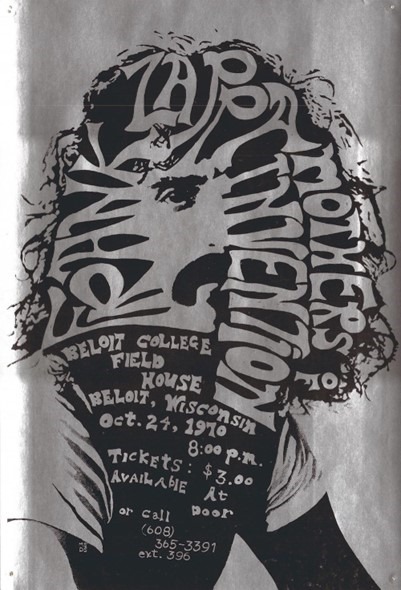



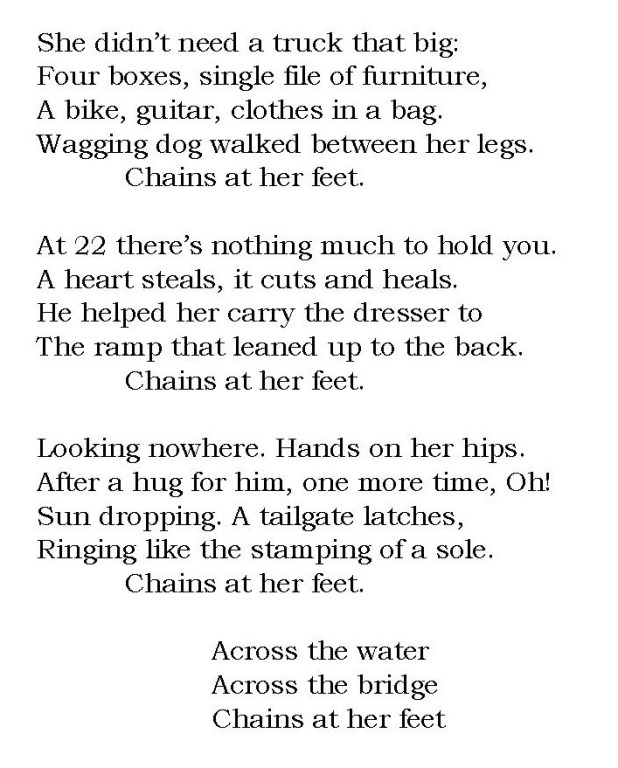


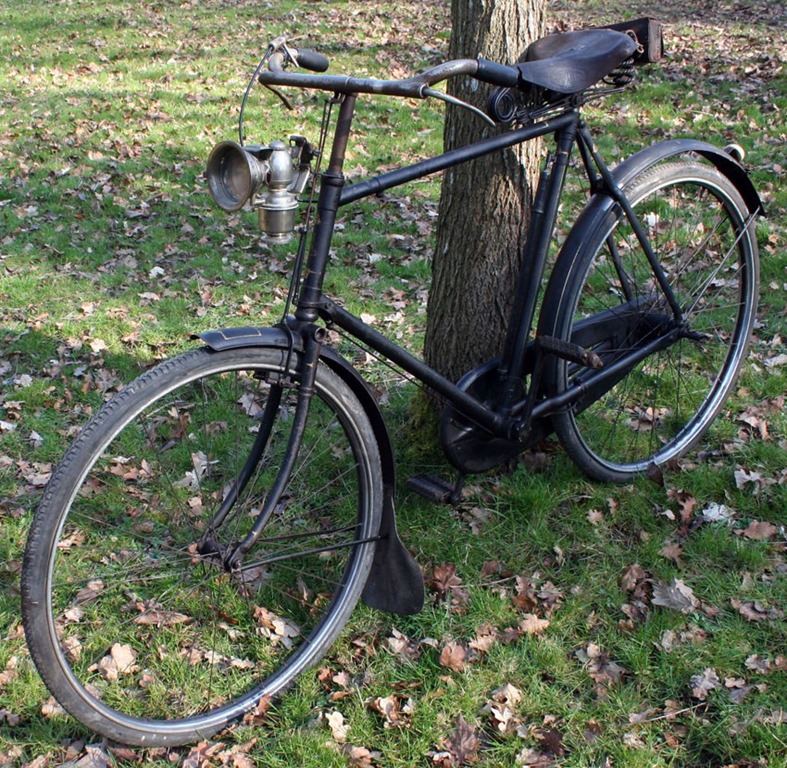
 Frank Hudson