Her Final Summer Was It

I got to see the Emily Dickenson biopic A Quiet Passion”  this month. I can recommend it with a warning: this is not a work that intends to be friendly or easy to digest. It does present a reasonable estimation of what may have made up Dickinson’s life experience, showing it with enough detail to be (for me) very moving. However, it also tries to show the intellectual ferment of Dickinson’s time in a very strange way, by spending a fair amount of the movie’s running time having people converse with each other in an extended series of Oscar Wildean epigrams.
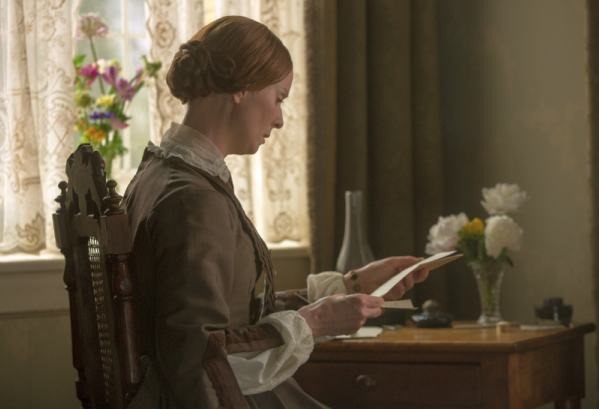
A-Quiet-Passion

This movie has no car chases or flying magician CGI battles

 
Of course, I have no way of knowing how people spoke in 1860 Amherst Massachusetts, but I doubt they spoke like this: epigram after epigram, back and forth like a free-style 19th-Century rap battle. What I guess the director/screenwriter is trying to do is give us some sense of Dickinson’s mind and the minds of others she paid attention to—Dickinson’s poetry is full of epigrams and busted epigrams after all. What he does is artificial, but then having folks read Emerson or other Transcendentalists out loud would be artificial too.
 
Another part that is harrowing is the time spent on the routines of death and dying in her time. Given Dickinson’s own gothic tendencies, this is not only defensible, it may be indispensable in conveying her outlook. And Cynthia Nixon’s performance as Dickinson is very very good.

So go see “A Quiet Passion”  if you would be interested in a portrayal of a what Dickinson may have been like as a person and what drove her as an artist. But do not go to see it if you want a friendly, straightforward introductory film biography that would introduce you a writer you have not yet committed your interest to.
 
For once I’m happy that this is a long preamble to today’s piece, Emily Dickinson’s “Her Final Summer Was It,”  because I do not really want to talk much about the work itself, as I don’t think I can speak a well as Dickinson’s own sparse words. I found in it great resonance to my own experience, particularly a summer 16 years ago—but as with all things we present here, the intent is not to dwell on my own life, but to connect to and impact yours. I hope I do the work justice.

Her Final Summer was it MS

Dickinson’s own hand-written manuscript of “Her final Summer was it”

You can hear my performance of “Her Final Summer Was It”  by using the player below. If you’d like to hear other Emily Dickinson pieces interpreted by the Parlando Project, we have done four other Dickinson poems with music here.

Soul Selector Blues

Sometime around the end of the 19th Century, a century that had seen accelerating change in technology and social order, new artistic movements began to flower on either side of the Atlantic. In the UK the Arts and Crafts movement and the Pre-Raphaelite Brotherhood looked backwards at things that had disappeared or were nearly gone, and revived them within a the new context of their present day. Interest in neglected folk-cultural traditions of nations began to arise. Others looked to new orders: utopianism and socialism. The seeds of what would be called Futurism began to take shape, a worship of the inherent art in technology.

Here’s a funny thing: all these things mashed-up in the ferment of the times. Some of the artists held to several or even all of these beliefs, participating in more than one of these seemingly different or even opposed movements. Call this brew “Modernism,” for the one thing that united it was a desire for something new, or at least new for the times, to be produced.

As the 20th Century got underway, American artists forged ahead in these movements. The reasons for that are multifold, but one is that they had a head start: Walt Whitman and Emily Dickinson and the Emersonian Transcendentalists had already pioneered distinctly American ways to be modern.

Let’s leave the salons and literary magazines now for a moment. Here’s something else that was happening at the same time, with only spotty distribution beyond its creators. Some African-Americans, presented with nominal freedom, economic serfdom, social repression, and what must honestly be called a sub-human classification by many learned men, continued to come to terms with European instruments and tempered scales, combining them with the already juicy stew of American music and the remembered modes of Africa. They produced their own Modernism, something that eventually got called “The Blues.”

Lyrically, this was an inherently skeptical art. As it percolated through commerce, the Blues got re-defined as a sad song of loss, and loss certainly is part of its subject matter, but the outlook of the original Blues writers was not simply that. A lot of it was satiric comment, and when the Blues dealt with the desire and farce of love and lust, as it often did, it wasn’t just about loss.

I could go on and on about the Blues, but for the moment, I’ll ask you to just absorb this: when William Butler Yeats was having a harp built to chant his poems to, as he believed the Celtic griots of old had done; and when Ezra Pound, Robert Frost, HD, Amy Lowell, William Carlos Williams, Gertrude Stein or T.S. Eliot were inventing their strain of Modernist poetry, often abroad, some other Americans were back in the States retuning guitars and looking for the notes between the keys of the piano with their own poetry that sought to “make it new.”

Emily Dickinson is a special case in so many ways, but one of those ways is that although she wrote much of work during the Civil War in the middle of the 19th Century, she was only published much later in the century. Her poems, so stripped down, so skeptical of received notions, so vivid in fresh images that didn’t map easily to conventional meaning, fit right in with work being written 50 years later by the Modernists.

Emily Dickinson Uncrowned Queen of the Blues 2

Warning: time travel plots often are ridiculous.


Today’s episode “Soul Selector Blues”  takes this time travel one step further. What if Emily Dickinson was a serf on the Dockery Plantation in Mississippi early in the 20th Century? Maybe she’d tune a guitar to “Spanish” and grab a slide to get those in-between notes, and then what would have been “The Soul Selects Her Own Society”  would come out like this.

To hear the LYL Band cover “Delta Amherst” Emily D’s classic 78 r.p.m. side “Soul Selector Blues” use the player below.


What Is It the Rain Dissolves

Writers often like to compose their written works in their heads while walking, and poets, all the more so. It seems natural—the walking footsteps and the metrical foot compare apace.
 
I too have done this; and with poetry in particular, composing lines while away from any paper or screen may also help winnow out the more memorable flow from forgettable stumbles. But my old joints now rebel more at morning walks, and my later day is filled with daily work on the Parlando Project and the mundane tasks of living.
 
My solution to this is that great 19th Century invention: the bicycle. In wheeled weightlessness, I am able to roll along through nature and the city morning’s opening scenes: the gloved gardeners, the obedient dog owners, the students at their stops, the hopeful sidewalk joggers, the babies held crooked in the left arm as the right sweeps the straps from the child car seat. I do this in all weather, rain and snow included, not wanting to miss one act of the theater of the seasons.

Novara Safari Smaller

Can you fit #npm17 and #30daysofbiking into one post? Sure.

 
It’s April, the National Poetry Month in this country, and I ride in the experience of that Chinese birdsong that Du Fu and Meng Haoran heard once and I hear now, and I know that the birds need no translation.  One Sunday dawn, as rain threatened, the sun shined through the clouds as if they were translucent filters. The steeples of the churches and peaks of houses, illuminated thus, were indeed rose and violet as Emily Dickinson promised to tell us.

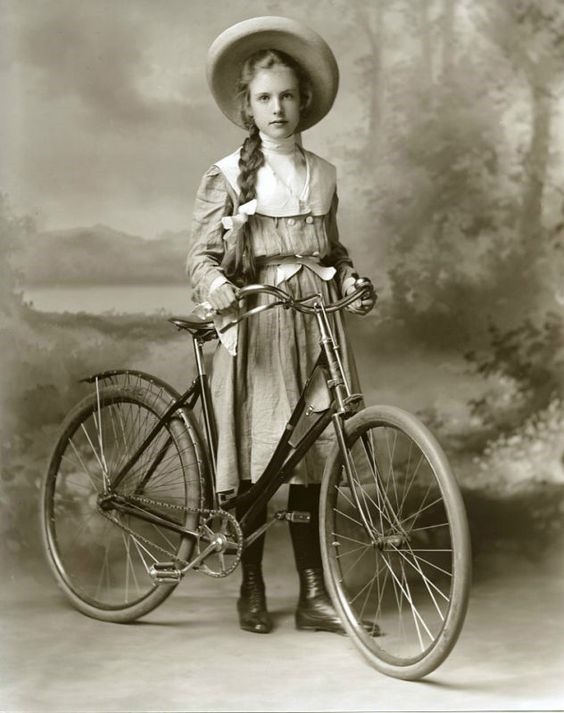
April isn’t just #npm17, it’s also serving up #30daysofbiking, and with the two in the same month I’ve said, “Emily Dickinson should have gotten a bicycle!” She could have maintained her thoughts’ enclosure, pedaled surely between the skeptics and the believers, and served her self-reliance within a somewhat broader world. Alas, she was just a bit too early for the modern bicycle—but it was close. Her mid-life “preceptor” Thomas Wentworth Higginson was a proponent of the bicycle and of women bicycling. Higginson, speaking about one of the early long-distance cyclists said:

“We found that modern mechanical invention, instead of disenchanting the universe, had really afforded the means of exploring its marvels the more surely. Instead of going round the world with a rifle, for the purpose of killing something – or with a bundle of tracts, in order to convert somebody – this bold youth simply went round the globe to see the people who were on it.”

Higginson, although speaking about my chosen ride, the acoustic motorcycle, seemed to be foreshadowing Robert Pirsig there.

19th Century lady and bike

A soul selects her own velocipede


Once more, a long preface to a short piece today. When I started the Parlando Project I thought I’d avoid that. Is another reason that April is National Poetry Month from the nursery rhyme “April showers/Bring May flowers?” Today’s piece “What Is It the Rain Dissolves”  was written on a bicycle on a morning ride in a light rain. I passed two kids trying to master skateboards and later a woman coming the other way on her bicycle, arms bare except for some elaborate tattoos.
 
Emily, is that you?

To hear the LYL Band perform the song “What Is It the Rain Dissolves”  use the player below.

Experience

Here’s another piece by Dave Moore. Dave plays almost all of the keyboards on the LYL Band music you hear here on this blog, and without his contributions I’d get tired of hearing my own voice all the time myself. Today’s audio piece “Experience”  started out intended as a poem, as Dave explains:

“My friend Ethna mentioned the Common Good Books poetry contest, which paid cash, on the theme of experience.

Naturally the next word in my mind was prurience, which in this version I ‘eschew.’ although I changed the printed version to ‘avoid.’  Still, I love the roll of ‘eschew prurience.’

I set out to state that every moment is an experience, and most of them are accidents, which constitutes the glory of the show.  But – But seriously…
When I brought this lyric to a LYL session, I draped it around a tune, trying to see how the words spilled over the dam.  Thus edified, I tinkered with it some before submitting to Common Good.

Of course, I lifted ‘life is but a joke’ from Dylan’s ‘All Along the Watchtower,’  but it worked so well in the stanza (is it a chorus?) of philosophy. I chose to leave the ‘do’ and ‘done’ lines as ironic music which states the case.

So, am I experienced?  Conclusively, I can say yes or no.”

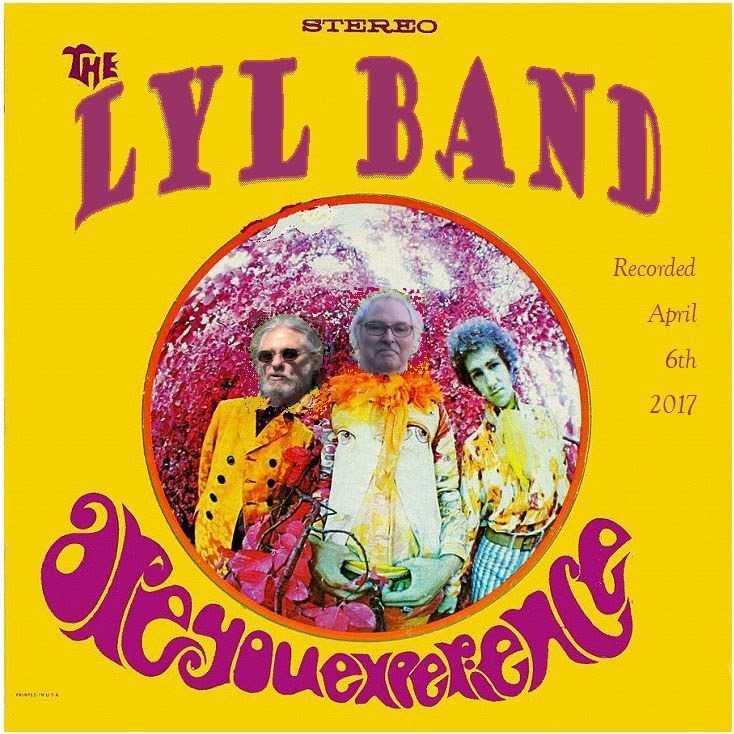
LYL Are You Experience Faces

“For those of another generation, he’s all but to make fun of,
but they do not understand the experience…”  Eric Burdon

Experience is an interesting topic for this book store’s contest. William Blake titled one of his collections of short lyrics “Songs of Experience,”  after which I cannot think of the word without thinking of Blake—but Blake also put much store in the auguries of innocence. Ralph Waldo Emerson toured the country as a speaker, but his contemporary Emily Dickinson famously constricted her travels as she grew up. Emerson’s mind worked best traveling widely, as in his essays. Dickinson mind produced compressed words pinned in a matrix of her famous dashes, and it’s Dickinson’s poetry that we are more likely to turn to today.  “Like a dream, experience is being where you are” Dave says.

Vinyl lovers, don’t be mislead by the cover shown above, The LYL Band’s version of Dave’s “Experience”  doesn’t feature Stratocasters on fire, which is not say that we won’t do that later. Use the player below to listen to “Experience,”  or some innocent instrument might get hurt.

The Spring 2017 Top 10

Since this is National Poetry Month in the US I’m hoping that I can exceed the usual 7 to 8 posts a month pace I’ve kept up here since the Parlando project began last August. The next audio piece should be up this weekend. For those who haven’t read the early posts here about what the Parlando project is, I usually summarize it as:

The Parlando Project is words (mostly, but not always poetry) accompanied by music (various kinds).

The Parlando audio pieces have been downloaded by podcast subscribers since launch almost 4,000 times. Given that we are now past the halfway point, I thought it might interesting to let you know what the “Top Ten” downloads have been so far. In Casey Kasem form, we’ll count it down upwards from 10 to 1. There are links in the list if you missed one of these audio pieces and the posts about them.

10. The Spring of Dead Things. One of the 3 pieces in the top 10 where I wrote the words. That’s OK with me, but one of the Parlando Project aims is “Other People’s Stories” which leads me to feature other people’s words more often than not. There’s lots of folks reading their own poetry out there, which is good in itself—but there’s lots of people reading their own poetry, so think there’s an unmet need for reading others work.

9. The Garden of Trust. One of my personal favorites. Weston Noble’s thoughts on the power of music, hard-won thoughts he expressed after a lifetime of work, touched me the moment I first read them, and my feeling only deepened when I found I was able to hear him express those beautiful thoughts in a recording made before his death. My thanks again to Luther College for allowing me to use this recording in my piece. If you want to sample one thing that the Parlando Project represents, and it really doesn’t represent one thing, start here.

8. I Felt A Funeral in My Brain. Writing the Parlando music and considering the words for performance has deepened my appreciation for Emily Dickinson, whose words we’ve featured more than any other writer, and I rather like my music for this one as well.

7. For John Renbourn Dying Alone. I hope some of the listeners to this piece who like acoustic guitar music find this a gateway to Renbourn’s music.

6. Arthur Koestler’s Death Song.  Although we’ve featured Dave Moore reading and singing his own work here, and there will be more of that to come later this year, his Top 10 appearance is for a piece where he wrote the words and music, though I performed it.

5. Eros. I sometimes wonder if this one gets a bonus from those searching for or intrigued by its title. Another one where I’m happy with how the recording and the music turned out. I remind myself that I should learn more about Emerson’s Transcendentalist revolution.

4. 2ebruary. There’s no telling what the “bonus” may be that’s lead more people to this piece. It could be the discussion of the movie “Patterson”  in the notes, or it could be the connection to bicycling. Or perhaps it’s the connection to Frank O’Hara’s “I do this, I do that” poems that I treasure and try to emulate. If you like this, I have another bicycle ride poem coming up later this spring.

3. Boris Pasternak’s February. We’re into the top 3 now.  I was remarking to Dave Moore during a break in our recording session yesterday, that February rather than April should have been picked as National Poetry Month, as the deep dark end of winter engenders more cruel monthly poetry. Pasternak gets to help prove that point here. One regret I have with what we’ve done so far with the Parlando Project is that I have not received permission to post our version of Margaret Atwood’s “February”  here.

2. Hymn To Evening. Speaking of things I treasure, hearing Phillis Wheatley’s story on the Freedom Trail in Boston is another one. Art is this thing that, unlike even persons, no one can own. Colonialism is a system that crosses oceans to take things from other lands for profit. Art is the system that sends out messages that can crisscross time and oceans with the information inside our breasts.

dollar-bill

we’re offering pictures of our #1 Parlando Project author for only one dollar


1. Frances. Interesting that two pieces from the colonial United States are 1 and 2, and that a piece with words by an young amateur poet tops the list. Maybe this is a tribute to the Pixies/Nirvana loud/soft arrangement trick in the music? Or that when it comes to subjects, love conquers all? Or that acrostics are about to become a thing?

Please continue to read and listen this month. I have a lot of planned pieces I’ll think you’ll like coming up here. Remember that the Parlando Project seeks variety in music and words, so you may hear things you like as well as not like as we go along, but stick with us as we want to continue to surprise you. I also want to thank those that have hit the like buttons on their favorite posts, and those who have hit the RSS button to follow this blog.

Light

What is lost when poetry is translated? Robert Frost thought it outright: “Poetry  is what is lost in translation.” Those who’ve read my notes here on the Parlando project know that I hold that poetry is words that want to sing. Those sound effects of the flowing sound of words, the call and response of rhyme, the beats of the dancing syllables—all that music can hardly be asked to make it past the visa-check at the translation station on languages’ borders.

In recent posts here I translated two poems from classical Chinese. As a non-Chinese speaker, I could not even hope to convey what musical effects the originals had.  To better see this as English speakers, let us look the other direction, and think about what Emily Dickinson’s “I’ll Tell You How the Sun Rose” (featured in our last post) would lose if we were to translate it to classical Chinese.

Would Dickinson’s poetic music carry over? In English we have the movement of the common meter/ballad meter in her poem, a beat that is ingrained in those who sing common Christian hymns or know secular songs using this meter in the folk and popular music fields.  Since this is a common form in our culture, we are primed to move to this meter, and rich associations may arise from other times we have felt the same beat. All that is most likely lost in translation.

There’s a pun in the first line. The sun “rose” and is pink. Puns won’t likely make it across the border.

Dickinson rhymed her poem. Translators sometimes choose to create rhyming poems in their destination language, but adding this degree of difficulty to the task may cause other defects in translation as the rhyme is sought.

English sometimes has an advantage when one translates to and from it, because it is the language of a much-invaded island, which was then taken up by a polyglot country across the ocean. English as we know it today is full of words with Latin and Germanic origin, echoes of French, Spanish, German, and even more. Occasionally, puns or even rhymes can be saved when the foreign language has these connections. And metric rules for accents and syllables can be somewhat portable across the European range.

But what if we were to translate from English to classical Chinese? I’ll take an audacious shot at Dickinson’s first verse. The English gloss from the ideograms resulting might go like this:

Tell Sun Rise
Ribbon Sequence
Towers Wet Purple-Quartz
Squirrel Messengers
Hills Unpinned Hats
Birdsong Started
Soft Talk Inside
Sun Recognized

Well, there’s something still there isn’t there, even if we as English speakers see the losses. What remains is Dickinson’s attention to an ordinary event with extraordinary details. And there’s some musical structure remaining: parallelism, theme and variation that doesn’t rely on beats or syllables that can still peak through.

Today’s episode is an English translation from the original Bengali by its own author, Rabindranath Tagore. Despite having attended school in England, despite familiarity with English as a resident of a then colonial province of the British Empire, despite some rumored editorial assistance from renowned English language poet William Butler Yeats, and despite Tagore’s well-attested to genius, “Light”  was published in English in 1912 as a prose translation.

tagore-einstein2

Some amateur violin player (left) meets up with Rabindranath Tagore (right)

 
Paradoxically this may be due to the original’s musicality. I’ll have more to say on Tagore next time, but for now just know that Tagore was a composer and songwriter, and that his songs are widely known and appreciated by millions of Bengali speakers.
 
So, to try to restore some of the impact originally present in this piece, I composed and played a rather dense musical accompaniment for Tagore’s translated words. I did this in ignorance of if Tagore had his own melody for this poem in Bengali. Besides animation and illumination of his English prose, I aimed to combine some of my appreciation his native region’s music and Western electric guitar based music. To hear Rabindranath Tagore’s “Light”  with my music and performance, use the player below.

I’ll Tell You How the Sun Rose

After our short trip to Chinese translation, let’s return again to Emily Dickinson, who is observing another morning.

This LYL Band performance of “I’ll Tell You How the Sun Rose”  is a bit imperfect. Alternative Parlando Project reader Dave Moore takes the lead here, but he and I are singing instead of our usual recitative, and we’re caught at the top of our singing range as well. Dave even bobbles a word in the line “The hills untied their bonnets.” So, yes, this leads to some imperfection—but this lyric is so perfect that perhaps it can carry us along anyway.

I suggest you listen to this piece now and then read my discussion of what I see in it afterward. Dickinson, like a good melody, doesn’t require understanding before enjoyment. The player to hear it is at the bottom of this post.

“I’ll Tell You How the Sun Rose”  begins with a homespun 19th century village dawn, and the singer starts right off almost bragging that they can tell us how the sun comes up. As proof, Dickinson unleashes a string of lovely, singing metaphors for sunrise, looking down from the dawn only once to let us see the squirrels running about as if with the news of the day. She concludes this section with finest simplicity: “That must have been the sun!”

Isn’t that a strange way to sum up dawn? It comes up and it’s already past tense, like Meng Haoran’s morning in the last post, and Dickinson comments on this common splendor as if she’s a surprised alien from another planet who has never seen the sun. Her boast that she can tell us “how the sun rose”—something she and all of us should already know, set in nothing more special than a prosaic town—becomes instead a small, whispered, apprehended wonder.

In the second section, Dickinson shifts gears so smoothly that no matter how many times you read or hear this poem you will never notice. There is a little engagement of the gears as she says of sunset “I know not,” unlike our first gear’s “I’ll tell you;” but we’re soon on to a rural scene with the sun rays like children climbing up and then down a stairway over a hedge or fence row (a stile).  At that point, there’s a bustle in your hedgerow as the dusk becomes a grey robed “dominie,” a strange and archaic word perhaps even in Dickinson’s 19th century, and a sure stumper for any modern English speaker.

A dominie is a Latin word meaning the leader of a congregation, a minister, a pastor—and ‘pastor” is derived from the word for shepherd—and that’s just what our grey dusk becomes as it leads the children of the dawn, now dusk, away like a flock, closing the bars, closing the gate, so that they cannot return.

Some readers are so charmed by Dickinson’s first section that they feel it is pedantic to think that this sunset section is describing a passage to death, “The undiscovered country from whose bourn, no traveler returns,” so no wonder that Dickinson moved from “I’ll tell you” to “I know not.”

That dominie seems so removed from the pleasant village of the first section, so foreign. Another subtle word choice contrasts the two sections. There’s only 88 words in this piece, and five of them are colors. “Rose” puns for dawn pink in the first line and then dawn is “amethyst,” a word for both purple and a semi-precious stone. The sunray children are “yellow”, and our strange dominie is dusky “gray.” The stile sunset stairway that the sunray children are climbing is “purple.” So out of our five colors, one of them is roughly the same color. In the first section, it’s semi-precious and wondrous, but in the second it’s just purple—a ruling, royal color perhaps—but those sunset ray children’s steps are ruled over not ruling, not shining like the amethyst steeples of the dawn.

stile sunset

Putting on the stile


Did you listen to the performance of “I’ll Tell You How the Sun Rose”  before reading all this? I feel a bit here as if I’m acting  like that dominie myself, leading you past the plain and beautiful dawn, over the stile, and closing the gate to simply hearing the sound and the manner of expression of Dickinson. Too often we make too much of the meaning of poetry, and particular the deeper meaning of poems. Just as Meng Haoran’s poem from last time can be understood well enough to be enjoyed by children, this poem too can be enjoyed as compressed observation. Perhaps it’s because I am an old man, one who has tried to write and make music for many years, that I care to see what is underneath the sun rays, to look over the stile, and to find what is inside Emily Dickinson’s expression.

To hear the LYL Band perform “I’ll Tell You How the Sun Rose,”  use the player below.

The Spring of Dead Things

Last night my computer news feed informed me that Chuck Berry had died. As with any 90 year old of a certain fame, the obits with their career summaries were already considered and ready. There were many elements the obits needed to include, and they did their job.

Chuck_Berry_1957

“Whenever a thing is done for the first time, it releases a little demon”


Around 40 years ago I wandered into a group of Minnesota poets who called themselves The Lake Street Writer’s Group, because they all lived, as I did then, within a few blocks of this main Twin Cities east/west commercial street—but what attracted me to them was that they had considered The Chuck Berry Writer’s Group as a leading alternative to that name.

I was then (as I am sometimes still) an obscure little poet. I like my works short, but I don’t require them to be all that clear or straightforward. I like them to play with words, both in the sense of assembling and using words in new ways; but also in the sense that they play with words in the same way that musicians play instruments. Chuck Berry was a beautiful example of that.
Tomorrow is the first day of spring.  Here’s an example of my trying to do that.  We know how to write the traditional spring poem. Spring! New beginnings! Happy blooming flowers! That’s probably the most welcome and acceptable way to write a spring song, because the world needs hope—but is it the only way?

What does spring’s beginning really look like? A few posts back I presented Boris Pasternak’s “February,” where he described a winter thaw not as a promise of Easter Bunny spring, but as a mucky, crow-ridden, rotten-fruit invocation of tears. Early spring is the cyclical end of dying, but as the wheel reaches March 20th, death is still palpably there to be ended.

For death, Spring is change—and how do we often react to change, particularly change that is imposed on us externally? I decided to tell that slant, to speak from those winter corpses at spring’s beginning. After all, we don’t choose spring, it’s decreed to us by nature and any ruler of nature we believe in, and nature is not a book only of triumphs, it’s full of predation and predestination.

Robin Eating Worms smaller

“Nature is a Haunted House – but Art – a House that tries to be haunted.”


My audio piece “The Spring of Dead Things”  is not in the musical mode of Chuck Berry—it’s more to the emo stylings of Emily Dickinson—but as players of words, these Americans had their slant bells to ring. To hear mine, use the gadget that appears below.


Bonus Emily Dickinson links


Here’s someone that notes that the sublime Randall Munroe of ekcd.com had some fun with Emily Dickinson. Her post also reminds us of the Gilligan’s Island theme connection. I do like that Munroe has fun with the possibility that Emily was a bit of bad-ass, which the poetry says she was.

This video has lots of laughs, particularly for the introverts among us.

And for those who would note that the comic characterization in that video isn’t true to Emily Dickinson, here one that’s true to Dickenson’s power, still has a some jokes, while noting that use of hymn meter. Wish I could talk that fast and coherently.

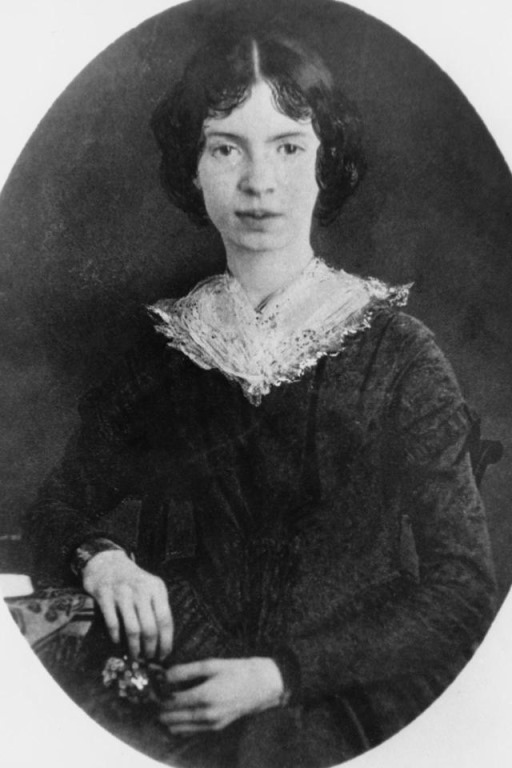
Emily Dickinson

Bad-ass? No, just keep thinking I’m only a dainty lovelorn lady.

No Parlando Project music links on this one, but we’ll be back with more on Winter soon.

Winter is Good

Here in the upper Midwest we are now in the middle of winter, and so are in a various ambivalence about it. Part of us doesn’t like the burden of winter, part of us wants to taunt it, and show that we can still have the upper hand over it, and some of us, those who don’t want to stop reading the book of nature, can find a cold, white chapter to puzzle over and admire.

I’ve already spoken here about how Minneapolis was settled as something of a colonial outpost of New England. The author of the words for this episode, Emily Dickinson was a lifelong New Englander, steeped in Transcendentalist thought, so we know she’s read that Winter chapter.

Just before dawn this morning, I jumped on my winter bicycle and took a ride to my favorite breakfast café.  It was seasonable, 20 degrees Fahrenheit and snowing, the streetlight globes surrounded with particulate halos of pelting snow. My tires were crunching the snow, the big knobs of their tread like typewriter keys imprinting the blank pavement’s page. It really was quite beautiful, if obscure of meaning. Summer rain saturates us, inebriates us. Snow surrounds us, but we are never more than a transient part of it, unable to understand its dance.

Roughneck in snow closeup

Winter is good – his Hoar Delights!  Also, there is tea and a frittata involved.


Emily Dickinson’s words are featured here a lot because she’s a great lyric poet and her words fit with music almost without effort. I learned decades ago that Dickinson favored “hymn meter,” that 8,6,8,6 syllable verse that makes much of Dickinson singable to the melodies of “Amazing Grace” or the “Gilligan’s Island” theme song. For “Winter is Good” I decided to throw out that pattern, turning some lines into refrains and marrying it to a melody similar to the Christmas carol “Joy To the World” instead.

Dickinson’s second verse is a doozy. Just 17 words in her text, but it twists so wildly. “Generic as a Quarry”—there’s winter’s white page I suppose. “And hearty – as a Rose-“ not sure where we go there. Dickinson was an avid gardener, and she no doubt missed her summer plants, but my best guess is just rosy cheeks.  And finally, the concluding two lines “Invited with asperity/But welcome when he goes.” A jokey finish that seems like it’s singing the old joke about the pleasure of hitting oneself on the head with a hammer because it feels so good when you stop.

Our various ambivalence aside, that’s what the Winter chapter in the book of nature says to us Northerners, our words arise and are recovered over by the white page; our music only the spaces between silence, soon to be drifted in.

To hear the LYL Band play this hymn to winter with words by Emily Dickinson, click on the gadget below.