Shine Perishing Republic: Meteors Not Less than Mountains

This post continues with the LYL Band’s noontime performance recorded on American Election Day, parts of which I’m sharing here this month. So far, I’d opened the live-in-the-studio session with a selection from a Stephen Vincent Benét poem “Litany for Dictatorships.”   Keyboardist/vocalist Dave Moore followed performing a poem, “Their Beauty Has More Meaning.”   Dave handed it to me after we performed it. “It’s by Robinson Jeffers” he told me.

“I’ve got a surprise for you” I replied, “because this is the next one I have from my stack.” Slouching toward Bethlehem, I handed him this rough chord sheet.
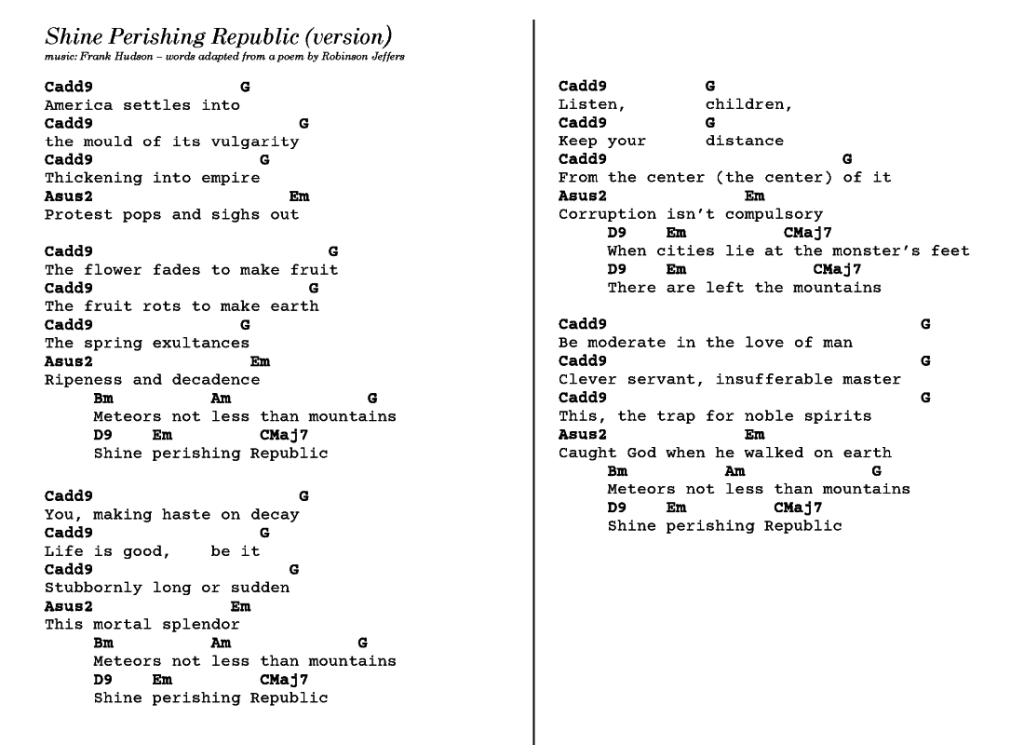
Shine Perishing Republic

The above is my song-adaptation. To see the full text of Jeffers’ poem as he wrote and published it, see this link.

.

This wasn’t the first time I thought about performing this Robinson Jeffers poem. When I went looking for stuff to perform on Election Day, I revisited it again. I already had a couple of pieces I thought I’d do as spoken word combined with music, and so I was now looking for something singable – and for all of its applicable prophetic attitude, this poem of Jeffers just didn’t “sing” off the page for me.

The thought struck me: well then, translate it into a song.*  I took the text of the poem and started to extract the images from the somewhat Latinate rhetoric of the original. One thing that songs like and page-poems often eschew is a chorus, and so moving from poem to song I extracted a line from the middle of the poem, an image reflecting Jeffers’ characteristic focus on geological time compared to the brevity of humanity and its efforts and actions.

Did I help or hurt Jeffers poem with my version? I do think I modified the exact meaning that Jeffers intended his poem to have. His prophetic text (I mean that largely in the Biblical sense) reads as more despairing than what I performed. I flatter myself to think that I fractured but sharpened some of his images. For my purposes it succeeded because I’d much rather sing my version.

I find it interesting to read his poem as Jeffers wrote it and note that it was published just over 100-years-ago. The American Republic’s turn to empire then was largely North and South continental, and its position among the world’s nations, important but not so preeminent and essential. My current nation’s deluded emperor seems prone to all of the bully-boy actions of imperialism – while utterly lacking the skills of alliances, strategy, tactics, and logistics that empires require. Heartened as I am today by the results of the election that was ongoing while we performed this, I remain fearful for the world and my country – and ours is not the only unbalanced and lethal war-lord on this globe. I didn’t gloss over Jeffers troubling concluding image, that humanity, the people whose power we must rely on against kings and oligarchs, are not infallible either. The Bible has its tyrants Herod and Pilate, but Barabbas won a popular election.

My version with this chorus brings forward a thought I think was in Jeffers’ message. The lifetimes of all nations (measured against the entire sweep of history and of the earth nations draw lines upon) are like the bright but short augury of a meteor compared to the long geologic truth of a mountain. Our lives, our citizen lives, are shorter yet – but can our imperfect – though capable of acts of humane worth – republic shine yet as it flies?**

You can hear the LYL Band performance of my version of Robinson Jeffers’ “Shine Perishing Republic”  with the audio player below. Has any such audio player burned out across the sky and struck itself invisible into some earth-bound rocks?  This highlighted link will unearth a new tab with its own audio player then.

Odd isn’t it, that without coordination on our part, both Dave and I had thought of Robinson Jeffers poetry as we considered Election Day. After quickly finding his place in this musical adaptation he’d never heard, I’m grateful that Dave’s organ part helped ground its performance last week. To further bring forward that chorus I promoted from Jeffers’ text, I did the make-yourself-a-multitrack-group-of-backing-singers thing last weekend and mixed that with the live performance.

.

*Longtime readers here will know this is what I do when translating work from other languages into English for performance here. I generally don’t try to convey the original syntax or characteristic word order of other languages, and I don’t try to follow some one-for-one recreation of their word-music either. I ask myself, what are the images the poet is evoking, and how can I evoke them in vivid contemporary English? This isn’t necessarily the best way for all poems and purposes, but it’s the default way I go about that task.

**Is it possible this “meteors not less than mountains” was informed some way in Jeffers’ mind from scientific cosmology’s theory that our planet was formed by the accretion of smaller rocks in space colliding and forming our globe? Per this mechanism, there’d be no ancient mountains on our planet’s surface without the preceding mandate of those cosmic ballots being cast! Might this metaphor have occurred to Jeffers as he built his Tor House and Hawk Tower on the coast of California from rocks he hauled and set together “making stone love stone?”

If Jeffers knew of the early versions of the more current accretion theory of planet formation, it might have to have been through Chamberlin and Moulton’s pioneering planetesimal hypothesis.

That’s a bit of wild speculation on my part, but Jeffers’ younger brother Hamilton had achieved a doctorate in astronomy at the time Jeffers was writing his poem.
Their Beauty Has More Meaning, or parachuting from a trainwreck

So, a momentous American Election Day, and the LYL Band reconvened during the noon-hour while voters were still casting their ballots. If you recall, I – acting as recording engineer, musician, and half-time vocalist – played the first few notes on electric guitar, went to sit on the stool beside my microphone position, and…

…I’d moved the stool that morning to check some audio wiring patch points. My blind ass couldn’t see that, and I plopped butt-first on the floor.

No matter how ominous great human events are, there’s room for a pratfall.

When the LYL Band plays – and we’ve done that for over 45 years – we’ve followed a practice of alternating between song leaders. Recovering my dignity (such as it is) I’d done my Stephen Vincent Benét selection. It was Dave’s turn, and in the Parlando Project spirit he had a poem by Robinson Jeffers. Just as Dave didn’t know what I would play or what I’d be singing or speaking, I didn’t know what Dave was starting to perform. I had a recording software screen in front of me, keying drum sequences and occasionally checking levels while trying to inventory and retrieve my limited stock of musical skills within myself – but no lyrics or music, not even a scribbled chord sheet. My posterior may have been sightless when we were thrown down from heaven, but in this musical situation, I have the decades that Dave and I have played together to guide me. I’m not sure what I’m thinking when I spontaneously play with him, and that’s a strange, yet somehow pleasant feeling. On one level my mind fears and braces for what bands call “a trainwreck,” where timing and pitches collide, and as I begin to play my ears will sometimes hear that collision emerging. I must try to repair the parts of the train as they are exploding! Other times, when it starts to work, I feel like a cartoon character rebuilding the train-track while sitting on the front of the moving locomotive: how fast can the rails and crossties be laid-down? When playing, I’m hastily searching for the “good notes,” the safe ones that won’t conflict with what Dave is playing while trying to allow the ones that rub and stretch with the other parts in urgent ways.*

I happen to like loosey-goosey music that finds itself in the playing, though not all musicians and listeners do. Without brag or pride I say: when mixing the recordings later, I’m often surprised at what makes enjoyable sense to my ex-post-facto composer’s judgement from what I remembered as a frantic grab for the emergency parachute rip chord.

In the midst of all that, I’m hearing and trying to react to the words Dave is spinning out. This time, they seem slightly familiar, but I can’t be bothered to wonder much about that. We finish the single take, the one you can hear below, and Dave says it was a poem by Robinson Jeffers. Here’s a link to the text of that poem.

Robinson Jeffers on the rocks

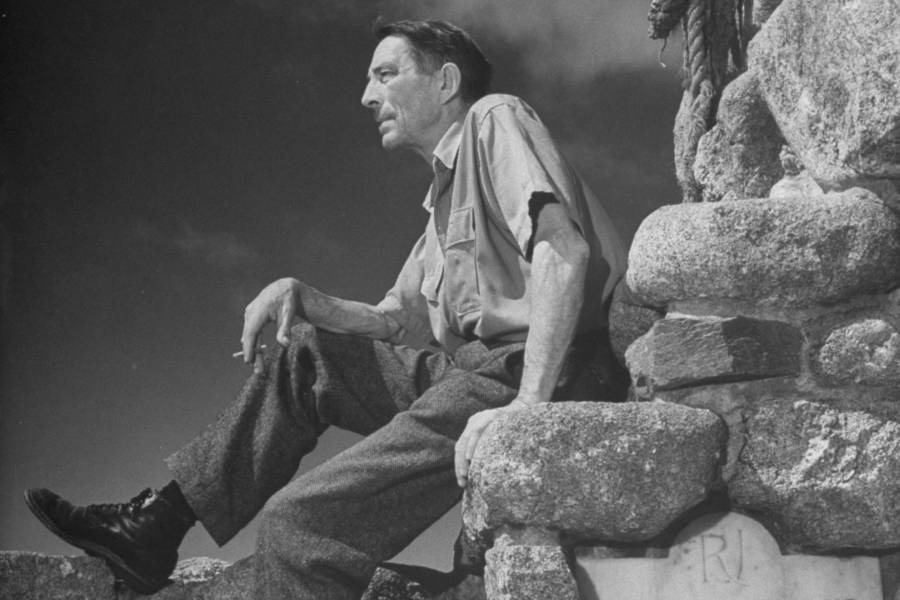
Robinson Jeffers, rock star, which is to say he built his own home out of rough-hewn stones.

.

I’ve always found Jeffers an odd case, and he interests me even if I suspect the two of us wouldn’t agree much. He’s a pioneer in the 20th century intensification of the 19th century American Transcendentalist theological examination of nature as the revealed truth – something I see in some contemporary poetry – but even if that approach retains currency, Jeffers take on these matters remains unusually strong and strange. He called a core tenet of his animating thought “inhumanism.” Today’s poem, chosen by Dave for performance, “Their Beauty Has More Meaning,”  examines the experience when the poem’s speaker (presumably Jeffers himself) examines a morning in its one-in-an-ages-long sequence of dawning and knows that he is as brief or briefer than a single day in the face of astronomical and geologic time. Even the birds and their birdsong, (always a handy metaphor for the musician’s or poet’s art) issues from any creature’s short life, though generations will perhaps repeat this utterance.

When Jeffers expresses his beliefs, one could find this outlook too fatalistic, even despairing – but in this example that Dave selected, Jeffers is, I think, at his most comforting. We, the ordinary people of this world (or the artists in it) are making our morning songs as best we can or must – beautiful to some ears at some moments, though we still have so little power to move the universe. Our “I Voted” stickers of last Tuesday are – at least at the individual level – tiny, constrained circles. Where I live, we’ve been through a year where the birdsong of whistles and car horns were arrayed against masked and armed troops, and two who did such were shot and killed. Is it comforting to know that we are small, temporary, things, doing the small, temporary things that are what we can do? In contrast, the self-styled great men who rule us think (as the previous piece in this series put it) that because they have great power, they must have great wisdom.

Jeffers wanted his message of human inadequacy to judge, and find lacking, the deadly engines of warfare – a human imitation of the great destructive acts of natural disasters. So strongly did he feel the human vanity in war that he steadfastly opposed WWII, the mighty violence that we often judge as on-the-whole necessary to oppose great human evils.

We finished playing Dave’s presentation of Jeffers’ poem. It was my turn at the mic. I had a chord sheet page for Dave, and a surprise. The nature of that surprise is part of the next post, coming up soon.

To hear the LYL Band perform Robinson Jeffers’ “Their Beauty Has More Meaning”  live in the studio on Election Day, you can pull the lever** for the audio player below. No player visible? You can request a provisional ballot – well, another way to get an audio player: this highlighted link that will open a new tab with its own audio player.


.


*We do use rough chord sheets for some pieces, we usually try to guess and announce the key center for a piece; but we don’t work out an arrangement between players, and the sheets are sketchy and undetailed. Is this the best way to do what we intend? I’m not sure, but it’s the way Dave and I have done this. With the rest of the Parlando Project pieces I’m increasingly working in the one-man-band scheme, playing and then rejecting or excepting the tracks I lay down or compose.

There are folks who intentionally skill themselves in free music improvisation, who come at the situation with more musical chops and theoretical knowledge. I admire, and praise that commitment, but I don’t believe art is essentially a hierarchy. I act instead on what I feel was the core belief of the 20th century folk revival and the later (but highly similar) punk-rock movement that saw music and art as the sharing of necessary expression.

**Old person reference. Voting machines used to be these 8-foot-high booth-sized contraptions where you flicked little levers like a pinball machine racking up points and then registered your choices with a bigger lever that felt like you were shifting a truck into gear when you yanked it over with a satisfying clunk. Filling little exam ovals with black ink lacks the tactile and auditory richness of the old ways. I could even say the modern silent ink seems like composition abstracted in musical notation while the old voting machines felt like grabbing a Bigsby whammy bar while slamming out a chord on a guitar.