A wonderful something about Emily Dickinson’s large body of poetry is that there are always “new” poems to discover just by paying attention to them. Take this one for example. It’s not one of the Greatest Hits, yet despite being an early poem – the estimated date of its manuscript is 1859, a few years before Dickinson’s most productive years in the 1860s – it already demonstrates her poetic strengths. Today I’m going to catalog some things I note in it, but if you’re not into such details, feel free to skip down the page to the performance.
Let’s start with some Dickinsonian unusual word choices, since she hits us with a couple right off. Uncountable poets have described the light of sunrise, but her choice of “flambeaux” to describe it seems novel. What’s a flambeaux?* It’s a big torch, often with a rank of multiple flames. To Dickinson it’d be a feature of a parade. Did she see or read of such? In her day, marches were a significant part of political campaigning. Her father was a politician, did his Whigs or the more raucous Democrats march with such torchlight? There are other parades that might feature flambeaux. Far from her largely Protestant Massachusetts, flambeaux were (and still are) part of New Orleans Mardi Gras. That’s something she wouldn’t have seen, but her poems sometimes gather exotica taken from her reading – perhaps this is one?
And “solemnizes me.” As a choice, a more active way to describe a change in outlook or mood. A reaction of mine here is a stretch, but my looking for connection ear also hears “Solomon-izing me.” Would the famously herbaceous Emily recall the line about the nature of field lilies from the Gospel of Matthew: “…not even Solomon in all his glory was arrayed like one of these.”
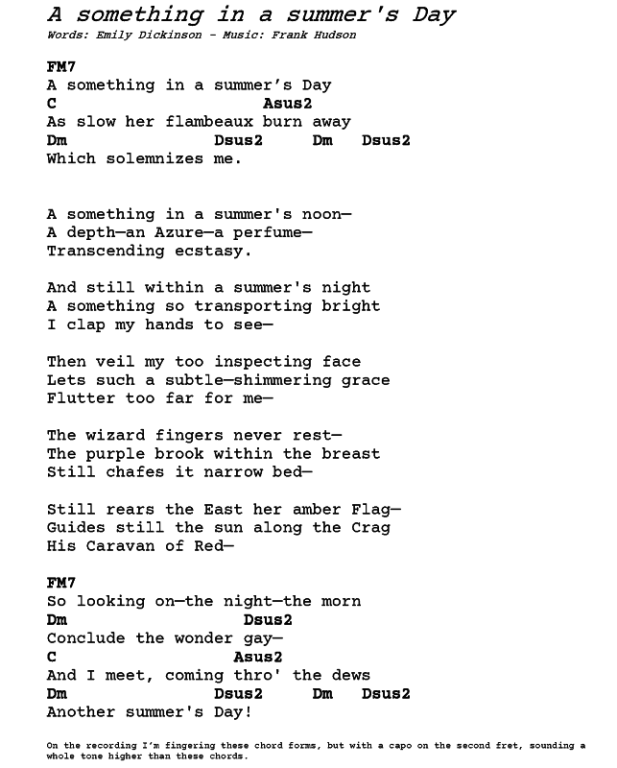
A chord sheet for today’s musical performance, included because I believe there are others out there who might like to sing this poem.
.
Word sound-music is rich in the poem. Besides this poem’s rhyme — none of her slant or off rhymes here, though I love the sound of that apostasy elsewhere in her poetry — but the sounds of inline words are constantly resonating and chiming with each other, a “shimmering grace” in sound.
Her famous 4-foot/3-foot hymn or ballad meter is present here, but with a twist: all save the last stanza have two 4-foot lines and then a concluding 3, which gives them a feeling of conclusion, much like the line/repeat/different sequence of the classic 3-line Blues stanza.
The plot of the poem is the procession of a day from dawn through day, then night, then the next dawn, but the middle of poem explicitly promises ecstasy.** The episodes contained there, I experience as such. There’s a nighttime wash of bright stars or moonlight.*** Dickinson’s voice here turns transported acolyte, clapping in my mind, dancing as well, like some Amherst Sufi.
What does she see, and want us to see, in the 4th stanza? Its transport is somewhat mysterious. It could be something like wispy clouds drifting over the stars and moon, but as a fellow northern-parts American with Dickinson, I suspect that “fluttering,” subtle–shimmering” grace is the Northern Lights.
And what’s being described in the 5th stanza? On the face of it, a little brook in nighttime – but I see something else in metaphor being developed here: the constrained “purple brook” seems to me to be veins. Veins in plants, veins in animals, coursing blood-vessels in ourselves. And the red, the next dawn’s red, that follows is as if the blood life-force within all of Gaia is bursting forth in this ecstatic vision beyond venous constraints.
And finally, there’s another switch-up: we get a concluding 4-line stanza, this time in the conventional hymn/ballad quatrain. And what does it present after this mystical vision? That vision’s mundane container: (just) another day. Is Dickinson trying to conventionalize herself here? Calm a possible reader that she’s not a wild-night, wild-eyed mystic, but just another twenty-something 19th century upper middle-class young woman who indulges herself in some daily nature thoughts in verse? Could it be a smile at a sense of contrast: that we attend to and then not attend to the great eternities of things throughout our lives? Or is she in addition reminding us that ordinary, ongoing, oh-so-daily, life is the stage, the ground, the staff upon which any visionary song of experience is scored?
I chose to stay calm in my solemnized performance of Dickinson. I used a small half-broken parlor guitar (the size of guitar Dickinson would have known) and also played a restrained upright bass part. In the background I allowed a shimmering modulated electric piano which I’m playing with one or two fingers to flutter for the fathomless stars. You can hear the sum of all this with the audio player below. If that’s not there, it’s only veiled by some ways of reading this blog – and you can click on this grace-granting highlighted link that will open a new browser tab with its own audio player gadget.
.
*It’s not a term relating to your friend who’s dating a drummer. Sorry. Not sorry. The mystic has written that the road of puns leads to the palace of wisdom.
**Earlier this summer I read Wild Poets of Ecstasy compiled by D. J. Moore, a near-400-page anthology collecting poems of erotic and spiritual passion. Capsule review: it promised more than it consistently delivered, but I appreciated the attempt, and it probably put me in the mood for this understanding of Dickinson’s poem today.
***An overwhelming wash of starlight would have been mundane to Dickinson in her time and place, as it still was for me in the tiny rural town I grew up in a century later. Whenever I return on some clear night to such skies over and outside of dense collections of lighted buildings and roads, I am star-drenched.


