The Galton Case

This is Parlando Project alternate reader Dave Moore’s birthday month, and so I thought it’d be a good time to interrupt the autumn poetry with his presentation of a short passage from detective novelist Ross MacDonald’s The Galton Case  first published in 1959.

Dave did this live performance that I recorded a few years back, and when I asked him earlier this fall about it, he wasn’t sure exactly what went into its choice. It may have been that some of the formative influences on the Parlando Project date to the era depicted in this scene in the novel, the “Beatnik*” phase where a certain kind of post WWII bohemia reached general public attention.

I’d characterize most of that general attention then as somewhere between comic amusement and pearl-clutching concern. The “beatnik” as a comic character became a stock item, and it’s easy to see the derivation from earlier foolish artist characters like Don Marquis’ Fothergil Finch.**  The world doesn’t understand their pure art, but in the comic context, the world is entirely right.  And then the concern-faction folks were writing that standards were surely slipping as free verse, free jazz, free-style prose myths, and free love were celebrated in the demimonde.

The Beatniks moive poster

Explosive ivory towers! The Beatnik id of the Fifties.


Fiction writers, even writers of detective fiction, have the choice of walking fine-borderlines on such things. Characters and voices can hit the comic notes, show the raggedness of the coloring outside the lines and the amputations when sharp lines cut, while allowing their readers the ability to vicariously experience those parts of town they would never visit. Attracted to the Beat but find it out of reach? Repelled by it? Find it phony? It’s possible to write a novel and hold the interest of readers who have one or more of those opinions of “Beatniks.”

This passage from Ross MacDonald is a good example. I’ve not read the book, I don’t know how it comes out, and what additional framing and information we might have if we did. Listening to the section Dave reads I wonder: does the narrator dislike the modern jazz playing behind the poet, or just dislike its incarnation that night? Is the poet reading to music a beatnik fool speaking useless nonsense, or a fool speaking the truth because they no longer care not to? What level of imposture is everyone portraying, and how can we know or find out?

We don’t know. We’ll turn pages so the detective can find out.

It occurs to me that detective fiction is allied on some essential level with literary criticism. Sherlock Holmes foretold the New Criticism; Edgar Allen Poe, one of the Fugitives before their time.

If last time Emily Dickinson was getting meta with autumn and poets who wrote about autumn, today we have Dave reading in front of the LYL Band this short, mysterious passage from The Galton Case  which describes—someone reading before a band.

Happy birthday Dave! The player is below…


*Beatnik was created by newspaper columnist Herb Caen who combined the term “Beat” used by some writers in the scene with the Russian suffix used for the tiny artificial earth satellite Sputnik launched in 1957. Many members of the “beat generation” didn’t like the term, which after all was a diminutive. People breaking molds don’t generally like labels anyway.

The successor term “Hippie” was similarly made by adding a diminutive suffix to an existing term “hip” that was used within the subculture. Both Hippie and Beatnik had connotations of a vague aspiration to bohemianism, particularly by those who might be too young to really understand.

**”The Poet of Revolt” as he self-branded. Furthermore in Marquis’ Hermoine and Her Little Group of Serious Thinkers  from 1916, we can find other characters like Voke Easeley the Modernist composer who “Doesn’t know a thing about music. He tried for years to learn and couldn’t. The only way he knows when you strike a chord on the piano is because he doesn’t like chords near as well as he does discords.”

Besides the Autumn poets sing

Since we’ve re-established that Emily Dickinson can do simple, here’s a lovely poem of hers that introduces more than a touch of “meta” to her poetry.

This poem’s first line starts the meta thing right off. You could quickly read the opening word as “Beside” without the s, and then the poets are singing in the presence of Fall. I suspect Dickinson wished to include that element but subvert it. “Besides”  means in this context “beyond that, in addition to.” So, there’s this thing: “Autumn” that poets sing about that is what? Well, it’s prosaic (i.e. prose and routine, not poetry and unique/charged). It’s small: “few,” and “little.”

Next stanza, the song now riffs with “few:” “A few…mornings,” “A few…eves.” Dickenson’s diction is still casual here, but she drops a couple of unusual adjectives with that repeated pair of fews. Unusual adjectives are often a weak crutch in poetry. Throw together some out-of-the-blue random adjective with a noun and you’re suddenly all surreal, poetically mysterious and creative—but more importantly, do these unexpected modifiers create a charged image?

“Incisive mornings,” is a bit of a play on words. Incisive here means not just perceptive, as in the coolness and lack of light predicting winter’s shorter days and lack of warmth: but taken in its other meanings, its winds are cutting and daylight is being incised, removed. “Ascetic eves” also speaks of removal, evenings no longer long with lingering light and it hints at spiritual matters this removal may reveal.

The second stanza ends with two references to poets, presumably examples of the ones mentioned as the poem opens: William Cullen Bryant, an older poet contemporary with Dickinson, and James Thomson, a Scottish poet of the 18th century. Neither are well-known today (though Bryant was a very important American cultural figure in his time). Dickinson mentions them and says that the stuff in their supposed Autumn poems are “gone.”*

In the context of these two stanzas, Dickinson is saying: the existing poets aren’t telling us much about autumn. I think that Dickinson’s sly inclusion of those two concise, precise, and original adjectives is cutting. She’s showing that in two words she can say more about autumn than they can in some long-winded poetry.

harvesters by Peter Bruegel the elder

Sheaves get mentioned in passing in Dickinson’s poem, so I get to exercise my love for Dutch painting


The second half of the poem has Dickinson unleashing her style of poetry against these musty odes. The third stanza’s word-music is just wonderful. I won’t dance about its architecture today—you can just read or listen to it—I’ll only point out that the end-words “brook” and “touch” have a lovely rhymish echo, even though they aren’t even slant rhyme. This stanza has the superb line “Sealed are the spicy valves” which partakes of the musicality but is an elusive image too. As I read it, I thought of gardeners in our climate planting garlic cloves this time of year, but garlic was not yet a thing in Emily’s New England. After an hour or so of trying to decode the image, to determine what specific spice plant in Dickinson’s time and place is referred to,**  I now think this a more generalized image of withered flowers. “Valves” is used only one other time in Dickinson’s poems, in the more famous A Soul selects her own Society  poem where they appear as “the Valves of her attention.” “Spicy” I’ve judged now is just a biologic/erotic reference to flowers pollination role. We may read the valves anatomically in various ways, but eyelids*** may be intended, as in the closing two lines of the stanza.

The final stanza is Dickinsonian too: nature in Dickinson’s poems is often personified in comical and non-charismatic species, here squirrels. Comically, her thoughts on the matter of autumn and poetry will be of great interest to the squirrel, and in this image she’s pointing out her non-existent status as a literary figure compared to Bryant et al.

It could just be a handy, casual sentiment to finish the poem, but Dickinson may be earnest in her concluding phrase: her mind is the sun that can illuminate the lack of sunlight as Winter solstice approaches.

Mostly acoustic guitar for the music performance today, though if you listen in the background you’ll hear a little harmonium and tambura. You won’t hear it in the rhythm or the instruments timbre, but I put a hidden reference to one James Marshall Hendrix in the music. You can read the full text of Dickinson’s poem here as you listen with the player gadget below.


*Thomson wrote the lyrics to “Rule Britannia,”  and Dickinson is likely referring to his long Miltonic blank verse poem called “The Seasons”  in her 16 line one. Bryant’s poetry may be largely forgotten, but his former cultural salience is still honored with a lot of school, street, park, and place names in the U.S.

**As an adult, Emily ran an extensive garden in the largely self-sufficient Dickinson family homestead, and in her youth she studied botany and produced a remarkable herbarium book filled with precisely identified plants—so it’s not crazy to think that she could have had a specific plant whose lifecycle she understood. A full-fledged farm field operated right across the road under Emily’s window at the homestead. The “sheaves” in Thomson’s poem wouldn’t have been abstract to her either.

*** If one wants to get more biographical in reading the poem, Dickinson famously went for treatment to Boston for some tantalizingly unspecified “eye problems” a few years after this early poem was written.

Dickinson’s Autumn

I sometimes wonder if I overstress the mysterious, even mystical, element in Emily Dickinson. Perhaps I’m overcorrecting for the too-limiting image of the charming eccentric writer of little poems that was her package-label when I first learned of her in the middle of the last century. I’ve since wanted to put the small print somewhere on the Emily Dickinson carton: contents may be unsettling during reading. Sold by weightiness, not boastful volume.

But Dickinson was at times a writer of lighter verse, enclosing seemingly cast-off poems in letters to friends. Her classmate (and in Dickinson’s lifetime, more literarily successful) friend Helen Hunt Jackson would write and publish casual poems about the seasons or travel. When Dickinson wrote this way, was she bending her art to expectations for women of her time, or was she expressing a playful side of herself? Humor, as in satire and incongruity, is an essential part of Dickinson’s verse, even her darkest verse. When it’s employed without mysterious, ambiguous themes, that same sense of humor can produce a poem like today’s “Autumn”  by Dickinson.

Even the part of me that loves to search for deeper meanings and undercurrents has trouble finding them in this poem. If forced to rely on that I could offer that her concluding remark that “Lest I should be old-fashioned, I’ll put a trinket on.” could be read as a comment on the loosening of plain-style 18th century Puritanism in Dickinson’s time. But let’s be serious: this is lighthearted, an example of the “happy Autumn” poem, and such things can make good songs.

Tree learning fall colors

Tiny clusters of turning leaves, like splatters on a green drop-cloth.


So I tried not to weigh this one down: major chords, acoustic guitar, bass, low Mellotron strings, and a touch of piano with the sustain pedal down. You can hear it with the player gadget below and read this short poem in its entirety by clicking this link.


Autumn Day

I was at the Midstream poetry reading series last night, and by choices, I therefore had to miss out on the wisdom that would be passed on by the elder chieftain of my nation who was speaking in the same town that night.

It’s often thought that age heightens certain perceptions, certain outlooks. In age one has a feeling for repetitions, the way that ox-turning time keeps bending back on itself so that the place one is plowing is beside the past and the future is just one row next over. There’s also a lessening of thought of one’s own self, which after all is a diminishing asset, one’s storehouse filled only with memories that the rats nibble at all night long.

So I missed what our aged chieftain said. From these considerations of age I’m sure he could hardly find time to speak of himself, which matters less and little; and instead he likely spoke from his heart, wise from his own failures far exceeding those of the younger ones, of how we can forgive and remember, and how our nation can continue to be born, cared for, urged on.

Instead I heard fellow poets read. Oh, we fail—as all artists do. We talk of ourselves, even us older ones. And when we take a break from that we talk of others imperfectly. We speak too softly, too loudly. We forget to reach for the music, or we do stretch for it and then fail to hold onto it. We search for beauty and come up with the same things over and over again, and how can we make that interesting? We are gloomy, forget to laugh, and hold our work back for funerals.

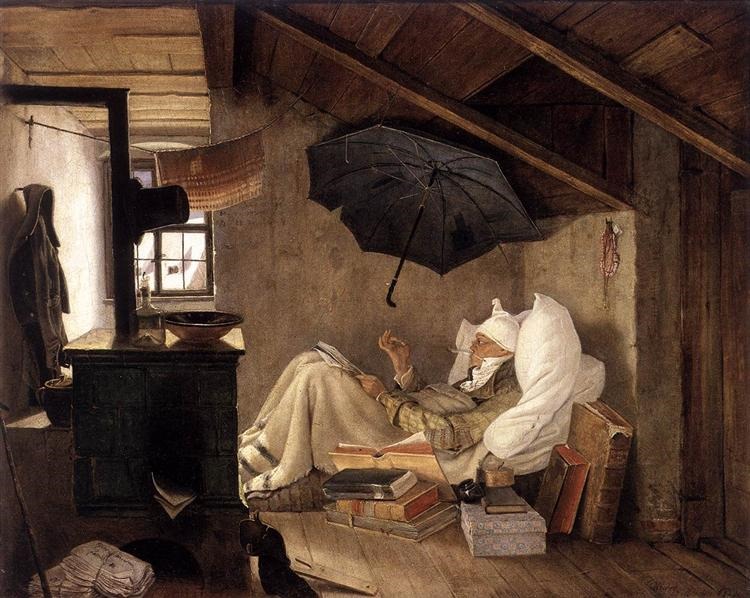
the-poor-poet-1837 by Carl Spitzweg

A graphic representation of the wisdom of poets such as myself


It was an older crowd last night, almost enough to make me feel younger for the couple of hours we were together. Today’s piece, Rainer Maria Rilke’s “Autumn Day,”  as much as Shakespeare’s piece from last time, seems to speak of the experience of age, but Rilke is much more directive. One doesn’t often see a poem so full of “You” statements as the final stanza of this poem is. I’m not sure of the idiomatic nature of “you” in German, the language Rilke wrote this in. There’s some sense that the rhetorical you in the poem may be directed at oneself: so Rilke speaking to Rilke; but as I read this poem, I can’t escape the sense of Rilke speaking to me, and as I perform Rilke’s words in my translation, I expect that you, particularly if you are an older person, will hear it as speaking to you, so concisely do those last five lines seem to outline this stage in a lifetime.

Autumn Day

If you’re curious to see a number of other translations and the original German, see this link.


But here’s why you come here and have read this far into this post: Rilke wrote this in his 20s.  These are not the biographical autumnal musings of an older man, and I’m not sure it’s even a poem adopting that persona. I almost translated the title here as Harvest Time but chose to stay with “Autumn Day”  because the copious other English-language translations used that for the title and using a different title would not allow searchers to find my fresh attempt to carry Rilke’s work into English.

Those who’ve followed my previous translations from other languages will know that I stress trying to express the imagery the author uses in a way that communicates to the modern English reader. Since that is my prime concern, I don’t make much of an effort to try to reproduce any of the word-music from the other language, but this time I did keep to a feeling of iambic pentameter for word-music’s sake. Much of my difference from other translations* was trying to sharpen the harvest imagery Rilke uses in the opening seven lines. The overall effect I aimed for was to clearly convey the weight and fullness of harvest bounty.

The final five lines converge more into a consensus with the other translations. One divergence: I read in one German speaker’s comment on their translation that “Alleen” (translated by many as alleys or avenues) was what they would call the tree-lined boulevards predominate in Rilke’s time. Not only did this strike home with me, who bicycles each day on tree-lined streets in my own town and time, but it seemed to be the linkage called for with the poems final image of following the restless wind-blown leaves on the pavements.

So back to this poem that may be read as a meditation on later life written by a 20-something. I think Rilke was trying to convey the harvest feeling, the fall into wintertime and that cyclical fallow season. Even as a young man he was able to convey this feeling an old man might appreciate. He didn’t need to be an old man to know this, he just had to read the book of nature which is older than all of us.

I often laugh as I think I’ve come across some wisdom from old age. “Aha! I’m just a slow learner” I exclaim.

To hear my performance of my fresh translation of Rilke’s “Autumn Day”  use the player below.


*I found almost 20 English translations of this poem almost immediately on the Internet. That seems extraordinarily popular as a translation subject. And I must give credit to Byron’s Muse blog who presented this poem earlier this fall which is where I first saw it.

Sonnet 73 “Bare Ruined Choirs”

Here’s one of the best-known of Shakespeare’s sonnets, which means it’s clearly one of “Poetry’s Greatest Hits.”

Since I’m not a real scholar or expert in such things, let’s take a look at it as if it was another of our presentations of lesser-known poems by little-known poets. You may want to follow along with the text, which can be found here. What might we see if we encounter it this way, without preconceptions?

The first thing one might notice is the antique language. In this case it’s not so much a case of “need to look that one up” words so much as it’s the olden-days tenses, pronouns and word forms: “mayst, ”thou,” “see’st,” “fadeth,” “doth,” “perceiv’st,” and “ere.” Given that the sonnet is a compressed form (this one uses 121 words) that might put one off. The syntax too, is not modern-day natural speech, but then when undertaking a sonnet even modern-day poets will sacrifice some of that for sound and compression of expression reasons.

If one is able to overlook those two things, or simply accept them as artifacts of the form and the time it was written, the next thing I notice is how much is stuffed into those 121 words. Tonight I’ll go to a meeting with three other poets, two of which are more accomplished than I am, with several published collections under their names. If I was to present to this group a poem with as many ideas and loosely linked tropes as Sonnet 73 (albeit with whatever level of skill I otherwise possess) they would likely be puzzled and displeased with it. Modern poetry is full of a great many styles, but many of them don’t try to push so much into so short a poem.

Let’s briefly look at those thoughts and the images by which we are to experience them. The first two lines open with a common autumn poem touchstone: the turning, falling, and fallen leaves. There are approximately 127 billion English language poems using autumn leaves by now, though there might have been only a few dozen in Shakespeare’s time. I think his image here is dual though, the left-leaves are compared to a balding head.

Chandos Portrait of Shakespeare

He’s not balding, he just has a large forehead. This disputed portrait has not been used to argue that Shakespeare was actually written by Larry Fine or translated from Klingon.

This image is further developed or morphed in the next two lines, including the image by which I always remember this poem: the now bare or near-bare branches bereft of the migratory and mate seeking/singing birds of earlier in the year liked to a ruined choir loft. Since choir lofts are elevated, and we’ve started with leaves equaling the now spare hair on a head, they are also the mind and voice which engenders such poetry and song.

Starting in the 20th Century some Shakespeare scholarship relates that ruined choirs image to the destruction and abandonment of Catholic abbeys and churches during his century. If so, Shakespeare has brought an undercurrent of the dangerous social change of his century into his short poem.*

Shakespeare doesn’t linger on that image, though it is so sharp it may have made his point. He next moves on to another image we now find common, the ending of a day related to the later parts of one’s life. His take is the variation (also used in some autumn poems) that there is extra beauty in the endingness, by implication it’s preciousness of limits, and from the luminous colors of sunset. He develops this a bit with an image that would have once seemed common, but has since fallen into disuse: that sleep is a model of death.

The final quatrain before the concluding couplet develops yet another image, one steeped in fire as one of the classical four elements. It’s antique physics, but observationally still rich for anyone that has ever dealt with burning wood: the speaker is the hot coals, hotter than the kindling fire of youth, or the early lapping flames. Since this is ostensibly a love poem, one can take this as another commonplace: fire equaling desire. My reading is that the love poem aspect is yet another layer of image, present, but not the only element, as it’s also about the artistic spirit that could create such a sonnet. The final line in the final quatrain is nearly the equal of the “bare ruined choirs” one. “Consumed by that which it was nourished by” is both a statement about the scientific nature of combustion; about desire, love, and it’s ending; and about the artistic impulse: that we must burn, fill and empty ourselves as if by weightless flame; that we will consume our time, our life-time.

The final couplet, as with many an English “Shakespearean” sonnet, jumps on to something else. In its guise as a love poem, it says that the lover must be extra passionate and devoted, because the poem’s speaker has limited time left and yet they still love them. What should we make of that? As a devotional interpersonal love-note, the thing the poem presents itself to be, it has emotional heft.** As a statement about the artistic drive, likewise. Every time one sets out to make something, we truly don’t know if it’s the last work we will do. As we age (I’m old, this is eminently personal with me) this becomes less and less a moot philosophical point. Treat the work as a lover, treat your lover as a work of art.

So, there’s a lot of territory in this poem. Even doing my best to present it with my performance there’s too much here to absorb in one listening, one reading, in one moment in one’s life. This is a reason why other kinds of poems may be better received. Many modern short poems seek to make one point, or tell a story with a plot rather than a complex instant that has no plot yet, or several plots happening at once. Those poems can work too, and work quickly.

Shakespeare seeks to lure us with his word-music, even now centuries later, even though he’s going to try to put a gallon of thought into a pint-sized poem, and even if he’s going to use a form of English we strain to hear as natural. “Bare ruined choirs where late the sweet birds sang” isn’t just an image, and an allusion to a piece of history that may be unfamiliar to us, it’s a lovely piece of sound. I could go on with other lines that have their compelling worth as sound: “When yellow leaves, or none, or few, do hang” or “Death’s second self, that seals up all in rest.” Can that word-music let us live with the 121 words long enough to get over the things which make us either hear this as “Shakespeare” the brand name or as an example of obsolescence?

I tried in my performance to illuminate the text and its sound as best I could. You can hear it with the player below. See no player? This alternate highlighted link will play it too.

*I’ve always loved the way Michael Wood presented the beginning of his series of TV programs on Shakespeare by saying he was born into what was a police state due to the whipsawing religious and geopolitical changes/wars/disputes England went through in the 16th century.

**By pointing out that this poem in my mind is expressing something about the experience of making art, I’m not prudishly seeking to eliminate the erotic reading. Many of the best images are bilateral. They aren’t just some thrown-off thing meant to decorate the poem with some cleverness or allusion. The thing used to represent the thing is real, maybe even more real than the thing it signifies. The thing signified enriches the image just as vice versa.

For an example of the erotic use of some similar imagery in a complex emotional landscape see this Edna St. Vincent Millay sonnet, a favorite of listeners here.

One piece of evidence that Shakespeare intends this as a complex set of images is that it was likely written when Shakespeare was in his 30s. Sure it reads “true” for this old man, but it’s not memoir as poetry. Memoir as poetry can work too, but I often feel that we’ve over-emphasized that mode.

Pied Beauty

It’s said about significant musicians that a careful listener can tell who’s playing just from their sound. The word-music of poets could be a similar tell, but in the case of poetry we have other kinds of data: subjects, characteristic outlooks, and the kind of imagery they choose to use—and those things often overwhelm the distinctions in the sound of a poet’s poem.

But even 130 years after his death, British poet Gerard Manley Hopkins sounds like no other. The piece I’m going to present today is one of his best known poems: “Pied Beauty,”  and he intended it as a rhymed metrical poem, but Hopkins’ conception of meter and phrasing is so unlike other English poets that it might sound like a piece of free verse.

If Hopkins doesn’t sound like other poetry in English, he does have some similarities to Old English and ancient Welsh poetry, two languages he had some familiarity with. In place of the traditional musical phrases that his Victorian contemporaries might use, flowing lines in regularly stressed feet, Hopkins substitutes shorter, broken and paused phrases and a great deal of word sound echoing beyond just conventional end-rhyme.

Reading Hopkins in the pre-Modernist era at the end of WWI must have been like hearing Thelonious Monk play piano just after WWII. It doesn’t sound “right,” it breaks, or more correctly ignores, rules of how things are supposed to sound. Yes, the phrasing is instantly felt as rhythmic, but that’s no anchor, because the rhythm is part of what’s “wrong.” But also like Monk, to more than a few listeners, it can be arresting, even on first listen. You don’t have to understand the structure, or know how it works differently—that’s not a simple task by the way—to hear something that grabs your attention. You may dig it; but even though we humans are natural imitating machines, you may still not be able to do it.

And so, like Monk, Hopkins doesn’t have as many imitators as he has admirers of his achievement, even today.

Monk Hopkins Genius of Modern Music

His music still sounds more modern than most—both of ‘em.


An additional barrier to Hopkins is that his subject matter, though explicitly Christian religious, is also often harrowing. British poets have long explored unrelieved melancholy, but Hopkins doesn’t want to read Job, or understand Job theologically, he wants (or can’t escape) to be Job.*

Which makes “Pied Beauty”  a good introduction to Hopkins word-music, because while it’s making a subtle theological point, this is not a particularly sad, tragic, or even solemn poem. Did Hopkins interject “Who knows how?” mostly to make his rhyme on the 8th line? I don’t know, but I can’t read that phrase and this poem without a little of the feeling of “Ain’t that funny? Unchanging, pure monotheist deity, and yet maker of a world of mixed and changing things.”

Musically, I’m not Thelonious Monk, nor was meant to be—am an attendant lord, one that will do. Still I musically sought to put a certain angle on my usual chords and cadences. Old-time Chicago jazz guy Eddie Condon said the modernist jazz composers flatted their fifths, while his crew just drank them. If so, I caucus with the modernists. Harmony has laws and customs, but the anarchists have melodies.**  The full text of Hopkins’s poem is here. My musical presentation of it is available with the player gadget below.


*Just because he’s so distinctive in his sound and phrasing, we don’t need to overlook the imagery in Hopkins’ poem. Skies like cows? That’s proto-Surrealist, “old bossy in the skies with diamonds” stuff. I have to confess that my eyes once read “brinded cow” as a more conventional if workmanlike “bridled cow.” Brinded means patched patterns as on cows’ hides, it’s an archaic Middle English word, in keeping with Hopkins’ love for the sound of the poetry of the ancestors of modern English. See also firecoal colored tree nuts and painted fish.

**Well this is true at least for me. When I’m not working in drone or heavily home-chord centered structures, I will construct chords and chord progressions based on others’ ideas, or the mathematical commonplaces, testing the results for interest. But for melody, I usually don’t choose to follow rules or commonplaces, and when I find myself approaching those things, I may start to subvert them immediately. Yes, there are pleasures in knowing exactly what note comes next—must come next—but there’s too little music out there that mines disputing that expectation.

I awoke this morning to read that Ginger Baker died, a prime musical iconoclast if there ever was one. I’d read the earlier notes that he was gravely ill and I think I may have tried to imitate some of his playing (those tom rolls…) with the drum track on this.

Edward Thomas’ October

Moving from 17th century Welsh poet Henry Vaughn we’ll jump forward to a favorite of this blog: 20th century Welsh poet Edward Thomas. Thomas is less well-known in the U.S. than he is in the U.K., perhaps because he’s sometimes classed as a “Georgian poet,” a loose classification given to early 20th century British poets who weren’t Modernists.

As far as America was concerned, not being a Modernist wasn’t a good thing as the 20th century continued, particularly given that two Americans (Ezra Pound and T. S. Eliot) were instrumental in the Modernist revolution in English-language poetry. Georgian poets were soon seen as those that hadn’t gotten the news about what sort of topics, outlooks, and word-music was appropriate for the new century. Societal and cultural failures were prime topics, skepticism and a multivalent posture toward agreed-upon premises were expected, and the tight starched collar of strict accentual-syllabic verse music was loosened.

Thomas’ other problem was that he was killed during WWI, and wasn’t published to any degree until after that war was over. In Great Britain, those war poets who held to the pre-war verse forms were given some license because of their service and sacrifice. In the U. S., this was largely a non-factor.

But of course, what kind of word-music a poet uses has little to do with his subjects or outlook. Thomas, like his American friend Robert Frost, was roughly as Modernist as any of his contemporaries, he just didn’t sound like one if you muffled his words so that only the sound and rhythms remained. Like Frost, he never developed a Cubist or Dadaist kaleidoscopic vision, but within the monocular vision by which they squinted at modern problems, their analysis was fully of the new century.

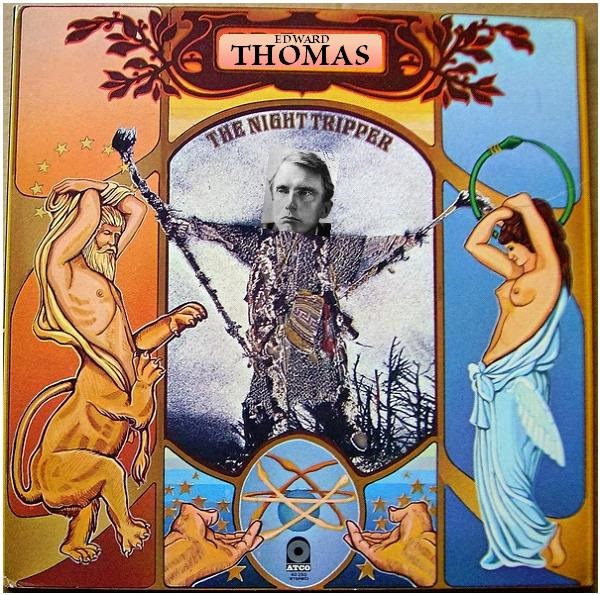
Edward Thomas The Night Tripper

Sun,  Moon, and Herbs; scabious and tormentil, Edward Thomas knows ‘em!

Case in point: today’s piece, Thomas’ autumn poem “October.”  The subject of “October”  is depression. Thomas gives it an old name “melancholy,” but depression and existential isolation is its matter. Many of Thomas’ other poems (including most of those we’ve featured here) have him focusing on the decision whether he as an over-draft-age man would volunteer to serve in WWI, a war whose cause he didn’t really believe in. In the end he decided that he would not exempt himself from the human suffering of the war.*  But in those poems, like this one, the other marker that lets one know that we are in an Edward Thomas poem is an almost encyclopedic knowledge of nature. “October”  shows this: the fall plants are specifically named, and the names he chooses for two of them: scabious and tormentil, specifically reference their palliative properties.** And so from the start “October”  features a prime Modernist tactic: the use of specific things to surround the actual, ineffable, topic of the poem. The October day described is altogether pleasant. He remarks it could just as well be spring, and the late fall flowers of the harebell are just as beautiful as the early spring flowers of the snowdrop.

He even muses that at some future time he may be able to see his depression clearly as a finished, or at least understood, thing. Notice: there’s close to nothing in this poem (other than that single “melancholy” that comes in the penultimate line, or that say-what’s-not, not what-is “I might as happy be” statement) that tries to say “I’m depressed and can’t presently find my way out of this mood, to decide my life.” He doesn’t even say “And now it’s fall, and I’ve got a damn winter to live through.” Instead, in “October”  Thomas leaves us in a Buddhist or Taoist moment, able to see the beauty and the sadness, equal reflections of each other. His opening couplet seems to me like it could be a poem by Du Fu or Li Bai, not the poem of an early 20th century Brit, and so I refrain those lines at the end of today’s performance.***

Elsewise in my performance I worked with the new orchestral virtual instruments which have given me more usable staccato articulations, which I’ve put in service of my simple “punk rock orchestration.” My finger strength has returned to a level that I felt comfortable playing the featured fretless bass motif for this.

The full text of Thomas’ poem his here. The player to hear my performance is below for some of you. Don’t see a player gadget? This highlighted hyperlink is another way to play my performance of it.

.

*Thomas’ outlook, his feeling that personal decisions even in the face of doubt and lack of information were critical, were gently chided by Robert Frost in Frost’s famous poem “The Road Not Taken.”  Frost was the stoic, Thomas the existentialist.

**Henry Vaughn, the practicing physician, was more overt about the pharmacology metaphors in his poem about “Affliction,”  but think of Thomas as an herb-doctor as he assembles the formulary of his nature scene here.

***Has anyone tried to translate Edward Thomas into Chinese? Although “October”  is written in English blank verse, so much of it seems like it would sit naturally as a poem in the classical Chinese manner.

Parlando Project Summer 2019 Top Ten part 3

Is everyone aligning themselves with autumn already? Here we’re looking back at summer and the audio pieces that the audience made their most liked and listened to, and we’re getting near the top of the countdown, moving toward the most popular single piece of the past three months. Today we look at numbers 4, 3, and 2.

4. Summer Silence by E. E. Cummings. Another one from our “Before They Were Modernists” series, “Summer Silence”  is an early E. E. Cummings poem published when Cummings was a college sophomore at Harvard. One doesn’t usually associate Cummings with constrained poetic forms, but “Summer Silence”  was written in 1913 in the Spencerian Stanza form, long before he could have learned from Hawk or Susan.

I try to do the best work I can with recording the music compositions here within the rapid pace I’ve accustomed myself to with this project. My equipment is modest, and my recording engineer’s skills are too, but I make the effort. That said, this one was recorded on a cell phone sitting in a cabin on the North Shore of Lake Superior: just me, an acoustic guitar, and a few summer birds that you can hear at the very end that wanted to enjoy July there too. The text of Cummings’ poem is available in the original post linked in bold above.


3. Higginson’s June by Thomas Wentworth Higginson. From another series, one that started before this summer but carried over into it: “The Roots of Emily Dickinson.” Higginson is essential to the Emily Dickinson story, the literary insider who Dickinson sought out in what I think was an attempt on her part to verify the worth of her unprecedented poetry. They met at least once, but the rest of the relationship was carried on via letters, of which we have only Dickinson’s side of the correspondence.

From Dickinson’s replies and Higginson’s later recounting, it’s been summarized that Higginson “didn’t get it,” thinking that her work needed some further polish to appeal to the mid-19th century public. Here in the 21st century we feel pretty smug about Higginson, thinking him like the infamous record exec who passed on the Beatles.*

Higginson had a highly eventful life outside of the Dickinson connection, as I’ve talked about in another post, but one thing I discovered this year was that Higginson at least dabbled in poetry himself. I can find no context for the poem of his I used here, but I speculated that it could be something he wrote in his youth. Whenever and for whatever reasons he wrote it, it is a good short summer lyric. And coincidentally it’s opening two lines could stand as the better judgment of Dickinson’s genius as it does in his poem for summer.

The music for this one is as electronic as “Summer Silence’s”  is acoustic. The text of Higginson’s poem to June is also in it’s original post bolded above.


Indian Pipes and 1st Edition of Dickinsons Poems

Higginson wrote the preface and helped edit and promote the publication of the first collection of Dickinson’s poems two years after her death. The flowers on its cover are usually called Indian Pipes and they were said to be a favorite of Dickinson’s. It’s a truly odd summer plant, which my living wife found and photographed in Northern Minnesota this year. The other common name for this translucent apparition: the ghost plant.


2. For You by Carl Sandburg. I kept going back to Sandburg this summer, and you the readers and listeners came along with me. Why? I frankly find him healing.

I started off this project in 2016 with a Sandburg-based audio piece which also served as a memorial for David Bowie; and for the 3rd anniversary of that launch I used this Sandburg poem as a memorial to my late wife who died near the beginning of this century.

That either of those Sandburg poems could be used as memorials does not make them passive elegies, and “For You”  is future-focused—just as it is full of ghosts. I’m not familiar enough to say how English speakers in the British Isles, in South Asia, the Antipodes, or elsewhere feel of the current times and challenges; but in Sandburg’s America when I read or listen to “For You,”  I too feel our ghosts and feel our future—close—even if each are unreal as we stand before the great door of a year with great hinges.

The text of “For You” is here if you’d like to read along.


*”Guitar groups are on their way out” is the famous rejection phrase, attributed to Dick Rowe of Decca Records. In Rowe’s defense, Beatles producer George Martin has been quoted that the Decca audition performance was not very good and that he wouldn’t have signed them on the basis of it either. A few months later, Rowe took a tip from George Harrison and signed another of those guitar groups, The Rolling Stones. Sometimes you get a second chance.

Parlando Project Summer 2019 Top Ten part 1

It’s that time again, when we look back on the past months and see what pieces were the most liked and listened to this summer. I do it countdown style, so here we start with the 10th, 9th, and 8th most popular pieces this season.

10. Pods (Neponset) by Carl Sandburg.  Do I say Sandburg is the forgotten Imagist too often? Maybe, but to my mind this is one of the finest short Imagist poems I’ve come across in my wanderings through early Modernist verse. Another thing I keep trying to counteract: the idea that Sandburg is simplistic and that his verse is absent the levels of ambiguity and ineffability that “great poetry” is said to offer. This 7-line poem about a small Illinois village with gardens and the train passengers traveling to see scenic wonders is an example.

My family has to put up with an amount of interruption by the focused and repetitive work of producing these pieces. Listening to the process of composition, when it involves (as it sometimes does with me) a lot of trial and error is  trying—but listening to the final mixing stages is excruciating. I mix at modest volume levels, but I’ve been told that headphones are not to be trusted in that work—so they hear these pieces sometimes being wiggled this way, and wrung out that way, over and over.  Not a good way to appreciate a piece.

So, it was a surprise this summer when my wife came in and told me this one sounded like one of the best ones I’ve done. Maybe it made it to number 10 because it stands to be listened to more than once?


9. I Saw a Peacock by Anonymous.  Long a leading composer in the folk music field, Anonymous can also craft a pretty good Surrealist poem with a humorous trick: the line breaks lead you to connect the thing previous with the last part of the line—when the “real” and much more mundane connection (as opposed to the wondrously apocalyptic thing you believe you’ve heard) is in the next line, after a breath pause of the line break.

I’ve read that this poem impressed Margaret Atwood in her early childhood with the wonder that poetry could create.

I seem to be working more and more with string and other orchestral compositions this summer. Part of that is that I’ve always been drawn to things that mix the attack-envelope of percussion instruments with the varieties of note length that stringed instruments, particularly bowed string instruments, can create—but it’s also because I was able to afford some additional orchestral instruments to play via my guitar’s MIDI pickup or with my little plastic keyboard this summer.


Here Be Monsters

Didn’t work? OK, try Black Mountain school with polka. No? Dubstep Hildegard von Bingen! Hard Bop Thomas Hardy! Still coming? Tell the gunner to give’em both barrels then. No, no! Not those barrels…


8. For Once, Then, Something by Robert Frost. Here’s an example of why I’m particularly grateful to the hardy listeners of these pieces. While I’m constrained by difficulties in obtaining permission to present writings still in copyright, I hope that you can see that I vary the type and the outlook of the poetry and other writing that I can and do use. I try too to mix Poetry’s Greatest Hits with deep cuts from esteemed poets, and more than a little of the lesser-known but worth considering.

Of course, for some (Many? Most?) the idea of poetry as an everyday thing that is not some mix of fearsome and intended obscurity, snores-ville decorative excess, and hoity-toity crap for those with nothing better to do has already removed them from reading or listening here.

Well then, as I’ve described this project from the beginning, I combine these words, mostly poetry, with various music. While people might just ignore poetry, they actively hate music that they don’t like. That disgust leads some (Many? Most?) to cling to a genre of music they find most able to please them, and to mark other sonic places as “here be monsters”—hideous creatures that disrespect what is right in music.*

Music doesn’t know what’s right and proper. It just wants to sound itself.

So how many people are out there who want to hear even the beloved, famous, respected American poet Robert Frost chanted to a pulsating Electronic Dance Beat arrangement?

Well, if you are the kind of people who read, listen, follow, and help propagate what the Parlando Project does, there are enough of you to make this the 8th most popular piece this past summer!


*By the way, if you don’t like some of the audio pieces that are presented here, that’s OK, even expected. Given that I’m pushing my capabilities as a composer and musician, you might even agree with my intent, yet not wish to negotiate my actualities. That’s part of why I like to mention that we vary things: you may like the next one that comes out, or enjoy taking a look at the nearly 400 pieces we have in our archives.

The Parlando Project audio pieces are available on Spotify. With the current Spotify mobile app you can even create playlists of your Parlando favorites—and exclude your “not so much favorites.”

Brancusi’s Golden Bird

It’s perhaps my favorite scene in D. A. Pennebaker’s Bob Dylan documentary Don’t Look Back.  Pennebaker has setup this narrative as Dylan tours England in 1965, introduced with shots of British music newspapers touting the teen-aged Donovan as Dylan’s rival. My well-remembered scene is shot in Dylan’s Savoy hotel room, where boffins can pick out various UK music figures sitting about and talking. In the background, there’s Donovan himself, tuning an acoustic guitar as Dylan asks if there’s anyone in the British Isles that is a poet like unto Allen Ginsberg. Dominic Behan is offered. Dylan says nah. Donovan has tuned up and launches into his “I’ll Sing a Song for You.”

“That’s a good song” Dylan chimes in as Donovan sings, and though eyes behind Ray-Ban shades he still seems to be paying respectful attention. Someone says “He plays like Jack man,” not a slur, but referring to Ramblin’ Jack Elliot, the legendary folkie and predecessor to Dylan in the Woody-Guthrie-continuation field.

Dylan takes the guitar from Donovan and launches into “It’s All Over Now, Baby Blue.”  The guitar has gathered a capo and Dylan has lost the shades. Donovan lights another filter cigarette and chews on his nails, figures how to be cool.

Now, “rating” Dylan songs is subjective and subject to mood, even for any one person. For this one person, It’s All Over Now, Baby Blue”  gets a lot of respect: a song about love using politics as a metaphor or a song about politics using love as a metaphor? The best metaphors are like that, the thing and the representation can flip places.

So besides the people-watching and the music in a movie about a songwriter that actually has little music in it,* the gist that’s often drawn from this scene is an unhelpful but crucial tip: if you’re ever in a song pull, don’t sing your song just before 1965-vintage Bob Dylan if you can help it.

OK, so I’ve already drifted back to 1965, let’s keep drifting backwards to 1922, and you’re a Modernist poet, not a singer-songwriter. You’re about to be published in The Dial,  the sort-of-successor to the mid-19th century American Transcendentalist house organ, now publishing the cream of Modernism in art and literature. Let’s get specific, the “you” you’re playing as you travel back in time is Mina Loy, a woman who’s au fait with the avant garde and whose poetry remains strikingly original even today. Yes, the Modernist movement is going to have its problems with women as artists, but Loy seems fierce.

Brancusis own photo of The Golden Bird

There are lovely color pictures of Brâncuși’s sculpture, but this is the artist’s own photo, which has a certain monochromatic mystery to it


And the Mina Loy poem that goes into that issue of The Dial is a glorious ode to a visual Modernist: one of Constantin Brâncuși’s series of bird sculptures “The Golden Bird.”  Loy’s poem has something the pre-WWI Modernists often had, a joy at the new way of looking and expression.**

The lesson of the Dylan’s Savoy Hotel room is true but unhelpful here. The November 1922 issue of the Dial leads off with a new publication of a poem called The Waste Land”  by T. S. Eliot. You might have heard of it.

The Dial November 1922
Antiquities dealers ask for more than $1,000 for this back issue


Art of course isn’t a competition. “Rating” art is a silly pastime that gets sillier the thinner you try to slice it. The emotional/intellectual transfer happens between art and audience or it doesn’t. Still the unhelpful rule would hold that if you’re trying to make an impression as a Modernist poet, holding up your “read me” sign next to what gets rated a masterpiece isn’t the way to go.

Now, almost a hundred years later, readers and critics are starting to look again at Loy, whose entire career was overshadowed compared to others she worked beside. How successful was her art? There’s no fixed record, because that assay happens every time it’s read or listened to. I think this tribute to Brâncuși stands up, even though it no longer benefits from the early 20th century shock of the new.***

Musically, today’s performance marks my annual tribute on the anniversary of the unfortunate death of the American musician and composer Jimi Hendrix. Each year for September 18th I plug in a Stratocaster electric guitar and try to channel a little of Hendrix’s bird in flight. Hendrix was enormously interested in the electric guitar’s timbral possibilities, so I tried to make my guitar part reflective, chirping with bird song, and gong-like in turn. You might easily think: this is my Savoy hotel room moment. You could be right, but I persist. My performance of Loy’s piece praising Brâncuși’s sculpture is available with the player below.  The text of her poem is here if you want to follow along.

If you ever find yourself, regardless of the unhelpful rule and your careful plans, as a Donovan next to someone as a Bob Dylan, one choice is: go ahead anyway. I’m glad Loy did.


*Yup, it’s true. The movie is forever showing Dylan about to go on stage and then it cuts to another backstage scene. This may have been necessary for music-rights issues, but the movie Pennebaker got was all the more unique because of this.

**RaulDukeBlog has sagely commented here about the gloomy-gus nature of so much of 20th century High Modernism. T. S. Eliot’s poem helped turn it that way, even if it was a personal expiation to break out of that. Two World Wars and surrounding atrocities certainly didn’t help cheer up the arts, and our present state is damp with sodden things that can only be dried with some fire that joy sparks. Another reason to go back earlier in Modernism, and to look at the kindling of artists like Loy and their pure enthusiasm for breaking out of entrenched tropes.

***A famous anecdote about Brâncuși’s work has it that at one point when the statue was being transported to the U.S. the customs officials refused to believe the abstract form was a sculpture at all, and it was instead classified as a metal ingot.