Before I reveal the most listened to piece during this just past summer, indulge me in a little “shop talk” as I report a few things about how the listenership for the audio pieces and readership for this blog have been going this summer.
Listenership on the audio continues to be somewhat volatile. June’s listenership was pretty good, July’s was excellent, and then August’s listenership fell to average at best, and early September followed that August trend.
This could just be “noise in the signal.” Or it could say something about seasonal variations in listenership. Spotify Parlando audio piece listenership (which I get broken out separate from those that listen on the player in the blog posts and those who catch the audio pieces on podcast services like Apple Podcasts, Stitcher, Player.fm etc.) didn’t follow the pattern, rising throughout the summer. Spotify has just started allowing their podcast audio to be added to playlists with the newest version of it’s mobile app, and this could help in the future, as it’s a convenient way to collect favorites (or to be honest, skip the ones you don’t care for).
And that last factor could be part of it too. It could be that folks just liked the July audio pieces more. My series on Spoon River Anthology, performed particularly poorly in numbers of audio listeners, something I wouldn’t have predicted. I’m comfortable with the thought that the deliberate eclecticism of genres I use will lead to differing responses. Still, the abject listenership failure of what I think of personally as one of my best pieces: August’s “Fiddler Jones” from that Spoon River series kind of bummed me out. Oh well, pieces sometimes get a second wind once they enter the long tail of our archives. Maybe that one will.
For a guy who likes data, the readership of this blog has a completely different trendline. That’s been on an upward slope ever since the launch of the blog, and then last April we had a huge readership jump during our U.S. National Poetry Month celebration, nearly doubling our best previous month’s readership. Readership held up all summer, and August, the same month that disappointed for listenership, set a new highest readership. There’s a week to go yet in September, and it’s already second only to that new readership high, and on track to surpass it before the month ends. Go figure…
So what was the most popular piece this past summer?
Back Yard by Carl Sandburg. Well this piece does sound pretty good too, and Sandburg is deserving of this level of attention. Not only does Sandburg not get enough credit for the Imagist integrity of his early 20th century verse, but this poem is lovely sounding. Sandburg’s “Back Yard” is ready to take the fixative of the silver moon rain and change into a moment, which then changes into another moment—always still, always changing. Always still, always changing. Ah, life….
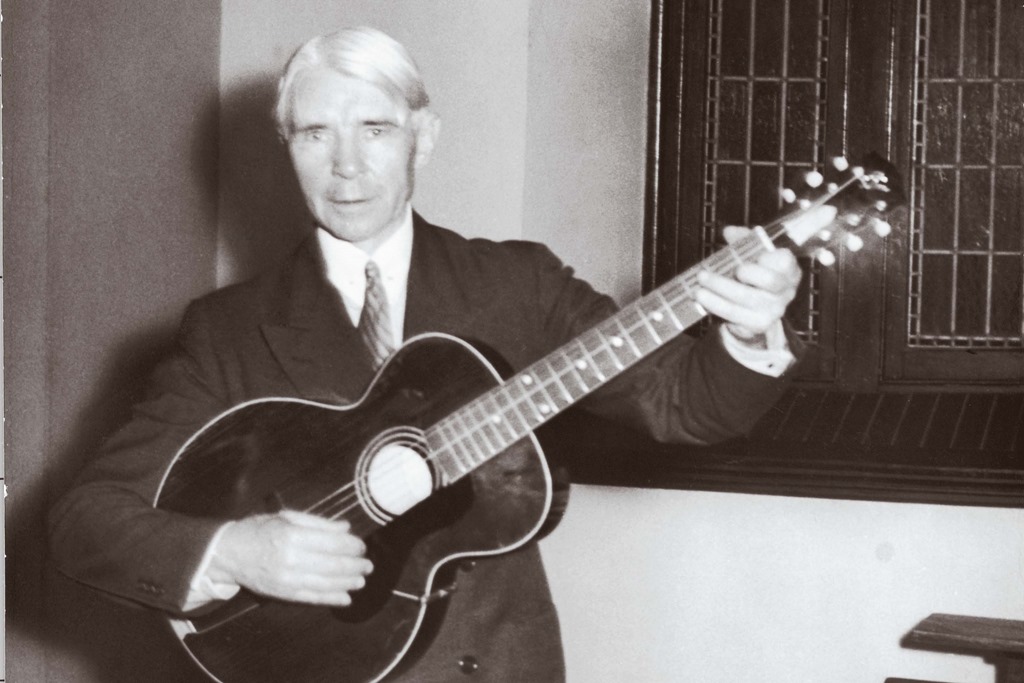
Americana artist looks to break through with his hip voicing of the Fsus chord
Things I find odd about how Sandburg has been judged: first there’s the judgement that he’s just not subtle enough, when I say those critics can’t see the subtleties—which if I’m right, proves my point; and secondly, the evaluation that his poetry is just broken up prose mislabeled as verse. That would be odd, Sandburg has an important secondary career as a popularizer of what we came to call “folk music” in the U. S. and was serious enough about developing his guitar chops that he asked Andres Segovia for a lesson. There’s music behind many a Sandburg poem, like this one, and composers more accomplished than I find it.
It may well be that the word-music of poetry and the music—of well, music—are two separate fields to be judged differently with different instrumentation, rules, and aesthetics. But until this is shown to be surely so, I tend to trust the judgement and tastes of musicians and composers over the judgement and tastes of literary critics and theorists on these matters.
Give a listen to Sandburg’s “Back Yard” with the player below. If you’d like to follow along with the text, you can read it here. And really, thanks for listening and reading along as we encountered music and words here this summer in order to see what we find!
Is everyone aligning themselves with autumn already? Here we’re looking back at summer and the audio pieces that the audience made their most liked and listened to, and we’re getting near the top of the countdown, moving toward the most popular single piece of the past three months. Today we look at numbers 4, 3, and 2.
4. Summer Silence by E. E. Cummings. Another one from our “Before They Were Modernists” series, “Summer Silence” is an early E. E. Cummings poem published when Cummings was a college sophomore at Harvard. One doesn’t usually associate Cummings with constrained poetic forms, but “Summer Silence” was written in 1913 in the Spencerian Stanza form, long before he could have learned from Hawk or Susan.
I try to do the best work I can with recording the music compositions here within the rapid pace I’ve accustomed myself to with this project. My equipment is modest, and my recording engineer’s skills are too, but I make the effort. That said, this one was recorded on a cell phone sitting in a cabin on the North Shore of Lake Superior: just me, an acoustic guitar, and a few summer birds that you can hear at the very end that wanted to enjoy July there too. The text of Cummings’ poem is available in the original post linked in bold above.
3. Higginson’s June by Thomas Wentworth Higginson. From another series, one that started before this summer but carried over into it: “The Roots of Emily Dickinson.” Higginson is essential to the Emily Dickinson story, the literary insider who Dickinson sought out in what I think was an attempt on her part to verify the worth of her unprecedented poetry. They met at least once, but the rest of the relationship was carried on via letters, of which we have only Dickinson’s side of the correspondence.
From Dickinson’s replies and Higginson’s later recounting, it’s been summarized that Higginson “didn’t get it,” thinking that her work needed some further polish to appeal to the mid-19th century public. Here in the 21st century we feel pretty smug about Higginson, thinking him like the infamous record exec who passed on the Beatles.*
Higginson had a highly eventful life outside of the Dickinson connection, as I’ve talked about in another post, but one thing I discovered this year was that Higginson at least dabbled in poetry himself. I can find no context for the poem of his I used here, but I speculated that it could be something he wrote in his youth. Whenever and for whatever reasons he wrote it, it is a good short summer lyric. And coincidentally it’s opening two lines could stand as the better judgment of Dickinson’s genius as it does in his poem for summer.
The music for this one is as electronic as “Summer Silence’s” is acoustic. The text of Higginson’s poem to June is also in it’s original post bolded above.
Higginson wrote the preface and helped edit and promote the publication of the first collection of Dickinson’s poems two years after her death. The flowers on its cover are usually called Indian Pipes and they were said to be a favorite of Dickinson’s. It’s a truly odd summer plant, which my living wife found and photographed in Northern Minnesota this year. The other common name for this translucent apparition: the ghost plant.
2. For You by Carl Sandburg. I kept going back to Sandburg this summer, and you the readers and listeners came along with me. Why? I frankly find him healing.
That either of those Sandburg poems could be used as memorials does not make them passive elegies, and “For You” is future-focused—just as it is full of ghosts. I’m not familiar enough to say how English speakers in the British Isles, in South Asia, the Antipodes, or elsewhere feel of the current times and challenges; but in Sandburg’s America when I read or listen to “For You,” I too feel our ghosts and feel our future—close—even if each are unreal as we stand before the great door of a year with great hinges.
*”Guitar groups are on their way out” is the famous rejection phrase, attributed to Dick Rowe of Decca Records. In Rowe’s defense, Beatles producer George Martin has been quoted that the Decca audition performance was not very good and that he wouldn’t have signed them on the basis of it either. A few months later, Rowe took a tip from George Harrison and signed another of those guitar groups, The Rolling Stones. Sometimes you get a second chance.
It’s that time again, when we look back on the past months and see what pieces were the most liked and listened to this summer. I do it countdown style, so here we start with the 10th, 9th, and 8th most popular pieces this season.
10. Pods (Neponset) by Carl Sandburg. Do I say Sandburg is the forgotten Imagist too often? Maybe, but to my mind this is one of the finest short Imagist poems I’ve come across in my wanderings through early Modernist verse. Another thing I keep trying to counteract: the idea that Sandburg is simplistic and that his verse is absent the levels of ambiguity and ineffability that “great poetry” is said to offer. This 7-line poem about a small Illinois village with gardens and the train passengers traveling to see scenic wonders is an example.
My family has to put up with an amount of interruption by the focused and repetitive work of producing these pieces. Listening to the process of composition, when it involves (as it sometimes does with me) a lot of trial and error is trying—but listening to the final mixing stages is excruciating. I mix at modest volume levels, but I’ve been told that headphones are not to be trusted in that work—so they hear these pieces sometimes being wiggled this way, and wrung out that way, over and over. Not a good way to appreciate a piece.
So, it was a surprise this summer when my wife came in and told me this one sounded like one of the best ones I’ve done. Maybe it made it to number 10 because it stands to be listened to more than once?
9. I Saw a Peacock by Anonymous. Long a leading composer in the folk music field, Anonymous can also craft a pretty good Surrealist poem with a humorous trick: the line breaks lead you to connect the thing previous with the last part of the line—when the “real” and much more mundane connection (as opposed to the wondrously apocalyptic thing you believe you’ve heard) is in the next line, after a breath pause of the line break.
I’ve read that this poem impressed Margaret Atwood in her early childhood with the wonder that poetry could create.
I seem to be working more and more with string and other orchestral compositions this summer. Part of that is that I’ve always been drawn to things that mix the attack-envelope of percussion instruments with the varieties of note length that stringed instruments, particularly bowed string instruments, can create—but it’s also because I was able to afford some additional orchestral instruments to play via my guitar’s MIDI pickup or with my little plastic keyboard this summer.
Didn’t work? OK, try Black Mountain school with polka. No? Dubstep Hildegard von Bingen! Hard Bop Thomas Hardy! Still coming? Tell the gunner to give’em both barrels then. No, no! Not those barrels…
8. For Once, Then, Something by Robert Frost. Here’s an example of why I’m particularly grateful to the hardy listeners of these pieces. While I’m constrained by difficulties in obtaining permission to present writings still in copyright, I hope that you can see that I vary the type and the outlook of the poetry and other writing that I can and do use. I try too to mix Poetry’s Greatest Hits with deep cuts from esteemed poets, and more than a little of the lesser-known but worth considering.
Of course, for some (Many? Most?) the idea of poetry as an everyday thing that is not some mix of fearsome and intended obscurity, snores-ville decorative excess, and hoity-toity crap for those with nothing better to do has already removed them from reading or listening here.
Well then, as I’ve described this project from the beginning, I combine these words, mostly poetry, with various music. While people might just ignore poetry, they actively hate music that they don’t like. That disgust leads some (Many? Most?) to cling to a genre of music they find most able to please them, and to mark other sonic places as “here be monsters”—hideous creatures that disrespect what is right in music.*
Music doesn’t know what’s right and proper. It just wants to sound itself.
So how many people are out there who want to hear even the beloved, famous, respected American poet Robert Frost chanted to a pulsating Electronic Dance Beat arrangement?
Well, if you are the kind of people who read, listen, follow, and help propagate what the Parlando Project does, there are enough of you to make this the 8th most popular piece this past summer!
*By the way, if you don’t like some of the audio pieces that are presented here, that’s OK, even expected. Given that I’m pushing my capabilities as a composer and musician, you might even agree with my intent, yet not wish to negotiate my actualities. That’s part of why I like to mention that we vary things: you may like the next one that comes out, or enjoy taking a look at the nearly 400 pieces we have in our archives.
The Parlando Project audio pieces are available on Spotify. With the current Spotify mobile app you can even create playlists of your Parlando favorites—and exclude your “not so much favorites.”
So how did the Spoon River Anthology get created and published in 1914, such an early date in the emergence of Modernist verse? Let me see if I can summarize what I know so far. In the early part of the 20th century Edgar Lee Masters was a busy lawyer practicing in Chicago. The most oft-remarked part of that career was that for a time Masters was partnered with the famed Clarence Darrow known for his progressive views and participation in numerous famous cases of the era.
I’ve quickly scoured a great deal of information this month on Masters, learning more each day, but it’s clear that for some time before 1914 Masters wanted dearly to become a writer of some kind, with a “trunk” of prose, plays and poetry, and a fair amount of rejection letters. It’s possible that, in his time, he might have been categorized by writers and cultural figures as a type that still exists, which for lack of a better name I’ll call a “wanna-be.”
Like all stereotypes, the wanna-be is unfair to some tagged with it, while seeming to be a useful short-hand among those who apply it. Authors from book tours only need to start a story with another about the businessman who buttonholes the author to say that they too have a novel, often partly written or even “just an idea, but…” and the fellow author will nod and immediately fill in the stereotypical details. Modern authors maybe divided into commercial, academic and bohemian enclaves, but all three can bemoan someone from outside those realms who thinks they are a writer, while giving signs that their real-life choices, risks, experience, and focus lie elsewhere.
Masters was certainly not the kind of wanna-be who claimed he had a novel in him, or “I once wrote poetry when I was young.” Despite what he described as a busy legal practice, he was writing—good bad or indifferent, he was taking his swings.
Here’s another stereotype label that could be applied to Masters in his time: “womanizer*” which is someone who engages in endless, usually short-term, love affairs: a cycle of attraction, infatuation, discovery of imperfection or the newness wears off, and then repeat. For a time prior to writing Spoon River, Masters was in a two-year extra-marital relationship with a Chicago woman Tennessee Mitchell.** Mitchell was a musician who taught piano, broke a glass ceiling for women as piano-tuners (lady brains can’t handle the complex tempering of all those notes you know), and who ran a salon where patrons, artists, and radicals mingled.
One question I had when I wondered how Masters could write a thoroughly Modernist work of poetry so early in the movement was did he cross paths with Chicago’s Poetry magazine and Carl Sandburg, then living and working in Chicago. In the case of the later, he certainly did. He struck up an acquaintance with his fellow Midwestern Modernist,*** and they took walks together and presumably talked about poetry as Masters was writing Spoon River. Masters referred to Sandburg in letters from this time as the “Swede Bard,” which even just between friends sounds dismissive and nativist, but this does point out something that shouldn’t be forgotten about Sandburg: he was the child of an immigrant. Masters didn’t have to “prove” his American legitimacy when he cast a critical eye on parts of its culture. Sandburg, though different in his politics from Masters, could be just as critical, but he was casting his critique from a different standing.
And Poetry magazine, a critical American organ in the dissemination of Modernism? Masters seems to have been stymied there. At one point he was having another of his affairs with a woman described in places as an editor at Poetry,*** but I so far haven’t seen that he was published in Poetry prior to Spoon River.
Instead the Spoon River Anthology owes its major inspiration and initial publication to a man down the Mississippi from south-western Illinois, William Reedy, the editor of Reedy’s Mirror in St. Louis, who like Harriet Monroe’s Poetry was ready and willing to publish American poets who were unabashedly American and willing to forge American verse in new modes, as Whitman and Dickinson had shown was possible in the previous century.
Inspiration? Well, for someone promoting American verse, Reedy’s prime move was to send Masters a copy of a recent translation by a British scholar from classical Greek late in 1912: Epigrams from the Greek Anthology.
A gift that helped start American Modernist poetry. Ironic, or Ionic?
.
Masters had an idea that stories from his southwest Illinois youth were good material, but he didn’t know how to present them. Even in 1913 he was thinking of shaping them into a play.**** As 1914 began, Masters, still being goaded by Reedy to drop his often florid and European-modeled verse and do something American, started writing the Spoon River epitaphs, accepting the incongruity of a classical Greek style of summing up a life being used for American Midwestern townfolk as having a certain satiric flavor. Masters sent a batch of them to Reedy, and as Masters himself recounted this, they were submitted in something of a mood of: you want American, well I’ll give you American and I’ll bet you won’t think it’s poetic.
Reedy published them, praised them. Throughout 1914 this process continued: Masters writing feverishly on the weekends while continuing a busy legal practice and sending off batches to Reedy and his Mirror of new Spoon River epitaphs to be published. Does Masters feel validated? Has he found his voice? There may be some ambivalence on his part at first. He has them published using a pen name Webster Ford. Some of that may be to protect his law career (lawyers who tell secrets about lives aren’t exactly sought out by clientele.) Part of it may be because he’s unsure. It’s even possible that “Webster Ford” may have been a way to escape his lawyer-who-thinks-he’s-a-poet issues with Chicago literary figures.
Ezra Pound, off in England, but considering himself the world-wide talent scout for all things Modernist, fires off a letter to Harriet Monroe. Pound is no stranger to urgency in speech, but he’s in full florid ALL CAPS shouting mode:
“GET SOME OF WEBSTER FORD’S STUFF FOR ‘POETRY’…Please observe above instruction as soon as possible.”
By the end of 1914, Masters drops the Webster Ford mask and puts his own name on the poems, and he’s looking to have Spoon River Anthology published in book-length form. He’s on his way, even if he’ll soon enough loose it.
For today’s Spoon River piece, here’s a companion to “Cooney Potter,” “Fiddler Jones,” showing the dialectical contrasts Masters likes to weave into his collection. With its invocation of music it was an immediate favorite with me. Besides the contrasts in values and outcomes that Masters uses, there are families’ and relationship stories throughout the book, but it’s unclear to me if Fiddler Jones is related to other Jones-surnamed characters in Spoon River.***** Jones is a common name, used as synonym for “anyone” idiomatically. But it’s also Welsh in origin, and there is a Jones family of specifically Welsh ancestry in Spoon River.
Reading “Fiddler Jones” I thought the character might be Afro-American. There’s one stated Afro-American character in Spoon River, and I wasn’t sure of the exact ethnic makeup of the region of Masters youth, but like finding out about the Afro-American community in Emily Dickinson’s region, assuming all-white is false default. As so often when I come to something like this, the Internet is my friend. It’s actually easy to search census demographic records for the two towns of Masters’ youth, and they were around 1% African American by those records. Of course, Masters’ book isn’t a documentary or demographic treatise, but that means there are 30-35 Afro-Americans living in Spoon River’s models in the later 19th century.
Strings link things: African styles mixed with Celtic styles in America.
.
From my musicological interests, the idea that that fiddler could have Celtic or Afro-American roots is apt, but in doing my music for today’s performance of “Fiddler Jones” I didn’t really follow traditional fiddle styles. I don’t play violin, and the solo violin line featured in today’s piece was played on guitar with a MIDI pickup using a lot of string vibrato and little of the short, rhythmic chops that might drive a field of dancers. Wondering what’s the dance tune they step off too mentioned in the poem? This blog has a good guess. The lyrics to that tune also end, as does Spoon River’s in the grave; and as Fiddler Jones does, with no regrets.
In composing the small orchestra accompaniment, I made sure to feature the bassoon and piccolos that bedevil Fiddler Jones in his mind as he tries to plow. I found myself rather enchanted as Fiddler Jones was, and as a result today’s piece is a bit longer than most here, but I hope you’ll find the spell as moving as I did. Player’s below.
.
*Particularly, but not exclusively, among arts and bohemians, even in Masters time there would also be women who were not called “mananizers” for some reason, and bisexuality and same-sex relationships too. The power relationships in such relationships would be too complex to discuss in a footnote: some exploitative, some less so, some respectful, some carnal, some duplicitous, some honest, and so on. So far, in my rapid overview of Masters he doesn’t seem particularly exploitative, and Spoon River shows he’s listening to women.
**Click this link and read about Tennessee Mitchell! After the end of her affair with Masters she eventually married another wanna-be-but-actually-could writer, an advertising man and entrepreneur Sherwood Anderson who went on to write Spoon River’s prose-in-law: Winesburg Ohio in 1919.
***At this point, do we need to broach the question of if Edgar Lee Masters was trying to sleep his way to the top of Modernist poetry?
****More irony, the brief poetic monologs in Spoon River so revealing of key details of entire lives in flat descriptive dialog became a staple of audition readings for actors since they so readily allow an actor to show keen presentation of character in a few lines.
*****We’ll meet one of those other Jones in Spoon River soon. You may think, small town, must be related, but in the 19th century Midwest residents are largely internal migrants from the previously settled regions of the U.S. and so, even later, it’s not certain. In my 20th century hometown, smaller than Spoon River, 20% of my class had the last name Johnson and were not related. As you might imagine, I thought the running joke in Blazing Saddles that every white townsperson is named “Johnson” was particularly funny.
I’d planned to move on from Carl Sandburg, but I couldn’t lose my train of thought.
This weekend I got a book I’d ordered, “Christmas on the Farm” by illustrator and writer Bob Artley. Why such a book in the dog days of summer? Well, three weeks ago I attended a memorial service for an uncle of mine, Lew Hudson, who’d been a friend and co-worker of Artley decades back at the Worthington Daily Globe newspaper, and I noted that Lew had written a preface for this book.
Artley’s book has charm aplenty. It’s a memoir of his winter childhood on a family farm in the 1920s. I decided I would use the stories in his book to try to locate the farm of his childhood. And thanks to our modern Internet-hosted maps I did, by following an illustration and accounts in the book that the farm was between Coulter and Hampton, north of the road to those towns, north of the railroad (it looks like it’s a rails to trails bike path now), and north of two farms on either side of Spring Creek. In personal memories we travel in time, but modern tech makes virtual travel in space objectively accessible.
It’s not exactly next door to the Iowa farm town where I grew up (60 miles away) but the countryside would be close. And the 30 years difference between his time and mine? Not so much to me these days.
That got me thinking about little Midwest towns, and I saw this short Sandburg poem in my notes from summer reading and I decided to work it up.
Last post I mentioned my theory that Sandburg’s Whitmanesque mode, those broad catalogs of observations in his longer poems, have caused him to be remembered as a 20th century imitator of Walt; and that did him no good, as the High Modernists were only grudging acknowledgers of Whitman’s breakthrough style. When long Sandburg poems overshadow the short ones, what he thoroughly intended to be Imagist poems are instead seen as slight, one-dimensional miniatures, not charged moments in time.
“Neponset, the village, clings to the Burlington railway main line”
So, let’s look and listen to “Pods” as if it could be what Sandburg intended it to be. Yes, its core is a natural, real, and present image, not written as a simile, just yoked together by poet’s observation. The village of Neponset is like a peapod on its railroad line, one of many, too easily cast as having no concernable uniqueness (the cliché is “as alike as peas in a pod”). Given that it’s written before commercial air travel, the passing passenger train is there to reinforce that Neponset is “flyover country.*” Notice that the poem avoids almost all adjectives and sentiments, so we should notice the one striking one it does use: those passing, unstopping trains are “Terrible.” How so?
Well, they’re loud, big, massive, and they shake the peapods on the vine, they even shake the town “slightly.” Are those trains modernity and time passing Neponset by? They and their sleepers in their cars might think that so. Yet, peapods will not mind, they will continue their cycle—so why not the like thing, the village? After all, the poem in its sparse word-count (39 words) wants to connect with a repeat of “slightly” and linked tremors that the earth (planet or ground? No matter, essence either way) is also shaken. The “movers and shakers” are really only shakers here, their moving is no different that the pea vine’s revolving cycle of seed to seed. The sleepers in the train are too peas in a pod.
Naw pard, ain’t thinking of going off on vacation. Gotta roundup those peas and drive’em to LeSeur.
Musically, this one has lots of synths, though now that I’ve reminded myself how to play electric bass again, I used that instrument to form the vine of this tune. There are two electric guitars on this track, but their signals are so modified that even I find it hard to pick them out from the keyboard synth parts. Vocally, I decided to let the last few lines, our passing trains, our unaware sleepers podded in their Pullman cars, repeat their cycles. Here’s the text of Sandburg’s poem, and the player to hear the performance of it is below.
*Why does Sandburg want us to know the limited (a train that makes stops at only the large cities) is going to “the Rockies and the Sierras?” Why not Chicago or Los Angeles or San Francisco, or even (as in another Sandburg limited train poem) Omaha? I wasn’t sure. Unlike the Midwest’s rolling hills, these are places of majestic natural heights invisible to Illinois townsfolk. Are these Mount Olympian ideals? I know that train companies were promoting trips to these scenic areas as vacation destinations, so our passengers may be more carefree in their travels than those remaining in the rural town. This could also be Sandburg the journalist fact-checking Sandburg the poet? The Burlington Route didn’t have through service to the West Coast, and Chicago (where this limited would have originated) is only 120 miles from the little village of Neponset, and so not exotically far away.
No time or money for a train ride to the mountains? Early 20th century VR: the stereoscopic viewer!
How did you like that last Carl Sandburg piece? It’s about as majestic as Sandburg goes, what with its extensive catalog of life in its fullness and emptiness. It seemed to me about right to mark the anniversary of this project’s launch, and my late wife, and my son, and my wife and family, and my country, and you. And I much enjoyed making the large-scale orchestra music for it.
But if it catches you in the wrong mood or with a different and certain analysis of life it can seem a bit too new-agey, suffused as it is with non-denominational spirituality.
Sandburg is best taken in large and varied portions. He has many moods and is open-hearted in a way that many poets are not.* Before I reminded myself I should do an anniversary piece earlier this week, I had another Sandburg poem I wanted to present, but I put “Black Horizons” on hold and completed “For You.” These two selections this week can be taken together to form a better picture of Sandburg.**
Sandburg can offer you balm and clarifying anger, and today’s piece is much closer to the later pole. Published in 1922, there’s not much I can think needs updating or footnoting to explain. You can read it, hear it, speak it yourself this month in 2019 and feel it as freshly as when it was written.
Musically, no orchestra today, just drums and percussion, fretless electric bass, acoustic guitar and voice. I tried to add a little color to my I, iii, IV, vi repeating cadence by flatting the 7th in the bass line, after watching Rick Beato on YouTube analyzing some Nirvana songs’harmonic complexities.*** In a more ideal performance I think the piece would work great with a choir or audience singing the refrain.
The player to hear my performance of Carl Sandburg’s “Black Horizons” is below (unless you’re reading this on an iPhone with the WordPress app—in which case, switch to a web browser to see the audio player, or you can subscribe to the audio pieces alone through most podcast services such as Apple Podcasts.)
*Why would that be? In literary circles by the middle of my century, poetry was the literary art devoted to complex, sometimes nearly unfathomable, emotional and perceptive states. A poet I heard read last night used a word “Apophasis,” which means describing something by what it is not, surrounding it with words that are not it. That term also describes a great deal of Modernist poetry. Poetry did this, at least in part, because so much tired verse of the preceding century or two repeated the same few emotional tropes until poets were tired of them. The great models of High Modernism made poetry a cult of misdirection, irony, personae, parody, and beautiful hermeticism. That poetry had power, if to a smaller audience, and one thing this project tries to do with music and performance is inject it with audible expression to illuminate the complex humanity in it.
**Yet they leave something out, the shorter, more purely Imagist Sandburg, a mode of his that I personally love and think deserves to be better remembered. That Sandburg has all the elusiveness and compression that Modernism propounded as a remedy to the overblown “listen to me play the cathedral organ stops of poetic sentiments” poetry it was rebelling against. For examples of the subtle Sandburg see this well-known poem and this deserves-to-be-better-known one.
Because of the more direct and Whitmanesque Sandburg, those Imagist poems are misread. They’re assumed to be slight, in a way that “A Station in the Metro,” “The Red Wheelbarrow” or “Oread” aren’t.
***My son has been learning Nirvana bass lines this year, which is stuff I can’t teach him because I only understand such things long enough to use them and because I lack the mimetic talent to transcribe existing pieces well. While recording this I discovered, to my horror, that I’d more or less forgotten how to play fretless bass while working on orchestration.
****Yes, it takes only seconds to decide. Revolution implies it takes only a little bit longer to implement that realization. We’re nearly 250 years into the American Revolution, and we’re still working on it. Sandburg’s poem is almost 100, and we’re still working on it. “The Sixties” are mostly 50 years old, and we’re still working on it. That’s your choice: still working on it, or giving up working on it.
Here’s a poem by Carl Sandburg, whose poems can be returned to for their light illuminating justice and injustice, but also because he will give you endurance and compensating love.
Injustice is large, it is ancient. Love is short as life, but nearer to us, and like the palm of a nearby hand it can blot out an immense but distant mountain. If enough hands are raised together, the most foreboding mountain can not only be obscured, it can be leveled.
How many in favor of more music and poetry?
Today marks the third year since the official launch of this project. My goal when I started was to create 100 to 120 audio pieces using various words, mostly other people’s words, and mostly poetry, combined with original music, music I planned to be as varied as I could make it. Today’s piece is the 360th of these.
That number amazes me, even though/because I have been there creating each of those music/words combinations. It means that nearly every day in the past three years I have been—or I have been avoiding—searching for and selecting words, composing music, playing and recording that music and then presenting some thoughts on that encounter with you.
I started as a guitar player, and in this time I’ve become nearly a functional bass player and found ways to allow my naïve keyboard skills to direct music making from that direction too. My abilities to integrate bowed strings and orchestral instruments into these pieces has grown, something that I’ve been indulging in a bit this month.
During this time my son has grown from a grade-schooler to the doors of high school. I think he still finds this activity a little odd, and as far as I know he never reads these posts, only hears the audio pieces in their halting steps of creation. He might recognize it later. Many of the posts here were written with him as the audience in mind.
My wife has been patient and forgiving of the time I spend on this, for which I am grateful. These few words are not thanks enough.
Dave Moore (you’ll hear from him again here soon) has of course been an important inspiration and help in the overall project.
And you, readers and listeners and fellow bloggers, are a large part of why this project has continued. This project has no revenue, no grants, no sponsoring institution. The reason it has continued past the first 120 pieces has been your response and assistance in spreading the word about it. You weren’t the reason I started this, but you’re the largest reason I continue with this project. Your likes, links and sharing help keep it going.
Renée Robbins. A memory too strong to forget and too heavy to carry. “Whisper, Oh beginners in the hills. Tumble, Oh cubs…”
So why did I start this project officially in August? I was thinking of my late wife, Renée Robbins, a caring person who helped and befriended many. I lack the personal skills to do what she did in that regard, but I can, in my idiosyncratic way assist the writers I present here. If poetry is a living art, it lives not just in the mind and memory, but in the moment and the ear. Thanks for your moments and your ears.
Earlier this year I presented part of the title poem from Sandburg’s Smoke and Steel collection, the first poem in that book of his. Today’s piece is the concluding one in the same book. As I mentioned above I’ve been working on larger orchestral arrangements with woodwinds, horns, and string sections lately, and that’s what I’m using here. I’m kind of moving through different orchestral colors in this short piece to match the range of Sandburg’s catalog in his poem.
The player gadget to hear Carl Sandburg’s “For You” is below. If you want to read the text of the poem, it’s available here.
Just a couple of posts back I said that early Carl Sandburg poetry can be just as aligned with the ideals of the Imagist school as the Trans-Atlantic poets such as the then contemporary work of Ezra Pound, Amy Lowell, H.D., Richard Aldington, F. S. Flint, T. S. Eliot, William Carlos Williams, and T. E. Hulme was. Yet he’s rarely mentioned as such.* Why might that be?
My guess is that there’s an issue with Sandburg’s more expansive mode, present in some of his work, Whitmanesque in character and scope. The Pound and Eliot school of Imagism wasn’t much on Whitman, charging him with lack of craftsmanship and concision. And then there’s the issue of cultural affinity, which while outside the text, is important. Of the above, only Lowell was from a wealthy background** (and Flint’s childhood seems positively Dickensian) but they all saw themselves as culturally elite. Most were familiar with classical languages, some had Ivy League educations (though none were Oxbridge, save for Hulme who was thrown out after a bit more than a year for rowdy behavior), most had spent time in Europe , even Williams, the most American-focused of these.
Sandburg? Born working class to two immigrants in the Midwest***. Drops out of school at age 13 to go to work. The jobs he had in the first 40 years of his life were modest in prestige, but varied in location and nature. Coal-heaver, farm laborer, Army private, milk-truck driver, political organizer, bricklayer, “The Front Page” era urban journalist. What T. S. Eliot knew about the whole of literature, Sandburg knew about the whole of working-class work and life.
One could make one mistaken generalization from Sandburg’s biography, that like Whitman self-advertised himself, he’d be “one of the roughs,” a man whose art would be artless and as unconcerned with the niceties of aesthetics as the correct fork for which dinner course. But just like the lazy assumption that there’d be no poets in foxholes, the idea there are no aesthetes who punch a clock is bogus. Sandburg’s early work is as concerned with Modernist beauty and style as working-class dignity—and he is very concerned with working-class dignity!
Is today’s Sandburg piece, “Back Yard” an Imagist poem following the three Imagist rules? Let me paraphrase them:
Direct treatment of the thing: that is, the focus in the poem is on the image itself which will be described, instead of the image being a decoration and figure of speech within the body of a poem more concerned with its moral or message for which the image is only a “like” illustration. Conciseness: no extra words, and though not stated, it’s corollary is no less-apt words used only to make the rhyme. And freer rhythms: word-music, like sound-music, is not required to limit itself to only extraordinarily regular and repetitive rhythms.
Direct treatment? The outdoor, summer night scene is just that. One is hardly aware here that it’s an image, it seems like simple reportage. Is it merely the “hardly news” that on a summer night if one is outside, perhaps sitting on an open porch, you’ll hear and see other people outside too?
Concise? Pretty much. It’s not In A Station of the Metro, or The Pool, or The Red Wheelbarrow, there is some re-iteration in it, even a single line refrain, but even by the standards of lyric poetry, this is a short poem. The elements of the scene are evoked, but there’s little extravagant or showy description. One element that many Imagist poems share (though never a formal rule AFAIK) is that colors are used to simply describe objects, though since this is a moonlit night scene the colors are more monochromatic.
A follow up question: how minor and mundane is “Back Yard” really? I can’t claim it’s a poem of great originality—but that’s not the job of every poem, and this is more a poem of the continuity of change, a moment of shared perception, not a striking new vision.
I think its intent, in it’s just over 100 words, is for us to see a chain of life in a Chicago night early in the 20th century; and in its everyday exactness, state those things that might link to a night tonight where we live today. The silver moonlight in the scene seems almost a preservative, everything is frozen in that direct moment. In my night tonight it may not be an Italian boy with an accordion, but Mexican music from the back yard at the end of the block. The couple Sandburg says will marry next month, are now-dead grandparents of people as old as I am. An old man has fallen asleep in the late and waiting moment, his back-yard cherry tree’s fruits held in a moonlit unmoving until his eyes close. He will likely pass on sooner than the marrying couple, and his dreams and those long-ago cherries will be returned to the place that dreams, fruit, and poems go and come from.
The poem closes with a perennial thought delivered in the scene’s description. The clocks, the poet relates, say he too must go. The clocks say that to all of the characters in his poem, and by extension to us, his audience. Sandburg, the artist, the poet, has the job like the moon to fix this moment in silver. Was he thinking here of the silver of his brother-in-law Edward Steichen’s art photographs? What does he mean by the poem’s closing line? What are the “silver changes?” My best understanding is they are the endless succession of such fixed moments. There will be more and more silver changes, a great richness, even as we are entirely not there.
Fancier than my back yard: “Nocturne-Orangery Staircase” (1908). Sandburg occasionally collaborated with his brother-in-law and pioneer in fine art photography Edward Steichen.
For the performance of “Back Yard” I decided to intersperse some other night moments, sung as commentary on Sandburg’s poem. You can hear it with the player gadget below. Want to read along? Here’s the text of the poem.
*Yes, Imagism is only a label, a piece of sticky paper put on some writers and writing. But because Imagism was so vital to the formation of English poetic Modernism, excluding Sandburg, “The Forgotten Imagist” from its usual ranks was part of how he was diminished in the late 20th century. The artistically-chosen stark simplicity of Imagism was admired, but similar directness in Sandburg was seen as populist simple-mindedness. For an example, here’s a long review of a late 20th century biography, where the dagger is that Sandburg’s poetry was “dumbed-down Whitman” and the charge seems to be that he was a pretentious yokel who was also a phony who pretended to be a yokel.
**I’m of the impression that Eliot and Pound’s family had at least upper-middle-class wealth too, but my informal memory is that some estrangement or streak of independence led them to live outside their families’ wealth.
It’s time for the seasonal tallying of the pieces presented here that received the most listens and likes from you during the past three months.
We presented 36 or 37 pieces in that time, including our increased posting activity during April’s National Poetry Month, but the most notable event for me during this interval was May, which became the most active month ever here for both blog visits and audio piece streams. I’m grateful that you’ve lent this effort some of your attention, and that goes double for any of you that helped spread the word about what we do here informally or through things like Facebook and Twitter.
As usual we’re going to follow the count-down format, moving from the 10th most popular piece as determined by your listens and likes and moving up to the most popular one.
10. Sweet Thames. It was a close finish with Charlotte Mew’s “The Trees are Down,” but one part of our ongoing annual April serial performance of “The Waste Land” made it into the Top Ten. “Sweet Thames,” the portion that kicks off that poem’s longest section “The Fire Sermon” was the part that made it, while the rest did not. Perhaps the listens/likes were lower because I warned our audience that “The Waste Land,” and particularly “The Fire Sermon” part of it, is not light entertainment, and things only got darker as “The Fire Sermon” continues after this. “Sweet Thames” may seem to have jaunty parts, particularly the catchy Mrs. Porter section near the end, but even that has dark undertones as it was sung by the ANZAC troops heading for the disastrous Gallipoli campaign in WWI.
I did like the music I composed and played for it though, mixing some buzzy synth lines with American delta-blues style slide guitar. Listen to it here:
You could think of Dr. Tearle’s 3 minutes of video here as the trailer if “The Waste Land” was a film. Definitely not a date movie then.
9. Smoke and Steel. Frequent visitors here know my love for Carl Sandburg, and the Sandburg piece that made our Spring Top 10 was a selection I took from the longer poem that is the title piece from his 1920 collection Smoke and Steel.
I found Sandburg’s extended metaphor of our working lives as smoke incredibly moving, something that a few of you must have agreed with. Musically, the toughest part was the piano part, the song’s musical hook. It’s not a complicated part, but I had to record it in two passes on my tiny plastic keyboard due to my naïve piano skills. Here’s the gadget to hear it.
Sandburg greets Richard Wilbur, Amiri Baraka, and Frank O’Hara at the start of a 20th century poetry symposium. “All poets must wear a hard hat and steel-toed boots before entering the typewriter area.”
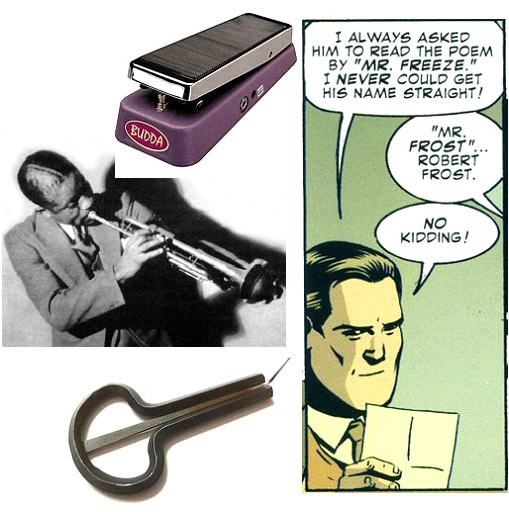
8. The Aim Was Song. Robert Frost’s ode to the genesis of poetry gave me an excuse to break out with an unapologetic electric lead-guitar song. The poem’s text talks about wind being shaped by the mouth, which may have clued me into using one of the oldest electric guitar effects devices: the wah-wah. The wah-wah is a foot-treadle pedal which when moved sweeps a frequency-band emphasis. The sweep of frequency seems to be changing the note as it sounds, like a jaw-harp or a horn plunger-mute. The player gadget for “The Aim Was Song” is below.
Wah-Wah Robert Frost
Next time we’ll continue the count-down with numbers 7 through 5.
Today is May Day, the international labor day, so I spent it working, looking through poetry books for something about our lives of work. There’s less there than there should be I think, the world of work somehow not seeming as poetic as human love and desire or as sublime as the observation of nature and things of the spirit without any human sweat in it.
This lack leads me to admire poets who address this imbalance. And the first one that came to my mind turned out to be the one I ended up using today: Carl Sandburg. That Sandburg might come to mind for others too as a poet of labor probably didn’t help his reputation at the start of our current century. He doesn’t come by that classification lightly, having had a career as an itinerate worker and labor organizer before he began as a poet, and even while he was publishing groundbreaking works of early American Modernist poetry like his Chicago Poems in 1917, he had a second, less well-known life as a Socialist radical.
Carl clocking in in his later years when his day job was goat farmer
Somehow Sandburg survived both the post WWI and post WWII red scares without great harm to his reputation, but by late in the 20th century there was less interest in Modernists who wanted to write about work and labor issues. The bohemian fringe more or less looked at straight work as an unfortunate event*, and the academic establishment was more interested in aesthetic rigor and the ability to carry lightly evidence of a full-fledged college education for its poets.
Proletarian writing had been done already. Time to move on.
As I keep reminding you and myself, our current century is now old enough to vote, it’s approaching adulthood. It might want to re-evaluate those judgements the old century made about its youthful innovators.
So, for today, May Day, I took the opening to Sandburg’s longer poem that gave its name to his 1920 collection Smoke and Steel and turned it into a labor hymn. “By this sign all smokes know each other.”



 Frank Hudson