I don’t know much about American poet James Whitcomb Riley, but then I gather that modern American literature doesn’t require us to know much about him. Going by the bullet points, I can say that he tried to be that now obsolete thing: a popular mass-market American poet in the era between Longfellow and before Frost and the Modernists. I read his good-sized Wikipedia article this morning just to make sure I wasn’t going to overlook or misstate some big aspect of his career, and found no special hidden element there requiring further investigation. The main thing that article impressed me with is how hard he personally worked to become a popular best-selling poet. He tried a great many routes: live readings and mixed-entertainment presentations, rural “common-folks” dialect verse, children’s books, submitting to literary magazines and working as a newspaper poet.*
I had looked briefly for Thanksgiving poems when a Riley poem named “Thanksgiving” popped up. My immediate reaction: “Not my kind of thing.” It had the form of sentimental verse without any attractive word-music. Here’s a link to the poem as Riley published it.
I’m not sure why I looked at it a second time. Perhaps other poems I found in my brief search also seemed weak candidates? On the second reading I noticed some more unusual elements in Riley’s poem. There are a couple of ways to write a Thanksgiving poem. One is to treat it as an autumn harvest poem, cataloging the bounty that nature has provided at the end of the growing season. Another is to write of the blessings one is grateful for. Riley makes moves toward those two approaches, but what he writes of includes as much distress as successful harvest. What emerges in this mixed accounting, once one gets past the antique and sometimes clunky language: thanksgiving for caring and love.
Caring and love? Sentimental claptrap? Pablum for the non-literary masses? As Thanksgiving 2026 approaches I now saw, felt, something else. Thoughts specific to our current lives overcame me, similar to reading the Robinson Jeffers poems I’ve featured earlier this month, or Conrad Aiken’s visions of an apocalyptic vampire. What has happened since last as Americans “our universal thanks were told?” My city, and several others, were overrun by crudely run armed groups who leaders claimed were seeking violent criminals. It was as if some madman proclaimed “You say you’re troubled by crime? Let’s tackle, beat, and gas some jaywalkers and drag some overtime parkers out the shattered windows of their cars while their kids watch. Document us doing this and we might arrest, beat, or yes, kill you.” I’m an elderly white European looking guy, my risk was to not like this behavior by my government and acting on that.** If I looked more like a person indigenous to the Americas, Africa, or Asia I might hesitate to go out in public. These masked guys made lots of mistakes, and they weren’t apologetic about it either.***
And these are only one set of outrages since last Thanksgiving. Wars of choice without consent, a vile and ineffective nationalism, planned extrajudicial airborne killings of hundreds of men in boats, copious self-dealing and corruption. Have I gone off on another digression from poetry and lost you reader?
And so, you’ve heard performances of poems lately here of fear, disgust, destruction, and endurance. When I performed live in the studio at noon-time on Election Day I could let those fears and doubts and bereavement about my country out.
Well, the election results just hours later are a hopeful sign. And in the midst of James Whitcomb Riley’s Thanksgiving poem this week I found this praise of love and caring, things that became necessary weapons and recompense to the outrages unleashed on us. Let me carve that out of the poem and make a song from it. You can see that I’ve compressed and rearranged Riley’s words to bring out those elements that touched me within the original poem.
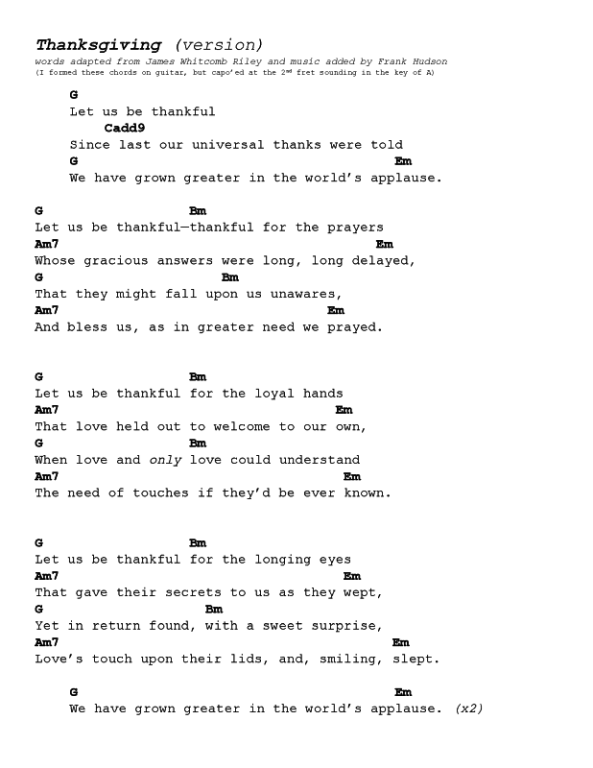
A chord sheet in case you want to sing this yourself.
.
While cleaning and reorganizing a storage space this afternoon I found a relic of my youth, this cardboard case still containing a guitar I used in the early days of the LYL Band. I recalled the guitar was bought broken, its top coming unglued all along the bottom edge and its bridge lifted nearly completely off the face of the guitar. I recall I crudely glued the separated edge with some wood glue and clamped it down to dry somehow. To deal with the bridge I used a trapeze tailpiece, and I made a rough-hewn saddle out of a piece of plastic model car sprue. I opened the cardboard case lid, and this battered instrument was still intact after 45 years of storage. Inside the case pocket was an old set list and a set of fingerpicks from when I played fingerstyle back then. Before I figure out what to do with this genuine punk-folk artifact I decided it needed to be played at least one more time. I restrung it and recorded the guitar track you’ll hear below. If the Pilgrims came over in a leaky boat, this instrument is at least as creaky a conveyance, but it sounds remarkably like a guitar when recorded, if not an outstanding example of same. In contrast, the violin part was played on my newest guitar, a Swedish designed headless solid body electric with a MIDI pickup with which I can control a virtual instrument fiddle. One thing I read about Riley: in his various activities to present himself as an entertainer he learned to play guitar and violin, so I’m hoping his shade forgives my surgery on his poem.
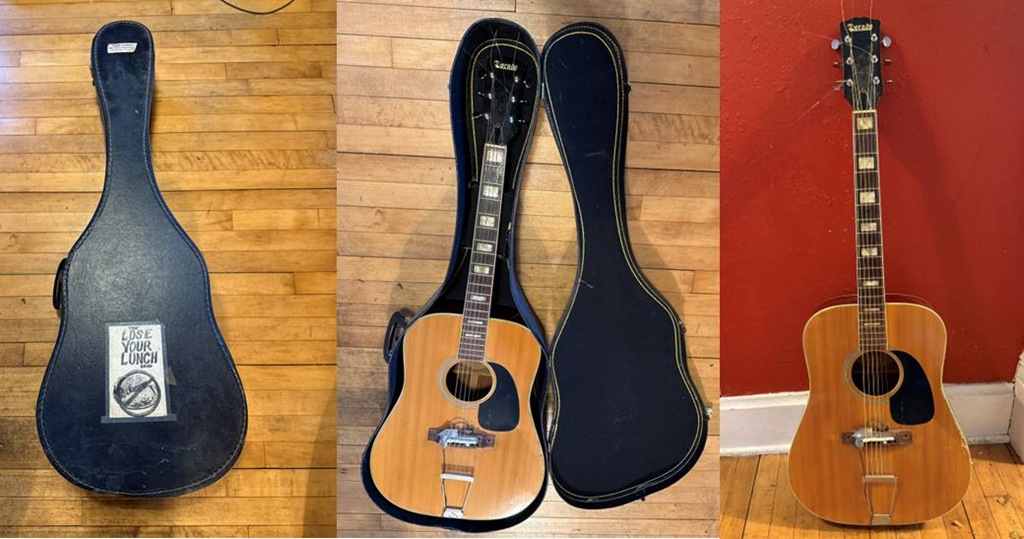
Uncasing a guitar I played in the first year or two of the LYL Band
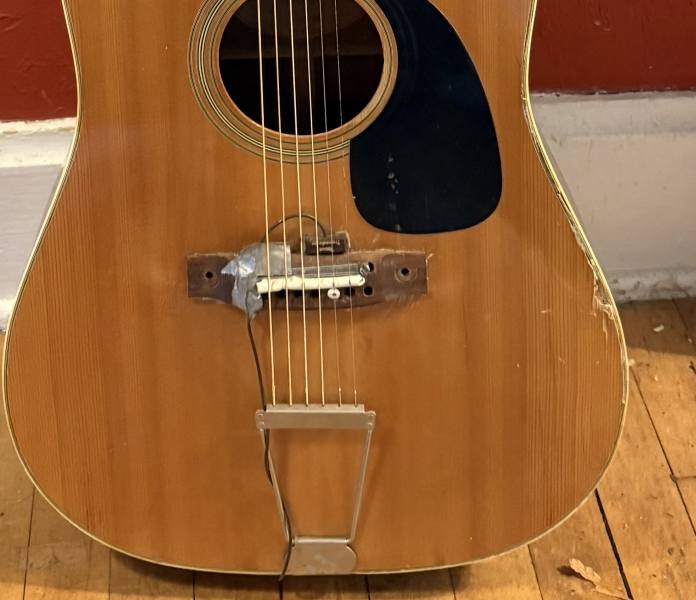
Closeup showing the punk-rock lutherie practices that made this bought-broken guitar playable
.
Audio player for my version of “Thanksgiving” is below. No player? I won’t need to get out the bottle of Titebond and tack one on your devices screen, as I offer this highlighted link that will open a new tab with its own audio player.
.
*I’ve only looked at newspaper poets peripherally so far, but besides occasionally printing outside verse contributors, some newspapers had a regular poetry feature written by an employee in Riley’s time. My impression is that this was often analogous to the later 20th century newspapers of my lifetime having an editorial cartoonist and/or illustrator who would use their art to portray observations and opinions about subjects of interest to the general reader. With the exception of song-lyrics, poetry as a popular or pulp artform has largely disappeared for now.
**Freakishly, the first American citizen observer shot and killed – and on the street just beyond the alley my office window looks out on – was a poet. I spent a couple decades in nursing, and the second observer killed was a nurse filming on another street in my city who reflexively turned to help a woman Maced and knocked down next to him.
***Acts like getting groceries etc. for neighbors became common. I heard tales of taking folks to medical appointments with passengers huddling below window level beside the Average White Person driving them.

